N A N O R E V I E W
Open Access
The effect of magnetic field on the impurity
binding energy of shallow donor impurities in a
Ga
1
−x
In
x
N
y
As
1
−y
/GaAs quantum well
Unal Yesilgul
1*, Fatih Ungan
1, Serpil
Ş
akiro
ğ
lu
2, Carlos Duque
3, Miguel Mora-Ramos
3,4, Esin Kasapoglu
1,
Huseyin Sari
1and Ismail Sökmen
2Abstract
Using a variational approach, we have investigated the effects of the magnetic field, the impurity position, and the nitrogen and indium concentrations on impurity binding energy in a Ga1−xInxNyAs1−y/GaAs quantum well. Our
calculations have revealed the dependence of impurity binding on the applied magnetic field, the impurity position, and the nitrogen and indium concentrations.
Keywords:Impurities, Quantum well, Dilute nitride
Review
Background
Over the past decade, the GaInNAs-based quantum-well structures have emerged as a subject of considerable theoretical and experimental research interest due to their very unique physical properties and due to a wide range of possible device applications. GaInNAs exhibits interesting new properties and differs considerably from the conventional III to V alloys. Significant changes occur in the electronic band structure compare with GaInAs with incorporation of small amounts of nitrogen into GaInAs. These include a large redshift of the band-gap, a highly nonlinear pressure dependence of the bandgap, an increase in the electron effective mass, and the N-induced formation of new bands [1-10]. This new material has received considerable attention due to the growing interest in its basic physical properties. Shan et al. showed that interaction between the conduction band and narrow resonant band formed by nitrogen states in GaInNAs alloys leads to a splitting of conduc-tion band into sub-bands and a reducconduc-tion of the funda-mental bandgap [11]. Fan et al. have investigated the electronic structures of strained Ga1−xInxNyAs1−y/GaAs quantum wells [12]. Hetterrich et al. investigated the electronic states in strained Ga0.62In0.38N0.015As0.985/
GaAs multiple quantum-well structures [13]. Pan et al. have investigated the optical transitions in Ga1−xInx
-NyAs1−y/GaAs single and multiple quantum wells using photovoltaic measurements at room temperature [14]. Several studies have been done on detailed optical characterization of Ga1−xInxNyAs1−y. These papers in-clude the temperature dependence of photolumines-cence, absorption spectrum, and low-temperature photoluminescence [15-19].
There are many studies associated with the hydro-genic binding of an electron to a donor impurity which is confined within low-dimensional heterostructures [20-25]. The understanding of the electronic and op-tical properties of impurities in such systems is import-ant because the optical and transport properties of devices made from these materials are strongly affected by the presence of shallow impurities. Also, it is well known that a magnetic field considerably affects the optical and electronic properties of semiconductors. Thus, the effects of magnetic field on the impurity binding energy are a very important problem [26-28]. However, up to now, to the best of our knowledge, no theoretical studies have been focused on impurity bind-ing energies in sbind-ingle GaInNAs/GaAs quantum well (QW) under the magnetic field.
In this paper, using a variational technique within the effective mass approximation, we have investigated the effects of the magnetic field, the impurity position, and
* Correspondence:[email protected]
1Physics Department, Cumhuriyet University, Sivas 58140, Turkey Full list of author information is available at the end of the article
the nitrogen (N) and indium (In) concentrations on im-purity binding energy in a Ga1−xInxNyAs1−y/GaAs QW.
Theoretical overview
The growth axis is defined to be along the z-axis and takes the magnetic field to be applied to the z-axis, i.e.,
B= (0, 0,B). We choose a vector potentialAin written form A¼1
2
By 2 ;
Bx 2;0
to describe the applied magnetic
field. Within the framework of the effective mass ap-proximation, the Hamiltonian of a hydrogenic donor im-purity in a Ga1−xInxNyAs1−y/GaAs quantum well in the presence of magnetic fields can be written as follows:
H¼ 1
2m peþ
e cAð Þre
h i2
þV zð Þ e2
εo∣reri∣; ð1Þ
where m* is the effective mass, e is the elementary charge,peis the momentum of the electron,εois the
di-electric constant of the system,reandriare the electron and impurity atom positions, and V(z) is the confine-ment potential of the electron in the z-direction. Using cylindrical coordinates (x=ρcosφ,y=ρcosφ z=z) , we obtain the Hamiltonian as follows:
H¼ ℏ2
2m
∂2
∂ρ2þ
1 ρ
∂ ∂ρþ
1 ρ2
∂2
∂φ2
ℏ2
2m
∂2
∂z2 þ e2B2
2mc2ρ
2þV zð Þ e2
εo
ffiffiffiffiffiffiffiffiffiffiffiffiffiffiffiffiffiffiffiffiffiffiffiffiffiffiffi ρ2þðzziÞ2
q ; ð2Þ
where the term ρ¼
ffiffiffiffiffiffiffiffiffiffiffiffiffiffiffiffiffiffiffiffiffiffiffiffiffiffiffiffiffiffiffiffiffiffiffiffiffiffiffiffiffiffiffiffi
xexi
ð Þ2þðyeyiÞ2
q
is the dis-tance between the electron and impurity in the (xand y) plane. The location of the hydrogenic donor in the structure is given as (0, 0,zi). The electron confining po-tential,V(z), is taken as follows:
V zð Þ ¼ V0 ∣z∣≤L=2 0 elsewhere;
ð3Þ
withLas the well width, andV0is the conduction band
offset which is taken to be 80% of the total discontinuity between the bandgap of GaAs and Ga1−xInxNyAs1−y grown on GaAs [13].
The bandgap energy and electron effective mass of Ga1−xInxNyAs1−y/GaAs is calculated using the band anti-crossing model (BAC). The electron effective mass of Ga1−xInxNyAs1−y/GaAs as predicted by the BAC model is given by the following [29,30]:
m Ga
1xInxNyAs1y
¼2mðInxGa1xAsÞ=
1 ffiffiffiffiffiffiffiffiffiffiffiffiffiffiffiffiffiffiffiffiffiffiffiffiffiffiffiffiffiffiffiffiffiffiffiffiffiffiffiffiffiffiECEN
ECEN
ð Þ2þ
4V2
NCy q 0 B @ 1 C A:
ð4Þ
TheEin the BAC model is taken to be the fundamen-tal bandgap energy (EG) for Ga1−xInxNyAs1−y:
E¼1
2 ðENþECÞ
ffiffiffiffiffiffiffiffiffiffiffiffiffiffiffiffiffiffiffiffiffiffiffiffiffiffiffiffiffiffiffiffiffiffiffiffiffiffiffiffiffiffi
ENEC
ð Þ2þ4V2
NCy
q
; ð5Þ
EC¼EC01:55y ð6Þ
EN¼1:65 1ð xÞ þ1:44x0:38xð1xÞ ð7Þ
VNC ¼2:7pffiffiffiffiy; ð8Þ
where y is the N composition in Ga1−xInxNyAs1−y; EC0
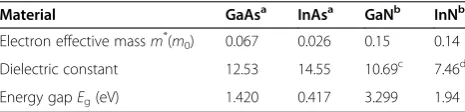
is the energy in the absence of N; EC, EN, and VNCare the bandgap energies of InGaAs atГpoint, the energy of the isolated N level in the InGaAs host material, and the coefficient describing the coupling strength between EN and the InGaAs conduction band, respectively. The band structure parameters used in this study are listed in Table 1 [31-36].
Using the variational method, it is possible to associate a trial wave function, which is an approximated eigen-function of the Hamiltonian described in Equation 2. The trial wave function is given by the following:
Ψð Þ ¼r ψð Þz φ ρ;ð λÞ; ð9Þ
where λ is the variational parameter, ψ(z) is the wave function of the donor electron which is exactly obtained from the Schrödinger equation in the z-direction with-out the impurity, and φ(ρ,λ) is the wave function in the (xandy) plane, and it is given by the following:
φ ρ;ð λÞ ¼1λ π2 1=2Exp½ρ=λ: ð10Þ
The ground state impurity energy is evaluated by min-imizing the expectation value of the Hamiltonian in Equation 2 with respect to λ. The ground state donor binding energy is calculated using the following equa-tion:
EB¼Ezmin
λ Ψ∣H∣Ψ; ð11Þ
[image:2.595.315.540.119.217.2]where Ezis the confinement ground state energy of the electron.
Table 1 Parameters of the binary compounds used for the calculation
Material GaAsa InAsa GaNb InNb
Electron effective massm*(
m0) 0.067 0.026 0.15 0.14 Dielectric constant 12.53 14.55 10.69c 7.46d
Energy gapEg(eV) 1.420 0.417 3.299 1.94
a
Vurgaftman et al. [33],b
Vurgaftman and Meyer [34],c
Chow et al. [35], and
d
[image:2.595.305.538.660.716.2]Results and discussion
In this paper, we have theoretically investigated the effects of the magnetic field, the impurity position, and the nitrogen and indium concentrations on impurity binding energy in a Ga1−xInxNyAs1−y/GaAs QW.
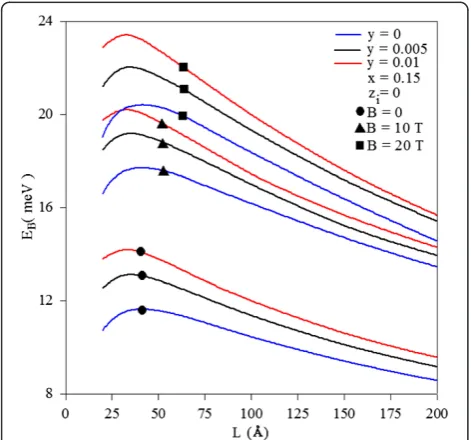
The variation of the impurity binding energy as a func-tion of the well width for different values of the magnetic field and for two different nitrogen concentrations (y= 0,
y = 0.005, andy= 0.01) is given in Figure 1. As seen in this figure, when the magnetic field increases, the bind-ing energy also increases. Magnetic field strength gives an additional parabolic magnetic confinement term. Under this additional magnetic confinement, the prob-ability of the electron and impurity atom being on the same plane increases, and therefore, the binding energy increases. In this figure, one sees that when the well width increases, the impurity binding energies increase until they reach a maximum value, and they bind to de-crease. This behavior is related to the change of the elec-tron and impurity atom confinement in the quantum well. It should be noted that the donor binding energy increases with nitrogen concentration. As the nitrogen concentration increases, both the electron effective mass and the band discontinuity increase, while dielectric con-stant decreases. In this case, the coulombic interaction between the electron and a donor impurity increases, and therefore, the impurity binding energy increases.
In Figure 2, we have presented the variation of the binding energy for a donor impurity placed on the cen-ter of a Ga1−xInxNyAs1−y/GaAs quantum well as a
function of the well width for different values of the magnetic field and for two different indium concentra-tions (× = 0.15 and × = 0.30). It is seen that the impurity binding energy decreases with the well width for the considered values of the indium concentration. This be-havior can be explained as follows: the band discontinu-ity and the dielectric constant increase with the increasing indium concentration; on the other side, the electron effective mass decreases. Thus, by increasing the indium concentration, particles get to be more ener-getic and they can penetrate into the potential barriers easily where the wave functions of the particles reflect their three-dimensional character, and the probability of finding the electron and hole in the same plane weakens. This behavior weakens the Coulomb interaction between the electron and impurity atom, and the binding energy begins to decrease.
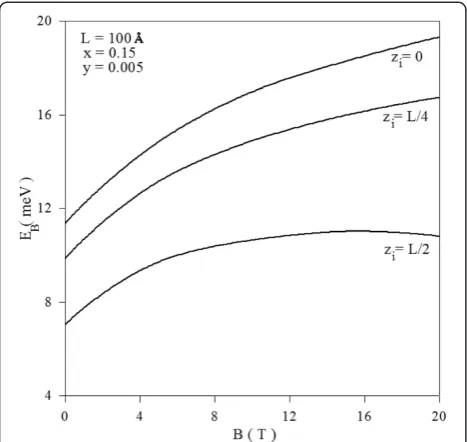
The calculated impurity binding energy for a hydrogenic donor in Ga1−xInxNyAs1−y/GaAs quantum well as a
func-tion of the magnetic field (B) is given in Figure 3 for differ-ent impurity positions (zi) and well width (L=100 Å). As
[image:3.595.306.539.87.307.2]expected, when the magnetic field increases, the binding energy also increases. It can be clearly seen that the im-purity binding energy decreases as the position of the impurity approaches the potential barriers. This is be-cause the electron impurity distance increases when the position of the impurity approaches the potential barriers. This leads to the weakening of the electrostatic inter-action, therefore to the decreasing in value of impurity binding energy.
Figure 1Variation of impurity binding energy as function of well width:magnetic-field values and nitrogen concentrations.
[image:3.595.56.292.464.684.2]This is for some values of the magnetic field (B= 0, 10, and 20 T) and nitrogen concentrations (y= 0, 0.005, and 0.01).
Figure 2Variation of impurity binding energy as function of well width:magnetic-field values and indium concentrations.
Conclusions
As a summary, we have investigated the effects of the magnetic field, the impurity position, and the nitrogen and indium concentrations on the impurity binding en-ergy in a Ga1−xInxNyAs1−y/GaAs quantum well in this
study. The calculations were performed within the ef-fective mass approximation. We have found the impurity binding energy on the magnetic field, the impurity pos-ition, and the nitrogen and indium concentrations. This case gives a new degree of freedom in device applica-tions, such as near-infrared electro-absorption modula-tors and quantum well infrared detecmodula-tors, and all optical switches. We hope that our results will stimulate further investigations of the related physics as well as device applications of group III nitrides.
Competing interests
The authors declare that they have no competing interests.
Authors' contributions
IS and HS defined the theoretical framework of the study. UY, FU, and SS conducted the numerical calculations, prepared computer programs, and gathered the research data. EK, CD, and MMR analyzed the data findings and contributed on conclusions. All authors read and approved the final manuscript.
Acknowledgments
This work supported by The Scientific and Technological Research Council of Turkey (TÜBİTAK) for a research grant COST 109T650 and was partially supported by the Scientific Research Project Fund of Cumhuriyet University under the project number F-360. MEMR acknowledges support from Mexican CONACYT through Research Grant CB-2008-101777 and 2011-2012 Sabbatical Grant No. 180636. He is also grateful to the Universidad de Antioquia for hospitality during his sabbatical stay. This research was partially supported by Colombian Agencies: CODI-Universidad de Antioquia (Estrategia de Sostenibilidad 2013-2014 de la Universidad de Antioquia) and Facultad de Ciencias Exactas y Naturales-Universidad de Antioquia
(CAD-exclusive dedication project (2012-2013). The authors thank CONACYT (Mexico) and COLCIENCIAS (Colombia) for support under the 2012-2013 Bilateral Agreement "Estudio de propiedades opticas, electronicas y de transporte en sistemas de baja dimension basados en carbono y semiconductores III-V: efectos de campos externos,temperatura y presion hidrostatica". The work was developed with the help of CENAPAD-SP, Brazil.
Author details
1Physics Department, Cumhuriyet University, Sivas 58140, Turkey.2Physics Department, Dokuz Eylül University, Izmir 35140, Turkey.3Instituto de Fisica, Universidad de Antioquia, Medellin, AA 1226, Colombia.4Faculty of Sciences, Morelos State University, Cuernavaca, CP 62209, Mexico.
Received: 16 July 2012 Accepted: 28 September 2012 Published: 24 October 2012
References
1. Ribeiro F, Latge A:Impurities in a quantum dot: a comparative study. Phys Rev B1994,50:4913.
2. Porras N, Perez S, Latge A:Binding energies and density of impurity states in spherical GaAs-‐(Ga, Al)As quantum dots.J Appl Phys1993,74:7624. 3. Movilla J, Planelles J:Off-centering of hydrogenic impurities in quantum
dots.Phys Rev B2005,71:075319.
4. Miller A, Chemla D, Schmitt S:Electroabsorption of highly confined systems: theory of the quantum–confined Franz–Keldysh effect in semiconductor quantum wires and dots.Appl Phys Lett1988,52:2154. 5. Nomura S, Kobayashi T:Clearly resolved exciton peaks in CdSxSe1−x
microcrystallites by modulation spectroscopy.Solid State Commun1990,
73:425.
6. Porras-Montenegro N, Perez-Merchancano S:Hydrogenic impurities in GaAs-(Ga, Al)As quantum dots.Phys Rev B1992,46:9780.
7. Zhu J:Exact solutions for hydrogenic donor states in a spherically rectangular quantum well.Phys Rev B1989,39:8780.
8. Zhu J, Xiong J, Gu B:Confined electron and hydrogenic donor states in a spherical quantum dot of GaAs-Ga1−xAlxAs.Phys Rev B1990,41:6001. 9. Pozina G, Ivanov I, Monemar B, Thordson J, Andersson T:Properties of molecular-beam epitaxy-grown GaNAs from optical spectroscopy. J Appl Phys1998,84:3830.
10. Bi W, Tu C:Bowing parameter of the band-gap energy of GaNxAs1−x. Appl Phys Lett1997,70:1608.
11. Shan W, Walukiewicz W, Ager J, Haller E, Geisz J, Friedman D, Olson J, Kurtz S:Band anticrossing in GaInNAs alloys.Phys Rev Lett1999,82:1221. 12. Fan W, Yoon S:Electronic band structures of GaInNAs/GaAs compressive
strained quantum wells.J Appl Phys2001,90:843.
13. Hetterich M, Dawson M, Egorov A, Bernklau D, Riechert H:Electronic states and band alignment in GalnNAs/GaAs quantum-well structures with low nitrogen content.Applied Physics Lett2000,76:1030.
14. Pan Z, Li L, Lin Y, Sun B, Jiang D, Ge W:Conduction band offset and electron effective mass in GaInNAs/GaAs quantum-well structures with low nitrogen concentration.Appl Phys Lett2001,78:2217.
15. Tournie E, Pinault M, Vezian S, Massies J, Tottereau O:Long wavelength GaInNAs/GaAs quantum-well heterostructures grown by solid-source molecular-beam epitaxy Appl.Phys Lett2000,77:2189.
16. Polimeni A, Capizzi M, Geddo M, Fischer M, Reinhardt M, Forchel A:Effect of temperature on the optical properties of (InGa)(AsN)/GaAs single quantum wells.Appl Phys Lett2000,77:2870.
17. Perlin P, Winiewski P, Skierbiszewski C, Suski T, Kaminska E, Subramanya S, Weber E, Mars D, Walukiewicz W:Solar cells with 1.0 eV band gap, lattice matched to GaAs.Appl Phys Lett2000,76:1279.
18. Pinault M, Tournie E:On the origin of carrier localization in Ga InNAs/ GaAs quantum wells.Appl Phys Lett2001,78:1562.
19. Shirakata S, Kondow M, Kitatani T:Photoluminescence and
photoreflectance of GaInNAs single quantum wells.Appl Phys Lett2001,
79:54.
20. Ungan F, Kasapoglu E, Sari H, Somken I:Dependence of impurity binding energy on nitrogen and indium concentrations for shallow donors in a GaInNAs/GaAs quantum well under intense laser field.The European Physical Journal B2011,82:313.
[image:4.595.57.291.89.310.2]21. Sali A, Fliyou M, Loumrhari H:Photoionization of shallow donor impurities in finite-barrier quantum-well wires.Physica B1997,233:196.
22. Duque C, Kasapoglu E, Sakiroglu S, Sari H, Sökmen I:Intense laser effects on donor impurity in a cylindrical single and vertically coupled quantum dots under combined effects of hydrostatic pressure and applied electric field.Appl Surf Sci2010,256:7406.
23. Ruihaoi W, Wenfang X:Optical absorption of a hydrogenic impurity in a disc-shaped quantum dot.Curr Appl Phys2010,10:757.
24. Kasapoglu E, Yesilgul U, Sari H, Sökmen I:The effect of hydrostatic pressure on the photoionization cross-section and binding energy of impurities in quantum-well wire under the electric field.Physica B2005,
368:76.
25. Yesilgul U, Kasapoglu E, Sari H, Sökmen I:Photoionization cross-section and binding energy of shallow donor impurities in GaInNAs/GaAs quantum wires.Solid State Communications2011,151:1175. 26. Sari H, Sökmen I, Yesilgul U:Photoionization of donor impurities in
quantum wires in a magnetic field.J Phys D: Appl Phys2004,37:674. 27. Terzis1 A, Baskoutas S:Binding energy of donor states in a GaAs quantum
dot: effect of electric and magnetic field.J Phys Conf Ser2005,10:77. 28. Kasapoglu E, Sari H, Sökmen I:Binding energy of impurity states in an
inverse parabolic quantum well under magnetic field.Physica B2007,
390:216.
29. Wu J, Shan W, Walukiewicz W:Band anticrossing in highly mismatched III-V semiconductor alloys.Semicond Sci Technol2002,17:860.
30. Skierbiszewski C:Experimental studies of the conduction-band structure of GaInNAs alloys.Semicond Sci Technol2002,17:803.
31. Ng ST, Fan W, Dang Y, Yoon S:Comparison of electronic band structure and optical transparency conditions of InxGa1−xAs1−yNy/GaAs quantum wells calculated by 10-band, 8-band, and 6-band k·p models.Phys Rev B
2005,72:115341.
32. Chuang SL:Physics of Optoelectronic Devices. New York: Wiley; 1995. 33. Vurgaftman I, Meyer J, Ram-Mohan L:Band parameters for III–V
compound semiconductors and their alloys.J Appl Phys2001,89:5815. 34. Vurgaftman I, Meyer J:Band parameters for nitrogen-containing
semiconductors.J Appl Phys2003,94:3675.
35. Chow W, Wright A, Nelson J:Theoretical study of room temperature optical gain in GaN strained quantum wells.Appl Phys Lett1996,68:296. 36. Gavrilenko V, Wu R:Linear and nonlinear optical properties of group-III
nitrides.Phys Rev B2000,61:2632.
doi:10.1186/1556-276X-7-586
Cite this article as:Yesilgulet al.:The effect of magnetic field on the impurity binding energy of shallow donor impurities in a Ga1−xInxNyAs1−y/ GaAs quantum well.Nanoscale Research Letters20127:586.
Submit your manuscript to a
journal and benefi t from:
7 Convenient online submission
7 Rigorous peer review
7 Immediate publication on acceptance
7 Open access: articles freely available online
7 High visibility within the fi eld
7 Retaining the copyright to your article