
N A N O R E V I E W
Open Access
Toward TiO
2
Nanofluids
—
Part 2:
Applications and Challenges
Liu Yang
1,2*and Yuhan Hu
1Abstract
The research about nanofluids has been explosively increasing due to their fascinating properties in heat or mass transportation, fluidity, and dispersion stability for energy system applications (e.g., solar collectors, refrigeration, heat
pipes, and energy storage). This second part of the review summarizes recent research on application of TiO2
nanofluids and identifies the challenges and opportunities for the further exploration of TiO2nanofluids. It is expected that the two exhaustive reviews could be a helpful reference guide for researchers to update the knowledge on research status of TiO2nanofluids, and the critical comments, challenges, and recommendations could be useful for future study directions.
Keywords:Nanofluids, Thermal conductivity, Application, Solar absorption
Review
Background
In the first part, the studies on the preparation, stability, and properties have been reviewed. It can be seen that many researches have been carried out on the directions of preparation and properties of nanofluids [1–7]. Mean-while, there are also many attempts that have been made for application of nanofluid, especially in energy systems [8–11]. Due to the enhancement in heat and mass transfer process, TiO2nanofluids have been tentatively applied to the fields of solar collectors [12], refrigeration [13–16], en-ergy storage [17, 18], heat pipes [19–21], and other energy applications [22–34], such as car radiator [31], PV/T hy-brid system [32, 33], and combined heat and power (CHP) systems [34]. In our previous studies, the heat transfer characteristics of TiO2 nanofluids in heat conduction, forced convection boiling heat transfer, and natural con-vection heat transfer have been summarized [35]. How-ever, it is far from a comprehensive summary for application of TiO2nanofluids; there are also many prac-tical applications for TiO2nanofluids. Here, in part 2, we will provide a detailed review on the thermal conductivity and energy-related applications of TiO2 nanofluids. We hope that the two reviews combined with our previous
report [35] can provide a comprehensive understanding on research progress of TiO2nanofluids. With the devel-opment of nanofluid technology, it is expected that nano-fluids will be practically applied as a new and efficient work fluid for those energy systems.
Application in Enhancing the Thermal Conductivity
Since the outstanding performance of nanofluids is gen-erally attributed to the physical properties of fluids with the addition of nanoparticles, the experimental or theor-etical investigations on the thermal conductivity of nanofluids should be an important topic in the field of nanofluids. Although most review articles introduced the thermal conductivity in the physical property part, enhancing the thermal conductivity is also an important application aspect of nanofluids. Another reason of putting thermal conductivity in the application part is to balance the content of the two reviews.
Many experimental and theoretical research results have shown that the addition of nanoparticles can distinctly improve the thermal conductivity of fluid. The influence factors on the thermal conductivity of nano-fluids can be induced as the following groups: (1) internal factors, including particles’type, content [36, 37], size [38], shape [39], and structure [40] and type of base fluid [41] and probable surfactant or pH regulator [42, 43] if have; (2) external factors, including temperature [40], supersonic vibration time [44], storage time [45], or
* Correspondence:[email protected]
1
Key Laboratory of Energy Thermal Conversion and Control of Ministry of Education, School of Energy and Environment, Southeast University, Nanjing, China
2Jiangsu Provincial Key Laboratory of Solar Energy Science and Technology,
School of Energy and Environment, Southeast University, Nanjing, China
running time [46]; and (3) microcosmic factors, such as surface charge state of nanoparticles [47], cluster of parti-cles [48], the interfacial nanolayer [49], Brownian motion [50], the aggregation [51], interfacial thermal resistance, and mass difference scattering [52]. Our previous study has provided a table to show the thermal conductivity of TiO2 nanofluids [35]. However, it is not intuitive and inconveni-ent to understand the differinconveni-ent effect factors on the influ-ence degree. Therefore, in this part 2, the influinflu-ences on the thermal conductivity of TiO2 nanofluids are shown in figures to provide a more perceptual understanding.
Particle Loading Effect
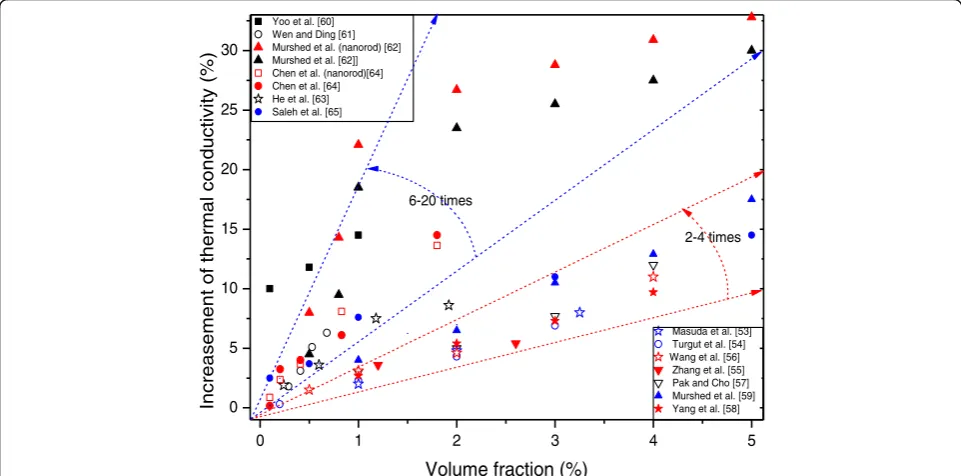
A summary of the increment of the thermal conductivity of TiO2–water nanofluids with the volume fraction of nanoparticles in available literatures is shown in Fig. 1. It can be seen from all experimental results that TiO2 nanoparticles can enhance the thermal conductivity of base fluids. However, the increments of different re-searches are profoundly different. For instance, one en-hancement on the thermal conductivity of nanofluids is about 2–4 times of volume loading of TiO2 nanoparti-cles, including Masuda et al. [53], Turgut et al. [54], Zhang et al. [55], Wang et al. [56], Pak and Cho [57], Yang et al. [58], and Mushed et al.’s [59] results. The other enhancement can reach 6–20 times of volume loading of TiO2nanoparticles, including Yoo et al. [60], Wen and Ding [61], Mushed et al. [62], He et al. [63], Chen et al. [64], and Saleh et al.’s [65] results.
The differences of results are probably as a result of, besides the volume fractions, the thermal conductivity of
TiO2nanofluids is also determined by the particles’ pa-rameters and the environmental circumstances, such as particle size and shape, surfactant, pH value, and temperature, which were quite different in different works. Moreover, some researchers observed that nano-particles have little effect on the thermal conductivity of TiO2nanofluids. Utomo et al. [66] investigated the ther-mal conductivity of water-based alumina and titania nanofluids. They observed that the thermal conductivity of TiO2nanofluids they prepared was slightly lower than the conventional model prediction due to the high con-tent of dispersants. And the results clearly showed that TiO2 nanofluids do not show anomalously thermal conductivity enhancement or convection heat transfer coefficient in a pipe flow as showed in other reports.
Particle Shape Effect
The influences of shape and size of nanoparticles are not as widely investigated as that of particle loading. The existing studies have not shown great effects by the par-ticle shape or size on the thermal conductivity of TiO2 nanofluids, which is most probably due to the relatively small quantities on this effect. Murshed et al. [62] dis-persed two kinds of TiO2 nanoparticle water using CTAB as dispersant. One type is in rod-shape with a diameter by length of 10 nm × 40 nm. And the other type is in spherical shapes of 15 nm in diameter. They observed that the thermal conductivity of both kinds TiO2 nanofluids increased with the increase in particle loading, while the rod-like particles had more contribu-tions than spherical ones. The maximum enhancements
0 1 2 3 4 5
0 5 10 15 20 25 30
Yoo et al. [60] Wen and Ding [61] Murshed et al. (nanorod) [62] Murshed et al. [62]] Chen et al. (nanorod)[64] Chen et al. [64] He et al. [63] Saleh et al. [65]
Masuda et al. [53] Turgut et al. [54] Wang et al. [56] Zhang et al. [55] Pak and Cho [57] Murshed et al. [59] Yang et al. [58] 6-20 times
2-4 times
)
%(
yti
vit
c
u
d
n
o
c
l
a
mr
e
ht
f
o
t
n
e
m
e
s
a
er
c
nI
Volume fraction (%)
[image:2.595.57.538.473.711.2]in the thermal conductivity for the former and the latter were about 33 and 30%, respectively. Chen et al. [64] studied the effective thermal conductivity of four types of nanofluids orthogonally made of TiO2 nanoparticles (25 nm) and TiO2 nanotubes (10 nm × 100 nm) with water and EG as base fluid, respectively. They found that the distinctions between the enhancement of TiO2 nano-particles and TiO2nanotubes on the thermal conductiv-ity were not large, while the enhancement is much larger than the calculation value of Hamilton–Crosser equation.
Temperature Effect
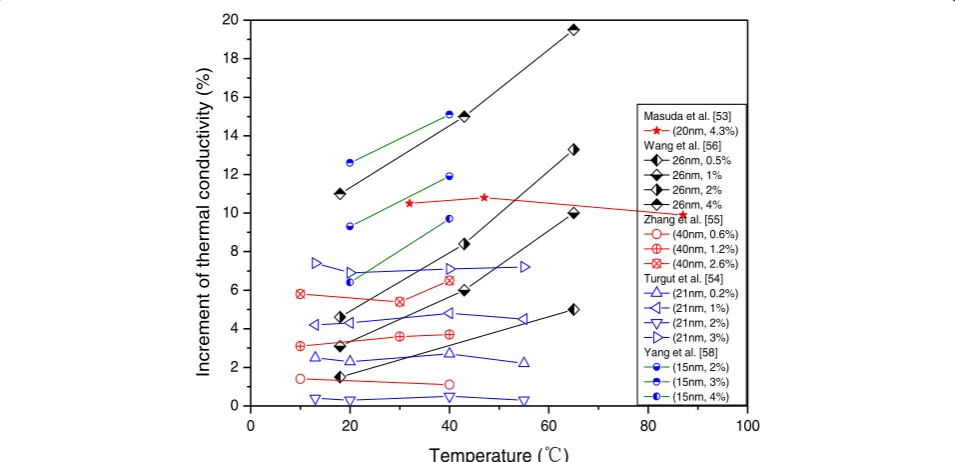
Temperature is another important influence factor on the thermal conductivity of TiO2 nanofluids. Figure 2 shows the influence of temperature on the enhancement of thermal conductivity of TiO2 nanofluids in different researches. Wang et al. [67] investigated the effect of particle loading and temperature on the thermal con-ductivity of water-based TiO2 nanofluids. The results showed that the working temperature plays more im-portant positive roles and makes more contribution to the thermal conductivity at a higher temperature. They also concluded that the results agreed with the theoret-ical values determined by considering the temperature-dependent Brownian motion and the micro-convection. Reddy et al. [68] investigated the thermal conductivity of TiO2 nanofluids for different particle loading in the range of 0.2–1.0% at different temperatures. And they observed that thermal conductivity of TiO2 nanofluids increases with an increase in both particle loading and temperature. Yang et al. [58] added TiO2 nanoparticles
to ammonia–water to prepare binary fluid-based nano-fluids. They also found that the increase in temperature could result in an increase in the thermal conductivity ratio of binary TiO2nanofluids to base fluid.
The above results showed that TiO2nanoparticles can make more contribution to the thermal conductivity of TiO2 nanofluids at higher temperature. However, some singular results about the effect of temperature can be also included. Turgut et al. [54] investigated the effective thermal conductivity of deionized water-based TiO2 nanofluids at temperatures of 13, 23, 40, and 55 °C. They observed that the thermal conductivity increases with an increase in particle loading but the change of temperature has little effect on the effective thermal conductivity of TiO2 nanofluids. In addition, some re-sults showed that temperature plays roles on the effect-ive thermal conductivity. Duangthongsuk and Wongwises [69] suspended TiO2nanoparticles in water with a volume loading range of 0.2 to 2%, and they col-lected the data at a temperature range of 15 to 35 °C. They observed that the measured thermal conductivity of TiO2–water nanofluids increased with the increase in both particle loading and temperature, but the thermal conductivity ratio decreased when the temperature in-creased; they attributed the reason to the faster growth rate of thermal conductivity of base fluid.
The reason of the uncertain role of temperature on the thermal conductivity ratio of TiO2 nanofluids may be due to the complex mechanism of thermal conductiv-ity of nanofluids. When temperature changes, the other parameters, such as the structure, surface activity, stabil-ity and of particles, the characteristic of dispersant, etc.
0 20 40 60 80 100
0 2 4 6 8 10 12 14 16 18 20
)
%(
yti
vit
c
u
d
n
o
c
l
a
mr
e
ht
f
o
t
n
e
m
er
c
nI
Temperature ( )
Masuda et al. [53] (20nm, 4.3%) Wang et al. [56]
26nm, 0.5% 26nm, 1% 26nm, 2% 26nm, 4% Zhang et al. [55]
(40nm, 0.6%) (40nm, 1.2%) (40nm, 2.6%) Turgut et al. [54]
(21nm, 0.2%) (21nm, 1%) (21nm, 2%) (21nm, 3%) Yang et al. [58]
(15nm, 2%) (15nm, 3%) (15nm, 4%)
[image:3.595.59.537.480.711.2]may be changed, and those parameters are generally much different in different works. Therefore, the influ-ences of temperature on the thermal conductivity ratio of TiO2nanofluids are related to the specific nanoparti-cles and base fluid types. This observation can be further improved by Cabaleiro et al.’s research [41], in which the temperature-dependent thermal conductivity behavior was studied for anatase and rutile TiO2nanofluids with ethylene and propylene glycol as base fluid, respectively. The temperature dependence of the thermal conductiv-ity of these four kinds of TiO2 nanofluids is shown in Fig. 3. It can be observed that all the four kinds of nano-fluids exhibited higher thermal conductivities than the corresponding base fluids. Temperature played differ-ent roles for TiO2 nanofluids containing different nanocrystalline structure nanoparticles and with different base fluids. The thermal conductivity increased as temperature increases for EG-based nanofluids, with a maximum increment of 11.4% by the temperature in the study range, while it seemed almost independent of temperature for PG-based nanofluids.
Base Fluid Effect
Ingredients of base fluids can also affect the thermal conductivity of TiO2 nanofluids. Chen et al. [64] mea-sured the effective thermal conductivity of spherical and tubular TiO2nanofluids with water and ethylene glycol as base fluids, respectively. They observed that both of the enhancements of TiO2 nanoparticles and TiO2 nanotubes with EG as base fluids were higher than that with water as base fluid. Reddy et al. [68] found that the thermal conductivity enhancement for water-based, EG/ W (40%:60%)-based, and EG/W (50%:50%)-based TiO2 nanofluids increased from 0.649 to 5.01%, 1.94 to 4.38%, and 10.64 to 14.2%, respectively, when the volume con-centration of TiO2 nanoparticles increased from 0.2 to
1.0% at room temperature (30 °C). However, some op-posite results can also be observed, Cabaleiro et al. [41] found that the thermal conductivity enhancements for TiO2 nanofluids with EG, PG, or paraffin oil as base fluids were distinctly lower than those with water as base fluids. Also, in Sonawane et al.’s report [70], the effect of base fluids was thought to be complex and inaccessible because the thermal conductivity of TiO2 nanofluids with 1 vol.% particle loading followed the following se-quence: paraffin oil-based nanofluid > water-based nano-fluid > EG-based nanonano-fluid, while that of pure base fluids followed the sequence water > EG > paraffin oil. They analyzed this erratic observation from the perspec-tive of the viscosity effect and thought that lower base fluid viscosity could make more contributions to the en-hancement of the thermal conductivity of nanofluids.
Surfactant Effect
The addition of surfactant is another important factor on the thermal conductivity of TiO2 nanofluids. Some results showed the surfactants have a positive effect on thermal conductivity. Saleh et al.’s [65] studied the effect of different types of surfactants on the thermal conduct-ivity of TiO2–water nanofluids, and the results are shown in Fig. 4. It can be seen that all of the three kinds of surfactants could greatly improve the thermal con-ductivity of nanofluids and the nanofluids with SDS as stabilizer exhibited the greatest enhancement, followed by those with CTAB and Span-80 as stabilizer. And they thought that the dispersion stability and surface proper-ties of the particles was involved in the enhancements in thermal conduction of nanofluids.
There are also some different results on the surfactant effect. Yang et al. [58] found that when the content of ammonia in base fluids increases, the thermal conductiv-ity ratio of TiO2 nanofluids will also increase because the stability of TiO2ammonia–water nanofluids will be
Fig. 3Temperature dependence of the thermal conductivity of four
kinds of TiO2nanofluids [41]. Reproduced with permission from Elsevier
Fig. 4Effect of different surfactants on the thermal conductivity of
[image:4.595.58.291.533.703.2] [image:4.595.305.539.546.705.2]improved in higher pH value. And the surfactants PEG1000 and PAA in low concentration have relatively smaller influence than other impact factors on thermal conductivity like, particles or ammonia content, temperature. However, PEG1000 can improve the stabil-ity TiO2 ammonia–water nanofluids, which induce the improvement of thermal conductivity of nanofluids. Murshed et al. [62] found that oleic acid and CTAB can improve the dispersion stability of TiO2nanofluids with-out impacting on thermal physical properties of nano-fluids and single-phase heat transfer coefficient because the surfactant content employed in their experiments was very low viz. 0.01–0.02 vol.%. There are also some results that showed the surfactants have a depressing ef-fect. Utomo et al. [66] investigated the thermal conduct-ivity of water-based Al2O3 and TiO2 nanofluids. They found that high loading of stabilizers could result in a decrease in the effective thermal conductivity of those two kinds of nanofluids.
Sonication Effect
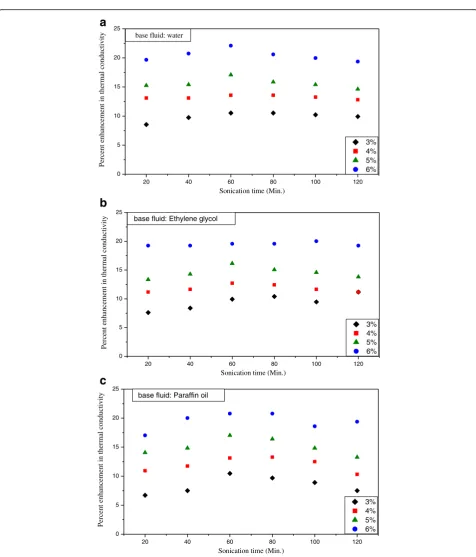
The sonication also showed some effects on the thermal conductivity of TiO2 nanofluids. Ismay et al. [71] found that the thermal conductivity of TiO2–water nanofluids achieved the maximum when the pH value is close to 7 and was further improved by 2 h’sonication. And they thought that aggregation can explain the observed en-hancements due to the percolation effect. Sonawane et al. [70] performed a particular research about the effect on thermal conductivity by the ultrasonic time, and the re-sults are shown in Fig. 5a–c. It can be found for all the three kinds of nanofluids in various concentrations, the in-creasing proportions of thermal conductivity increased firstly and then decreased as the ultrasonic time increases, and the maximum increment occurred at the sonication time of 60 min. They attributed the reason as follows: optimum sonication time of 60 min can intensify the Brownian motion of nanoparticles and the intermolecular interaction between particles and bulk liquid, which re-sulted in an enhancement of thermal conductivity. How-ever, longtime sonication of exceeding 60 min could induce the clustering and aggregating of nanoparticles, which was thought accountable for the decline of heat transport and thermal conductivity in nanoparticles.
Theoretical Studies
The theoretical study of nanofluids is one of the research hotspots in the field of nanofluids. There have been numer-ous thermal conductivity models proposed in recent years. It is generally regarded that most conventional models can be used for TiO2nanofluid unless there are special restric-tions. However, due to the great difference in the experi-mental data of thermal conductivity of TiO2nanofluids, it is almost impossible for a single model to fit all different
results. Due to the conventional models are hard to be ap-plied to an individual case, some targeted thermal conduct-ivity models for TiO2 nanofluids are also proposed in recent years. Table 1 provides a summary of available ther-mal conductivity model equations specialized in TiO2 nanofluids. It can be seen that the factors such as interfacial layer [59, 72], Brownian movement [73, 74], particle size and aspect ratio [72, 75], and aggregation [76] have been considered in some models. And there are also some models that are proposed just by experimental fitting or analysis of variance [68, 74, 77–82]. It can be possible to conclude that those models are only suitable for their indi-vidual cases. Although the theoretical studies on the ther-mal conductivity of nanofluids have been much developed, the most fundamental flaw lies in the great difference in dif-ferent experimental results. It is rather difficult to compre-hensively and accurately grasp the heat conduction process in nanofluid since the nanostructure and micromotion of particles are hard to quantitatively describe. Therefore, due to the poor accuracy of the models for an individual appli-cation case, the best way to obtain the thermal conductivity of nanofluids for designing the application system is to carry out a preliminary experiment.
The above analysis reveals that at present, there still exist controversies and inconsistencies on the influence factors on thermal conductivity of TiO2nanofluids. Al-though particle loading has exhibited a positive correl-ation with thermal conductivity of nanofluids, the effects of other factors including particle shape, size, base fluid type, temperature, surfactant, and sonication are unified. Even for particle loading effect, the intensities of growth in thermal conductivity differ widely for different sam-ples. The inconsistencies of thermal conductivity of nanofluids in various researches are mainly because the thermal conductivity is simultaneously affected by many factors especially some microscopic parameters such as particle clustering and micromotion which are rather difficult for a quantitative analysis or measurement.
Another controversy is the mechanism of enhancement in heat conduction of nanofluids. The particle clustering and gathering are thought to be responsible for the en-hancement in the heat conduction of nanofluids [48, 50, 51]. However, the stable nanofluids with fewer aggregations by suitable surfactant or sonication treatment also have showed higher thermal conductivity [62, 65, 66, 70, 71]. The main mechanism of enhancement in heat conduction of nanofluids is the particle clustering or the micromotion, or some other factors need to be further analyzed.
Solar Absorption
poor absorption properties of the conventional working fluid. Therefore, in recent years, the nanofluid technol-ogy has been gradually used in the solar collectors to produce superior thermal and optical properties. It is ex-pected that this new generation of heat transfer and
solar absorption fluid can improve the efficiency of use of solar energy.
As shown in Fig. 6, a typical schematic diagram of nanofluid-based concentrating solar water heating sys-tem can be observed in Khullar et al.’s reports [83]. They
20 40 60 80 100 120
0 5 10 15 20 25
base fluid: Ethylene glycol
3% 4% 5% 6%
yti
vit
c
u
d
n
oc
la
mr
e
ht
ni
t
ne
me
c
na
h
ne
t
ne
cr
e
P
Sonication time (Min.)
20 40 60 80 100 120
0 5 10 15 20 25
base fluid: Paraffin oil
3% 4% 5% 6%
yti
vit
c
u
d
n
oc
la
mr
e
ht
ni
t
ne
me
c
na
h
ne
t
ne
cr
e
P
Sonication time (Min.)
20 40 60 80 100 120
0 5 10 15 20 25
base fluid: water
3% 4% 5% 6%
yti
vit
c
u
d
n
oc
la
mr
e
ht
ni
t
ne
me
c
na
h
ne
t
ne
cr
e
P
Sonication time (Min.)
a
b
c
Fig. 5The percent enhancement in thermal conductivity as a function of sonication time.aBase fluid: water.bBase fluid: ethylene glycol.cBase
[image:6.595.59.536.79.637.2]Table 1 Theoretical expressions of existing thermal conductivity models for TiO 2 nanofluids Autho rs Year Mod el expre ssions Note Murshe d et al. [ 59 ]: 2008 keff ¼ kp − klr ðÞ φp klr 2 β
3−1
β 3þ 1 ðÞ þ kp þ 2 klr ðÞ β
3φ1
p β 3k lr − kf ðÞ þ kf ½ β 3 1 kp þ 2 klr ðÞ − kp − klr ðÞ φp β
3þ1
β 3− 1 ðÞ β 1 =1 + t / R β2 =1+ t /(2 R ) klr and t are therm al cond uctivity and thick ness of the interfac ial layer . This model cons iders the interfacial lay er and has be en validated for TiO 2 ,A l2 O3 , and Al nanofluids. Duang thongs uk an d Wong wises [ 77 ] 2009 knf = kf (a + b φ ) At 15 °C: a = 1.0225, b = 0.0272 At 25 °C: a = 1.0204, b = 0.0249 At 35 °C: a = 1.0139, b = 0.0250 It is a fitte d line ar eq uation for TiO 2 nanofl uids within 2 vol.%. Corcion e [ 73 ] 2011
keff¼kf
1 þ 4 : 4 Re 0 : 4 p Pr 0 : 66 f
T Tfr
10
kp kr
0 : 03 φ 0 : 66 Red ¼ uB
dp¼υ
2
ρf
kB
T
πμ
2df
p whe re Tfr are the free zing point of the bas e fluid (about 273. 16 K for water), Rep is the nan oparticle Reynol ds num ber. This model cons iders Brown ian mot ion and ha s been validated for TiO 2 ,A l2 O3 , and CuO nano fluids. Applied range: 0.2% < φ < 9%, 10 nm < d < 150 nm, 294 K < T < 324 K. Okek e et al. [ 76 ] 2011 (1 − φnc )( kf − knc )/( kf +2 knc )+ φnc ( kp − knc )/( kf +2 knc )= 0 whe re knc is the therm al conduc tivity of the im aginary medium with backbon es. φnc is taken as the volume fra ction of the particle s which be long to de ad end s. This model cons iders the aggreg ate size s, particle loading, an d interf acial resis tance bas ed on fractal and che mical dime nsions . And it has be en vali dated for Al2 O3 , CuO, and TiO 2 nan ofluids. Azmi et al. [ 78 ] 2012
keff¼kf
0 : 8938 1 þ φ 100 1 : 37 1 þ T 70 0 : 2777 1 þ d 150 − 0 : 0336
αf αp
0 : 0173 7 This model ha s been validat ed for water based Al2 O3 , ZnO, and Ti O2 nano fluids. Applied range: φ < 4%, 20 nm < d < 150 nm, 29 3 K< T < 343 K . Redd y and Rao [ 88 ] 2013 knf = kf (a + b φ ) Regre ssion cons tants a and b at variou s temp eratu res for water, 40% :60% and 50%:5 0% EG/W . It is a fitte d exp ressi on for TiO 2 na nofluid s. Applied range: 30 °C < T < 70 °C, 0.2% < φ < 1%. Zerra di et al. [ 79 ] 2014 knf = ks + kb ks ¼
k pþk f
ψ
þ
ψφ
1
−
k p k f
k pþk f
ψ
þ
φ
1
−
k p k f
kB ¼ G kf εf X
N i¼1
Ai Pr p di αφ þ β þ χφ ðÞ 1 ν ffiffiffiffiffiffiffiffiffiffiffi ffi 18 kb T πρ di s ! q þ δ 2 4 3 5 Pr AT whe re ψ is a shape facto r d e fined by ψ ¼ 2 φ 0 : 2
lpfordp
cylindri cal part icles ψ =2 φ 0.2 for spherical particles α , β , and χ are the rmop hysic coeffi cients. This model is bas ed on the Mont e Carl o simulation combi ned with a new Nusselt num be r corr elatio n. It has be en vali dated for Al2 O3 – H2 O, CuO – H2 O, TiO 2 – H2 O, and CNT – H2 O nano fluids. Abdo lbaqi et al. [ 80 ] 2016
keff¼kf
Table 1 Theoretical expressions of existing thermal conductivity models for TiO 2 nanofluids (Continued) Shukl a et al. [ 74 ] 2016 k
nf¼kf
1 − φ ðÞ þ π 6 π 1 = 3 φ 4 = 3 1 þ 0 : 5 6 φ π ðÞ 1 = 3 2
k bf kp
þ
ψ Nu
2 4
3−1 5
whe re ψ is the sphe ricity of nan oparticle . This model cons iders Brown ian mot ion. And it has been validated for water an d EG-ba sed TiO 2 and Al2 O3 nano fluids. Wei et al. [ 81 ] 2017 100( knf − knf )/ kf = 0.44 3 + 2.636 φ It is a line ar fit of the measu red values for dia therm ic oil-based TiO 2 na nofluids. App lied ran ge: φ < 1%. Pryazh nikov et al. [ 82 ] 2017
knf¼kf
1 þ 4 : 82 φ − 23 : 1 φ 2 It is a fitte d exp ressi on based on the measured valu es for 150 nm partic les of TiO 2 . Yang et al. [ 75 ] 2017 keff ¼ 1 π Z π 0 k
2sinz
2ω
þ
k
2cosx
2ω
1
=
2 dω
kz ¼ Rkp kf H þ R ðÞ kp − φ kp þ φ kf ðÞ þ H φ kp þ H 1 − φ ðÞ kf H þ R kx ¼ kf kp þ kf þ φ kp − kf ðÞ kp þ kf − φ kp − kf ðÞ whe re kx and kz are the effective the rmal cond uctivity in radial and axial directio ns, respe ctively. This model cons idere d the part icle aspect rati o and ha s been validated for cylindri cal TiO 2 and Bi2Te3 nan ofluids. Yang et al. [ 72 ] 2017 keff ¼ H þ 2 t ðÞ keff x þ R þ t ðÞ keff z H þ R þ 3 t keff x ¼ A φp kp þ α B þ β C ðÞ φp klr þ 1 þ α þ β ðÞ φp kf − kf A φp þ α B þ β C ðÞ φp þ 1 þ α þ β ðÞ φp − 1 keff z ¼ H þ 2 t H φp H þ 2 t ðÞ klr kp 2 tkp þ Hk lr þ α klr þ kf − H þ 2 t ðÞ 1 þ α ðÞ kf φp H whe re α ¼ R þ t ðÞ 2− R 2 R 2 ; β ¼ 2 tR þ t ðÞ 2 HR 2 ; t ¼ ffiffiffiffi ffi 2 π p σ A ¼ − 2 klr kp þ klr ; B ¼
R⋅Rþt
kp − klr klr þ kp − 1 ; C ¼ − 2 kf klr þ kf klr ¼ kp 1 þ t = R − kf = kp ðÞ 2 1 þ t = R − kf = kp − tkf ðÞ =
RkpðÞ
thought that a great amount of emission reductions and energy savings could be achieved when implementing a nanofluid-based concentrating solar collector. Chaji et al. [84] investigated the effects of particles’content and the liquid’s flow rate on the efficiency of a small-scale flat plate collector with TiO2nanofluids. They found the index of collector efficiency using TiO2 nanofluids was increased by 2.6 to 7% compared to base fluid based on the European Standard EN12975-2. Said et al. [85] used TiO2–H2O nanofluid as the working fluid to enhance the performance of a flat plate solar collector. They ob-served the nanofluids prepared could keep stable for more than 1 month. The results showed that compared to water base fluid, the energy efficiency can be in-creased by 76.6 vol.% loading and 0.5 kg/min flow rate, and the highest exergy efficiency of 16.9% could be achieved at these operating conditions.
The theoretical research on the performance of a solar collector using nanofluids has also been developed in re-cent years. Alim et al. [86] studied theoretically the en-tropy generation, heat transfer characteristics, and the pressure drop of Al2O3, CuO, SiO2, and TiO2nanofluids in a flat plate solar collector under laminar flow. They found that all kinds of nanofluids can improve the per-formance while the friction factor was almost similar to that of water-based fluid. Faizal et al. [87] also carried out a numerical study on the performance of those four kinds of nanofluids in the solar collector. They observed that the energy savings of all the four kinds of nanofluids can exceed 20%, which would result in emission reduc-tions of greenhouse gases.
The performance enhancement by nanofluids in solar collectors is generally attributed to two primary factors: the enhanced heat transfer characters and optical proper-ties. Therefore, the optical properties of nanofluids in solar absorption system were also investigated by researchers. Said et al. [88] performed both experiment and analytical studies on the solar absorption performance of TiO2and Al2O3nanofluids. They used two volume fractions of 0.1 to 0.3 vol.% for the photosensitive property investigation. Some classical theories including Rayleigh, Maxwell– Gar-nett, and Lambert–Beer’s approaches were adopted in
their analytical analysis. They concluded that the optical properties of TiO2 nanofluids were higher than that of Al2O3nanofluids within the range of visible light for all particle loading. He et al. [89] compared the light–heat conversion efficiency of the TiO2–water and CNT–water nanofluids in an evacuated tube solar collector in both sunny and cloudy conditions. They observed that the in-crement of temperature of CNT–water nanofluid is higher than that of TiO2–water nanofluids, which indicated that the light–heat conversion characteristic of the former is better than the latter.
Said et al. [90] thought that most research was focused on the fundamental thermophysical and optical proper-ties of nanofluids; the studies on some important factor for scattering and absorption including particle size, shape, and content as well as base fluid type were rarely found. To examine those factors, they carried out related research and observed that the particle size has little ef-fect when below 20 nm, and particle content was dir-ectly proportional to the extinction coefficient. For the nanofluids containing 20 nm TiO2 nanoparticles, the transmissivity was almost zero for wavelengths ranging from 200 to 300 nm, but 71% for 400 nm and 88% for 900 nm respectively. They also suggested that the vol-ume fraction of TiO2 nanoparticles should be below 0.1%, at which a much better result can be obtained.
Kim et al. [91] carried out a detailed theoretical re-search by using MWCNT, Al2O3, CuO, SiO2, and TiO2 nanofluids with PG (propylene glycol)–water (20:80) base fluid in a high-temperature U-tube solar collector. They observed the collector efficiency of the solar col-lector efficiency has distinctly positive correlation with thermal conductivity of nanoparticles added since it is in the sequence from greatest to least: MWCNT, CuO, Al2O3, TiO2, and SiO2 nanofluids. They also analyzed the emission reduction of CO2 and SO2 as well as the electricity and energy consumption worldwide. Their re-sults support that nanofluids has great potential for en-ergy saving and emission reduction. Due to their theoretical results have not considered the dispersion situation of different nanofluids, the actual performance is needed to be experimentally verified.
[image:9.595.57.539.88.201.2]Coincidentally, a similar experimental study of flat plate solar collector using different nanofluids was car-ried out by Verma et al. [92]. The experimental results indicated that for only 0.75% particle volume loading and at 0.025 kg/s flow rate, the exergy efficiency of nanofluids compared to water is increased by 29.32, 21.46, 16.67, 10.86, 6.97, and 5.74%, respectively, for gra-phene, CuO, Al2O3, TiO2, and SiO2nanofluids. Also, the drop in entropy generation followed this sequence. Their results also supported that the solar collector efficiency has a positive correlation with thermal conductivity of nanoparticles added.
However, there are also some researches giving differ-ent results. Mahian et al. [93] analyzed the performance of a minichannel-based solar collector using four differ-ent water nanofluids with Cu, Al2O3, TiO2, and SiO2 nanoparticles respectively. Their results showed the Al2O3nanofluids exhibited the highest heat transfer co-efficient while the lowest value belonged to SiO2–water nanofluids, but the outlet temperature followed this se-quence: Cu > TiO2> Al2O3> SiO2nanofluids. They also observed that entropy generation of TiO2–water is lower than that of Al2O3–water nanofluids despite of the ther-mal conductivity of the former is lower than the latter.
Refrigeration
Nano-refrigerant is a special kind of nanofluid which con-sists of nanoparticles and refrigerant as well as the probable lubricant. Nano-refrigerant is a new generation of refriger-ant for using compression or absorption refrigeration, air conditioning systems, heat pumps, etc. In recent years, many studies regarding nano-refrigerants have shown that adding nanoparticles into refrigerants or lubricant can achieve a better system performance and energy efficiency.
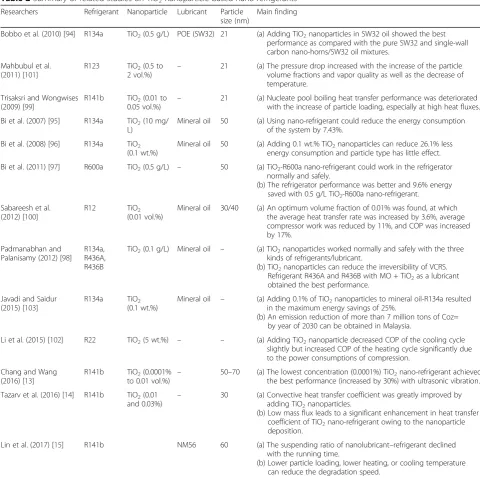
Table 2 shows summary of related studies on TiO2 nanoparticle-based nano-refrigerants. It can be seen that the TiO2 nanoparticles can work normally and safely with many kinds of refrigerants, including R134a, R600a, R436a, R436b, R141b, R123, R12, R22, and R410a. It can be seen that most results showed that adding TiO2 nanoparticles could bring benefits to the refrigeration system and the lubricating oil system, such as improving the performance [94], reducing the energy consumption [95–97], and the irreversibility [98]. Also, some research focused on the heat transfer [99, 100] and pressure drop [101] of the nano-refrigerant system to investigate the effect mechanism of the nanoparticles. Li et al. [102] in-vestigated the coefficient of performance (COP) of the refrigeration system for both the cooling cycle and heat-ing cycle, and the results showed that addheat-ing TiO2 nano-particle would lead to a slight decrease in COP of the cooling cycle but a significant increase in COP of the heating cycle based on the power consumption of the compression. Bi et al. [96] experimentally investigated
the reliability and performance of a domestic refriger-ator with HFC134a as refrigerant and Mineral oil with TiO2nanoparticles mixtures as lubricant. As illustrated in Fig. 7, the system main consists of fresh food storage room and frozen food storage room as well as refriger-ation system pipelines. The results showed that the system TiO2 nanoparticles works normally and safely and adding 0.1 wt.% TiO2 nanoparticles can reduce 26.1% energy consumption while particle type has little effect on performance.
In addition, there is likewise a forward-looking study on the effect on the environment. Javadi and Saidur [103] observed that adding 0.1% of TiO2 nanoparticles to mineral oil-R134a could result in the maximum en-ergy savings of 25% and reduce the CO2 emission by 7 million tons by year of 2030 in Malaysia.
It can be seen from Table 2 that the amounts of nano-particles used in refrigerants were very low as below 0.1% [94–103], which can prevent clogging by the pos-sible sedimentation of nanoparticles. However, although all results seemed positive, the long-term performance of the refrigeration system using nano-refrigerants is a great challenge.
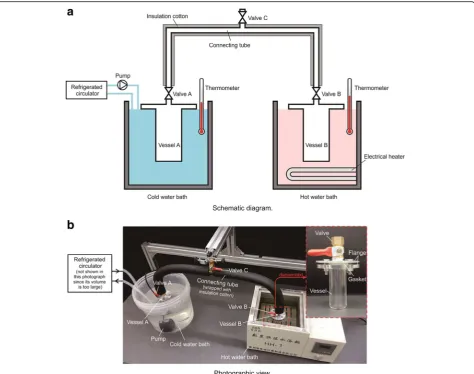
Lin et al. [15] investigated the suspending ratio of (0.1 to 1%) nanolubricant–refrigerant after continuous alter-nation processes of condensation and evaporation. The schematic diagram and photographic view of their ex-perimental system is shown in Fig. 8. They found that the degradation ratio was 28 to 73% after 20 times’ alter-nate operations. Also, they found lower particle loading can reduce the degradation speed. It can be concluded that the longtime performance of nano-refrigerant sys-tem is the essential step for further application in nano-refrigeration system.
Energy Storage
The storage of latent heat is through the most efficient mean of storing thermal energy. The conventional PCMs have a shortcoming of inadequate heat transfer perform-ance which can reduce the rate of storing and releasing thermal energy. Therefore, some researchers have stud-ied the method of improving the heat transfer perform-ance by adding nanoparticles into PCMs.
fluids, which exhibited good potential for being applied to cool storage as a substitute for conventional PCMs.
Another similar study was conducted by He et al. [105]. They also found the thermal conductivity of satu-rated BaCl2aqueous solution can be distinctly enhanced by 12.76% when adding a small amount of TiO2 nano-particles at−5 °C. Although decreases in the latent heat and specific heat and an increase in viscosity were found, those varieties have little effect on the cool storage sys-tem since the supercooling degree is reduced by 84.92%. They also thought that TiO2-saturated BaCl2 aqueous
solution is suitable for low-temperature energy stor-age industries.
[image:11.595.56.537.94.572.2]Studies on cool storage of TiO2nano-PCMs are in the minority, while most PCM applications focus on the heat storage. Table 3 shows a brief summary on the ther-mal conductivities and the latent heat of TiO2 nano-PCMs for thermal storage applications in existing litera-tures. Sharma et al. [106] prepared a composite of pal-mitic acid (PA) and TiO2 nanoparticles with SDBS as dispersant for thermal energy storage application. The preparation steps of PA–TiO2composites are shown in Table 2Summary of related studies on TiO2nanoparticle-based nano-refrigerants
Researchers Refrigerant Nanoparticle Lubricant Particle
size (nm)
Main finding
Bobbo et al. (2010) [94] R134a TiO2(0.5 g/L) POE (SW32) 21 (a) Adding TiO2nanoparticles in SW32 oil showed the best
performance as compared with the pure SW32 and single-wall carbon nano-horns/SW32 oil mixtures.
Mahbubul et al.
(2011) [101]
R123 TiO2(0.5 to
2 vol.%)
– 21 (a) The pressure drop increased with the increase of the particle
volume fractions and vapor quality as well as the decrease of temperature.
Trisaksri and Wongwises
(2009) [99]
R141b TiO2(0.01 to
0.05 vol.%)
– 21 (a) Nucleate pool boiling heat transfer performance was deteriorated
with the increase of particle loading, especially at high heat fluxes.
Bi et al. (2007) [95] R134a TiO2(10 mg/
L)
Mineral oil 50 (a) Using nano-refrigerant could reduce the energy consumption
of the system by 7.43%.
Bi et al. (2008) [96] R134a TiO2
(0.1 wt.%)
Mineral oil 50 (a) Adding 0.1 wt.% TiO2nanoparticles can reduce 26.1% less
energy consumption and particle type has little effect.
Bi et al. (2011) [97] R600a TiO2(0.5 g/L) – 50 (a) TiO2-R600a nano-refrigerant could work in the refrigerator
normally and safely.
(b) The refrigerator performance was better and 9.6% energy
saved with 0.5 g/L TiO2-R600a nano-refrigerant.
Sabareesh et al.
(2012) [100]
R12 TiO2
(0.01 vol.%)
Mineral oil 30/40 (a) An optimum volume fraction of 0.01% was found, at which
the average heat transfer rate was increased by 3.6%, average compressor work was reduced by 11%, and COP was increased by 17%.
Padmanabhan and
Palanisamy (2012) [98]
R134a, R436A, R436B
TiO2(0.1 g/L) Mineral oil – (a) TiO2nanoparticles worked normally and safely with the three
kinds of refrigerants/lubricant.
(b) TiO2nanoparticles can reduce the irreversibility of VCRS.
Refrigerant R436A and R436B with MO + TiO2as a lubricant
obtained the best performance.
Javadi and Saidur
(2015) [103]
R134a TiO2
(0.1 wt.%)
Mineral oil – (a) Adding 0.1% of TiO2nanoparticles to mineral oil-R134a resulted
in the maximum energy savings of 25%.
(b) An emission reduction of more than 7 million tons of Coz= by year of 2030 can be obtained in Malaysia.
Li et al. (2015) [102] R22 TiO2(5 wt.%) – – (a) Adding TiO2nanoparticle decreased COP of the cooling cycle
slightly but increased COP of the heating cycle significantly due to the power consumptions of compression.
Chang and Wang
(2016) [13]
R141b TiO2(0.0001%
to 0.01 vol.%)
– 50–70 (a) The lowest concentration (0.0001%) TiO2nano-refrigerant achieved
the best performance (increased by 30%) with ultrasonic vibration.
Tazarv et al. (2016) [14] R141b TiO2(0.01
and 0.03%) –
30 (a) Convective heat transfer coefficient was greatly improved by
adding TiO2nanoparticles.
(b) Low mass flux leads to a significant enhancement in heat transfer
coefficient of TiO2nano-refrigerant owing to the nanoparticle
deposition.
Lin et al. (2017) [15] R141b NM56 60 (a) The suspending ratio of nanolubricant–refrigerant declined
with the running time.
Fig. 9. It can be observed that the dispersion methods including adding surfactant, stirring, and ultrasonic vi-bration were implemented under the condition that the temperature of the base PA is above the melting temperature to confirm its liquid state.
Their results showed that the thermal conductivity in-creased by 12.7, 20.6, 46.6, and 80% when the mass frac-tions of TiO2 nanoparticle were 0.5, 1, 3, and 5%, respectively. And they considered this PCM could be a good candidate as potential solar thermal energy storage materials due to its high latent heat and thermal reliabil-ity of palmitic acid. Harikrishnan et al. [107] dispersed TiO2nanoparticles into PCM stearic acid and found this composite can accelerate the melting and solidification rates due to the enhanced heat transfer performance. They also observed that the addition of 0.3% nano-TiO2 nanoparticles can increase the thermal conductivity of stearic acid by approximately 63%. In their another re-search [108], they used stearic acid and lauric as base PCM and found an increment of 42% in thermal con-ductivity and a reduction of only 2% of latent heat of fu-sion. Motahar et al. [109] dispersed the TiO2 nanoparticles into organic PCM n-octadecane and found that the maximum enhancements of thermal conductiv-ity in solid and liquid phases occurred at 3 and 4 wt.%, respectively. Moreover, the maximum average thermal
conductivity enhancement for both phases was 26.6% when loading 5 wt.% nanoparticles.
Another experimental research focusing on the solidi-fication process of PCM containing TiO2 nanoparticles was also performed by Motahar et al. [110]. They ob-served that the rheological behavior of liquid PCM– TiO2 at higher loading tends to Bingham fluids so that their solidification experiments were performed within 0–2.17 Bingham numbers. The results showed that the addition of TiO2nanoparticles can enhance the thermal conduction process and hence increase the solidified volume. For particle mass loading of 1, 2, and 4%, the solidified volume fraction was increased by 7, 9, and 18%, respectively. At last, they proposed a universal cor-relation to predict the solidified volume fraction as a function of Fourier number, Rayleigh number, solid Ste-fan number, Bingham number, and particle loading.
Most of the results showed that when adding TiO2 nanoparticles, the thermal conductivity of PCMs can be greatly increased, while the latent heat will be de-creased slightly, which is probably as a result of the thermal conductivity of nanoparticles which is much larger than the base composite, while the nanoparti-cles will not take part in the phase changing process as the base composite. However, in some case, both of the thermal conductivity and latent heat capacity
[image:12.595.55.538.86.377.2]of PCMs were considered to be elevated. Wang et al. [111] prepared nano-PCMs by adding TiO2 nanoparti-cles into paraffin. They found the addition of TiO2 nanoparticles can change the phase transition temperature and latent heat capacity of paraffin. The phase transition temperature dropped with <1% load-ing, while increased with >2% loading of particles. The latent heat increased firstly and then decreased
as the loading of particles increase. And the turning concentration is 0.7 wt.%, at which a maximum latent heat capacity can be achieved. While the thermal con-ductivity of the nano-PCMs increased monotonously with the loading of TiO2 nanoparticles. When the loading of TiO2 nanoparticles reached 7 wt.%, the thermal conductivity was increased by 13% but the la-tent heat was reduced by 9%.
[image:13.595.62.537.87.461.2]Fig. 8a,bExperimental setup for condensation–evaporation alternation [15]. Reproduced with permission from Elsevier
Table 3Summary on thermal conductivities and the latent heat of TiO2nano-PCMs
Researchers Composite Thermal conductivity (W/m k) Latent heat (kJ/kg)
Base PCM Nano-PCM Base PCM Nano-PCM
Sharma et al. [106] Palmitic acid/5% TiO2 0.194 0.35 – 180.03
Harikrishnan et al. [107] Stearic acid/0.3% TiO2 0.19 0.31 131 127
Harikrishnan et al. [108] (SA + LA)/1% TiO2 0.19 0.27 173.98 173.22
Motahar et al. [109] n-octadecane/5% TiO2 0.45 0.57 – –
Wang et al. [111] Paraffin/0.7% TiO2 0.22 0.23 168 194
[image:13.595.57.540.620.731.2]Heat Pipes
The characteristics of boiling heat transfer and critical heat flux enhancement of nanofluids can be utilized in the heat pipe to improve its performance and broaden the application range. And some numerical results [112, 113] have shown that for thermosyphon heat pipe, using the nanofluid could achieve a better heat transfer char-acteristics. Also, some researchers have carried out re-lated research using TiO2nanofluids.
Zhou et al. [114] tested gravity heat pipes filled with DI water and TiO2nanofluids, where the concentration and filling ratio of nanoparticles were varied and the ini-tial temperature distribution was given. The result indi-cated that the heat pipes filled with nanofluids had a lower start-up temperature and a shorter start-up time in evaporation section under the condition of a water bath. And the biggest temperature drop between the evaporation section and the condensation section for heat pipes filled with TiO2 nanofluids was lower than those filled with DI water. The start-up time of heat pipes with filling ratios ranged between 50 and 70% in the evaporation section increased with the increase of the filling ratio and heating temperature, but the small inclination angle had a negative effect on the start-up performance.
Saleh et al. [65] collected data from different nanofluid experiments, where particle volume loading was up to 1.0% and the temperature of measurements ranged from 10 to 60 °C. They discovered that these data agreed with the classical Brownian motion theoretical model. They also investigated experimentally the effect of nanofluids on the thermal performance of heat pipes by measuring the wall temperature and thermal resistance distribu-tions between the evaporation and condensation section. They found that distilled water and nanofluids achieved the best heat transfer performance when the inclination was set to 45° and the charge volume ratio of working fluid was 60%.
In 2015, Monirimanesh et al. [115] designed a thermosyphon-type heat pipe heat exchanger (HPHX) using TiO2 nanofluids as the working fluid to save en-ergy in an air conditioning system. Their experimental apparatus was constructed as shown in Fig. 10. They es-tablish a pre-cooling and pre-heating device to produce altered conditions of the inlet air for investigating the performance of HPHX. The evaporator and condenser section of the HPHX functioned as a pre-cooler and reheating coil for the air conditioning system respect-ively. They also employed an electric heater and electric boiler to supply heat and steam into the entered fresh
[image:14.595.59.540.88.225.2]Fig. 9Preparation steps of PA–TiO2composites [106]. Reproduced with permission from Elsevier
[image:14.595.59.539.570.715.2]air by a fan for the purpose of simulating the hot and humid climate. Their results showed that using TiO2 nanofluids and increasing the HPHX number of rows could make a part of air condensed on the evaporator fin, which could enhance the energy in the pre-cooling section. The use of 3 wt.% TiO2–methanol nanofluids in a four-row HPHX could achieve the highest energy sav-ings ranging from 30.6 to 32.8% when the inlet air under the properties of 45 °C and 50–74% relative humidity. Based on a comprehensive consideration of the main purpose of supplying the energy required for reheating, they suggested that 2 wt.% TiO2–methanol nanofluid for the four-row HPHX would have been adequate and more economical.
Mass Transfer
The mass transfer of nanofluids is another important ap-plication aspect of TiO2 nanofluids. Current research has shown that TiO2nanofluids can be used to enhance the absorption process of CO2and NH3 as well as the mass transfer coefficient of electrolyte fluids.
Li et al. [116] prepared stableN-methyldiethanolamine (MDEA)-based nanofluids to strengthen the absorption performance of CO2 in the MDEA solution. The CO2 absorption characteristics in the gas/liquid interface of nanofluids were investigated by measuring the absolute pressure drop of gas. The mass fraction of MDEA was 50%. And they used two particle mass fractions of 0.1 and 0.4%. The results showed that the CO2absorption rate increases with increasing temperature and it is en-hanced by the added nanoparticles. However, at 20 and 30 °C, the enhancement caused by the mass fraction of nanoparticle (0.1 and 0.4%) reduced gradually. The ef-fective absorption ratio varied from 1.03 to 1.14. Also, CO2bubble absorption ratio increased with the increase of nanoparticle mass fraction.
Yang [117] prepared stable TiO2 nanofluids without adding dispersant and then carried out a comparative experiment on the falling film performance of absorp-tion of ammonia gas by nanofluids and pure water. The schematic diagram of the experimental system for NH3– H2O nanofluid falling film absorption is shown in Fig. 11. They found that the absorption rate of ammonia gas can be increased by 10% when adding anatase TiO2 nano-fluids. Wu [118] used the similar experimental device but changed the falling film tube of Fig. 11 into a fin tube. He investigated the effect of rutile TiO2nanofluids on the ammonia absorption performance of falling film outside a fin tube. The result showed that the combined use of zigzag tubule and TiO2nanofluids can strengthen the ammonia–water falling film absorption and the max-imum increment can reach 60.8%.
Beiki et al. [119] investigated experimentally the turbu-lent mass transfer characteristics of TiO2 and γ-Al2O3
electrolyte nanofluids in a circular tube. The results showed that adding 0.015 vol.% TiO2and 0.01 vol.% γ -Al2O3 could bring an increase in mass transfer coeffi-cient of the electrolyte solution by 18 and 10%, respect-ively. They found that the enhancement ratio was independent of Reynolds number. The mass transfer co-efficients increased firstly and then decreased as the nanoparticle loading increase. They attributed the cause of the existing of optimal particles’ loading to the clus-tering of nanoparticles and forming bigger agglomerates with smaller Brownian velocity when exceeding the optimum loading.
Coolant of Milling
As a coolant, nanofluids’ heat transfer enhancement characteristic can improve the cooling performance [120]. Moreover, when nanofluids are used for milling, another characteristic of nanofluids viz. enhancement in wear resistance can also play an important role in ex-tending the lifetime of the milling tool.
Yogeswaran et al. [121] investigated experimentally the effects of coolant of TiO2–EG nanofluid on the tool wear and workpiece temperature at the various milling condi-tions when used for milling a stainless steel AISI 304. The milling tool was made of a TiN-coated carbide insert. The results showed that comparing to pure base fluid, the
1 2 3
4 5 6 7
8 9
10 11 12
15
13
[image:15.595.306.538.406.654.2]14
Fig. 11Schematic diagram of the experimental system for NH3–H2O
nanofluid falling film absorption [117].1NH3 vessel,2decompression
valve,3constant pressure controller,4,11container of solution,5inlet
of cooling water,6,10constant flow controller,7falling film tube,8
visible absorber body,9solution distributor,12tubes for balancing
pressure,13outlet of cooling water,14HP data acquisition instrument,
workpiece temperature was reduced by 30% when using the nanofluid as coolant. The tool wear from milling using the EG-based TiO2nano-coolant is much less than using the normal commercial coolant because the nanofluids can reduce the heat penetrating into the inserts. And the tool life is increased as a result of the nanoparticles re-duces the damage on the edge of the tool.
Muthusamy et al. [122] also compared the efficiency of nanoparticle-based coolant (TiO2–EG) and conventional water-soluble coolant on the tool life and wear perform-ance of a TiN-coated carbide insert in the end-milling process of AISI304 stainless steel. The results showed that using TiO2–EG nanofluid as coolant could increase the tool life from 32.67 to 54.9 min (increased by 40.55%) comparing to that using TiO2–EG nanofluid as coolant instead of water-soluble coolant. They attributed the cause to a Ti nanoparticle layer on the edge of the insert formed during the milling process when using TiO2–EG nanofluid, which can be proved from the SEM and EDX of cutting edge as shown in Fig. 12. When using nanofluids as coolant, the oxidation still occurred despite the cutting temperature was reduced at the interface of the tool and workpiece since it can be found from Fig. 12 the O peak on the EDX spectrum. The hard oxidation layer was formed due to the entering of oxy-gen from TiO2–EG nanofluid into the tool–workpiece interface. Then, the hard oxidation layer can protect the tool from micro-cracking and chipping wear because it could not be easily detached despite under the severe impact of the milling force and took parts of the tool surface from the workpiece.
Challenges and Future Works
Challenges
The above energy-related examples have exhibited the extensive application prospect and excellent properties of TiO2 nanofluids. Although in some cases, especially in heat transfer applications, the heat transfer perform-ance of TiO2 nanofluids are not better than that of Ag, Cu, and CNT nanofluids, TiO2nanofluid is also a good choice due to their comprehensive properties for in-stance better dispersion and chemical stability, security, and economy.
Although TiO2nanofluids have showed great enhance-ment in heat transfer of solar collectors, refrigeration, energy storage, heat pipes, and coolant of milling, the in-vestigations on the performances including dispersion stability and heat transfer performance after running op-erations are in great lack. Most dispersion stability stud-ies are in static conditions, but it is important that the nanofluids prepared should be treated in the practical application conditions to examine the dynamic cycle sta-bility and the sustainasta-bility of both system performance and components of nanofluids.
Generally, the biggest downside in application of nano-fluids is the sedimentation and degeneration of nanopar-ticles after long running which makes the long-term performances of nanofluid system challenged. Some re-searchers have proposed a new idea and a novel method to re-disperse the aggregates in real time of the running system [123]. However, the concrete effect of the device has to be verified experimentally, and then, the design and location of the re-dispersion device needs to be im-proved. The surfactant is expected to have positive effect on the re-dispersion characteristic of aggregates. How-ever, one of the biggest flaws in using surfactants is the occurrence of foaming when the fluids are under flowing or heating conditions which would have adverse impacts on the heat or mass transfer application of nanofluids. This defect suggests the amount of surfactant employed in the nanofluids should be limited.
Another great limitation in application of nanofluid is the increase in pumping power and pressure drop of nanofluids, which is essential for the high-quality appli-cation of solar collectors, refrigeration, and heat pipes. For instance, Sajadi and Kazemi [124] found the propor-tional increase in pressure drop of TiO2 nanofluids is higher than that of heat transfer coefficient. While Teng et al. [125] found the pressure drop proportion of TiO2 nanofluids for turbulent flow is lower than that for lam-inar flow. Therefore, if the extra energy consumption by the increased viscosity of nanofluids exceeds the benefit from the heat or mass transfer enhancement, there will be no application prospect. The most extreme case is when a large amount of agglomerations emerge, the pumping power and pressure drop of nanofluids will be greatly increased, which might lead to serious impact on system performance. Moreover, based on the similarity principle in heat transfer study, for instance in forced convection process, Nusselt number is determined by Reynolds number and Prandtl number, different thermal conductivity and viscosity will induce different Nu even though for the same experimental heat transfer coeffi-cient. Therefore, the properties of nanofluids are essen-tial for quantitative study in those application fields.
Future Works
hydrophilic and lipophilic liquids, nontoxic and non-corrosive natures, chemical stability, lower price, and good appearance. Therefore, TiO2 nanofluid is thought as one of the closest kinds to practical industrial applica-tion environment because of their better dispersion and chemical stability, security, and economy.
However, although TiO2nanofluids have shown enor-mously exciting potential applications, before commercialization of nanofluids, some urgent problems are summarized as follows:
Firstly, acquiring high-quantity nanofluid with out-standing long-term and high-temperature stability is the
fundamental of the entire research since in any practical application, it is essential to have a stable suspension.
Secondly, the way to enhance and keep the stability of nanofluids in real time is a key issue in the actual use since the sedimentations of nanoparticles seem inevitable after a long-term running. The method to re-disperse the aggre-gation of nanoparticles in real time by adding some dis-persion device in the system with functions of ultrasound or agitation might be a useful option [123].
[image:17.595.60.538.87.536.2]Thirdly, although the surfactants were used to improve the dispersion and adhesion performance of nanoparti-cles in liquid, the effect of surfactants on the physical
Fig. 12SEM and EDX of cutting edge [122]. At a cutting speed of 1500 rpm, feed rate of 0.02-mm tooth, and axial depth of 0.1 mm using
properties and system performance needs to be investi-gated. The amount of surfactants should be investigated experimentally owing to the positive and negative effects of surfactants.
Fourth, the pumping power or pressure drop of nano-fluids is another challenge for the engineering applica-tion. Using nanofluids with higher viscosity than base fluids will induce a higher pressure drop and hence needs more pumping power [125]. The method to achieve higher heat transfer coefficient and lower pres-sure drop needs to be further studied.
Fifth, the waste management of the invalid nanofluids should also be considered when applying them to indus-trial systems. The impact on the environment by the nanofluids restricts many kinds of nanofluids containing heavy metal, toxic substance, or other hazardous sub-stances. The super whiteness dyeing behavior of TiO2 nanofluids should also be noticed to prevent the envir-onment getting contaminated.
Sixth, although some studies have analyzed the en-tropy generation in tubes [126], microchannels [127], sheet, and other types of flow [128, 129], the entropy generation characteristic of nanofluid in the full system is actually the most important parameter for the full-system application or designing.
Last but not least, there is lack of evaluation index on the performance of nanofluids, especially on the stability, adhesion, and property sustainability of nanofluids. There is no unified indicator to evaluate the stability and adhe-sion of nanofluids. The uniform evaluation indexes on the different properties of nanofluids are needed [130].
The above problems are urgently needed to solve for the further application of TiO2nanofluids, which point out the directions of the future works in this field. It is believed that these problems and challenges will be solved or reduced with the development of nanofluid technology in the future.
Conclusions
This second part of the review summarizes recent re-search on application of TiO2 nanofluids and identifies the challenges and opportunities for the further explor-ation of TiO2 nanofluids. It can be concluded that al-though particle loading has exhibited a positive correlation with thermal conductivity of nanofluids, the effects of other factors including particle shape, size, base fluid type, temperature, surfactant, and sonication are uni-fied. Even for particle loading effect, the intensities of growth in thermal conductivity differ widely for different samples. TiO2nanofluids have shown good applications in many energy-related filed. However, the indeterminacy of long-term performances for both nanofluid and system and the increment in pressure drop are needed to investi-gate for further application. The forecast research
hotspots are regarded as the long-term and high-temperature stability and re-disperse the aggregation of nanoparticles in real-time system, the required amount of surfactants, the heat transfer and pumping power charac-teristics, and the evaluation index on the stability, adhe-sion, and property sustainability of nanofluids.
Acknowledgements
The work of this paper is financially supported by the National Natural Science Foundation of China (51506028) and the Natural Science Foundation of Jiangsu Province (BK20150607). The supports are gratefully acknowledged.
Authors’Contributions
LY wrote this paper. YH collected materials and improved this paper. All the authors have read and approved the final manuscript.
Competing Interests
The authors declare that they have no competing interests.
Publisher’s Note
Springer Nature remains neutral with regard to jurisdictional claims in published maps and institutional affiliations.
Received: 19 May 2017 Accepted: 3 June 2017
References
1. Yang L, Hu Y (2017) Toward TiO2 Nanofluids—Part 1: Preparation and
Properties. Nanoscale Res Lett 12: 417
2. Esfe MH, Afrand M, Gharehkhani S, Rostamian H, Toghraie D, Dahari M
(2016) An experimental study on viscosity of alumina-engine oil: effects of temperature and nanoparticles concentration. Int Commun Heat Mass
Transfer 76:202–208
3. Toghraie D, Alempour SM, Afrand M (2016) Experimental determination of
viscosity of water based magnetite nanofluid for application in heating and
cooling systems. J Magn Magn Mater 417:243–248
4. Dardan E, Afrand M, Isfahani AHM (2016) Effect of suspending hybrid
nano-additives on rheological behavior of engine oil and pumping power. Appl
Therm Eng 109:524–534
5. Eshgarf H, Afrand M (2016) An experimental study on rheological behavior
of non-Newtonian hybrid nano-coolant for application in cooling and
heating systems. Exp Therm Fluid Sci 76:221–227
6. Toghraie D, Mokhtari M, Afrand M (2016) Molecular dynamic simulation of
copper and platinum nanoparticles Poiseuille flow in a nanochannels.
Physica E: Low-dimensional Systems and Nanostructures 84:152–161
7. Esfe MH, Afrand M, Yan WM, Yarmand H, Toghraie D, Dahari M (2016)
Effects of temperature and concentration on rheological behavior of
MWCNTs/SiO2(20–80)-SAE40 hybrid nano-lubricant. Int Commun Heat Mass
Transfer 76:133–138.
8. Esfe MH, Akbari M, Karimipour A, Afrand M, Mahian O, Wongwises S (2015)
Mixed-convection flow and heat transfer in an inclined cavity equipped to a hot obstacle using nanofluids considering temperature-dependent
properties. Int J Heat Mass Transfer 85:656–666
9. Sepyani K, Afrand M, Esfe MH (2017) An experimental evaluation of the
effect of ZnO nanoparticles on the rheological behavior of engine oil. J Mol
Liq 236:198–204
10. Mahian O, Kianifar A, Heris SZ, Wen D, Sahin AZ, Wongwises S (2017)
Nanofluids effects on the evaporation rate in a solar still equipped with a
heat exchanger. Nano Energy 36:134–155
11. Abedini E, Zarei T, Rajabnia H, Kalbasi R, Afrand M (2017) Numerical
investigation of vapor volume fraction in subcooled flow boiling of a
nanofluid. J Mol Liq 238:281–289
12. Kasaeian A, Daviran S, Azarian RD, Rashidi A (2015) Performance evaluation
and nanofluid using capability study of a solar parabolic trough collector.
Energy Convers Manage 89:368–375
13. Chang TB, Wang ZL (2016) Experimental investigation into effects of ultrasonic
vibration on pool boiling heat transfer performance of horizontal low-finned
![Fig. 3 Temperature dependence of the thermal conductivity of fourkinds of TiO2 nanofluids [41]](https://thumb-us.123doks.com/thumbv2/123dok_us/8847384.933588/4.595.58.291.533.703/fig-temperature-dependence-thermal-conductivity-fourkinds-tio-nanofluids.webp)
![Fig. 6 Schematic of nanofluid-based concentrating solar water heating system. Redrawn based on reference [83]](https://thumb-us.123doks.com/thumbv2/123dok_us/8847384.933588/9.595.57.539.88.201/schematic-nanofluid-based-concentrating-solar-heating-redrawn-reference.webp)
![Fig. 7 Schematic diagram of a domestic refrigerator with HFC134a, mineral oil and TiO2 nanoparticles [96]](https://thumb-us.123doks.com/thumbv2/123dok_us/8847384.933588/12.595.55.538.86.377/fig-schematic-diagram-domestic-refrigerator-hfc-mineral-nanoparticles.webp)
![Fig. 9 Preparation steps of PA–TiO2 composites [106]. Reproduced with permission from Elsevier](https://thumb-us.123doks.com/thumbv2/123dok_us/8847384.933588/14.595.59.539.570.715/fig-preparation-steps-tio-composites-reproduced-permission-elsevier.webp)
![Fig. 11 Schematic diagram of the experimental system for NH3–H2Onanofluid falling film absorption [117]](https://thumb-us.123doks.com/thumbv2/123dok_us/8847384.933588/15.595.306.538.406.654/fig-schematic-diagram-experimental-onanofluid-falling-film-absorption.webp)
