A Solution for Environmental Constrained Economic
Dispatch Problems using Honey Bee Algorithm
H. Vennila
Department of Electrical and Electronics Engineering
Noorul Islam University, Kumaracoil Tamil Nadu, INDIA
T. Ruban Deva Prakash,
PhD Department of Electrical and ElectronicsEngineering Noorul Islam University
Kumaracoil Tamil Nadu, INDIA
ABSTRACT
In this paper, honey bee algorithm is proposed to optimise the economic and emission dispatch problems in power systems effectively. This optimization method focuses the global solution in a sense that a generation company need carry out the cost reduction and emission reduction under competitive environment. In recent years increasing of thermal power plants air pollution and concentration of carbon dioxide emission leads to the global warming. This paper solves the economic dispatch and the combined economic and emission dispatch problem considering both ramp rate and valve point loading effect. To demonstrate the effectiveness of the proposed method Economic & Emission dispatch problems are tested in 6 bus and 10 unit test system and comparisons was made with other optimization techniques.
Keyword
Honey Bee Algorithm, Economic Dispatch, Emission.
1.
INTRODUCTION
The sizes of electric power systems are increasing rapidly to meet the energy requirements. A number of power plants are connected in parallel to supply the system load by interconnection of power stations. With the development of integrated power systems it becomes necessary to operate the plant units most economically. The economic scheduling of generators aims to guarantee at all times the optimum combination of generators connected to the system to supply the load demand [1]. For a power system to return a profit on the capital invested, proper operation is very important in operating the system for any load condition so that the cost of delivered power is minimum. To determine the economic distribution, operating costs of the unit must be expressed in terms of the power output. Generally the operating cost is expressed as a quadratic function of the power output.
Nowadays, a large part of energy production is done with thermal sources. Thermal electrical power generating is one of the most important sources of carbon dioxide (CO2), Sulphur
dioxide (SO2) and nitrogen oxides (NO2) which create
atmospheric solution [2].The clean Air Act Amendments of 1990 mandates that the electric utility industry should reduce its S02 emission by 10 million ton/year and the NOx by 2
million ton/year from 1980 level [3].
Combined economic and emission dispatch has been proposed in the field of power generation dispatch, which simultaneously minimises both fuel cost and pollutant emissions. When the emission is minimized the fuel cost may
be unacceptably high or when the fuel cost is minimised the emission may be high.
Several Optimization techniques such as lambda iteration ,linear programming(LP), non-linear programming(NLP), quadratic programming(QP) and interior point method(IPM)[4], the GA[5], GA Combined with Simulated annealing[6] are employed for solving the economic dispatch problem.
When environmental constraints are augmented to the basic economic dispatch problem, ED becomes a multi-objective optimization problem. Many methods are used for solving the multi-objective economic dispatch using weighting factor approach [7], €-constraint method [8],goal programming approach[9] etc. Weight factor approach and €-constraint approach are time consuming and tends to find weak solutions and goal programming approach requires a priori knowledge about the shape of the search space.
In this paper, Honey Bee Algorithm was used to find the solution of Economic and Emission dispatch problems. It has been used for Electronic design, digital filter optimisation, and Robot control.
2.
PROBLEM
FORMULATION
Economic load dispatch pertains to optimum generation scheduling of available generators in an inter connected power system to minimise the cost of generation subject to relevant system constraints
2.1 Economic Dispatch
a.Fuel Cost minimisation
Min CT=
∑𝐹𝑖 𝑃𝑔𝑖 i)∑(aiPg
2i+biPgi+ci) (1) Where CT is the total generation cost($/hr), Fi is the fuel-cost function of generator i($/hr), n is the number of units, Pgi isthe real power generation of generator i in MW, and ai,bi,ci are
the cost coefficients of unit i.
The objective function is subject to equality and inequality constraints such as,
∑P
gi=P
D+P
L(2)
Pgimin≤Pgi≤Pgimax
PD=Power demand in MW
PL=Network loss in MW
Pgimin,Pgimax= Minimum and Maximum power generation limit
of generator i.
b.Objective function subject to Ramp rate limits
Considering Ramp rate limits , real power generation limits are modified as,
Max(Pgimin, Pg 0
i-DRi)≤Pgi≤min(Pgimax, Pg 0
i+URi)
where i=1,2,...n (4)
Pg0i= Previous operating point of generator i
DRi,URi= Down and Up ramp rate limits of the generator i.
2.2. Considering Valve point loading effect
The objective function is given by
Fi(Pgi)=aiPg2i+biPgi+ci+ 𝑑𝑖𝑠𝑖𝑛(𝑒𝑖 𝑃𝑔𝑖𝑚𝑖𝑛 − 𝑃𝑔𝑖 )
(5) Where, di, ei=Valve point loading constants
Subject to the constraints (2-4).
III. Combined Economic and Emission Dispatch
The amount of emission from a fossil- based thermal generator unit depends on the amount of power generated by the unit. But this emission is not considered in pure ED problem. Considering emission control the objective function is formulated as,
E(Pg)=∑(αiPg2i+βiPgi+γi)x102+xiexp(yiPgi) (6)
Where αi,βi, γi,,xi,yi= emission coefficients of unit i
Combined economic and emission dispatch problem is formulated as
Ψ=ξ1*Fi(P)+δ2*K*E
ξ1, ξ2=weight factors.
Subject to constraints (2-4).
3.
P
ROPOSEDH
ONEYB
EEA
LGORITHM3.1 Bees in nature
A colony of honey bees can extend itself over long distances in order to exploit a large number of food sources at the same time [10]. A colony prospers by deploying its foragers to good yields. In principle, flower patches with plentiful amounts of nectar or pollen that can be collected with less effort should be visited by more bees, whereas patches with less nector or pollen should receive fewer bees[11,12].During the harvesting season, a colony continues its exploration, keeping a percentage of the population as scout bees. When they return to the hive, those scout bees that found a patch rated above a certain quality threshold deposit their nector or pollen and go to the “dance floor” to perform a dance known as the “waggle dance”[10].
This mysterious dance is essential for colony communication, and contains three pieces of information regarding a flower patch: the direction in which it will be found, the distance from the hive and the quality rating [12]. This information helps the colony to send its bees to flower patches precisely, without using guides or maps. Each individual’s knowledge of the outside environment is gleaned solely from the waggle dance. This dance enables the colony to evaluate the relative merit of different patches according to both the quality of the
food they provide and the amount of energy needed to harvest it [12]. After waggle dancing on the dance floor, the dance (i.e. the scout bee) goes back to the flower patch with follower bees that were waiting inside the hive .More follower bees are sent to more promising patches. This allows the colony to gather food quickly and efficiently.
While harvesting from a patch, the bees monitor its food level. This is necessary to decide upon the next waggle dance when they return to the hive [12].If the patch is still good enough as a food source and it will be advertised in the waggle dance and more bees will be recruited to that source.
3.2. Proposed Bees Algorithm
The Bees Algorithm is an optimisation algorithm inspired by the natural foraging behaviour of honey bees to find the optimal solution. Fig.2 shows the simplest form of honey bee algorithm. This algorithm requires a number of parameters to be set namely: number of scout bees (n), number of sites selected out of n visited sites (m), number of best sites out of m selected sites (e), number of bees recruited for best e sites (ne), number of bees recruited for the worst sites (nw), initial size of patches (ngh) which includes sites and its neighbourhood and stopping criterion. The algorithm starts with the n scout bees being placed randomly in the search space. The fitness’s of the sites visited by the scout bees are evaluated in step2.
... 1.Initialise population with random solutions.
2.Evaluate fitness of the population. 3.While(stopping criterion not met) // Forming new population
4.Select sites for neighbourhood search 5. Recruit bees for selected sites
(more bees for best e sites) and evaluate fitnesses. 6. Select the fittest bee from each patch.
7. Assign remaining bees to search randomly and evaluate their fitnesses.
8. End While.
... Fig1. Honey bee Algorithm for Optimisation
In step 4, bees that have the highest fitnesses are chosen as “ selected bees” and sites visited by them are chosen for neighbourhood search. Then, in steps 5 and 6 , the algorithm conducts searches in the neighbourhood of the selected sites, assigning more bees to search near to rhe best e sites. The bees can be chosen directly according to the fitnesses associated with the sites they are visiting. Alternatively, the fitness values are used to determine the probability of the bees being selected. Searches in the neighbourhood of the best e sites which represent more promising solutions are made more detailed by recruiting more bees to follow them than the other selected bees. Together with scouting, this differential recruitment is a key operation of the Bees Algorithm.
3.3 Parameters used in honey bee
Algorithm
Number of scout bees-100
Number of sites selected for neighbouring search-10 Number of bees recruited for best e sites, m-3
Number of bees recruited for the other (m-e) selected sites-7 Number of iterations- 50
4. SIMULATION RESULTS AND
DISCUSSIONS
4.1. Description of the test systems
To validate the proposed Honey Bee Algorithm, it is tested with two test systems having nonconvex solution spaces. The first test system consists if six generators with a total load of 1263MW[9].All the generators are having ramp rate limits. The best generation cost reported until now is $15,423/h. The previous best generation cost was $15,450[15].
The second system consists of ten generators with multifuel options and valve-point effects[14]. The first generator is having two fuel options, and the remaining generators are having three fuel options. The best generation cost reported so far is $624.1273[15].
The combined Economic and Emission dispatch problem was solved for six generator system . The generator emission coefficients are taken from ref[16].
4.2. Convergence Test
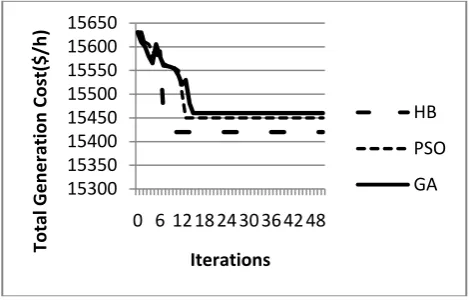
The convergence test is performed in order to find out the effectiveness of the quickness of the Honey bees Algorithm in terms of the number of main PSO iterations .The Proposed honey bee algorithm is applied in a 6-generator system and the obtained convergence characteristics are given in Fig1 . The output of generation cost is given in Table1 . From the output, it is evident that Honey bee Algorithm is for more superior when compared with PSO and GA algorithms. The worse experience component provides the extra diversification which causes this superiority.
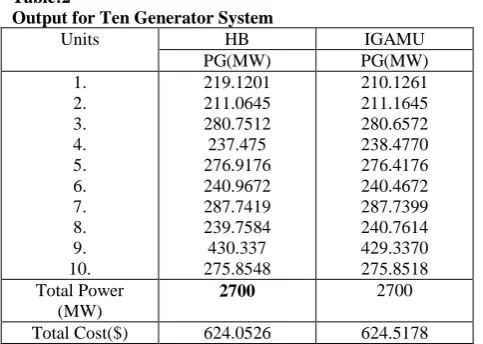
In IGAMU [15], multiple fuel option and valve point loading are combined to resolve the economic dispatch problems. IGAMU is faster and yields quality solutions compared to conventional genetic algorithm with multiplier upgrading[CGAMU][15].The characteristics of solution to the EDVLMF problem using HB and convergence characteristics
[image:3.595.316.551.113.263.2]are compared with that of IGAMU method illustrated in Fig2 and Table[2].
[image:3.595.48.259.221.386.2]Fig.2. Cost comparison between three algorithms for six generator system
[image:3.595.306.557.284.450.2]Fig.3. Cost comparison between HB and IGAMU for ten generator system.
Table: 1
Output for Six Generator System
15300 15350 15400 15450 15500 15550 15600 15650
0 6 12 18 24 30 36 42 48
To
tal
Ge
n
e
ration
Co
st($/
h
)
Iterations
HB
PSO
GA
Generator Power Output in
MW
Methods
HB PSO GA
P1 446.787 447.497 474.8066 P2 173.2531 173.3221 178.6363 P3 263.0745 263.4745 262.2089 P4 138.8594 139.0594 .2826 P5 165.2761 165.4761 151.9039 P6 87.124 87.128 74.1812 Total
Power(MW) Generation Cost($/h)
1274.374
15,423
1275.957
15,450
1276.0195
15, 459
Generator Power Output in
MW
Methods
HB PSO GA
P1 446.787 447.497 474.8066 P2 173.2531 173.3221 178.6363 P3 263.0745 263.4745 262.2089 P4 138.8594 139.0594 .2826 P5 165.2761 165.4761 151.9039 P6 87.124 87.128 74.1812 Total
Power(MW) Generation Cost($/h)
1274.374
15,423
1275.957
15,450
1276.0195
15, 459
0 200 400 600 800 1000
0 29 58 87
116 145 174
To
tal
Ge
n
e
ration
Cost($/h
)
Iterations
HB
Table:2
Output for Ten Generator System
Units HB IGAMU
PG(MW) PG(MW)
1. 2. 3. 4. 5. 6. 7. 8. 9. 10.
219.1201 211.0645 280.7512 237.475 276.9176 240.9672 287.7419 239.7584 430.337 275.8548
210.1261 211.1645 280.6572 238.4770 276.4176 240.4672 287.7399 240.7614 429.3370 275.8518 Total Power
(MW)
2700 2700
Total Cost($) 624.0526 624.5178
Table:3
Cost Comparison after 50 trials
Total Generation
Cost($/h)
Methods
GA PSO HB
Minimum Maximum Average
15459 15524 15469
15450 15492 15454
15423 15426 15421
Table:4
Results of best fuel cost for the HB and 3 approaches
Unit HB [16] [17] [18]
1. 0.0965 0.1281 0.1086 0.1168 2. 0.2412 0.2702 0.3056 0.3165 3. 0.2360 0.5552 0.5818 0.5441 4. 0.9653 1.0053 0.9846 0.9447 5. 0.4925 0.4544 0.5288 0.5498 6. 0.3465 0.4453 0.3584 0.3964
Best Cost 598.13 606.66 607.807 608.245
[image:4.595.49.299.584.735.2]Emission 0.2203 0.2207 0.22015 0.21664
Table 5:
Results of best emission for HB and 3 approaches
Unit HB [16] [17] [18]
1. 0.3842 0.3713 0.4043 0.4113
2. 0.4350 0.4665 0.4525 0.4591
3. 0.5167 0.5642 0.5525 0.5117
4. 0.2975 0.3650 0.4079 0.3724
5. 0.5395 0.5223 0.5468 0.5810
6. 0.5462 0.5783 0.5005 0.5304
Cost 641.36 648.01 642.603 647.251
Best Emission
0.1936 0.1945 0.1942 0.1943
Table:6
Combined Economic and Emission dispatch using HB
Unit HB [16] [17] [18]
1. 0.2165 0.1761 0.2594 0.2699 2. 0.3178 0.2818 0.3848 0.3885 3. 0.5671 0.5407 0.5645 0.5645 4. 0.6839 0.7696 0.7030 0.6570 5. 0.6014 0.6501 0.5431 0.5441 6. 0.3953 0.4456 0.4091 0.4398
Cost 609.563 612.35 616.06 618.68
Emission 0.1943 0.2074 0.2011 0.1994
4.3. Comparisons of the solutions
By comparing the best power output of the six generator system using HB algorithm,GA and PSO
it is seen that in HB algorithm the generation cost is minimum. Thus the HB algorithm has multiple advantages of best generation schedule with minimum network loss, keeping generation costs viable.
4.4. Robustness Test
Multiple iterations with different initializations are required for determining the performance of heuristic algorithms. For these algorithms to be robust, they should give constant results in all iterations.
The results of 50 iterations with the six bus system are compared and shown in Table3 which clearly highlights the superiority of the Honey Bee Algorithm over GA[15]and PSO[15] . The maximum and average values obtained by Honey Bee Algorithm have only marginal variations from the minimum value. This reiterates the fact that HB is more sturdy and vigorous.
5. CONCLUSIONS
This paper has presented a new optimisation algorithm to solve the ED problem. The performance of the proposed algorithm is demonstrated for 6 bus and10 unit test system. The algorithm generally outperformed other techniques that were compared with the accuracy of the results obtained. The Bees algorithm found many trade off solutions. The Bees Algorithm is a computationally fast multi objective optimiser tool for complex engineering optimisation problems without any special domain information, apart from that needed to compute objective functions.
6. REFERENCES
[1] Ash faq Husain,” Electrical Power Systems,” CBS Publishers & Distributors, New Delhi.
[2] M.Basu,” A Simulated Annealing-based goal-attainment method for economic emission load dispatch of fixed head hydrothermal power systems,” Electrical power and
Energy Systems, 27, 2005, pp.147-153
.
[3] A.A.El-Keib, H.Ma, J.L.Hart.1994.Economic Dispatch in view of the Clean Air Act of 1990. IEEE Trans.Power Systems 9(2):972-978.
[5] D.C.Walters and G.B.Sheble,”Genetic Algorithm solution economic dispatch with valve point loading,”IEEE Trans.Power Syst., Vol.8,no.3,pp.1325-1332,Aug.1993.
[6] K.P.Wong and Y.W.Wong,”Genetic and genetic/Simulated annealing approaches to economic dispatch,”Proc.Inst.Elect.Eng.,Gen.,Transm.,Disrib., Vol.141,no.5,pp.507-513,Sep.1994.
[7] C.S.Chang,K.P.Wong,and B.Fan, Security-Constrained Multi-Objective generation dispatch using bicriterion global optimization, in Proc.IEE Gen Transm.Dist., Vol.142,no.4,pp.406-414,July 1995.
[8] R.Yokoyama, S.H.Bae, T.Morita and H.Sasaki, “Multi objective optimal generation dispatch based on probabily Security criteria,”IEEE Trans.Power Systems, Vol.3, no.1, pp. 317-324,Feb 1988.
[9] J.Nanda, D.P.Kothari,K.S.Lingamurthy,”Economic Emission load dispatch through goal programming technigue, IEEE Trans, Energy Conversion, Vol.3,no.1,pp.26-32, March 1988.
[10]Seeley, T.D. The Wisdom of the Hive: The Social Physiology of Honey Bee Colonies, 1996(Harvard University Press, Cambridge)
[11]Bonabeau E,Dorigo M, and Theraulaz G.Swarm Intelligence: from Natural to Artificial Systems. Oxford University Press, New Yark,1999.
[12] Camazine S, Deneubourg J, Franks N R, Sneyel ,Theraula G and Bonabeau E. Self Organisation in Biological Systems. Princeton: Princeton University Press, 2003.
[13] Z.L.Gaing,” Particle swarm optimization to solving the economic dispatch considering the generator constraints,” IEEE Trans.Power Syst., vol.18,no.3,pp.1187-1195,Aug.2003.
[14] N.Sinha,R.Chakrabarti, and
P.K.Chattopadhyay,”Evolutionary programming technicques for economic load dispatch.”IEEE Trans.Evol.Comput.,vol.7,no.1,pp.83-94,Feb.2003.
[15] K.Thanuskodi,”A New Particle Swarm Optimization Solution to Nonconvex Economic Dispatch Problems,” IEEE Trans.Power Syst., vol.22,no.1.Feb2007.
[16] Hemamalini, Sishaj P.Simon,” Emision constrained economic with valve point effect using Particle Swarm Optimisation,” TENCON 2008.IEEE REGON 10.Conference, 19-21 November 2008 page(s): 1-6.
[17] M.Abido,” Environmental/Economic Power dispatch using multi objective evolutionary algorithms,”IEEE Trans.Power Syst., Vol.18, no.4,pp.1529-1537, Nov 2003.