Performance Analysis of various Codecs using RSVP on
VoIP Quality of Service over Variable Bandwidth
B. K. Mishra
Principal, Thakur College of Engineering and TechnologyThakur Village, Kandivali (East)
Mumbai-400101
S. K. Singh
Research Scholar-MukeshPatel School of Technology Management and
Engineering
NMIMS University, Santacruz Mumbai-400056
Kalpana Patel
PG Student -Thakur College ofScience and Commerce, Thakur Village, Kandivali (East) Mumbai -400101
ABSTRACT
With the rapid growth of the Internet, customers are demanding multimedia applications such as telephony and video on demand, to be available on the internet. Voice over Internet Protocol (VoIP) is a rapidly emerging technology for voice communication that uses the ubiquity of IP-based networks. The greatest challenge is the provisioning of Quality of Service (QoS) over limited bandwidth. Multimedia applications need a lot more bandwidth and have different QoS requirements than the applications that were used in early years of the internet. The purpose of this paper is to check the performance of VoIP application under different Codec’s such as G.711, G.729 and G.723.1 over variable bandwidth. This paper proposes RSVP protocol for providing end to end QoS for real time applications over diverse networks. The performance is checked under RSVP and Non RSVP. Packet end to end delay and packet delay variation are evaluated through simulation. The result shows that under any bandwidth G.723.1 gives better result as compared to G.711 and G.729. Simulation is done using OPNET IT Guru Academic edition.
General Terms
Performance, Design, Verification.
Keywords
QoS-Quality of service, CODEC, RSVP- Reservation Protocol, VoIP - Voice over Internet Protocol
1.
INTRODUCTION
The keen interest in Voice over Internet Protocol (VoIP) and Internet Protocol (IP) Telephony and its' accelerated adoption rate has led many to the realization that the long-established Public Switched Telephone Network (PSTN) model will be replaced in the next 10 to 15 years. Voice over Internet Telephony (VoIP) is becoming the preferred choice of deployment all over the world. Telecommunication companies around the globe are embarking in VoIP. As more and more users are using the VoIP network, Quality of Services (QoS) will become a major area that need to be addressed at. This is to ensure the reliability, availability and quality of the calls is as good as the PSTN network. VoIP technology uses Internet Protocol (IP) network to transmit voice. Voice is packetised and sends over the IP network to the destination [1].
Generally PSTN are routed on circuit switched network whereas VoIP are routed via packet switched network. Currently, VoIP is one of the fastest growing technologies in the world. However, VoIP services are susceptible to IP network burstiness causing packets drop and momentary gap in the call. Because of the bursty nature of digital communications traffic, even the most over provisioned network will have interruption [16]. The quality of the VoIP calls is also very much dependent on factors such as latency and jitter. Latency occurs when data are delivered too slowly, usually due to congestion and jitter is a variation of packet delays. Latency and jitter can cause packet drop.
Resource Reservation Protocol (RSVP) is a proposed IETF standard for requesting and negotiating resource allocations between end users and networks or among network components. RSVP is broadly accepted in different QOS mechanisms. The main objective of this paper is to study the effect of various voice codec schemes on the VoIP Quality of Service (QoS) using RSVP protocol over variable bandwidth. Popular voice codecs such as G.711, G.729a, G.723.1 and G.726 are studied and VoIP simulation models are built. The voice codec performance is determined with the best performance codec is identified through current research work.
2.
RELATED WORK
The term Voice over Internet Protocol, or VoIP, has been used as a catch-all phrase in the industry to refer collectively to a large group of technologies designed to provide Internet-based communications services [11]. More accurately, VoIP refers only to the underlying transport protocol that encapsulates voice traffic or voice media streams and allows them to be carried over data networks, using IP network technologies or internet protocols. VoIP, however, is not IP Telephony, nor is it the more widely used industry terminology as IP communications that refers to an even broader definition of communications applications.
request when receiving RESV. If the sender successfully receives the RESV message, meaning that the end-to-end resources have been reserved for the flow, the sender starts to transfer data. In DiffServ, the Expedited Forwarding (EF) service is suitable for Internet Telephony and videoconferencing [3] [20]. However, EF services are expensive. In order to meet requirements for Next generation Network, some proposal to support on mobility as MRSVP [19] has been discussed in past. RSVP Flow Transparency and Localized RSVP attempted to resolve mobility issues with RSVP. However, due to the complexity and difficulty in supporting large signaling messages, mobility, congestion control and security, these approaches which were directly derived from RSVP failed to achieve wide acceptance [2][15]. Few efforts has been taken in past to discuss performance analysis by using various codecs but as such does not achieve wide acceptance [18].
3.
DIFFERENT VOICE CODECS
Voice transmission is analogical, whereas the data network is digital. The process to sample analogical waves into digital information is made by an encoder-decoder (CODEC). There are many standards to sample an analogical voice signal into a digital one. The process is often quite complex. Most of the conversions use pulse code modulation (PCM) or variations.The bandwidth is used more efficiently with the application of voice compression codec. The compression of the waveform can save bandwidth.This is especially interesting in low speed connections so one can have more VoIP connections at the same time.Another way to save bandwidth is using the silence suppression.Voice codec is used to compress and decompress analogue voice signal into digital format for transmitting in the packet network. During call setup, voice terminal or gateways can automatically negotiate on which codec to be used from the codec selection list that these equipments support.
The popular voice codecs used in the telecommunication industry are G.711 which is widely used in the PSTN environment [5][6], G.729 which is using Conjugate-Structure code modulation (PCM) channel to and from a 40, 32, 24 or 16 Algebraic-Code-Excited Linear-Prediction (CS-ACELP) algorithm [7], G.726 which can be used to convert a 64 kbit/s A-law or μ-law pulse kbit/s channel [8], and G.723.1 which has two-bit rates associated with it, 5.3 and 6.3 kbit/s [9]. There are also some other codec like G.113 which reflects transmission impairments due to speech processing recognized by ITU [10].
4.
MAINTAINING QUALITY OF SERVICE
In multimedia based services QoS is essentially having two phases. Initial setup phase and real-time multimedia exchange phases. In the audio based application, end to end transmission delay should be small enough so that interference should not affect the normal conversation [12]. Resource Reservation Protocol (RSVP) do resource negotiation between end users and network components to make sure that enough transport resources are provided to deliver multimedia flows promptly. In the generic Internet based solutions, call signaling and resource negotiation are handled by separate protocols. A number of studies based on the integration of call signaling with resource negotiation and maintaining quality of service over next generation network can be found in the literature [15][16][22].
VoIP QoS is determined by many factors and the most important parameters are the voice codec used for the VoIP call, the one
way end-to-end delay of the voice packet and packet delay variations or jitter. Voice codecs using higher compression will degrade the QoS much more than the lower compression codecs. The higher compression codec will introduce additional delay due to longer processing time at the gateway or IP phones but gives higher bandwidth efficiency. ITU-T Recommendation G.114 recommends the following limits for one-way end-to-end transmission time [5].
• 0 to 150 ms: Acceptable for most user applications.
• 150 to 400 ms: Acceptable provided that Administrations are aware of the transmission time impact on the transmission quality of user applications.
• Above 400 ms: Unacceptable for general network planning purpose. However, it is recognized that in some exceptional cases this limit will be exceeded.
The main problems of a VoIP quality of service are latency, jitter, packet loss and echo. Therefore it is important to design the network running VoIP application not to exceed 150 ms one-way delay or the QoS will be severely affected. Jitter is the variation of delay the voice packet experience when transversing across the network. Now a day most of the VoIP networks deployed come with dynamic jitter buffer to minimize the jitter effect on the VoIP QoS. The jitter buffer is responsible to re-ordered out of sequence packets and to remove duplicate packets. Packets that arrive much later than the allocated jitter buffer period will be discarded. The choice of voice codec and the one-way delay the voice packet experienced will determine the quality of the VoIP calls. Jitter and silence suppression technique implemented will also effect the VoIP quality of service.
In order to provide a requested QoS, the nodes of a network must perform session initiation phase, reservation setup, admission control, policy control, packet scheduling, and packet classification functions.
In the current research work reservation setup protocol is used to pass the QoS request originating in an end-system to each router along the data path, or in the case of multicasting, to each router along the branches of the delivery tree. In particular, it enables QoS more effective and there is considerable amount of reduction in packet end to end delay and packet delay variation which is reflecting in results. RSVP can be also used for the reservation setup protocol for heterogeneous network and it has been extensively discussed in past [13] [14].
5.
NETWORK DESIGN AND
CONFIGURATION FOR RSVP
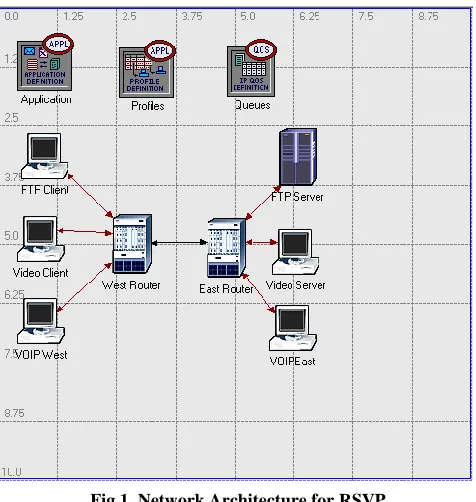
The following network design has been taken into consideration. At the first step single traffic is used for each of the functions such as Ftp, Video Conferencing and VoIP which is shown in Fig. 1. For 3G and 4G requirement the basic architecture can be modified with reference of Bandwidth. A reference bandwidth of 50 Mbps to 100 Mbps is considered for 3G network and tested multimedia content delivery over this network.
Fig 1. Network Architecture for RSVP
6.
SIMULATIONS RESULTS AND
ANALYSIS
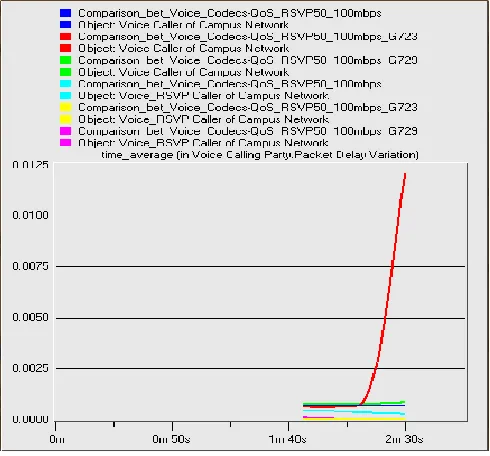
Simulation has been done using OPNET software for variable bandwidth condition. Here the evaluation has been done for 10Mbps, 100 Mbps and 1Gbps which are the expected bandwidth of 3G and 4G networks. Packet end to end delay and packet delay variation is measured.
It is tested for voice traffic under different CODECS like G.711, G.723.1, and G.729. Results have been compared with and without RSVP.
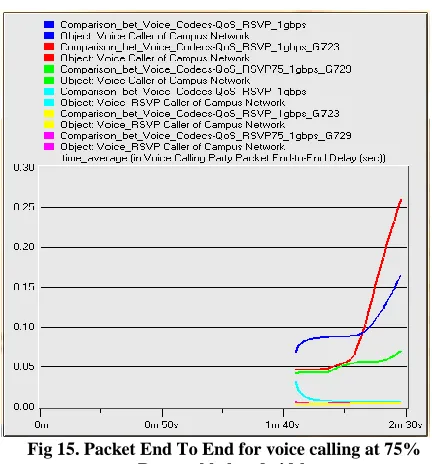
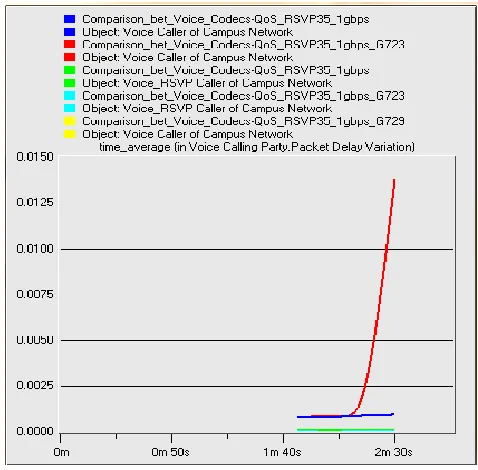
From Table 1 to Table 6, show the detailed analysis of packet end to end delay and Packet delay variation in seconds for voice traffic with different CODECS over variable bandwidth. Results have been taken with and without RSVP. Results shows, packet end to end delay is comparatively less in RSVP. It also shows the detail analysis of packet delay variation in seconds for voice traffic over variable bandwidth. Results show that packet delay variation is very less in RSVP. It also shows that, CODEC G.723.1 gives better performance as compared to other codecs when used with RSVP.A detailed comparative analysis has been done by considering variable bandwidth condition and packet delay variation and packet end to end delay is plot which is shown from fig 2 to Fig 19.
TABLE1. STATISTICS OF PACKET END TO END DELAY FOR VOIP
OVER VARIABLE BANDWIDTH WITH CODEC G.711
BANDWIDTH MAXIMUM
RESERVABLE
BANDWIDTH
PACKET END TO END DELAY
(SEC)
NON
RSVP
RSVP
10MBPS 35% 0.124042 0.0096688742
50% 0.12405 0.0079470199
75% 0.159138 0.0058609272
100MBPS 35% 0.0890863 0.0078145695
50% 0.089104 0.0068874172
75% 0.160737 0.0060927152
1GBPS 35% 0.139037 0.0090066225
50% 0.139055 0.0078145695
75% 0.166396 0.0062251656
TABLE2. STATISTICS OF PACKET DELAY VARIATION OVER VARIABLE BANDWIDTH WITH CODEC G.711
BANDWIDTH MAXIMUM
RESERVABLE
BANDWIDTH
PACKET DELAY VARIATION
(SEC)
NON RSVP RSVP
10MBPS 35% 0.00107407 0.000327814 50% 0.00107592 0.000288079 75% 0.00229768 0.000197019 100MBPS 35% 0.00070055 0.000327814
50% 0.00070190 0.000291390 75% 0.00238222 0.000251655 1GBPS 35% 0.00148132 0.000339404 50% 0.00148153 0.000301324 75% 0.00256809 0.000230132
TABLE3. STATISTICS OF PACKET END TO END DELAY FOR VOIP
OVER VARIABLE BANDWIDTH WITH CODEC G.723.1
BANDWIDTH MAXIMUM
RESERVABLE
BANDWIDTH
PACKET END TO END
DELAY (SEC) NON
RSVP
RSVP
10MBPS 35% 0.0449134 0.0052251656
50% 0.0449156 0.0046523179
75% 0.0454405 0.0038576159
100MBPS 35% 0.239434 0.0054238411
50% 0.239436 0.0050463576
75% 0.239438 0.0046688742
1GBPS 35% 0.260924 0.0031125828
50% 0.260924 0.0031125828
75% 0.260923 0.0041887417
TABLE4. STATISTICS OF PACKET DELAY VARIATION OVER VARIABLE BANDWIDTH WITH CODEC G.723.1
Bandwidth
Maximum
Reservable
Bandwidth
Packet Delay Variation (Sec) Non RSVP RSVP
[image:3.612.312.548.188.343.2] [image:3.612.57.291.623.708.2]100Mbps 35% 0.0121124 0.000020397 50% 0.0121122 0.000016953 75% 0.012112 0.000016821 1 Gbps 35% 0.0138284 0.000010198 50% 0.0138284 0.000010198 75% 0.0138285 0.000013509
TABLE5. STATISTICS OF PACKET END TO END DELAY FOR VOIP
OVER VARIABLE BANDWIDTH WITH CODEC G.729
BANDWIDT
H
MAXIMUM
RESERVABLE
BANDWIDTH
PACKET END TO END DELAY (SEC) NON
RSVP
RSVP
10MBPS 35% 0.0673306 0.009735099 50% 0.0673077 0.006966887 75% 0.0673524 0.006490066 100MBPS 35% 0.0567918 0.007284768 50% 0.056795 0.005655629 75% 0.0567771 0.005956953 1GBPS 35% 0.0705304 0.0093046358
50% 0.0705375 0.0067682119 75% 0.0705269 0.0065364238
TABLE6.STATISTICS OF PACKET DELAY VARIATION OVER VARIABLE BANDWIDTH WITH CODEC G.729
Bandwidth
Maximum
Reservable
Bandwidth
Packet Delay Variation (Sec)
Non RSVP RSVP
10 Mbps 35% 0.00082867 0.0000604305 50% 0.00082916 0.0000529801 75% 0.00083044 0.0000521523 100Mbps 35% 0.00085107 0.000026821
50% 0.00085105 0.000026821 75% 0.00085098 0.000035265 1 Gbps 35% 0.00094984 0.000068543 50% 0.000950252 0.000054139 75% 0.000950538 0.000052649
[image:4.612.47.273.72.169.2]Result Analysis for Bandwidth 10 Mbps
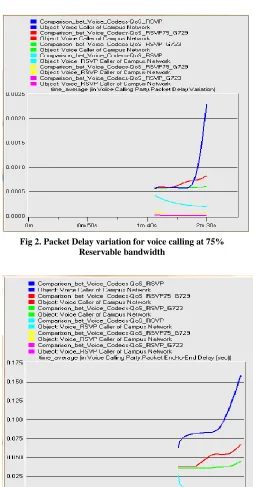
[image:4.612.316.567.82.331.2]Fig 2. Packet Delay variation for voice calling at 75% Reservable bandwidth
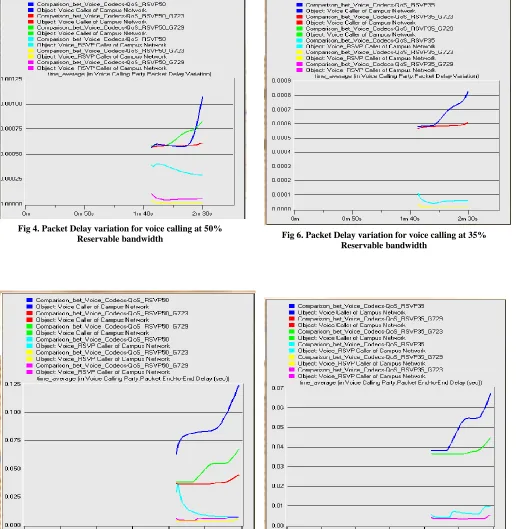
[image:4.612.316.569.90.577.2] [image:4.612.48.279.378.585.2]Fig 4. Packet Delay variation for voice calling at 50% Reservable bandwidth
[image:5.612.54.571.75.604.2]Fig 5. Packet End to End Delay for voice calling at 50% Reservable bandwidth
Fig 6. Packet Delay variation for voice calling at 35% Reservable bandwidth
[image:5.612.57.563.362.620.2]Result Analysis for Bandwidth 100 Mbps
Fig 8. Packet Delay variation for voice calling at 75% Reservable bandwidth
Fig 9. Packet End To End for voice calling at 75% Reservable bandwidth
[image:6.612.54.288.89.348.2]Fig 10. Packet Delay variation for voice calling at 50% Reservable bandwidth
[image:6.612.329.574.97.325.2]Fig 12. Packet Delay variation for voice calling at 35% Reservable bandwidth
Fig 13. Packet End To End for voice calling at 35% Reservable bandwidth
[image:7.612.336.551.72.318.2]Result Analysis for Bandwidth 1Gbps
Fig 14. Packet Delay variation for voice calling at 75% Reservable bandwidth
[image:7.612.67.294.356.587.2] [image:7.612.335.551.365.597.2][image:8.612.54.284.81.323.2]
Fig 16. Packet Delay variation for voice calling at 50% Reservable bandwidth
Fig 17. Packet End To End for voice calling at 50% Reservable bandwidth
[image:8.612.330.556.355.574.2]Fig 18. Packet Delay variation for voice calling at 35% Reservable bandwidth
Fig 19. Packet End To End for voice calling at 35% Reservable bandwidth
Fig 2 to Fig 7 shows packet delay variation and end to end delay for voice traffic for RSVP and non RSVP network for 10 Mbps. In both the cases end to end delay and packet delay variation is considerably low for RSVP network when CODEC G.723.1 is used.
[image:8.612.54.297.381.596.2]CODEC G.723.1. But for Non RSVP application, end to end delay and delay variation is less when G.729 is used.
Fig 14 to Fig 19 shows packet end to end delay for voice calling for RSVP and non RSVP network for 1Gbps. Here also for RSVP, packet end to end delay and packet delay variation is considerably less with CODEC G.723.1. For Non RSVP application, end to end delay and delay variation is less with CODEC G.729.
7.
CONCLUSION
Packet end to end delay and packet delay variations are the two major parameter that helps to determine the quality of voice. If both are less, then the quality of service is good. One of the unexpected results of the RSVP research effort has been the realization that Packet end to end delay and Packet delay variation are lesser for RSVP enabled client as compared to Non RSVP Client. Here the network architecture has been tested on variable bandwidth condition for voice based application. Results have been evaluated for both non RSVP and RSVP network. It has been observed that, for a given bottleneck link capacity, as the requirement of voice application increases, Packet end to end delay and Packet delay variation for RSVP enabled client decreases as more bandwidth is allocated to RSVP client. On other side, Packet end to end delay and Packet delay variation for Non RSVP client increases as less bandwidth is available to transfer their packets. RSVP’s receiver-initiated reservations accommodate heterogeneous QoS requests from different receivers. It has been observed that G.711 codec has the highest Packet end to end delay and Packet delay variation, on the other hand, G.723.1 has the lowest Packet end to end delay and Packet delay variation .It shows fair results from 10Mbps to 1Gbps which reflects that it can be used in 3G as well as 4G networks. Hence by using RSVP Protocol in combination with G.723.1 codec gives better performance comparing with other Codec and general objective can be achieved by using G.723.1 codec. Results are useful for QoS support for Next Generation Network.
8.
ACKNOWLEDGMENT
Our sincere thanks to Thakur Educational Trust and Management to provide all the facilities and infrastructure to carried out the research work.
9.
REFERENCES
[1] Costa, Nelson, Nunes, Má, rio Serafim, “Adaptive Quality of Service in Voice over IP Communications, “Fifth International Conference on Networking and Services, 2009. ICNS '09, Valencia, Spain, 20-25 April 2009, pp. 19-24. [2] C. Shen, W. Seah, et al., Mobility Extensions to RSVP in an
RSVP-Mobile IPv6 Framework, Internet draft (July 2002) [Online]
[3] Eunkyu lee,Sang Ick Byun, Myungchul kim “A Translator between Integrated services RSVP and differentiated services for End to End QOS”. IEEE March 2003 Page(s): 1394 - 1401 vol.2.
[4] G. Camarillo, W. Marshall, J. Rosenberg, Integration of resource management and SIP, IETF RFC 3312, October, 2002.
[5] ITU-T Recommendation G.114: One-way transmission time; 05/2000.
[6] ITU-T Recommendation G.711: Pulse code modulation (pcm) of voice frequencies; 11/1988.
[7] ITU-T Recommendation G.729: Coding of speech at 8 kbit/s using conjugate-structure algebraic-code-excited linear-prediction (CSACELP); 03/1996.
[8] ITU-T Recommendation G.726: 40, 32, 24, 16 kbit/s adaptive differential pulse code modulation (ADPCM); 12/1990.
[9] ITU-T Recommendation G.723.1 : Dual rate speech coder for multimedia communications transmitting at 5.3 and 6.3
kbit/s; 03/1996.
[10] ITU-T Recommendation G.113: Transmission impairments due to speech processing; 02/2001.
[11] Jonathan Davidson, Voice over IP Fundamental (2nd Edition), Cisco Press, 2006.
[12] J. Manner, K. Raatikainen, Localized QoS Management for Multimedia Applications in Wireless Access Networks, in: Proc. IASTED IMSA 2003 (January 2003).
[13] Mubashar Mushtaq and Toufiq ahmed “Multimedia Caching Integration for Efficient content Delivery over Heterogeneous Networks”. March 31 2008-April 4 2008 on page(s): 1011-1012.
[14] Nen chaung Wang and jyh-Woei Jiang “Extending RSVP for QOS support in Heterogeneous wireless networks”.ICCS 2006. 10th IEEE Singapore International Conference. Volume, Oct. 2006 Page(s):1 – 5.
[15] Neill Weilkinson “Next Generation Network Services Technologies and Strategies” john willey and sons ltd pp 167-170.
[16] Pascal Lorenz, “QOS in Next Generation Network. 26th International Conference Interfaces ITI 2004, June 7-10. [17] S.Cherry, “Seven Myths About Voice over IP”, IEE
Spectrum, March 2005.
[18] Shahrizal Sahabudin , Mohamad Yusoff Alias “End-to End Delay Performance Analysis of Various Codecs on VoIP Quality of Service” IEEE Proceedings 2009 Page(s):607-612
[19] Talukdar, B. Badrinath and A. Acharya, MRSVP: a Resource Reservation Protocol for an Integrated Services Network with Mobile Hosts, Wireless Networks 2001.
[20] Tomas Robles, Hector velyous, Arndt kadelka, “QOS for all IP System beyond 3g”, Communications Magazine, IEEE Volume 39, Issue 8, Aug 2001 Page(s):64 - 72
[21] Yorem Benet “The complementary role of RSVP and differentiated services in the full service QOS network.” Communication Magazine IEEE Feb 2000. Volume:38, On page(s): 154-162.