How to cite this paper: Maleki, M., Mohammadi, S. and Nazarian, A. (2014) The Difference of Mental Skills in Superior Basketball Players and Gymnasts with Different Levels of Experience. Open Access Library Journal, 1: e591.
http://dx.doi.org/10.4236/oalib.1100591
The Difference of Mental Skills in Superior
Basketball Players and Gymnasts with
Different Levels of Experience
Mohammad Maleki, Sardar Mohammadi, Ali Nazarian
University of Kurdistan, Sanandaj, IranEmail: [email protected]
Received 4June 2014; revised 12July 2014; accepted 14August 2014
Copyright © 2014 by authors and OALib.
This work is licensed under the Creative Commons Attribution International License (CC BY).
http://creativecommons.org/licenses/by/4.0/
Abstract
This study aimed to compare mental skills between superior basketball players and gymnasts. Subjects included 161 basketball players (91 experienced: aged 22.47 ± 2.27, and 70 enced, aged 23.13 ± 2.2) and 114 gymnasts (66 experienced; aged 22.77 ± 2.03 and 48 inexperi-enced, aged 22.79 ± 2.25). The questionnaire used for this study was OMSAT-3 that assessed men-tal skills in three main categories of foundation menmen-tal skills, psychosomatic skills and cognitive skills. Results showed significant differences between elite and sub-elite basketball players and gymnasts in basic mental skills, psychosomatic skills and cognitive skills. These results will help coaches and athletes to improve their performance and consolidate and expand the use of mental skills they need for each competition in closed and open sport skills.
Keywords
Mental Skills, Basketball, Gymnasts, Experience
Subject Areas: Psychology, Sports Science
1. Introduction
Although athletes’ physical fitness and the kind of techniques they use can affect their performance to a great extent, mental preparation can also affect a sport player’s performance tremendously [1]. Mental preparation and perceived mental skills [2] are essential requirements for continuous peak performance. To this end, researchers believe that the following factors affect athletes’ performance: commitment, quality of exercise, concentration, refocusing in competition, using mental imagery, goal setting, activation, competition planning, high self-confi- dence, controlling anxiety, and positive attitude [3].
OALibJ | DOI:10.4236/oalib.1100591 2 August 2014 | Volume 1 | e591
skill and performance level in various sport fields [4]. One of the most significant current discussions in sport psychology is that mental skills in team and individual sports are different for the athletes in each field [5]. De-pending on the different physical and technical characteristics, amount of reliance on their abilities and interac-tions with teammates, athletes experience unique factors affecting their exercise and competition. Some re-searchers believe that athletes in individual sports must have a rather higher level of mental preparation in com-parison with team-sport athletes, since they must rely on their own abilities during a sport context, rather than getting help from teammates [6]. Athletes in various sports receive different stimulations and responses, thus have their own different interpretation of mental skills. Therefore, mental skills used by athletes of open sports are not necessarily similar to skills that might be used by athletes of closed sports [7], because in such sports the athlete’s motor pattern is constant compared with environmental features, which enables them to perform more effectively in exercise and competition [4]. The most important mental factors to acquire in expertise are moti-vation and self-confidence, by which athletes manifest their expertise leading to focused performance, refocus-ing and positive anxiety control [8].
Mental skills are important components for success in major sport competitions [3]. The amount of use of mental skills can be considered as a main factor distinguishing an elite athlete from a sub-elite one. Taking into account the influence of competition environment on athletes’ performance and considering the fact that most environmental factors target athletes’ mental aspects, the importance of training and measuring the results can be considered one of the coaches’ main responsibilities. Sport psychologists have divided mental skills into three main categories [9]: The first category is founding mental skills, including goal setting, self-confidence and commitment. Therefore, it can be claimed that subsequent mental skills will not be influential until such mental skills are stabilized in the athlete [10] [11]. The second category is psychosomatic skills, which include anxiety reactions, fear control, relaxation, and activation. According to Landers and Boutcher (1998) such fea-tures deal with athletes’ physiological characteristics [12]. The third category is called cognitive skills, which includes imagery, mental practice, focusing, refocusing and competition planning [13].
Recent developments in team and individual sports have heightened the need for coaches’ and researchers’ knowledge about mental preparation programs for the athletes. Accordingly, Devonport (2006) investigating mental skills in elite kick-boxers found that imagery, positive self-talk, relaxation, focusing, control of emotions and goal setting skills influence success [14]. Some researchers [15] also found that athletes in closed skill sports like gymnastics could better focus and refocus after failure. Similarly, Kruger (2010), comparing mental skills between successful and unsuccessful golf players, concluded that the two groups were different in such skills as acquisition of motivation, anxiety reaction, fear control, self-confidence, and mental imagery [16]. So-toodeh, Talebi, Hemayattalab, and Arabameri (2012) examined the differences between elite and non-elite- taekwondo athletes and found that non-elite athletes need to improve such skills as competition planning, goal setting, activation, self-confidence, and commitment. They also found that elite athletes need to improve refo-cusing and anxiety reaction [17]. In another study, Nourbakhsh and Maleki (2005) found a significant difference between elite male athletes in individual and team sports on anxiety reaction and mental training skills [18]. Ghare, Keshtidar and Jahangiri (2009) investigated the difference of mental skills in open and closed sports in athletes and indicated that the two groups differ only in psychosomatic skills [19].
Literature review clearly reveals affective variables related to mental skills, such as experience [1] and clear-ing up ambiguity for athlete’s psychological features in various sports. Studies indicate that athletes’ level of experience is strongly related to their amount of use from mental skills. So far, however, there has been little discussion about relationship between individual and team sports, neither the effectiveness of the above factors is proved in case of other contexts where it is possible for such variables to play an important role. In addition, this relationship isn’t clear between individual and team sports with different exercise and competition climates. The purpose of this study, therefore, is to find out if there is any difference between elite and sub-elite basketball players and gymnasts in their basic mental skills, psychosomatic skills, and cognitive mental skills.
2. Methodology
OALibJ | DOI:10.4236/oalib.1100591 3 August 2014 | Volume 1 | e591
22.79 ± 2.25). The criterion used in this study to distinguish elite from sub-elite participants was three years of professional experience, that is, athletes who had taken part in the country’s sport championship for three or more than three years were considered as elite and those who took part in such sport championships for less than three years were considered as inexperienced.
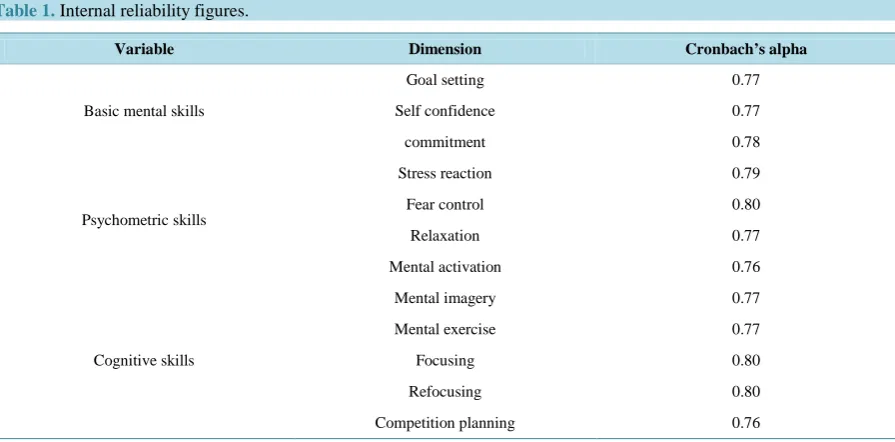
The questionnaire used for this study was OMSAT-3 that assessed mental skills in three main categories of basic mental skills (goal setting, self-confidence and commitment), psychosomatic skills (stress reaction, fear control, relaxation, and mental activation) and cognitive skills (focusing, refocusing, mental imagery, mental exercise, and competition planning). Internal reliability of the questionnaire was measured by alpha amount ranging from 0.68 to 0.88 and its validity ranging from 0.78 to 0.96 [20]. In another study, Sanati Monfared (2006), working with a number of Iranian athletes in Iran’s national championship committee, measured the va-lidity and reliability of the questionnaire as equivalent to r = 0.89, using test retest method [21]. As a result, analytical results for mental skills (p = 0.000, df = 63, AGFI = 0.956) were obtained. To obtain the question-naire’s internal reliability, Cronbach’s Alpha was used and the amount of reliability for anxiety scale turned out to be 0.88. Table 1 indicates the internal reliability of both variables in the questionnaire.
Taking into account the obtained figures for Alpha, it could be claimed that the obtained Alpha is within an acceptable range and measurement tools have acceptable internal reliability. In order to organize, summarize, and categorize the information in this study, the researchers used descriptive methodology and inferential statis-tics. In order to measure the reliability, MAANOVA was applied to examine the difference between obtained data using SPSS software version 20 and LISREL version 8.57.
3. Results
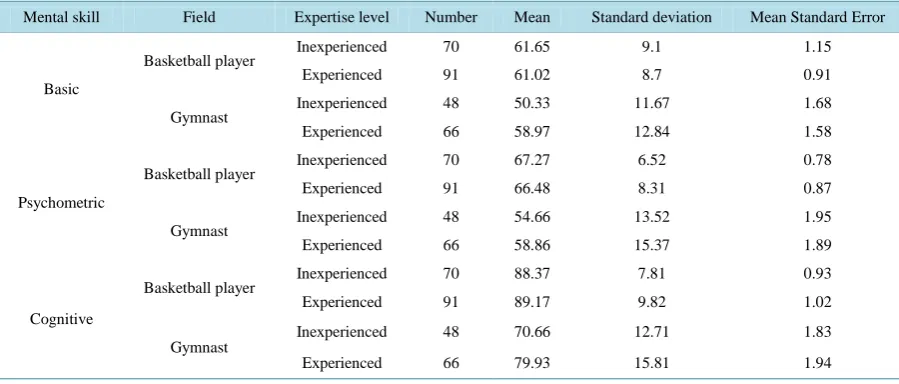
The results of this study indicate are descriptive and prescriptive. Table 1 indicates descriptive results of three mental categories in this study.
In this study, the researcher intends to find out if there is any difference between elite and sub-elite basketball players’ and gymnasts’ basic mental skills, psychosomatic skills, and cognitive skills. After making sure that the data have been equally distributed by Kolmogrov-Smirnov test (p > 0.05), and after testing co-variance matrix using Box test (p < 0.05), MANOVA test was applied to examine the hypothesis. According to the results of this study, there is a significant difference between elite and sub-elite basketball players and gymnasts in basic men-tal skills (F3271 = 13.3, p = 0.000), psychosomatic skills (p = 0.000, F3271 = 18.63) and cognitive skills (F3271 =
32.77, p = 0.000) (Table 2). This means that the more experience in exercise and competition, the more use mental skills.
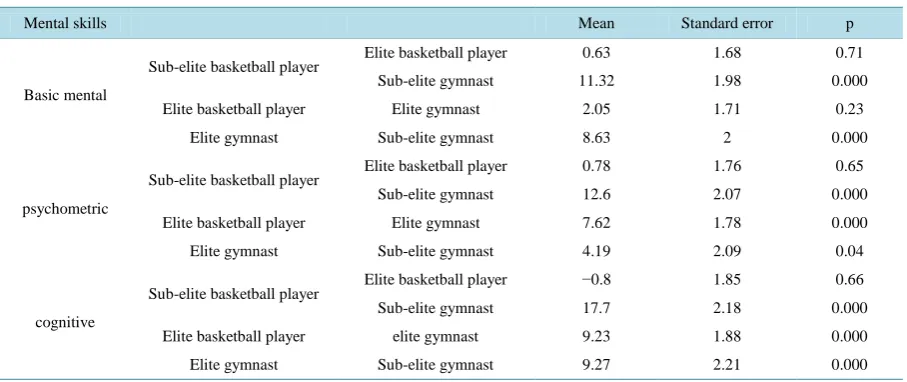
[image:3.595.90.538.499.720.2]Since there exists a meaningful difference between all groups’ mean according to the results of this study, LSD test was used to identify groups that had meaningful difference with each other (Table 3).
Table 1. Internal reliability figures.
Variable Dimension Cronbach’s alpha
Basic mental skills
Goal setting 0.77
Self confidence 0.77
commitment 0.78
Psychometric skills
Stress reaction 0.79
Fear control 0.80
Relaxation 0.77
Mental activation 0.76
Cognitive skills
Mental imagery 0.77
Mental exercise 0.77
Focusing 0.80
Refocusing 0.80
OALibJ | DOI:10.4236/oalib.1100591 4 August 2014 | Volume 1 | e591 Table 2. Descriptive results of mental skills.
Mental skill Field Expertise level Number Mean Standard deviation Mean Standard Error
Basic
Basketball player Inexperienced 70 61.65 9.1 1.15
Experienced 91 61.02 8.7 0.91
Gymnast Inexperienced 48 50.33 11.67 1.68
Experienced 66 58.97 12.84 1.58
Psychometric
Basketball player Inexperienced 70 67.27 6.52 0.78
Experienced 91 66.48 8.31 0.87
Gymnast Inexperienced 48 54.66 13.52 1.95
Experienced 66 58.86 15.37 1.89
Cognitive
Basketball player Inexperienced 70 88.37 7.81 0.93
Experienced 91 89.17 9.82 1.02
Gymnast
Inexperienced 48 70.66 12.71 1.83
Experienced 66 79.93 15.81 1.94
Table 3. Results of MANOVA test in three categories of basic mental, psychosomatic and cognitive skills.
Metal skills M ± SD F3271 p eta
Effect of group
Basic mental skills 57.99 ± 0.65 13.30 0.000 0.128
psychometric skills 61.82 ± 0.68 18.63 0.000 0.171
Cognitive skills 82.03 ± 0.72 32.77 0.000 0.266
According to the results of this study, there is a significant difference in basic mental skills among sub-elite gymnasts and basketball players (p = 0.000), and among elite and sub-elite gymnasts (p = 0.000). There is also significant difference in psychosomatic skills among sub-elite basketball players and gymnasts (p = 0.000), elite basketball players and gymnasts (p = 0.000), and elite and sub-elite gymnasts (p = 0.000). Finally, as it was found in the present study, there is significant difference in cognitive skills among sub-elite basketball players and gymnasts (p = 0.000), elite basketball players and gymnasts (p = 0.000), and elite and sub-elite gymnasts (p = 0.000). This means that experience of different conditions in group and individual sports influences on mental skills. It should be mentioned that no significant difference was found in any of the three categories investigated in this study between elite and sub-elite basketball players. (p = 0.71, p = 0.65, and p = 0.66 respectively) (Table 4).
4. Discussion
The purpose of the current study was to find out if there was any difference in basic mental, psychosomatic and cognitive skills among basketball players and gymnasts with varying levels of experience. The results indicated significant differences between elite and sub-elite basketball players and gymnasts in terms of mental skills.
It was found that there is significant difference among basic mental skills (goal setting, self-confidence, and commitment) between elite and sub-elite gymnasts (p < 0.05). Goal setting [10], self-confidence [8], and com-mitment [11] are some of the most important factors distinguishing athletes with high levels of performance from those with low-levels of performance. A possible explanation for this is that as the level of experience and expertise of the athlete increases, sport goals become more specialized and challenging, leading athletes toward further success [22]. Professional athletes have, through experience and expertise, realized that better perform-ance requires improvement of reconstructing basic mental techniques, such as goal setting and pre-competition fear control [23]. The findings of the current research are in line with a number of other research studies on ath-lete mental skills [16] [17] [20] [24] [25].
OALibJ | DOI:10.4236/oalib.1100591 5 August 2014 | Volume 1 | e591 Table 4. The result of comparison in four groups in terms of basic mental, psychosomatic, and cognitive skills.
Mental skills Mean Standard error p
Basic mental
Sub-elite basketball player Elite basketball player 0.63 1.68 0.71
Sub-elite gymnast 11.32 1.98 0.000
Elite basketball player Elite gymnast 2.05 1.71 0.23
Elite gymnast Sub-elite gymnast 8.63 2 0.000
psychometric
Sub-elite basketball player Elite basketball player 0.78 1.76 0.65
Sub-elite gymnast 12.6 2.07 0.000
Elite basketball player Elite gymnast 7.62 1.78 0.000
Elite gymnast Sub-elite gymnast 4.19 2.09 0.04
cognitive
Sub-elite basketball player Elite basketball player −0.8 1.85 0.66
Sub-elite gymnast 17.7 2.18 0.000
Elite basketball player elite gymnast 9.23 1.88 0.000
Elite gymnast Sub-elite gymnast 9.27 2.21 0.000
and conditions and demand for focus, both in individual and team sports athletes use different mental skills be-cause of different experiences related to these factors [5]. Researchers believe that since individual sports ath-letes can’t rely on their teammates, they are more likely to be threatened by anxiety reactions during the sport competition [4]. Since anxiety reaction is measured by physical response to the demands of the competition en-vironment, it is closely similar to physical anxiety. Anxiety theorists believe that athletes in individual and closed sports have enough time to process physical signals, thus have enough time to negatively react to physi-cal responses. In team and open sports, however, since athletes have more attention and interaction during the sport competition, there is less time for the athletes to think about anxiety signals [26]. This finding is in agree-ment with literature [18] [19]. Those studies indicated that there exists a significant difference between psycho-somatic skills in individual and team sports athletes and athletes in team sports can control anxiety better than individual athletes.
A significant difference was found between psychosomatic skills among elite and sub-elite gymnasts (p < 0.05). One of the psychosomatic skills serving as an important predictor index of competition anxiety is anxiety reaction [16] [17] [24]. Negative reaction to anxiety can destroy athlete performance. Weinberg and Gould (2007) believe that as the athlete’s experience and expertise expands, such factors as being selected for a team, financial concerns, existence of powerful opponents in competitions, media quality, the expectations of the fan for championship, previous sport injuries, and fear from failure affect athletes’ performance [1]. His result con-firms the researcher hypothesis and was consistent with literature [16] [17] [24], thus athlete’s experience and expertise level can influence the type and amount of mental skill usage.
There exists significant difference between elite basketball players and gymnasts in cognitive skills (p < 0.05). The kind of mental skill used in team sports is not necessarily similar to those used in individual sports [7]. Ac-cording to Orlick (1996), the most important factors contributing the success of elite athletes include exercise quality, mental exercise, planning for the competition, focusing and refocusing [11]. In open sport skills where performance environment is permanently changing, to facilitate their performance, athletes try to improve such skills as focusing and refocusing. In closed sport skills, however, where there exists stable condition, improving mental exercise skills are of greater importance than the other skills [19]. Yet, the findings of this study were different from the findings of Ghare et al. (2009). According to their findings, there is no significant difference between cognitive skills of the athletes in team and individual sports. In those study [19] athletes in open sports (basketball, volleyball and wrestling) and closed sports (swimming and track and field) acted differently. In this study, however, the data was collected only from basketball players (open sport) and gymnasts (closed sports). Although the main categorizing index of open and closed sports is stability and instability in the context, the quality and ways of using mental skills for improving performance in sport context has been different and could thus be considered as a reason to this inconsistency.
OALibJ | DOI:10.4236/oalib.1100591 6 August 2014 | Volume 1 | e591
differences in individual’s level of expertise in focusing and forming clean and controlled mental imagery, which is reflected in athletes successful performance at the time of competition. The above issue has been con-firmed in literature review. In Walpes’s (2003) study, for example, skilled gymnasts were able to focus better than unskilled gymnasts [27]. According to the researchers, successful gymnasts first master basic skills, then turn them to advanced skills; so require more focus. In this way they improve their skills to boost focusing [27]. Neil et al. (2003) investigated the intensity and direction of competition anxiety signals and mental skills use as a function of the level of expertise in rugby players [28]. They indicate that sub-elite athletes often use relaxa-tion techniques to reduce anxiety during the competirelaxa-tion, while elite athletes use a combinarelaxa-tion of skills in order to improve their performance by maintaining intensity levels. There exist close relationship between focus and mental imagery skills, since athletes create mental imagery when they are optimally concentrate and attend on their goals. Mental imagery helps athletes to keep their mental focus during sport competition and gain self- confidence for peak performance [29]. Vealy (1988) believes that elite athletes are able to master mental im-agery, take it under their control, and manipulate it in order to achieve pre-planned goals [30]. In individual sports, such as gymnastics, the athlete’s performance is manageable; thus, mental imagery can contribute as the main axis of skills during the performance.
Since less attention is paid to individual sports and because athletes in these fields need more concentration, mental exercise shall be used more in such fields [11]. Moreover, the reconstruction of cognitive skills, such as goal setting and mental imagery for reducing pre-competition anxiety is needed, in order to improve perform-ance [23]. The present study found a meaningful difference between elite and sub-elite gymnast and was thus consistent with the findings of literature [17] [25] [31].
It seems that better understanding and identifying mental skill is crucial in group and individual sports. This finding will help coaches and athletes to improve their performance and consolidate and expand the use of men-tal skills they need for each competition. However, more research on this topic needs to be undertaken before the association between sport experience level and mental skills is more clearly understood. Thus, further re-search should be done to investigate the quality and quantity of such mental skills and their degree of influence on improving athletes’ performance during exercise and competition, both in the case of elite and sub-elite men and women who are basketball players or gymnasts.
References
[1] Weinberg, R.S. and Gould, D. (2007) Foundations of Sport and Exercise Psychology. Human Kinetics Publishers, Champaign.
[2] Moritz, S.E., Feltz, D.L., Fahrbach, K.R. and Mack, D.E. (2000) The Relation of Self-Efficacy Measures to Sport Per-formance: A Meta Analytic Review. Research Quarterly for Exercise and Sports, 71, 280-294.
http://dx.doi.org/10.1080/02701367.2000.10608908
[3] Williams, J.M. (2001) Applied Sport Psychology: Personal Growth to Peak Performance. 4thEdition, Mayfield Pub-lishing Company, Mountain View.
[4] Cox, R.H. and Liu, Z. (1993) Psychological Skills: A Cross Cultural Investigation. International Journal of Sport Psy-chology, 24, 326-334.
[5] Taylor, J. (1996) Intensity Regulation and Athletic Performance. In: Van Raalte, J.L. and Brewer, B.W., Eds., Explor-ing Sport and Exercise Psychology, American Psychological Association, Washington, DC, 3-24.
[6] Cox, R.H., Liu, Z. and Qiu, Y. (1996) Psychological Skills of Elite Chinese Athletes. International Journal of Sport Psychology, 27, 123-132.
[7] Jones, G. and Hanton, S. (1996) Interpretation of Competitive Anxiety Symptoms and Goal Attainment Expectancies. Journal of Sport & Exercise Psychology, 18, 144-157.
[8] Williams, J.M. and Krane, V. (2001) Psychological Characteristics of Peak Performance. In: Williams, J.M., Ed., Ap-plied Sport Psychology: Personal Growth to Peak Performance, May Field Publishing Company, Mountain View, 137-144.
[9] Bush, N.D., Salmela, J.H. and Green-Demers, I. (2000) The Ottawa Mental Skills Assessment Tool (OMSAT-3). The Sport Psychologist, 15, 1-19.
[10] Bota, J.D. (1993) Development of the Ottawa Mental Skills Assessment Tool (OMSAT). Unpublished Master Thesis, University of Ottawa, Ottawa.
OALibJ | DOI:10.4236/oalib.1100591 7 August 2014 | Volume 1 | e591 [12] Landers, D.M. and Boutcher, S.H. (1998) Arousal-Performance Relationships. In: Williams, J.M., Ed., Applied Sport
Psychology: Personal Growth to Peak Performance, Mayfield, Mountainview, 197-218.
[13] Meyers, M.C., Bourgeois, A.E., LeUnes, A. and Murray, N.G. (1998) Mood and Psychological Skills of Elite and Sub- Elite Equestrian Athletes. Journal of Sport Behavior, 22, 399-409.
[14] Devonport, T.J. (2006) Perception of the Contribution of Psychology to Success in Elite Kickboxing. Journal of Sport Science and Medicine, 5, 99-107.
[15] Grandjean, D.B., Taylor, A.P. and Weiner, J. (2002) Confidence, Concentration and Competitive Performance of Elite Athletes: A Natural Experiment in Olympic Gymnastics. Journal of Sport and Exercise Psychology, 24, 320-327.
[16] Kruger, A. (2010) Sport Psychological Skills That Discriminate between Successful and Less Successful Female Uni-versity Field Hockey Players. African Journal for Physical, Health Education, Recreation and Dance, 16, 239-250.
http://dx.doi.org/10.4314/ajpherd.v16i2.55963
[17] Sotoodeh, M.S., Talebi, R., Hemayattalab, R. and Arabameri, E. (2012) Comparison of Selected Mental Skills between Elite and Non-Elite Male and Female Taekwondo Athletes. World Journal of Sport Sciences, 6, 32-38.
[18] Nourbakhsh, P. and Maleki, M. (2005) Comparison of Foundation, Psychosomatic and Cognitive Mental Skills be-tween Team and Individual Male Superior Athletes in Khuzestan and Relationship bebe-tween Those Skills with Self-Ef- ficacy. Harakat, 23, 125-141.
[19] Ghare, M.A., Keshtidar, M. and Jahangiri, M. (2009) Comparison of Mental Skills, Self-Confidence and Competition Anxiety Interpretation among Open and Closed Skills Athletes. Research in Sport Sciences, 25, 49-66.
[20] Durand-Bush, N., Salmela, J.H. and Green-Demers, I. (2001) The Ottawa Mental Skills Assessment Tool (OMSAT-3). The Sport Psychologist, 15, 1-19.
[21] Monfared, S. (2006) Validating OMSAT-3 Questionnaire and Confirming Effect of Mental Preparation Program on Mental Skills at Athletes Participating Asian Games, Doha-Qatar. Iran Olympic National Committee.
[22] Mallett, C.J. and Hanrahan, S.J. (2004) Elite Athletes: Why Does the “Fire” Burn So Brightly? Psychology of Sport and Exercise, 5, 183-200.http://dx.doi.org/10.1016/S1469-0292(02)00043-2
[23] Fletcher, D. and Hanton, S. (2001) The Relationship between Psychological Skill Usage and Competitive Anxiety Re- sponses. Psychology of Sport and Exercise, 2, 89-101.http://dx.doi.org/10.1016/S1469-0292(00)00014-5
[24] Craciun, M., Dobosi, S., Popioan, N. and Prodea, C. (2011) A Confirmatory Factor Analysis of the Ottawa Mental Skills Assessment Tool (OMSAT-3*)—Romanian Version. Human Movement, 12, 159-164.
http://dx.doi.org/10.2478/v10038-011-0014-x
[25] Stevenson, M. (1999) The Use of Mental Skills by Male and Female Athletes. UMI, Ann Arbor.
[26] Hardy, L. and Jones, G. (1990) Future Directions for Research into Anxiety in Sport. In: Jones, G. and Hardy, L., Eds., Anxiety and Performance in Sport, Wiley, Chichester, 281-290.
[27] Walpes, S. (2003) Psychological Characteristics of Elite and Non-Elite Level Gymnasts. Doctoral Thesis, Washington State University, Washington DC.
[28] Neil, R., Mellalieu, D.S. and Hanton, S. (2006) Psychological Skills Usage and the Competitive Anxiety Response as a Function of Skill Level in Rugby Union. Journal of Sport Science and Medicine, 5, 415-423.
[29] Martens, R. (1987) Coaches Guide to Sport Psychology. Human Kinetics, Champaign.
[30] Vealy, R.S. (1988) Future Directions in Psychological Skills Training. The Sport Psychologist, 2, 318-336.