http://dx.doi.org/10.4236/ijg.2015.67052
Pb Isotopes Study in Recent Sediments
from Paraty Bay (Rio de Janeiro, Brazil):
Antropogenic Versus Oceanic Signatures
M. C. Geraldes1, S. D. Pereira2, H. H. Villena2, F. W. e Herms21Faculty of Geology-UERJ, São Francisco Xavier, Maracanã, Rio de Janeiro, Brazil 2Faculty of Oceanografy-UERJ, Rua São Francisco Xavier, Maracanã, Rio de Janeiro, Brazil
Email: [email protected], [email protected], [email protected], [email protected]
Received 19 May 2015; accepted 11 July 2015; published 16 July 2015
Copyright © 2015 by authors and Scientific Research Publishing Inc.
This work is licensed under the Creative Commons Attribution International License (CC BY). http://creativecommons.org/licenses/by/4.0/
Abstract
We carried out Pb isotopes studies in sediments from Paraty Bay located in the SE area of the Rio de Janeiro State to discriminate the signature of metal contamination from domestic sewage, in-dustries, shipyards and geogenic sources. The studied samples have been chosen in two sectors of the Bay, including the Paraty area and Juatinga Bay. Sample preparation procedures included: 1) drying and granulometric separations (200 mesh); 2) weighting; 3) complete dissolution and 4) Pb isotope analysis obtained by MC-ICP-MS (ratios 208Pb/204Pb, 207Pb/204Pb, 206Pb/204Pb). Prelimi-nary results when plotted in the 207Pb/204Pb versus 208Pb/204Pb and 207Pb/206Pb versus 206Pb/204Pb diagrams showed three groups of signatures. The first group (samples PY-01, PY-03 PY-106 and PY-127) presented 207Pb/206Pb values in the range from 1.191 to 1.209. The isotope values may be interpreted as contribution of a pollutant sources of Pb not yet identified. The second group (PY-11, PY-13, PY-21, PY-22, PY-46, PY-51, PY-109 and PY-111) showed 207Pb/206Pb values in the range from 1.188 to 1.222. The last group (samples PY-123 and PY-135) presented higher 207Pb/ 206Pb values from 1.321 to 1.322 and probably represented oceanic signature. The Pb isotope data of the second group may be interpreted as the result of oceanic water and pollutant sources mix-ture from the continent. According to the literamix-ture the anomalous Pb signamix-ture is similar to anthropogenic source. The Pb isotope results here reported are coherent with the reported data from the continent area. We may conclude that significant isotopic differences in Pb signatures are consequence of anthropogenic Pb isotope signature. In this way, Pb isotope is an important tool to trace the changing sources of pollutant Pb (and other metals) in ocean environment.
Keywords
1. Introduction
Industrial emissions and lead addition in the gasoline are responsible for the great amount of lead in the envi-ronment. The variety of used lead ores in the industrial activities has introduced this metal that presents different abundances between its isotopes. This abundance of isotopes defines signatures allowing identifying industrial sources that use ores of different origins, allowing the use of the isotopic ratios as an efficient tracer of natural or polluting sources in the environment. Studies on the sources of contaminant metals, its dynamic of transport as well as its destination can provide one better understanding on the impact in the global biogeochemical cycle. In the south hemisphere the information regarding the isotopic signatures of the lead are scarce, having as pioneer-ing work developed by [1].
This study was focused in the Paraty Bay (Figure 1), limited in the northeast for the Serra do Mar, in the southeast for the Maciço de Cunha and to the south for the Maciço de Trindade. These mountains comprise high areas (up to 1.4 km) formed by Neproterozoic orogenies (Ribeira Belt rocks). The study area is located in most important geoeconomic area of Brazil, which encloses the cities of Rio de Janeiro, São Paulo, Belo Horizonte and Vitória, being considered a potentially catalytic area of development blunting as one of the industrial and tourist polar regions of the State of Rio de Janeiro.
The antropic activity of this region is responsible for launching of some potentially toxic substances in the tributaries that empty in the Bay, being distinguished the heavy metals. They have the circulation limited and are carried to the estuarine zones. Among the activities distinguished mainly the marinas, responsible for fuel spil-ling.
The regional geology of the area of the Paraty Bay includes units of the Pre-Cambrian basement, Cretaceous alkaline bodies and Quaternary plains. The rocks of the basement are represented by charnockite gneisses and intercalated granites of maphic rocks probably of Neoproterozoic age. Finally the Quaternary sediments include coastal plains enclosing fluvial sediments, tide canals and mangrove. Geomorphologic features of the region of the Paraty Bay suggest close relation with the directions of the structures observed in the Precambrian rocks, but also younger generated during events of rifting and opening of the Atlantic Ocean. The sediments present ar-rangement that indicates the alignment to brittle Mesozoic structures that must have guided the evolution of the relief in the region. The Quaternary sedimentary sequences present continuity in the direction of the continental platform of the Santos Basin, where other older sedimentary sequences occur (Paleogen and Cretaceous) in-cluded in the rift transitional phases and marine (transgressive and regressive) of the continental margin.
[image:2.595.141.456.486.712.2]The knowledge of the ecosystem of the region of the Paraty Bay, based on a detailed knowledge of the sea circulation, of the transport and deposition of sediments, is of great importance for the planning of a sustainable development of the resources of the region, as well as of mitigation of the observed impacted environment.
Metal Contamination and Pb Isotope Signature
In such a way, the validation of the characteristics of the contaminations in heavy metals and its possible sources present high relevance for the characterization of the exposition human being resulted of the process of indu-strialization and activities of tourism. The methodology had as focus the sediments and its isotopic signatures of lead.
The heavy metals can be highly toxic and the increase of its concentration in the atmosphere and hydrosphere can characterize a local pollution with high risk for the human and animal health [2]. In industrial and port areas, as it is the case in the Paraty Bay, innumerable are the anthropogenic sources that can liberate pollutants for the environment, being great the difficulty of distinguishing these sources as well as quantifying its partial contribu-tions.
Secular and geographic modifications in the isotopic compositions of Pb can supply evidences to the presence of anthropogenic Pb compared with data of concentration of this element [3] [4]. The advantage of the Pb iso-topic investigation relative to the quantitative studies is due the possibility of distinction of the signatures of anthropogenic and the natural Pb in a specific region [5]. This distinction, in turn, elapses of the maintenance of the original signature of the mineral deposit supplying of Pb that becomes a pollutant agent through the antropic action [6]. Research carried in the industrialized countries has shown that the characterization of each source can be made with precision, using the isotopic compositions of Pb of each of the probable sources of this element [7].
[image:3.595.90.539.395.721.2]The general objective of this work was the characterization of the sedimentary dynamics and the antropic contributions in the marine sediments (Figure 2) based on the application of environmental geochemistry and indication of the pollutants. Thus, this contribution intends the better characterization of the Pleistocene-Holo- cenic sedimentary deposits, to investigate the connection between the sedimentary evolution of the half-closed environment of Paraty Bay and its relation with environments and the evolution of the sedimentary system of continental shelf around State of Rio de Janeiro.
2. Procedures
The 15 samples had been collected using Van Veen during 3 days of work from March to September of 2008. After they had been carried to the Geologic Laboratory of Sample Preparation (LGPA-UERJ) for the procedures of grain sized separation (fractions lesser than 200 mesh). The chemical preparation consisted in weighing of 0.1 g of sediment, total dissolution in acid way (HNO3 + HF), and posterior reading in the spectrometer of mass
(ICP-MS) in ACTLABS Laboratory in Canada. The sample preparation was carried through in the following stages:
1) First the samples had been removed of the plastic bags and placed in aluminum containers to avoid conta-mination and, after that, placed in box of light until the total drying. In some samples having large amounts of clay after the drying was necessary to make the disaggregation of the material.
2) The following step was to sieving the samples in fractions of 2.0 mm (10 mesh), 1.41 mm (14 mesh), 0.50 mm (35 mesh), 0.35 mm (45 mesh), 0.17 mm (80 mesh), 0.12 mm (120 mesh), <0.12 mm.
3) After the total weighing of the material accumulated in each sieve a fraction of 2.0 grams of each fraction of the material had been separate for analysis. This preparation did not present serious problems of contamina-tion due to high concentracontamina-tion of Pb in the samples.
4) The 2.0 g fraction of each sample had been placed in becker with 8 ml of H2O2 for elimination of the organic
matter. After this they had been placed in the stove until the complete drying of the material.
5) After the drying the material was weighed again and carried to the mass spectrometer laboratory. Chemical attack for dissolution of the samples procedures had the objective to dissolve the sediment for the ionization of metals. For this, the HNO3 and HF acids, both in the concentration of 6N had been used.
6) Spectrometry of Mass Analysis. The isotopic analyses had been carried through in spectrometer of mass with induced plasma (HR-ICP-MS). This technique presents the advantage of eliminate the phase of concentra-tion of Pb by ionic exchange column and also for not using tracers. For such, standards for correcconcentra-tion of iso-topic fractionation are used.
7) The Pb isotope data used in geochronological studies have their values expressed in relation to the isotope
204
Pb, that is, 208Pb/204Pb, 207Pb/204Pb and 206Pb/204Pb ratios. However, in environmental studies, since the first works published in the end of the decade of 1960, the use of the ratios between three radiogenic isotopes was preferred (208Pb, 207Pb and 206Pb). This preference is justified because these isotopes occur in larger ab-undance than the 204Pb isotope, and consequently, their signals obtained in the mass spectrometer are steadier and present values closely between themselves. In this way the ratios between them present more accurate values, favoring the data interpretation. Another advantage of using the ratios 208Pb/207Pb or 206Pb/207Pb is to prevent the corrections of interferences of 204Pb, as mercury. In such a way diagrams as 208Pb/207Pb versus
206
Pb/207Pb had been created making possible the identification of the isotopic signatures of the varied anth-ropogenic and natural sources.
3. Results
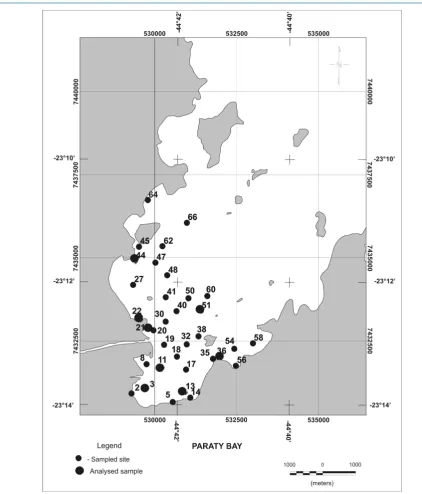
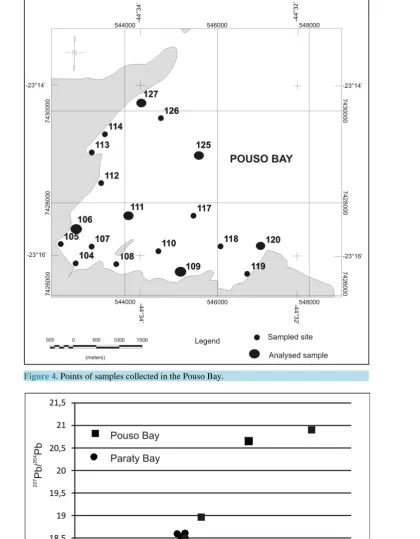
The sediments of the Paraty Bay had been investigated with the aim to characterize the isotopic signatures of Pb to identify the antropic and natural contributions of metals in the marine region. The area presents potentially polluting activities of the ocean as domestic sewer, industrial and port activities. The area presents two small bays represented for Paraty and Pouso where the deep sediments had been sampled (by Van Veen), being 9 places in the first area (PY-01, PY-03, PY-11, PY-13, PY-21, PY-22, PY-35, PY-46 and PY-51). Samples had been collected in Paraty Bay as shoed in Figure 3. In the Pouso Bay, 6 samples had been collected (PY-106, PY-109, PY-111, PY-123, PY-127 and PY-135), with localization presented in Figure 4. In Table 1 the values of the isotopic ratios of Pb are presented.
The results when plotted in the diagram 207Pb/204Pb versus 208Pb/204Pb (Figure 5) and the diagram 207Pb/206Pb versus 206Pb/204Pb (Figure 6) can tentatively be grouped in three sets. The first group (samples PY-01, PY-03 PY-106 and PY-127) had presented values of 207Pb/204Pb between 1.191 and 1.209. This group can be inter-preted as an anthropogenic source not yet identified and is comprised by samples next to the continent.
The second group (samples PY-11, PY-13, PY-21, PY-22, PY-46, PY-51, PY-109 and PY-111) showed values of 207Pb/204Pb between 1.188 and 1.222. The last group (samples PY-123 and PY-135) presented higher values of
207
Figure 3. Points of samples collected in the Paraty Bay.
mixture between groups one and three.
The values of isotopes of the lead indicate different signatures and can be interpreted as contamination for two different sources of pollution, being able to define possible end members. The end member A is represented by the samples next to the continent and the end member B is represented by the samples next to the ocean not contaminated. The remaining samples may be interpreted as intermediate values and as mixture between the two end members.
4. Discussion and Conclusions
Figure 4. Points of samples collected in the Pouso Bay.
Figure 5. Diagram 207Pb/204Pb versus 208Pb/204Pb for the samples of the Paraty Bay and the
Figure 6. Diagram 207Pb/206Pb versus 206Pb/204Pb for the samples of the Paraty Bay and the Pouso Bay.
Table 1. Analytical results of isotopes of Pb.
Sample 208Pb/204Pb 207Pb/204Pb 206Pb/204Pb 206Pb/207Pb
PY-01 37.04 15.33 18.32 1.195
PY-03 37.78 15.3 18.35 1.199
PY-11 38.34 15.39 18.16 1.180
PY-13 37.72 15.46 18.6 1.203
PY-21 37.97 15.49 18.19 1.174
PY-22 37.56 15.45 18.37 1.189
PY-35 37.58 15.48 18.61 1.202
PY-46 37.75 15.47 18.52 1.197
PY-51 37.59 15.48 18.51 1.196
PY-106 37.97 15.26 18.45 1.209
PY-109 38.26 15.45 18.35 1.188
PY-111 38.36 15.52 18.96 1.222
PY-123 41.27 15.64 20.66 1.321
PY-127 36.75 15.38 18.32 1.191
PY-135 41.52 15.8 20.9 1.323
two signatures, one closely to the continent and can be interpreted as of antropic origin, with values of 207Pb/
206
Pb between 1.188 and 1.222. The other signature, obtained in samples collected close to the open ocean, more distant of the continent, indicates values of 207Pb/206Pb between 1.322 and 1.323 and can be interpreted as an oceanic source according to the [8] [9].
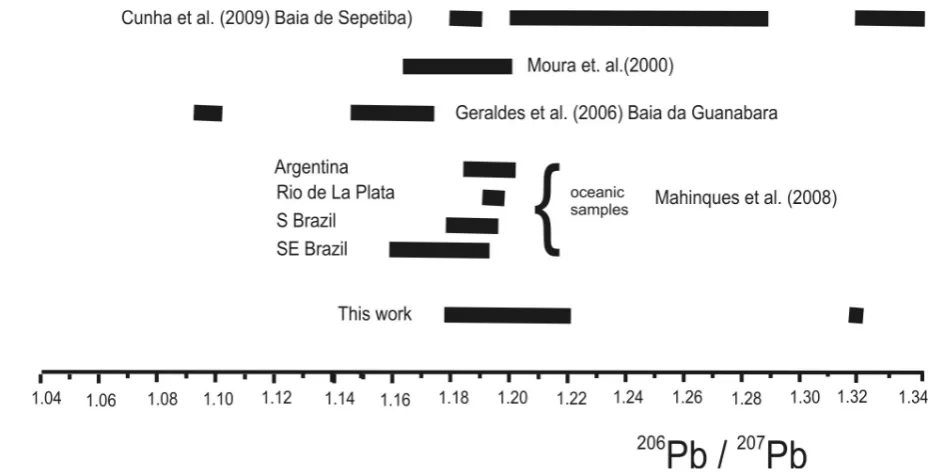
The comparison of these values with data of the literature of studies in coastal areas in Brazil is shown in Figure 7. In this way, the studies reported by [10] in the Sepetiba Bay (Rio de Janeiro), [11] in the Guanabara Bay (Rio de Janeiro), [12] in lagoons close to Belem (Pará) and Mahiques et al. (2008) with analysis of sediments in oceanic waters collected in the coast of Brazil and Argentina are compared in the diagram.
[image:7.595.91.538.327.589.2]Figure 7. Comparison of the values of Pb isotopes here reported with values with data of the literature of studies in coastal
areas in Brazil and Argentina.
authors have identified two end members: one is represented by the water of Guandu River and the second is represented by oceanic waters. Both are mixed by the currents inside the bay, in a movement with clock direc-tion. In this case, the collected sediments next the mouth of Guandu River (206Pb/207Pb between 1.188 and 1.191) are similar the isotopic signature of the gasoline and industrial pollution (206Pb/207Pb between 1.072 and 1.330) and similar to the end member A (close to the continent) here reported. On the other hand, the collected sedi-ments next the entrance area of the Sepetiba Bay, the oceanic water yielded values of 206Pb/207Pb between 1.341 and 1.336 and suggest a second source, very close to the Pb signature values here reported to the end member B. If this hypothesis is correct, the signature of lead isotopes of the ore used for the industrial area in the Paraty and Pouso Bay here reported are also responsible for the pollution for metals in the area inside of Sepetiba Bay.
For the Guanabara Bay the results of the isotopic analyses reported by Geraldes et al. (2006) show that the samples collected in Paquetá Island (PQ-01, PQ-02, PQ-03, PQ-04 and PQ-05), present for the ratio 206Pb/207Pb values between 1.174 and 1.152. For the samples collected in Surui River (SU-06, SU-07, SU-08, SU-09 and SU-10) the values presented for the ratio 206Pb/207Pb are between 1.065 and 1.092. For the samples of Guanabara Bay (BG-11 and BG-12) the values presented for the ratio 206Pb/207Pb are of 1.155 and the 1.166. For the sam-ples of Iriri River (IR-13, IR-14 and IR-15) the values presented for the ratio 206Pb/207Pb are between 1.164 and 1.156. These values can be interpreted as end members (represented for Surui and Iriri Rivers) and the values obtained in the sediments of the Guanabara Bay may represent mixture similar to the end member A here re-ported. Paqueta Island (within Guanabara Bay) indicates a distinct Pb signature probably due local pollutant.
The work of [12] reports isotopic data of Pb in lagoon sediments of Belem region (Pará) and includes results of Pb isotopes in core of 80 cm of length, characterizing the anthropogenic contributions result of domestic sewers. The 206Pb/207Pb values are similar to the end member A here reported.
According to [13], sediments from the Southern Brazil and Argentina exhibit a mixture of sediment materials from the La Plata River estuary with source areas represented by cratonic units (old crust) as suggested by the high radiogenic Pb isotopic values. Samples from Southern Brazil exhibit average values of 206Pb/207Pb from 1.178 to 1.196, followed by sediments from the La Plata River estuary (206Pb/207Pb from 1.1.190 to 1.196), Ar-gentina (206Pb/207Pb from 1.183 to 1.195). Samples from Southeastern Brazil show 206Pb/207Pb values from 1.158 to 1.193. As distinctive features we may observe the displacement of the Pb isotopes of the samples from S Bra-zil, between 27˚S and 25˚S, towards more radiogenic values at 25˚S. The 206
Pb/207Pb values reported by [13] are similar to the end member A here reported.
Figure 8. Comparison of the values of Pb isotopes here reported with values of reported studies in continental areas in Brazil.
dies can be cited [1] [14]-[16]. All the works present results of isotopic composition of Pb of sediments, whole rock, K-feldspar, soils, fuels and aerosols, corresponding to isotopic signatures of rocks and environments or current deposition of sediments.
The 206Pb/207Pb values reported by [14] in gasoline and aerosols are similar to the values here reported. In similar way, the 206Pb/207Pb values obtained by [16] in gasoline and industrial waste are in the same range of the
206
Pb/207Pb values here reported for the end member A. Only the 206Pb/207Pb values reported by [15] for Neoproterozoic Pb ore showed different range and indicated that the ore from Vale do Ribeira mining district was not the source of the lead identified in the Paraty area.
5. Concluding Remarks
The results here presented from Paraty Bay showed Pb isotopic signatures values from 1.118 to 1.209. The Pb isotopic analysis of the samples collected in the Pouso Bay defined two groups: the first with values from 1.188 to 1.222 and the second with values from 1.321 to 1.323. These results may be interpreted as two Pb isotope signatures comprised of continental sediments and antropic pollution and oceanic signature.
When compared with antropic sources, the results here reported are similar to the Pb isotope values of gaso-line (206Pb/207Pb values about 1.2) and industrial waste (206Pb/207Pb values from 1.16 to 1.35). The 206Pb/207Pb values from 1.151 to 1.091 here presented are similar to the anthropogenic signatures reported in other works in Brazil (Figure 7). For example, two studies using Pb isotope signatures of aerosols have been reported: the first study [1] reports aerosols Pb signatures from Brazil (9 samples), Argentina (3 samples) and Chile (9 samples) and shows 206Pb/207Pb values from 1.147 to 1.177. Studies on the Pb isotope composition of the São Paulo city atmosphere [14] collected daily during fourteen months (August, 1999-September, 2000) indicate 206Pb/207Pb values from 1.142 to 1.273. The values are related to contribution of Pb-containing gasoline additives and in-dustrial activities. Pb isotope studies in sediments are reported also in Brasilia (DF) and Belém (PA) where
206
Pb/207Pb values range 1.152 and 1.202 [16] and 1.162 and 1.203 [12] and characterize anthropogenic sources which are interpreted as sewage and industrial polluters.
con-sequence of anthropogenic Pb isotope variations [17] [18]. In this way, Pb isotope is an important tool to trace the changing sources of pollutant Pb (and other metals) in ocean environment through time.
Acknowledgements
This work was sponsored by FAPERJ Grant E-26/100.662/2009 to M.C.G. and CNPq Grant 552904/2007-4 to S.D.P.
References
[1] Bollhöfer, A. and Rosman, K.J.R. (2000) Isotopic Source Signatures for Atmospheric Lead: The Southern Hemisphere.
Geochimica et Cosmochimita Acta, 64, 3251-3262. http://dx.doi.org/10.1016/S0016-7037(00)00436-1
[2] Marcantonio, F., Zimmerman, A., Xu, Y.F. and Canuel, E. (2002) A Pb Isotope Record of Mid-Atlantic US
Atmos-phere Pb Emissions in Chesapeake Bay Sediments. Marine Chemistry, 77, 123-132.
http://dx.doi.org/10.1016/S0304-4203(01)00081-0
[3] Hong, S., Candelone, J.P. and Boutrons, C.F. (1994) Greenland Ice Evidence of Hemisphere Scale Pollution for Lead
Two Millennia Ago by Greek and Roman Civilizations. Science, 265, 1841-1843.
http://dx.doi.org/10.1126/science.265.5180.1841
[4] Luck, J.M. and Othman, D.B. (2002) Trace Elements and Pb Isotope Variability during Rainy Events in the NW
Me-diterranean: Constraints on Anthropogenic and Natural Sources. Chemical Geology, 182, 443-460.
http://dx.doi.org/10.1016/S0009-2541(01)00324-2
[5] Paula, A.H. and Geraldes, M.C. (2005) Holocene Pb Isotope Chronological Standard Curve: The Record of the
Anth-ropogenic Activity in the Last 6,000 Years. Terrae, 2, 55-60
[6] Niagru, J.O. (1989) A Global Assessment of Natural Sources of Atmospheric Trace Metal. Nature, 338, 47-49.
http://dx.doi.org/10.1038/338047a0
[7] Verón, A., Flament, P., Bertho, M.L., Alleman, L., Flegal, R. and Hamelin, B. (1999) Isotopic Evidence of Pollutant
Lead Sources in Northwestern France. Atmospheric Environment, 33, 3377-3388.
http://dx.doi.org/10.1016/S1352-2310(98)00376-8
[8] Stevenson, M.R., Dias-Brito, D., Stech, J.L. and Kampel, M. (1998) How Do Cold Water Biota Arrive in a Tropical
Bay near Rio de Janeiro, Brazil? Continental Shelf Research, 18, 1595-1612.
http://dx.doi.org/10.1016/S0278-4343(98)00029-6
[9] Miranda, L.B., Ikeda, Y., Castro-Filho, B.M. and Pereira-Filho, N. (1977) Note on the Occurrence of Saline Fronts in the Ilha Grande (RJ) Region. Boletim do Instituto Oceanográfico, 26, 249-256.
http://dx.doi.org/10.1590/S0373-55241977000200003
[10] Cunha, B.C.A., Rocha, D., Geraldes, M.C., Pereira, S.D. and Almeida, A.C. (2009) Pb Isotopic Signatures in Sedi-ments of a Sub-Tropical Coastal Lagoon: Anthropogenic Sources for Metal Contamination in the Sepetiba Bay (SE- Brazil). Journal of Coastal Research, 56, 797-801.
[11] Geraldes, M.C., Paula, A.H., Godoy, J.M. and Valeriano, C.M. (2006) Pb Isotope Signatures of Sediments from
Gua-nabara Bay, SE Brazil: Evidence for Multiple Anthropogenic Sources. Journal of Geochemical Exploration, 88, 384- 387. http://dx.doi.org/10.1016/j.gexplo.2005.08.081
[12] Moura, C.A.V., Gaudette, H.E., Carvalho, M.C. and Morales, G.P. (2004) The Use of Lead Isotope Composition as a
Tool to Investigate the Anthropogenic Impacts on the Environment in the Metropolitan Region of Belém (PA). Terrae,
1, 16-25.
[13] Mahiques, M.M., Tassinari, C.C.G., Marcolinic, S., Violantec, R.A., Figueira, R.C.L., Silveira, I.C.A., Buronea, L. and de Mello e Sousa, S.H. (2008) Nd and Pb Isotope Signatures on the Southeastern South American Upper Margin: Im-plications for Sediment Transport and Source Rocks. Marine Geology, 250, 51-63.
http://dx.doi.org/10.1016/j.margeo.2007.11.007
[14] Aily, C. (2002) Caracterização isotópica de Pb na atmosfera: Um exemplo da cidade de São Paulo. Dissertação de
me-strado, Instituto de Geociências, USP, São Paulo, 76 p.
[15] Moraes, R.P., Figueiredo, B.R. and Lafon, J.M. (2004) Pb-Isotopic Tracing of Metal-Pollution Sources in the Ribeira Valley, Southeastern Brazil. Terrae, 1, A19-A26.
[16] Gioia, S.M.C.L., Pimentel, M.M., Guimarães, E.M., Campos, J.E.L., Dantas, E.L. and Maruoka, M.T.S. (2003)
At-mospheric Deposition and Sources of Anthropogenic Lead in Sediments from an Artificial Lake in Brasilia, Central
Brazil. Proceedings of theIV South American Symposium on Isotope Geology, Salvador-Bahia, 24-27 August 2003,
[17] Helland, A., Göran, A. and Skei, J. (2002) Source Dependent Behavior of Lead and Organic Matter in the Glomma Estuary, SE Norway: Evidence from Isotope Ratios. Marine Chemistry, 78, 149-169.
http://dx.doi.org/10.1016/S0304-4203(02)00016-6
[18] Komárek, M., Ettler, V., Chrastný, V. and Mihaljevič, M. (2008) Lead Isotopes in Environmental Sciences: A Review.