Volume 2009, Article ID 503203,10pages doi:10.1155/2009/503203
Research Article
Some Limit Properties of Random Transition
Probability for Second-Order Nonhomogeneous
Markov Chains Indexed by a Tree
Zhiyan Shi and Weiguo Yang
Faculty of Science, Jiangsu University, Zhenjiang 212013, China
Correspondence should be addressed to Zhiyan Shi,[email protected]
Received 1 September 2009; Accepted 24 November 2009
Recommended by Andrei Volodin
We study some limit properties of the harmonic mean of random transition probability for a second-order nonhomogeneous Markov chain and a nonhomogeneous Markov chain indexed by a tree. As corollary, we obtain the property of the harmonic mean of random transition probability for a nonhomogeneous Markov chain.
Copyrightq2009 Z. Shi and W. Yang. This is an open access article distributed under the Creative Commons Attribution License, which permits unrestricted use, distribution, and reproduction in any medium, provided the original work is properly cited.
1. Introduction
A tree is a graph G {T, E} which is connected and contains no circuits. Given any two verticesσ, tσ /t∈T, letσtbe the unique path connectingσandt. Define the graph distance
dσ, tto be the number of edges contained in the pathσt.
LetTobe an arbitrary infinite tree that is partially finitei.e., it has infinite vertices, and
each vertex connects with finite verticesand has a rooto. Meanwhile, we consider another kind of double root tree T; that is, it is formed with the root o of To connecting with an
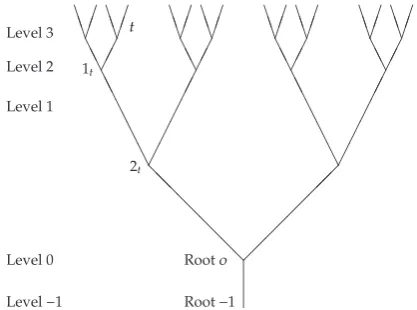
arbitrary point denoted by the root−1. For a better explanation of the double root tree T, we take Cayley treeTC,N for example. It is a special case of the treeTo, the rootoof Cayley
tree hasNneighbors, and all the other vertices of it haveN1 neighbors each. The double root treeTC,N seeFigure 1is formed with rootoof treeTC,N connecting with another root
−1.
Letσ,tbe vertices of the double root treeT. Writet≤σσ, t / −1iftis on the unique path connectingotoσ, and|σ|for the number of edges on this path. For any two verticesσ,
tσ, t / −1of the treeT, denote byσ∧tthe vertex farthest fromosatisfyingσ∧t ≤σand
Level 3 Level 2 Level 1
Level 0 Level−1
t
1t
2t
Rooto
[image:2.600.195.404.97.252.2]Root−1
Figure 1:Double root treeTC, 2.
The set of all vertices with distance nfrom rooto is called thenth generation ofT, which is denoted byLn. We say thatLnis the set of all vertices on levelnand especially root
−1 is on the−1st level on treeT. We denote byTn the subtree of the treeT containing the vertices from level−1 the root−1to levelnand denote byTon the subtree of the treeTo
containing the vertices from level 0the roototo leveln. Lett/o,−1be a vertex of the tree
T. We denote the first predecessor oftby 1t, the second predecessor oftby 2t, and denote by
ntthenth predecessor oft. LetXA {Xt, t∈A}, and letxAbe a realization ofXAand denote
by|A|the number of vertices ofA.
Definition 1.1. LetG{1,2, . . . , N}andPz|y, xbe nonnegative functions onG3. Let
P Pz|y, x, Pz|y, x≥0, x, y, z∈G. 1.1
If
z∈G
Pz|y, x1, 1.2
thenPis called a second-order transition matrix.
Definition 1.2. LetT be double root tree and letG {1,2, . . . , N}be a finite state space, and let{Xt, t∈T}be a collection ofG-valued random variables defined on the probability space
Ω,F, P. Let
P px, y, x, y∈G 1.3
be a distribution onG2, and
Pt
Pt
be a collection of second-order transition matrices. For any vertex tt /o,−1, if
PXtz|X1ty, X2t x, Xσ forσ∧t≤1t
PXtz|X1ty, X2tx
Pt
z|y, x ∀x, y, z∈G, PX−1x, Xoy
px, y, x, y∈G,
1.5
then{Xt, t∈T}is called aG-value second-order nonhomogeneous Markov chain indexed by
a treeT with the initial distribution1.3and second-order transition matrices1.4, or called aT-indexed second-order nonhomogeneous Markov chain.
Remark 1.3. Benjamini and Peres 1 have given the definition of the tree-indexed homogeneous Markov chains. Here we improve their definition and give the definition of the tree-indexed second-order nonhomogeneous Markov chains in a similar way. We also give the following definitionDefinition 2.3of tree-indexed nonhomogeneous Markov chains.
There have been some works on limit theorems for tree-indexed stochastic processes. Benjamini and Peres1have given the notion of the tree-indexed Markov chains and studied the recurrence and ray-recurrence for them. Berger and Ye 2 have studied the existence of entropy rate for some stationary random fields on a homogeneous tree. Ye and Berger see 3, 4, by using Pemantle’s result 5 and a combinatorial approach, have studied the Shannon-McMillan theorem with convergence in probability for a PPG-invariant and ergodic random field on a homogeneous tree. Yang and Liu6have studied a strong law of large numbers for the frequency of occurrence of states for Markov chains field on a homogeneous treea particular case of tree-indexed Markov chains field and PPG-invariant random fields. Yang see7 has studied the strong law of large numbers for frequency of occurrence of state and Shannon-McMillan theorem for homogeneous Markov chains indexed by a homogeneous tree. Recently, Yangsee8has studied the strong law of large numbers and Shannon-McMillan theorem for nonhomogeneous Markov chains indexed by a homogeneous tree. Huang and Yang see9 have also studied the strong law of large numbers for Markov chains indexed by an infinite tree with uniformly bounded degree.
LetPtxt | x1t, x2t PtXt xt | X1t x1t, X2t x2t. ThenPtXt |X1t, X2tis called the random transition probability of a T-indexed second-order nonhomogeneous Markov chain. Liu 10has studied a strong limit theorem for the harmonic mean of the random transition probability of finite nonhomogeneous Markov chains. In this paper, we study some limit properties of the harmonic mean of random transition probability for a second-order nonhomogeneous Markov chain and a nonhomogeneous Markov chain indexed by a tree. As corollary, we obtain the results of10,11.
2. Main Results
Lemma 2.1. Let{Xt, t∈T}be aT-indexed second-order nonhomogeneous Markov chain with state
spaceGdefined as inDefinition 1.2, and let{gtx, y, z, t∈T}be a collection of functions defined on
G3. LetL
−1{−1},L0{o}, andFnσXT
n . Set
tnλ, ω
eλt∈Tn\{o}{−1}gtX2t,X1t,Xt
t∈Tn\{o}{−1}E
eλgtX2t,X1t,Xt|X 1t, X2t
, 2.1
Proof. Obviously, whenn≥1, we have
P xTnP XTn xTnPX−1x−1, Xoxo
t∈Tn\{o}{−1}
Ptxt|x1t, x2t. 2.2
Hence
P XLn xLn |XTn−1xTn−1
P x
Tn
PxTn−1
t∈Ln
Ptxt|x1t, x2t. 2.3
Then
Eeλt∈LngtX2t,X1t,Xt| F
n−1
xLn∈GLn
eλt∈LngtX2t,X1t,xtP XLn xLn |XTn−1
xLn∈GLn
eλt∈LngtX2t,X1t,xt
t∈Ln
Ptxt|X1t, X2t
t∈Ln
xt∈G
eλgtX2t,X1t,xtP
txt|X1t, X2t
t∈Ln
EeλgtX2t,X1t,Xt|X 1t, X2t
a.e.
2.4
On the other hand, we also have
tnλ, ω tn−1λ, ω e
λt∈LngtX2t,X1t,Xt
t∈LnE
eλgtX2t,X1t,Xt|X 1t, X2t
. 2.5
Combining2.4and2.5, we arrive at
Etnλ, ω| Fn−1 tn−1λ, ω a.e., 2.6
Thus the lemma is proved.
Theorem 2.2. Let{Xt, t∈T}be aT-indexed second-order nonhomogeneous Markov chain with state
spaceG defined as inDefinition 1.2, and its initial distribution and probability transition collection satisfying
PX−1x−1, Xoxo P
x, y>0, ∀x, y∈G, Pt
respectively. Let
btmin
Pt
z|y, x, x, y, z∈G, t∈T\ {o}{−1}. 2.8
If there existsa>0such that
lim sup
n→ ∞
1 Tn
t∈Tn\{o}{−1}
ea/btM <∞, 2.9
then the harmonic mean of the random conditional probability{PtXt|X1t, X2t, t∈Tn\ {o}{−1}} converges to1/Na.e., that is,
lim
n→ ∞
Tn
t∈Tn\{o}{−1}PtXt|X1t, X2t −1
1
N a.e. 2.10
Proof. Letgtx, y, z Ptz|y, x−1inLemma 2.1. Then it follows fromLemma 2.1that
tnλ, ω
eλt∈Tn\{o}{−1}PtXt|X1t,X2t−
1
t∈Tn\{o}{−1}E
eλPtXt|X1t,X2t−1 |X1 t, X2t
2.11
is a nonnegative martingale. According to Doob martingale convergence theorem, we have
lim
n→ ∞tnλ, ω tλ, ω<∞ a.e. 2.12
Thus
lim sup
n→ ∞
1
Tnlntnλ, ω≤0 a.e. 2.13
It follows from2.11and2.13that
lim sup
n→ ∞
1 Tn
⎧ ⎨ ⎩λ
t∈Tn\{o}{−1}
PtXt|X1t, X2t −1
−
t∈Tn\{o}{−1}
lnEeλPtXt|X1t,X2t−1 |X1 t, X2t
⎫⎬
⎭≤0 a.e.
By2.14and the inequalities lnx≤x−1x >0, and 0≤ex−1−x≤x2/2e|x|, we have
lim sup
n→ ∞
1 Tn
t∈Tn\{o}{−1}
λPtXt|X1t, X2t
−1−λN
≤lim sup
n→ ∞
1 Tn
t∈Tn\{o}{−1}
lnEeλPtXt|X1t,X2t−
1
|X1t, X2t
−λN
≤lim sup
n→ ∞
1 Tn
t∈Tn\{o}{−1}
EeλPtXt|X1t,X2t−
1
|X1t, X2t
−1−λN
lim sup
n→ ∞
1 Tn
t∈Tn\{o}{−1}
xt∈G
Ptxt|X1t, X2t
eλPtxt|X1t,X2t−
1
−1−λPtxt|X1t, X2t −1
≤ λ2
2lim supn→ ∞ 1 Tn
t∈Tn\{o}{−1}
xt∈G
Ptxt|X1t, X2t
−1e|λ|Ptxt|X1t,X2t−1
≤ λ2
2lim supn→ ∞ 1 Tn
t∈Tn\{o}{−1}
xt∈G 1
bt
e|λ|/bt
≤ λ2N
2 lim supn→ ∞
1 Tn
t∈Tn\{o}{−1} 1
bt
e|λ|/bt a.e.
2.15
It is easy to see that
max 0<λ<1{xλ
x, x >0}−e−1
lnλ. 2.16
Let 0< λ < a, by2.15,2.16,2.8, and2.9we have
lim sup
n→ ∞
1 Tn
t∈Tn\{o}{−1}
PtXt|X1t, X2t −1−N
≤ λN
2 lim supn→ ∞ 1 Tn
t∈Tn\{o}{−1} 1
bt
eλ/bt
λN
2 lim supn→ ∞ 1 Tn
t∈Tn\{o}{−1} 1
bt
eλ
ea
1/bt ea/bt
≤ λN
2a−λelim supn→ ∞
1 Tn
t∈Tn\{o}{−1}
ea/bt
λN
2a−λeM,
Lettingλ → 0, by2.17, we have
lim sup
n→ ∞
1 Tn
t∈Tn\{o}{−1}
PtXt|X1t, X2t
−1−N≤0 a.e. 2.18
Let−a < λ <0, by2.15,2.8, and2.9we have
lim inf
n→ ∞
1 Tn
t∈Tn\{o}{−1}
PtXt|X1t, X2t −1−N
≥ λN
2 lim supn→ ∞
1 Tn
t∈Tn\{o}{−1} 1
bt
e−λ/bt
λN
2 lim supn→ ∞
1 Tn
t∈Tn\{o}{−1} 1
bt
e−λ
ea
1/bt ea/bt
≥ λN
2aλelim supn→ ∞
1 Tn
t∈Tn\{o}{−1}
ea/bt
λN
2aλeM.
2.19
Lettingλ → 0−, by2.19, we have
lim inf
n→ ∞
1 Tn
t∈Tn\{o}{−1}
PtXt|X1t, X2t
−1−N≥0 a.e. 2.20
Combining2.18and2.20, we obtain2.10directly.
From the definition above, we know that the difference between To and T lies in
whether the rootois connected with another root−1. In the following, we will investigate some properties of the harmonic mean of the transition probability of nonhomogeneous Markov chains on the treeTo. First, we give the definition of nonhomogeneous Markov chains
on the treeTo.
Definition 2.3. LetTobe an arbitrary tree that is partly finite, letG {1,2, . . . , N}be a finite
state space, and let{Xt, t∈To}be a collection ofG-valued random variables defined on the
probability spaceΩ,F, P. Let
Ppx, x∈G 2.21
be a distribution onG, and
Pt
Pt
be a collection of transition matrices. For any vertextt /o, if
PXty|X1tx, Xσ forσ∧t≤1t
PXty|X1tx
Pt
y|x, ∀x, y∈G,
PXox px, x∈G,
2.23
then {Xt, t ∈ To} is called a G-value nonhomogeneous Markov chain indexed by a tree
To with the initial distribution2.21and transition matrices 2.22, or called a To-indexed
nonhomogeneous Markov chain.
Let Ptxt | x1t PtXt xt | X1t x1t. Then PtXt | X1tis called the random transition probability of aTo-indexed nonhomogeneous Markov chain. Since a Markov chain
is a special case of a second-order Markov chain, we may regard the nonhomogeneous Markov chain onToto be a special case of the second-order nonhomogeneous Markov chain
onTwhen we do not take the difference ofToandTon the root−1 into consideration. Thus for
the nonhomogeneous Markov chain on the treeTo, we can get the results similar toLemma 2.1
andTheorem 2.2.
Lemma 2.4. Let{Xt, t∈To}be aTo-indexed second-order nonhomogeneous Markov chain with state
spaceGdefined as inDefinition 2.3, and let{gtx, y, t ∈To}be a collection of functions defined on
G2. LetL
0{o}andFnσXT
n
o . Set
tnλ, ω
eλ
t∈Ton\{o}gtX1t,Xt
t∈Ton\{o}E
eλgtX1t,Xt|X 1t
, 2.24
whereλis a real number. Then{tnλ, ω,Fn, n≥1}is a nonnegative martingale.
Theorem 2.5. Let{Xt, t ∈ To}be aTo-indexed nonhomogeneous Markov chain with state spaceG
defined as inDefinition 2.3, and its initial distribution and probability transition collection satisfying
PXox px>0, ∀x∈G,
Pt
y|x>0, ∀x, y∈G, t∈To\ {o},
2.25
respectively. Let
btmin
Pt
y|x, x, y∈G, t∈To\ {o}. 2.26
If there existsa>0such that
lim sup
n→ ∞
1 Ton
t∈Ton\{o}
then the harmonic mean of the random conditional probability {PtXt | X1t, t ∈ T
n
o \ {o}}
converges to1/Na.e., that is
lim
n→ ∞
Ton
t∈Ton\{o}PtXt|X1t −1
1
N a.e. 2.28
If the successor of each vertex of the tree To has only one vertex, then the
nonhomogeneous Markov chains on the treeTodegenerate into the general nonhomogeneous
Markov chains. Thus we obtain the results in10,11.
Corollary 2.6see10,11. Let{Xn, n≥0}be a nonhomogeneous Markov chain with state space
G, and its initial distribution and probability transition sequence satisfying
pi>0, i∈G, Pk
i, j>0, i, j∈G, k1,2, . . . ,
2.29
respectively. Let
akmin
Pk
i, j, i, j∈G, k1,2, . . . . 2.30
If there existsa>0such that
lim sup
n→ ∞
1
n
n
k1
ea/ak M <∞, 2.31
then
lim
n→ ∞
n
n
k1PkXk|Xk−1−1
1
N a.e. 2.32
Proof. When the successor of each vertex of the tree To has only one vertex, the
nonhomogeneous Markov chains on the treeTodegenerate into the general nonhomogeneous
Markov chains, the corollary follows directly fromTheorem 2.5.
Acknowledgments
This work is supported by the National Natural Science Foundation of China10571076, and the Postgraduate Innovation Project of Jiangsu University no. CX09B 13XZ and the Student’s Research Foundation of Jiangsu Universityno. 08A175.
References
2 T. Berger and Z. X. Ye, “Entropic aspects of random fields on trees,”IEEE Transactions on Information Theory, vol. 36, no. 5, pp. 1006–1018, 1990.
3 Z. Ye and T. Berger, “Ergodicity, regularity and asymptotic equipartition property of random fields on trees,”Journal of Combinatorics, Information & System Sciences, vol. 21, no. 2, pp. 157–184, 1996.
4 Z. Ye and T. Berger,Information Measures for Discrete Random Fields, Science Press, Beijing, China, 1998.
5 R. Pemantle, “Automorphism invariant measures on trees,”The Annals of Probability, vol. 20, no. 3, pp. 1549–1566, 1992.
6 W. Yang and W. Liu, “Strong law of large numbers for Markov chains field on a Bethe tree,”Statistics & Probability Letters, vol. 49, no. 3, pp. 245–250, 2000.
7 W. Yang, “Some limit properties for Markov chains indexed by a homogeneous tree,”Statistics & Probability Letters, vol. 65, no. 3, pp. 241–250, 2003.
8 W. Yang and Z. Ye, “The asymptotic equipartition property for nonhomogeneous Markov chains indexed by a homogeneous tree,”IEEE Transactions on Information Theory, vol. 53, no. 9, pp. 3275– 3280, 2007.
9 H. Huang and W. Yang, “Strong law of large numbers for Markov chains indexed by an infinite tree with uniformly bounded degree,”Science in China, vol. 51, no. 2, pp. 195–202, 2008.
10 W. Liu, “A strong limit theorem for the harmonic mean of the random transition probabilities of finite nonhomogeneous Markov chains,”Acta Mathematica Scientia, vol. 20, no. 1, pp. 81–84, 2000Chinese.