2018 International Conference on Computational, Modeling, Simulation and Mathematical Statistics (CMSMS 2018) ISBN: 978-1-60595-562-9
Simulation of Performance of the Longwall in Underground Coal Mine
Victor OKOLNISHNIKOV
1*, Alexander ORDIN
2and Sergey RUDOMETOV
11Institute of Computational Technologies SB RAS
Academician M.A. Lavrentiev Avenue, 6, 630090, Novosibirsk, Russia
2N.A. Chinakal Institute of Mining SB RAS
Krasnyi Avenue 54, 630091, Novosibirsk, Russia *Corresponding author
Keywords: Coal mining, Simulation system, Visual interactive simulation, Longwall mining system.
Abstract. A simulation model of the performance of the longwall in underground coal mine is presented. The simulation model is developed with the help of our own simulation system MTSS, which contains a specialized library of mining equipment models and a coal seam model. The main goal of the simulation for coal mining technological processes in stoping face is the evaluation of productivity of a cutter-loader depending on different factors. Such factors are: technical parameters of a cutter-loader, size of a longwall face, conditions and constrains of technological processes in stoping face, geophysical state of a coal seam.
Introduction
At present, many coal mines have problems in making decisions to increase productivity, to improve coal production planning, to use new mining equipment and new perspective technologies for coal mining. The most suitable way to solve these problems is simulation.
A large number of publications on the use of simulation to support decision making on the design, the development and the optimization of coal mines testifies the importance of these problems [1-8].
To solve these problems the simulation system MTSS [9] was developed. It is a visual interactive and process-oriented discrete simulation system intended to develop and execute the technological processes models. A distinguishing feature of the simulation system is its orientation toward the users who are the experts in a particular subject area (process engineers, mining engineers) not having experience in usage of universal simulation systems. The fast development of models is carried out owing to the visual-interactive interface and specialized libraries of models of technological equipment for specific subject areas.
The simulation system MTSS provides the user with the following options: visually interactive model construction with a graphical editor, setting model parameters, various modes of model execution, 2D and 3D model visualization. The simulation system MTSS uses 2D as a graphical editor and 2D, 3D for visualization of model execution.
To simulate the technological processes in coal mines in MTSS simulation system the specialized libraries of technological equipment for such coal mine subsystems as an underground conveyor network, a pumping subsystem, and a power supply subsystem were developed. With the use of the specialized libraries a number of models of these subsystems for underground coal mines in Kuznetsk Coal Basin (Russia, Western Siberia) were created [10].
The Mathematical Model of Performance of the Cutter-Loader The theoretical advance speed of a cutter-loader is [11, 12]:
1 1
2 2 3 4 5 6
30 cos
K
K K K K K
N n V
fP Psin SDn
(1) where
V — the speed of the cutter-loader; N — the power of the effector motor;
η — the efficiency of the effector reduction gearing; n1 — the cutting tools in the cutting line;
K1 — the coefficient of the horsepower input to cutter-loader travel; f — the cutter-loader and transporter friction coefficient;
P — the cutter-loader weight;
α — the angle of inclination of the cutter-loader;
“plus” and “minus” in front of the cutter-loader weight specify the cutter-loader movement up and down the longwall, respectively;
S — the weighted average of the coal cutting resistance; D —the diameter of the augers;
n2 — the cutting tools that synchronously cut the face;
K2 — the coefficient of squeeze which takes into account the cutting force decrease due to the ground pressure;
K3, K4, K5, K6 — the coefficients for the cutting angle, the cutting tool width, the cutting tool dulling and the cutting tool shape, respectively.
Among the above mentioned parameters the coal cutting resistance S influences on the motion rate the most. The coal cutting resistance is considered to be invariable in a certain vast area and is defined by data obtained while drilling the geological prospecting well with (2)
1
( c c r r)
c r k m f m f S
m m
(2)
where
mc, mr — the coal mass and the rock mass respectively;
fc, fr — the coal hardness and the interbed rock hardness respectively; k — a certain coefficient.
In the case of several geological prospecting wells S is calculated with the Inverse Distance Weighting method according to (3).
2 1 2 1 , 0 ( , ) , 0 n i i i i n i i i i d S if d
S X Y d
S if d
wheren — the number of wells nearest to stoping face that are taken into account while calculating; Si — the coal cutting resistance in ith well calculated with formula (2);
di — the distance between the ith well and the mining face with current position (X,Y), calculated with (4)
2
2 ( )
)
( i i
i X x Y y
where (xi, yi) — the coordinates of the ith well.
While one-way operating of the cutter-loader the time of one way is:
1
1
one way scr end one cut end one cut scr
L L
T T T T T
V V
(5) where
L — the length of the longwall face;
V1 — the speed of the cutter-loader movement up the longwall determined by (1);
Vscr — the speed of the cutter-loader movement when scraping operation is performing;
Tend one cut — the time of the cutter-loader at the end of the longwall face by one-way operating.
While shuttle operating of the cutter-loader the time of one cycle is:
1 2
1 2
2 2
shuttle end end
L L
T T T T T
V V
(6) where
L — the length of the longwall face;
V1, V2 — the speeds of the cutter-loader movement up and down the longwall determined by (1), respectively;
Tend — the time of the cutter-loader at the end of the longwall face by shuttle operating.
While one-way operating of the cutter-loader the productivity of the cutter-loader per time Twork is: work one way one way mrLТ A Т (7) where
γ — the average mean density of the rock mass; m — the working-bed height;
r — the cutter–loader cut width.
Substituting V1 from (1) into (5) and Tone way from (5) into (7) we get:
2 2 3 4 5 6
1 1 + co 3 s 1 0 scr work one way
end one cut
mrТ
A
fP Psi SDn K K K K K T
N n K V L
n (8) While shuttle operating of the cutter-loader the productivity of the cutter-loader per time Twork is: 2 work shuttle shuttle mrLТ A Т (9) Substituting V1, V2 from (1) into (6) and Tshuttle from (6) into (9) we get:
2 2 3 4 5 6
1 1 cos + 30 work shuttle end mrТ
A fP SDn K K K K K T
N n K L
(10)Integrated Simulating Model of Stoping Face Operations
mining in stoping face was implemented. Using the specialized library of simulating models of mining equipment an integrated model for technological processes of underground coal mining in stoping face was developed. The integrated model involves the following interactive models:
A coal seam model.
A cutter-loader model moving up and down the longwall face.
A model of a self-moving roof support.
A model of a flight conveyor
All parameters of the mine equipment models correlate with the parameters of the actual mine equipment operating at one of the coal mine in in Kuznetsk Coal Basin. The goals of the simulation for coal mining technological processes in stoping face are:
The evaluation of productivity of a cutter-loader depending on different factors including the variety of geophysical conditions of the coal seam.
The input data acquisition (input coal stream) for operating of the belt conveyor network model of the coal mine.
Generally, in the stoping face the following factors influence the productivity of the cutter-loader:
The geophysical state of the coal seam.
The advance speed of the cutter-loader.
The technical characteristics of the cutter-loader.
The delays at the end of the longwall face.
The delays associated with the movement of the roof support.
The delays associated with the flight conveyor.
The delays associated with the belt conveyor.
The delays associated with the increase of methane release.
The delays associated with equipment failures.
Regulations conditions and maintenance etc.
In this paper the influence of the first six factors on the cutter-loader productivity was studied. Since the main factor influencing on the cutter-loader productivity is the state of the coal seam (the coal cutting resistance) that restricts the advance speed of the cutter-loader, the subject of the research is the detailed simulating of one-way operating and shuttle operating of the cutter-loader together with roof supports movement depending on geophysical state of coal seam. Under these conditions the top speed and the cutter-loader productivity were calculated with (1) and (7) of the mathematical model.
Figure 1 shows the coal seam model with two geological prospecting wells.
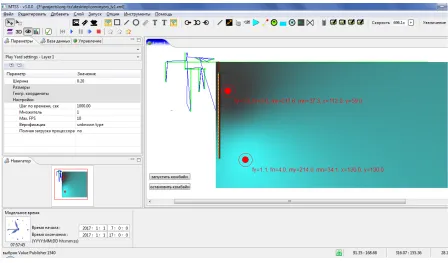
Figure 2 shows the integrated model of underground coal mining technological processes in stoping face carried out with simulation system MTSS. In Figure 2 the coal seam with two geological prospecting wells is painted over. The areas with reduced resistance are painted in a lighter tone. The belt conveyor and power lines are designated in the main window.
The equipment parameters and operation modes can be set interactively in the parameters window. The control buttons are entered in the main window: to start the cutter-loader; to stop the cutter-loader.
With the developed simulation model of the technological process of underground coal mining in the stoping face a series of experiments was performed. For one-way and shuttle operations the average productivity of the cutter-loader was calculated, depending on the length of the longwall face. All experiments were carried out under the equal conditions of the passage of the cutter-loader for a certain depth into the coal seam.
Figure 1. The 3D coal seam model with two geological prospecting wells.
Figure 2. The main window of the stoping face model.
The shuttle operation of coal mining in the stoping face is more productive in comparison with the one-way operation.
Increasing the length of the longwall face, beginning from a certain value, does not significantly affect the increase in the productivity of the cutter-loader.
[image:5.612.189.424.558.722.2]Conclusions
The extension of the considered simulation model of the stoping face operation is assumed to be carried out in the future.
Models of aerogas dynamics of methane-air flow in a long stope and models of a belt conveyors subsystem, a ventilating subsystem, and a power supply subsystem of a coal mine will be additionally included into the integrated model of the stoping face operation.
The MTSS simulation system can be used not only for simulation of the existing coal mining technologies, but also for simulation of perspective robotized technologies and manless coal mining technologies.
References
[1] Abubakary Salama, Jenny Greberg, and Håkan Schunnesson, “The use of discrete event simulation for underground haulage mining equipment selection,” in International Journal of Mining and Mineral Engineering, vol. 5, no. 3, 2014, pp. 256-271.
[2] M. Fioroni, L. Santos, L. Franzese, I. Santana, G. Telles, J. Seixas, B. Penna, and G. Alkmim, “Logistic Evaluation of an Underground mine Using Simulation,” 2014 Winter Simulation Conference, Savannah, GA, USA, pp. 1855-1865, 2014.
[3] Theodore N. Michalakopoulos, Christos P. Roumpos, Michael J. Galetakis, and George N. Panagiotou, “Discrete-Event Simulation of Continuous Mining Systems in Multi-layer Lignite Deposits,” in Lecture Notes in Production Engineering, Proceedings of the 12th International Symposium Continuous Surface Mining, 2015, pp. 225-239.
[4] Piotr Gospodarczyk, “Modeling and Simulation of Coal Loading by Cutting Drum in Flat Seams,” Archives of Mining Sciences, vol. 61, no. 2, 2016, pp. 385-379.
[5] Tolgay Kara, and M. Cengiz Savaş, “Design and Simulation of a Decentralized Railway Traffic Control System,” in Engineering, Technology & Applied Science Research, vol. 6, no. 2, 2016, pp. 945-951.
[6] M. Ben Ayed, L. Zouari, and M. Abid, “Software In the Loop Simulation for Robot Manipulators,” in Engineering, Technology & Applied Science Research, vol. 7, no. 5, 2017, pp. 2017-2021.
[7] Yubing Gao, Dongqiao Liu, Xingyu Zhang and Manchao He, “Analysis and Optimization of Entry Stability in Underground Longwall Mining,” in Sustainability, vol. 9, no. 11, 2017.
[8] Ryszard Snopkowski, Aneta Napieraj, and Marta Sukiennik, “Method of the Assessment of the Influence of Longwall Effective Working Time Onto Obtained Mining Output,” in Archives of Mining Sciences, vol. 61, no. 4, 2017, pp. 967-977.
[9] V.V. Okolnishnikov, and S.V. Rudometov, “A System for Computer Simulation of Technological Processes,” in St. Petersburg State Polytechnic University Journal. Computer Science. Telecommunications and Control Systems, vol. 181, no. 1, 2014, pp. 62-68.
[10] Victor Okolnishnikov, Sergey Rudometov, and Sergey Zhuravlev, “Simulating the Various Subsystems of a Coal Mine,” in Engineering, Technology & Applied Science Research, vol. 6, no. 3, 2016, pp. 993-999.