2018 3rd International Conference on Computational Modeling, Simulation and Applied Mathematics (CMSAM 2018) ISBN: 978-1-60595-035-8
Multilevel Wavelet Decomposition Based Harris Corner Detection
Algorithm for Remote-sensing Image
Bing ZHOU, Xiao-xing NIU, Xiao-nan LIU and Xin-xin YANG
*Henan University, Kaifeng, Henan, 475000, China
*Corresponding author
Keywords: Remote-sensing image, Multilevel wavelet decomposition, Corner detection, Harris algorithm.
Abstract. Because of the interference of the noise and the subtle texture, the Harris algorithm will generate much more false corners. An improved Harris algorithm based on multilevel wavelet decomposition is proposed. By multilevel wavelet decomposition, the high frequency components of image are extracted. These high frequency components with different scales are parsed, and the noises and subtle textures are suppressed while the original image edge features are kept. The final experiment shows that the improved corner detection algorithm can effectively reduce the number of false corners.
Introduction
The geometric feature extraction is a major task for remote-sensing data registration. The key to the extraction is the feature point matching between images. Harris algorithm is a widely used corner detection algorithm in feature extraction because of its simple calculation and high stability. However, in the process of extracting, corners are vulnerable to the interference of noise and subtle texture, which causes more false corners.
In order to resolve this problem, an improved Harris algorithm based on multilevel wavelet decomposition is proposed in this paper. Though the decomposition, the subtle texture and noise are suppressed and corner detection results are optimized. It is verified by experiment that this improved corner detection algorithm can obviously improve the quality of corner detection and reduce the number of false corner points.
This paper has five sections. The second section introduces the related research work of corner detection. In the third section, based on the analysis of Harris algorithm, an improved method based on multilevel wavelet decomposition is proposed. The fourth section is the experiment. The last section is the conclusion.
Related work
Feature-based image registration algorithms are widely studied[1],[2]. By comparing the feature sets with obvious gray scale changing, this kind of algorithm uses feature matching algorithm to find related feature points. And then the mapping relation is established according to the feature points to achieve the goal of image registration. According to the models of the feature points, feature-based image registration algorithms can be divided into three categories: edge point based[3], corner based [4] and interest operator based[5].
In 2002, Zhou G.K applied the edge feature of the image after wavelet transforming to extract corners, which reduces the time-cost and improves the matching results compared to gray value based method[10]. In order to resolve the difficult problem of finding a threshold applicable to all kinds of corner extraction algorithm, Shen presented the concept of self-adaptive threshold in 2010[11]. In the same year, Ding Lin proposed a local adaptive Harris corner detection method. This method reduces the occurrence of mismatch and makes the matching points distributed more evenly[12].
In 2012, Kumar et al. proposed an image registration algorithm based on wavelet decomposition and Color-SIFT. The multi-resolution analysis of the image is carried out by wavelet transform, and then feature points are extracted on the low frequency sub-image by using Color-SIFT algorithm. The final match of the image is achieved by matching the acquired feature points. In 2013, Liu B.C et al. used the second order differential operator to extract the edge of the image for corner detection. This detection method is a good solution for resolving the problem of missed and wrong corners in Harris algorithm[13]. Aiming at the problem that Harris algorithm does not have scale invariance, Ge P.P et al. proposed a new kind of feature point extraction algorithm named Harris-SURF in 2014. This algorithm improves the robustness of Harris algorithm for image rotation, scaling and illumination variation while ensuring the efficiency[14].In 2015, Xu J.J et al. proposed a fast image registration algorithm based on improved Harris-SIFT operator. The Harris algorithm is optimized by constructing Gaussian scale space, which greatly reduces the computation time of algorithm[15]. For the problem of uneven distributed feature points, Zhou H, etc. use image partitioning strategy for corner detection. The evenly distributed feature points combined with mutual information improved the accuracy of registration[16].In 2016, Zhou J.H et al. proposed a fast sub-pixel registration algorithm. Because the classic sub-pixel registration algorithm is not efficient, this algorithm uses effective sub-graph instead of original image for sub-pixel registration and improves the efficiency greatly[17]. In traditional Harris corner detection, manually inputting a single threshold may cause pseudo-corner and clustered corner points. In 2017, Zhang J.S et al. proposed an improved image registration method for Harris corner detection method, which realized an uniform distribution of corners[18].
In summary, in recent years, many experts and scholars improve Harris algorithm through the wavelet decomposition. But these improvements only involve direct use of high-frequency components and do not optimize the extraction process. This paper focuses on the optimization of edge feature extraction process based on multilevel wavelet decomposition to reduce the influences of noises and subtle edges on feature extraction.
Corner Detection Algorithm Based on Multilevel Wavelet Decomposition
Analysis of Harris Corner Detection Algorithm
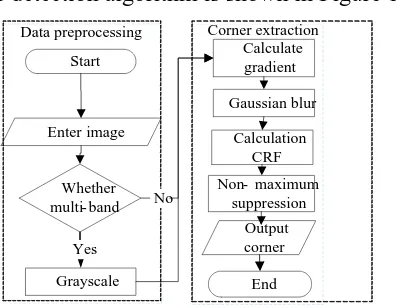
The flow chart of Harris corner detection algorithm is shown in Figure 1.
Start
Enter image
Whether multi- band
Yes
Grayscale
Calculate gradient
Gaussian blur
Calculation CRF Non- maximum
suppression Output corner
End Data preprocessing Corner extraction
[image:2.595.204.402.600.754.2]No
Figure 1. Flow chart of Harris corner detection algorithm.
First step is determining the image type. If it is a multi-spectral image, a gray conversion process is followed to convert it to a single-band grayscale image by weighted averaging, which is shown with formula (1).
, 0.299 ( , ) 0.578 ( , ) 0.114 ( , )Gray i j R i j G i j B i j
(1) If it is a single band image, go directly to the next step.
In second step, the gray scale gradients Ix and Iy in the X and Y directions are calculated, while
their products Ixy, 2 x I and 2 y I
are calculated too as formula(2), (3)and(4).
-1 0 1
-1 0 1
-1 0 1 x I I I x
(2)
-1 0 1 -1 0 1 -1 0 1
y I I I y
(3)
2 2
,
, ,
x x x y y y x y x y
I I I I I I I I I
(4)
In step three, Gaussian smoothing is performed on the Ixy, 2 x I and 2 y I
by the Gaussian function plate to obtain coefficients A, B and C as formula (5).
2 2 2 2
( x) x , ( y) y , ( xy) xy
Ag I I w Bg I I w Cg I I w
(5) In step four, A, B, and C are used to calculate corner response value CRF as formula (6), in which k is an empirical constant, its value ranges from 0.04 to 0.06.
2 2 2
det - (trace ) ( ) ( )
R M k M AB C k A B (6)
The last step is to select corners by non-maximal suppression in a certain size window.
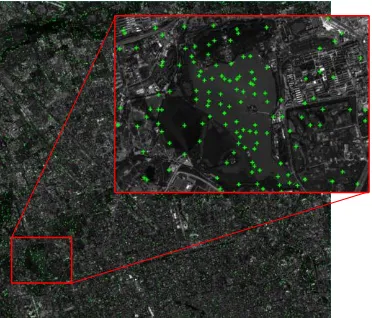
[image:3.595.206.392.578.737.2]Harris algorithm is simple and stable, but it is susceptible to noise and subtle texture. Figure 2 is a result image of Harris algorithm. It can be seen that at the water area, there are lots of obvious false corners due to the influences of subtle textures such as boat and water wave.
Multilevel Wavelet Decomposition Based HARRIS Corner Detection Algorithm
Through the analysis of the Harris algorithm, it can be seen that to locate the coordinate of the corner points is mainly based on the variation of gray value in different directions. The sharper the gray scale and the more the direction variation, the greater the response values of corners. The key of Harris algorithm is to analyze the edge characteristics of image, so it can use edge features instead of original image to reduce the interferences of low-frequency components and subtle texture. In this paper, the wavelet decomposition method is used to extract edge features.
The wavelet decomposition can decompose the target image into high frequency component and low frequency component through a series of mathematical transformations. The low frequency component is the part which gray value changes slowly, and it represents the frame and outline of the image. The high frequency component is the region where the gray value of image changes frequently, which reflects details of the image and contains edge features. By the wavelet decomposition not only noise suppression can be performed at large scale, but also image edge information can be better detected at small scale.
Because the gray values around noises change sharply, the edge detection results often contain part of noise data. In order to filter out the noises as much as possible, the image can be decomposed by multilevel wavelet to obtain high frequency components at different scales. Then the noises are reduced by superimposing the high frequency components of different scales. The calculation process is shown in Equation 2-7 and 2-8.
1
1
(
( ) ) ( 2n )
n n
l
h x
f l h x l(7)
1
( ( ) )
( ) n n( )
n
G x
h x h x [image:4.595.182.412.471.734.2](8) In which, hn(x) is the low frequency component obtained by n-level filtering of the original image, f(l) is low-pass filter operator and G(x) is high frequency components of n-level wavelet decomposition.
Figure 3. The high-frequency components of 4-level wavelet decomposition.
and subtle texture than that of former-level decomposition, because the high-level decomposition to the high-frequency components of low-level decomposition can filter out some of the noises and subtle texture. However comparing the high-frequency components of the first and fourth level, it can be found that the passivation of the low-pass filter also results in passivizing to the edge features of the high-frequency components of high-level decomposition.
[image:5.595.166.435.205.316.2]As shown in Figure 4, the standard deviations of the high-frequency components decrease progressively. It is indicated that the passivized high frequency component lost the details due to excessive smoothness of the edge feature, so its edge feature cannot truly reflect the spatial information of the target image.
Figure 4. The standard deviations of four level high frequency components of the MASS data of GF-2 satellite.
Target image
The first layer wavelet decomposition
Low frequency component
High frequency component
The second layer wavelet decomposition
Low frequency component High frequency
component
……
Nth layer wavelet decomposition High frequency
component
Edge feature start
End Find out
exclusiveOR
Filter useless data
Find out exclusiveOR
Filter useless data High frequency
component
Figure 5. Edge feature extraction process based on multilevel wavelet decomposition.
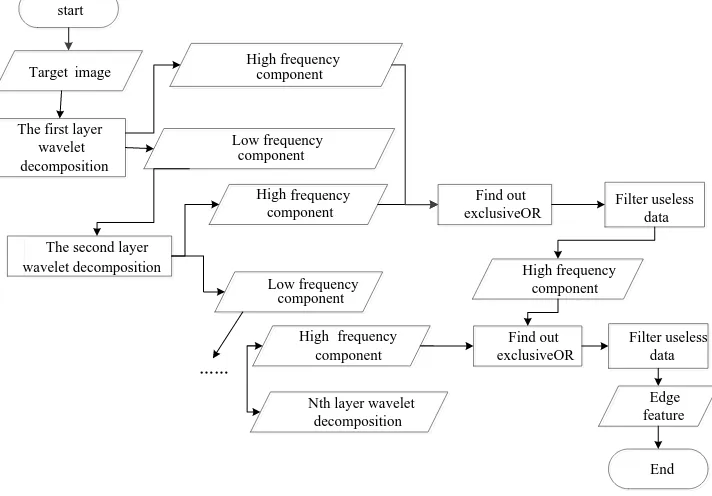
In order to solve this problem that the high-frequency component of low-level contains too much noise and that of high-level is too smooth, the high-frequency components of high-level and low-level can be compared, according to the differences, the noise and subtle texture in the high-frequency component of low-level decomposition could be removed. Figure 5 is an improved edge feature extraction process based on multilevel wavelet decomposition.
The details are as follows:
(1) The B3-spline is chosen as low-pass filter due to the best edge detection performance[20]. The low frequency component of the original image is obtained by convolute the original image with the low-pass filter. The high-frequency component is obtained by subtracting the low-frequency component from the original image.
[image:5.595.119.475.351.599.2]decomposition increasing, the image scale becomes smaller, the noises and subtle textures become less. The location of the noise and subtle texture can be determined by the exclusive OR of the high frequency components of this level and previous level. And then filter out these useless data from the previous level to obtain the optimized high frequency components preliminarily.
After n-level wavelet decomposition, the optimized edge characteristics of original image will be obtained.
In Figure 6 (a) is the high-frequency components of first level and (b) is the improved high frequency component. The goal of multilevel wavelet decomposition is to extract the edge characteristics of the image. Comparing the improved high frequency components with that of the first level, it can be seen that the optimized data removes most of the noise and subtle texture mean while preserving the edge features.
[image:6.595.159.434.232.383.2](b) (a)
Figure 6. Comparison of improved high-frequency component.
Test Results
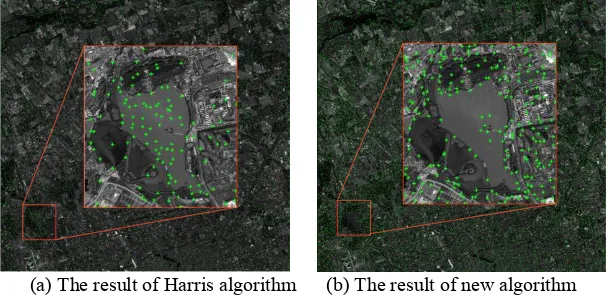
The new algorithm is implemented by C++, which is compiled and run on vs2010. The GF satellite data of Beijing area is selected as the experimental data, and the corner detection algorithm proposed in this paper is experimented. Because the corners of the remote sensing image are not convenient for visual inspection, this paper made a comparison in the aspect of angular-repetition-rate. The times of wavelet decomposition in this experiment is 3, and the filter operator is B3-spline. And its Gaussian window size is 5×5 and the value of K in corner response function CRF is 0.05.
The Harris algorithm used as a contrast in this experiment is an improved method according to the literature[12].
(a) The result of Harris algorithm (b) The result of new algorithm Figure 7. GF2 multi-spectral image of the local area corner detection results.
[image:6.595.146.451.562.711.2]The corner-repetition-rate refers to the degree of repetition of the corner when the image was rotated and disturbed by the noise. In corner detection, it is often used to evaluate the quality of corner detection algorithms[19]. Corner-repetition-rate R is calculated as:
1 2
N ( ) / 2
R
n n
(9)
In the formula, n1 is the number of corners in the case of noise free, and n2 is the number of corners with additional noises. N is the number of repetitions of the corners at two cases.
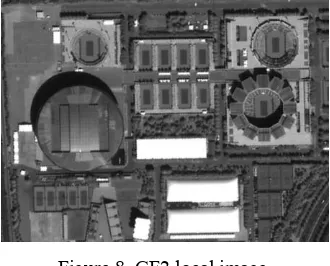
[image:7.595.215.380.216.349.2]In order to easily observe the repeated corners with different noises, this experiment selects part of GF-2 PAN image, as shown in Figure 8.
Figure 8. GF2 local image.
Among the results, the images of (a1), (a2), (a3) and (a4) were obtained by Harris algorithm with none noise, 2% noise, 4% noise, 8% noise respectively. And the images of (b1), (b2), (b3) and (b4) were obtained by new algorithm with none noise, 2% noise, 4% noise, 8% noise respectively.
(a2) (a3) (a4)
(b1) (b2) (b4)
(a1)
[image:7.595.120.480.409.548.2](b3)
Figure 9. Comparison of Corner Detection under Different Noise Environments.
Figure 10. Comparison of corner repetition rate at different noise levels.
[image:7.595.189.409.579.688.2]Conclusion
Based on Harris algorithm, this paper introduces the multilevel wavelet decomposition to solve the problems of pseudo-corner points. In addition, this paper optimizes the decomposed high-frequency components, and suppresses the noise and subtle texture. The experimental results show that the improved algorithm can effectively reduce the false corner.
References
[1] Wang C.G, Luo L, Gao X.R, Peng J.P. TOFD image registration based on adaptive threshold of scale invariant feature transform algorithm [J]. Information Technology, 2017, (04): 78-81.
[2] Zhang H.M, Zhang J.S, Luo Y.T, Chen B.Y. A SIFT fast registration method based on image region Segmentation [J] Infrared Technology, 2017, (04):341-344.
[3] Martinez A, Gelb A, Gutierrez A. Edge Detection from Non-Uniform Fourier Data Using the Convolutional Gridding Algorithm [J]. Journal of Scientific Computing, 2014, 61(3):490-512.
[4] Sipiran I, Bustos B. Harris 3D: a robust extension of the Harris operator for interest point detection on 3D meshes [J]. The Visual Computer, 2011, 27(11): 963-976.
[5] Jiang L, Liu J, Li D, et al. 3D Point Sets Matching Method Based on Moravec Vertical Interest Operator[C]. Proceedings of the 2011 2nd International Congress on Computer Applications and Computational Science. Springer Berlin Heidelberg, 2012: 53-59.
[6] Wu Y, Ma W, Gong M, et al. A Novel Point-Matching Algorithm Based on Fast Sample Consensus for Image Registration [J]. IEEE Geoscience & Remote Sensing Letters, 2014, 12(1):43-47.
[7] Lin H, Du P, Zhao W, et al. Image registration based on corner detection and affine transformation[C] International Congress on Image and Signal Processing. IEEE, 2010:2184-2188.
[8] Moravec H P. Obstacle avoidance and navigation in the real world by a seeing robot rover [M]. Stanford University, 1980.
[9] Harris C. A combined corner and edge detector [J]. Proc Alvey Vision Conf, 1988, 1988(3):147-151.
[10] Zhou G.K. Remote sensing image registration technology based on wavelet extraction edge feature point [D]. Northwestern Polytechnical University, 2002.
[11] Shen S, Zhang X, Wei H. Auto-adaptive Harris corner detection algorithm based on block processing[C] International Symposium on Signals Systems and Electronics. 2010:1-4.
[12] Ding L. A local adaptive Harris corner registration method [A]. Surveying and Mapping Press. The Second Forum on Advanced Surveying and Mapping [C]. Surveying and Mapping Press, 2010:3.
[13] Liu B.C, Zhao J, Sun Q. Improved Harris Corner Detection Method Based on Edge [J]. Chinese Journal of Liquid Crystals and Displays, 2013, 28(6):939-942.
[14] Ge P. P, Chen Q, Gu Y.H, et al. Algorithm of remote sensing image matching based on Harris corner and SURF feature [J]. Application Research of Computers, 2014, 31(7):2205-2208.
[15] Xu J. J, Zhang Y, Zhang H. Fast image registration algorithm based on improved Harris-SIFT operator [J]. Journal of Electronics Measurement & Instrumentation, 2015, 29(1):48-54.
[17] Zhou J.H, Zhu J. J, Zhou C, et al. A fast sub-pixel registration method for remote sensing image [J]. Engineering of Surveying and Mapping, 2016, 25(7):71-77.
[18] Zhang J. S, Zhang H.M, Luo Y. T, et al. Image registration method based on improved Harris corner detection algorithm [J]. Laser & Infrared, 2017, 47(2).
[19] Zhou Z. Y, Yan M. L, Chen S. D, et al. Image registration and stitching algorithm of rice low-altitude remote sensing based on Harris corner self-adaptive detection[J].Transactions of the Chinese Society of Agricultural Engineering, 2015, 31(14):186-193.