R E S E A R C H
Open Access
Windschitl type approximation formulas
for the gamma function
Zhen-Hang Yang
1,2and Jing-Feng Tian
1**Correspondence: [email protected]
1College of Science and
Technology, North China Electric Power University, Baoding, P.R. China Full list of author information is available at the end of the article
Abstract
In this paper, we present four new Windschitl type approximation formulas for the gamma function. By some unique ideas and techniques, we prove that four functions combined with the gamma function and Windschitl type approximation formulas have good properties, such as monotonicity and convexity. These not only yield some new inequalities for the gamma and factorial functions, but also provide a new proof of known inequalities and strengthen known results.
MSC: Primary 41A10; 26A48; secondary 33B10; 26A51
Keywords: Gamma function; Windschitl type approximation formula; Monotonicity; Convexity; Inequality
1 Introduction
Forx> 0, the classical Euler’s gamma functionand psi (digamma) functionψare defined by
(x) = ∞
0
tx–1e–tdt and ψ(x) =
(x)
(x), (1.1)
respectively. The derivativesψ, ψ, ψ, . . . are known as polygamma functions. The gamma function has various important applications in many branches of science. For this reason, scholars strive to find various better approximations for the factorial or gamma function by using different ideas and techniques, for instance, Ramanujan [1, p. 339], Burn-side [2], Gosper [3], Alzer [4], Shi et al. [5], Batir [6,7], Mortici [8–12], Nemes [13, Corol-lary 4.1], [14], Qi et al. [15,16], Feng and Wang [17], Chen [18–21], Yang et al. [22–25], Lu et al. [26–28], Xu et al. [29]. Some properties of the remainders of certain approximations for the gamma function can be found in [4,16,23,30–35].
In this paper, we are interested in Windschitl’s approximation formula (see [36]) given by
(x+ 1)∼W0(x) =√2πx
x e
x xsinh1
x
x/2
, asx→ ∞. (1.2)
As shown in [21, Eq. (3.18)], the rate of Windschitl’s approximationW0(x) converging to
(x+ 1) is likex–5asx→ ∞, and likex–7if one replacesW0(x) with
W1(x) =√2πx
x e
x xsinh1
x+
1 810x6
x/2
(1.3)
by an easy check. These show thatW0(x) andW1(x) are more accurate approximations for the gamma function. In 2009, Alzer [37] proved that for allx> 0,
√
2πx
x e
x xsinh1
x
x/2
1 + α
x5
<(x+ 1)
<√2πx
x e
x xsinh1
x
x/2
1 + β
x5
(1.4)
with the best possible constantsα= 0 andβ = 1/1620. Recently, Lu, Song and Ma [27] extended Windschitl’s formula to an asymptotic expansion:
(n+ 1)∼√2πn
n e n nsinh 1 n+ a7 n7+
a9 n9 +
a11 n11 +· · ·
n/2
(1.5)
asn→ ∞witha7= 1/810,a9= –67/42525,a11= 19/8505, . . . , and proved that there exists anmsuch that, for everyx>m, the double inequality
xsinh 1 x+ 1 810x7–
67 42525x9
x/2
<√(x+ 1) 2πx(x/e)x <
xsinh 1 x+ 1 810x7
x/2
(1.6)
holds. An explicit formula for determining the coefficients ofn–k(n∈N) was given in [19, Theorem 1] by Chen. Another asymptotic expansion
(x+ 1)∼√2πx
x e
x xsinh1
x
x/2+∞j=0rjx–j
, asx→ ∞, (1.7)
was presented in the same paper [19, Theorem 2].
Let us consider the four new Windschitl type approximation formulas, asx→ ∞, which are
(x+ 1)∼√2πx
x e
x xsinh1
x
x/2
exp
1 1620x5
:=W01(x), (1.8)
(x+ 1)∼√2πx
x e
x xsinh1
x
x/2
exp
1 1620x5 –
11 18,900x7
:=W02(x), (1.9)
(x+ 1)∼√2πx
x e
x xsinh1
x
x/2
1 + 1 1620x5
:=W01∗(x), (1.10)
(x+ 1)∼√2πx
x e
x xsinh1
x
x/2
1 + 1 1620x5 –
11 18,900x7
=W02∗(x). (1.11)
The aim of this paper is, by investigating the monotonicity and convexity of the functions
to establish some new sharp inequalities between the gamma function(x+ 1) and Winds-chitl’s approximation formulaW0(x). As a by-product, a concise proof of Alzer inequalities
(1.4) is presented, and a strengthening for Lu et al.’s inequalities (1.6) is given.
The rest of this paper is organized as follows. In Sect.2, three lemmas are given, which are crucial to the proofs of our results. In Sect. 3, five monotonicity and convexity re-sults for the functions constructed from the gamma function and Windschilt’s formula are proved. Some new inequalities between the gamma or factorial functions with Wind-schilt’s formula are established in Sect.4. In Sect.5, numeric comparisons of several better approximation formulas are presented.
2 Lemmas
To prove our results, we need three lemmas as follows.
Lemma 1 The inequalities
x x
2+71 84 x4+13
14x2+ 27 560
<ψ
x+1 2
, (2.1)
x x
4+227 66x2+
4237 2640 x6+155
44x4+ 329 176x2+
375 4928
<ψ
x+1 2
<1
x x4+67
36x2+ 256 945 x4+35
18x2+ 407 1008
(2.2)
hold for x> 0.
Proof The inequality (2.1) was proved in [38, Remark 2.2]. Let
g1(x) =ψ
x+1 2
–1
x x4+67
36x2+ 256 945 x4+35
18x2+ 407 1008
,
g2(x) =ψ
x+1 2
–x x 4+227
66x2+ 4237 2640 x6+155
44x4+ 329 176x2+
375 4928
.
Then we have
g1(x+ 1) –g1(x) =ψ
x+3 2
– 1
x+ 1
(x+ 1)4+6736(x+ 1)2+256945 (x+ 1)4+35
18(x+ 1)2+ 407 1008
–ψ
x+1 2
+1
x x4+67
36x2+ 256 945 x4+35
18x2+ 407 1008
= 921,600×x(2x+ 1)2(x+ 1) 1008x4+ 1960x2+ 407–1
× 1008x4+ 4032x3+ 8008x2+ 7952x+ 3375–1> 0.
Hence, we conclude that
g1(x) <g1(x+ 1) <· · ·< lim
n→∞g1(x+n) = 0,
Analogously, we have
g2(x+ 1) –g2(x)
=ψ
x+3 2
– (x+ 1)((x+ 1)
4+227 66(x+ 1)
2+4237 2640)
(x+ 1)6+155
44(x+ 1)4+ 329
176(x+ 1)2+ 375 4928
–ψ
x+1 2
+ x(x
4+227 66x
2+4237 2640) x6+155
44x4+ 329 176x2+
375 4928
= –58,982,400×(2x+ 1)2 4928x6+ 17,360x4+ 9212x2+ 375–1
× 4928x6+ 29,568x5+ 91,280x4+ 168,000x3
+ 187,292x2+ 117,432x+ 31,875–1
< 0.
It then follows that
g2(x) >g2(x+ 1) >· · ·> lim
n→∞g2(x+n) = 0,
which proves the second formula of (2.2). This completes the proof.
Lemma 2 The inequalities
t2
sinh2t > 1 –
1 3t
2+ 1
15t
4– 2
189t
6, (2.3)
t2
sinh2t > 1 –
1 3t
2+ 1
15t
4– 2
189t
6+ 1
675t
8– 2
10,395t
10 (2.4)
hold for all t> 0.
Proof The inequalities in question are equivalent to
h1(t) =
2 189t
6– 1
15t
4+1
3t
2– 1
cosh2t– 1 2t2 + 1 > 0
and
h2(t) =
2 10,395t
10– 1
675t
8+ 2
189t
6– 1
15t
4+1
3t
2– 1
cosh2t– 1 2t2 + 1 > 0
fort> 0, respectively.
Expanding into a power series yields
h1(t) =
2 189t
6– 1
15t
4+1
3t
2– 1
∞
n=0
22n+1 (2n+ 2)!t
2n+ 1
= 2 189
∞
n=3
(2t)2n
32(2n– 4)!– 1 15
∞
n=2
(2t)2n
8(2n– 2)!+ 1 3
∞
n=1
(2t)2n
– 2
∞
n=0
(2t)2n (2n+ 2)!+ 1 :=
1 1890
∞
n=3
(n– 3)×p5(n) (2n+ 2)! (2t)
2n,
where
p5(n) = 40n5+ 60n4– 122n3– 543n2– 296n+ 1050.
We assert thatp5(n) > 0 forn≥3, sincep5(n) can be written as
p5(n) = 40(n– 3)5+ 660(n– 3)4+ 4198(n– 3)3+ 12,399(n– 3)2+ 15,832(n– 3) + 6561,
which is evidently positive forn≥3. Henceh1(t) > 0 for allt> 0. While
h2(t) =h1(t) +
2 10,395t
10– 1
675t
8
∞
n=0
22n+1 (2n+ 2)!t
2n
= 1 1890
∞
n=3
(n– 3)×p5(n) (2n+ 2)! (2t)
2n+ 2
10,395
∞
n=5
(2t)2n
29(2n– 8)!
– 1 675
∞
n=4
(2t)2n 27(2n– 6)! :=
1 415,800
∞
n=5
(n– 5)×p9(n) (2n+ 2)! (2t)
2n,
where
p9(n) = 160n9– 1200n8+ 2368n7– 1768n6+ 2354n5+ 14,845n4
– 6403n3– 70,782n2– 57,384n+ 138,600.
It is easy to check that
p9(n) = 160m9+ 6000m8+ 98,368m7+ 921,112m6+ 5392,514m5+ 20,270,695m4
+ 48,258,997m3+ 68,827,423m2+ 51,883,321m+ 15,041,130 > 0,
form=n– 5≥0, which provesh2(t) > 0 fort> 0. The proof is complete.
The following lemma offers a simple criterion to determine the sign of a class of special polynomials on given interval contained in (0,∞) without using Descartes’ Rule of Signs, which plays an important role in studying certain special functions, see, for example, [39, 40]. A series version can be found in [41,42].
Lemma 3([39, Lemma 7]) Let n∈Nand m∈N∪ {0}with n>m and let Pn(t)be an nth degree polynomial defined by
Pn(t) =
n
i=m+1 aiti–
m
i=0
aiti, (2.5)
Consequently,for a given t0> 0,if Pn(t0) > 0then Pn(t) > 0for t∈(t0,∞)and if Pn(t0) < 0
then Pn(t) < 0for t∈(0,t0).
3 Monotonicity and convexity
Theorem 1 T he function
f0(x) =ln(x+ 1) –ln
√
2π–
x+1 2
lnx+x–x 2ln
xsinh1
x
is strictly decreasing and convex on(0,∞).
Proof Differentiation yields
f0(x) =ψ(x+ 1) –1 2ln
xsinh1
x
+ 1
2xcoth
1
x–lnx–
1 2x–
1 2,
f0(x) =ψ(x+ 1) + 1 2x3
1
sinh2(1/x)– 3 2x+
1 2x2.
Replacingxby (x+ 1/2) in inequality (2.1) leads to
ψ(x+ 1) >5 6
(2x+ 1)(21x2+ 21x+ 23)
35x4+ 70x3+ 85x2+ 50x+ 12,
and using which tof0(x) gives
f0(x) >5 6
(2x+ 1)(21x2+ 21x+ 23) 35x4+ 70x3+ 85x2+ 50x+ 12
+ 1 2x3
1
sinh2(1/x)– 3 2x+
1 2x2 =f01
1
x
.
Simplifying yields
f01(t) =
1 2
t3
sinh2t+
1 6
t(36t5+ 42t4– 80t3– 220t2– 210t– 105)
12t4+ 50t3+ 85t2+ 70t+ 35
= t 12
f02(t)
(12t4+ 50t3+ 85t2+ 70t+ 35)sinh2t,
where
f02(t) = 36t5+ 42t4– 80t3– 220t2– 210t– 105
cosh2t
+ 72t6+ 264t5+ 468t4+ 500t3+ 430t2+ 210t+ 105.
Expanding into a power series gives
f02(t) =
36
∞
n=2
22n–4
(2n– 4)!t
2n+1– 80
∞
n=1
22n–2
(2n– 2)!t
2n+1– 210
∞
n=0
22n
(2n)!t
2n+1
+
42
∞
n=2
22n–4
(2n– 4)!t
2n– 220
∞
n=1
22n–2
(2n– 2)!t
2n– 105
∞
n=0
22n
(2n)!t
2n
=
∞
n=4
(n– 3)(36n3+ 19n+ 70)22n (2n)! t
2n+1
+
∞
n=4
(84n4– 252n3– 209n2+ 157n– 210)22n–2
(2n)! t
2n> 0,
where the inequality holds due to
84n4– 252n3– 209n2+ 157n– 210
= 84(n– 4)4+ 1092(n– 4)3+ 4831(n– 4)2+ 7893(n– 4) + 2450 > 0
forn≥4.
It then follows that f01(t) > 0 for t > 0, so f0(x) > 0 for x > 0. This yields f0(x) <
limx→∞f0(x) = 0, which proves the desired result.
Theorem 2 The function
f1∗(x) =ln(x+ 1) –ln√2π–
x+1 2
lnx+x–x 2ln
xsinh1
x
–ln
1 + 1
1620x5
is strictly increasing and concave on(0,∞).
Proof Differentiation yields
f1∗(x) =ψ(x+ 1) –1 2ln
xsinh1
x
+ 1
2xcoth
1
x
–lnx– 1 2x–
1 2+
5
x(1620x5+ 1),
f1∗(x) =ψ(x+ 1) + 1 2x3
1
sinh2(1/x)– 3 2x+
1 2x2 – 5
9720x5+ 1
x2(1620x5+ 1)2.
Sincelimx→∞f1∗(x) = 0, it suffices to provef1∗(x) < 0 forx> 0. Replacingxby (x+ 1/2) in
the right-hand side inequality of (2.2) leads to
ψ(x+ 1) < 1 30
3780x4+ 7560x3+ 12,705x2+ 8925x+ 3019
(2x+ 1)(63x4+ 126x3+ 217x2+ 154x+ 60), (3.1)
which indicates that
f1∗(x) < 1 30
3780x4+ 7560x3+ 12,705x2+ 8925x+ 3019
(2x+ 1)(63x4+ 126x3+ 217x2+ 154x+ 60)
+ 1 2x3
1
sinh2(1/x)– 3 2x+
1 2x2 – 5
9720x5+ 1 x2(1620x5+ 1)2 :=f
∗
11
1
x
,
where
f11∗(t) = t
3
cosh2t– 1– 3 2t+
1 2t
2– 5t7 t5+ 9720
(t5+ 1620)2
+ 1 30
t(3019t4+ 8925t3+ 12,705t2+ 7560t+ 3780)
Using the inequality
cosh2t– 1 >
4
n=1
22n (2n)!t
2n= 2t2+2
3t
4+ 4
45t
6+ 2
315t
8
yields
f11∗(t)
< t
3
2t2+2 3t4+
4 45t6+
2 315t8
–3 2t+
1 2t
2– 5t7 t5+ 9720
(t5+ 1620)2
+ 1 30
t(3019t4+ 8925t3+ 12,705t2+ 7560t+ 3780)
(t+ 2)(60t4+ 154t3+ 217t2+ 126t+ 63)
= –1 30
× t9×f12∗(t)
(t5+ 1620)2(t+ 2)(t6+ 14t4+ 105t2+ 315)(60t4+ 154t3+ 217t2+ 126t+ 63)
< 0
fort> 0, where the inequality holds due to
f12∗(t) = 8100t14+ 39,690t13+ 193,586t12+ 645,960t11+ 2,028,124t10
+ 90,019,275t9+ 406,666,800t8+ 1976,029,740t7+ 6395,589,900t6
+ 20,173,546,260t5+ 51,035,406,750t4+ 110,592,337,500t3
+ 184,843,490,400t2+ 254,068,164,000t+ 101,627,265,600 > 0
fort> 0. This implies thatf2(x) < 0 for allx> 0, and the proof is complete.
Theorem 3 The function
f1(x) =ln(x+ 1) –ln√2π–
x+1 2
lnx+x–x 2ln
xsinh1
x
– 1
1620x5
is strictly increasing and concave on(0,∞).
Proof We clearly see that
f1(x) =f1∗(x) +D
1 1620x5
,
whereD(y) =ln(1 +y) –y. By Theorem2,f1∗is strictly increasing and concave on (0,∞), so if we provex→D(y) is strictly increasing and concave on (0,∞), then so will bef1, and the proof will be complete. Now we easily check that forx> 0,
dD(y)
dx =
1
d2D(y) dx2 = –
1 54
2970x5+ 1 x7(1620x5+ 1)2 < 0,
which completes the proof.
Theorem 4 The function
f2(x) =ln(x+ 1) –ln√2π–
x+1 2
lnx+x
–x 2ln
xsinh1
x
– 1
1620x5 +
11 18,900x7
is strictly decreasing and convex on(0,∞).
Proof Differentiation yields
f2(x) =ψ(x+ 1) –1 2ln
xsinh1
x
+ 1
2xcoth
1
x
–lnx– 1 2x–
1 2+
1 324x6 –
11 2700x8,
f2(x) =ψ(x+ 1) + 1 2x3
1
sinh2(1/x)– 3 2x+
1 2x2–
1 54x7+
22 675x9.
Sincelimx→∞f2(x) = 0, it suffices to provef2(x) > 0 forx> 0. Replacingxby (x+ 1/2) in the left-hand side inequality of (2.2) leads to
ψ(x+ 1) > 7 30
(2x+ 1)(165x4+ 330x3+ 815x2+ 650x+ 417)
77x6+ 231x5+ 560x4+ 735x3+ 623x2+ 294x+ 60,
and applying which tof2(x) gives
f2(x) > 7 30
(2x+ 1)(165x4+ 330x3+ 815x2+ 650x+ 417) 77x6+ 231x5+ 560x4+ 735x3+ 623x2+ 294x+ 60
+ 1 2x3
1
sinh2(1/x)– 3 2x+
1 2x2 –
1 54x7+
22 675x9 =f21
1
x
.
Making a change of variablet= 1/xyields
f21(t) = 7 30
t(t+ 2)(417t4+ 650t3+ 815t2+ 330t+ 165) 60t6+ 294t5+ 623t4+ 735t3+ 560t2+ 231t+ 77
–3 2t+
1 2t
2– 1
54t
7+ 22
675t
9+t
2
t2
sinh2t.
We distinguish two cases to provef21(t) > 0 for allt> 0. Case1:t≥1. Application of inequality (2.3) gives
f21(t) >
7 30
t(t+ 2)(417t4+ 650t3+ 815t2+ 330t+ 165)
60t6+ 294t5+ 623t4+ 735t3+ 560t2+ 231t+ 77–
3 2t+
1 2t
2
– 1 54t
7+ 22
675t
9+t
2
1 –1 3t
2+ 1
15t
4– 2
189t
6
= 1 9450
t9×p6(t)
60t6+ 294t5+ 623t4+ 735t3+ 560t2+ 231t+ 77,
where
p6(t) = 18,480t6+ 90,552t5+ 178,384t4+ 160,230t3+ 51,205t2– 1617t– 539.
Clearly,p6(t) > 0 fort≥1, sof21(t) > 0 fort≥1.
Case2: 0 <t< 1. Using inequality (2.4) yields
f21(t) >
7 30
t(t+ 2)(417t4+ 650t3+ 815t2+ 330t+ 165)
60t6+ 294t5+ 623t4+ 735t3+ 560t2+ 231t+ 77–
3 2t+
1 2t
2
– 1 54t
7+ 22
675t
9+t
2
1 –1 3t
2+ 1
15t
4– 2
189t
6+ 1
675t
8– 2
10,395t
10
= t
11×q 6(t)
60t6+ 294t5+ 623t4+ 735t3+ 560t2+ 231t+ 77,
where
q6(t) = – 4 693t
6– 14
495t
5+2881
1485t
4+4816
495t
3+400,919
20,790 t
2+1573
90 t+ 1573
270 .
Since the coefficients of polynomialq6(t) satisfy the conditions of Lemma3andq6(1) = 53,681/990 > 0, we find thatq6(t) > 0 fort∈(0, 1), and thenf21(t) > 0 fort∈(0, 1).
This ends the proof.
Theorem 5 The function
f2∗(x) =ln(x+ 1) –ln√2π–
x+1 2
lnx+x
–x 2ln
xsinh1
x
–ln
1 + 1
1620x5 –
11 18,900x7
is strictly decreasing and convex on[4/3,∞).
Proof We easily see that
f2∗(x) =f2(x) –D
1 1620x5 –
11 18,900x7
,
whereD(y) =ln(1 +y) –y. By Theorem4,f2is strictly decreasing and convex on (0,∞), so if we provex→D(y) is strictly increasing and concave on [4/3,∞), then so will bef2∗, and the proof will be complete. Now we easily check that forx≥4/3,
dD(y)
dx =
1 8100
(25x2– 33)(35x2– 33)
x8(35x2+ 56,700x7– 33)> 0,
d2D(y) dx2 = –
p11(x)
where the last inequality holds due to
p11(x) = 67,375x11– 180,180x9+ 114,345x7+
1225 54 x
6–2233
27 x
4+8591
90 x
2–2662
75
= 385x7
175
x2–16 9
2
+1388 9
x2–16 9
+1465
81
+ 1 1350x
2 175x2– 3192
+242 675
56
x2–16 9
+5
9
> 0,
which completes the proof.
4 Inequalities
As is well known, analytic inequalities [43–45] play a very important role in different branches of modern mathematics. Using the theorems presented in the previous section, we can obtain some new inequalities for the gamma function and factorial function related to Windschitl’s formula.
Corollary 1 Let W0(x)be defined by(1.2).Then the inequalities
max
1,exp
1 1620x5 –
11 18,900x7
<(x+ 1)
W0(x) < 1 + 1
1620x5 <exp
1 1620x5
(4.1)
hold for all x> 0.If x≥√33/35,then we have
1 + 1 1620x5 –
11
18,900x7 <exp
1 1620x5 –
11 18,900x7
<(x+ 1)
W0(x) < 1 + 1
1620x5 <exp
1 1620x5
. (4.2)
Proof The first and second inequalities in (4.1) follow directly from the monotonicity of
f0,f2andf1∗on (0,∞) given in Theorems1,4and2, respectively, due tof0(∞) =f2(∞) =
f1∗(∞) = 0. The third one holds due to a simple inequality 1 +y<eyfory> 0. The proof of
inequalities (4.2) is similar, which completes the proof.
Using the monotonicity off0,f1∗andf2on (0,∞) and noting that
f0(1) =ln√ e
2πsinh1, f
∗
1(1) =ln
1620 1621
e
√
2πsinh1
, f2(1) =lne
28,349/28,350
√
2πsinh1,
we immediately get the following corollary.
Corollary 2 For n∈N,the inequalities
1 <√ n! 2πn(n
e)n(nsinh 1 n)n/2
≤α0,
β1∗
1 + 1
1620n5
≤√ n!
2πn(n
e)n(nsinh 1 n)n/2
exp
1 1620n5 –
11 18,900n7
<√ n! 2πn(ne)n(nsinh1
n)n/2
≤α2exp
1 1620n5–
11 18,900n7
hold with the best constantsα0=e/
√
2πsinh1≈1.000,34,β1∗= 1620e/(1621√2πsinh1)≈ 0.999,72andα2=e28,349/28,350/
√
2πsinh1≈1.000,30.
The proof of inequalities (1.4) presented by Alzer [37] seems to be somewhat compli-cated. With the aid of the first and second inequalities in (4.1), we can give a new and simpler proof.
Proof of inequalities(1.4) The sufficiency for the inequalities (1.4) to hold forx> 0 follows by the first and second inequalities in (4.1). The necessary condition for the left-hand side inequality of (1.4) to hold forx> 0 follows from the following relation:
lim
x→0+
ln(x+ 1) –ln√2π– (x+1
2)lnx+x– x
2ln(xsinh 1
x) –ln(1 + α x5)
ln(1/x)
= ⎧ ⎨ ⎩
1
2 ifα= 0,
–92 ifα= 0.
While the necessary condition for the right-hand side of (1.4) to hold forx> 0 follows from the limit relation
lim
x→∞
ln(x+ 1) –ln√2π– (x+1
2)lnx+x– x
2ln(xsinh 1
x) –ln(1 + β x5) x–5
= 1
1620–β≤0.
This completes the proof.
The following corollary offers a strengthening for Lu et al.’s inequalities (1.6).
Corollary 3 The inequalities
xsinh
1
x+
1 810x7–
67 42,525x9
x/2
<
xsinh1
x
x/2
exp
1 1620x5 –
11 18,900x7
<√(x+ 1) 2πx(x/e)x
<
xsinh1
x
x/2
exp
1 1620x5
<
xsinh
1
x+
1 810x7
x/2
(4.3)
hold for x>c, where c= 0for the second,third and fourth inequalities, while c=x0≈
0.43738for the first one,here x0is the unique solution of the equation
1
x+
1 810x7 –
67 42,525x9= 0
Proof Clearly, the second and third inequalities of (4.3) follow by the first and second inequalities in (4.1). It remains to prove the first and last inequalities of (4.3).
(i) The last one is equivalent to
x
2ln
xsinh
1
x+
1 810x7
>x
2ln
xsinh1
x
+ 1
1620x5,
or equivalently,
h3(t) =ln sinh
t+ 1 810t
7
–ln sinht– 1 810t
6> 0
fort= 1/x> 0. Denote byl(t) =ln sinhtandt2= (t+t7/810). Then by Taylor formula we
have
h3(t) =l(t2) –l(t) – 1 810t
6= (t2–t)l(t) +l(t)
2! (t2–t)
2+l(ξ)
3! (t2–t)
3– 1
810t
6,
wheret<ξ<t+t7/810. Sincel(t) = 2(cosht)/sinh3t> 0, we get
h3(t) > 1 810t
7cosht
sinht – t14
2×8102
1
sinh2t–
1 810t
6:= t6×h31(t)
2×8102sinh2t,
where
h31(t) = 810tsinh2t– 810cosh2t+ 810 –t8.
Due to
h31(t) = 540t4+ 144t6+
101 7 t
8+ 810
∞
n=5
(n– 1)22n
(2n)! t
2n> 0,
we conclude thath3(t) > 0 fort> 0.
(ii) To ensure that the first inequality holds, it is necessary to establish
xsinh
1
x+
1 810x7–
67 42,525x9
> 0
forx> 0, for which it suffices so show that
1
x+
1 810x7 –
67 42,525x9=
85,050x8+ 105x2– 134
85,050x9 > 0.
By Lemma3, the numerator in the above fraction, as an 8th degree polynomial, has a unique zerox0on (0,∞). Numeric computation givesx0≈0.437,38.
Now the first inequality is equivalent to
x
2ln
xsinh
1
x+
1 810x7 –
67 42,525x9
<x
2ln
xsinh1
x
+ 1
1620x5 –
or equivalently,
h4(t) =ln
sinh
t+ 1 810t
7– 67
42,525t
9
–ln(sinht) – 1 810t
6+ 11
9450t
8< 0
fort= 1/x∈(0, 1/x0), where 1/x0≈2.28632 is clearly the unique zero of the polynomial
t1≡t1(t) =t+
1 810t
7– 67
42,525t
9
on (0,∞). In view ofl(t) = –1/sinh2t< 0, we have
h4(t) =l(t1) –l(t) –
1 810t
6+ 11
9450t
8< (t
1–t)l(t) –
1 810t
6+ 11
9450t
8
=
1 810t
7– 67
42,525t
9
cosht
sinht –
1 810t
6+ 11
9450t
8
= – 1 85,050
t6
sinht 105sinht– 105tcosht+ 134t
3cosht– 99t2sinht
= – 1 85,050
t6
sinht
∞
n=3
4(268n– 99)(n– 1)(n– 2) (2n– 1)! t
2n–1< 0,
which completes the proof.
Remark1 Clearly, the proof of Corollary3can also be regarded as a new proof of Lu et al.’s inequalities (1.6). Moreover, our proof gives the minimum value ofm, i.e.,min(m) =
x0≈0.437,38, such that the the double inequality (1.6) holds for allx>x0.
5 Numeric comparisons
By the asymptotic expansion listed in [46, Eq. (6.1.40)]
ln(x+ 1)∼ln√2π+
x+1 2
lnx–x+
∞
n=1
B2n
2n(2n– 1)x2n–1, (5.1)
we easily verify that our four approximation formulasW01(x),W01∗(x),W02(x) andW02∗(x), defined by (1.8), (1.10), (1.9) and (1.11), respectively, have the following limit relations:
lim
x→∞
ln(x+ 1) –lnW01(x)
x–7 =xlim→∞
ln(x+ 1) –lnW01∗(x)
x–7 = –
198 340,200,
lim
x→∞
ln(x+ 1) –lnW02(x)
x–9 =xlim→∞
ln(x+ 1) –lnW02∗(x)
x–9 =
143 170,100.
Also, for another approximation formulaW1(x) defined by (1.3), we have
lim
x→∞
ln(x+ 1) –lnW1(x)
x–7 = –
163 340,200.
Denote the two approximation formulas generated by the double inequality (1.6) by
WL1(x) =
√
2πx
x e
x xsinh
1
x+
1 810x7
x/2
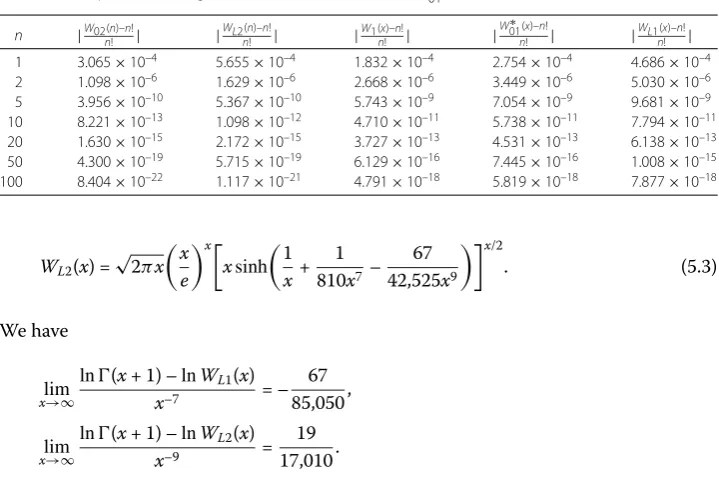
Table 1 Comparison amongW02(1.9),WL2(5.3),W1(1.3),W∗01(1.10) andWL1(5.2)
n |W02(n)–n!
n! | |WL2(
n)–n!
n! | |
W1(x)–n!
n! | |
W01∗(x)–n!
n! | |WL1(
x)–n!
n! |
1 3.065×10⁻⁴ 5.655×10⁻⁴ 1.832×10⁻⁴ 2.754×10⁻⁴ 4.686×10⁻⁴
2 1.098×10⁻⁶ 1.629×10⁻⁶ 2.668×10⁻⁶ 3.449×10⁻⁶ 5.030×10⁻⁶
5 3.956×10⁻¹⁰ 5.367×10⁻¹⁰ 5.743×10⁻⁹ 7.054×10⁻⁹ 9.681×10⁻⁹
10 8.221×10⁻¹³ 1.098×10⁻¹² 4.710×10⁻¹¹ 5.738×10⁻¹¹ 7.794×10⁻¹¹
20 1.630×10⁻¹⁵ 2.172×10⁻¹⁵ 3.727×10⁻¹³ 4.531×10⁻¹³ 6.138×10⁻¹³
50 4.300×10⁻¹⁹ 5.715×10⁻¹⁹ 6.129×10⁻¹⁶ 7.445×10⁻¹⁶ 1.008×10⁻¹⁵
100 8.404×10⁻²² 1.117×10⁻²¹ 4.791×10⁻¹⁸ 5.819×10⁻¹⁸ 7.877×10⁻¹⁸
WL2(x) =√2πx
x e
x xsinh
1
x+
1 810x7–
67 42,525x9
x/2
. (5.3)
We have
lim
x→∞
ln(x+ 1) –lnWL1(x)
x–7 = –
67 85,050,
lim
x→∞
ln(x+ 1) –lnWL2(x)
x–9 =
19 17,010.
These, in combination with Corollaries2,1and3, show that the approximation for-mulaW02(x) given by (1.9) is the best among those listed above, which can be seen from comparison Table1.
6 Conclusion
In this paper, we provide four Windschitl type approximation formulas for the gamma function, and prove that those functions, involving the gamma function and Windschitl type functions, have good properties, including monotonicity and convexity. From these facts we obtain some new sharp Windschitl type bounds for the gamma and factorial functions. These sharp inequalities, together with numerical comparisons, illustrate that
W02(x) defined by (1.9) is the best approximation formula among those mentioned in Sect.5.
Moreover, we give a simple proof of Alzer’s inequalities (1.4), and improve and strengthen Lu et al.’s inequalities (1.6).
It is worth mentioning that our proofs of Theorems1–5are subtle and interesting, since the approximations deal with the gamma and hyperbolic sine functions, and it is difficult to establish their monotonicity and convexity by usual methods. Evidently, Lemmas2and 3play important roles.
Acknowledgements
The authors would like to express their sincere thanks to the anonymous referees for their great efforts to improve this paper.
Funding
This work was supported by the Fundamental Research Funds for the Central Universities (No. 2015ZD29) and the Higher School Science Research Funds of Hebei Province of China (No. Z2015137).
Competing interests
The authors declare that they have no competing interests.
Authors’ contributions
Author details
1College of Science and Technology, North China Electric Power University, Baoding, P.R. China.2Department of Science
and Technology, State Grid Zhejiang Electric Power Company Research Institute, Hangzhou, P.R. China.
Publisher’s Note
Springer Nature remains neutral with regard to jurisdictional claims in published maps and institutional affiliations.
Received: 3 March 2018 Accepted: 30 September 2018
References
1. Ramanujan, S.: The Lost Notebook and Other Unpublished Papers. Springer, Berlin (1988) 2. Burnside, W.: A rapidly convergent series for logN!. Messenger Math.46, 157–159 (1917)
3. Gosper, R.W.: Decision procedure for indefinite hypergeometric summation. Proc. Natl. Acad. Sci. USA75, 40–42 (1978).https://doi.org/10.1073/pnas.75.1.40
4. Alzer, H.: On some inequalities for the gamma and psi functions. Math. Comput.66(217), 373–389 (1997).
https://doi.org/10.1090/S0025-5718-97-00807-7
5. Shi, X., Liu, F., Hu, M.: A new asymptotic series for the Gamma function. J. Comput. Appl. Math.195, 134–154 (2006).
https://doi.org/10.1016/j.cam.2005.03.081
6. Batir, N.: Inequalities for the gamma function. Arch. Math.91, 554–563 (2008).
https://doi.org/10.1007/s00013-008-2856-9
7. Batir, N.: Bounds for the Gamma function. Results Math.72, 865–874 (2017).
https://doi.org/10.1007/s00025-017-0698-0
8. Mortici, C.: A new Stirling series as continued fraction. Numer. Algorithms56(1), 17–26 (2011).
https://doi.org/10.1007/s11075-010-9370-4
9. Mortici, C.: Improved asymptotic formulas for the gamma function. Comput. Math. Appl.61, 3364–3369 (2011).
https://doi.org/10.1016/j.camwa.2011.04.036
10. Mortici, C.: Further improvements of some double inequalities for bounding the gamma function. Math. Comput. Model.57, 1360–1363 (2013).https://doi.org/10.1016/j.mcm.2012.11.020
11. Mortici, C.: A continued fraction approximation of the gamma function. J. Math. Anal. Appl.402, 405–410 (2013).
https://doi.org/10.1016/j.jmaa.2012.11.023
12. Mortici, C.: A new fast asymptotic series for the gamma function. Ramanujan J.38, 549–559 (2015).
https://doi.org/10.1007/s11139-014-9589-0
13. Nemes, G.: New asymptotic expansion for the Gamma function. Arch. Math. (Basel)95, 161–169 (2010).
https://doi.org/10.1007/s00013-010-0146-9
14. Nemes, G.: More accurate approximations for the gamma function. Thai J. Math.9(1), 21–28 (2011)
15. Guo, B.N., Zhang, Y.J., Qi, F.: Refinements and sharpenings of some double inequalities for bounding the gamma function. J. Inequal. Pure Appl. Math.9(1), Article ID 17 (2008)
16. Qi, F.: Integral representations and complete monotonicity related to the remainder of Burnside’s formula for the gamma function. J. Comput. Appl. Math.268, 155–167 (2014).https://doi.org/10.1016/j.cam.2014.03.004
17. Feng, L., Wang, W.: Two families of approximations for the gamma function. Numer. Algorithms64, 403–416 (2013).
https://doi.org/10.1007/s11075-012-9671-x
18. Chen, C.-P.: Unified treatment of several asymptotic formulas for the gamma function. Numer. Algorithms64, 311–319 (2013).https://doi.org/10.1007/s11075-012-9667-6
19. Chen, C.-P.: Asymptotic expansions of the gamma function related to Windschitl’s formula. Appl. Math. Comput.245, 174–180 (2014).https://doi.org/10.1016/j.amc.2014.07.080
20. Chen, C.-P., Paris, R.B.: Inequalities, asymptotic expansions and completely monotonic functions related to the gamma function. Appl. Math. Comput.250, 514–529 (2015).https://doi.org/10.1016/j.amc.2014.11.010
21. Chen, C.-P.: A more accurate approximation for the gamma function. J. Number Theory164, 417–428 (2016).
https://doi.org/10.1016/j.jnt.2015.11.007
22. Yang, Z.-H., Chu, Y.-M.: Asymptotic formulas for gamma function with applications. Appl. Math. Comput.270, 665–680 (2015).https://doi.org/10.1016/j.amc.2015.08.087
23. Yang, Z.-H.: Approximations for certain hyperbolic functions by partial sums of their Taylor series and completely monotonic functions related to gamma function. J. Math. Anal. Appl.441, 549–564 (2016).
https://doi.org/10.1016/j.jmaa.2016.04.029
24. Yang, Z.-H., Tian, J.-F.: Monotonicity and inequalities for the gamma function. J. Inequal. Appl.2017, Article ID 317 (2017).https://doi.org/10.1186/s13660-017-1591-9
25. Yang, Z.-H., Tian, J.-F.: An accurate approximation formula for gamma function. J. Inequal. Appl.2018, Article ID 56 (2018).https://doi.org/10.1186/s13660-018-1646-6
26. Lu, D.: A new sharp approximation for the Gamma function related to Burnside’s formula. Ramanujan J.35(1), 121–129 (2014).https://doi.org/10.1007/s11139-013-9534-7
27. Lu, D., Song, L., Ma, C.: A generated approximation of the gamma function related to Windschitl’s formula. J. Number Theory140, 215–225 (2014).https://doi.org/10.1016/j.jnt.2014.01.023
28. Lu, D., Song, L., Ma, C.: Some new asymptotic approximations of the gamma function based on Nemes’ formula, Ramanujan’s formula and Burnside’s formula. Appl. Math. Comput.253, 1–7 (2015).
https://doi.org/10.1016/j.amc.2014.12.077
29. Xu, A., Hu, Y., Tang, P.: Asymptotic expansions for the gamma function. J. Number Theory169, 134–143 (2016).
https://doi.org/10.1016/j.jnt.2016.05.020
30. Qi, F., Niu, D.-W., Guo, B.-N.: Monotonic properties of differences for remainders of psi function. Int. J. Pure Appl. Math. Sci.4(1), 59–66 (2007)
32. Shi, X.-Q., Liu, F.-S., Qu, H.-M.: The Burnside approximation of gamma function. Anal. Appl.8(3), 315–322 (2010).
https://doi.org/10.1142/S0219530510001643
33. Qi, F., Guo, B.-N.: Some properties of extended remainder of Binet’s first formula for logarithm of gamma function. Math. Slovaca60(4), 461–470 (2010).https://doi.org/10.2478/s12175-010-0025-7
34. Qi, F., Guo, B.-N.: Integral representations and complete monotonicity of remainders of the Binet and Stirling formulas for the gamma function. Rev. R. Acad. Cienc. Exactas Fís. Nat., Ser. A Mat.111(2), 425–434 (2017).
https://doi.org/10.1007/s13398-016-0302-6
35. Yang, Z.-H., Tian, J.-F.: Two asymptotic expansions for gamma function related to Windschitl’s formula. Open Math.16, 1048–1060 (2018).https://doi.org/10.1515/math-2018-0088
36. Smith, W.D.: The gamma function revisited.http://schule.bayernport.com/gamma/gamma05.pdf(2006) 37. Alzer, H.: Sharp upper and lower bounds for the gamma function. Proc. R. Soc. Edinb.139A, 709–718 (2009).
https://doi.org/10.1017/S0308210508000644
38. Yang, Z.-H., Chu, Y.-M., Zhang, X.-H.: Sharp bounds for psi function. Appl. Math. Comput.268, 1055–1063 (2015).
https://doi.org/10.1016/j.amc.2015.07.012
39. Yang, Z.-H., Chu, Y.-M., Tao, X.-J.: A double inequality for the trigamma function and its applications. Abstr. Appl. Anal.
2014, Article ID 702718 (2014).https://doi.org/10.1155/2014/702718
40. Yang, Z.-H., Tian, J.: Monotonicity and sharp inequalities related to gamma function. J. Math. Inequal.12(1), 1–22 (2018).https://doi.org/10.7153/jmi-2018-12-01
41. Yang, Z.-H., Tian, J.: Convexity and monotonicity for the elliptic integrals of the first kind and applications.
arXiv:1705.05703[math.CA]
42. Yang, Z.-H., Qian, W.-M., Chu, Y.-M., Zhang, W.: On approximating the arithmetic-geometric mean and complete elliptic integral of the first kind. J. Math. Anal. Appl.462, 1714–1726 (2018).https://doi.org/10.1016/j.jmaa.2018.03.005
43. Tian, J., Wang, W., Cheung, W.-S.: Periodic boundary value problems for first-order impulsive difference equations with time delay. Adv. Differ. Equ.2018, Article ID 79 (2018).https://doi.org/10.1186/s13662-018-1539-5
44. Tian, J.-F.: Triple Diamond-Alpha integral and Hölder-type inequalities. J. Inequal. Appl.2018, Article ID 111 (2018).
https://doi.org/10.1186/s13660-018-1704-0
45. Tian, J.-F., Ha, M.-H.: Extensions of Hölder’s inequality via pseudo-integral. Math. Probl. Eng.2018, Article ID 4080619 (2018).https://doi.org/10.1155/2018/4080619