R E S E A R C H
Open Access
Simple form of a projection set in hybrid
iterative schemes for non-linear mappings,
application of inequalities and computational
experiments
Li Wei
1*and Ravi P. Agarwal
2,3*Correspondence:
[email protected] 1School of Mathematics and Statistics, Hebei University of Economics and Business, Shijiazhuang, China
Full list of author information is available at the end of the article
Abstract
Some relaxed hybrid iterative schemes for approximating a common element of the sets of zeros of infinite maximal monotone operators and the sets of fixed points of infinite weakly relatively non-expansive mappings in a real Banach space are
presented. Under mild assumptions, some strong convergence theorems are proved. Compared to recent work, two new projection sets are constructed, which avoids calculating infinite projection sets for each iterative step. Some inequalities are employed sufficiently to show the convergence of the iterative sequences. A specific example is listed to test the effectiveness of the new iterative schemes, and
computational experiments are conducted. From the example, we can see that although we have infinite choices to choose the iterative sequences from an interval, different choice corresponds to different rate of convergence.
Keywords: Iterative scheme; Lyapunov functional; Metric projection; Maximal monotone operator; Weakly relatively non-expansive mapping
1 Introduction
Throughout this paper, letXbe a real Banach space with norm · andX∗be the dual space ofX. LetKbe a non-empty closed and convex subset ofX. Letx,fbe the value of
f ∈X∗atx∈X. We writexn→xto denote that{xn}converges strongly toxandxnx to denote that{xn}converges weakly tox.
Suppose thatAis a multi-valued operator fromXintoX∗.Ais said to be monotone [1] if for∀vi∈Aui,i= 1, 2, one hasu1–u2,v1–v2 ≥0. The monotone operatorAis called maximal monotone ifR(J+kA) =X∗, fork> 0, whereJ:X→2X∗is the normalized duality mapping defined by
J(x) =f ∈X∗:x,f=x2=f2, ∀x∈X.
A pointx∈D(A) is called a zero ofAifAx= 0. The set of zeros ofAis denoted byA–10. Suppose that the Lyapunov functionalφ:X×X→(0, +∞) is defined as follows:
φ(x,y) =x2– 2x,j(y)+y2, ∀x,y∈X,j(y)∈J(y).
LetTbe a single-valued mapping ofKinto itself.
(1) IfTp=p, thenpis called a fixed point ofT. AndFix(T)denotes the set of fixed points ofT;
(2) If there exists a sequence{xn} ⊂Kwhich converges weakly top∈Ksuch that
xn–Txn→0, asn→ ∞, thenpis called an asymptotic fixed point ofT[2]. And
Fix(T)denotes the set of asymptotic fixed points ofT;
(3) If there exists a sequence{xn} ⊂Kwhich converges strongly top∈Ksuch that
xn–Txn→0, asn→ ∞, thenpis called a strong asymptotic fixed point ofT[2].
AndFix(T)denotes the set of strong asymptotic fixed points ofT; (4) Tis called strongly relatively non-expansive [2] ifFix(T) =Fix(T)=∅and
φ(p,Tx)≤φ(p,x)forx∈Kandp∈Fix(T);
(5) Tis called weakly relatively non-expansive [2] ifFix(T) =Fix(T)=∅and
φ(p,Tx)≤φ(p,x)forx∈Kandp∈Fix(T).
IfX is a real reflexive and strictly convex Banach space andK is a non-empty closed and convex subset ofX, then for eachx∈Xthere exists a unique pointx0∈Ksuch that
x–x0=inf{x–y:y∈K}. In this case, we can define the metric projection mapping
PK:X→KbyPKx=x0for∀x∈X[3].
IfXis a real reflexive, strictly convex, and smooth Banach space andKis a non-empty closed and convex subset ofX, then for∀x∈X, there exists a unique pointx0∈K such thatφ(x0,x) =inf{φ(y,x) :y∈K}. In this case, we can define the generalized projection mappingK:X→KbyKx=x0for∀x∈X[3].
Note that ifXis a Hilbert spaceH, thenPKandKare coincidental.
Since maximal monotone operators and weakly (or strongly) relatively non-expansive mappings have close connection with practical problems, one has a good reason to study them. During past years, much work has been done in designing iterative schemes to ap-proximate a common element of the set of zeros of maximal monotone operators and the set of fixed points of weakly (or strongly) relatively non-expansive mappings. Among them, a projection iterative scheme is considered as one of the effective iterative schemes which almost always generates strongly convergent iterative sequences (see [4–8] and the references therein). Next, we list some recent closely related work.
Klin-eam et al. [5] presented the following projection iterative scheme for maximal monotone operatorAand two strongly relatively non-expansive mappingsBandC in a real uniformly convex and uniformly smooth Banach spaceX.
⎧ ⎪ ⎪ ⎪ ⎪ ⎪ ⎪ ⎪ ⎪ ⎨ ⎪ ⎪ ⎪ ⎪ ⎪ ⎪ ⎪ ⎪ ⎩
vn=J–1[βnJxn+ (1 –βn)JC(J+rnA)–1Jxn],
yn=J–1[αnJxn+ (1 –αn)JBvn],
Hn={p∈K:φ(p,yn)≤φ(p,xn)},
Vn={p∈K:p–xn,Jx1–Jxn ≤0},
xn+1=Hn∩Vn(x1), n∈N.
(1.1)
Then{xn}generated by (1.1) converges strongly toA–10∩Fix(B)∩Fix(C)(x1).
uniformly convex and uniformly smooth Banach spaceXis presented [4]. ⎧ ⎪ ⎪ ⎪ ⎪ ⎪ ⎪ ⎪ ⎪ ⎪ ⎪ ⎪ ⎪ ⎪ ⎪ ⎪ ⎪ ⎪ ⎪ ⎪ ⎪ ⎪ ⎪ ⎪ ⎪ ⎪ ⎪ ⎨ ⎪ ⎪ ⎪ ⎪ ⎪ ⎪ ⎪ ⎪ ⎪ ⎪ ⎪ ⎪ ⎪ ⎪ ⎪ ⎪ ⎪ ⎪ ⎪ ⎪ ⎪ ⎪ ⎪ ⎪ ⎪ ⎪ ⎩
x1∈X, r1> 0,
yn= (J+rnA)–1J(xn+en),
zn=J–1[αnJxn+ (1 –αn)Jyn],
un=J–1[βnJxn+ (1 –βn)JBzn],
H1={p∈X:φ(p,z1)≤α1φ(p,x1) + (1 –α1)φ(p,x1+e1)},
V1={p∈X:φ(p,u1)≤β1φ(p,x1) + (1 –β1)φ(p,z1)},
W1=X,
Hn={p∈Hn–1∩Vn–1∩Wn–1:φ(p,zn)≤αnφ(p,xn) + (1 –αn)φ(p,xn+en)},
Vn={p∈Hn–1∩Vn–1∩Wn–1:φ(p,un)≤βnφ(p,xn) + (1 –βn)φ(p,zn)},
Wn={p∈Hn–1∩Vn–1∩Wn–1:p–xn,Jx1–Jxn ≤0},
xn+1=Hn∩Vn∩Wn(x1), n∈N.
(1.2)
Then{xn}generated by (1.2) converges strongly toA–10∩Fix(B)(x1).
In recent work, Wei et al. [8] extended the corresponding topic to the case for infinite maximal monotone operatorsAiand infinite weakly relatively non-expansive mappings
Bi.
⎧ ⎪ ⎪ ⎪ ⎪ ⎪ ⎪ ⎪ ⎪ ⎪ ⎪ ⎪ ⎪ ⎪ ⎪ ⎪ ⎪ ⎪ ⎪ ⎪ ⎪ ⎪ ⎪ ⎪ ⎨ ⎪ ⎪ ⎪ ⎪ ⎪ ⎪ ⎪ ⎪ ⎪ ⎪ ⎪ ⎪ ⎪ ⎪ ⎪ ⎪ ⎪ ⎪ ⎪ ⎪ ⎪ ⎪ ⎪ ⎩
x1∈X, r1,i∈(0, +∞), i∈N,
yn,i= (J+rn,iAi)–1J(xn+en), i∈N,
zn,i=J–1[αnJxn+ (1 –αn)JBiyn,i], i∈N,
V1=X=W1,
Vn+1,i={p∈X:yn,i–p,J(xn+en) –Jyn,i ≥0}, i∈N,
Vn+1= (
∞
i=1Vn+1,i)∩Vn,
Wn+1,i={p∈Vn+1,i:φ(p,zn,i)≤αnφ(p,xn) + (1 –αn)φ(p,yn,i)}, i∈N,
Wn+1= (∞i=1Wn+1,i)∩Wn,
Un+1={p∈Wn+1:x1–p2≤ PWn+1(x1) –x1
2+λ n+1},
xn+1∈Un+1, n∈N.
(1.3)
Then{xn}generated by (1.3) converges strongly to
P∞
n=1Wn(x1)∈
∞
i=1
A–1i 0
∩
∞
i=1 Fix(Bi)
.
Compared to traditional (monotone) projection iterative schemes (e.g., (1.1) and (1.2)), some different ideas in (1.3) can be seen. (1) Metric projection mappingPWn+1instead of
A special case of (1.3) is presented as Corollary 2.13 in [8]. Now, we rewrite it as follows:
⎧ ⎪ ⎪ ⎪ ⎪ ⎪ ⎪ ⎪ ⎪ ⎪ ⎪ ⎪ ⎪ ⎪ ⎪ ⎪ ⎪ ⎪ ⎨ ⎪ ⎪ ⎪ ⎪ ⎪ ⎪ ⎪ ⎪ ⎪ ⎪ ⎪ ⎪ ⎪ ⎪ ⎪ ⎪ ⎪ ⎩
x1∈H, e1∈H,
yn= (I+rnA)–1(xn+en),
zn=αnxn+ (1 –αn)Byn,
U1=H=V1,
Un+1={p∈Un: (yn–p)(xn+en–yn)≥0,
p–zn2≤αnp–xn2+ (1 –αn)p–yn2},
Vn+1={p∈Un+1:x1–p2≤ PUn+1(x1) –x12+λn+1},
xn+1∈Vn+1, n∈N.
(1.4)
Based on iterative scheme (1.4), an iterative sequence is defined as follows after taking
H= (–∞, +∞),Ax= 2x,Bx=xforx∈(–∞, +∞),en=αn=λn=1n, andrn= 2n–1:
⎧ ⎪ ⎪ ⎪ ⎨ ⎪ ⎪ ⎪ ⎩
x1= 1,
yn=xn1+2+enrn, n∈N,
xn+1= x1+yn–
√
(x1–yn)2+λn+1
2 , n∈N.
(1.5)
A computational experiment based on (1.5) is conducted in [8], from which we can see the effectiveness of iterative scheme (1.4).
Inspired by the work of [8], three questions come to our mind. (1) In iterative scheme (1.3), in each iterative stepn, countable setsVn+1,iandWn+1,iare needed to be evaluated. It is formidable. Can we avoid it? (2)xn+1in either (1.3) or (1.4) can be chosen arbitrarily in a set, can a different choice ofxn+1inVn+1lead to a different rate of convergence? (3) Which one is better, our new one or those in [8]? In this paper, we shall answer the questions, con-struct new simple projection sets in theoretical sense, and do computational experiments for some special cases.
2 Preliminaries
In this section, we list some definitions and results we need later. The modulus of convexity ofX,δX: [0, 2]→[0, 1], is defined as follows [9]:
δX( ) =sup
1 –x+y
2 :x,y∈X,x=y= 1,x–y ≥
for∀ ∈[0, 2]. A Banach spaceXis called uniformly convex [9] ifδX( ) > 0 for∀ ∈[0, 2]. A Banach spaceXis called uniformly smooth [9] if the limitlimt→0x+tyt–x is attained uniformly for (x,y)∈X×Xwithx=y= 1.
Xis said to have Property (H): if for every sequence{xn} ⊂Xconverging weakly tox∈X andxn → x, one hasxn→x, asn→ ∞. The uniformly convex and uniformly smooth Banach spaceXhas Property (H).
It is well known that ifXis a real uniformly convex and uniformly smooth Banach space, then the normalized duality mapping Jis single-valued, surjective andJ(kx) =kJ(x) for
intoX, and bothJandJ–1are uniformly continuous on each bounded subset ofXorX∗, respectively [9].
Lemma 2.1([2]) Suppose that X is a uniformly convex and uniformly smooth Banach space and K is a non-empty closed and convex subset of X.If B:K→K is weakly relatively non-expansive,thenFix(B)is a closed and convex subset of X.
Lemma 2.2([1]) Let A:X→2X∗be a maximal monotone operator,then
(1) A–10is a closed and convex subset ofX;
(2) ifxn→xandyn∈Axnwithyny,orxnxandyn∈Axnwithyn→y,then
x∈D(A)andy∈Ax.
Lemma 2.3([8]) Let K be a non-empty closed and convex subset of a uniformly smooth Banach space X.Let x∈X and x0∈K.Thenφ(x0,x) =infy∈Kφ(y,x)if and only ifx0–
z,Jx–Jx0 ≥0for all z∈K.
Lemma 2.4([10]) Let X be a real uniformly smooth and uniformly convex Banach space,
and let{xn}and{yn}be two sequences of X.If either{xn}or{yn}is bounded andφ(xn,yn)→ 0as n→ ∞,then xn–yn→0as n→ ∞.
Lemma 2.5([11]) Let X be a real uniformly smooth and uniformly convex Banach space
and A:X→2X∗be a maximal monotone operator with A–10=∅.Then,for∀x∈X,∀y∈ A–10,and r> 0,one hasφ(y, (J+rA)–1Jx) +φ((J+rA)–1Jx,x)≤φ(y,x).
Let{Kn}be a sequence of non-empty closed and convex subsets ofX. Then the strong lower limit of{Kn},s-lim infKn, is defined as the set of allx∈Xsuch that there existsxn∈
Knfor almost allnand it tends toxasn→ ∞in the norm; the weak upper limit of{Kn},
w-lim supKn, is defined as the set of allx∈Xsuch that there exists a subsequence{Knm} of{Kn}andxnm∈Knmfor everynmand it tends toxasnm→ ∞in the weak topology; the limit of{Kn},limKn, is the common value whens-lim infKn=w-lim supKn[12].
Lemma 2.6([12]) Let{Kn}be a decreasing sequence of closed and convex subsets of X,i.e.,
Kn⊂Kmif n≥m.Then{Kn}converges in X andlimKn=
∞
n=1Kn.
Lemma 2.7([13]) Suppose that X is a real uniformly convex Banach space.IflimKnexists
and is not empty,then{PKnx}converges weakly to PlimKnx for every x∈X.Moreover,if X
has Property(H),the convergence is in norm.
Lemma 2.8([14]) Let X be a real uniformly convex Banach space and r∈(0, +∞).Then there exists a continuous, strictly increasing, and convex function η: [0, 2r]→[0, +∞)
with η(0) = 0such that kx+ (1 –k)y2≤kx2+ (1 –k)y2–k(1 –k)η(x–y)for k∈[0, 1],x,y∈X withx ≤r andy ≤r.
Lemma 2.9 ([15]) Let X be the same as that in Lemma2.8. Then there exists a con-tinuous,strictly increasing,and convex functionη: [0, 2r]→[0, +∞)withη(0) = 0such that ∞i=1kixi2≤∞i=1kixi2–k1kmη(x1–xm)for all {xn}∞n=1⊂ {x∈X:x ≤r},
{kn}∞n=1⊂(0, 1)with
∞
3 Main results
In this section, our discussion is based on the following conditions:
(I1) Xis a real uniformly convex and uniformly smooth Banach space andJ:X→X∗is
the normalized duality mapping;
(I2) Ai:X→X∗is maximal monotone andBi:X→Xis weakly relatively non-expansive
for eachi∈N. And(∞i=1A–1 i 0)∩(
∞
i=1Fix(Bi))=∅;
(I3) {en} ⊂Xis the error sequence such thaten→0, asn→ ∞;
(I4) {rn,i}and{λn}are two real number sequences in(0, +∞)withinfnrn,i> 0fori∈N
andλn→0, asn→ ∞;
(I5) {an,i}and{bi}are two real number sequences in(0, 1)and
∞
i=1an,i= 1 =
∞ i=1bifor
n∈N;
(I6) {αn}and{βn}are two real number sequences in[0, 1).
Theorem 3.1 Let{xn}be generated by the following iterative scheme:
⎧ ⎪ ⎪ ⎪ ⎪ ⎪ ⎪ ⎪ ⎪ ⎪ ⎪ ⎪ ⎪ ⎪ ⎪ ⎪ ⎪ ⎪ ⎨ ⎪ ⎪ ⎪ ⎪ ⎪ ⎪ ⎪ ⎪ ⎪ ⎪ ⎪ ⎪ ⎪ ⎪ ⎪ ⎪ ⎪ ⎩
x1∈X, e1∈X,
yn=J–1[αnJxn+ (1 –αn)
∞
i=1an,iJ(J+rn,iAi)–1J(xn+en)],
zn=J–1[βnJxn+ (1 –βn)
∞
i=1biJBiyn],
U1=X=V1,
Un+1={v∈Un:φ(v,yn)≤αnφ(v,xn) + (1 –αn)φ(v,xn+en),
φ(v,zn)≤βnφ(v,xn) + (1 –βn)φ(v,yn)},
Vn+1={v∈Un+1:x1–v2≤ PUn+1(x1) –x1
2+λ n+1},
xn+1∈Vn+1, n∈N.
(3.1)
If 0 ≤ supnαn < 1 and 0 ≤ supnβn < 1, then xn → P∞m=1Um(x1) ∈ (
∞
i=1A–1i 0) ∩ (∞i=1Fix(Bi)),as n→ ∞.
Proof We split the proof into seven steps.
Step1.Unis a non-empty closed and convex subset ofXfor eachn∈N. Noticing the definition of Lyapunov functional, we have
φ(v,yn)≤αnφ(v,xn) + (1 –αn)φ(v,xn+en)
⇐⇒ 2αnv,Jxn+ 2(1 –αn)
v,J(xn+en)
– 2v,Jyn
≤αnxn2+ (1 –αn)xn+en2–yn2
and
φ(v,zn)≤βnφ(v,xn) + (1 –βn)φ(v,yn)
⇐⇒ 2βnv,Jxn+ 2(1 –βn)v,Jyn– 2v,Jzn
≤βnxn2+ (1 –βn)yn2–zn2.
ThusUnis closed and convex for eachn∈N.
For this, we shall use inductive method. Now,∀q∈(∞i=1A–1 i 0)∩(
∞
i=1Fix(Bi)). If n= 1, then q∈U1 =X is obviously true. In view of the convexity of · 2 and Lemma2.5, we have
φ(q,y1) =q2– 2
q,α1Jx1+ (1 –α1) ∞
i=1
a1,iJ(J+r1,iAi)–1J(x1+e1)
+
α1Jx1+ (1 –α1) ∞
i=1
a1,iJ(J+r1,iAi)–1J(x1+e1)
2
≤ q2– 2α1q,Jx1– 2(1 –α1) ∞
i=1
a1,i
q,J(J+r1,iAi)–1J(x1+e1)
+α1x12+ (1 –α1) ∞
i=1
a1,i(J+r1,iAi)–1J(x1+e1)2
=α1φ(q,x1) + (1 –α1) ∞
i=1
a1,iφ
q, (J+r1,iAi)–1J(x1+e1)
≤α1φ(q,x1) + (1 –α1)φ(q,x1+e1).
Moreover, from the definition of weakly relatively non-expansive mapping, we have
φ(q,z1)≤ q2– 2β1q,Jx1– 2(1 –β1) ∞
i=1
biq,JBiy1
+β1x12+ (1 –β1) ∞
i=1
biBiy12
=β1φ(q,x1) + (1 –β1) ∞
i=1
biφ(q,Biy1)≤β1φ(q,x1) + (1 –β1)φ(q,y1).
Thusq∈U2.
Suppose the result is true forn=k+ 1. Then, ifn=k+ 2, we have
φ(q,yk+1) =q2– 2
q,αk+1Jxk+1+ (1 –αk+1) ∞
i=1
ak+1,iJ(J+rk+1,iAi)–1J(xk+1+ek+1)
+
αk+1Jxk+1+ (1 –αk+1) ∞
i=1
ak+1,iJ(J+rk+1,iAi)–1J(xk+1+ek+1)
2
≤ q2– 2αk+1q,Jxk+1
– 2(1 –αk+1) ∞
i=1
ak+1,i
q,J(J+rk+1,iAi)–1J(xk+1+ek+1)
+αk+1xk+12+ (1 –αk+1) ∞
i=1
ak+1,i(J+rk+1,iAi)–1J(xk+1+ek+1)2
=αk+1φ(q,xk+1) + (1 –αk+1) ∞
i=1
ak+1,iφ
q, (J+rk+1,iAi)–1J(xk+1+ek+1)
Moreover,
φ(q,zk+1)≤ q2– 2βk+1q,Jxk+1– 2(1 –βk+1) ∞
i=1
biq,JBiyk+1
+βk+1xk+12+ (1 –βk+1) ∞
i=1
biBiyk+12
=βk+1φ(q,xk+1) + (1 –βk+1) ∞
i=1
biφ(q,Biyk+1)
≤βk+1φ(q,xk+1) + (1 –βk+1)φ(q,yk+1).
Thenq∈Uk+2. Therefore, by induction, (
∞
i=1A–1i 0)∩(
∞
i=1Fix(Bi))⊂Unforn∈N.
Step2.PUn+1(x1)→P∞m=1Um(x1), asn→ ∞.
It follows from Lemma 2.6thatlimUnexists andlimUn=
∞
n=1Un=∅. Since Xhas Property (H), then Lemma2.7implies thatPUn+1(x1)→P∞m=1Um(x1), asn→ ∞.
Step3.Vn=∅, forN∪ {0}, which ensures that{xn}is well defined.
SincePUn+1(x1) –x1=infy∈Un+1y–x1, then forλn+1, there existsδn+1∈Un+1 such
thatx1–δn+12≤(infy∈Un+1x1–y)
2+λ
n+1=PUn+1(x1) –x1
2+λ
n+1. This ensures that
Vn+1=∅forn∈N∪ {0}.
Step4. Both{xn}and{PUn+1(x1)}are bounded.
Sinceλn→0, then there existsM1> 0 such thatλn<M1forn∈N. Step 2 implies that
{PUn+1(x1)}is bounded, and then there existsM2> 0 such thatPUn+1(x1) ≤M2forn∈N.
SetM= (M2+x1)2+M1. Sincexn+1∈Vn+1, thenx1–xn+12≤ PUn+1(x1) –x12+λn+1≤
M,∀n∈N. Thus{xn}is bounded.
Step5.xn+1–PUn+1(x1)→0, asn→ ∞.
Sincexn+1∈Vn+1⊂Un+1andUnis a convex subset ofX, then for∀k∈(0, 1),kPUn+1(x1) +
(1 –k)xn+1∈Un+1. Thus
PUn+1(x1) –x1≤kPUn+1(x1) + (1 –k)xn+1–x1. (3.2)
Since{xn}is bounded, it follows from (3.2) and Lemma2.8that
PUn+1(x1) –x1
2≤
kPUn+1(x1) + (1 –k)xn+1–x1
2
≤kPUn+1(x1) –x1
2
+ (1 –k)xn+1–x12
–k(1 –k)ηPUn+1(x1) –xn+1.
Therefore,kη(PUn+1(x1) –xn+1)≤ xn+1–x12–PUn+1(x1) –x12≤λn+1. Lettingk→1
first and thenn→ ∞, we know thatPUn+1(x1) –xn+1→0, asn→ ∞.
Step6.xn→P∞m=1Um(x1),yn→P∞m=1Um(x1) andzn→P∞m=1Um(x1), asn→ ∞. From Step 2 and Step 5, we know thatxn→P∞m=1Um(x1), asn→ ∞. And thenxn+1–
xn→0, asn→ ∞. Sincexn+1∈Vn+1⊂Un+1anden→0, then
+ (1 –αn)xn+12+ (1 –αn)xn+en2– 2(1 –αn)
xn+1,J(xn+en)
=xn+12–αnxn2– (1 –αn)xn+en2 + 2αnxn–xn+1,Jxn+ 2(1 –αn)
xn+en–xn+1,J(xn+en)
≤xn+12–xn+en2
+αn
xn+en2–xn2
+ 2αnxnxn+1–xn + 2(1 –αn)xn+enxn+en–xn+1 →0.
Then Lemma2.4implies thatxn+1–yn→0 and thenyn→P∞m=1Um(x1), asn→ ∞. Sincexn+1∈Vn+1⊂Un+1 andJis uniformly continuous on each bounded subset ofX, then
0≤φ(xn+1,zn)≤βnφ(xn+1,xn) + (1 –βn)φ(xn+1,yn) =βn
xn+1,Jxn+1–Jxn+xn–xn+1,Jxn
+ (1 –βn)φ(xn+1,yn)
≤βnxn+1Jxn+1–Jxn+βnxnxn+1–xn+ (1 –βn)φ(xn+1,yn)→0.
Using Lemma2.4again, we havexn+1–zn→0 and thenzn→P∞m=1Um(x1), asn→ ∞.
Step7.P∞
m=1Um(x1)∈(
∞
i=1A–1i 0)∩(
∞
i=1Fix(Bi)). First, we shall show thatP∞
m=1Um(x1)∈
∞ i=1A–1i 0.
From (3.1) and Lemma2.5, for∀q∈(∞i=1A–1i 0)∩(∞i=1Fix(Bi)), we have
φ(q,yn)≤αnφ(q,xn) + (1 –αn) ∞
i=1
an,iφ
q, (J+rn,iAi)–1J(xn+en)
≤αnφ(q,xn) + (1 –αn)
∞
i=1
an,i
φ(q,xn+en) –φ
(J+rn,iAi)–1J(xn+en),xn+en
.
Then
(1 –αn) ∞
i=1
an,iφ
(J+rn,iAi)–1J(xn+en),xn+en
≤αnφ(q,xn) –φ(q,yn) + (1 –αn)φ(q,xn+en) =αn
φ(q,xn) –φ(q,xn+en)
+φ(q,xn+en) –φ(q,yn)
≤ xn2–xn+en2+ 2qJ(xn+en) –Jxn
+xn+en2–yn2+ 2qJyn–J(xn+en).
Since 0≤supnαn< 1, then
∞
i=1an,iφ((J+rn,iAi)–1J(xn+en),xn+en)→0, which implies from Lemma2.4that (J+rn,iAi)–1J(xn+en) – (xn+en)→0, asn→ ∞. Thus from Step 6, (J+rn,iAi)–1J(xn+en)→P∞m=1Um(x1), asn→ ∞.
Denote un,i = (J +rn,iAi)–1J(xn+en), then Jun,i+rn,iAiun,i =J(xn+en). Since un,i →
P∞
m=1Um(x1), xn→P
∞
m=1Um(x1),en→0,infnrn,i> 0 andJ is uniformly continuous on
each bounded subset of X, then Aiun,i→0 fori∈N, as n→ ∞. Using Lemma 2.2,
P∞
m=1Um(x1)∈
Next, we shall show thatP∞
m=1Um(x1)∈
∞
i=1Fix(Bi). Sincezn=J–1[βnJxn+ (1 –βn)
∞
i=1biJBiyn], thenJzn–Jxn= (1 –βn)(
∞
i=1biJBiyn–Jxn). Since both J and J–1 are uniformly continuous on each bounded subset of X, z
n →
P∞
m=1Um(x1),xn→P
∞
m=1Um(x1) and 0≤supnβn< 1, then
∞
i=1biJBiyn–Jxn→0, which implies thatJ–1(∞
i=1biJBiyn)→P∞m=1Um(x1), asn→ ∞. Employing Lemma2.9, for∀q∈(∞i=1A–1
i 0)∩(
∞
i=1Fix(Bi)), we have
φ
q,J–1
∞
i=1
biJBiyn
=q2– 2
q,
∞
i=1
biJBiyn
+ ∞ i=1
biJBiyn
2
≤ q2– 2 ∞
i=1
biq,JBiyn+ ∞
i=1
biBiyn2–b1bkη
JB1yn–JBkyn
= ∞
i=1
biφ(q,Biyn) –b1bkη
JB1yn–JBkyn
. (3.3)
SinceJyn→JP∞m=1Um(x1) and
∞
i=1biJBiyn→JP∞m=1Um(x1), then from the definition of weakly relatively non-expansive mapping and (3.3), we have
b1bkη
JB1yn–JBkyn
≤
∞
i=1
biφ(q,Biyn) –φ
q,J–1
∞
i=1
biJBiyn
≤
∞
i=1
biφ(q,yn) –φ
q,J–1
∞
i=1
biJBiyn
=yn2– 2q,Jyn+ 2 ∞
i=1
biq,JBiyn–
∞ i=1
biJBiyn
2
→0,
asn→ ∞. This ensures thatJB1yn–JBkyn→0 fork= 1, asn→ ∞.
Since yn→P∞m=1Um(x1), then{yn} is bounded. Since (q–Biyn)2 ≤φ(q,Biyn)≤
φ(q,yn)≤(q+yn)2, then Biyn ≤ q or Biyn ≤2q+yn, i∈N. SetK =
sup{yn:n∈N}+ 2q, thenK< +∞.
Since∞i=1bi= 1, then for∀ε> 0, there existsm0∈Nsuch that∞i=m0+1bi< ε 4K. SinceJB1yn–JBkyn→0, asn→ ∞, for∀k∈ {1, 2, . . . ,m0}, then we can choosen0∈N such thatJB1yn–JBkyn<2εfor alln≥n0andk∈ {2, . . . ,m0}. Then, ifn≥n0,
JB1yn–
∞
i=1
biJBiyn
≤ m0 i=2
biJB1yn–JBiyn+ ∞
i=m0+1
biJB1yn–JBiyn
< m0 i=2 bi ε 2+ ∞
i=m0+1
bi
2K<ε 2+
ε
2 =ε.
This implies thatJB1yn–
∞
Repeating the above process for showingP∞
m=1Um(x1)∈Fix(B1), we can also prove that
P∞
m=1Um(x1)∈Fix(Bk),∀k∈N. Therefore,P
∞
m=1Um(x1)∈
∞
i=1Fix(Bi).
This completes the proof.
Theorem 3.2 Let{xn}be generated by the following iterative scheme:
⎧ ⎪ ⎪ ⎪ ⎪ ⎪ ⎪ ⎪ ⎪ ⎪ ⎪ ⎪ ⎪ ⎪ ⎪ ⎪ ⎪ ⎪ ⎨ ⎪ ⎪ ⎪ ⎪ ⎪ ⎪ ⎪ ⎪ ⎪ ⎪ ⎪ ⎪ ⎪ ⎪ ⎪ ⎪ ⎪ ⎩
x1∈X, e1∈X,
yn=J–1[αnJx1+ (1 –αn)∞i=1an,iJ(J+rn,iAi)–1J(xn+en)],
zn=J–1[βnJx1+ (1 –βn)
∞
i=1biJBiyn],
U1=X=V1,
Un+1={v∈Un:φ(v,yn)≤αnφ(v,x1) + (1 –αn)φ(v,xn+en),
φ(v,zn)≤βnφ(v,x1) + (1 –βn)φ(v,yn)},
Vn+1={v∈Un+1:x1–v2≤ PUn+1(x1) –x1
2+λ n+1},
xn+1∈Vn+1, n∈N.
(3.4)
Ifαn→0,βn→0,then xn→P∞m=1Um(x1)∈(
∞
i=1A–1i 0)∩(
∞
i=1Fix(Bi)),as n→ ∞.
Proof Copy Steps 2, 3, 4, and 5 of Theorem3.1, and do small changes in Steps 1, 6, and 7 in the following way.
Step1.Unis a non-empty closed and convex subset ofX. We notice that
φ(v,yn)≤αnφ(v,x1) + (1 –αn)φ(v,xn+en)
⇐⇒ 2αnv,Jx1+ 2(1 –αn)
v,J(xn+en)
– 2v,Jyn
≤αnx12+ (1 –αn)xn+en2–yn2
and
φ(v,zn)≤βnφ(v,x1) + (1 –βn)φ(v,yn)
⇐⇒ 2βnv,Jx1+ 2(1 –βn)v,Jyn– 2v,Jzn
≤βnx12+ (1 –βn)yn2–zn2.
ThusUnis closed and convex forn∈N. Next, we shall prove that (∞i=1A–1
i 0)∩(
∞
i=1Fix(Bi))⊂Un, which ensures thatUn=∅. For this, we shall use inductive method. Now,∀q∈(∞i=1A–1
i 0)∩(
∞
i=1Fix(Bi)). Ifn= 1,q∈U1=Xis obviously true. In view of the convexity of · 2and Lemma2.5, we have
φ(q,y1) =q2– 2
q,α1Jx1+ (1 –α1) ∞
i=1
a1,iJ(J+r1,iAi)–1J(x1+e1)
+
α1Jx1+ (1 –α1) ∞
i=1
a1,iJ(J+r1,iAi)–1J(x1+e1)
≤ q2– 2α1q,Jx1– 2(1 –α1) ∞
i=1
a1,i
q,J(J+r1,iAi)–1J(x1+e1)
+α1x12+ (1 –α1) ∞
i=1
a1,i(J+r1,iAi)–1J(x1+e1) 2
=α1φ(q,x1) + (1 –α1) ∞
i=1
a1,iφ
q, (J+r1,iAi)–1J(x1+e1)
≤α1φ(q,x1) + (1 –α1)φ(q,x1+e1).
Moreover, from the definition of weakly relatively non-expansive mapping, we have
φ(q,z1)≤ q2– 2β1q,Jx1– 2(1 –β1) ∞
i=1
biq,JBiy1
+β1x12+ (1 –β1) ∞
i=1
biBiy12
=β1φ(q,x1) + (1 –β1) ∞
i=1
biφ(q,Biy1)≤β1φ(q,x1) + (1 –β1)φ(q,y1).
Thusq∈U2.
Suppose the result is true forn=k+ 1. Then, ifn=k+ 2, we have
φ(q,yk+1) =q2– 2
q,αk+1Jx1+ (1 –αk+1) ∞
i=1
ak+1,iJ(J+rk+1,iAi)–1J(xk+1+ek+1)
+
αk+1Jx1+ (1 –αk+1) ∞
i=1
ak+1,iJ(J+rk+1,iAi)–1J(xk+1+ek+1)
2
≤ q2– 2αk+1q,Jx1 – 2(1 –αk+1)
∞
i=1
ak+1,i
q,J(J+rk+1,iAi)–1J(xk+1+ek+1)
+αk+1x12+ (1 –αk+1) ∞
i=1
ak+1,i(J+rk+1,iAi)–1J(xk+1+ek+1) 2
=αk+1φ(q,x1) + (1 –αk+1) ∞
i=1
ak+1,iφ
q, (J+rk+1,iAi)–1J(xk+1+ek+1)
≤αk+1φ(q,x1) + (1 –αk+1)φ(q,xk+1+ek+1).
Moreover,
φ(q,zk+1)≤ q2– 2βk+1q,Jx1– 2(1 –βk+1) ∞
i=1
biq,JBiyk+1
+βk+1x12+ (1 –βk+1) ∞
i=1
=βk+1φ(q,x1) + (1 –βk+1) ∞
i=1
biφ(q,Biyk+1)
≤βk+1φ(q,x1) + (1 –βk+1)φ(q,yk+1).
Thenq∈Uk+2. Therefore, by induction,∅ = (
∞
i=1A–1i 0)∩(
∞
i=1Fix(Bi))⊂Un, forn∈N.
Step6.xn→P∞m=1Um(x1),yn→P∞m=1Um(x1), andzn→P∞m=1Um(x1), asn→ ∞. Following from the results of Step 2 and Step 5,xn→P∞m=1Um(x1), asn→ ∞. And then
xn+1–xn→0, asn→ ∞.
Sincexn+1∈Vn+1⊂Un+1,αn→0, anden→0, then
0≤φ(xn+1,yn)≤αnφ(xn+1,x1) + (1 –αn)φ(xn+1,xn+en) =αnxn+12+αnx12– 2αnxn+1,Jx1
+ (1 –αn)xn+12+ (1 –αn)xn+en2– 2(1 –αn)
xn+1,J(xn+en)
=xn+12–αnx12– (1 –αn)xn+en2 + 2αnx1–xn+1,Jx1+ 2(1 –αn)
xn+en–xn+1,J(xn+en)
≤xn+12–xn+en2
+αn
xn+en2–x12
+ 2αnx1xn+1–x1 + 2(1 –αn)xn+enxn+en–xn+1 →0,
asn→ ∞. Lemma2.4implies thatxn+1–yn→0 and thenyn→P∞m=1Um(x1) asn→ ∞. Sincexn+1∈Vn+1⊂Un+1andβn→0, then
0≤φ(xn+1,zn)≤βnφ(xn+1,x1) + (1 –βn)φ(xn+1,yn)→0.
Lemma2.4implies thatxn+1–zn→0 and thenzn→P∞m=1Um(x1) asn→ ∞.
Step7.P∞
m=1Um(x1)∈(
∞
i=1A–1i 0)∩(
∞
i=1Fix(Bi)). First, we shall show thatP∞
m=1Um(x1)∈
∞ i=1A–1i 0. From (3.4) and Lemma2.5, for∀q∈(∞i=1A–1
i 0)∩(
∞
i=1Fix(Bi)), we have
φ(q,yn)≤αnφ(q,x1) + (1 –αn) ∞
i=1
an,iφ
q, (J+rn,iAi)–1J(xn+en)
≤αnφ(q,x1) + (1 –αn)
∞
i=1
an,i
φ(q,xn+en) –φ
(J+rn,iAi)–1J(xn+en),xn+en
.
Thus
(1 –αn) ∞
i=1
an,iφ
(J+rn,iAi)–1J(xn+en),xn+en
≤αnφ(q,x1) –φ(q,yn) + (1 –αn)φ(q,xn+en) =αn
φ(q,x1) –φ(q,xn+en)
+φ(q,xn+en) –φ(q,yn)
≤αn
φ(q,x1) –φ(q,xn+en)
+xn+en2–yn2
Sinceαn→0, then
∞
i=1an,iφ((J+rn,iAi)–1J(xn+en),xn+en)→0, which implies from Lemma2.4that (J+rn,iAi)–1J(xn+en) – (xn+en)→0, asn→ ∞. Thus (J+rn,iAi)–1J(xn+
en)→P∞m=1Um(x1), asn→ ∞.
Let un,i = (J + rn,iAi)–1J(xn + en), then Jun,i + rn,iAiun,i = J(xn + en). Since un,i →
P∞
m=1Um(x1), xn→P
∞
m=1Um(x1),en→0, and infnrn,i> 0, then Aiun,i→0 fori∈N, as
n→ ∞. Using Lemma2.2,P∞
m=1Um(x1)∈
∞
i=1A–1i 0. Next, we shall show thatP∞
m=1Um(x1)∈
∞
i=1Fix(Bi).
Since zn = J–1[βnJx1 + (1 –βn)∞i=1biJBiyn], then Jzn – Jxn = βn(Jx1 – Jxn) + (1 –
βn)(∞i=1biJBiyn–Jxn). Since bothJandJ–1 are uniformly continuous on each bounded subset ofX,zn→P∞m=1Um(x1),xn→P∞m=1Um(x1), andβn→0, then
∞
i=1biJBiyn–Jxn→ 0, which implies thatJ–1(∞
i=1biJBiyn)→P∞m=1Um(x1), asn→ ∞.
The following proof is the same as the corresponding part in Step 7 of Theorem3.1.
This completes the proof.
Theorem 3.3 Suppose that{xn}is generated by the following iterative scheme:
⎧ ⎪ ⎪ ⎪ ⎪ ⎪ ⎪ ⎪ ⎪ ⎪ ⎪ ⎪ ⎪ ⎪ ⎪ ⎪ ⎪ ⎪ ⎨ ⎪ ⎪ ⎪ ⎪ ⎪ ⎪ ⎪ ⎪ ⎪ ⎪ ⎪ ⎪ ⎪ ⎪ ⎪ ⎪ ⎪ ⎩
x1∈X, e1∈X,
yn=J–1[αnJx1+ (1 –αn)
∞
i=1an,iJ(J+rn,iAi)–1J(xn+en)],
zn=J–1[βnJxn+ (1 –βn)
∞
i=1biJBiyn],
U1=X=V1,
Un+1={v∈Un:φ(v,yn)≤αnφ(v,x1) + (1 –αn)φ(v,xn+en),
φ(v,zn)≤βnφ(v,xn) + (1 –βn)φ(v,yn)},
Vn+1={v∈Un+1:x1–v2≤ PUn+1(x1) –x12+λn+1},
xn+1∈Vn+1, n∈N.
(3.5)
If0≤supnβn< 1andαn→0,then xn→P∞m=1Um(x1)∈(
∞
i=1A–1i 0)∩(
∞
i=1Fix(Bi)),as
n→ ∞.
Theorem 3.4 Suppose that{xn}is generated by the following iterative scheme:
⎧ ⎪ ⎪ ⎪ ⎪ ⎪ ⎪ ⎪ ⎪ ⎪ ⎪ ⎪ ⎪ ⎪ ⎪ ⎪ ⎪ ⎪ ⎨ ⎪ ⎪ ⎪ ⎪ ⎪ ⎪ ⎪ ⎪ ⎪ ⎪ ⎪ ⎪ ⎪ ⎪ ⎪ ⎪ ⎪ ⎩
x1∈X, e1∈X,
yn=J–1[αnJxn+ (1 –αn)
∞
i=1an,iJ(J+rn,iAi)–1J(xn+en)],
zn=J–1[βnJx1+ (1 –βn)
∞
i=1biJBiyn],
U1=X=V1,
Un+1={v∈Un:φ(v,yn)≤αnφ(v,xn) + (1 –αn)φ(v,xn+en),
φ(v,zn)≤βnφ(v,x1) + (1 –βn)φ(v,yn)},
Vn+1={v∈Un+1:x1–v2≤ PUn+1(x1) –x12+λn+1},
xn+1∈Vn+1, n∈N.
(3.6)
If0≤supnαn< 1andβn→0,then xn→P∞m=1Um(x1)∈(
∞
i=1A–1i 0)∩(
∞
i=1Fix(Bi)),as
n→ ∞.
two setsUn+1andVn+1are enough. This difference leads to some different techniques for proving the main results.
Corollary 3.6 If X reduces to a Hilbert space H,then(3.1)becomes as follows:
⎧ ⎪ ⎪ ⎪ ⎪ ⎪ ⎪ ⎪ ⎪ ⎪ ⎪ ⎪ ⎪ ⎪ ⎪ ⎪ ⎪ ⎪ ⎨ ⎪ ⎪ ⎪ ⎪ ⎪ ⎪ ⎪ ⎪ ⎪ ⎪ ⎪ ⎪ ⎪ ⎪ ⎪ ⎪ ⎪ ⎩
x1∈H, e1∈H,
yn=αnxn+ (1 –αn)∞i=1an,i(I+rn,iAi)–1(xn+en),
zn=βnxn+ (1 –βn)
∞ i=1biBiyn,
U1=H=V1,
Un+1={v∈Un:v–yn2≤αnv–xn2+ (1 –αn)v–xn–en2,
v–zn2≤βnv–xn2+ (1 –βn)v–yn2},
Vn+1={v∈Un+1:x1–v2≤ PUn+1(x1) –x1
2+λ n+1},
xn+1∈Vn+1, n∈N.
(3.7)
Similarly, we can get the special forms of (3.4), (3.5),and (3.6) in the frame of Hilbert space H.
Corollary 3.7 If,further,rn,i≡rn,Ai≡A,and Bi≡B,then we can get a special case for (3.7):
⎧ ⎪ ⎪ ⎪ ⎪ ⎪ ⎪ ⎪ ⎪ ⎪ ⎪ ⎪ ⎪ ⎪ ⎪ ⎪ ⎪ ⎪ ⎨ ⎪ ⎪ ⎪ ⎪ ⎪ ⎪ ⎪ ⎪ ⎪ ⎪ ⎪ ⎪ ⎪ ⎪ ⎪ ⎪ ⎪ ⎩
x1∈H, e1∈H,
yn=αnxn+ (1 –αn)(I+rnA)–1(xn+en),
zn=βnxn+ (1 –βn)Byn,
U1=H=V1,
Un+1={v∈Un:v–yn2≤αnv–xn2+ (1 –αn)v–xn–en2,
v–zn2≤βnv–xn2+ (1 –βn)v–yn2},
Vn+1={v∈Un+1:x1–v2≤ PUn+1(x1) –x12+λn+1},
xn+1∈Vn+1, n∈N,
(3.8)
where A is maximal monotone,B is weakly relatively non-expansive,and{rn} ⊂[0, +∞)
satisfiesinfnrn> 0.
Corollary 3.8 If,in Corollary3.7,αn≡0,then(3.8)can be further simplified as follows:
⎧ ⎪ ⎪ ⎪ ⎪ ⎪ ⎪ ⎪ ⎪ ⎪ ⎪ ⎪ ⎪ ⎪ ⎪ ⎪ ⎪ ⎪ ⎨ ⎪ ⎪ ⎪ ⎪ ⎪ ⎪ ⎪ ⎪ ⎪ ⎪ ⎪ ⎪ ⎪ ⎪ ⎪ ⎪ ⎪ ⎩
x1∈H, e1∈H,
yn= (I+rnA)–1(xn+en),
zn=βnxn+ (1 –βn)Byn,
U1=H=V1,
Un+1={v∈Un:v–yn ≤ v–xn–en,
v–zn2≤βnv–xn2+ (1 –βn)v–yn2},
Vn+1={v∈Un+1:x1–v2≤ PUn+1(x1) –x1
2+λ n+1},
xn+1∈Vn+1, n∈N.
Remark3.9 Comparing (3.9) and (1.4), we may find that they are different due to different construction ofUn+1. This indicates again that (3.1) is different from (1.3).
Remark3.10 ChooseH= (–∞, +∞),Ax= 2x, andBx=xforx∈(–∞, +∞). Leten=βn=
λn=n1 andrn= 2n–1 forn∈N. ThenAis maximal monotone andBis weakly relatively non-expansive. Moreover,A–10∩Fix(B) ={0}.
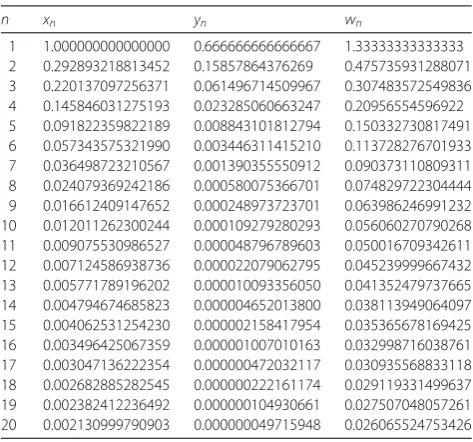
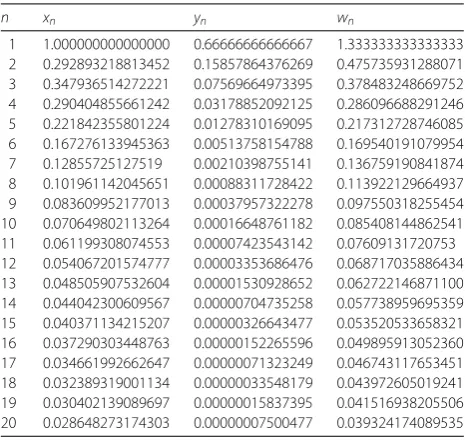
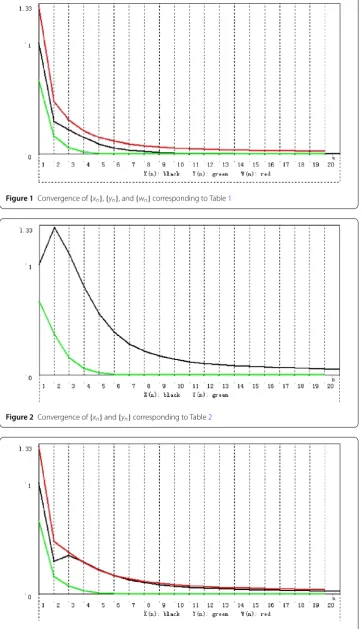
Corollary 3.11 Take the example in Remark3.10.We can choose the following three iter-ative sequences{xn}among infinite choices by iterative scheme(3.9).
⎧ ⎪ ⎪ ⎪ ⎪ ⎪ ⎨ ⎪ ⎪ ⎪ ⎪ ⎪ ⎩
x1= 1, x2= 1 – √
2 2 ,
yn=xn1+2+enrn, n∈N,
wn=minm≤n(1 +rm)ym, n∈N,
xn+1=x1–
(x1–wn)2+λn+1, n∈N\ {1},
(3.10)
⎧ ⎪ ⎪ ⎨ ⎪ ⎪ ⎩
x1= 1,
yn=xn1+2+enrn, n∈N,
xn+1= (1 +rn)yn, n∈N,
(3.11)
and ⎧ ⎪ ⎪ ⎪ ⎪ ⎪ ⎨ ⎪ ⎪ ⎪ ⎪ ⎪ ⎩
x1= 1, x2=76– √
2 4 ,
yn=xn1+2+enrn, n∈N,
wn=minm≤n(1 +rm)ym, n∈N,
xn+1=x1
+wn–√(x1–wn)2+λn+1
2 , n∈N\ {1}.
(3.12)
Then{xn}generated by(3.10), (3.11),and(3.12)converges strongly to0∈A–10∩Fix(B),
as n→ ∞.
Proof We can easily see from iterative scheme (3.9) that
yn=
xn+en 1 + 2rn
forn∈N, (3.13)
and
zn=βnxn+ (1 –βn)yn forn∈N. (3.14)
From (3.14), we can see that (v–zn)2≤βn(v–xn)2+ (1 –βn)(v–yn)2is always true for
v∈(–∞, +∞). Then we can simplifyUn+1andVn+1as follows:
Un+1=Un∩
v∈(–∞, +∞) : 2(xn+en–yn)v≤(xn+en)2–y2n
forn∈N, (3.15)
and
Vn+1=Un+1∩
x1–
x1–PUn+1(x1)
2
+λn+1,x1+
x1–PUn+1(x1)
2 +λn+1
Next, we split the proof into three parts.
Part1. We shall show that both{xn}and{yn}generated by (3.10) converge strongly to 0∈A–10∩Fix(B), asn→ ∞.
By using inductive method, we first show that the following is true:
⎧ ⎪ ⎪ ⎪ ⎪ ⎪ ⎪ ⎪ ⎪ ⎪ ⎪ ⎪ ⎪ ⎪ ⎪ ⎨ ⎪ ⎪ ⎪ ⎪ ⎪ ⎪ ⎪ ⎪ ⎪ ⎪ ⎪ ⎪ ⎪ ⎪ ⎩
x1= 1, x2= 1 – √
2 2 , 0 < (1 +rn+1)yn+1< 1, n∈N,
U1= (–∞, +∞) =V1,
U2= (–∞,43], V2= [1 – √
2 2 ,
4 3],
Un+1= (–∞,wn], n∈N\ {1},
Vn+1= [x1–
(x1–wn)2+λn+1,wn], n∈N\ {1}, we may choosexn+1=x1–
(x1–wn)2+λn+1, n∈N\ {1}.
(3.17)
In fact, ifn= 1,y1=x1+21+er11 =23. Since (x1+e1) –y1= 2r1y1= 2y1=43> 0, then from (3.15),
U2= (–∞, +∞)∩(–∞, (1 +r1)y1] = (–∞,34]. ThusPU2(x1) =x1. From (3.16),V2=U2∩
[1 – √
2 2 , 1 +
√ 2 2 ] = [1 –
√ 2 2 ,
4
3]. So, we may choosex2= 1 – √
2 2 . Ifn= 2,y2=1+2x2+re22 =103 –
√ 2
10 andw2=min{(1 +r1)y1, (1 +r2)y2}= 9–3√2
10 = (1 +r2)y2. It is easy to see that 0 < (1 +r2)y2< 1, and thenx2+e2–y2= 2r2y2> 0. From (3.15),U3=U2∩ (–∞, 3y2] = [–∞,43]∩(–∞,9–3
√ 2
10 ] = (–∞,w2], and thenPU3(x1) =w2=
9–3√2
10 . From (3.16),
V3=U3∩[x1–
(x1–w2)2+λ3,x1+
(x1–w2)2+λ3] = [1 –
(1+3 √
2 10 )2+
1 3,
9–3√2 10 ] = [x1–
(x1–w2)2+λ3,w2]. Then we may choosex3=x1–
(x1–w2)2+λ3.
Suppose that (3.17) is true forn=k. We now begin the discussion forn=k+ 1. Since 0 < (1 +rk+1)yk+1< 1, thenxk+1+ek+1–yk+1= 2rk+1yk+1> 0. From (3.15) and (3.13),
Uk+2=Uk+1∩(–∞, (1 +rk+1)yk+1] = (–∞,wk+1], and thenPUk+2(x1) =wk+1.
Note thatwk+1< 1 =x1<x1+
(x1–wk+1)2+λk+2and
(x1–wk+1)2+λk+2>x1–wk+1> 0, then from (3.16) we know that
Vk+2=
x1–
(x1–wk+1)2+λk+2,wk+1
.
Then we may choose
xk+2=x1–
(x1–wk+1)2+λk+2.
Sinceyk+2=x1+2k+2+rke+2k+2 =1+2xk+2k+2+(k+2)(1+21 k+2), then (1 +rk+2)yk+2=1+21+rrkk+2+2(xk+2+ek+2). Note that
(1 +rk+2)yk+2> 0 ⇐⇒ xk+2+ek+2> 0
⇐⇒ 1 + 1
k+ 2>
(1 –wk+1)2+λk+2
⇐⇒ 1 + 2
k+ 2+ 1
(k+ 2)2 > (1 –wk+1) 2+ 1
k+ 2
⇐⇒ 1 + 1
k+ 2+ 1
This is obviously true. Then (1 +rk+2)yk+2> 0. Since
xk+2+ 1
k+ 2= 1 –
(1 –wk+1)2+ 1
k+ 2+ 1
k+ 2<wk+1+ 1
k+ 2
< 1 + 1
k+ 2< 1 + 2k+2 1 + 2k+1 =
1 + 2rk+2 1 +rk+2
,
then (1 +rk+2)yk+2=1+21+rkrk+2+2(xk+2+ek+2) < 1. By now, we have proved that (3.17) is true.
In this part, it is left to prove thatxn→0,yn→0, asn→ ∞.
From (3.17),{(1 +rn)yn}is bounded, which implies that{wn}is bounded. Thus{xn}is bounded. Let{xni}be any subsequence of{xn}such thatlimi→∞xni=a. Thenwni→aand
yni→0 asi→ ∞. Since 0 <wni≤(1 +rni)yni< 1, then 0≤a≤limi→∞(1 +rni)yni≤1. That is, 0≤a≤limi→∞rniyni≤1. From the fact that 2rnyn=xn+en–yn, we havelimi→∞(1 +
rni)yni=a2. By now, we know that 0≤a≤a2≤1, thena= 0. This means that each strongly convergent subsequence of{xn}converges strongly to 0. Thusxn→0∈A–10∩Fix(B), as
n→ ∞. And thenyn→0,wn→0, asn→ ∞.
Part2. We shall show that both{xn}and{yn}generated by (3.11) converge strongly to 0∈A–10∩Fix(B), asn→ ∞.
First, we shall use inductive method to show that the following is true:
⎧ ⎪ ⎪ ⎪ ⎪ ⎪ ⎪ ⎪ ⎪ ⎪ ⎪ ⎪ ⎪ ⎪ ⎪ ⎨ ⎪ ⎪ ⎪ ⎪ ⎪ ⎪ ⎪ ⎪ ⎪ ⎪ ⎪ ⎪ ⎪ ⎪ ⎩
x1= 1,
0 < (1 +rn+1)yn+1< (1 +rn)yn, n∈N, 1+2n+1
(n+2)2n+1< (1 +rn+1)yn+1< 1, n∈N\ {1},
U1= (–∞, +∞) =V1, V2= [1 – √
2 2 ,
4
3], V3= [1 – √
3 3 ,
11 10],
Un+1= (–∞, (1 +rn)yn], n∈N\ {1},
Vn+1= [x1–
[x1– (1 +rn)yn]2+λn+1, (1 +rn)yn], n∈N\ {1, 2}, we may choosexn+1= (1 +rn)yn, n∈N.
(3.18)
In fact, ifn= 1,y1=x1+21+er11 =23. Since (x1+e1) –y1= 2r1y1= 2y1=43> 0, then from (3.15),
U2= (–∞, +∞)∩(–∞, (1 +r1)y1] = (–∞,34]. ThusPU2(x1) =x1. From (3.16),V2=U2∩
[1 – √
2 2 , 1 +
√ 2 2 ] = [1 –
√ 2 2 ,
4
3]. Then we may choosex2= (1 +r1)y1= 4 3.
Ifn= 2,y2= 1+2x2+re22 =1130. It is easy to see that 0 < (1 +r2)y2=1110 < (1 +r1)y1=43. From (3.15),U3=U2∩(–∞, 3y2] = (–∞,1110] = (–∞, (1 +r2)y2], and thenPU3(x1) =x1. From
(3.16),V3=U3∩[1 – √
3 3 , 1 +
√ 3 3 ] = [1 –
√ 3 3 ,
11
10]. Then we may choosex3= (1 +r2)y2= 11 10. Thusy3=x1+23+re33 =27043. It is easy to check that 0 < (1 +r3)y3=4354<1011= (1 +r2)y2and 1+2
3
(2+2)23 <
(1 +r3)y3< 1.
Suppose that (3.18) is true forn=k. Next, we show the result is true forn=k+ 1. Since 0 < (1 +rk+1)yk+1< (1 +rk)yk< 1, then (3.15) implies thatUk+2=Uk+1∩(–∞, (1 +
rk+1)yk+1] = (–∞, (1 +rk+1)yk+1] andPUk+2(x1) = (1 +rk+1)yk+1.
Note that (1 + rk+1)yk+1 < 1 = x1 < x1 +
[x1– (1 +rk+1)yk+1]2+λk+2 and x1 –
[x1– (1 +rk+1)yk+1]2+λk+2< (1 +rk+1)yk+1. Then, from (3.16), we know that
Vk+2=
x1–
x1– (1 +rk+1)yk+1
2
+λk+2, (1 +rk+1)yk+1
Thus we may choose
xk+2= (1 +rk+1)yk+1.
And then,yk+2=x1+2k+2+rkek+2+2 =1+2xk+2k+2 +(k+2)(1+21 k+2). So (1 +rk+2)yk+2=1+21+rrkk+2+2(xk+2+ek+2). Note that
(1 +rk+2)yk+2> 0 ⇐⇒ xk+2+ek+2> 0 ⇐⇒ (1 +rk+1)yk+1+ 1
k+ 2> 0,
which is obviously true from the assumption. Thus (1 +rk+2)yk+2> 0. Since (1 +rk+1)yk+1< 1, then 1+2
k+1
1+2k+2[(1 +rk+1)yk+1+k1+2] <1+2 k+1
1+2k+2kk+3+2< 1. Thus
(1 +rk+2)yk+2= (1 +rk+2)
xk+2+ek+2 1 + 2rk+2
=1 + 2 k+1
1 + 2k+2
(1 +rk+1)yk+1+ 1
k+ 2
< 1.
Note that
(1 +rk+2)yk+2< (1 +rk+1)yk+1
⇐⇒ 1 +rk+2 1 + 2rk+2
(xk+2+ek+2) < (1 +rk+1)yk+1
⇐⇒ 1 + 2k+1
1 + 2k+2
(1 +rk+1)yk+1+ 1
k+ 2
< (1 +rk+1)yk+1
⇐⇒ 2k+2– 2k+1
1 + 2k+2 (1 +rk+1)yk+1>
1 + 2k+1 (k+ 2)(1 + 2k+2)
⇐⇒ (1 +rk+1)yk+1>
1 + 2k+1 (k+ 2)2k+1,
which is true from the assumption. Compute the following:
(1 +rk+2)yk+2=
1 +rk+2 1 + 2rk+2
(xk+2+ek+2)
=1 + 2 k+1
1 + 2k+2
(1 +rk+1)yk+1+ 1
k+ 2
> 1 + 2 k+1
1 + 2k+2
1 + 2k+1 (k+ 2)2k+1+
1
k+ 2
= 1 + 2 k+1
(k+ 2)2k+1 >
1 + 2k+2 (k+ 3)2k+2.
By now, we have proved that (3.18) is true.
In this part, it is left to prove thatxn→0,yn→0, asn→ ∞.
Since {(1 +rn)yn} is decreasing and bounded in (0, 1), then limn→∞(1 +rn)yn =
limn→∞xn=a. Coming back to (3.13), we know thatrnyn→0, asn→ ∞. Thenyn→0, and thenxn→0, asn→ ∞.