© 2015, IRJET.NET- All Rights Reserved
Page 686
FEASIBILITY STUDY OF JUST IN TIME INVENTORY MANAGEMENT ON
CONSTRUCTION PROJECT
Patil Yogendra R.
1, Patil Dhananjay S.
21
P.G.Scholar, Department of Civil Engineering, Rajarambapu Institute of Technology, Islampur, Maharashtra,
2
HOP Construction Management, Rajarambapu Institute of Technology, Islampur, Maharashtra, India
---***---
Abstract –
Abstract: Just in time philosophy has lot ofPotentional for managing movement of construction material from manufacturing yard to construction site. The traditional approach to material delivery has been used in construction industry for many years. It is imbedded in the corporate structure as the way to procure materials. Major Construction Industries have been trying to adopt new business initiatives in order to stay alive in the new competitive market place. Companies must strive to create high quality, and Low cost products that can get to the customers in the shortest time possible. Just-in-time production system is one of these initiatives that focus on cost reduction by eliminating non-value added activities. This Paper Deals with Implementing Just in Time Inventory Control Approach on Highway Construction. JIT has Tremendous Effect on Material Delivery Operation. During Implementation of JIT Organization is required, to put desired efforts on all levels of the work.
Keywords: just in time, Cost Reduction, Non value added activity.
1. Introduction
Increasing Global competition has forced the Indian construction Industries to look for some new techniques to meet the challenges in Construction Industry. During last two or three decades construction environment all over the world has experienced more changes, particularly, the construction environment has become one of the most important elements in creating the value added contents for the products and service [1], [2]. The traditional approach to material delivery has been used in construction industry for many years [3]. The approach created lot of problem to construction industry. Fast development in communication, better quality material and fast material transportation
systems has become global in nature. Construction industry also demands more product variety that means reduced lot size and high flexibility in construction work. Manpower cost has also risen [4], [5]. All these factors tend to increase the material and project cost. But the industry has to maintain the cost at a reasonable level. To overcome material delivery problem just in time method is used for large projects [6[, [7]. Just in Time method application on delivery of concrete is done in Japan. Ready mix concrete is prototypical example of batch process where a customer process releases an order to batch for the supplying process and receives product as a result. This batch process does not allow any inventory of product to be maintained because the product is perishable [8]. Precast concrete supplier examine if contractors are ready to adopt the JIT philosophy for receiving and installing precast concrete components on-site. Lessons are drawn from the empirical findings to determine how contractors can prepare for JIT management of precast concrete components [9].
JIT principle was introduced by Toyota Company in Japan. JIT is a system that produces the required item at the time and in the quantities needed. By using JIT principle we can maintain quality of the entire project and increase efficiency of the workers. JIT principle says that inventories are not more important and should be considered as waste [10], [11].
© 2015, IRJET.NET- All Rights Reserved
Page 687
JIT Implementation depend on supplier .Thecharacter of every supplier is strongly related to the success or failure of any materials-management system. Thus, selection of vendors is the critical initial step, because selection of vendors affects the construction itself. Therefore, good vendor selection is important for an effective materials-management system, which leads the successful completion of a project [13].
2. CONCEPT OF JUST IN TIME
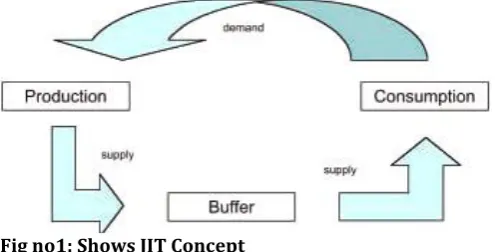
[image:2.595.36.284.471.597.2]Just in Time (JIT) production is a manufacturing philosophy which increases speed of production. JIT Concept is, “Company produces only what is needed, when it is needed and in the quantity that is needed”. The company produces only what the customer requests, to actual orders, not to forecast. JIT can also be defined as producing the necessary units, with the required quality, in the necessary quantities, at the last safe moment. It means that company can manage with their own resources and allocate them very easily.
Fig no1: Shows JIT Concept
Various Steps in Implementation of JIT:
Source identification: Just in Time means produce right quantity of material at right time. Not before or after the work. Large company has their own source but small construction industry is facing problems in material management.
Vendor analysis: vendor is a organization who supplies material to company. Vendor may be single or more it’s depending upon company.
Scheduling: scheduling gives clear idea about daily work. Submit advance schedule to vendor. Make storage
facility
and safety stock for material. Plan includes date, time, place, quantity, place and no. of equipment.
3. Case study
3.1) Introduction about company:
Place: Aland (Gulbarga)
Type of work: Road Construction
Type of Road: Black Top Road (Flexible Pavement) Length of Road: 63KM
Cost of Project: 37Cr
.Name of Company: Patil and Company State-Maharashtera, Dist-Solapur, Country-India
© 2015, IRJET.NET- All Rights Reserved
Page 688
3.2) JIT Implementation Process:
One of the major objectives in implementing a JIT System is to achieve a common goal of the whole company. First step is identification of material delivery problem in company and provide solution to company. Second step is Material Quantity Calculation. ABC, HML, VED, SDE Analysis is done. Analysis helps to select material for JIT Application. Third Step is preparation of JIT plan. Equipment productivity calculated. Find out number of days required to complete work. Plan includes date, place of material delivery, time and no. of equipment required. Fourth step is vendor selection. Analytical Hierarchical Process is used for vendor selection. Then material procurement plan prepared. JIT Plan Submit to plant and vendor. Maintain proper communication between site engineer, vendor and plant supervisor.
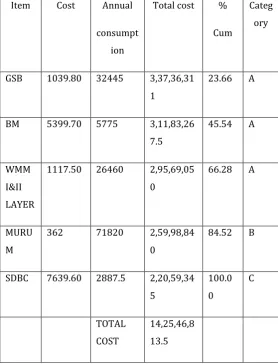
ABC Analysis:
[image:3.595.296.575.168.533.2]A class items required tight inventory control, A class tem have high consumption value. Special care must be taken because consumption value is high and Wastage Creates more economical loss to the company. B class items In between A and C moderately care must be taken. B Class items have low consumption value than A Class items but higher consumption value than C Class items. Grouping of ABC items largely used in material management. By using this method we can select items for just in time application.
Table No 1: Shows ABC Analysis
Item Cost Annual consumpt
ion
Total cost % Cum
Categ ory
GSB 1039.80 32445 3,37,36,31 1
23.66 A
BM 5399.70 5775 3,11,83,26 7.5
45.54 A
WMM I&II LAYER
1117.50 26460 2,95,69,05 0
66.28 A
MURU M
362 71820 2,59,98,84 0
84.52 B
SDBC 7639.60 2887.5 2,20,59,34 5
100.0 0
C
TOTAL COST
© 2015, IRJET.NET- All Rights Reserved
Page 689
% COST
100
90
70
40
20
A B (murum) C (SDBC)
10 30 100
% OF ITEMS
Fig No 2: Shows ABC Analysis Graph
3.3) Equipment productivity calculation I. Hindustan front end loader Production
Loader Output
= =104.78m3/hr II. Tipper Production
No. of bucket loads =
= = 4.56 ≈ 5 buckets
Loading time=Loader cycle time X No of Buckets= 86X5=430sec=7.16min
Cycle time = Loading Time = 7.16 min
+ Haul Time = 31 min +Dump Time = 2 min +Return Time = 18.84 min Cycle Time = 59 min
Output = = = 13.40 x e = 13.40 x 0.76 = 10.38m3/hr.
III. Grader = no of passes x distance Speed x efficiency = 6X 0.385 (mile)
2.3x 0.84 ) = 1 hour= 34 cum
IV. Paver: = Quantity x 60 TIME = 13.44X60
22.4 = 36 cum.
Table No: 2 Shows Equipment Productivity Calculation
EQUIPMENT EFFICIEN CY
EQUPMENT PRODUCTIVT
Y
Capacity of Tipper
Volvo-930(Grader)
84.33% 34
Paver 84.33% 36
© 2015, IRJET.NET- All Rights Reserved
Page 690
3.4) Monthly Consumption of each item
Total monthly target= 3.5 km
GSB required for 1 km = 660 cum. (lxbxh) For 3.5 km G.S.B required = 3.5x660=2310 cum. WMM required for 1 km=979 cum.
For3.5kmWMM Required=979X3.5=3426.5 BM required for 1 km=297 cum.
For 3.5 km WMM Required=297X3.5=1039.5 cum
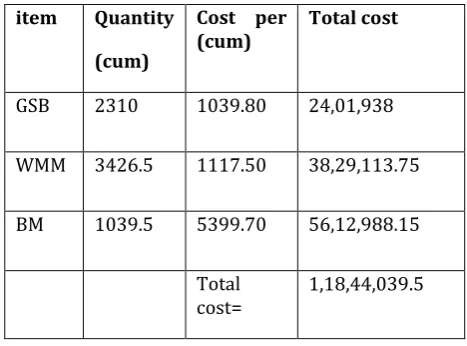
4) Economical analysis Between Conventional Method and JIT Method
[image:5.595.332.566.142.315.2]4.1) JIT Method Cost
[image:5.595.322.566.365.567.2]Table No: 3 Shows Material Consumption cost
Table No: 4 Equipment cost
1) Conventional Method Cost
Table No: 5 Shows Material Consumption cost
Table No: 6 Shows Equipment cost
JIT Method Total Cost for 3.5 km required =
1, 18, 44,039.5+6, 89,000 = 1, 25, 33039.5 Conventional Method Cost saving by using just in time method=
1, 18, 44,039.5+14, 13,500 =1, 32, 57,539.5
Total Cost Saving BY using JIIT method is
1.32,57,539.5-1,25,33,039.5=724500
To complete 3.5 km target per month:
Conventional method requires 47 days and for just in time it requires 26 days.
Type of item Type of equipment
Cost per hour/day
Total cost
GSB GRADER 1500 1,05,000 WMM GRADER 1500 1,26,000 BM PAVER 1500 42,000 ALL 3
MATERIAL
HYWA 4000(PER DAY)
4,16,000
TOTAL COST=
6,89,000
item Quantity
(cum)
Cost per (cum)
Total cost
GSB 2310 1039.80 24,01,938 WMM 3426.5 1117.50 38,29,113.75 BM 1039.5 5399.70 56,12,988.15
Total cost=
1,18,44,039.5
item Quantity (cum)
Cost per (cum)
Total cost
GSB 2310 1039.80 24,01,938 WMM 3426.5 1117.50 38,29,113.75 BM 1039.5 5399.70 56,12,988.15
Total cost=
1,18,44,039.5
Type of item Type of equipment
Cost per hour/day
Total cost
GSB GRADER 1500 1,89,000 WMM GRADER 1500 2,31,000 BM PAVER 1500 73500 ALL 3
MATERIAL
HYWA 4000(PER DAY)
920000
TOTAL COST=
© 2015, IRJET.NET- All Rights Reserved
Page 691
5) Monthly material procurement plan
Table No: 7 Shows Material Procurement Plan (3.5Km)
Developing procurement plans – when to buy, from where and how much Monitoring flow of materials, delivery and consumptions.
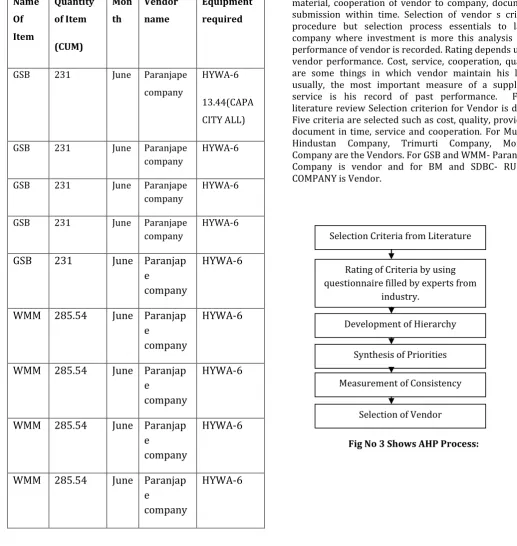
[image:6.595.23.541.189.736.2]Vendor evaluation is the ranking of supplier’s performance in terms of quality of material, cost of material, cooperation of vendor to company, document submission within time. Selection of vendor s critical procedure but selection process essentials to large company where investment is more this analysis past performance of vendor is recorded. Rating depends upon vendor performance. Cost, service, cooperation, quality are some things in which vendor maintain his level usually, the most important measure of a supplier's service is his record of past performance. From literature review Selection criterion for Vendor is done. Five criteria are selected such as cost, quality, providing document in time, service and cooperation. For Murum Hindustan Company, Trimurti Company, Moraya Company are the Vendors. For GSB and WMM- Paranjape Company is vendor and for BM and SDBC- RUDRA COMPANY is Vendor.
Fig No 3 Shows AHP Process:
Name Of Item
Quantity of Item
(CUM)
Mon th
Vendor name
Equipment required
GSB 231 June Paranjape company
HYWA-6 13.44(CAPA CITY ALL) GSB 231 June Paranjape
company
HYWA-6
GSB 231 June Paranjape company
HYWA-6
GSB 231 June Paranjape company
HYWA-6
GSB
231
June Paranjap
e
company
HYWA-6
WMM 285.54
June Paranjap
e
company
HYWA-6
WMM 285.54
June Paranjap
e
company
HYWA-6
WMM 285.54
June Paranjap
e
company
HYWA-6
WMM 285.54
June Paranjap
e
company
HYWA-6
Selection Criteria from Literature
Rating of Criteria by using questionnaire filled by experts from
industry.
Development of Hierarchy
Synthesis of Priorities Measurement of Consistency
[image:6.595.332.513.412.617.2]© 2015, IRJET.NET- All Rights Reserved
Page 692
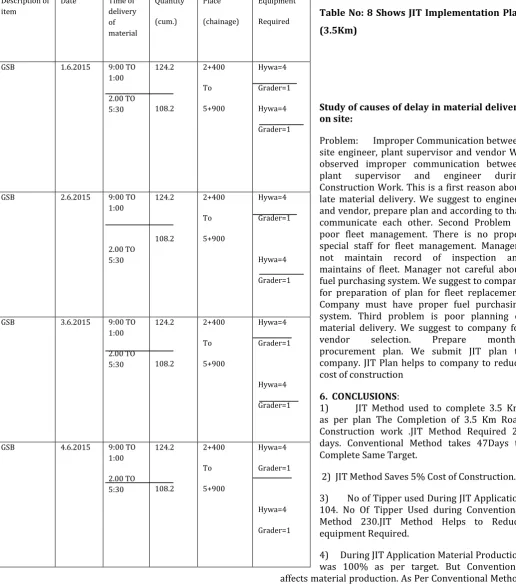
Table No: 8 Shows JIT Implementation Plan (3.5Km)
Study of causes of delay in material delivery onsite:
Problem: Improper Communication between site engineer, plant supervisor and vendor We observed improper communication between plant supervisor and engineer during Construction Work. This is a first reason about late material delivery. We suggest to engineer and vendor, prepare plan and according to that communicate each other. Second Problem is poor fleet management. There is no proper special staff for fleet management. Managers not maintain record of inspection and maintains of fleet. Manager not careful about fuel purchasing system. We suggest to company for preparation of plan for fleet replacement. Company must have proper fuel purchasing system. Third problem is poor planning of material delivery. We suggest to company for vendor selection. Prepare monthly procurement plan. We submit JIT plan to company. JIT Plan helps to company to reduce cost of construction
6. CONCLUSIONS:
1) JIT Method used to complete 3.5 Km. as per plan The Completion of 3.5 Km Road Construction work .JIT Method Required 26 days. Conventional Method takes 47Days to Complete Same Target.
2) JIT Method Saves 5% Cost of Construction. 3) No of Tipper used During JIT Application 104. No Of Tipper Used during Conventional Method 230.JIT Method Helps to Reduce equipment Required.
4) During JIT Application Material Production was 100% as per target. But Conventional affects material production. As Per Conventional Method Material Production was only 50% as per Target.
Description of item
Date Time of delivery of material Quantity (cum.) Place (chainage) Equipment Required
GSB 1.6.2015 9:00 TO 1:00 2.00 TO 5:30 124.2 108.2 2+400 To 5+900 Hywa=4 Grader=1 Hywa=4 Grader=1
GSB 2.6.2015 9:00 TO 1:00 2.00 TO 5:30 124.2 108.2 2+400 To 5+900 Hywa=4 Grader=1 Hywa=4 Grader=1
GSB 3.6.2015 9:00 TO 1:00 2.00 TO 5:30 124.2 108.2 2+400 To 5+900 Hywa=4 Grader=1 Hywa=4 Grader=1
[image:7.595.35.552.148.733.2]© 2015, IRJET.NET- All Rights Reserved
Page 693
8. REFERENCES:
1] Delbridge R., 1995, “Surviving JIT: control and resistance in a Japanese transplant”, Journal of Management Studies, Vol. 32, pp: 803-817.
2] Ebrahimpour, M. and Schonberger R. J., 1984, “The Japanese Just-in-Time/Total Quality control production system: potential for developing countries”, International Journal of Production Research, Vol.22, pp: 421-430
3] Garg, D., 1997, “Relevance of JIT purchasing in Indian industries”.
4] Vikas Kumar., 1992, “Employee involvement in JIT success: Eicher experience”. Productivity, Vol: 33, pp: 366-369.ISSN: 0975-
5] D.K Singh and Satyendra SINGH (1997). Managing productivity in construction.JIT operations and measurements.
6] Bandyopadhyay, j.k and jay ram, “implementing just in time production and procurement strategies”. International general and management 83-9
7] Low siu pheng and Choong Joo Chuan , ‘’ Just in time Management of precast components’”
8) Iris D. Tommelein1 and Annie En Yi Li2,(2001) “Just in Tme Concrete Delivery”.
9) By Low Sui Pheng1 and Choong Joo Chuan2, “Just in Time Management on Precast Concrete Components” 10] Williams J. “ready mix concrete supply’.
11] Ankintoye, A.1995, Just in time application and implementation for building material management’. 12] Gupta y.p a feasibility study of JIT Purchasing systems implementation in a manufacturing facility.” International journal and production management. 13] Monden, Toyota Production system [institute of