© 2016, IRJET | Impact Factor value: 4.45 | ISO 9001:2008 Certified Journal
| Page 609
Parametric Study of Beam to Column Bolted Connection with Cellular
Beams
Anju Mohan
1, Dr. K. A Abubaker
2, Lakshmi G Das
31
Department of Civil Engineering, IIET, Nellikuzhy
2
Chief Consultant, SAFE, Edappally
3
Asst. Professor, Dept. of Civil Engineering, IIET, Nellikuzhy, Kerala, India
---***---Abstract - This project intent a comprehensive finite
element analysis of extended end plate beam to column connections, with cellular beam or castellated beam. The models are created with circular and hexagonal shaped web openings along the length of beam. The behaviour of such connection is evaluated by conducting a parametric study in which the parameters introduced were the distance of the first web opening from the face of the column, and the web opening shape. ANSYS software is used for the analysis. Nonlinear dynamic FE analysis was conducted for the study. The analysis result shows that castellated beam with hexagonal shaped web opening gives better result in terms of stress distribution and less deflection than that with circular web openings. The ideal distance of first web opening from the column face was also identified.
Key Words: Cellular beam, Web opening, Non linear analysis, stress distribution, deflection...
1. INTRODUCTION
In recent years, researchers study alternative connection designs for steel seismic-resistant frames by reducing the beam section in different ways including that of creating web opening along the length of beam (castellated beam). This project intent a finite element (FE) analysis of extended end-plate beam-to-column connections, with circular web opening (cellular beam) and hexagonal shaped web openings introduced along the length of the beam. The parameters introduced to evaluate the performance were the distance of first web opening from the face of the column (S), and the web opening shape.
2. FINITE ELEMENT ANALYSIS OF BEAM TO
COLUMN BOLTED CONNECTION
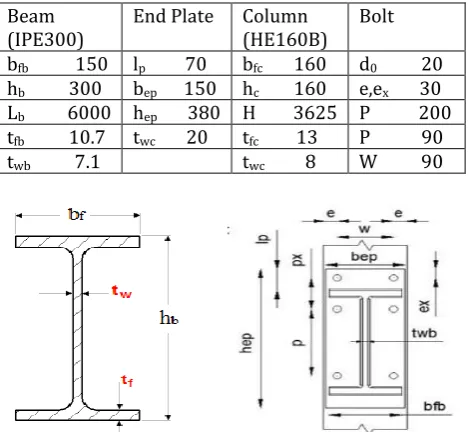
[image:1.595.305.540.291.507.2]The model of steel beam column joint was created based on the study conducted by Konstantinos Daniel et al., I sections are used for creating steel beam and column. The details of the connections are shown in the table below.
Table -1: Dimension of the connection (All in mm)
Beam
(IPE300) End Plate Column (HE160B) Bolt bfb 150 lp 70 bfc 160 d0 20 hb 300 bep 150 hc 160 e,ex 30 Lb 6000 hep 380 H 3625 P 200 tfb 10.7 twc 20 tfc 13 P 90 twb 7.1 twc 8 W 90
Fig-1: Detailed configuration of extended end plate connectio
n
2.1 Element Types and Material Properties
Shell 181 elements are used to model beam, column, and plate and beam 4 elements are used to model bolts. The young’s modulus of steel is 2.1x10⁵ N/mm2, Poisson’s ratio is 0.3 and density of steel is taken as 7850kg/m3.
Table -2: Mechanical properties of the connection (all in MPa)
Beam Column Plate Bolt
fy 308.5 fy 289.4 fy 291.5 fy 900
2.2 Specimen Geometry, Modeling and Meshing
© 2016, IRJET | Impact Factor value: 4.45 | ISO 9001:2008 Certified Journal
| Page 610
Table -3: Parameters considered for the studyModel Shape of web opening
Distance of first web opening from the column face (S) (mm)
1 Circular 200
2 Circular 350
3 Circular 400
4 Circular 520
5 Hexagonal 200
6 Hexagonal 350
7 Hexagonal 400
8 Hexagonal 520
For all parametric analyses, the web opening diameter, do, was taken as equal to 0.8hb, where hb is the height of the beam;and S0/d0 is taken as 1.2 where S0 is centre to centre distance between adjacent web openings
For shell 181 element the mesh set up such that quadrilateral elements were created.
2.3 Boundary conditions and Loading
The top and bottom end of the column were fixed, the cantilever end of the beam was kept free. The specimen was loaded cyclically following the SAC loading protocol. Beam end displacements were applied at the location of 4.84 m from the face of the column on the beam with an upward and a downward displacement producing one cycle of the loading protocol. A total of 32 cycles, equivalent to 128 applied displacements, were computed. The SAC loading protocol is shown in Table-3summarises the displacements values, ΔLC, applied as load-steps.
Table -
3
: Beam end displacement for cyclic loading sequenceNo of
cycles (accumulative) Load step displacements End ΔLC (m)
6 24 0.0116297
6 48 0.0155063
6 72 0.0232594
4 88 0.0310125
2 96 0.0465188
2 104 0.0620250
2 112 0.0930375
2 120 0.1240500
2 128 0.1550625
3. ANALYSIS AND RESULTS
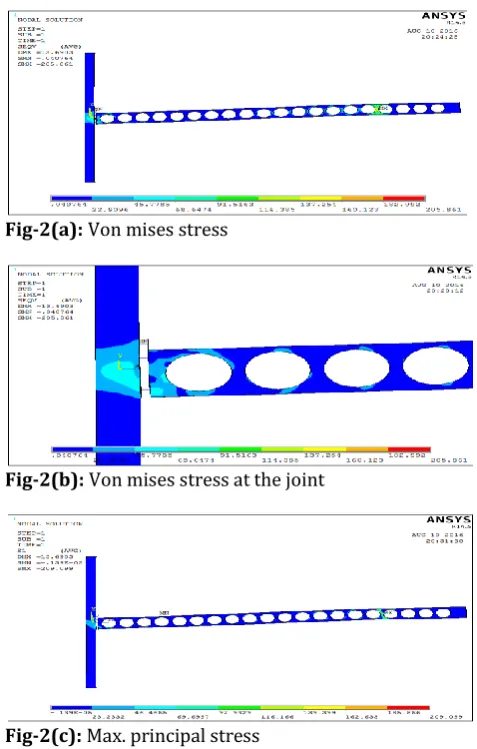
The analysis was carried out on the models and the results were obtained. Non linear dynamic analysis was conducted for the analysis. The study analyzes the deflection, maximum principle stress, and von mises stress of the different models created.
Fig-2(a):
Von mises stress
Fig-2(b):
Von mises stress at the joint
Fig-2(c):Max. principal stress
Fig-2: Analysis result of a typical model with circular web opening (model 1)
[image:2.595.306.545.191.566.2]© 2016, IRJET | Impact Factor value: 4.45 | ISO 9001:2008 Certified Journal
| Page 611
Fig-3(b):Von mises stress at the joint
Fig-3(c):Max. principal stress
Fig-3: Analysis result of a typical model with hexagonal shaped web opening (model5)
4. COMPARISON OF RESULTS
A total of 8 models are analyzed and the results were compared.
Table-4: Results of FE models Model Von-Mises
Stress (MPa)
Deflection Max.principal stress (MPa)
1 205.861 13.69 209.099
2 289.368 13.89 325.933
3 221.761 13.87 222.825
4 215.983 13.68 217.969
5 197.464 13.46 231.92
6 207.584 13.69 225.162
7 193.597 13.62 213.771
8 200.467 13.47 217.476
Fig-4: Von mises V/s Location on beam
Fig-5: Deflection V/s Location on beam
Fig-6: Load step V/s Location on beam
© 2016, IRJET | Impact Factor value: 4.45 | ISO 9001:2008 Certified Journal
| Page 612
Table-5: Von mises stress of models with circular webopening
Model Column face distance,S
(mm)
Von mises stress (MPa)
1 200 60.55
2 350 17
3 400 20.56
4 520 20.33
Table-6: Von mises stress of models with hexagonal shaped web opening
Model Column face distance
(mm)
Von mises stress (MPa)
5 200 53.35
6 350 6.08
7 400 25.74
8 520 23.40
From the above table it is clear that the column face distance, S of 200 mm for the first web opening resulted in the critical stress concentration close to the column face while larger distance of 520mm resulted in the early ending of FE analysis. Therefore the ideal column face distance, S being identified as 350mm where the stress was found to be minimum.
5. CONCLUSION
An extensive literature survey were conducted Eight models of the beam column joint are prepared
in ANSYS software
Dynamic nonlinear analysis is conducted
Von mises stress, Max. principal stress, deflection etc. are selected for comparison
The values of von mises stress and maximum principal stress are lower in the models with hexagonal shaped web opening
Deflections are lesser in models with hexagonal shaped web opening
Lowest ‘S’ results in concentration of stress close to the joint
Larger ‘S’ results in early ending of FE analysis Ideal column face distance ‘S’ was identified as
350mm
Models with hexagonal shaped web openings shows better results.
REFERENCES
[1] Konstantinos Daniel, Theodore Papadopoulos, “A FE parametric study of RWS beam-to-column bolted connections with cellular beams”, Journal of Constructional Steel Research, Vol. 116, 2016, PP 92– 113.
[2] Jamadar A. M., Kumbhar P. D, “Parametric study of castellated beam with circular and diamond shaped openings”, International Research Journal of Engineering and Technology (IRJET), Vol.2, 2015, PP 715-722.
[3] P.D. Kumbhar, and A.M. Jamadar, “Optimization of opening size for castellated beam with sinusoidal openings”, International Journal of Optimization in Civil Engineering, Vol.5, 2015, PP 301-313
[4] R. Rahnavard, A. Hassanipour, N. Siahpolo, “Analytical study on new types of reduced beam section moment connections affecting cyclic behaviour”, Case Studies in Structural Engineering, Vol. 3, 2015, PP 33–51.
[5] Konstantinos Daniel Tsavdaridis, “Application of structural topology optimisation to perforated steel Beams”, Computers and Structures, Vol.158, 2015, PP 108–123.
[6] Fattouh M.F. Shaker and Waseem M. Abd Elrahman, “Analytical Behavior of Steel Pre-tensioned Bolted Connections with Flushed and Extended End Plates under Bending”, World Applied Sciences Journal ,Vol.30,2014,PP 673-684.
[7] Bernice V. Y. Wong, Ian W. Burgess, “The influence of tensile membrane action on fire-exposed composite concrete floor-steel beams with web-openings”, Procedia Engineering, Vol.62, 2013, PP 710 – 716. [8] Y.Q. Wang, L. Zong, Y.J. Shi, “Bending behavior and
design model of bolted flange-plate connection”, Journal of Constructional Steel Research, Vol.84, 2013, PP 1–16.
[9] Abdelrahim Khalil Dessouki, Ahmed Hassan Youssef, Mohamed Mostafa Ibrahim, “Behavior of I-beam bolted extended end-plate moment connections”, Ain Shams Engineering Journal, Vol.4, 2013, PP 685–699. [10] M. Saranik, L. Jézéquel, D. Lenoir, “Experimental and numerical study for fatigue life prediction of bolted connection”, Procedia Engineering, Vol.66, 2013, PP 354 – 368.
[11] S. Durif, and A. Bouchaïr, “Behavior of cellular beams with sinusoidal openings”, Procedia Engineering, Vol. 40, 2012, PP 108 – 113.
[12] J. E. Jam, N. O. Ghaziani, “Numerical and experimental investigation of bolted joints”, International Journal of Engineering, Vol. 3, 2011, PP 285-296
© 2016, IRJET | Impact Factor value: 4.45 | ISO 9001:2008 Certified Journal
| Page 613
[14] J.G. Williams, R.E. Anley, D.H. Nash, T.G.F. Gray,“Analysis of externally loaded bolted joints: Analytical, computational and experimental study”, International Journal of Pressure Vessels and Piping, Vol.86, 2009, PP 420–427.
[15] Jeong Kim, Joo-Cheol Yoon, Beom-Soo Kang, “Finite element analysis and modeling of structure with bolted joints”, Applied Mathematical Modelling, Vol.31, 2007, PP 895–911.
[16] Ramin Vafaeipour Sorkhabi, Alireza Naseri, and Masoud Naseri, “Optimization of the Castellated Beams by Particle Swarm”, Algorithms Method APCBEE Procedia, Vol.9, 2014, PP 381 – 387. [17] Resmi Mohan, Preetha Prabhakaran, “ Finite
Element Analysis to Compare the Deflection of Steel Beam with and without Web Openings”, IOSR Journal of Mechanical and Civil Engineering (IOSR-JMCE), 2016, PP 7-11.
[18] Prof. R. R. Jichkar, Prof. N. S. Arukia, Prof. P. D. Pachpor, “ Analysis of Steel Beam with Web Openings Subjected To Buckling Load”, Int. Journal of Engineering Research and Applications, Vol. 4, May 2014, PP 185-188.