© 2016, IRJET | Impact Factor value: 4.45 | ISO 9001:2008 Certified Journal | Page 1550
Enhanced Routing Algorithm to Improve the Performance of
Wireless Sensor Network
Navdeep kaur
1, Mandeep kaur
21
Student of M.Tech(ECE)
2Assistant Professor(ECE)
Dept. of Electronics &Communication Engineering, BCET(Gsp), Punjab, India
---***---Abstract -
Routing protocols is one of the most importantaspects of WSN (wireless sensor network) and plays very important in efficient, flexible and error free delivery of the data packets in WSN. We have been seen that packet losses due to collisions are often misinterpreted as link failures, which are called False Routing Failure (FRF). As a consequence, the routing protocol attempts to find an alternative path even though the current path is still valid existing routing techniques such HTLC-MeDSR provides multi path option but suffers from the high energy consumption. In this paper author proposed a hybrid technique which uses DBTMA (Dual Busy Tone Multiple Access) which reduces the chance of collision and Dijkstra’s algorithm for finding shortest path to destination which reduces unwanted hop count and which leads to the better performance of the network with increased network lifetime .
Key Words: WSN, Routing protocols, DBTMA, MeDSR,
HTLC-MeDSR
1.INTRODUCTION
Wireless Sensor Networks (WSN) is ad-hoc networks that can be recognized with no need for preceding communications architecture. WSN nodes (sensors or actuators) associated to forward sensor data hop-by-hop from the source nodes to the sink nodes and vice versa. Sensor nodes consist of sensing, data processing, communication, storage and energy components. In order to decrease the cost, these sensor nodes are small devices with remarkable resource constrains.Conventionally, WSNs have been used for observing applications based on low-rate data storage with little interval of operation. New approach in image sensor technology have permitted the apply of audio and video sensors, which have the capacity to reclaim, store, process, fuse and/or correspond multimedia data, originated from heterogeneous sources (multimedia sensor nodes, scalar sensor nodes, etc.), emerging in a recent category of WSNs, called Wireless Multimedia Sensor Networks (WMSN) .
WMSN can be designed for realtime applications, which demand inflexible cutt-off point, low delay, high throughput and reliability, and non-real time applications, which usually require medium to high bandwidth, low losses, etc. The transmissions in real time and non real time of multimedia and/or scalar data may have different Quality of Service (QoS) requirements, such as bounded latency or delay, throughput, jitter, energy efficiency, and reliability, depending on the application. Some instances of real-time mission critical and monitoring applications are explored and recover, security surveillance, patient monitoring figure 1 shows basic architecture of WSN.
Figure, 1 current localization algorithms
1.1
Issues in represented MAC Protocol for Wireless Sensor Network:.
© 2016, IRJET | Impact Factor value: 4.45 | ISO 9001:2008 Certified Journal | Page 1551
3
QoS Support: In wireless sensor network, the nodes areportable most of time. Due to this nature providing Quality of Service (QoS) in such a network is very inappropriate. Bandwidth reservation made at one point of time may become disabling once the nodes pass out of the region where the reservation was made. For time commentative traffic periods such as in military communications, QoS authenticate is mandatory. Thus, the MAC protocols for ad hoc wireless networks that are to be used in real-time applications must have some type of resource reservation technique.
4
Synchronization: The synchronization between nodes in a network is very essential for bandwidth reservation by nodes. Interchange of control packets may be required for attaining synchronization, but the control packets should not utilize too much of network bandwidth.5
Lack of Central Coordination: Wireless sensor networks do not have rationalized coordinators; also it is not credible as the nodes keep working persistently. Therefore, nodes must be organized in a dispensed manner for achieving access to the channel. This requires exchange of control information. The MAC protocol must make sure that additional overhead, in terms of bandwidth utilization due to these control information exchange must not very high.6
Hidden and Exposed Terminal Problems: The hidden and exposed terminal problems are distinctive to wireless networks. The hidden terminal problem refers to the collision of packets at a accepting node due to the synchronous transmission of those nodes that are not within the extreme transmission range of sender, but are within the transmission range of receiver. Collision occurs when both nodes transmit packets at the same time without knowing the transmission of each other. The exposed terminal problem refers to the inability of a node, which is interrupted due to transmission by a adjacent transmitting node, to transmit to another node. These two problems appreciably reduce the throughput of a network when the traffic is high. Thus, the MAC protocol must be free from the hidden and exposed terminal problems.7
Mobility of Nodes: This is the most important factor affecting the performance of the protocol. As the nodes in wireless sensor networks are mobile most of the time, the bandwidth reservations made or the controlinformation exchanged may end up being of no use. The MAC protocol has no role to play in influencing the mobility of nodes, the protocol design must take this mobility factor into consideration so that the performance of the system is not significantly affected by the node mobility.
2. LITERATURE REVIEW
Naercio Magaia et al. (2015) [1] have presented a new multi-objective approach for the WMSN routing problem that takes into account QoS parameters such as delay and ETX. The Dynamic Source Routing (DSR) protocol, one of the adeptly known Mobile Ad-hoc Networks (MANETs) routing protocols, is a single path on-demand routing protocol. If a data packet has to be forward and no route to the destination is accessible, the source node starts a route discovery process by flooding Route Request (RREQ) packets choose the destination node. Each neighbor receiving the RREQ packet examine if it is the destination. If so, it sends a Route Reply (RREP) packet reverse to the source after adding the assembled routing information accommodate in the RREQ packet. The shortest returned path is the one used for routing. The High Throughput Low Coupling Multipath extension to the Dynamic Source Routing (HTLC-MeDSR) protocol is a multipath on-demand routing protocol. Similarly to DSR, a RREQ is providing only if a data packet has to be sent and no route to that destination exists. The destination also issues RREP packets to the received RREQ packets. HTLC-MeDSR uses probe packets to detect link failures and each node overhears other nodes packet transmissions to increase the False Routing Failures (FRFs) accuracy. HTLC-MeDSR uses ETX information to find high throughput paths, and the correlation factor to find paths with low coupling if they exist. This section confers some of the researches that are done in the field of Medium Access Control (MAC) in ad hoc networks. The primitive MAC protocol proposed for wireless networks is ALOHA, so called random-access mode.
© 2016, IRJET | Impact Factor value: 4.45 | ISO 9001:2008 Certified Journal | Page 1552
which the time is split into number of slots, whose durationis entirely equal to the transmission time of a solitary packet (assuming constant-length packets). The nodes are authorized to transmit only at the conception of a slot. Here collision can occur only if two or more nodes transmit at the beginning of same slot, they overlap thoroughly rather than partially expanding channel efficiency. By this basic change, the maximum throughput in slotted ALOHA expanding by a factor of two to 36 To further revamp the channel utilization,
In [3
] Klein rock and Tobagi suggests a third approach for using the channel; namely, the Carrier Sense Multiple Access (CSMA) mode. In this scheme the nodes seek to elude collisions by following to the carrier transmitted by other nodes. Based on the information about the state of the channel, CSMA protocol is split into non-persistent CSMA and p-persistent CSMA. In non-persistent CSMA, the node transmits if the channel is observed idle. If the channel is sensed busy, the node schedules the retransmission to some later time according to the retransmission delay distribution. In p-persistent CSMA, the node sense the channel ceaselessly, before the channel is idle. It then transmits in that given slot with probability p and delays its transmission to next slot with probability 1−p. If collision occurs, the node waits for a random delay before retransmitting. The notable case of p-persistent CSMA is 1-persistent CSMA, that transmits the packet as shortly as it senses a idle channel with probability p = 1. This paper also scrutinized the performance of both ALOHA and CSMA and shows that CSMA protocols outperforms the performance of ALOHA not only in terms of higher throughput, they also accomplish superior under high network loads with a commensurate lesser established delay. Among other CSMA protocols p-persistent CSMA bestow best performance. Considering the benefits of carrier sensing most of the succeeding MAC protocols are based on CSMA mechanism. Throughout this paper they assumed that all are within range and in line-of-sight of each other. Each terminal, however, may not be able to hear the other entire terminal’s traffic. This gives rise to “hidden-terminals” problem. The maximum throughput of CSMA with no hidden terminals is 83% approximately.In [4
] , Tobagi and Kleinrock exhibit that the existence of hidden terminals significantly reduces the performance of CSMA. To banish problem, they instigate the Busy Tone Multiple Access (BTMA) protocol as an extension of CSMA. This protocol splits the convenient bandwidth into two distinct channels: a busy-tone (control) channel and a message (data) channel. When a node is ready for transmission, it senses the busy tone channel. If the tone is lacked, it transmits a tone signal on thebusy-tone channel and begins data transmission; otherwise, it holds off the packet for transmission at some later time. Other nodes sensing carrier on data channel also transmits busy-tone signal on their busy-tone channel. Though this mechanism diminished the probability of collisions, bandwidth utilization is very poor. The inability of BTMA is the use a separate channel to transfer the condition of the data channel. As CSMA protocol senses the state of the channel only at the transmitter, this protocol does not overcome the hidden terminal problem, when the transmitter and receiver are not in the range of each other. Also the bandwidth utilization is less because of exposed terminal problem.
In [5
], Karn present a new scheme, Multiple Access with Collision Avoidance (MACA) to overcome the shortcomings of CSMA. The MACA protocol was superlative by the CSMA/CA method [9]. MACA uses two signaling packets: Request-to-Send (RTS) and Clear-to-Send (CTS). Here, the RTS/CTS interchange between source and destination precedes the data transmission. In MACA, any station hearing an RTS defer long adequate so that the transmitting station can be presented with the arrive back CTS and any Thus MACA overcomes the hidden and exposed terminal problem. If a node does not receive a CTS packet in response to RTS send, the nodes apply the Binary Exponential Back off (BEB) algorithm to back off for some time before alloying. Station hearing the CTS defer long enough to refrain from colliding with the returning data transmission. According to [10] the Binary Exponential Back off (BEB) algorithm used in MACA does not distribute the bandwidth in fair manner, as it regulates the back-off counter value very quickly. Also, MACA does not use any Acknowledgement (ACK) packet for acknowledging the reception of data packet. When data packets undergo a collision, or are impure by noise, the error has to be recuperating by the transport layer that enlarges the end-to-end delay accomplished by the application.RTS-CTS-© 2016, IRJET | Impact Factor value: 4.45 | ISO 9001:2008 Certified Journal | Page 1553
DATA exchange. Other features, such as manage of backoffvalue to Communicate congestion information, use of data-sending (DS) packet to advertise the use of the shared channel and use of request-for-request-to-send (RRTS) packet to integrate with the sender of RTS, are assimilated in MACAW further to revamp performance.
In [7
], Talucci et al. introduced MACA by Invitation (MACA-BI), as a simplified version of Multiple Access with Collision Avoidance (MACA). In MACA-BI, the RTS part of the RTS/CTS handshake is suppressed, leaving only the Ready-to-Receive (RTR) control message which can be viewed as an “invitation” by the receiver to transmit. If the sender node is willing to transmit, it acknowledges by forward a DATA packet. The proficiency of this protocol is based on the capability of the receiver node to imagine arrival rate of traffic at sender node veraciously. For this prophecy, the DATA packets in MACA-BI are modified to convey control information with regard backlogged proceed at the transmitter node, number of packets queued and packet lengths.Hass et al. [8
] proposed a new MAC protocol, termed as the dual busy tone multiple access (DBTMA) scheme, as an extension to the BTMA scheme. This protocol uses two busy-tones on control channel, BTt and BTr. This paper shows DBTMA protocol is superior to other schemes that rely on the RTS/CTS dialogue on a single channel or to those that rely on a single busy tone. The operation of the DBTMA protocol is based on the RTS packet and two narrow-bandwidth, out-of-band busy tones. With the use of the RTS packet and the received busy tone, which is set up by the receiver, our scheme completely solves the hidden- and the exposed-terminal problems. The busy tone, which is set up by the transmitter, provides protection for the RTS packets, increasing the probability of successful RTS reception and, consequently, increasing the throughput.3.P
ROPOSEDM
ETHODOLOGYIn wireless sensor network while transmission of data, Contention and collision are main reason for delay, And handling it with the proper management of the collision including the mechanism like High throughput and Low Coupling- multipath extension Dynamic Source Routing. HTLC MeDSR is used for multipath and uses prob packet for the proper delivery of the packets. Including features of HTLC MeDSR collision is trying to reduce with help of collision mechanism. We are Using flags and collision algorithm for handing collision in traffic with certain conditions like Number of packet only can send at a time, so less traffic occurrence on the same channel. Following gaps identified are:
1.
It has been stated that packet loss due to collisions are often misinterpreted as link failures, which are called False Routing Failure (FRF). As a consequence, the routing protocol attempts to find an alternative path even though the current path is still valid.2.
HTLC-MeDSR has multiple route but it does not have any mechanism for short path for the data transmission. So, packet travel through the nodes which are not needed to visit and it causes more energy consumption of the nodes than needed.3.
Transmissions in real time and non-real time of multimedia may have different Quality of Service (QoS) requirements, such as bounded latency or delay, throughput, jitter, energy efficiency, and reliability, depending on the application and due to the ignorance of the collision of the packets in HTLC-MeDSR it causes the less ETX (expected transmission count). ETX is total no. of packets reached to the destination.Solutions provided by the proposed methodology is : Use of the DBTMA (Dual Busy Tone Multiple Access)
technique we can solve the problem of collision, so it is helpful for the HTLC-MeDSR protocol to increase the performance. It need not to find alternative path when collision occurs.
By use of the dijkstra’s algorithm for the finding the short route to decrease the hop counts distance to reach the destination. So we can avoid the travelling of the unnecessary node to reach the destination. Use of the collision avoidance mechanism is helpful
for increase the ETX (expected transmission count) of the network, so we can able transmit more amounts of data in less time that means it is improvement of the QoS.
4.ALGORITHM
1. Area selection for the deployment of the network 2. Outline the area of the grid (area is fixed)
3. Deploy the sensor nodes in grid forms (according to the grid area sensor will get deployed)
4. Sense the data
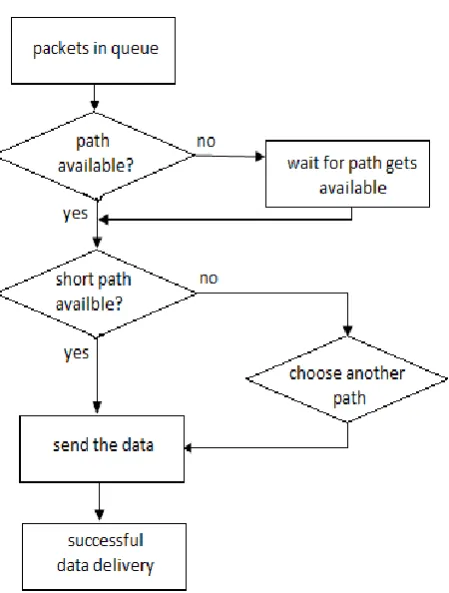
5. choose the best path to send or to receive If (path!= available )
{ wait until path gets available
//*first priority to short path Choose Short path
© 2016, IRJET | Impact Factor value: 4.45 | ISO 9001:2008 Certified Journal | Page 1554
choose other long path to send the data} Else {
send the data with short path }
busy tone on the control channel we need to consider
a. BTt(Transmit busy tone) and b. BTr (Receive busy tone)
Mechanism to reduce collision and contention problem:
Muti route:
With short path :takes less time to transfer packet With long path: takes long time but reliability is
more
Prob packet: prob packet for the proper delivery of the packets.
6. If sensed data send successfully then go to step 4 or else go to step 5 and resend the data.
7. Go to step 4.
Figure, 2 The flow chart of choosing the path
[image:5.595.307.557.114.302.2]
5.RESULT AND ANALYSIS
Figure.3 This represent throughput on different source rate
Units:
Throughput: (no of packets/seconds) Source rate: (kbps)
Figure 4: This represents packet loss on different source rate
Units
[image:5.595.60.285.391.688.2]© 2016, IRJET | Impact Factor value: 4.45 | ISO 9001:2008 Certified Journal | Page 1555
Figure5:
This represents delay on different source rate
UnitsDelay (seconds) Source rate (kbps
)
5. CONCLUSIONS
Simulation results show that proposed routing
algorithm (Enhanced HTLC-MeDSR with
DBTMA Routing Algorithm ) performs better as
compared to existing technique (HTLC-MeDSR)
in terms of the QoS metrics( throughput,delay
and packet loss).
In this simulation ,grid scenario has been used
for the better data transmission, If we consider
the end-to-end delay, it reduced by reducing
the collision and distance.
In this scenario multiple path from source to
destination has been used to solve the problem
of the link failure. If we consider the
throughput ,it increased by reducing the delay
and collision & packet loss into the network.
We have depicted this result by using graphs
and simulation in Network Simulator NS-2
6. REFERENCES
[1] L. Klein rock and F. A. Tobagi, “Packet switching in radio
channels: Part I—Carrier sensing multiple-access modes and their throughput–delay characteristics,” IEEE Trans. Commun., vol. COM-23, no 12, pp. 1417–1433[2] P. Karn, “MACA—A new channel access method for packet radio,” in ARRL/CRRL Amateur Radio 9th Computer Networking Conference, pp. 134–140.
[3] A. Tobagi and L. Klein rock, “Packet switching in radio channels: Part II—The hidden terminal problem in carrier
sense multiple-access and the busy-tone solution,” IEEE Trans. Commun., vol. COM-23, pp.1417–1433,.
[4]V. Bharghavan, A. Demers, S. Shenker, and L. Zhang, “MACAW: A media access protocol for wireless LAN’s,” in
Proc. ACM SIG COMM’94, 1994, pp. 212–225.
[5] F. A. Tobagi and L. Klein rock, “Packet switching in radio channels: PartIII—Polling and (dynamic) split-channel reservation multiple access,”IEEE Trans. Commun., vol. COM-24, pp. 832–844,.
[6] C. Wu and V. O. K. Li, “Receiver-initiated busy-tone multiple access in packet radio networks,” in Proc. ACM SIG COMM ’87, pp. 336–342.
[7]C.L.Fulmar and J. J. Garcia-Luna-Aceves, “Floor acquisition multiple access (FAMA) for packet-radio networks,” in Proc. ACM SIG COMM’95, pp. 262–273
.
[8]“Solutions to hidden terminal problems in wireless networks,” in Proc. ACM SIG COMM ’97, pp. 39–49
.
[9] Zygmunt J. Haas, “A New Routing Protocol for the Reconfigurable Wireless Networks”, Proceedings of the 6th International Conference on Universal Personal Communications, pages 562–566. IEEE, October
[10]N. Magaia, P. R. Pereira, A. Grilo, High throughput low coupling multipath routing for wireless multimedia sensor networks, Accepted for publication in 560 Ad Hoc & Sensor Wireless Networks (AHSWN), An International Journal