Graph Theoretical Algorithms For JVM Operand
Stack Visualization And Bytecode Verification
Sergej Alekseev, Andreas Karoly, Duc Thanh Nguyen and Sebastian Reschke
Abstract—The bytecode verification is an important task of the Java architecture that the JVM specification suggests. This paper presents graph theoretical algorithms and their implementation for the data flow analysis of Java bytecode. The algorithms mainly address the extended static visualization and verification of the JVMs operand stack to allow a deeper understanding in bytecode behavior. Compared to the well known algorithms, the focus of our approach is the visualization of the operand stack and a graph theoretical extension of the verification algorithms.
We also show some experimental results to illustrate the effectiveness of our algorithms. All presented algorithms in this paper have been implemented in the Dr. Garbage tool suite. The Dr. Garbage project resulted from research work at the University of Oldenburg and is now further maintained at the University of Applied Sciences Frankfurt am Main. The tool suite is available for download under the Apache Open Source license.
Index Terms—java virtual machine, operand stack, verifica-tion, visualizaverifica-tion, data flow analysis.
I. INTRODUCTION
T
HE computational model of the Java Virtual Machine (JVM) corresponds to a stack machine [2]. Some other programming languages are also based on the computer model of a stack machine, for example Forth [4] and PostScript [3]. The algorithms and approaches presented in this paper are applicable to any stack based language, although we present our algorithms based on the JVM.All bytecode instructions of the JVM take operands from the stack, operate on them and return results to the stack. Each method in a java class file has a stack frame. Each frame contains a last-in-first-out (LIFO) stack known as its operand stack [1, The JavaR Virtual Machine Specification]. The stack frame of a method in the JVM holds the method’s local variables and the method’s operand stack. Although the sizes of the local variables get predetermined at the start of the method and always stay constant, the size of the operand stack dynamically changes as the method’s byte code instructions are executed. The maximum depth of a frame’s operand stack is determined at compile-time and is supplied along with the code for the method associated with the frame. Additionally, if a class is loaded by the JVM, the JVM verifies its content and makes sure there is no over- or underflow of the operand stack. But neither the Java compiler nor the JVM verifier perform a deep content analysis of the operand stack because such analyses are very
Manuscript received July 12, 2013; revised August 12, 2013.
Sergej Alekseev, Andreas Karoly and Duc Thanh Nguyen are with the Department of Computer Science, Fachhochschule Frankfurt am Main University of Applied Sciences, 60318 Frankfurt am Main, Germany (Phone. +49 69-1533-3673, e-mail: [email protected], [email protected], [email protected]).
Sebastian Reschke is with AVM GmbH, 10559 Berlin, Germany (e.mail: [email protected]).
time consuming and usually unnecessary, because the Java compiler generates reliable bytecode. Nevertheless, there are many tools that modify bytecode at runtime or generate it from different sources other than Java. In such cases, a more precise and detailed analysis of the operand stack is needed to localize potential runtime errors. The operand stack errors are very hard to track and most of them do not arise until many byte code instructions have already been executed.
In this paper we present graph theoretical algorithms for extended static verification and visualization of the operand stack. The algorithm ASSIGN OPSTACK STATES (section III-A) computes all possible contents of a method’s operand stack. The following sections describe possible methods of analysis (size, type and content based) which can be performed on the calculated operand stack contents.
Section III-E describes a LOOP ANALYSIS algorithm to handle the operand stacks of methods which contain cycles. In section IV we propose a graph theoretical transforma-tion algorithm to represent the operand stack structure and define a very simple grammar which includes the mathemat-ical and logmathemat-ical operations in java similar syntax to visualize the contents and conditions of operand stacks based on the operand stack computation algorithm in section III-A.
All presented algorithms have been implemented in the context of the Dr. Garbage tool suite project [6] and we present some experimental results in section V which can be obtained from the Dr. Garbage tool suite project [6].
Furthermore, these algorithms are suitable as an extension of the Java compiler and JVM verifier.
II. RELATED WORK
Klein and Wildmoser explain improvements of Java byte-code verification in their papers [12, Verified lightweight bytecode verification], [14, Verified Bytecode Subroutines] and [13, Verified bytecode verifiers]. There the purpose of a verifier for bytecode regarding the Java operand stack and the possible misbehaviour like underflow and overflow are mentioned. The operand stack is shown as an array of types (e.g. int) per bytecode instruction. The described verification includes the type checking of operand stack entries. Stephen N. Freund and John C. Mitchell present in their paper [11, A Type System for the Java Bytecode Language and Verifier] a specification in the form of a type system for a subset of the bytecode language. And they developed a type checking algorithm and prototype bytecode verifier implementation.
The approach of Klein and Wildmoser, as well as the approach of Freund and Mitchell are partially related to our algorithm for the type based analysis in section III-C. But in addition to these algorithms we present a graph theoretical extension of the type based analysis.
subroutine], [18, Java and the Java Virtual Machine - Def-inition, Verification, Validation], [19, A type system for Java bytecode subroutines] and [20, Subroutines and java bytecode verification].
Eva Rose deals in her paper [15, Lightweight Bytecode Verification] with the verification algorithms on embedded computing devices. Xavier Leroy’s papers [9, Java bytecode verification: an overview] and [10, Java bytecode verification: algorithms and formalizations] review the various bytecode verification algorithms for crucial security Java components on the Web. The application field of our algorithm is not limited, but in view of the memory consumption (section III-A Algorithm) our approach in its pure form is not suitable for using on embedded devices.
In the paper [16, Analyzing Stack Flows to Compare Java Programs] of Lim and Han the Java operand stack is used by algorithms to identify clones of Java programs. They describe how the JVM specification defines the operand stack before and after each bytecode of a Java program. For visualization of the stack an array of dots with one dot per entry of the operand stack is used. Our approach provides a more versatile form of the operand stack representation.
III. STATIC OPERAND STACK ANALYSIS
An essential idea behind the static operand stack analysis is to identify a set of potential control flow paths in a method, to calculate all possible operand stack states by interpreting the byte code instructions for each path and to identify inconsistencies of the operand stack by comparing these states.
In the next subsection a graph theoretical algorithm is presented which traverses all control flow paths of a method and assigns the calculated operand stack states to each bytecode instruction in each control flow path.
The control flow path analysis is based on a control flow graph (CF G) of a method. The CF G is defined as a tuple G = (V, A), where V is a nonempty set of vertices representing bytecode instructions of a method, A is a (possibly empty) set of arcs (or edges) representing transitions between the bytecode instructions. Formally A is the finite set of sets(a, b), wherea, b∈V.
As a CF G containing loops has unlimited numbers of potential paths, the CF G has to be transformed into a directed acyclic graph (DAG) with a limited number of paths by removing loop backedges (as identified by a depth-first search of theCF G). The number of operand stack states in each acyclic path always equals the number of vertices (or number of corresponding byte code instructions) in this path. The subsections III-B, III-C and III-D present techniques for a static operand stack analysis in acyclic graphs based on the operand stack size, type of stack variables and operand stack content. The subsection III-E extends operand stack analysis to arbitrary control flow graphs that contain cycles.
A. Algorithm for assigning stack states to vertices in a DAG
The algorithmASSIGN OPSTACK STATESin fig. 1 iden-tifies all possible control flow paths by visiting vertices of theDAGin topological order. This order ensures that all the predecessors of a vertexv are visited beforev itself.
'
&
$
% /*Gis directed acyclic graph defined asG= (V, E)*/
ASSIGN OPSTACK STATES (G)
1 for (each vertex v∈V in topological order ){ 2 S[]=N U LL;
3 for (all incoming edgesl ofv ){ 4 v0=otherend(l, v); 5 S=S∪v0.stack;
6 }
7 for (each stack states∈S ){ 8 updateStack(s, v);
9 }
10 v.stack =S; 11 }
Fig. 1. Algorithm for assigning stack states to vertices in a DAG
The algorithm calculates a list of all possible operand stack states for the current vertexv (fig. 1: lines 2-6) by iterating all the predecessors of the vertex v and building the set of stack statesSas a disjunct union of all predecessors operand stack lists.
All stack states of the listS are updated by pop or push operations corresponding to the byte code instruction of the vertexv (fig. 1: lines 7-9).
After execution of the algorithm a list of all possible operand stack states is assigned to each vertex of theDAG. Theorem 3.1: (Operand Stack Algorithm) Given a di-rected acyclic graph G = (V, E), after the algorithm AS-SIGN OPSTACK STATESin fig. 1 visits a vertexv∈V, the property variable stack of v contains a list of all possible operand stack states in the vertexv.
Proof:By induction on the depth of a vertexv∈V and paths from theST ART vertex tov.
Base Case: v depth is0 (v=ST ART). The theorem is trivially satisfied.
Induction Step: The list of all possible operand stack states S for the vertex v with d > 0 is calculated by updating all elements of the list S = {∀s ∈ S|update(s)} (lines 7-9). The list S is a set of all operand stack states of all immediate predecessors v0...vn of v with the depth d−1,
soSn
i=0vi.stack(lines 3-5). By induction hypothesis, each
path section from the ST ART to vi must be visited and
all operand stack states are assigned to the property variable vi.stack.
All successorsv0...vn ofvmust have a depth greater than
[image:2.595.304.555.51.219.2]d, because the graph is aDAG. So the theorem holds for allv∈V with depthd >0.
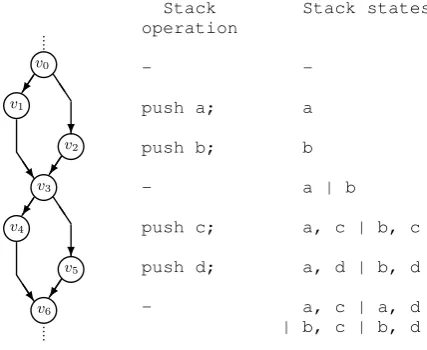
Fig. 3 illustrates how the algorithm operates on the ex-ample CFG. The vertices in this exex-ample are labeled in topological order. The following control paths exist:
• p1={..., v0, v1, v3, v4, v6, ...}
• p2={..., v0, v1, v3, v5, v6, ...}
• p3={..., v0, v2, v3, v4, v6, ...}
• p4={..., v0, v2, v3, v5, v6, ...}
In path p1 the vertex v1 pushes the variable a and the
vertexv4 pushes the variable c onto the stack. The operand
stack states can be assigned to each vertex of path p1 as
follows:p1={..., v0(−), v1(a), v3(a), v4(a, c), v6(a, c), ...}.
Byte code Stack size List of variable List of variables types on the stack 0 iload_1; 1 I a
1 iload_2; 2 I,I a, b
2 if_icmple 7; 0 -
-5 iload_1; 1 I a
6 goto 4; 1 I a
9 iload_2; 1 I b
10 iconst_2; 2 I,I a, 2 | b, 2
11 invokestatic 16; 0 -
-n v0
?
n v1
?
n v2
?
n v5
?
QQs
n v6
+
n v9
?
n v10
?
[image:3.595.73.496.50.232.2]n v11
Fig. 2. CFG, corresponding byte code and the operand stack representation.
Stack Stack states operation
-
-push a; a
push b; b
- a | b
push c; a, c | b, c
push d; a, d | b, d
[image:3.595.62.276.275.450.2]- a, c | a, d | b, c | b, d
n v0
J
J
?
n v1
J J ^
n v2
n v3
J
J
?
n v4
J J ^
n v5
n v6
Fig. 3. CFG with operand stack states computed by the algorithm.
procedure is not efficiently in terms of runtime complexity. To calculate all possible stack states in each vertex of aDAG it is not necessary to traverse each control path separately. Instead our algorithm calculates the stack states step by step for all paths by visiting the vertices of aDAGin topological order.
Generally, the runtime complexity of a topological search algorithm for the given directed acyclic graph G with n vertices and m arcs can be found in O(n+m) (see [7] or [8]). The memory allocation complexity to store all possible operand stack combinations in our algorithm grows exponentially. As you can see from the example in fig. 3 the number of combinations N depends on the number of sequential branches in the DAG and equals the multipli-cation of the number of branches in each branch. In this case N = 2×2 = 4. So the complexity of the memory allocation can be calculated asO(nn). To solve this problem a pragmatic approach is used in our implementation. We define the maximum number of combinations which have to be calculated by the algorithm to limit the memory allocation. The number of maximum combinations is variable and can be redefined for each operand stack.
The algorithm ASSIGN OPSTACK STATES in fig. 1 can be easily adapted to calculate the stack depth (used for size
based analysis) and the list of variable types (used for type based analysis) in each node. Instead of the operand stack state combinations, a single value is stored in the property variablestackof each vertex. In this case, both the runtime O(n +m) and the memory allocation O(n) have linear complexity. An example of the operand stack representation is illustrated in the fig. 2.
B. Size based operand stack analysis
A size based analysis can be achieved by simply altering the algorithmASSIGN OPSTACK STATESin fig. 1 to calcu-late the operand stack depth value and store it in the property variable for each vertex in the corresponding CFG. By trivial comparison of the operand stack depth values assigned to the CFG’s vertices, the following types of inconsistencies can be determined:
• Stack over or underflow: The max operand stack size is calculated as the algorithm visits the vertices of the corresponding CFG in topological order. By comparing the calculated max size with the max stack size, stored in the class file, over- or underflow stack errors can be determined. The overflow verification is generally available in the JVM as specified in [1, The JavaR Virtual Machine Specification]. Our approach also allows to determine the bytecode addresses of the instructions which cause the stack overflow.
• Leaving objects on stack:
The stack size of each end vertex (e.g. return byte in-struction) in the CFG is verified. Herewith is determined if any objects remain on the stack. By the reference to the bytecode instructions of the remained objects a warning is generated about possibly unused byte code instructions (instructions which push these objects onto the stack).
Byte code Stack size
2 if_icmple 7; 0
5 iload_1; 1
6 iconst_1; 2
7 goto 4; 2
10 iload_2; 1
11 iconst_2; 2 | 3
n v2
?
n v5
?
QQs
n v6
?
n v7
+
n v10
?
[image:4.595.59.272.50.191.2]n v11
Fig. 4. Asymmetrical operand stack size inconsistency
The runtime complexity for this analysis is in O(n+m)
and the memory allocation complexity is inO(n), wheren is the number of vertices andmnumber of arcs in the CFG.
C. Type based operand stack analysis
According to the JavaR Virtual Machine Specification [1] the JVM supports the operand stack type verification in general. Gerwin Klein and Tobias Nipkow formalize and describe algorithms for an iterative data flow analysis that statically predicts the types of values on the operand stack and in the register set [14], [12], [13] as mentioned in section II. In this section we present a graph-theoretical approach in addition to the well known verification techniques.
A type based analysis is realized by adaptation of the algorithmASSIGN OPSTACK STATESin fig. 1 to calculate a list of variable types on the stack and store it in the property variable for each vertex in the corresponding CFG. By comparison of the values assigned to the CFG’s vertices the following types of inconsistencies can be determined:
• Expected type: To ensure proper code execution at runtime, all operands on the stack have to be type correct in terms of what operand type the bytecode instruction expects. For example anistoreinstruction can not handle afloat operand.
• Asymmetrical type lists: The types of operands on a stack can differ on the incoming edges of a vertex. The backtrace algorithm allows to reference the bytecode instructions which pushed operands with different types onto the stack.
The runtime complexity for this analysis is in O(n+m)
and the memory allocation complexity is inO(n), wheren is the number of vertices andmnumber of arcs in the CFG.
D. Content based operand stack analysis
The algorithm ASSIGN OPSTACK STATESin fig. 1 cal-culates a list of variables on the stack for each bytecode instruction and stores it in the property variable of the vertex in the corresponding CFG. In a certain vertex several variable combinations on the stack are possible.
This analysis allows to figure out unnecessary branches in the bytecode. The bytecode example in fig. 5 contains an if-branch. The bytecode instructions (offset 5 and 9) in both branches push the same variable b onto the stack. A backtrace algorithm prints the bytecode addresses of instructions which lead to the duplicated operand stack states.
Byte code List of variables on the stack
2 if_icmple 7;
-5 iload_2; b
6 goto 4;
9 iload_2; b
10 iconst_2; b, 2 | b, 2
n v2
?
n v5
?
QQs
n v6
+
n v9
?
n v10
Fig. 5. Operand Stack with the same content in two branches
This kind of analysis is related to compiler optimization techniques, but in our approach the operand stack analysis is used to localize unused instructions. Our approach is partially comparable to the method of Lim and Han described in their paper [16, Analyzing Stack Flows to Compare Java Programs]. Although the goal of their paper is to identify clones of Java programs, the approach is absolutely different. The runtime complexity for this analysis is inO(n+m), wherenis the number of vertices andmnumber of arcs in the CFG. The memory allocation complexity is inO(nn)as
mentioned in the section III-A.
E. Loop based operand stack analysis
This section extends the analysis algorithms to arbitrary control flow graphs that can contain cycles. The algorithm fig. 1 in section III-A only works for acyclic paths, which correspond to back edge free paths. The main idea of the loop based analysis is that the operand stack states before entering and after leaving a loop have to be equal. Otherwise, each iteration of the loop would push objects onto the stack or pop them from the stack and the state of the stack would be undefined.
A depth-first search algorithm identifies a set of back edges B ⊂ E in a graph G = (V, E), that contains cycles. The graphGis transformed into a directed acyclic graph (DAG) by removing the back edgesD= (V, E0), whereE0=E\B. Each back edgeb∈B lies on a loop.
Theorem 3.2: (Loop Analysis Algorithm) The operand stack of a method represented by a control flow graph G that contains cycles is consistent if:
1) Size based analysis (section III-B) and type based analysis (section III-C) have been performed without any error on the directed acyclic graphDtransformed from the graphG.
2) and for each back edgeb∈Bwith the start vertexvs∈
V and the end vertex ve∈V: the operand stack state
assigned to the start vertexvsand the states assigned
to the start verticesv0, ...vn of all incoming edges of
the end vertex veare equal in size and type.
Proof: The point 1 of the theorem does not need to be proofed, because in case of any errors the stack is inconsistent. The point 2 can be proofed by the contradiction of the operand stack states.
[image:4.595.318.545.53.190.2]n v0
.. .
n vn @ @ I n vs
@@R b
n ve
-Fig. 6. Loop based analysis
• Each back edgeb∈B lies on one loop.
• There are possibly several forward paths ve → ... →
vs→ve in the loop.
Each forward path must have the same operand stack state in the last vertex, because all paths are acyclic and they pass the back edgeb. All acyclic paths have already been verified by the point 1 of the theorem.
The back edge b is a single back edge of the vertexvs,
because all other edges are outside the loop and must belong to theDAG. So all states of other incoming edges have been already verified by the point 1 of the theorem.
If the state of the vertexvewould not be equal to the states
of verticesv0...vn then the stack would be inconsistent.
The following algorithm for the loop based analysis is derived from the theorem 3.2. The algorithm executes the '
&
$
% /*D is a directed acyclic graph,D= (V, E0). B is a */
/* set of back edges,B*E0. The back edge b∈B, */ /*b={vs, ve}, wherevs, ve∈V. */ LOOP ANALYSIS (D,B)
1 for (each back edgeb∈B ){
2 for (all incoming edgesl of ve ){
3 v=otherend(l, ve);
4 if(v.stack6=vs.stack){
5 printERROR;
6 } } }
Fig. 7. Loop based analysis algorithm
operand stack comparison for all back edgesb∈Bidentified in the previous step of the analysis. The runtime complexity for this analysis is inO(n+m) wherenis the number of vertices andm number of arcs in the CFG.
IV. VISUALIZATION OF THEOPERANDSTACK
The simplest way to visualize the operand stack is to cal-culate the state of the operand stack in each instruction of a method and display the complete list of instructions with cor-responding states. The calculation of the operand stack states is performed by the algorithm ASSIGN OPSTACK STATES in section III-A fig. 1. The simple representation of the operand stack is shown in fig. 2, section III-A. To make the operand stack content more comprehensible we have defined a grammar (see appendix A) which includes variable types and names, logical combination and arithmetical operations and developed an algorithm to transform the control flow graph of a method to a tree representation.
The algorithm TRANSFORM GRAPH in fig. 8 creates a basic block graph Gb for the given control flow graph G
(line 1), removes the back edges in Gb (line 2) and starts
a Depth First Searchfrom each start basic block B, where
'
&
$
% /*Gis a control flow graph,G= (V, E). */
TRANSFORM GRAPH (G)
1 Gb =createBasicBlockGraph(G);
2 removeBackEdges(Gb);
3 T = createTree(); /*T is an empty tree. */ 4 for (all start basic blocksB∈Vb)
5 CREAT E T REE(B, T); 6 };
CREATE TREE (B,T)
1 add a new tree nodenfor B toT; 2 for ( all verticesv∈B ){
3 addv as child ofnto the treeT; 4 }
5 for (all outgoing argsl ofB ){
6 CREAT E T REE(otherend(l, B), T); 7 }
Fig. 8. Transformation algorithm for the operand stack representation
[image:5.595.47.296.357.492.2]indegree(B) = 0(line 4). For each basic blockBa new tree noden is created (RoutineCREATE TREE: line 1) and all vertices of a basic blockB(each vertex represents a bytecode instruction) are added as children ofBto the treeT (Routine CREATE TREE: lines 2-4). The bytecode instruction treeT is used to represent the operand stack structure in a view.
Fig. 9. Operand stack representation
An example representation of a Java bytecode is shown in fig. 9.
V. EXPERIMENTAL RESULTS
As stated in section III-A the more combinations of se-quential branches are contained in the bytecode of a method, the more memory needs to be allocated. In practice, excessive memory allocation happens very rarely. We analyzed over 500 methods from different Java classes of the Standard Java Library with the implementation based on the Dr. Garbage tools [6], [5]. The five most representative methods are listed in the table I which have been selected by the following criteria:
• methods with a large number of bytecode instructions
• methods that contain a large number ofifor switch
instructions
[image:5.595.324.528.395.543.2]TABLE I
EXPERIMENTALRESULTS: MS -MAX STACK SIZE, C -MAX NUMBER OF STACK COMBINATIONS, AS - #OF ASSIGNED STACKS, SE - #OF STACK ENTRIES, BI - #OF BYTE CODE INSTRUCTIONS, IF/S - #OF IF/SWITCH
INSTRUCTIONS
Package Path (class.method) MS C AS SE BI IF/S
sun.awt.geom.Curve.compareTo() 31 1 1 18 508 25/0
XmlChars.isCompatibilityChar() 2 2 1 2 309 85/1
Font3D.triangulateGlyphs() 6 2 2 5 2462 84/0
Matrix3d.compute svd() 10 1 1 8 1558 19/0
javax.media.j3d.Alpha.value() 5 1 1 5 775 39/0
The experimental results have shown that despite a number of conditional branch operators or stack entries along with method instructions, the amount of stack combinations stay in limit.
VI. CONCLUSION
This paper describes new algorithms for operand stack analysis and visualization based on graph theoretical meth-ods. Although the algorithms partially execute trivial operand stack verifications, they can be obtained as a supplement to the well known algorithms. The operand stack visualization algorithms presented in this paper are the first that can represent the operand stack in such a comprehensive way.
Experimental results showed that the performance and memory consumption do never deviate from linearity, al-though the theoretical memory consumption has exponential complexity. It is obviously possible with the synthetically generated code to reach the limits, but such code constructs do not occur in practice. We are convinced that a lot of new tools can be designed and implemented based on these algorithms and results
APPENDIXA
OPERANDSTACKCONTENTGRAMMAR
<Stack> ::= <StackEntry>{"," <StackEntry>}{"|" <Stack>} <StackEntry> ::= <type> <value>
<type> ::= "B" | "C" | "D" | "F" | "I" | "J" | "S" | "Z" | "L" | <array type>
<array type> ::= "[" { "[" } <type>
<value> ::= <variable name> | <constant> | <array name> | <math operation>
<variable name> ::= <char>{<char>}
<char>::= any one of the 128 ASCII characters, but not any of special characters [, ], (, ), \, /, ;, ... or the space character
<constant> ::= 0 | 1 | 2 | 3 | 4 | 5 | 6 | 7 | 8 | 9 | <float_constant> {<constant>}
<array name> ::= <variable name> [ <numeric> | <variable name> ]
<float_constant> ::= <constant> "." <constant>
<math operation> ::="("<value> <operation> <value>")" <operation> ::= "+" | "-" | "*" | "/" | "%" | "ˆ" | "|"
| "<<" | ">>"
ACKNOWLEDGMENT
The authors would like to thank the Dr. Garbage Project Community for supporting the implementation of proposed algorithms and tools [5].
REFERENCES
[1] Tim Lindholm, Frank Yellin, Gilad Bracha and Alex Buckley,
The JavaR Virtual Machine Specification, Java SE 7 ed., 2013, http://docs.oracle.com/javase/specs/jvms/se7/html/
[2] Bruce Ian Mills, Theoretical Introduction to Programming, Springer 2006, ISBN 978-1-84628-263-8
[3] Adobe Systems,PostScript language reference. 3.Edition , Addison-Wesley 1999, ISBN 0-201-37922-8
[4] Leo Brodie,Starting FORTH: an introduction to the FORTH language and operating system for beginners and professionals, Prentice-Hall 1987, ISBN 0-201-37922-8
[5] Sergej Alekseev, Peter Palaga and Sebastian Reschke,The Dr. Garbage Tools Project, 2013, http://www.drgarbage.com
[6] Sergej Alekseev, Victor Dhanraj, Sebastian Reschke, and Peter Palaga, Tools for Control Flow Analysis of Java Code, Proceedings of the 16th IASTED International Conference on Software Engineering and Applications, 2012, http://www.actapress.com/PaperInfo.aspx?paperId=454811
[7] Gnther Stiege, Graphen und Graphalgorithmen, Shaker; Auflage: 1, 2006, ISBN 3832251138
[8] Donald E. Knuth,The Art of Computer Programming, Addison Wesley, 1997, ISBN 0201896834
[9] Xavier Leroy,Java bytecode verification: an overview, Computer Aided Verification, CAV 2001, Vol. 2102 of Lecture Notes in Computer Science, pages 265-285. Springer, 2001.
[10] Xavier Leroy,Java bytecode verification: algorithms and formaliza-tions, Journal of Automated Reasoning, Vol. 30 Issue 3-4, Pages 235 - 269, 2003, http://gallium.inria.fr/ xleroy/publi/bytecode-verification-JAR.pdf
[11] Stephen N. Freund, John C. Mitchell, A Type System for the Java Bytecode Language and Verifier, Journal of Auto-mated Reasoning, Vol. 30 Issue 3-4, Pages 271 - 321, 2003, http://theory.stanford.edu/people/jcm/papers/03-jar.pdf
[12] Gerwin Klein, Tobias Nipkow,Verified lightweight bytecode verifica-tion, Concurrency and Computation: Practice and Experience, Vol. 13, Pages 1133-1151, 2001
[13] Gerwin Klein, Tobias Nipkow, Verified bytecode verifiers, Journal Theoretical Computer Science, Vol. 298, Issue 3, Pages 583 - 626, 2003, http://tumb1.biblio.tu-muenchen.de/publ/diss/in/2003/klein.pdf [14] Gerwin Klein, Martin Wildmoser,Verified Bytecode Subroutines,
Jour-nal of Automated Reasoning, Vol. 30 Issue 3-4, Pages 363 - 398, 2003, http://www.cse.unsw.edu.au/ kleing/papers/KleinW-TPHOLS03.pdf [15] Eva Rose,Lightweight Bytecode Verification, Journal of Automated
Reasoning, Vol. 31, Issue 3-4, Pages 303-334, 2003
[16] Hyun-il Lim, Taisook Han,Analyzing Stack Flows to Compare Java Programs, EICE Transactions 95-D(2), Pages 565-576, 2012 [17] Alessandro Coglio,Simple verification technique for complex Java
bytecode subroutine, In Proc. 4th ECOOP Workshop on Formal Tech-niques for Java-like Programs, 2002
[18] Robert Strk, Joachim Schmid, and Egon Brger, Java and the Java Virtual Machine - Definition, Verification, Validation, Springer, 2001. [19] R. Stata and M. Abadi,A type system for Java bytecode subroutines, In
Proc. 25th ACM Symp. Principles of Programming Languages, Pages 149–161. ACM Press, 1998.