Ames Laboratory Publications
Ames Laboratory
8-16-2006
Magnetism of (Dy0.5Er0.5)Al2 single crystal in ac
and dc magnetic fields
Evgenii M. Levin
Iowa State University, [email protected]
Karl A. Gschneidner Jr.
Iowa State University, [email protected]
Thomas A. Lograsso
Iowa State University, [email protected]
Deborah L. Schlagel
Iowa State University, [email protected]
Follow this and additional works at:
http://lib.dr.iastate.edu/ameslab_pubs
Part of the
Condensed Matter Physics Commons
, and the
Metallurgy Commons
The complete bibliographic information for this item can be found at
http://lib.dr.iastate.edu/
ameslab_pubs/122
. For information on how to cite this item, please visit
http://lib.dr.iastate.edu/
howtocite.html
.
Magnetism of (Dy0.5Er0.5)Al2 single crystal in ac and dc magnetic fields
Abstract
The temperature (4.2–90 K), ac magnetic field (1.25–50 Oe), frequency (5–125 Hz), and bias dc magnetic
field (0–10 kOe) dependencies of the real and imaginary components of the ac magnetic susceptibility, and
the temperature (4.2–250 K) and dc magnetic field(0.1–50 kOe) dependencies of the dc magnetic
susceptibility and magnetization of a(Dy
0.5Er
0.5)Al
2single crystal have been studied. Isothermal
magnetization measurement in a dc magnetic field indicates that (Dy
0.5Er
0.5)Al
2orders ferromagnetically at
37 K. The ac and dc magnetic susceptibilities of (Dy
0.5Er
0.5)Al
2exhibit a similar behavior in the
paramagnetic region but quite different behaviors in the ferromagnetic state. Both the real and imaginary
components of the ac magnetic susceptibility are sensitive to the applied ac magnetic field, the
crystallographic direction, and the bias magnetic field, showing that domain wall dynamics mainly account for
the response to the ac magnetic field. The contributions to the magnetization process arise from the
magnetically ordered Dy and Er sublattices and depend upon the single-ion anisotropy of the Dy and Er ions.
Keywords
Physics and Astronomy, Materials Science and Engineering, dysprosium alloys, erbium alloys, aluminium
alloys, ferromagnetic materials, magnetic susceptibility, magnetic domain walls, magnetic anisotropy
Disciplines
Condensed Matter Physics | Metallurgy
Comments
The following article appeared in
Journal of Applied Physics
100 (2006): 043902 and may be found at
http://dx.doi.org/10.1063/1.2234540
.
Rights
Copyright 2006 American Institute of Physics. This article may be downloaded for personal use only. Any
other use requires prior permission of the author and the American Institute of Physics.
Magnetism of (Dy0.5Er0.5)Al2 single crystal in ac and dc magnetic fields
E. M. Levin, K. A. Gschneidner, T. Lograsso, and D. L. Schlagel
Citation: J. Appl. Phys. 100, 043902 (2006); doi: 10.1063/1.2234540
View online: http://dx.doi.org/10.1063/1.2234540
View Table of Contents: http://jap.aip.org/resource/1/JAPIAU/v100/i4
Published by the AIP Publishing LLC.
Additional information on J. Appl. Phys.
Journal Homepage: http://jap.aip.org/Journal Information: http://jap.aip.org/about/about_the_journal
Top downloads: http://jap.aip.org/features/most_downloaded
Magnetism of
„
Dy
0.5Er
0.5…
Al
2single crystal in ac and dc magnetic fields
E. M. Levin
Ames Laboratory, Iowa State University, Ames, Iowa 50011-3020
and Department of Physics and Astronomy, Iowa State University, Ames, Iowa 50011-3020
K. A. Gschneidner, Jr.a兲
Materials and Engineering Physics Program, Ames Laboratory, Iowa State University, Ames, Iowa 50011-3020 and Department of Materials Science and Engineering, Iowa State University, Ames, Iowa 50011-2300
T. Lograsso and D. L. Schlagel
Materials and Engineering Physics Program, Ames Laboratory, Iowa State University, Ames, Iowa 50011-3020
共Received 12 October 2005; accepted 25 May 2006; published online 16 August 2006兲
The temperature共4.2– 90 K兲, ac magnetic field共1.25– 50 Oe兲, frequency共5 – 125 Hz兲, and bias dc magnetic field共0 – 10 kOe兲dependencies of the real and imaginary components of the ac magnetic susceptibility, and the temperature共4.2– 250 K兲and dc magnetic field共0.1– 50 kOe兲dependencies of the dc magnetic susceptibility and magnetization of a 共Dy0.5Er0.5兲Al2 single crystal have been studied. Isothermal magnetization measurement in a dc magnetic field indicates that共Dy0.5Er0.5兲Al2
orders ferromagnetically at 37 K. The ac and dc magnetic susceptibilities of共Dy0.5Er0.5兲Al2exhibit
a similar behavior in the paramagnetic region but quite different behaviors in the ferromagnetic state. Both the real and imaginary components of the ac magnetic susceptibility are sensitive to the applied ac magnetic field, the crystallographic direction, and the bias magnetic field, showing that domain wall dynamics mainly account for the response to the ac magnetic field. The contributions to the magnetization process arise from the magnetically ordered Dy and Er sublattices and depend upon the single-ion anisotropy of the Dy and Er ions. © 2006 American Institute of Physics. 关DOI:10.1063/1.2234540兴
I. INTRODUCTION
The cubic Laves phasesRAl2 intermetallic compounds,
where R is a 4f element, have been studied for more than 30 years and they still attract attention due to their interest-ing magnetic properties. Surprisinterest-ing magnetic phenomena, such as a zero net magnetic moment in the 共Sm1−xGdx兲Al2
ferromagnet,1 the anisotropic spin form factor for SmAl2,2
the magneto-optical properties of RAl2, where R= La, Ce,
and Pr,3 and the behavior of the real and imaginary compo-nents of the ac magnetic susceptibility of RAl2, where R
= Dy, Er, and Gd,4have stimulated studies of these materials. The existence of magnetically orderedRAl2compounds with
either a small or a large localized magnetic moment, ferro-and antiferromagnetic interactions between different lan-thanides R andR
⬘
, and the possibility to grow high quality 共R,R⬘
兲Al2 single crystals make these materials convenient for fundamental studies of some aspects of magnetism in 4f-electron metallic systems. Especially interesting are solid solutions based on two binary ferromagnetic compounds where the lanthanide ions initially have different exchange interaction energies and single-ion anisotropies resulting in a complex competition between them which affects both the microscopic and macroscopic magnetic parameters such as the easy magnetization direction 共EMD兲, magnetoelastic coupling, and domain wall dynamics.共DyxEr1−x兲Al2 solid solutions based on the DyAl2 and
ErAl2binary compounds crystallize in the cubic MgCu2-type
crystallographic structure. DyAl2is a ferromagnet with a
Cu-rie temperatureTCof 62 K and EMD is the关100兴direction,5
while ErAl2 is a ferromagnet with TC= 14 K and the 关111兴
direction is the EMD.6 Hence, because Dy and Er ions are statistically distributed in the lattice of the共DyxEr1−x兲Al2
ma-terial, they will create specific short- and long-range compe-titions of contributions which will determine the EMD, and one can expect complex magnetic field and temperature de-pendencies of the magnetization of 共DyxEr1−x兲Al2 materials
when measured along different crystallographic directions in dc and ac magnetic fields.
In addition to these scientific reasons for studying 共Dy0.5Er0.5兲Al2 this alloy could be used for low-temperature magnetic refrigeration7and, therefore, detailed studies of this material prepared from high purity components are important for this potential utilization. The earlier reported heat capac-ity data for the 共Dy0.5Er0.5兲Al2 polycrystalline sample
showed that it orders ferromagnetically below⬃38 K.7,8The ac magnetic susceptibilityacmeasured in a low ac magnetic
field 共1.25 Oe, 125 Hz兲 shows a narrow peak at ⬃38 K which splits into two peaks in a bias dc magnetic field of
Hdc艌2 kOe.8 Although the ac magnetic susceptibility is a
powerful tool for the study of magnetic materials,9,10its in-terpretation may not be a simple task because it can show a similar behavior even for materials with quite different mag-netic ground states. For instance, a similar peak of the ac
a兲Author to whom correspondence should be addressed; FAX:共515兲
294-9579; electronic mail: [email protected]
JOURNAL OF APPLIED PHYSICS100, 043902共2006兲
0021-8979/2006/100共4兲/043902/8/$23.00 100, 043902-1 © 2006 American Institute of Physics
magnetic susceptibility can be in principle observed in anti-ferromagnets 共AFMs兲, superparamagnets 共SPs兲, and spin-glass共SG兲systems.9–12Furthermore, an ac magnetic suscep-tibility peak can be observed in some ferromagnets, e.g., in Ni–Cu,13V–Fe,13and Pd–Fe alloys.14Although the behavior of the ac magnetic susceptibility of ferromagnets below the Curie temperature mainly is determined by the domain wall movement, in some cases it can be mistaken with that ob-served in the AFM, SG, and SP materials, where a similar behavior related to the interaction between localized mag-netic moments occurs.
Another intriguing phenomenon is the splitting of the ac magnetic susceptibility peak by a bias dc magnetic field as observed in some 3d-electron materials.15The existence of a “high-temperature” peak is explained by the contribution from the initial susceptibility, while the “low-temperature” peak is attributed to the appearance of a SG system. The movement of the splitting peaks in the opposite directions with increasing dc magnetic field was explained by the en-hancement of ferromagnetism and the hindrance of the for-mation of the SG phase by the bias dc magnetic field.15,16A similar splitting was also observed in the DyTi2Ga4,
ErTi2Ga4,17 and 共Dy0.5Er0.5兲Al2 共Ref. 8兲 4f-electron
materials.
Furthermore, the ac magnetic susceptibility includes two components—the real ac
⬘
and the imaginary ac⬙
—but only during the last 15 years have both components been studied in detail for a few systems, e.g., metallic R2Fe14B,18 DyFe11Ti,19 and Sm2Fe17,20 and the oxide Fe3O4.21 It isknown that both components of the ac magnetic susceptibil-ity are determined mainly by the magnetocrystalline aniso-tropy 共for example, see Refs. 19 and 20兲. Because ac
⬘
in-cludes contributions from both the domain wall movement 共DWM兲 and magnetization rotation, andac⬙
reflects the en-ergy losses during the magnetization process in the solid, their temperature dependencies can be complex, particularly in polycrystalline materials. Therefore, the understanding of the behavior of the ac magnetic susceptibility of some 3d-, 4f-, and also 5f-electron materials is still unsatisfactory. Fur-thermore, the ac magnetic susceptibility data presented in most publications are shown only in arbitrary units and the calculation of magnetic constants and their comparison with those determined from dc magnetic susceptibility data usu-ally is impossible. Hence, it is interesting to study and com-pare the magnetic properties of various high quality single crystalline materials measured in both ac and dc magnetic fields.In this paper we report on the temperature共4.2– 90 K兲, ac magnetic field共1.25– 50 Oe兲, and bias dc magnetic field 共0 – 10 kOe兲 dependencies of the real and the imaginary components of the ac magnetic susceptibility, and the tem-perature 共4.2– 250 K兲 and dc magnetic field 共0.1– 50 kOe兲 dependencies of the dc magnetic susceptibility dc and the magnetization M of a high quality 共Dy0.5Er0.5兲Al2 single
crystal. The similarities and differences of the magnetic pa-rameters measured in the alternating and direct magnetic fields are discussed.
II. EXPERIMENTAL DETAILS
The 共Dy0.5Er0.5兲Al2 single crystal was grown using the
Bridgman technique. Stoichiometric quantities of aluminum 共⬎99.99+ at. % pure兲, and dysprosium and erbium 共both 99.8+ at. % pure兲, which were obtained from the Materials Preparation Center, Ames Laboratory US-DOE,22 were first arc melted together under argon gas. After the initial arc melt the buttons were turned over and remelted. This procedure was repeated four more times to increase the homogeneity of the button. Several prepared buttons were then remelted and drop cast into a water cooled copper mold to make one large ingot for growing the single crystal. This ingot was placed in an alumina crucible and heated under a vacuum of ⬃10−4Pa to 770 K to degas the ingot and crucible. The
fur-nace was backfilled with argon gas to a pressure of ⬃2
⫻105Pa. Following pressurization, the heating was
[image:5.612.310.561.45.439.2]contin-ued until the ingot reached a temperature approximately 200 K above the melting point of the alloy and held for 1 h before crystal growth was initiated. A growth rate of approxi-mately 5 mm/ h was used to prepare the high quality single crystals. The single crystal for this study was oriented by using the backreflection Laue method.
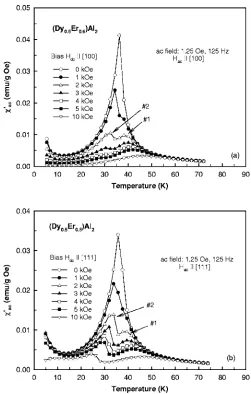
FIG. 1. The temperature dependencies of the real component of the ac magnetic susceptibility of the共Dy0.5Er0.5兲Al2single crystal measured in a 1.25 Oe ac magnetic field and various bias magnetic fields for the关100兴 共a兲 and关111兴 共b兲directions.
For magnetic measurements the sample had the shape of a cube 2⫻2⫻2 mm3 with a demagnetization factor of ⬃1 / 3. Although the demagnetization factors along the关100兴 and关111兴directions for a cube-shaped sample are different, we estimate the difference to be⬃3%, which does not sig-nificantly affect the results of the measurements.23 The dc magnetization and the real and imaginary components of the ac magnetic susceptibility were measured with the dc and ac magnetic field vectors parallel to the关100兴or关111兴direction using a Lake Shore, model 7225 magnetometer. The mea-surements were made during heating in the temperature range of 4.2– 300 K, while the dc magnetic field was varied from 0 to 50 kOe, the ac magnetic field from 1.25 to 25 Oe, and the frequency from 5 to 125 Hz. The errors of the crys-tallographic axis orientation with respect to the magnetic field vector are⬃5%. The errors of the magnetic measure-ments are less than 1%.4
III. EXPERIMENTAL RESULTS
A. The real and imaginary components of the ac magnetic susceptibility
The real ac
⬘
and imaginary ac⬙
components of the ac magnetic susceptibility of a zero magnetic field cooled 共Dy0.5Er0.5兲Al2 single crystal were measured in various acmagnetic fields, and in zero and nonzero bias dc magnetic fields. The temperature dependencies of ac
⬘
measured in a 1.25 Oe ac magnetic field for the关100兴and关111兴directions and various bias dc magnetic fields are shown in Fig. 1. In zero dc magnetic field ac⬘
of 共Dy0.5Er0.5兲Al2 for the 关100兴direction displays a narrow nearly symmetrical peak at ⬃36 K 关Fig. 1共a兲兴. In the 2 kOe bias dc magnetic field the main peak splits into two peaks: the “high” temperature peak 1 at⬃38 K and the “low” temperature peak 2 at⬃31 K. The former is gradually shifted to higher temperatures and the latter shifts slowly to lower temperatures with increasing dc magnetic field. The temperature dependence of the inverse ac magnetic susceptibility共ac
⬘
兲−1 follows the Curie-Weiss law ac⬘
=Npeff2
/ 3k共T−⌰p兲 with the paramagnetic Curie
tempera-ture ⌰p= 36 K and the effective magnetic moment peff
= 10.46B, while the expected effective magnetic moment
for the equiatomic mixture of free Dy3+ and Er3+ ions is 10.12B. The imaginary component of the ac magnetic
sus-ceptibility has a small positive peak at ⬃35 K and its mag-nitude decreases with the bias magnetic field 共not shown here兲 similar to that observed for the DyAl2 and ErAl2
compounds.4
Unlike for the关100兴direction, the position of peak 2 for ac
⬘
in the关111兴direction in 1.25 Oe shows a strongdepen-dence on the bias dc magnetic field. It shifts to lower tem-peratures with an increasing dc magnetic field from ⬃33 K in 2 kOe to ⬃18 K in 10 kOe, Fig. 1共b兲. The imaginary component measured for the关111兴direction is close to zero. Note also that for the共Dy0.5Er0.5兲Al2single crystal the
Curie-Weiss law parameters, i.e.,peffand⌰p, are identical for both
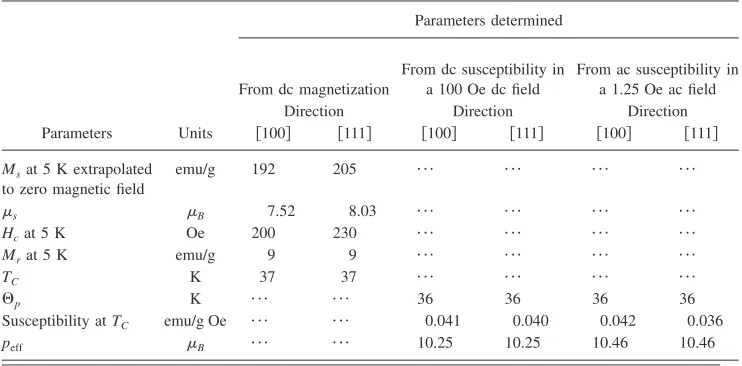
the关100兴and关111兴directions共see Table I兲.
The simultaneous influence of both the temperature and bias magnetic field on the real component of the ac magnetic susceptibility of the 共Dy0.5Er0.5兲Al2 single crystal for the
关100兴and关111兴directions is shown in Fig. 2 as three dimen-sional plots. Although the plots are slightly different because of the anisotropy of the magnetization of the alloy, one can clearly see that the bias dc magnetic field sharply freezes the magnetic system making it unable to respond to a low ac magnetic field in the ferromagnetic region for both directions in relatively high dc fields.
The temperature dependencies of ac
⬘
and ac⬙
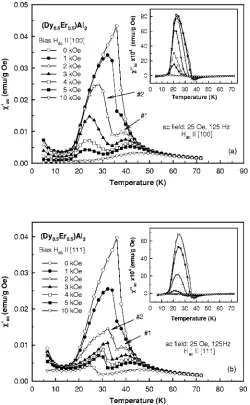
of the 共Dy0.5Er0.5兲Al2 single crystal measured for the 关100兴 and关111兴directions in a 25 Oe ac magnetic field共20 times larger than that used for measurements presented in Fig. 1兲 are shown in Fig. 3. In zero bias dc magnetic field ac
⬘
for the 关100兴direction above 36 K关see Fig. 3共a兲兴exhibits the same behavior above 36 K as measured in the 1.25 Oe magnetic field关see Fig. 1共a兲兴. Hence, a larger ac magnetic field does not affect the real component of the ac magnetic susceptibil-ity of共Dy0.5Er0.5兲Al2above⌰p. In contrast,ac⬘
below⌰pissensitive to the magnitude of the ac magnetic field, i.e., the peak is highly asymmetric. In bias dc magnetic field⬎1 kOe ac
⬘
measured in a 25 Oe ac magnetic field splits in two [image:6.612.124.495.64.247.2]peaks. Peak 1 is similar to that measured in the 1.25 Oe ac magnetic field while peak 2 shows a considerably larger am-plitude and shifts to lower temperature more rapidly with an
TABLE I. Magnetic parameters of the共Dy0.5Er0.5兲Al2single crystal determined in dc and ac magnetic fields.
Parameters Units
Parameters determined
From dc magnetization
From dc susceptibility in a 100 Oe dc field
From ac susceptibility in a 1.25 Oe ac field Direction Direction Direction
关100兴 关111兴 关100兴 关111兴 关100兴 关111兴
Msat 5 K extrapolated to zero magnetic field
emu/g 192 205 ¯ ¯ ¯ ¯
s B 7.52 8.03 ¯ ¯ ¯ ¯
Hcat 5 K Oe 200 230 ¯ ¯ ¯ ¯ Mrat 5 K emu/g 9 9 ¯ ¯ ¯ ¯
TC K 37 37 ¯ ¯ ¯ ¯
⌰p K ¯ ¯ 36 36 36 36
Susceptibility atTC emu/g Oe ¯ ¯ 0.041 0.040 0.042 0.036 peff B ¯ ¯ 10.25 10.25 10.46 10.46
043902-3 Levinet al. J. Appl. Phys.100, 043902共2006兲
increasing dc magnetic field. A large change is also observed for the imaginary component: in zero bias dc magnetic field the positive ac
⬙
peak below 36 K is large 关see the inset in Fig. 3共a兲兴, which is approximately seven times larger than that measured in 1.25 Oe. Furthermore, the positiveac⬙
peak is similar to the behavior of ac⬘
peak 2 in that the former decreases with increasing bias dc magnetic field and shifts to lower temperature.The temperature and bias dc magnetic field dependen-cies of the ac
⬘
and ac⬙
components of the 共Dy0.5Er0.5兲Al2single crystal for the 关111兴direction 关Fig. 3共b兲兴 are qualita-tively similar to those for the关100兴direction关Fig. 3共a兲兴but their magnitudes are smaller by about 20% andac
⬙
becomes close to zero in a 3 kOe bias dc magnetic field, while for the 关100兴direction it approaches zero in a 10 kOe bias dc mag-netic field. The anisotropic behavior of the ac magmag-netic sus-ceptibility measured in a 25 Oe ac field is about the same as that observed in a 1.25 Oe ac magnetic field. The measure-ment of the ac magnetic susceptibility in a 50 Oe ac mag-netic field 共this measurement was made using an Oxford MagLab 2000 magnetometer兲showed continuing changes of ac⬘
andac⬙
in line with those described above. Also note thatac
⬘
of共Dy0.5Er0.5兲Al2measured in zero and low bias dcmag-netic fields, i.e., less than 3 kOe, shows a minimum at about
15 K. No such behavior was observed in either ErAl2 and DyAl2.4Therefore, the real and imaginary components of the
ac magnetic susceptibility of the共Dy0.5Er0.5兲Al2single
crys-tal for the 关100兴 and关111兴directions show a strong depen-dence on the temperature and the magnitude of both the ac magnetic field and bias dc magnetic field.
B. Magnetization/magnetic susceptibility in dc magnetic fields
The temperature dependencies of the magnetization of the共Dy0.5Er0.5兲Al2single crystal for the关111兴direction
mea-sured in a 20 kOe dc magnetic field and the inverse dc mag-netic susceptibility 共dc兲−1 are presented in Fig. 4. The dc
magnetic susceptibility of共Dy0.5Er0.5兲Al2along the关111兴
di-rection above ⬃36 K follows the Curie-Weiss law with the paramagnetic Curie temperature ⌰p= 36 K and effective
magnetic momentpeff= 10.25B. The same⌰pandpeffwere
[image:7.612.312.562.48.453.2]observed for the 关100兴direction 共see Table I兲. The effective magnetic moment is in good agreement with the expected
[image:7.612.50.304.50.408.2]FIG. 2. 共Color online兲Three dimensional plots showing the simultaneous influence of temperature and dc magnetic field on the real component of the ac magnetic susceptibility of the共Dy0.5Er0.5兲Al2single crystal measured in a 1.25 Oe ac magnetic field for the关100兴 共a兲and关111兴 共b兲directions.
FIG. 3. The temperature dependencies of the real component of the ac magnetic susceptibility of the共Dy0.5Er0.5兲Al2single crystal for the关100兴 共a兲 and关111兴 共b兲directions measured in 25 Oe ac magnetic field and various bias dc magnetic fields. The insets show the temperature dependencies of the imaginary component for the same magnetic fields and directions.
peff= 10.12B for the equiatomic mixture of free Dy3+ and
Er3+ ions. The value of T
C in共Dy0.5Er0.5兲Al2 is close to the
value of 38 K calculated from the average TC of DyAl2
共62 K兲 共Ref. 5兲and ErAl2共14 K兲 共Ref. 6兲and is in excellent
agreement with earlier reported value determined from the heat capacity measurements of a共Dy0.5Er0.5兲Al2
polycrystal-line sample.7,8
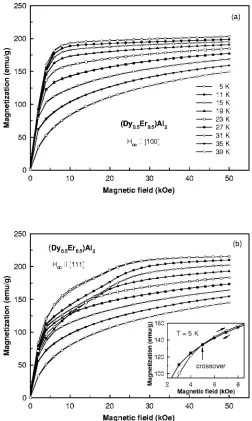
The magnetization of the共Dy0.5Er0.5兲Al2single crystal in
the 关100兴 and 关111兴 directions at various temperatures are shown in Fig. 5 and is typical for ferromagnets with a non-zero magnetocrystalline anisotropy. The 关100兴 direction is the EMD in dc magnetic fields at least below⬃2 kOe, which is similar to that observed for a polycrystalline DyAl2
sample,4 and suggests that the magnetization of 共Dy0.5Er0.5兲Al2 along this direction is determined mainly by
DWM 关Fig. 5共a兲兴. The magnetization of 共Dy0.5Er0.5兲Al2
along the 关111兴 direction 关Fig. 5共b兲兴 at temperatures below ⬃30 K shows a complex behavior. Initially, the magnetiza-tion increases with magnetic field as in a normal ferromag-net, but then, with increasing dc magnetic field there is a crossover of the magnetization curves from the 关100兴 to 关111兴direction due to the rotation of the magnetization vec-tor with increasing dc magnetic field.
The rotation of the magnetization vector in 共Dy0.5Er0.5兲Al2begins when it reaches a value ofnMs, where
Msis saturated magnetization of ⬃200 emu/ g andn= 0.57,
i.e., close to a value of 0.53 which is typically observed for ferromagnets with a cubic crystal structure.24 The saturated magnetic momentss, per lanthanide atom for the关100兴and
关111兴 directions in the 共Dy0.5Er0.5兲Al2 single crystal at 5 K,
extrapolated to zero magnetic field, are 7.52B and 8.03B,
while s for DyAl2 is 9.89B 共Ref. 4兲along the关100兴, and
for ErAl2it is 7.9B 共Ref. 5兲along the关111兴direction.
Dur-ing increasDur-ing and decreasDur-ing of the magnetic field at 5 K along the关111兴direction between 0 and 20 kOe, the magne-tization of共Dy0.5Er0.5兲Al2does not show a common behavior
关see the inset of Fig. 5共b兲兴. The magnetization during the magnetizing process in the region of 5艋Hdc艋16 kOe is larger than that observed during the demagnetizing process.
In a field of 5 kOe both magnetization curves show a cross-over, and below 5 kOe the magnetization during the denetizing process is larger than that observed during the mag-netizing process. Hence, below 5 kOe the magmag-netizing- magnetizing-demagnetizing process is typical for ferromagnets with a nonzero remanence. The observed behavior of the magneti-zation in the 5艋Hdc艋16 kOe region may be a result of two
processes:共1兲domain walls are partially shifted back reduc-ing the size of magnetic domains and/or共2兲the vector of the magnetization inside of the domains deviates from the direc-tion of the external magnetic field reflecting a competidirec-tion between the magnetization of the two magnetic ions, Dy and Er. The first process is more likely for a domain structure with thin and mobile domain walls, which is typical for the
RAl2-based magnetic systems.25
[image:8.612.310.562.47.468.2]Figure 6 shows temperature dependencies of the coerciv-ityHcand the remanent magnetizationMrof共Dy0.5Er0.5兲Al2. FIG. 4. The temperature dependencies of the dc magnetization and inverse
dc magnetic susceptibility of the共Dy0.5Er0.5兲Al2single crystal with applied magnetic field parallel to the关111兴direction.
FIG. 5. The magnetization curves for the共Dy0.5Er0.5兲Al2single crystal for the共a兲 关100兴and共b兲 关111兴directions measured in a dc magnetic field at various temperatures. The symbols vs temperature for both directions are shown in共a兲. The inset in共b兲shows the crossover of magnetization for the
关111兴direction during increasing共open symbols兲and reducing共solid sym-bols兲magnetic field.
043902-5 Levinet al. J. Appl. Phys.100, 043902共2006兲
[image:8.612.52.297.49.238.2]These parameters were determined from the magnetization of the共Dy0.5Er0.5兲Al2single crystal along the关100兴and关111兴 directions in dc magnetic fields changing between −20 and +20 kOe at various temperatures. BothHcand Mrhave the
zero values atT艌36 K but they become nonzero and gradu-ally increase as the temperature decreases. Below⬃15 K the coercivity of 共Dy0.5Er0.5兲Al2 for the 关100兴 and 关111兴 direc-tions becomes different. Note that below this temperature the Er ions in the ErAl2 compound are ferromagnetically ordered.6Finally, both the coercivity and remanent magneti-zation of共Dy0.5Er0.5兲Al2at 5 K共i.e.,Hc= 200 and 230 Oe for
关100兴 and 关111兴 directions, respectively, and Mr= 9 emu/ g
for both directions兲 are significantly larger than those ob-served for DyAl2 and ErAl2 共i.e., Hc= 42 and 18 Oe and
Mr= 4 and 1 emu/ g, respectively兲. 4
C. Temperature and magnetic field dependencies of the ratio of the magnetizations in the†100‡ and†111‡directions
It is well known that the anisotropy of magnetization, particularly in single crystalline materials, mainly arises from the magnetocrystalline anisotropy.24Therefore, the be-havior of the magnetocrystalline anisotropy in the 共Dy0.5Er0.5兲Al2 single crystal where both lanthanide ions have strong single-ion anisotropy can be qualitatively under-stood by comparing the behavior of the magnetization along both the关100兴and关111兴crystallographic directions.
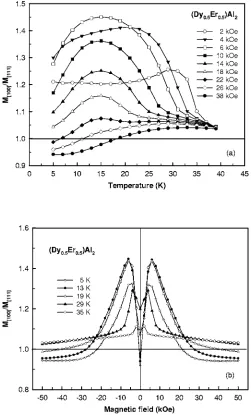
Figure 7 shows the temperature and magnetic field de-pendencies of theM关100兴/M关111兴ratio calculated from the iso-thermal M关100兴 and M关111兴 magnetizations of the
共Dy0.5Er0.5兲Al2 single crystal measured in various dc
mag-netic fields for the 关100兴 and关111兴directions, respectively. The temperature dependencies of M关100兴/M关111兴 for 共Dy0.5Er0.5兲Al2 at various applied dc magnetic fields are shown in Fig. 7共a兲. As one can see the关100兴direction at 5 K in 2艋Hdc⬍22 kOe is the EMD and theM关100兴/M关111兴 ratio exhibits a peak which is dependent on the magnetic field. This temperature decreases from 30 to 15 K in magnetic fields of 2 and 6 kOe, respectively, and then remains nearly
constant with increasing magnetic field up to 22 kOe. Simul-taneously, forHdc艌22 kOe theM关100兴/M关111兴ratio decreases
with increasing magnetic field at all temperatures below 36 K. At 5 K the ratio changes sign showing that the 关111兴 direction becomes the EMD for Hdc艌22 kOe. However, if the temperature increases, the 关100兴 direction becomes the EMD again. The temperatures of this transformation depends on the applied dc magnetic field and changes from 7 K at 22 kOe to 18 K at 38 kOe, reflecting the temperature in-duced magnetic field dependent spin-reorientation effect.
The isothermal magnetic field dependencies of the
M关100兴/M关111兴 ratio calculated from the isothermal magneti-zations of the共Dy0.5Er0.5兲Al2 single crystal measured in ap-plied magnetic fields ranging from −50 to + 50 kOe along both the M关100兴 and M关111兴 directions are presented in Fig. 7共b兲. At temperatures 艋19 K, the EMD changes direction twice reflecting the competition between the different contri-butions to the magnetocrystalline anisotropy of 共Dy0.5Er0.5兲Al2. At 5 K the EMD of 共Dy0.5Er0.5兲Al2 is the
[image:9.612.50.298.48.227.2]关111兴 direction in applied magnetic fields larger than
[image:9.612.311.562.49.464.2]FIG. 6. The temperature dependencies of the coercivityHcand remanent magnetizationMrof the共Dy0.5Er0.5兲Al2single crystal for the关100兴and关111兴 directions.
FIG. 7. The isofield temperature共a兲and isothermal magnetic field共b兲 de-pendencies of theM关100兴/M关111兴magnetization ratio for the共Dy0.5Er0.5兲Al2 single crystal.
兩20兩kOe and the 关100兴 direction for Hdc between −20 and
+20 kOe. At 13 K the EMD is aligned with the关111兴 direc-tion in magnetic fields less than 1 kOe and greater than 兩⬃27兩kOe while between 1⬍Hdc⬍27 kOe it is aligned
with the关100兴direction. At 29 K and above, the EMD is the 关100兴direction regardless of the strength of the applied mag-netic fields.
Hence, the behavior of the M关100兴/M关111兴 ratio in 共Dy0.5Er0.5兲Al2reflects a high sensitivity to the orientation of total magnetic moment to both the temperature and applied magnetic field. It appears that magnetic moments of Dy and Er ions in ferromagnetic共Dy0.5Er0.5兲Al2are oriented, respec-tively, in the same directions as in the binary DyAl2 and ErAl2compounds共see above兲.5,6Hence, the main reason for the magnetocrystalline anisotropy in 共Dy0.5Er0.5兲Al2 is the single-ion anisotropy due to the nonspherical wave functions of the Dy and Er ions and their interaction with their nearest neighbors. The temperature and magnetic field dependencies of the magnetocrystalline anisotropy in 共Dy0.5Er0.5兲Al2 are
determined by the competition between different orientations of the magnetic moments in the Dy and Er sublattices. The preferred orientation of the Dy and Er magnetic moments in the 共Dy0.5Er0.5兲Al2 lattice can be changed by the applied
magnetic field. The high sensitivity of the local interactions between the lanthanide ions and the neighboring Al ions to temperature and applied magnetic field results in a complex behavior of theM关100兴/M关111兴ratio 关see Figs. 7共a兲and 7共b兲兴.
IV. DISCUSSION
The magnetic properties of the ferromagnetic 共Dy0.5Er0.5兲Al2single crystal in the ac and dc magnetic fields
show a similar behavior above the Curie temperature and quite different below. The magnetic susceptibility measured in both the dc and ac magnetic fields follows the Curie-Weiss law with nearly identical parameters reflecting magnetically disordered states of both Dy and Er ions aboveTC共see Table
I兲. BelowTCthe magnetization measured in the dc magnetic
field is typical for a ferromagnet with nonzero magnetocrys-talline anisotropy, while the real component of the ac mag-netic susceptibility reflects the “freezing” of a total magmag-netic moment showing a sharp peak around TC. Similar ac
mag-netic susceptibility peaks as noted above were also observed in antiferromagnets, superparamagnets, and spin glasses, however, the nature of peaks in all these materials is deter-mined by quite different physical phenomena.
The main difference between the behavior of the mag-netic susceptibility measured in a dc or ac magmag-netic field is its behavior below the Curie temperature determined by the domain wall movement.20,21Therefore, the interpretation of the ac magnetic susceptibility in ferromagnetic materials is not a simple problem4,16,17 because it mainly reflects the os-cillation of domain walls under the influence of the ac mag-netic field and the existence of various additional magmag-netic phenomena, e.g., the magnetic viscosity and after effect.24A comparison of the magnetic susceptibility measured in both the ac and dc magnetic fields shows that the temperature dependence of the ac
⬘
measured in zero bias dc magnetic field belowTCis reflected by the behavior of the coercivity,which supports the conclusion of Kou et al.19 that the real component of the ac magnetic susceptibility is mainly deter-mined by the temperature dependence of the magnetocrystal-line anisotropy. Hence, the ac magnetic susceptibility ad-equately shows that in the ferromagnetic state with nonzero coercivity the domain structure has lost the ability to respond to the low applied ac magnetic field particularly in bias dc magnetic fields. As one can see in Fig. 1共b兲, the real compo-nent of the ac magnetic susceptibility of a ferromagnet such as 共Dy0.5Er0.5兲Al2 displays a narrow peak when it is
mea-sured in a low ac magnetic field. Note that a bias dc magnetic field drastically lowers and splits this peak into two peaks.
The magnetic field dependencies of magnetization clearly show that 共Dy0.5Er0.5兲Al2 is a ferromagnet with TC
⬇36 K. Hence, the observed peak of the temperature depen-dence of the ac magnetic susceptibility of 共Dy0.5Er0.5兲Al2is
determined by the Langevin paramagnetism at high tempera-tures and by a decreasing response of the magnetic system due the continuous freezing of the magnetic domains at low temperatures.
The existence of the twoac
⬘
peaks in a bias dc magnetic field is determined by the presence of two different contribu-tions. The high-temperatureac⬘
peak, i.e., peak 1, reflects the initial susceptibility and its decrease with an increase of the bias dc magnetic field occurs because it becomes more dif-ficult for the low ac magnetic field to reorient the localized magnetic moment already oriented by the high dc magnetic field. The shifting of peak 1 to a higher temperature with increasing dc magnetic field is determined by the relationB/T共␥+兲, whereBis the dc bias magnetic field and␥ and are the critical exponents of the magnetic order↔disordered transition.26,27
The low-temperature ac
⬘
peak, i.e., peak 2, may be caused by either the temperature induced spin reorientation or by domain wall movement, or both. In general, the tem-perature induced change of orientation of the magnetically ordered localized magnetic moment, the so-called spin reori-entation, is the result of the interplay of crystal field and magnetic exchange28 and has been observed in various lanthanide-based intermetallic compounds. In共Dy0.5Er0.5兲Al2it should be related to the different orientations of the Dy and Er magnetic moments. However, if theac
⬘
peak 2 is deter-mined by the spin reorientation of the 关100兴localized mag-netic moment to the关111兴direction, its amplitude when the ac magnetic field is increased from 1.25 to 25 Oe must be the same value as ac⬘
peak 1, which is recognized as the initial susceptibility. The large increase of the amplitude of the ac⬘
peak 2 with increasing ac field, its small difference for both crystallographic directions of 共Dy0.5Er0.5兲Al2, andthe fact that the temperature of the ac
⬘
peak 2 is not low enough for spin-reorientation processes 共see Figs. 3 and 5兲 indicate that the main reason for occurrence of this peak is the contribution from domain wall movement. Therefore, the low-temperature ac⬘
peak 2 observed in 共Dy0.5Er0.5兲Al2 issimilar to those observed for the DyTi2Ga4 and ErTi2Ga4
compounds17 and is due to the ac magnetic field activated domain wall movement.
The imaginary component of the ac magnetic suscepti-bility usually shows the energy losses共the absorption of
en-043902-7 Levinet al. J. Appl. Phys.100, 043902共2006兲
ergy by the material兲during magnetization of a material in an ac magnetic field. In paramagnetic and ferromagnetic ma-terials above the Curie temperatureac
⬙
is always positive and close to zero.18–21In ferromagnetic materials, the increase in ac⬙
below TC is mainly caused by domain wall motion.19When a low ac magnetic field is applied parallel to the EMD, the main contribution to the ac magnetic susceptibility is due to the domain wall movement and energy losses will be en-countered and ac
⬙
shows a nonzero value. When a low ac magnetic field is applied parallel to the hard magnetic direc-tion共HMD兲, the contribution to the ac magnetic susceptibil-ity from the rotation of the magnetic moments appears and the energy loss will be very small.19Hence, the magnitude of ac⬙
measured along the HMD will be less than that measuredalong the EMD.
The observed positive ac
⬙
in the 关100兴 EMD in the 共Dy0.5Er0.5兲Al2 single crystal below TC measured in a1.25 Oe ac magnetic field is consistent with an energy loss process in anisotropic ferromagnets due to domain wall movement.19,20 The sharp increase of the ac
⬙
peak of 共Dy0.5Er0.5兲Al2 measured in a 25 Oe ac magnetic field re-flects the increased energy absorption by oscillating domain walls excited by a large ac magnetic field. Note that ac⬙
has a large positive magnitude along both crystallographic direc-tions. However, the magnitude of ac⬙
is less for the 关111兴 direction compared to that for the 关100兴 direction, and it decays faster with increasing bias dc magnetic field 共see in-sets of Fig. 3兲. Also note that the temperature of theac⬙
peak for the关111兴direction is practically independent of the bias dc magnetic field while for the关100兴direction the peak tem-perature decreases with increasing field.Hence, for some ferromagnetic systemsac
⬙
will show a sharp increase of the absorbed energy due to DWM when the magnitude of the ac magnetic field is increased. This has been shown above for single crystal ferromagnetic 共Dy0.5Er0.5兲Al2 and also in Ref. 4 for polycrystallineferro-magnetic DyAl2and ErAl2. Therefore, the dependence of the
imaginary component of the ac magnetic susceptibility on the ac magnetic field magnitude, as observed in 共Dy0.5Er0.5兲Al2, can be used as an effective experimental
method to distinguish hysteretic ferromagnets from antifero-magnetic and spin-glass materials, all of which show a large positive peak in the real component of the ac magnetic susceptibility.
V. CONCLUSIONS
The compound 共Dy0.5Er0.5兲Al2 is a ferromagnet below
⬃37 K with a strong temperature and magnetic field depen-dent magnetocrystalline anisotropies. The Curie temperature of 37 K and, therefore, the total exchange interaction energy are determined by a superposition of both the Dy–Dy and Er–Er interactions. The easy magnetization direction changes from the关100兴direction, just below the Curie temperature, to the关111兴direction at lower temperatures. This indicates that the Dy ions mainly determine the magnetization at high tem-peratures, while Er ions dominate at low temperatures. The application of a dc magnetic field shifts this spin-reorientation transformation to higher temperatures. The
temperature dependence of the real component of the ac magnetic susceptibility shows a narrow positive peak at the Curie temperature.
The narrow peak of the real component of the ac mag-netic susceptibility in 共Dy0.5Er0.5兲Al2 is associated with the
temperature dependence of the coercive fields and with the domain wall dynamics excited by the ac magnetic field in a ferromagnet with a strong temperature dependent magneto-crystalline anisotropy. Above the Curie temperature measure-ments made in the ac and dc magnetic fields give similar results, while belowTClarge differences are observed due to
the different behaviors of the domain walls of共Dy0.5Er0.5兲Al2
in alternating and direct magnetic fields.
ACKNOWLEDGMENTS
This manuscript has been authored by Iowa State Uni-versity of Science and Technology under Contract No. W-7405-ENG-82 with the U.S. Department of Energy and supported by the Office of Basic Energy Sciences, Materials Sciences Division.
1H. Adachi and H. Ino, Nature共London兲 401, 148共1999兲.
2H. Adachi, H. Kawata, and M. Ito, Phys. Rev. B 63, 054406共2001兲. 3R. J. Lange, S. J. Lee, P. C. Canfield, and D. W. Lynch, Phys. Rev. B 63,
035105共2001兲.
4E. M. Levin, V. K. Pecharsky, and K. A. Gschneidner, Jr., J. Appl. Phys. 90, 6255共2001兲.
5D. Kohake, A. Leson, H.-G. Purwins, and A. Furrer, Solid State Commun. 43, 965共1982兲.
6H.-G. Purwins, E. Walker, B. Barbara, M. F. Rossignol, and A. Furrer, J. Phys. C 9, 1025共1976兲.
7K. A. Gschneidner, Jr., H. Takeya, J. O. Moorman, and V. K. Pecharsky, Appl. Phys. Lett. 64, 253共1994兲.
8K. A. Gschneidner, Jr., V. K. Pecharsky, and S. K. Malik, Adv. Cryog. Eng. 42, 475共1997兲.
9J. A. Mydosh, Spin Glasses: An Experimental Introduction 共Taylor & Francis, London, 1993兲.
10F. Palacio, F. J. Lazaro, and A. J. van Duyneveldt, Mol. Cryst. Liq. Cryst. 176, 289共1989兲.
11T. Bitoh, K. Ohba, M. Takamatsu, T. Shirane, and S. Chikazawa, J. Magn. Magn. Mater. 154, 59共1996兲.
12A. De Moral, J. I. Arnaudas, and P. M. Gehring, J. Phys.: Condens. Matter 6, 4779共1994兲.
13D. W. Carnegie, Jr., C. J. Tranchita, and H. Claus, J. Appl. Phys. 50, 7318
共1979兲.
14G. Griffith, F. A. Volkening, and H. Claus, J. Appl. Phys.57, 3392共1985兲. 15B. H. Verbeek, G. J. Nieuwenhuys, H. Stocker, and J. A. Mydosh, Phys.
Rev. Lett. 40, 586共1978兲.
16J. A. Geohegan and S. M. Bhagat, J. Magn. Magn. Mater. 25, 14共1981兲. 17K. Ghosh, S. Ramakrishnan, and G. Chandra, J. Magn. Magn. Mater. 119,
L5共1993兲.
18D.-X. Chen, V. Skumryev, and H. Kronmuller, Phys. Rev. B 46, 3496
共1992兲.
19X. C. Kou, R. Grossinger, G. Hilscher, H. R. Kirchmayr, and F. R. de Boer, Phys. Rev. B 54, 6421共1996兲.
20M. D. Kuz’min, L. M. Garcia, M. Artigas, and J. Bartolome, Phys. Rev. B 54, 4093共1996兲.
21D.-X. Chen, V. Skumryev, and J. M. D. Coey, Phys. Rev. B 53, 15014
共1996兲.
22Materials Preparation Center, Ames Laboratory US-DOE, Ames, IA, www.mpc.ameslab.gov
23J. A. Osborn, Phys. Rev. 67, 351共1945兲.
24S. Chikazumi,Physics of Ferromagnetism, 2nd ed.共Oxford Science, New York, 1997兲, p. 655.
25A. del Moral and J. I. Arnaudas, J. Magn. Magn. Mater. 62, 71共1986兲. 26D. Drobac, J. Magn. Magn. Mater. 159, 159共1996兲.
27D. Drobac, J. Magn. Magn. Mater. 183, 71共1998兲.
28J. M. Cadogan and S. A. Dann, J. Magn. Magn. Mater. 131, L5共1994兲.