Abstract— Manual Facial Action Coding studies (FACS) have discovered a fuzzy facial expression that is both specific and sensitive to pain. However, manual pain coding imposes limitations such as training time and effort, technological requirements and human subjective factors. To surmount these challenges, in the last decade and a half, devices embedded with artificial neural networks (ANNs) have been used in researching pain through facial expression. Using neural-network theory, this paper argues that face perception of pain is organized around ‘fuzzy’ cases such that human observers judge a pain face based on their recognition that one face is more or less similar to other faces whose results are remembered and assessed (‘fuzzy case based reasoning’). A study implementing a fuzzy case-based reasoning system integrated with an ANN (FCBR-ANN) produced more than 90% accuracy in pain perception. Face perception of pain using an FCBR-ANN may be a real-time alternative to manual coding of pain by human observers, and may prove clinically useful.
Index Terms— artificial neural network, CBR, fuzzy case-based reasoning, pain detection
I. INTRODUCTION
ACIAL expression is a major means for human beings to express emotions. The face can express emotion sooner than people verbalize or even realize their feelings. In the past decade, much progress has been made in building computer systems to understand pain through facial expression. However, much less is known about pain compared with emotional expression. Several studies using the Facial Action Coding System (FACS) have reliably identified the occurrence of certain combinations of facial muscles, contractions, or facial action units (AUs), across various acute clinical pain conditions [1][2]. In general, AU's are a contraction or relaxation of one or more facial muscles. There is consensus regarding the claim that the facial expression of pain is distinct from the expression of basic emotions [3]. According to FACS investigator's guide, AU4 (brow lower), AU6 (cheek raiser), AU7 (lid tighten), AU9 (nose wrinkle) and AU10 (upper lip raiser) are the target action units that occur when pain is facially expressed. Moreover, the following AU12 (lip corner puller), AU20 (lip stretch), AU25 (lips part), AU26 (jaw drop) and AU27 (mouth stretch) may occur with pain and/or with major variants. The set of used AU’s within this work is presented in Table I.
Manuscript received March 18, 2016.
Mati Golani is with Ort Braude College, Department of Software Engineering, P.O. Box 78 Snunit 51, Karmiel 21982 Israel (phone: + 972-4-9086464; fax: +972-4- 9901-852; e-mail: [email protected]).
Simon P. van Rysewyk is with University of Tasmania, Department of Philosophy, School of Humanities, (e-mail:
[email protected], [email protected]).
TABLE I COMMON AU’S
AU description Facial muscle Example
26 Jaw drop
Masseter, relaxed Temporalis and internal Pterygoid
4 Brow
lower
Corrugator supercilii, Depressor supercilii
43 Eyes
closed Relaxation of Levator palpebrae superioris; Orbicularis oculi, pars palpebralis 1 Inner brows raiser Frontalis, parsmedialis 15 Lip corner depressor Depressor angulioris (a.k.a. Triangularis)
20 Lip
stretcher
Risorius w/ platysma
9 Nose
wrinkler Levator labii superioris alaquaenasi 2 Outer brow raiser Frontalis, pars lateralis
5 Upper
lip-raiser
Levator palpebrae
superioris
This paper argues that ANN approaches to face perception of pain is organized around ‘fuzzy’ cases such that human observers judge a pain face based on their recognition that one face is more or less similar to other faces whose results are remembered and assessed.
It is clear that there is an increased demand for rapid and accurate pain detection in the age of remote medicine and mobile computing, where emerging technologies can be adopted in order to improve patient treatment and satisfaction.
This paper is organized as follows: Section IIII introduces known structured and non-structured based modeling methods, including fuzzy CBR-ANN based model. In Sections III,IV,V we present data pre-processing and
Pain Perception - a Fuzzy CBR Approach
Mati Golani, Simon P. van Rysewyk
training, testing and results, and architecture, respectively. Finally, in Section VI, we conclude and suggest future research directions.
II. MODELING TECHNIQUES
A. Case-Based Reasoning
Case-Based Reasoning (CBR) is the process of solving new problems based on the repository of solutions to similar past problems. A Doctor that diagnoses a patient by recalling another patient that exhibited similar symptoms is using case-based reasoning. Thus, case-based reasoning is analogy-making.
It has been claimed that case-based reasoning is actually utilized by humans on a daily basis. This view is related to prototype theory, which is most deeply explored in cognitive science.
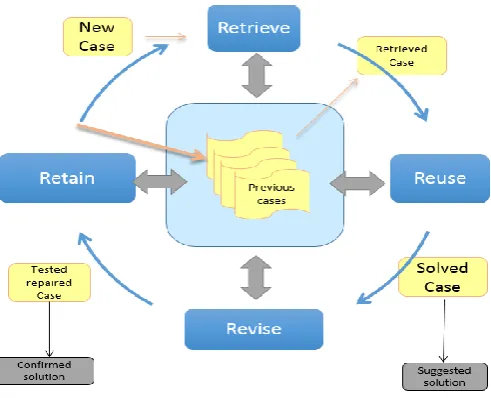
Case-based reasoning has been formalized for purposes of computer reasoning as a four R-step process (Fig. 1):
1. Retrieve: Given a target problem, the cases from the case-base whose problem is most similar to the new problem.
2. Reuse: the solutions from the retrieved cases to create a proposed solution for the new problem.
3. Revise: modify the proposed solution to take account of the problem differences between the new problem and the problems in the retrieved cases
[image:2.595.39.285.472.671.2]4. Retain: Store the new problem and its revised solution as a new case for the case-base if appropriate.
Figure 1 CBR cycle
B. Fuzzy Logic
Fuzzy logic is a form of many-valued logic or probabilistic logic. It deals with reasoning that is approximate rather than fixed and exact. Compared to traditional binary sets, fuzzy logic variables may have a truth value that ranges in degree between 0 and 1. The founder of fuzzy logic argues that fuzzy logic is necessary when the available information is too imprecise to justify the use of
numbers, and second, when there is a tolerance for imprecision which can be exploited to achieve tractability, robustness, low solution cost, and better rapport with reality [4], whereas conventional computer logic is incapable of manipulating data representing subjective or vague human ideas [5].
C. Fuzzy CBR
Fuzzy logic is especially useful for CBR since CBR is fundamentally analogical reasoning [6]. Fuzzy logic is designed to operate with linguistic expressions, and simplifies elicitation of knowledge from domain experts, such as knowledge of how similarity between two cases depends on the difference between their individual, collective, and temporal attributes. Fuzzy logic emulates human reasoning about similarity of real world cases, which are fuzzy; that is, continuous and not discrete [7].
D. HYBRID FCBR AND ANN FOR PAIN EXPRESSION
RECOGNITION
1) Hybrid CBR and ANN system
The healthcare domain has been interested in hybrid CBR and ANN systems for the last decade and a half. The term hybrid infers that a case-based system utilizes a fuzzy logic-based neural network for diagnosing symptoms in electronic systems [8]. One motivating example lies in uncertainty and ambiguity of symptom descriptors. In the domain of medical diagnosis, an integrated case-based reasoning and neural network approach was used to generate hypotheses and to guide the CBR mechanism to search for a similar previous case that supported a hypothesis [9].
CBR-ANN hybrid systems can outperform ANN models in solving problems that cannot be solved by the neural network alone with a sufficient level of accuracy. A crucial step in a case-based system design is the case metrics determination, as well as ways to index those cases in the case-base for efficient and correct retrieval [10].
2) Integrating ANN in CBR
An artificial neural network (ANN) is a mathematical model based on brain structure. Interconnected processing units that form a network, ANN’s can adopt diverse topologies, and learning procedures. Due to space limits, the interested reader can refer to [11][12].
The introduction of a neural network in a hybrid CBR system may support one of the processes in the CBR cycle [14]. In this paper, a sigmoid activation function was chosen over Radial-Based-Function (RBF) since the task of pain expression recognition slightly differs from usual prediction methods that might fit to RBF. The training data is noisy, and there are many cases to consider. It is known that RBF is one of the best methods to use for function approximation. However, when the cases output in the data set fluctuate for very similar cases, it is difficult to build such a function that will process the points of all results.
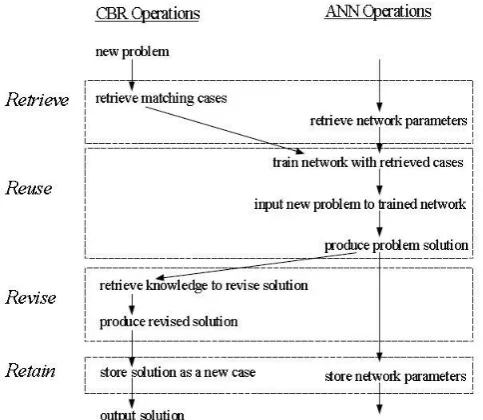
[image:3.595.303.553.49.448.2]The structure of the hybrid system is presented in Fig. 2 [14]. The ANN parameters should be loaded during the retrieval phase, and stored when the CBR system stores new cases. The main contribution of the ANN is in the reuse phase. The network is trained to recognize cases that are similar to the new problem. Then, for a new case problem, the network should also produce a similar solution. The revise phase is used here as in any CBR system, and it contains an option to revise the network solution, if needed. The retain phase follows the final case solution, which is stored for later use. The network state is also saved here.
Figure 2. Hybrid CBR-ANN interaction
III. TRAINING
A. Preprocessing
The first set was taken from [15]. It comprises videos of professional actors expressing pain. The second set was taken from [16], and it comprises images of professional actors conveying various non-pain expressions such as happiness, and sadness.
A classification GUI was developed for the
pre-processing stage. Initially, for each classified video segment (Fig. 3.a), the tracker collected all information (i.e. AU measures) during tracking, and once completed, displayed this information in the classification GUI. Next, a human operator mapped the expression in each frame to a pain value after examining the expression involved in a frame (Fig. 3.b). The results were saved in a CSV data set file.
Figure 3 (a)-top. Tracker; (b)-bottom. Human classification
B. Normalization
Normalized data has a common base, which means that every member is evaluated for each metric with respect to other members metric in the group on a scale range of [-1,1]. ANN’s perform much better on normalized data sets. The normalization step was applied on the input and the target vectors of the data set (pain perception level).
C. Hidden layer size
One should take into consideration when comparing networks with relatively similar accuracy, that the smaller the network, the more general it is in terms of model. When the network size increases, it may encapsulate the specific data set instead of the general model. In order to determine the proper hidden layer size, an initial training phase was conducted on networks with variable hidden layer size. The results infer that a hidden layer of 4 to 5 neurons provides best results. Bigger layers maybe provide better results with respect to training errors, but this result is actually misleading, since it is a symptom of over-fitting, and reduced generalization.
D. Early stopping
[image:3.595.48.290.343.553.2]improving generalization. The data is divided into training-set and validation-training-set.
The training set is used for computing the gradient and updating the network weights and biases. The validation set is used for monitoring. The error on the validation set is monitored during the training process. The validation error normally decreases during the initial phase of training, as does the training set error. However, when the network begins to over-fit the data, the error on the validation set typically begins to rise. When the validation error increases for a specified number of iterations, or beyond a predefined threshold –Alpha, the training is stopped. Early stopping is effectively limiting the used weights in the network, and thus imposes regularization. The output of this stage is a generalized ANN.
E. CBR module
We define a distance measure that provides an indication for the similarity between two cases. The similarity function uses the case AU's and is defined as the weighted first order norm of the distance vector, as presented in Equation 1.
m
1 i
2 1
2
1
,
)
=
.
.
(
Similarity
C
C
w
iC
AU
iC
AU
i (1)The weight denoted as wi in (1) is assigned to each AU
according to its power in affecting the final case output. In order to determine these weights we made a series of sensitivity analysis that is described in the following subsection.
Giving a case C, The first phase of the presented CBR cycle is the retrieval of the k-nearest cases. The number k is configurable, and is taken to be 80 in default. Using the similarity distance measure one gets a group PQ of k cases, such that for any Ci ∉ PQ and Cj ∈ PQ the following
D(C,Ci) > D(C,Cj) holds.
F. Sensitivity Analysis - neural network analyzer
[image:4.595.305.547.54.185.2]Once the generalized ANN was generated and trained, it was utilized in order to determine the similarity weights. For this purpose, a neural network analyzer was implemented. The input for the analyzer is a case that represents a neutral face expression. First, the analyzer computes the network’s output for the neutral case. Next, it generates a series of tests, in which the input contains an increased/decreased value of some AU's combinations from the original neutral case, and monitors the effect on the ANN’s output. Thus, one can infer what AU's are more important in determining the final output, i.e. pain level. The results are normalized into weights to be used in the similarity function. An example of this phase is illustrated in Fig. 4.
Figure 4. Singular AU's analysis example
IV. TESTING AND RESULTS
The CBR system stores 1420 cases. Per each new case, the Retrieve phase retrieves the 80 most similar cases as described in III.E. Next, the generalized ANN starts a specialization session in which further incremental training is performed with retrieved set.
Once this training is completed, the specialized ANN is ready to evaluate new cases, and produces an output that represents the perceived pain level.
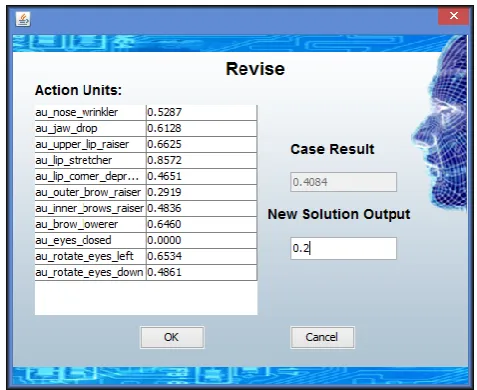
In case the suggested solution is wrong, the operator can initiate a revise phase as presented in Fig. 5. Here, the generalized ANN will be retrained with the original training set plus the new revised case.
Figure 5. Revise phase
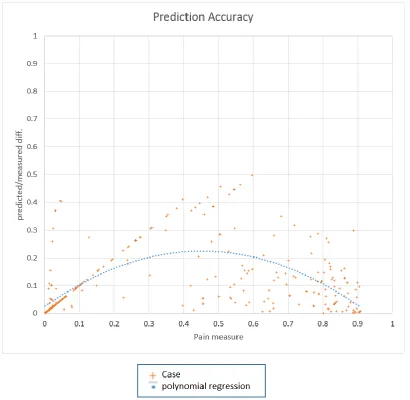
[image:4.595.302.541.396.591.2]Figure 6. Pain perception accuracy
Fig. 6 shows the testing outcome of 300 random cases with a polynomial regression trend-line. Noteworthy is that for the extreme values (no pain, or maximal pain), the difference between the predicted pain level of the FCBR-ANN and human estimated pain level is less than 3%. The fuzzy nature of pain perception is also reflected in the midrange pain level [0.4-0.6], where the calculated difference is around 0.2 with standard deviation of 0.18. Naturally, in this range, two human experts comparison may even provide a bigger difference.
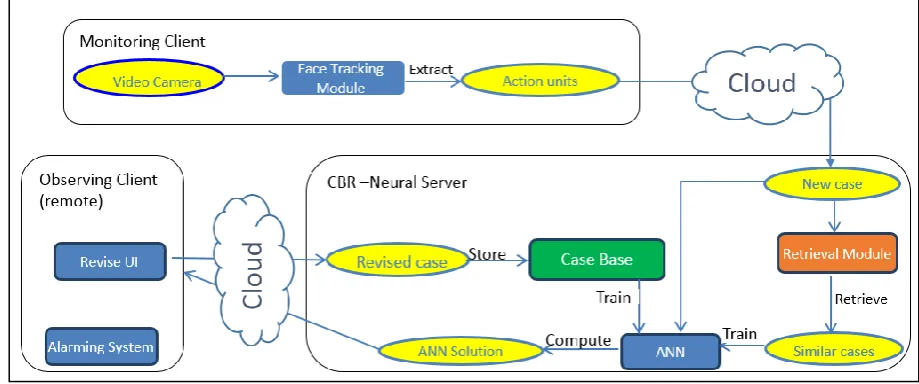
V. ARCHITECTURE
The prototype was implemented as independent modules that interconnect with each other. A high level module design is presented in Fig. 7. The monitoring client was implemented in C++ due to the Visage SDK constraints. This module extracts AU measures and sends them via sockets to a remote server that runs the FCBR-ANN module. The CBR output, in terms of pain level, is sent to the observ-
-er client for acknowledgement or revised feedback.
VI. CONCLUSION
In this paper we present an argument that face perception of pain is organized around ‘fuzzy’ cases such that human observers, like ANNs, judge a pain face based on their recognition that one face is more or less similar to other faces whose results are remembered and assessed (‘fuzzy case based reasoning’).
These philosophical claims were tested in a study conducted by one of the authors implementing a fuzzy case-based reasoning system integrated with an ANN. The system which produced more than 90% accuracy in face perception of pain.
Figure 7: Architecture design
perception. The benefits of this approach have been discussed in this work.
Possible future avenues can further evaluate this hybrid system as a model of human face perception of pain by comparing its performance with other ANN systems, including complex recurrent ANNs to assess perception of temporal properties using dynamical pain faces as input. Face perception of pain using an FCBR-ANN may be a real-time alternative to manual coding of pain by human observers, and may prove clinically useful.
ACKNOWLEDGMENT
The implementation of the presented study was supported by academic licensing of a Visage SDK software module
REFERENCES
[1] P. Ekman, W. V. Friesen, J. C. Hager. Facial action coding system (FACS). Salt Lake City: A Human Face; 2002.
[2] K. M. Prkachin. The consistency of facial expressions of pain: a comparison across modalities. Pain 1992;51:297–306.
[3] D. Simon, K. D. Craig, F. Gosselin, P. Belin, P. Rainville. Recognition and discrimination of prototypical dynamic expressions of pain and emotions. Pain 2007
[4] L. A. Zadeh. “Fuzzy Logic=Computing with Words”, IEEE Transactions on Fuzzy Systems, Vol. 4, No. 2, May 1996, pp. 103– 111.
[5] L. A. Zadeh. (1965) Fuzzy sets, Information and Control, Vol. 8 (June 1965), 338-353; reprinted in Bezdek, J. C., and Pal, S. K. (eds.) (1992) Fuzzy Models for Pattern Recognition, IEEE Press, 35–45. [6] D. B. Leake. (1996) CBR in context. The present and future; in
Leake, D. B. (editor) (1996) Case-Based Reasoning: Experiences, Lessons & Future Directions, American Association for Artificial Intelligence, Menlo Park California, USA, 3–30
[7] Savvas, Nikolaidis, and C. Lazos. Fuzzy case identification in case based reasoning systems. Computational Intelligence 15.3 (1999).
[8] Z. Q. Liu, F. Yan. Fuzzy neural network in case-based diagnostic system, IEEE Transactions on Fuzzy Systems, IEEE 5(2) (1997) 209-222
[9] E. B. Reategui. J. A. Campbell, B. F. Leao. Combining a neural network with case-based reasoning in a diagnostic system, Artificial Intelligence in Medicine 9(1) (1997) 5-27
[10] J. Main, T. S. Dillon, R. Khosla. Use of fuzzy feature vectors and neural networks for case retrieval in case based systems, Procs. Biennial Conference of the North American Fuzzy Information Processing Society - NAFIPS, IEEE, (1996) 438-443
[11] J. L. Elman. Distributed Representations, Simple Recurrent Networks, and Grammatical Structure, in Touretzky (1991), 91–122. [12] G. Hinton. How Neural Networks Learn from Experience, Scientific
American, 1992. 267(3): 145–151.
[13] J. Corchado, B. Lees. Integrated Case-Based Neural Network Approach to Problem Solving (1999)
[14] B. Lees, J. Corchado. Integrated Case-Based Neural Network Approach to Problem Solving in proc. XPS-99: Knowledge-Based Systems - Survey and Future Directions (1999): 157-166
[15] C. Lamm, E. C. Porges, J. T. Cacioppo, and J. Decety. Perspective taking is associated with specific facial responses during empathy for pain. Brain research 2008, 1227, 153-161.