Original Article
Expression of COX-2 in different types of arthritis
Ming Yang, Yilei Chen, Jianjun Ma, Jia Chen, Shuanglin Wan
Department of Orthopaedics, Sir Run Run Shaw Hospital of Medical College of Zhejiang University, Hangzhou, Zhejiang, China
Received November 30, 2015; Accepted March 10, 2016; Epub June 1, 2016; Published June 15, 2016
Abstract: The specific overexpression of COX-2 is not only affected by the function of normal cartilage cells, but also lead to metabolism imbalance of chondroproteoglycan, which is mediated by inflammatory cytokines, so as to make arthritis irreversible progress and aggravate the disease. Study the mRNA and protein differential expression of COX-2 in the periosteum of rheumatoid arthritis, rheumatic arthritis, bone arthritis, and psoriatic arthritis in order to provide a theoretical basis for the specific treatment of different types of arthritis. From January 2010 to December 2013 in Peking University Hospital 117 cases of patients with arthritis and 30 cases of controls were collected. Suprapatellar bursa fluid was extracted. The COX-2 protein content in articular tissue liquid was measured by ELISA, expression of mRNA in tissue fluid of COX-2 was detected by RT-PCR, quantitative analysis of COX-2 protein was car
-ried out by Western blot. A total of 80 cases were supervised, according to the Ct value of β-actin and COX-2 gene, the expression of mRNA was calculated, and the expression of COX-2 protein was significantly increased in patients with osteoarthritis, rheumatoid arthritis and psoriatic arthritis, while the expression of COX-2 in rheumatic arthritis and control group was not significantly changed, there was not statistically significant. The expression of COX-2 in different types of arthritis had a significant difference, which needed to take different treatment measures.
Keywords: Cyclooxygenase, osteoarthritis, gene expression
Introduction
Arthritis is a kind of disease induced by inflam -matory reaction that occur in human joints and the surrounding tissues, which are divided into dozens of types. Widely occurred in the world, China has more than 100000000 arthritis patients, and the number has been increasing. Clinical manifestations show red, swollen, hot, pain, dysfunction and deformity in joint, which seriously influence the life quality of patients [1]. It is one of the most serious diseases.
Arthritis is caused by mental stimulation, cold, damp, wind, strain, postpartum, trauma and other incentives. Early systemic manifestations may be fever, fatigue, muscle soreness, fatigue, anorexia, weight loss and anemia etc. The com-mon local symptoms are that the patients feel only a small number of (1-2) joints pain, but there is no obvious swelling and fever. A few weeks and months later, a few numbers of joints are found swelling and limitation of activ -ity and gradually involving other symmetrical
joints. Furthermore, there are obvious stiffne-ss and similar degenerative joint disease joint stiffness [2, 3]. According to the classification of different arthritis, it has different diagnostic methods and different treatment methods.
Different arthritis has different etiology, clinical manifestations, treatment and prognosis, wh-ich mainly related to inflammation, autoimmune reaction, infection, metabolic disorders, trau -ma, and other factors related to the disease. So it is important to study the pathogenic factors of all types of arthritis [4, 5].
6544 Int J Clin Exp Pathol 2016;9(6):6543-6548 the two reasons and further influence, caused
by spur production, further aggravated the arthritis [5, 6].
In addition, an acidic body will cause trace ele -ments to lose, especially the loss of calcium related arthritis is an important reason for the occurrence of arthritis. Moreover, the imbal -ance of calcium is not significantly correlated with the type of arthritis, and most types of arthritis are related to calcium imbalance [7, 8].
Cyclooxygenase (COX) is a necessary enzyme for prostaglandin (PGs) synthesis, which is also a key enzyme in the initial step of synthesis, which is called epoxide hydratase. In general, the effective expression of COX1 is able to ensure the normal operation of the body func -tion and the normal physiological func-tion of the tissues and organs. But COX2 is manifest -ed as the physiological function of the oppo -site, when the high expression of COX2 preci-sely the inflammation or tumor occur. The ex-pression of COX2 is highly expressed in arthri -tis, which can increase the expression of PGE2 and result in the accumulation of free radicals in the body. But when inflammation occur, the disease is further aggravated, the clinical mani -festation such as edema, pain, etc appear [9-11]. The use of molecular antagonists can relieve symptoms.
Materials and methods
Research object
The experimental groups were the arthritis patients in the departments of orthopedics, general surgery, dermatology and other related departments of Sir Run Run Shaw Hospital of Medical College of Zhejiang University from January 2011 to December 2014. After clinical diagnosis of arthritis, the patients were regis -tered with the clinical data.
Tissue fluid sampling was obtained from lateral margin of the patella by patellar puncture, loca -tion was carried out at the junc-tion between upper edge of patella and the vastus lateralis muscle. Press the junction between the depres-sion of the patellar lateral femoral muscle and pierce 0.5-1 cm sticking a snail, appearance of frustration sense would meet requirement. Its characteristics: the distribution of neurons was little, the pain assessment was good, and the feeling was not sensitive, the tissue was thin to
operate easily. Near the suprapatellar bursa, the fluid of suprapatellar bursa was down crowded, therefore, the liquid was extracted more thoroughly, and the fluid was directly extracted by the needle moving upward. Control groups: random patients hospitalized in Sir Run Run Shaw Hospital of Medical College of Zhejiang University during the same period, which were designed according to the ratio of male: female 1:1. The ages of patients were 33-70 years old, whose average age were 58.39±9.41 years old. There was no significant difference in age and sex distribution between the two groups (P>0.05).
The study protocol was approved by the Re-search Ethics Committee of Sir Run Run Shaw Hospital of Medical College of Zhejiang Uni-versity, and all patients gave their informed consent before study commencement.
ELISA
The ELISA kit was purchased from IBL (Cat. No. 27186, Japan). 300 μl IBL lysate were added into 500 μl joint tissue liquid, mixing with oscil -lator mix or with pipette gun, rotating for 30 minutes in 2-8°C, and then centrifuging with 10000 rpl for 10 minutes. 200 μl treating fluid were detected for ELISA, and detecting steps were carried out according to the instructions. RT-PCR
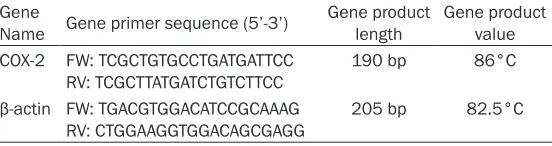
above reactions were placed on the ice, and the samples were added to the PCR to react. RT-PCR primer design and synthesis: PCR prim -er was designed and assessed by Prim-erPremi-er 6.0 and Oligo7 software, respectively, which were synthesized by shenggong Shanghai (Ta- ble 1).
Real-time PCR detected Ct value of gene ampli -fication, the Ct value was negatively related to DNA initial copy number. ΔCt value of each sample was analyzed according to an internal reference named β-actin by relative quantifica -tion. ΔCt = Target gene Ct-internal reference gene Ct, ΔCt was the data of analysis value. Western-blot
GABAAR in lung tissue was detected by Western blot. 12 μl proteins were dissolved in 2× SDS buffer, after being boiled 5 minutes, the sam -ples were transferred to the (PVDF) membrane by SDS-PAGE, after the membrane being incu -bated with evaporated skimmed milk for 1 hour, PVDF membrane was incubated with one antibody, after washing 3 times with TBST me-mbrane and HRP labeled two antibody was being incubated for 1 hour. After washing with TBST, display color belt were analyzed by ECL chemiluminescence.
Statistics analysis
Statistical analysis of laboratory test results was carried out by SPSS19.0 software. Com-parison among multiple groups, homogeneity test of variance, analysis of variance (ANOVA) and pairwise comparison (q test) were per -formed in turn. T test and X2 test were per-formed between the two groups. Measurement data was showed with x ± s, P<0.05 for the dif -ference was significant.
Results
General clinical data
80 cases of arthritis patients were selected from Gansu Second People’s Hospital, includ
-sification of OA was 1~3 grade according to Kellg-ren standard [3]. The score table named psoriasis area and severity index (PASI) was used for classification and diagnostic criteria of psoriatic arthritis. All selected cases were not treated with the anti-chemokine drugs, or the follow-up was guaranteed to stop other related drugs for more than 2 weeks. Exclusion of patients with active gastrointestinal ulcers, kid -ney, liver disease or blood coagulation dysfunc -tion, as well as AIDS and other infectious dis -eases of blood, the patients were diagnosed inflammatory arthritis, gout or acute knee joint injury by clinical diagnosis.
ELISA detection of Cox-2 in articular tissue fluid
Preparation of standard product: 0.5 ml of dis -tilled water were put into the standard bottle, get 140 ng/ml standard product of human COX-2 after being mixed. 230 μl standard prod -uct was mixed in the No. 1 tube, and then 230 μl standard product extracting from No. 1 tube was added to No. 2 tube, followed by continu -ous dilution in turn and the standard range was 70~1.09 ng/ml. The OD value was read at A450. Before drawing the standard curve, the OD values of all the detection holes (including standard and unknown sample) were subtract -ed from sample blank hole. In the logarithmic coordinate paper, the corresponding concen-tration of standard OD based on which a stan -dard curve was made.
mRNA results of COX-2 being detected by fluo-rescence RT-PCR
[image:3.612.93.369.86.159.2]Internal reference gene named β-actin and tar -get gene named COX-2 were amplified by fluo -rescence quantitative PCR, respectively, and the fluorescence amplification curves were ob-tained, which appeared obvious S-type amplifi -cation curve. Dissolve curve and dissolve peak were obtained by making dissolve curve, the results showed that Tm value of beta-actin in each reaction hole was 82.5°C, the Tm values
Table 1. Primer sequences and related information Gene
Name Gene primer sequence (5’-3’) Gene product length Gene product value
COX-2 FW: TCGCTGTGCCTGATGATTCC
RV: TCGCTTATGATCTGTCTTCC 190 bp 86°C
β-actin FW: TGACGTGGACATCCGCAAAG
RV: CTGGAAGGTGGACAGCGAGG 205 bp 82.5°C
-6546 Int J Clin Exp Pathol 2016;9(6):6543-6548 of the COX-2 gene of the target genes of each
sample were 86°C. There only one peak in each of the amplification curves, which proved that PCR only produce one product, and which was not affected by the primer dimer.
Western blot
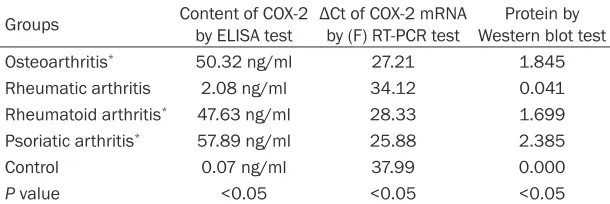
Protein bands were analyzed by gray scale after ECL chemiluminescence. The expression of COX-2 protein was significantly increased in patients with osteoarthritis, rheumatoid arthri-tis group and psoriatic arthriarthri-tis group, but there was no obvious change in the expression of rheumatic arthritis and control group (Table 3). It was showed that the expression of COX-2 was not associated with the occurrence of rheumat -ic arthritis.
Discussion
The incidence of arthritis is often associated with mutiple internal causes and external ca- uses including inheritance, bacterial/viral infec -tions, environmental factors. Arthritis may oc-cur at any stage in life. Moreover, incidence rate of arthritis is gradually increasing with ages, especially higher in women aging 40 to 60. The facet joints of hands were generally involved in arthritis progress, such as finger joints and wrist joints, and the bilateral lesions occurred simultaneously, which seriously impacted on
In daily life, many people have joint pain prob -lems. Many reasons result in arthritis. Given multiple factors of patients, including age, sex, location of onset and symptoms, common diag -nosis were made as soft tissues arthritis, carti -lagious arthritis, osteoarthritis or inflammatory arthritis. Arthritis, regardless of its cause, gen -erally could be cured or relieved if timely medi -cal treatment and symptomatic treatment was promptly performed [12, 13].
According to the research analysis, the occur -rence of osteoarthritis is closely related to age and obesity. The prevalence of osteoarthritis is only 2% under 45 years old, and the prevalence rate of 65 years old is 68%. Age and obesity are the risk factors of osteoarthritis, which clinical manifestation show all joints are involved, but not limited to the joints of upper hand. It can be found that the patients with negative rheuma -toid factor in the blood [13, 14].
[image:4.612.91.525.86.178.2]Rheumatic arthritis belongs to allergic disease, which is one of the main manifestations of rheumatic fever. With acute onset of fever and joint pain, typical clinical manifestations are mild/moderate fever and migratory multiple joints pain, and most of the involved joints are knee, ankle, shoulder, elbow, wrist and other large joints. Common performance has a joint transfer to another joint, the lesion shows red, swollen, hot, pain, some patients also have the
Table 2. General clinical data analysis of the research object
Groups number (n)Case age (years)Average Male/female ratio General assessment Kellgren classification Good Medium Bad 1 grade 2 grade 3 grade
Osteoarthritis 30 56.4 0.76 0 7 23 0 11 19
Rheumatic arthritis 30 23.2 1.31 1 12 17 0 11 19
Rheumatoid arthritis 30 43.8 0.63 0 10 20 0 11 19
Psoriatic arthritis 27 45.6 1.43 0 4 26 0 2 28
Control 30 44.7 1.22 27 3 0 28 2 0
Table 3. Difference statistics between the expression of objective gene and target protein
Groups Content of COX-2 by ELISA test ΔCt of COX-2 mRNA by (F) RT-PCR test Western blot testProtein by
Osteoarthritis* 50.32 ng/ml 27.21 1.845
Rheumatic arthritis 2.08 ng/ml 34.12 0.041
Rheumatoid arthritis* 47.63 ng/ml 28.33 1.699
Psoriatic arthritis* 57.89 ng/ml 25.88 2.385
Control 0.07 ng/ml 37.99 0.000
P value <0.05 <0.05 <0.05
Superscript *represented statistical significance (P<0.05, versus control).
[image:4.612.90.395.224.326.2]incidence of several joints at the same time. Subtypical patients have only joints pain but no other joint inflammation, acute inflammation is generally subside after 2-4 weeks, leaving no sequelae, but which frequently repeated atta-ck. If the rheumatic activity affect the heart, myocarditis and even cardiac valvular lesions may occur [14, 15].
The pathogenesis of gout arthritis is due to endocrine causes, which is related with pro-duce increasing and discharge reduction of uric acid. When uric acid is unable to discharge nor-mally, it will precipitate in the key place, espe -cially in small joints, which is characterized by acute onset and rapid relief, which can be caused by excessive eating. The clinical mani -festations are red, swollen, heat and pain. Single joint involvement was more common. That is a need for an appropriate drug interven -tion in a timely manner, but often relapse again [12-14].
The types of arthritis are various and the patho -genesis is complex. Recent experiments in vitro confirm that the special expression of COX-2 is not only affect the function of normal articular cartilage cells, but is mediated by inflammatory cytokines in the metabolic imbalance, so as to make arthritis irreversible progress and aggra -vate the disease [14, 15]. The study of COX-2 has become a new trend of the treatment of arthritis.
Expressed rarely in normal circumstances, COX-2 is an enzyme which was producted and induces effect with induction of intracellular or intercellular inflammatory cytokines, for exam -ple, some immune cells such as mononuclear cells and macrophages can express COX-2. In addition, some of endothelial cells such as synovial cells, fibroblasts and endothelial cells also can express COX-2 [16, 17]. In pathological conditions, the high expression of COX-2 can promote the formation of new blood vessels and help tumor cells escape immune surveil-lance and other effects to promote the occur -rence and development of arthritis by inhibiting apoptosis. Anti-inflammatory effect is positive associated with inhibition level of COX-2 [18-20]. Different types of arthritis have different expressions of COX-2. Our study found that ΔCt value of rheumatoid arthritis inflammatory group and the control group both was over 30, while the ΔCt value of bone arthritis, rheuma
-toid arthritis inflammatory group and psoriatic arthritis group were between 25-28, due to the ΔCt value and protein expression was negative -ly correlated, therefore COX-2 expression of bone arthritis and rheumatoid arthritis inflam -matory group and psoriatic arthritis inflamma -tion group in mRNA level was much higher than that of rheumatic arthritis group and control group. Western blot showed that the expres-sion of COX-2 was not associated with the occurrence of rheumatoid arthritis. Consequ-ently, COX-2 inhibitor treatment was effective for osteoarthritis, rheumatoid arthritis and pso -riatic arthritis, while no efficacy of COX-2 inhibi -tor was observed for rheumatoid arthritis due to absence of targeting molecule COX-2. In addition, COX-2 inhibitors have many advan -tages, such as promising analgesic effect and less gastrointestinal adverse reactions, which have been widely used in clinical treatment [21-23]. Based on our results, the effect of COX-2 inhibitors on the clinical treatment of arthritis warrants further exploration.
Disclosure of conflict of interest
None.
Address correspondence to: Dr. Shuanglin Wan, Department of Orthopaedics, Sir Run Run Shaw Hospital of Medical College of Zhejiang University, Hangzhou 310016, Zhejiang, China. Tel: +86-571-86002200; Fax: +86-571-+86-571-86002200; E-mail: wans [email protected]
References
[1] Patrignani P, Patrono C. Cyclooxygenase Inhibi
-tors: From Pharmacology to Clinical Read-Outs, Biochim Biophys Acta 2014; 25: 194-202.
[2] Georgopoulou S, Prothero L, Lempp H, Gallo
-way J, Sturt J. Motivational interviewing: rele
-vance in the treatment of rheumatoid arthri
-tis? Rheumatology (Oxford) 2015; [Epub ahead of print].
[3] Fiorucci S, Distrutti E. COXIBs, CINODs and H2S-releasing NSAIDs: current perspectives in the development of safer non steroidal anti-in
-flammatory drugs. Curr Med Chem 2011; 18:
3494-505.
[4] Riggenbach MD, Wright TW, Dell PC. Recon
-struction of the Distal Oblique Bundle of the Interosseous Membrane: A Technique to Re
-store Distal Radioulnar Joint Stability. J Hand Surg Am 2015; 40: 2279-82.
[5] Nacke E, Paksima N. The Evaluation and Treat
6548 Int J Clin Exp Pathol 2016;9(6):6543-6548 [6] Rowan AD, Litherland GJ. Tribbles and arthritis:
what are the links? Biochem Soc Trans 2015;
43: 1051-6.
[7] Rask K, Zhu Y, Wang W, Hedin L, Sundfeldt K. Ovarian epithelial cancer: a role for PGE2-syn
-thesis and signalling in malignant transforma -tion and progression. Mol Cancer 2006; 5: 62-62.
[8] Koli E, Mittl GS, Zuckerman JD. Simultaneous Versus Staged Total Hip Arthroplasty A Review. Bull Hosp Jt Dis 2015; 73: 78-82.
[9] Capone ML, Tacconelli S, Sciulli MG, Patrignani P. Clinical pharmacology of selective COX-2 in -hibitors. Int J Immunopathol Pharmacol 2003; 16: 49-58.
[10] Joshi P, Dhaneshwar SS. An update on disease modifying antirheumatic drugs. Inflamm Aller
-gy Drug Targets 2014; 13: 249-261.
[11] Rousseau JC, Delmas PD. Biologilcal markers
in osteoarthritis. Nat Clin Pract Rheumatol
2007; 3: 346-356.
[12] Niu X, Mu Q, Li W, Yao H, Li H, Li Y, Hu H, Huang H. Protective effects of esculentic acid against endotoxic shock in Kunming mice. Int Immuno -pharmacol 2014; 23: 229-235.
[13] Clancy KW, Weerapana E, Thompson PR. De
-tection and identification of protein citrullina
-tion in complex biological systems. Curr Opin Chem Biol 2015; 27: 1-6.
[14] Shimomura K, Kanamoto T, Kita K, Akamine Y, Nakamura N, Mae T, Yoshikawa H, Nakata K. Cyclic compressive loading on 3D tissue of hu
-man synovial fibroblasts upregulates prosta
-glandin E2 via COX-2 production without IL-1β and TNF-α. Bone Joint Res 2014; 3: 280-288.
[15] Zampeli E, Vlachoyiannopoulos PG, Tzioufas AG. Treatment of rheumatoid arthritis: Unravel -ing the conundrum. J Autoimmun 2015; 65: 1-18.
[16] Huang QC, Huang RY. The cyclooxygenase-2/ thromboxane A2 pathway: a bridge from rheu
-matoid arthritis to lung cancer? Cancer Lett
2014; 354: 28-32.
[17] Rüegg C, Mariotti A. Vascular integrins: pleio -tropic adhesion and signaling molecules in vascular homeostasis and angiogenesis. Cell
Mol Life Sci 2003; 60: 1135-1157.
[18] Shyni GL, Sindhu G, Helen A. Downregulation of inflammatory mediators and pro-inflamma
-tory cytokines by alkaloids of jeevaneeya ra
-sayana in adjuvant-induced arthritis. Immunol
Invest 2014; 24: 1-18.
[19] Niu X, Mu Q, Li W, Yao H, Li H, Huang H. Escu
-lentic acid, a novel and selective COX-2 inhibi
-tor with anti-inflamma-tory effect in vivo and in vitro. Eur J Pharmacol 2014; 740: 532-538.
[20] Uemura T, Yagi H, Okada M, Yokoi T, Shintani K, Nakamura H. Elbow septic arthritis associated with pediatric acute leukemia: a case report and literature review. Eklem Hastalik Cerrahis 2015; 26: 171-4.
[21] Lin B, Zhao Y, Han P, Yue W, Ma XQ, Rahman K, Zheng CJ, Qin LP, Han T. Anti-arthritic activity of Xanthium strumarium L. extract on complete Freund’s adjuvant induced arthritis in rats. J
Ethnopharmacol 2014; 155: 248-255. [22] Pineda C, Caballero-Uribe CV, Gutiérrez M, Ca
-zenave T, Cardiel MH, Levy R, Espada G, Rose
C, Santos-Moreno P, Pons-Estel BA,
Muñoz-Louis R, Soriano ER, Reveille JD. Report on the First PANLAR Rheumatology Review Course
Rheumatoid Arthritis: Challenges and
Solu-tions in Latin America. J Clin Rheumatol 2015;
21: 435-9.
[23] Guilak F, Fermor B, Keefe FJ, Kraus VB, Olson SA, Pisetsky DS, Setton LA, Weinberg JB. The role of biomechanics and inflammation in car