ePrints Soton
Copyright © and Moral Rights for this thesis are retained by the author and/or other
copyright owners. A copy can be downloaded for personal non-commercial
research or study, without prior permission or charge. This thesis cannot be
reproduced or quoted extensively from without first obtaining permission in writing
from the copyright holder/s. The content must not be changed in any way or sold
commercially in any format or medium without the formal permission of the
copyright holders.
When referring to this work, full bibliographic details including the author, title,
awarding institution and date of the thesis must be given e.g.
AUTHOR (year of submission) "Full thesis title", University of Southampton, name
of the University School or Department, PhD Thesis, pagination
Evolutionary Simulation Models:
On their character, and application to problems
concerning the evolution of natural signalling systems
Seth Gwydion Bullock
Submitted for the degree of DPhil
University of Sussex
I hereby declare that this thesis has not been submitted, either in the same or different form, to this
or any other university for a degree.
Acknowledgements
Many people have contributed to this thesis. I will not be able to list them all, but some of the
most important cannot go unmentioned. First, this thesis could not have been completed without the support and encouragement of many people. Foremost among this group is the late Dr. Jane
Beattie. Professor Graham Loomes stepped in to fill Jane’s shoes and, like her, provided invaluable advice, a sense of humour, and a usefully orthogonal perspective on my work, in addition to
enormously appreciated financial support.
I am indebted to the School of Cognitive and Computing Sciences for waiving my tuition fees for the duration of my doctoral studies, to those who provided me with teaching work during
these studies, and to Phil Husbands for arranging a period of employment at the outset of these
studies. I must also acknowledge the contributions made by the Baldwin Bewdley Trust and the Bromyard Grammar School Foundation, charitable organisations which provided me with £150
toward books, and three installments of £250 each towards living expenses, respectively.
My family have offered support throughout my studies. Particular mention must go to my
grandmother who, in addition to taking an interest in my financial well-being, occasionally also
provided aid of a more sartorial kind.
Various colleagues, both within COGS and beyond, provided the perfect critical audience, and
contributed to the ideas presented here to a great extent. Particular amongst these were Guillaume Barreau, Pete de Bourcier, Ezequiel di Paolo, Berkan Eskikaya, Joe Faith, Inman Harvey, Nick
Jacobi, Phil Jones, Ronald Lemmen, Giles Mayley, Jason Noble, Richard Vaughan, Henrietta Wilson and Mike Wheeler.
Henrietta Wilson, in particular, convinced me that evolutionary thought was not as
unproblem-atic as I had at first imagined, and endured many hours of discussion, especially during recurrant periods of crisis. Mike Wheeler and Peter de Bourcier inculcated in me an interest in biological
simulation, whilst Jason Noble and Ezequiel di Paolo thrashed out some of the thornier
method-ological and theoretical problems with me.
The exceptional supervision provided by Dave Cliff and Phil Husbands ensured that my studies proceeded with only infrequent interruption. The continual, unqualified, and unconditional
posi-tive reinforcement offered by Dave (despite the odd initial knock-back), and Phil’s preternatural
social urbanity, mark them as doyens of the first water.
More generally, I would also like to acknowledge the stimulating and interdisciplinary
envi-ronment which exists within COGS; an envienvi-ronment which directly results from the energy and
enthusiasm provided by (amongst other groups) the Artificial Life Reading Group, the Cognitive Philosophy Reading Group, and the first EASy MSc cohort, who unwittingly provided me with a
useful forum for testing ideas at an early stage of development.
Over the last seven years, I have been aided and abetted in extra-curricular duties by a formidable
A few of the chapters within this thesis have suffered a more concerted review process than the
others as a result of their having been published or presented elsewhere. . .
Chapter 4
Much of this chapter was previously published as a technical report (Bullock, 1995a). Many thanks
to Inman Harvey, Phil Husbands and Richard Vaughan for discussion of the issues addressed herein, to Julia Hutchison for her numeracy, and to Dave Cliff and two anonymous reviewers for
comments on a previous draft.
Chapter 6
Much of this chapter was previously published as a paper co-authored with Dave Cliff (Bullock
& Cliff, 1997). However, the text of this chapter and the results presented here are my own. The qualitative findings have been replicated independently by Dave Cliff using his own code. I
thank Anthony Arak, Magnus Enquist, and Daniel Osorio for discussions, and Marian Dawkins,
Henrietta Wilson, and an anonymous reviewer for help with previous drafts of this chapter.
Chapter 7
Much of this chapter was previously published as (Bullock, 1997). However, the text of this
chapter includes extended discussion, and previously unpublished results. Thanks to Guillaume Barreau, Ezequiel di Paolo, Tim Guilford, John Maynard Smith, Jason Noble, Danny Osorio,
Marian Stamp Dawkins, Michael Wheeler, and Henrietta Wilson, for discussion concerning the issues raised here, and help with previous drafts of this chapter. Some of the figures within this
chapter were produced with the aid of Dave Cliff’s graph-plotting utility, eegplot.
Thanks to all these reviewers and discussants, and, finally, special thanks to those few who
Evolutionary Simulation Models:
On their character, and application to problems
concerning the evolution of natural signalling systems
Seth Gwydion Bullock
Abstract
Evolutionary simulation modelling is presented as a methodology involving the application of modelling techniques developed within the artificial sciences to evolutionary problems. Although modelling work employing this methodology has a long and interesting history, it has remained, until recently, a relatively underdeveloped practice, lacking a unifying theoretical framework.
Within this thesis, evolutionary simulation modelling will be defined as the use of simulations, constructed under constraints imposed by evolutionary theories, to explore the adequacy of these theories, through the modelling of an adaptive system’s ongoing evolution.
Evolutionary simulation models may be considered to lie within the field of artificial life, since its concerns include theories of life, evolution, dynamical systems, and the relationship between ar-tificial and natural adaptive systems. Simultaneously, evolutionary simulation modelling should be regarded as distinct from, yet complementing, existing evolutionary modelling techniques within the biological sciences.
The ambit of evolutionary simulation modelling includes those systems towards which one is able to take the evolutionary perspective, i.e., systems comprising agents which change over time through the action of some adaptive process. This perspective is broad, allowing evolutionary simulation models to address linguistic models of glossogenetic change, anthropological models of cultural development, and models of economic learning, as well as models of biological evolution. Once this methodology has been defined, it is applied to a group of problems current within theoretical biology, concerning the evolution of natural signalling systems.
The ubiquity of natural communication is a well attested phenomenon. However, recently the utility of such communication within a world populated by neo-Darwinian selfish individuals has been questioned. Theoretical models proposed to account for the existence of signalling within the animal kingdom are reviewed, and evolutionary simulation models are constructed in an attempt to assess these theories. Specifically, models of the evolution of complex symmetry, and models of the evolution of honesty, are addressed.
Submitted for the degree of DPhil
University of Sussex
1 Introduction 1
1.1 The Ninth Bridgewater Treatise & The First Evolutionary Simulation Model . . . 2
1.2 Evolutionary Simulation Models . . . 4
1.3 The Evolutionary Perspective . . . 4
1.4 Prospects for Artificial Co-Evolutionary Design . . . 5
1.5 The Evolution of Natural Signalling Systems . . . 6
1.6 Biases and Signal Evolution . . . 8
1.7 Honesty and Signal Evolution . . . 9
1.8 Summary . . . 10
2 Evolutionary Simulation Models 12 2.1 Chapter Outline . . . 13
2.2 Artificial Life . . . 14
2.3 Strong vs. Weak Artificial Life . . . 17
2.3.1 Artificial Intelligence . . . 17
2.3.2 Artificial Life . . . 18
2.4 A Class System for Artificial Life . . . 19
2.4.1 High Class Artificial Life . . . 19
2.4.2 Model Class Artificial Life . . . 20
2.4.3 Working Class Artificial Life . . . 22
2.4.4 Fluidity and Constraints . . . 23
2.5 Arguments Supporting the use of Artificial Life Simulation as a Theoretical Tool 24 2.5.1 Equations vs. Simulations . . . 25
2.5.2 Conservative Simulation . . . 25
2.5.3 Radical Simulation . . . 26
2.5.4 Simulations as Sources of Empirical Data . . . 27
2.5.5 Problems with the Simulation Approach . . . 28
2.6 Evolutionary Simulation Models and Game Theoretic Models . . . 32
2.6.1 A Dynamic Perspective on Adaptive Systems . . . 33
2.6.2 Biological Simulation . . . 35
2.6.3 The Role of Evolutionary Simulation Modelling . . . 37
2.7 Summary . . . 38
3 The Evolutionary Perspective 39 3.1 The Potential for an Evolutionary Perspective within Scientific Enquiry . . . 40
3.2 Meliorative Trends . . . 43
Contents vii
3.3.1 Evolutionary Economics . . . 46
3.3.2 Evolutionary Linguistics . . . 47
3.3.3 Evolutionary Psychology and Social Anthropology . . . 49
3.3.4 Evolutionary Cosmology . . . 50
3.3.5 Evolutionary Computation and Evolutionary Design . . . 51
3.4 Evolutionary Models of Non-Evolutionary Phenomena . . . 52
3.5 The Evolutionary Perspective and Evolutionary Simulation Modelling . . . 54
4 Prospects for Artificial Co-Evolutionary Design 55 4.1 Introduction . . . 55
4.2 Co-evolutionary Design . . . 56
4.3 Predator-Prey Co-evolution . . . 58
4.4 Implications . . . 60
4.5 Conclusion . . . 62
5 The Evolution of Natural Signalling Systems 63 5.1 Efficacy . . . 63
5.2 Strategy . . . 64
5.3 Conventional Signalling . . . 66
5.4 Sensory Exploitation . . . 68
5.5 Handicaps . . . 69
5.5.1 Genetic Models of the Handicap Principle . . . 71
5.5.2 Game Theoretic Accounts of the Handicap Principle . . . 72
5.6 Defining Communication . . . 76
6 The Evolution of Symmetrical Signals 83 6.1 Introduction . . . 83
6.2 Symmetry . . . 84
6.3 Replication . . . 85
6.4 Discussion . . . 87
6.5 Extension . . . 88
6.6 Theoretical Discussion . . . 91
6.7 Methodological Discussion . . . 93
6.7.1 Mutation . . . 94
6.7.2 Colour . . . 97
6.7.3 Noise . . . 97
6.7.4 Search . . . 99
6.7.5 Summary . . . 100
6.8 Conclusion . . . 100
7 The Evolution of Honest Signals 101 7.1 Introduction . . . 101
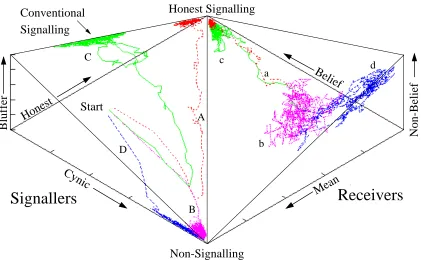
7.2 A Discrete Signalling Game . . . 103
7.3.1 Results . . . 108
7.4 Quality and Need . . . 112
7.4.1 Quality and Need Unrelated . . . 112
7.4.2 Quality and Need Related . . . 113
7.5 A Continuous Signalling Game . . . 117
7.5.1 Grafen’s Proof . . . 119
7.5.2 General Solution . . . 119
7.6 An Evolutionary Simulation Model of a Continuous Signalling Game . . . 121
7.6.1 Continuous Fitness Functions . . . 121
7.6.2 Continuous Signalling and Response Strategies . . . 125
7.6.3 Algorithm and Parameters . . . 127
7.6.4 Results . . . 129
7.6.5 Summary . . . 135
7.7 Discussion . . . 137
7.7.1 Reconciliation of Results . . . 137
7.7.2 Reconciliation of Positions . . . 139
7.7.3 Handicap Signalling and Co-operative Signalling . . . 141
7.7.4 The Generality of the Handicap Principle . . . 143
7.7.5 Extensions . . . 145
7.8 Conclusion . . . 146
8 Conclusions 147 8.1 A Framework for Evolutionary Simulation Modelling . . . 147
8.2 Examples of Evolutionary Simulation Modelling . . . 148
8.3 Interdisciplinarity . . . 149
Chapter 1
Introduction
In 1837, twenty-two years before the publication of Darwin’s On the Origin of Species, and over
a century before the advent of the first modern computer, a piece of speculative work was
pub-lished as an uninvited Ninth Bridgewater Treatise. The previous eight works in the series had been sponsored by the will of Francis Henry Egerton, Earl of Bridgewater, and a member of the
English clergy. The will’s instructions were to make money available to commission and publish
an encyclopedia of natural theology concerning “the Power, Wisdom, and Goodness of God, as manifested in the Creation” (Brock, 1966; Robson, 1990).
The ninth publication in this series is noteworthy in that, unlike its eight forerunners, it neither
sought to draw attention to miraculous states of affairs deemed unlikely to have come about by
chance, and thus thought to be the work of a divine hand (e.g., the length of the terrestrial day, which seems miraculously suited to the habits of man and other animals), nor did it seek to
recon-cile scientific findings with a literal reading of the Old Testament (e.g., disputing evidence which
suggested an alarmingly ancient earth, accounting for the existence of dinosaur bones, or promot-ing evidence for the occurrence of the great flood, etc.). In contrast to these apologetic efforts, the
author of the ninth Bridgewater treatise produced what is, to my knowledge, the first instance of an evolutionary simulation model.
Since this thesis will address the topic of evolutionary simulation modelling it seems appropri-ate to begin with a brief account of this model. This will allow an introduction of the two concerns
with which this thesis will be occupied. The first of these two concerns involves the definition of
evolutionary simulation modelling. Chapters 2 and 3 will address the relative position that evo-lutionary simulation modelling occupies, contrasting it with work within the field of artificial life
and the evolutionary sciences in an attempt to provide a coherent theoretical framework within which to embed the modelling practice.
The second concern will be to provide prototypical examples of the use of evolutionary sim-ulation modelling to test scientific theories. The evolution of natural signalling systems will be
chosen as a research area amenable to such an approach, and will be reviewed in Chapter 5, whilst
Chapters 6 and 7 will offer specific models designed to assess particular theories within this field. The intervening Chapter 4 will serve as an interlude of interest to those who wish to turn
As can be seen from the synopsis presented above, both conceptual and empirical issues will
be addressed within this thesis. In addition, throughout this thesis, an historical perspective will
frequently be adopted in an attempt to provide a coherent picture of the relationship between the work presented here and the studies which preceded it.
1.1
The Ninth Bridgewater Treatise & The First Evolutionary Simulation Model
The author of the Ninth Bridgewater Treatise was Charles Babbage, the designer of the differ-ence engine and analytical engine (the first automatic calculating devices, and thus precursors to
the modern computer). Indeed, in 1837 he was one of perhaps a handful of scientists capable of
carrying out research involving both evolution and computational modelling. Even so, Babbage’s model takes the form of a thought experiment, since neither the difference engine nor the more
complex analytical engine were fully constructed until after Babbage’s death in 1871.
Further-more, the notion of evolution employed by Babbage is distinctly underdeveloped compared with either that presented by Darwin over two decades later, or the evolutionary notions existing at the
time of Babbage’s writing (e.g., Lamarck, 1809). Despite these two hindrances, the model stands as a usefully simple case study with which to approach the character of evolutionary simulation
modelling.
Babbage’s (1837) model (see also Babbage, 1864, Chapter XXIX “Miracles” for a rather whimsical account of the model’s development) was situated within what was then a controversial
debate. It addressed the geological dispute between catastrophists and uniformitarians.
Prima facie this debate was internal to geology, since it concerned the geological record’s
potential to show evidence of divine intervention (principally in the form of support for the Old Testament accounts of the Creation and the Deluge). Catastrophists argued for an interventionist
interpretation of geological evidence, taking discontinuities in the record to be indicators of the
occurrence of miracles (violations of laws of nature). In contrast, uniformitarians insisted that in order to carry out scientific enquiry, the entire geological record must be assumed to be the result
of unchanging processes. Allowing a role for divine miracles, the uniformitarians claimed, would
render competing explanations equally valid. No theory could be claimed to be more parsimonious or coherent than a competing theory which invoked necessarily inexplicable exogenous influences in its account of the phenomena at issue.
The ramifications of this debate for empirical science were plain. For as long as discontinuities
could not be accounted for in uniformitarian terms, catastrophists could justify the postulation of unaccountable external influences, and scientists interested in accounting for phenomena
empiri-cally would find such influences unpalatable as they rendered scientific explanation impotent.
Although this dispute had already been dealt something of a death blow with Lyell’s (1830) publication of his Principles of Geology, the publication of the Bridgewater treatises and works
like them evidences its slow demise. Only subsequent to the coup de gr ˆace provided by Darwin’s work on evolution did natural theology texts finally cease to be published (Brock, 1966).
Babbage’s response to the catastrophist position was to construct what can now be recognised as a simple evolutionary simulation model. He proposed that a suitably programmed difference
engine could be made to output a series of numbers according to some law (e.g., the integers, in
Chapter 1. Introduction 3
series of numbers according to some different law (e.g., the integers, in order, from 200000
on-wards). Although the output of such a difference engine (an analogue of the geological record)
would feature a discontinuity (in our example the jump from 100000 to 200000), the underlying
process responsible for this output had been constant (i.e., the general law, or program, that the
machine was obeying had not changed). The discontinuity was the result of the naturally un-folding mechanical (and computational) process. No external tinkering analogous to the assumed
intervention of a providential deity had taken place.
Babbage thus tried to show that what might appear to be discontinuities were not necessarily
the result of meddling, but could be the natural result of unchanging processes. In doing this
he cultivated the image of God as a programmer, engineer, or industrialist, capable of setting a process in motion that would accomplish His intentions without Him intervening repeatedly.
In Victorian Britain, the notion of God as draughtsman of an ‘automatic’ universe, one which
would run unassisted, without individual acts of creation, destruction, etc., proved attractive. This conception was subsequently reiterated by several other natural philosophers (e.g., Darwin, Lyell,
and Chambers) who argued that it implied “a grander view of the Creator — One who operated by general laws” (Young, 1985, p.148).
For the purposes of this introduction, what is of interest here is not the theological
implica-tions of Babbage’s work, nor the effect it had on the catastrophist/uniformitarian debate, but the manner in which Babbage mobilised his computational resources to attack a theoretical position.
Babbage’s computational system was a simple analogue of a natural system (the geology of the planet) implemented mechanically. Babbage did not seek to capture the complexity of real
geol-ogy in his system. Indeed the analgeol-ogy between the difference engine’s program and geological processes is a crude one. However, the formal resemblance between the computing machine and
the geological process is sufficient to enable a point about the latter system’s dynamics to be made.
Babbage’s computing machine is thus clearly being employed as a model.
For now I shall award it the status of an evolutionary simulation model since it is implemented
as an unfolding computational process. The necessary tightening of this notion will be deferred
until the next chapter, but, for the moment, a few brief observations will serve to give a flavour of what is intended by the phrase.
First, that Babbage’s model is an unfolding computational process sets it apart from work in which models of dynamic change are constructed as mathematical proofs and are thus not
evolutionary simulations. For example, Thomas Malthus’ (1798) work on population dynamics, in which he demonstrated that population growth would outstrip that of agriculture, was constructed
using paper and pencil.
However, it is not merely the computational nature of Babbage’s model which ensures its status as an evolutionary simulation model. His reliance on the ongoing dynamic behaviour of
his computational model, rather than on any end result it might produce, distinguishes it from modelling work which, although involving computational processes, uses computers as tools for
solving what would otherwise prove to be intractable mathematical problems. For example the use of computers to discover digits of pi, or to iteratively solve the differential equations which might
comprise a model of population dynamics will not count as evolutionary simulation modelling
In contrast, the substantive element of Babbage’s model is the evolutionary aspect of the simulation
(i.e., the manner in which it changes over time). For the thought experiment which Babbage
considers, his suitably programmed difference engine will, in principle, run forever. Its calculation is not intended to produce some end product, but rather the ongoing calculation is itself the object
of interest.
1.2
Evolutionary Simulation Models
In Chapter 2 of this thesis, the class of evolutionary simulation models, which includes Babbage’s
system as its oldest member, will be outlined. In order to define this class, attention will be paid
to two issues. First, what characteristics must a piece of evolutionary simulation work have to possess for it to be a model, and secondly what characteristics must a model have to possess before
it can be termed an evolutionary simulation model. Dealing with these questions will require some
preliminary groundwork.
Before criteria for membership of the class of evolutionary simulation models can be
ascer-tained, some attention to the general constitution of artificial life, and to the scientific status of models will be necessary. To this end, Chapter 2 will begin with a brief (and selective) sketch
of the field of artificial life. Subsequently, the scientific status of artificial life research will be
discussed, and a typology with which to classify artificial life work will be introduced. Within this typology, the class of artificial life work which will be of central importance for the remainder of
the thesis, evolutionary simulation models, will be defined, and criteria governing the constraints on such models will be outlined.
At this point, although a workable definition of a certain style of modelling will have been achieved, the factors constraining the applicability of this modelling approach to viable subject
matter remain undetermined. Although Babbage’s system models an abstract geological process,
the majority of extant modelling work in this vein addresses biological subject matter. Should evolutionary simulation modelling be limited to problems within biology? What are the prospects
for evolutionary simulation models which address linguistic, economic, or psychological subject
matter? Discussion of the scope of application of evolutionary simulation modelling techniques will be necessary before such concerns can be properly assessed.
1.3
The Evolutionary Perspective
Chapter 3 will introduce the notion of the evolutionary perspective; a perspective which can be taken towards any system which comprises agents which change over time through the action
of some adaptive process. It will be noted that any system towards which one is able to take the
evolutionary perspective is a system which may be validly modelled using evolutionary simulation modelling techniques.
The appeal of the evolutionary perspective is very strong. However, a brief discussion will demonstrate that the factors responsible for its appeal have in some instances been fallacious.
Primary among these misconceptions is the, sometimes unacknowledged, notion of an inexorable progress inherent in the evolutionary process.
Chapter 1. Introduction 5
1986), and presented by the authors of the Bridgewater Treatises as supporting the existence of
God are founded on the observation that many aspects of the natural world seem to be wonderfully
complex, robust, economical, attractive, and generally suited to the existence and habits of man and other living creatures. That this is so is taken to be an indication of the existence of some
coherent, conscious, benevolent, designer.
Subsequent to Darwin’s formulation of an evolutionary account of natural history and the
re-sulting gradual demise of natural theology, the very same observations of a well-adapted natural order, coupled with a naive appreciation of the evolutionary process as involving some
direc-tional element, have lead to a different, yet equally teleological, lay interpretation of the evolved
world. The features of natural forms considered attractive from an anthropocentric perspective (e.g., beauty, economy, complexity, robustness, etc.), which were once thought to demand an
ex-planation in terms of a creation myth, are now accounted for by the ‘invisible hand’ of evolutionary
selection. Over evolutionary time, natural selection, and other evolutionary forces are assumed to change organisms from simple, fragile protozoa, into majestic, complex primates, cunningly
fash-ioned insects, etc.; from lonely, blind, dumb, automata, to social, vocal, intellectual triumphs of evolutionary progress.
An account of this pervasive misconception (which afflicts evolutionary scientists as well as
lay persons and academics from non-evolutionary disciplines) will be presented as both a caution-ary point concerning (mis)application of the evolutioncaution-ary perspective, and a useful context from
which to approach the practice of artificial evolutionary design.
1.4
Prospects for Artificial Co-Evolutionary Design
One field in which the evolutionary perspective is currently enjoying a fashionable notoriety could
be termed artificial evolutionary design. Chapter 4 will address the tension between the resolutely
directional nature of the manual design process and the resolutely directionless character of natural selection. If, as has been argued in the previous section, evolution has no overarching progressive
tendency, how can practitioners of artificial evolutionary design rely on artificial evolution to
pro-duce satisfactory solutions to design problems in reasonable amounts of time? Indeed, why would engineers expect evolution to be a powerful search process? Unsurprisingly the seeds of the attrac-tion in viewing evoluattrac-tion as a directed search process stem from the same fallacious perspective
described in the previous chapter, and ultimately, as was mentioned above, from a germ-line which
stretches back to the apologism of natural theology.
As an instance of this mis-application of the evolutionary perspective, the notion of artificial
co-evolutionary design will be introduced, its attraction outlined, and its actual utility assessed. It
will be concluded that although there is a role for artificial evolution in designing artefacts, that role is a much more limited one than is typically imagined.
Rather than considering artificial evolutionary design to be harnessing the creative power of
natural selection (or sexual selection, or other forms of natural evolutionary process), it will be
proposed that artificial evolutionary design be considered as a form of artificial selection. By this I mean to compare artificial evolution as it is practiced by design engineers to artificial selection
as it is practiced within animal husbandry. This change of perspective affords a more realistic
prob-lems of the teleological fallacy outlined above by placing the designer centrally with respect to the
evolutionary process, and entrusting her with the burden of directing it, rather than leaving this to
some propitious ‘invisible hand’.
1.5
The Evolution of Natural Signalling Systems
For the remainder of the thesis, attention will be turned toward a class of animal behaviour to which
the evolutionary perspective may lawfully be taken. Signalling behaviour is abundant throughout the animal kingdom (see Hauser, 1996, for a recent review of the biological signalling literature).
The diversity of communication systems is huge, and styles of signalling vary along many
di-mensions. Some signalling systems involve relatively conservative signals, e.g., the intracellular signals which regulate cell behaviour, or the signals of playful intent used by many juvenile
an-imals to ensure that their actions are interpreted as play behaviour rather than attempts at attack
or copulation. In contrast, some signalling systems involve relatively extravagant signals, e.g., signals of aggressive intent, mating displays, signals of unpalatability, etc. In addition to these
un-contentious examples, some signalling systems seem less straightforwardly communicative, e.g., camouflage and crypsis. Finally, the unique phenomenon of human language, so central to our
everyday notions of communication, seems very far removed from any of the comparatively crude
semaphores with which the rest of the animal kingdom make do.
Biologists faced with this profusion of differing systems evidently have their work cut out
accounting for the particular character of each. However, until recently workers in this area were at least assured of the adaptive value of such signalling behaviours and thus had no cause to
question the evolutionary function of communication. Communication between members of a group of animals with some confluence of interest was considered beneficial in as much as it
beneficially co-ordinated the behaviour of the group. Such co-ordination was reasoned to confer
advantages, in terms of efficient resource allocation, which groups of non-signalling, less well co-ordinated animals would not enjoy. Hence signalling groups would proliferate at the expense
of their taciturn competitors.
Such group-selectionist accounts of co-operative behaviour fell into disrepute during the mid-sixties as the result of the observation that what was beneficial for an individual was not necessarily beneficial for the group it belonged to (Williams, 1966; Hamilton, 1964). Adaptive explanations at
the level of the individual or gene were proposed as more powerful and parsimonious than those at
the level of the group, and group selectionist thought was characterised as “sloppy” (Sober, 1994, p.xii). These were the beginnings of a more individualistic perspective on evolutionary change (as
popularized in Dawkins’ The Selfish Gene) which would not tolerate accounts of communication
as adaptive merely at the group level.
If signallers act selfishly, it was mooted, why should they signal anything other than
manipula-tive lies, and conversely, if observers act selfishly, why should they bother to pay attention to such unreliable signals. However, although it was feared that the selfish actions of individuals might
compromise the stability of natural signalling systems, such systems, as noted above, appeared to be the frequent products of evolution. Evolutionary theorists were thus left with an explanatory
vacuum to fill. It is the theories which stepped into this breach which form the subject matter of
Chapter 1. Introduction 7
If signalling systems exist to promote the needs of the individual (or the needs of individual
genes), one might expect the signals involved to be exploitative as evolutionary success can only
be achieved at the expense of others. In a pair of seminal papers, Dawkins and Krebs (1978; Krebs and Dawkins, 1984) proposed that signallers and the observers of signals might experience a
conflict of interest in that they may want different things from the signals they exchange. Signallers benefit from signals which manipulate their receiver in some fashion advantageous to the signaller.
In contrast, receivers of signals benefit from a source of relevant, veridical, information which would otherwise be unavailable. The authors propose that this conflict results in an evolutionary
struggle, or arms race (Dawkins & Krebs, 1979).
From this perspective, although the signalling systems we observe throughout the natural world seem intricately balanced, signallers wholeheartedly calling, warning, informing, etc., whilst
receivers attend, and respond, this stability is illusory. Over evolutionary time periods the
one-upmanship predicted by Krebs and Dawkins would become apparent.
For example, propositioned mates might discover, and pay attention to, some indicator which
predicts the characteristics of a potential mate of interest to them (perhaps the colour of a male bird’s ruff is a good indicator of the male’s virility). The indicator (particular coloured ruff) might
become a compelling signal which reliably elicits mating opportunities. As a result mating
dis-plays which feature this indicator will gradually proliferate in the male population. But this pro-liferation might occur at the expense of the indicator’s predictive power (the coloured ruff is now
sported by all manner of males including, perhaps, impotent suitors). The ubiquity of such a sig-nal reduces its informative content (the presence of a particular coloured ruff ceases to be a strong
indicator of virility), forcing the choosy mates to abandon it in favour of some further method of eliciting the information they require (perhaps the size of the ruff is better correlated with virility),
and the cycle starts again.
Such signals have been termed conventional (Dawkins & Guilford, 1991) in that their utility relies on the maintenance of a convention. Such signals bear information only arbitrarily, and
are sensitive to the effects of signallers that break with the convention, and thus degrade their
informational content.
Conventional signalling models propose that dishonest individuals will remain at a low
fre-quency in the signalling population, parasitic upon the honesty of others. If the conventional rela-tionship between the signals and relevant states of affairs is compromised to too great an extent the
signalling system may collapse. However, negative feedback within the signalling system acts to prevent this through increasingly degrading the signal’s worth as it is increasingly abused, and thus
both discourages the increasing proliferation of dishonest strategists, and encourages signallers to
establish alternative conventional signalling systems.
For example, a conventional account of the evolution of aposematism (emetic
unpalatabil-ity) and mimicry (merely resembling an unpalatable prey type without investing in unpalatability itself) might claim that a strong conventional association between a particular appearance (e.g.,
red spots on black wings) and unpalatability would have to exist prior to the success of deceitful mimetic adaptations. Further, as the strength of the convention upon which the success of the
mimic depends is itself dependent on the degree to which the convention is observed, the success
conven-tional signalling models predict a low level of cheating, maintained by an evolutionary negative
feedback.
The implications and further details of this position will be addressed in Chapter 5. For the time being it will suffice to present this conventional account as establishing a foundation upon
which two further developments have been built. The first involves the role of sensory and motor biases in signalling systems (e.g., Ryan, 1990).
1.6
Biases and Signal Evolution
Since animals typically utilise their sensory and motor equipment for all manner of activities, it
has been proposed that certain biases or predispositions may exist within those systems prior to their becoming used to effect or detect signals. For example, the visual system of an animal which
uses sight to find prospective mates, might also be used to forage for food. In order that the animal
forages effectively, some adaptation of the visual system to this task might have occurred over evolutionary time. Such an adaptation may be ripe for exploitation. For example, a tendency of
females to orient toward stimuli of a certain colour, which has evolved as a foraging adaptation, might be exploited by suitors during mating displays.
This situation is similar, but subtly different from the conventional situation described above
in that, unlike the response strategy within a conventional signalling system, the signal recipient’s response is not as free to adapt under selective pressure. Although exploitation of the observer’s
sensory bias by signallers might promote the exaptation of the bias (i.e., signaller behaviour might exert a selective pressure, which, in a conventional signalling system, would tend to result in a
change of response behaviour on the part of the signal receiver), the role of the receiver’s sensory bias as a useful adaptation in an alternative context may ensure its persistence in the population.
Consider again the previous example in which a sensory bias which causes females to attend to
areas of the visual field which are a certain colour is exploited by male suitors in order to gain female attention. Although this exploitation might result, on average, in females mating with
lower quality males, the sensory bias may persist due to its utility in prey detection.
Furthermore, as this example illustrates, for signalling systems founded on sensory biases, the relationship between signal and informational content is not arbitrary, but is constrained by the nature of the pre-existing bias within the system. Whereas conventional signals are considered
to carry information arbitrarily (e.g., that red means stop, and green means go, is not taken from
scripture, but is settled upon through some more capricious process), the sensory bias described in the above example could not be exploited by signallers using an arbitrarily coloured display.
Rather the form and function of the signal are intimately related to that of the receiver’s
disposi-tions.
Chapter 6 will present an evolutionary simulation model which assesses a hypothesis which
proposes the evolution of symmetry as an exploitation of receiver bias (Enquist & Arak, 1994). The authors of the hypothesis claim that the complex symmetry of many displays in the natural
world are the result of evolutionary pressures to exploit a bias inherent in all visual systems which favours signals which are invariant under many transformations. Such signals, it is claimed, are
easier to discriminate from irrelevant stimuli. I present an evolutionary simulation model which
Chapter 1. Introduction 9
that rather than promoting complex symmetry, in reality the bias promotes simple homogeneity.
This chapter will also assess some of the methodological issues involved in evolutionary
sim-ulation modelling in an attempt to discover why Enquist and Arak (1994) failed to discover the true nature of the bias they were exploring.
1.7
Honesty and Signal Evolution
Until now, the post-group-selectionist account of signal evolution which I have described has involved the potential for cheating. From the perspectives outlined above, signalling systems
are considered to be inherently prone to dishonesty. However, one theory which has been under
development for the past 20 years, and has attracted a great deal of attention from evolutionary theorists, proposes that many, if not all, signalling systems are inherently honest (Zahavi, 1975,
1977a, 1977b, 1987, 1993).
Zahavi suggests that the cost that signallers inevitably pay in producing a signal stabilises its honesty. This notion, which has been dubbed the ‘handicap principle’, is subtle, and attempts to
formalise it have occupied many evolutionary theorists over the last few decades (e.g., Enquist, 1985; Grafen, 1990a, 1990b; Maynard Smith, 1976, 1991). A detailed exposition of its many
facets must be postponed until Chapter 5. However, a brief sketch of the main thrust of Zahavi’s
argument will be attempted here.
Those that stand to gain most from bluffing, cheating, treachery, etc., are those that cannot
afford to make good their claim. They fear being put to the test. They claim to be healthy, wealthy, hungry, strong, agile, knowledgeable, trustworthy, etc., but do not wish to demonstrate these
qual-ities prior to gaining copulation, food, security, admission, reprieve, or whatever resource it is that they are begging for. Since the production of an arbitrary deceptive signal is cheaper than
obtain-ing the quality it dishonestly advertises, such individuals will be tempted to cheat, bluff, or lie. As
noted above, conventional models of such signalling predict just such cheating, maintained at a low level by an evolutionary negative feedback mechanism.
In contrast Zahavi’s contention is that the very act of signalling is a test to which dishonest
individuals are being put. Not only this, but it is a test that the dishonest signaller must surely fail. This contention is underwritten by the following observation. Those that are healthy, wealthy, etc., can more easily afford to make signals to that effect than those which are not. Since this is the
case, over evolutionary periods of time, the forces of signal selection (Zahavi, 1987) will ensure
that signals come to vary in proportion to the quality that they advertise, and that a signal’s form will not be arbitrarily related to the information it carries, but will be significantly influenced by
it.
An example may help to clarify this notion. In scenarios in which one individual’s wealth is a deciding factor in another’s decision making (as some would have it be in human mate selection,
for example), it pays the decision maker to exploit any accurate indicator of wealth. According to the handicap principle, such an indicator would be the extravagance of the individual’s spending.
Since only the wealthy can afford to waste money, a wanton disregard for expenditure can be taken as an indicator of wealth (Zahavi, 1987). Signals demonstrate the ability of an individual to bear
a handicap. As such they are honest indicators of the degree to which the signaller possesses the
Zahavi’s position is that the honesty of many signalling systems typically considered to be of
a conventional nature is in fact maintained by some form of handicap effect. He lists intracellular
signals, ritualised movements, vocal signals, colour patterns, mimicry, and altruistic acts as honest signals stabilised by their cost (Zahavi, 1977b, 1987), even going so far as to suggest that the
widening of the eyes which he claims occurs when humans gaze at a loved one is an honest indicator of affection maintained by the handicap of decreased acuity during such bouts of
wide-eyedness (Zahavi, 1987, p.317). Thus Zahavi clearly feels that the handicap principle is of near universal applicability. This position appears to motivate his enthusiastic suggestion that “as a
method, the assumption that a signal is involved with cheating usually leads to a dead end while
the search for the honest meaning may lead one to exciting new discoveries” (Zahavi, 1987, p.317). In Chapter 7 a series of evolutionary simulation models will be presented in an attempt to
clarify the still problematic notion of the handicap principle. The points of departure for these
models will be the work of Grafen (1990b) and Hurd (1995), both of whom attempt to demonstrate the integrity of the handicap principle analytically.
First Hurd’s (1995) discrete action-response model will be extended and subsequently ren-dered as an evolutionary simulation model in order to show that the benefits accrued by signallers
from their signalling behaviour are as important as the costs incurred. This model will also serve
to demonstrate the compatibility of conventional signalling accounts with those couched in terms of the handicap principle.
Subsequently an analogous extension to Grafen’s (1990b) continuous model of the handicap principle in the context of sexual selection will be undertaken. This model will demonstrate the
ex-tent to which the findings of the discrete model can be generalised to models involving continuous variables. It will be shown that the implications of these models demand a recasting of Zahavi’s
handicap principle in cost-benefit terms. This recasting will go some way towards reconciling
the differences between conventional and handicap theories and will also enable the conditions favourable to each to be determined.
1.8
Summary
This thesis will establish a framework within which the dynamic behaviour of natural systems, comprised of agents subject to some adaptive process, can be modelled as ongoing activity. Such
modelling will be termed evolutionary simulation modelling since the simulation of a system’s
evolution will be central to any such modelling.
Thus described such modelling can be contrasted with conventional models of adaptive
be-haviour, e.g., game theoretic models within economics (von Neumann & Morgenstern, 1944), and
biology (Maynard Smith, 1982), in which the transient behaviour of models prior to the achieve-ment of some stable state, if it is considered at all, is typically considered to be secondary to the
nature of the possible stable states admitted by the model.
In addition, such evolutionary simulation modelling may profitably be compared with
cur-rent movements towards dynamic, or evolutionary, perspectives within many traditionally non-evolutionary disciplines, e.g., non-evolutionary linguistics (Pinker, 1994), non-evolutionary economics
(Dosi & Nelson, 1994), and developmental psychology (Thelen & Smith, 1994).
Chapter 1. Introduction 11
modelling, the validity of theories concerning the evolution of natural signalling systems will be
addressed through the construction of such models. Specifically, models will be constructed in
order to test hypotheses concerning the role of biases within signalling systems, and problems of honesty within such systems.
The role of evolutionary simulation modelling, as outlined within this thesis, is to enable the assessment of a wide range of theories which purport to account for the behaviour of various
nat-ural systems. Since it is the case that such systems are studied to a large extent independently by specialised groups of academics, each with its own methodology, philosophy and ideology,
evo-lutionary simulation modelling, like other general purpose modelling techniques, is by its nature
inherently interdisciplinary. In addition to performing the standard duties of a concluding passage, Chapter 8 will close with some thoughts on the nature of interdisciplinary work.
Charles Babbage’s (1837) unsolicited attempt to alleviate certain problems within geology, the
work with which this introduction opened, in many ways exemplifies the precarious, interdisci-plinary role of evolutionary simulation modelling. His use of tools which were perceived to be
Evolutionary Simulation Models
The title of this chapter is not intended to be a neologism. Neither ‘evolutionary simulation
mod-elling’, nor ‘evolutionary simulation model(s)’, will be capitalised or abbreviated within this thesis
since each is intended to be a descriptive phrase, referring straightforwardly to the use of computer simulations as evolutionary models of adaptive systems. However, these phrases do have a
neol-ogistic flavour, since they are necessarily shorthands. By evolutionary simulation modelling, I
do not wish to refer to just any use of computer modelling within evolutionary biology, nor any evolutionary simulation design within artificial life. However, subject to certain provisos to be detailed within this chapter, certain pieces of work within either of these two practices might be
legitimately classified as evolutionary simulation modelling.
As a crude first approximation, the phrase can be thought of as capturing the notion that some simulations may be used as models of adaptive processes, and, furthermore, that it is the evolution
of those simulations (i.e., the manner in which those simulations change over time) which is their
substantive element. It is the dynamic behaviour of such simulations which may be used to dispute or uphold the validity of evolutionary theories.
Such a characterisation of evolutionary simulation modelling clearly accommodates a style of computer simulation which could be employed by theoretical biologists. Simultaneously, the
same characterisation of evolutionary simulation modelling just as clearly accommodates the use of artificial life techniques as evolutionary modelling tools. However, as this chapter unfolds, much
of computer simulation within biology will be found to be of a different style to that motivated
under the nascent auspices of evolutionary simulation modelling, whilst much of the evolutionary simulation carried out within artificial life will be found to fail to achieve the status of scientific
modelling.
In an effort to clearly specify what is meant by these statements, the body of this chapter stands
as a longhand exposition of its title, seeking to define a role for evolutionary simulation modelling which accounts for the influence of both artificial life and evolutionary biology.
A Naive Assumption
Mutually supporting arguments are often difficult to construct, each one requiring the others to
Chapter 2. Evolutionary Simulation Models 13
initially provide some scaffolding with which to support the whole construction. Once the thesis
has been presented in its entirety, it simply remains to demonstrate that it can survive the gradual
removal of the supporting material.
In contrast, the arguments presented within this chapter threaten to be mutually defeating, since
the character of evolutionary modelling within biology is often presented in opposition to that of evolutionary simulation within artificial life. Before it is possible to show that these two practices
have, as Bonabeau and Theraulaz (1996) put it, a “non-empty intersection”, and furthermore that this intersection defines a scientific tool with which problems within many diverse evolutionary
fields may be addressed, some equivalent scaffolding must be in place, in order to separate the two
antagonistic arguments.
This separating scaffolding takes the form of one naive assumption, namely, that evolutionary
simulation modelling does not take place, and has never taken place, within biology, but is
prop-erly considered to be a practice lying exclusively within the field of artificial life. This assumption is patently incorrect, and potentially incoherent, since the overlap between artificial life and
biol-ogy is considerable. Although computer modelling within biolbiol-ogy has typically been of a style different to that motivated within this thesis, there have no doubt been instances of what could be
classified as evolutionary simulation modelling within biology. Some of this work predates
arti-ficial life (e.g., Babbage, 1837), whilst some has been more recent (e.g., Krakauer & Johnstone, 1995).
However, for the time being the assumption that evolutionary simulation modelling is specific to artificial life will allow a clear account of its makeup to be constructed without requiring the
constant qualification of statements, or the development of elaborate inter-related accounts com-paring and contrasting approaches within biology with those within artificial life.
2.1
Chapter Outline
Evolutionary simulation modelling clearly stands in some relationship to both evolutionary
mod-elling within biology, and evolutionary simulation as it is practiced within artificial life. This
chapter will clarify the nature of these two relationships. Since the former relationship is most straightforward (primarily as a result of the relative maturity of evolutionary modelling within biology), most of this chapter will deal with the relationship between evolutionary simulation
modelling and artificial life. The argument presented within this chapter is that whilst
evolution-ary simulation modelling has benefited enormously from the advent of artificial life modelling
techniques, it has been hamstrung by artificial life rhetoric, dogma, and wide-eyed over-ambition.
Since the development of new modelling techniques within artificial life has often been
as-sociated with the development of new perspectives on what is being modelled (e.g., Kauffman, 1993), arguments in favour of the adoption of such modelling techniques have often been
accom-panied by, and confused with, arguments motivating the adoption of new philosophical positions, or conceptual schemes (e.g., Ray, 1994). Since evolutionary simulation modelling, although
bear-ing strong resemblance to the practices carried out within several research programmes within artificial life, shares few of the ideological tenets which are espoused by their authors, particular
care will be taken to outline the differences between evolutionary simulation modelling and other
This will be achieved though a protracted process of elimination. The repeated application
of increasingly fine-grained methods of systematically distinguishing between different classes of
artificial life practice will be used to identify the necessary and sufficient conditions for a piece of research to count as evolutionary simulation modelling.
This process of elimination will proceed as follows. First the strong/weak dichotomy some-times used to distinguish between research agendas within artificial life (and artificial intelligence)
will be dismissed as too blunt an instrument for the purposes of this chapter. Subsequently, a three-way distinction between aspects of artificial life which may be roughly characterised as
philosophical, scientific, and engineering, will be presented. This will enable evolutionary
simula-tion modelling, and other artificial life modelling work, to be distinguished from, on the one hand, the exploration of conceptual schemes within artificial life, and, on the other, the exploration of
new design techniques within artificial life. To the extent that disciplines other than artificial life
involve these three aspects, they too may be arranged within a similar hierarchy.
Amongst those researchers interested in employing artificial life techniques as scientific tools,
one can identify an axis which promotes the use of evolutionary simulations as models with which to examine evolutionary phenomena. The multiple arguments in favour of this practice, although
similar, may be discriminated between on the basis of the role evolutionary simulations are
pro-posed to play with respect to (i) the natural sciences concerned with the relevant evolutionary phenomena, and relatedly (ii) the existing techniques with which they are modelled.
The various positions of these proponents can crudely be characterised as ranging from (a) the advocation of a conservative use of simulation models as an (often-claimed inferior) alternative
to existing evolutionary modelling techniques, to (b) the advocation of a radical use of simulation models to explore aspects of evolutionary processes which are claimed to be necessarily opaque
to existing modelling techniques.
Evolutionary simulation modelling, as it is presented within this thesis, is neutral with respect to this conservative/radical axis. However, whilst the conservative use of evolutionary simulation
modelling is relatively uncontentious, proponents at the radical pole of this continuum risk the
same conflation of modelling technique with philosophical position which dogs much of would-be artificial life modelling. For example, the role of simulations which involve notions of emergence,
self-organisation, complexity, etc., will only be resolved as and when the theoretical utility of these notions becomes clearer.
By comparison, clear methodological differences between evolutionary simulation models and closely related evolutionary modelling techniques inspired by the application of game theory to
evolutionary phenomena (Maynard Smith, 1982) have equally clear implications for modelling
practices employing each technique. In order to assess the differences in perspective which each affords, the naive assumption which has been in place throughout the chapter will be relaxed, and
simulation modelling as it is practiced within the biology community will be discussed.
2.2
Artificial Life
Between the publication of Babbage’s (1837) evolutionary simulation model of geological
dis-continuities, with which the previous chapter opened, and the emergence of artificial life in the
Chapter 2. Evolutionary Simulation Models 15
simulation modelling were published.
For the greater part of this period computing machinery was hardly more advanced than the
machines designed by Babbage in the first half of the 19th century, but with the post-world-war development of the first modern electronic digital computers came a surge of research into
com-putational theory, some of which addressed biological phenomena.
Seminal work by mathematicians such as Turing (1952) on reaction diffusion models of
mor-phogenesis, von Neumann and Burks (1966) on automata theory and self-replication, McCulloch and Pitts (1943) on the logic of neural circuitry, Holland (1975) on the formal properties of
adap-tation, and Walter (1963) and Ashby (1956) on cybernetics, involved the application of logic,
mathematics, robotics, and control theory to essentially biological problems.
The above-cited pieces of research (with the exception of Babbage) are now recognised as the
intellectual precursors to the field which has come to be known as artificial life. Although, more
proximally, artificial life can be considered to be the offspring of artificial intelligence (see Brooks, 1991, and Steels, 1994, for accounts of artificial life’s relationship to artificial intelligence), it is
becoming increasingly apparent that the work published under the artificial life rubric (e.g., models of morphogenesis, cellular automata models, behaviour based robotics, the simulation of adaptive
behaviour, etc.) has inherited much of its method, and some would say madness, either directly,
or circuitously, from these mid-century pioneers.
Of these original and inspirational pieces of research, techniques for implementing adaptive
processes within computers have had the most direct impact on the development of evolutionary simulation modelling. Most important of these techniques are computer algorithms which
imple-ment some analogue of evolutionary adaptation.
Here, genetic algorithms (Holland, 1975) will be taken as prototypical of such adaptive
algo-rithms, but several alternatives have been developed (evolutionary strategies, Rechenberg, 1973;
genetic programming, Koza, 1993), and analogous work implementing ontogenetic, rather than phylogenetic, adaptation (i.e., learning) have also had a parallel influence within modelling paradigms
concerned with development, rather than evolution (Rumelhart & McClelland, 1986; McClelland
& Rumelhart, 1986).
Genetic algorithms (GAs) were developed by Holland during the 60s, and 70s, as an abstract
model of evolutionary adaptation in natural systems. Their use was initially limited, but has grown rapidly during the last decade or so, resulting in the recent emergence of a wide variety of work
within the genetic algorithm community (see chapter 4 for more details, and Mitchell, 1996, for a recent review of the subject).
A healthy proportion of genetic algorithm work within artificial life involves harnessing this
artificial evolutionary process in order to automatically design artefacts (e.g., Hillis, 1990, applied GAs to the task of designing efficient sorting algorithms; Husbands, 1993, applied GAs to the
problem of producing efficient schedules for production plants; Harvey, Husbands, & Cliff, 1994, applied GAs to the design of control architectures for mobile robots; Thompson, 1996, applied
GAs to the task of evolving reconfigurable electronic circuits to perform a variety of tasks). How-ever, its role within evolutionary simulation modelling is more in line with that for which it was
initially intended, i.e., as a model of natural evolutionary adaptation.
prototypical example of the application of this style of modelling to a biological problem will be
presented.
In 1987, Hinton and Nowlan employed a genetic algorithm in an exploration of the Baldwin effect. This effect was hypothesized by Baldwin (1896) to increase the efficiency of natural
selec-tion through the effect of individual learning by organisms, but did not require the inheritance of acquired characteristics for this increase in efficiency to take place.
Hinton and Nowlan’s (1987) study of the Baldwin effect took the form of a computer simula-tion which implemented a period of artificial evolusimula-tion in which a populasimula-tion of artificial agents
underwent reproduction with variation and heredity, and were subsequently selected for on the
basis of an artificial criterion of fitness. In many respects this artificial evolutionary paradigm was similar to the in vitro evolutionary experiments carried out in many evolutionary biology
labora-tories. However, Hinton and Nowlan were able to explore the effects of varying the conditions
under which their agents evolved in a manner which would prove very hard to implement in the laboratory.
The authors attempted to demonstrate that the strength and character of the Baldwin effect could be ascertained through the implementation and exploration of a genetic algorithm
simula-tion.
The scenario considered by Hinton and Nowlan was, by their own admission, both extreme and simple. An artificial organism which possessed a phenotype consisting of 20 traits was
en-visaged. The absence or presence of each trait was coded for by one of 20 genes. One particular combination of the presence and absence of these 20 traits was specified to confer a reproductive
advantage upon such an organism. The remaining combinations of present and absent traits were all specified to confer an equal but lower rate of reproduction. An evolutionary process faced with
such a scenario can do no better, on average, than random search. However, evolution coupled with
an organism’s learning ability should discover the fitter phenotype more efficiently, if Baldwin’s proposed evolutionary factor is effective.
The algorithm designed to test this hypothesis consisted of a number of elements. First, a
pop-ulation of artificial organisms was constructed. The genotype of each artificial organism consisted of a string of twenty characters (genes), each of which was drawn from an alphabet of three
sym-bols (alleles) denoted, 1, 0, and ?. A particular allele at a particular location (loci) on the genome indicated the innate presence (1), innate absence (0), or unspecified status (?) of the trait coded for
at that loci. Innately specified traits were static throughout an organism’s lifetime, whereas traits with an unspecified status were subject to a learning algorithm during an organism’s lifetime.
Learning was a simple affair. Each organism was allowed a maximum of 1000 attempts to
learn the beneficial combination of traits. Each attempt consisted of each unspecified trait being randomly determined as either present or absent. If this new assignment resulted in an organism
with the combination of present and absent traits which had been specified to confer upon it a reproductive advantage, the organism was awarded one point for every remaining attempt (i.e., if
an organism achieved the beneficial combination of traits at the 400th attempt it would score 599 points).
A population of organisms was reproduced by choosing pairs of parental organisms and mixing
Chapter 2. Evolutionary Simulation Models 17
each of its parents. Parent organisms were chosen at random with a bias towards those with the
highest scores, i.e., those which had spent most of their lifetime with the correct specification of
traits. Those organisms who had never possessed this advantageous combination were the least likely to be chosen. Conversely, those organisms possessing this combination of traits from birth
were the most likely to be chosen.
Thus, the fitness of an organism was dependent on two factors. First, a genotype with an
‘incorrectly’ specified innate trait would never enjoy an increase in fitness. Secondly, organisms with no incorrectly specified traits, would benefit from learning to the extent that they had fewer
unspecified traits. These two factors can be thought of as ensuring that learning superimposes
a gradient on a fitness landscape which otherwise would have been flat save for a sharp peak representing the combination of traits which enjoyed increased fitness. This gradient allowed
evolution to gradually, but unproblematically, proceed from any genotype featuring no incorrectly
specified innate traits to the genotype featuring the correct combination of genetically specified innate traits.
Hinton and Nowlan’s simulation did indeed result in convergence upon the optimal genotype at a rate much faster than could be achieved without learning (although a low level of unspecified
genes remained in the population, see Harvey, 1993, for an explanation of this phenomenon in
terms of genetic drift). Further work in the same vein as Hinton and Nowlan (1987) has gone some way towards identifying aspects of evolutionary landscapes which impact on the efficiency
of the Baldwin effect. Issues such as the correlation between genotype space and phenotype space (i.e., the degree to which something which is easily learned is also something which can easily
be genetically assimilated), the role of detrimental fitness effects due to learning, and the effect of differences in the character of the fitness landscape prior to the effects of learning, are all being
explored (see, e.g., Mayley, 1996, and additional papers in the special issue of the Evolutionary
Computation journal on Evolution, Learning, and Instinct: 100 Years of the Baldwin Effect, edited
by Turney, Whitley & Anderson).
As mentioned above, throughout the following discussion of the role of evolutionary
simu-lation modelling within artificial life, Hinton and Nowlan’s (1987) study of the Baldwin effect should be kept in mind as a prototypical piece of such research.
2.3
Strong vs. Weak Artificial Life
A distinction between strong and weak artificial life has been made by Sober (1996) and Pattee (1996) in an analogous move to the distinction made by Searle (1980) between strong and weak
artificial intelligence. For these authors, the terms strong and weak distinguish between research
concerning artificial systems which are claimed to possess a quality (intelligence or life), and artificial systems which claim to increase our understanding of a quality (intelligence or life)
through some systematic similarity with the natural systems which possess it.
2.3.1 Artificial Intelligence
The distinction between strong and weak artificial intelligence arose as a result of the adoption of a new analogy for the mind — the computational metaphor. A mind, it was claimed, could be
or retrieving stored information during this processing), before outputting the information in the
form of action.
The power of this metaphor was very strong. Whereas previous models of mind (e.g., Plato’s comparison of the mind to a wax tablet), had been useful in explicating mental phenomena, it
had never been suggested that they could exhibit mental phenomena. With the formulation of the Physical Symbol System Hypothesis (Newell & Simon, 1976) came the possibility that, rather
than resembling the mind in some abstract manner, a computer could actually be a mind.
This hypothesis characterised cognition as symbol processing. What minds were doing could
be viewed as structure-sensitive computational processes manipulating complex symbolic entities
constructed systematically from primitive symbolic entities. By analogy with natural languages and computational languages, cognition could be said to involve a “language of thought” (Fodor,
1975).
2.3.2 Artificial Life
The analogous move made within artificial life is less clearly presented in the literature, but takes the form of various functionalist claims about the nature of life (e.g., Bedau, 1996). If life, like
mind, can be claimed to be an abstract property of certain organisations, then life can be realised
within media other than carbon-based chemistry. However, a list of consensually agreed-upon criteria with which to distinguish the class of living organisations from the class of non-living
organisations has yet to be compiled. In addition, debate concerning candidate criteria has a long history and is still controversial (Boden, 1996b).
Partly as a result of this lack of consensus regarding the concept of life, much work within ar-tificial life is hard to place with respect to the strong vs. weak dichotomy. Some research concerns
systems which are neither claimed to be alive, nor claimed to offer any advance over previous
notions of what it is to be alive. For example, evolutionary roboticists strive to produce robots which are robust solutions to difficult design constraints through the harnessing of some artificial
evolutionary design process (e.g., Cliff, Harvey, & Husbands, 1993). Such work is a central aspect of artificial life, yet is hard to square with the strong/weak distinction. In contrast, some artificial
life work seems to fall across the strong/weak divide. For example, “synthetic biologists” (Ray,
1994) and “synthetic ethologists” (MacLennan, 1991) both realise, and study, artificial systems which are claimed to potentially be alive (contingent upon their satisfying “formal criteria for life”
MacLennan, 1991, p.638). Such researchers insist that the ‘inoculation’ of life into the medium
of a digital computer (strong artificial life) is itself a technique with w