The SIGMORPHON 2019 Shared Task:
Morphological Analysis in Context and Cross-Lingual Transfer
for Inflection
Arya D. McCarthy♣,Ekaterina Vylomova♥,Shijie Wu♣,Chaitanya Malaviya♠,
Lawrence Wolf-Sonkin♦,Garrett Nicolai♣,Christo Kirov♣∗,Miikka Silfverberg],
Sebastian Mielke♣,Jeffrey Heinz[,Ryan Cotterell♣, andMans Hulden\
♣Johns Hopkins University ♥University of Melbourne ♠Allen Institute for AI
♦Google ]University of Helsinki [Stony Brook University \University of Colorado
Abstract
The SIGMORPHON 2019 shared task on cross-lingual transfer and contextual analysis in morphology examined transfer learning of inflection between 100 language pairs, as well as contextual lemmatization and morphosyn-tactic description in 66 languages. The first task evolves past years’ inflection tasks by ex-amining transfer of morphological inflection knowledge from a high-resource language to a low-resource language. This year also presents a new second challenge on lemmatization and morphological feature analysis in context. All submissions featured a neural component and built on either this year’s strong baselines or highly ranked systems from previous years’ shared tasks. Every participating team im-proved in accuracy over the baselines for the inflection task (though not Levenshtein dis-tance), and every team in the contextual analy-sis task improved on both state-of-the-art neu-ral and non-neuneu-ral baselines.
1 Introduction
While producing a sentence, humans combine vari-ous types of knowledge to produce fluent output— various shades of meaning are expressed through word selection and tone, while the language is made to conform to underlying structural rules via syntax and morphology. Native speakers are often quick to identify disfluency, even if the meaning of a sentence is mostly clear.
Automatic systems must also consider these constraints when constructing or processing lan-guage. Strong enough language models can often reconstruct common syntactic structures, but are insufficient to properly model morphology. Many languages implement large inflectional paradigms that mark both function and content words with a varying levels of morphosyntactic information.
∗
Now at Google
For instance, Romanian verb forms inflect for per-son, number, tense, mood, and voice; meanwhile, Archi verbs can take on thousands of forms ( Kib-rik,1998). Such complex paradigms produce large inventories of words, all of which must be pro-ducible by a realistic system, even though a large percentage of them will never be observed over billions of lines of linguistic input. Compounding the issue, good inflectional systems often require large amounts of supervised training data, which is infeasible in many of the world’s languages.
This year’s shared task is concentrated on en-couraging the construction of strong morphologi-cal systems that perform two related but different inflectional tasks. The first task asks participants to create morphological inflectors for a large num-ber of under-resourced languages, encouraging sys-tems that use highly-resourced, related languages as a cross-lingual training signal. The second task welcomes submissions that invert this operation in light of contextual information: Given an unanno-tated sentence, lemmatize each word, and tag them with a morphosyntactic description. Both of these tasks extend upon previous morphological competi-tions, and the best submitted systems now represent the state of the art in their respective tasks.
2 Tasks and Evaluation
2.1 Task 1: Cross-lingual transfer for morphological inflection
Annotated resources for the world’s languages are not distributed equally—some languages simply have more as they have more native speakers will-ing and able to annotate more data. We explore how to transfer knowledge from high-resource lan-guages that are genetically related to low-resource languages.
Instead of giving some number of training exam-ples in the language of interest, we provided only a limited number in that language. To accompany it, we provided a larger number of examples in either a related or unrelated language. Each test example asked participants to produce some other inflected form when given a lemma and a bundle of morphosyntactic features as input. The goal, thus, is to perform morphological inflection in the low-resource language, having hopefully ex-ploited some similarity to the high-resource lan-guage. Models which perform well here can aid downstream tasks like machine translation in low-resource settings. All datasets were resampled from UniMorph, which makes them distinct from past years.
The mode of the task is inspired byZoph et al. (2016), who fine-tune a model pre-trained on a high-resource language to perform well on a low-resource language. We do not, though, require that models be trained by fine-tuning. Joint modeling or any number of methods may be explored instead.
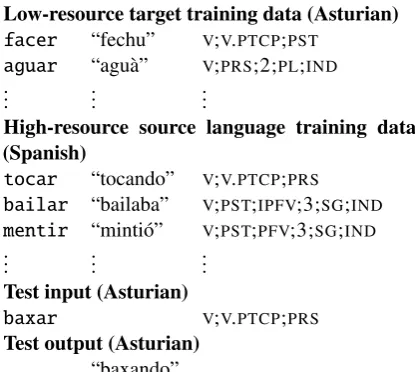
Example The model will have access to type-level data in a low-resource target language, plus a high-resource source language. We give an ex-ample here of Asturian as the target language with Spanish as the source language.
Low-resource target training data (Asturian)
facer “fechu” V;V.PTCP;PST aguar “agu`a” V;PRS;2;PL;IND
..
. ... ...
High-resource source language training data (Spanish)
tocar “tocando” V;V.PTCP;PRS bailar “bailaba” V;PST;IPFV;3;SG;IND mentir “minti´o” V;PST;PFV;3;SG;IND
..
. ... ...
Test input (Asturian)
baxar V;V.PTCP;PRS
Test output (Asturian)
[image:2.595.76.284.464.650.2]“baxando”
Table 1: Sample language pair and data format for Task 1
Evaluation We score the output of each system in terms of its predictions’ exact-match accuracy and the average Levenshtein distance between the predictions and their corresponding true forms.
2.2 Task 2: Morphological analysis in context
Although inflection of words in a context-agnostic manner is a useful evaluation of the morphological quality of a system, people do not learn morphol-ogy in isolation.
In 2018, the second task of the CoNLL– SIGMORPHON Shared Task (Cotterell et al., 2018) required submitting systems to complete an inflectional cloze task (Taylor, 1953) given only the sentential context and the desired lemma – an example of the problem is given in the following lines: A successful system would predict the plu-ral form “dogs”. Likewise, a Spanish word form “ayuda” may be a feminine noun or a third-person verb form, which must be disambiguated by con-text.
The are barking. (dog)
This year’s task extends the second task from last year. Rather than inflect a single word in context, the task is to provide a complete morphological tagging of a sentence: for each word, a successful system will need to lemmatize and tag it with a morphsyntactic description (MSD).
The dogs are barking .
the dog be bark .
DET N;PL V;PRS;3;PL V;V.PTCP;PRS PUNCT
Context is critical—depending on the sentence, identical word forms realize a large number of po-tential inflectional categories, which will in turn influence lemmatization decisions. If the sen-tence were instead “The barking dogs kept us up all night”, “barking” is now an adjective, and its lemma is also “barking”.
3 Data
3.1 Data for Task 1
Language pairs We presented data in 100 lan-guage pairs spanning 79 unique lanlan-guages. Data for all but four languages (Basque, Kurmanji, Mur-rinhpatha, and Sorani) are extracted from English Wiktionary, a large multi-lingual crowd-sourced dictionary with morphological paradigms for many lemmata.1 20 of the 100 language pairs are either
1The Basque language data was extracted from a manually designed finite-state morphological analyzer (Alegria et al.,
distantly related or unrelated; this allows specula-tion into the relative importance of data quantity and linguistic relatedness.
Data format For each language, the basic data consists of triples of the form (lemma, feature bun-dle, inflected form), as inTable 1. The first fea-ture in the bundle always specifies the core part of speech (e.g., verb). For each language pair, sepa-rate files contain the high- and low-resource train-ing examples.
All features in the bundle are coded according to the UniMorph Schema, a cross-linguistically con-sistent universal morphological feature set ( Sylak-Glassman et al.,2015a,b).
Extraction from Wiktionary For each of the Wiktionary languages, Wiktionary provides a num-ber of tables, each of which specifies the full in-flectional paradigm for a particular lemma. As in the previous iteration, tables were extracted using a template annotation procedure described in (Kirov et al.,2018).
Sampling data splits From each language’s col-lection of paradigms, we sampled the training, de-velopment, and test sets as in 2018.2 Crucially, while the data were sampled in the same fashion, the datasets are distinct from those used for the 2018 shared task.
Our first step was to construct probability distri-butions over the (lemma, feature bundle, inflected form) triples in our full dataset. For each triple, we counted how many tokens the inflected form has in the February 2017 dump of Wikipedia for that language. To distribute the counts of an observed form over all the triples that have this token as its form, we follow the method used in the previous shared task (Cotterell et al.,2018), training a neu-ral network on unambiguous forms to estimate the distribution over all, even ambiguous, forms. We then sampled 12,000 triples without replacement from this distribution. The first 100 were taken as training data for low-resource settings. The first 10,000 were used as high-resource training sets. As these sets are nested, the highest-count triples tend to appear in the smaller training sets.3
is discussed inMansfield(2019). Data for Kurmanji Kurdish and Sorani Kurdish were created as part of the Alexina project (Walther et al.,2010;Walther and Sagot,2010).
2
These datasets can be obtained from https:// sigmorphon.github.io/sharedtasks/2019/
3Several high-resource languages had necessarily fewer, but on a similar order of magnitude. Bengali, Uzbek, Kannada,
The final 2000 triples were randomly shuffled and then split in half to obtain development and test sets of 1000 forms each.4 The final shuffling was performed to ensure that the development set is similar to the test set. By contrast, the development and test sets tend to contain lower-count triples than the training set.5
Other modifications We further adopted some changes to increase compatibility. Namely, we cor-rected some annotation errors created while scrap-ing Wiktionary for the 2018 task, and we standard-ized Romanian t-cedilla and t-comma to t-comma. (The same was done with s-cedilla and s-comma.)
3.2 Data for Task 2
Our data for task 2 come from the Universal Depen-dencies treebanks (UD;Nivre et al.,2018, v2.3), which provides pre-defined training, development, and test splits and annotations in a unified anno-tation schema for morphosyntax and dependency relationships. Unlike the 2018 cloze task which used UD data, we require no manual data prepa-ration and are able to leverage all 107 monolin-gual treebanks. As is typical, data are presented in CoNLL-U format,6although we modify the mor-phological feature and lemma fields.
Data conversion The morphological annotations for the 2019 shared task were converted to the Uni-Morph schema (Kirov et al., 2018) according to McCarthy et al.(2018), who provide a determin-istic mapping that increases agreement across lan-guages. This also moves the part of speech into the bundle of morphological features. We do not attempt to individually correct any errors in the UD source material. Further, some languages received additional pre-processing. In the Finnish data, we removed morpheme boundaries that were present in the lemmata (e.g.,puhe#kieli7→puhekieli ‘spoken+language’). Russian lemmata in the GSD treebank were presented in all uppercase; to match
Swahili. Likewise, the low-resource language Telugu had fewer than 100 forms.
4
When sufficient data are unavailable, we instead use 50 or 100 examples.
5This mimics a realistic setting, as supervised training is usually employed to generalize from frequent words that ap-pear in annotated resources to less frequent words that do not. Unsupervised learning methods also tend to generalize from more frequent words (which can be analyzed more easily by combining information from many contexts) to less frequent ones.
the 2018 shared task, we lowercased these. In de-velopment and test data, all fields except for form and index within the sentence were struck.
4 Baselines
4.1 Task 1 Baseline
We include four neural sequence-to-sequence mod-els mapping lemma into inflected word forms: soft attention (Luong et al.,2015), non-monotonic hard attention (Wu et al.,2018), monotonic hard atten-tion and a variant with offset-based transiatten-tion distri-bution (Wu and Cotterell,2019). Neural sequence-to-sequence models with soft attention (Luong et al.,2015) have dominated previous SIGMOR-PHON shared tasks (Cotterell et al., 2017). Wu et al.(2018) instead models the alignment between characters in the lemma and the inflected word form explicitly with hard attention and learns this alignment and transduction jointly. Wu and Cot-terell(2019) shows that enforcing strict monotonic-ity with hard attention is beneficial in tasks such as morphological inflection where the transduction is mostly monotonic. The encoder is a biLSTM while the decoder is a left-to-right LSTM. All mod-els use multiplicative attention and have roughly the same number of parameters. In the model, a morphological tag is fed to the decoder along with target character embeddings to guide the decoding. During the training of the hard attention model, dy-namic programming is applied to marginalize all latent alignments exactly.
4.2 Task 2 Baselines
Non-neural (M¨uller et al.,2015): The Lemming model is a log-linear model that performs joint morphological tagging and lemmatization. The model is globally normalized with the use of a sec-ond order linear-chain CRF. To efficiently calculate the partition function, the choice of lemmata are pruned with the use of pre-extracted edit trees.
Neural (Malaviya et al.,2019): This is a state-of-the-art neural model that also performs joint morphological tagging and lemmatization, but also accounts for the exposure bias with the applica-tion of maximum likelihood (MLE). The model stitches the tagger and lemmatizer together with the use of jackknifing (Agi´c and Schluter,2017) to expose the lemmatizer to the errors made by the tagger model during training. The morphological tagger is based on a character-level biLSTM em-bedder that produces the embedding for a word,
Team Avg. Accuracy Avg. Levenshtein
AX-01 18.54 3.62
AX-02 24.99 2.72
CMU-03 58.79 1.52
IT-IST-01 49.00 1.29
IT-IST-02 50.18 1.32
Tuebingen-01† 34.49 1.88
Tuebingen-02† 20.86 2.36
UAlberta-01* 48.33 1.23
UAlberta-02*† 54.75 1.03
UAlberta-03*† 8.45 4.06
UAlberta-04*† 11.00 3.86
UAlberta-05* 4.10 3.08
UAlberta-06*† 26.85 2.65
Baseline 48.55 1.33
Table 2: Task 1 Team Scores, averaged across all Lan-guages; * indicates submissions were only applied to a subset of languages, making scores incomparable.† in-dicates that additional resources were used for training.
and a word-level biLSTM tagger that predicts a morphological tag sequence for each word in the sentence. The lemmatizer is a neural sequence-to-sequence model (Wu and Cotterell,2019) that uses the decoded morphological tag sequence from the tagger as an additional attribute. The model uses hard monotonic attention instead of standard soft attention, along with a dynamic programming based training scheme.
5 Results
The SIGMORPHON 2019 shared task received 30 submissions—14 for task 1 and 16 for task 2— from 23 teams. In addition, the organizers’ baseline systems were evaluated.
5.1 Task 1 Results
Five teams participated in the first Task, with a variety of methods aimed at leveraging the cross-lingual data to improve system performance.
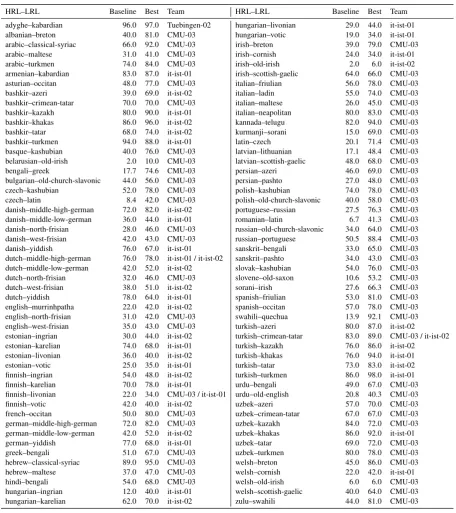
HRL–LRL Baseline Best Team HRL–LRL Baseline Best Team
adyghe–kabardian 96.0 97.0 Tuebingen-02 hungarian–livonian 29.0 44.0 it-ist-01
albanian–breton 40.0 81.0 CMU-03 hungarian–votic 19.0 34.0 it-ist-01
arabic–classical-syriac 66.0 92.0 CMU-03 irish–breton 39.0 79.0 CMU-03
arabic–maltese 31.0 41.0 CMU-03 irish–cornish 24.0 34.0 it-ist-01
arabic–turkmen 74.0 84.0 CMU-03 irish–old-irish 2.0 6.0 it-ist-02
armenian–kabardian 83.0 87.0 it-ist-01 irish–scottish-gaelic 64.0 66.0 CMU-03
asturian–occitan 48.0 77.0 CMU-03 italian–friulian 56.0 78.0 CMU-03
bashkir–azeri 39.0 69.0 it-ist-02 italian–ladin 55.0 74.0 CMU-03
bashkir–crimean-tatar 70.0 70.0 CMU-03 italian–maltese 26.0 45.0 CMU-03
bashkir–kazakh 80.0 90.0 it-ist-01 italian–neapolitan 80.0 83.0 CMU-03
bashkir–khakas 86.0 96.0 it-ist-02 kannada–telugu 82.0 94.0 CMU-03
bashkir–tatar 68.0 74.0 it-ist-02 kurmanji–sorani 15.0 69.0 CMU-03
bashkir–turkmen 94.0 88.0 it-ist-01 latin–czech 20.1 71.4 CMU-03
basque–kashubian 40.0 76.0 CMU-03 latvian–lithuanian 17.1 48.4 CMU-03
belarusian–old-irish 2.0 10.0 CMU-03 latvian–scottish-gaelic 48.0 68.0 CMU-03
bengali–greek 17.7 74.6 CMU-03 persian–azeri 46.0 69.0 CMU-03
bulgarian–old-church-slavonic 44.0 56.0 CMU-03 persian–pashto 27.0 48.0 CMU-03
czech–kashubian 52.0 78.0 CMU-03 polish–kashubian 74.0 78.0 CMU-03
czech–latin 8.4 42.0 CMU-03 polish–old-church-slavonic 40.0 58.0 CMU-03
danish–middle-high-german 72.0 82.0 it-ist-02 portuguese–russian 27.5 76.3 CMU-03
danish–middle-low-german 36.0 44.0 it-ist-01 romanian–latin 6.7 41.3 CMU-03
danish–north-frisian 28.0 46.0 CMU-03 russian–old-church-slavonic 34.0 64.0 CMU-03
danish–west-frisian 42.0 43.0 CMU-03 russian–portuguese 50.5 88.4 CMU-03
danish–yiddish 76.0 67.0 it-ist-01 sanskrit–bengali 33.0 65.0 CMU-03
dutch–middle-high-german 76.0 78.0 it-ist-01 / it-ist-02 sanskrit–pashto 34.0 43.0 CMU-03
dutch–middle-low-german 42.0 52.0 it-ist-02 slovak–kashubian 54.0 76.0 CMU-03
dutch–north-frisian 32.0 46.0 CMU-03 slovene–old-saxon 10.6 53.2 CMU-03
dutch–west-frisian 38.0 51.0 it-ist-02 sorani–irish 27.6 66.3 CMU-03
dutch–yiddish 78.0 64.0 it-ist-01 spanish–friulian 53.0 81.0 CMU-03
english–murrinhpatha 22.0 42.0 it-ist-02 spanish–occitan 57.0 78.0 CMU-03
english–north-frisian 31.0 42.0 CMU-03 swahili–quechua 13.9 92.1 CMU-03
english–west-frisian 35.0 43.0 CMU-03 turkish–azeri 80.0 87.0 it-ist-02
estonian–ingrian 30.0 44.0 it-ist-02 turkish–crimean-tatar 83.0 89.0 CMU-03 / it-ist-02
estonian–karelian 74.0 68.0 it-ist-01 turkish–kazakh 76.0 86.0 it-ist-02
estonian–livonian 36.0 40.0 it-ist-02 turkish–khakas 76.0 94.0 it-ist-01
estonian–votic 25.0 35.0 it-ist-01 turkish–tatar 73.0 83.0 it-ist-02
finnish–ingrian 54.0 48.0 it-ist-02 turkish–turkmen 86.0 98.0 it-ist-01
finnish–karelian 70.0 78.0 it-ist-01 urdu–bengali 49.0 67.0 CMU-03
finnish–livonian 22.0 34.0 CMU-03 / it-ist-01 urdu–old-english 20.8 40.3 CMU-03
finnish–votic 42.0 40.0 it-ist-02 uzbek–azeri 57.0 70.0 CMU-03
french–occitan 50.0 80.0 CMU-03 uzbek–crimean-tatar 67.0 67.0 CMU-03
german–middle-high-german 72.0 82.0 CMU-03 uzbek–kazakh 84.0 72.0 CMU-03
german–middle-low-german 42.0 52.0 it-ist-02 uzbek–khakas 86.0 92.0 it-ist-01
german–yiddish 77.0 68.0 it-ist-01 uzbek–tatar 69.0 72.0 CMU-03
greek–bengali 51.0 67.0 CMU-03 uzbek–turkmen 80.0 78.0 CMU-03
hebrew–classical-syriac 89.0 95.0 CMU-03 welsh–breton 45.0 86.0 CMU-03
hebrew–maltese 37.0 47.0 CMU-03 welsh–cornish 22.0 42.0 it-ist-01
hindi–bengali 54.0 68.0 CMU-03 welsh–old-irish 6.0 6.0 CMU-03
hungarian–ingrian 12.0 40.0 it-ist-01 welsh–scottish-gaelic 40.0 64.0 CMU-03
[image:5.595.71.528.145.659.2]hungarian–karelian 62.0 70.0 it-ist-02 zulu–swahili 44.0 81.0 CMU-03
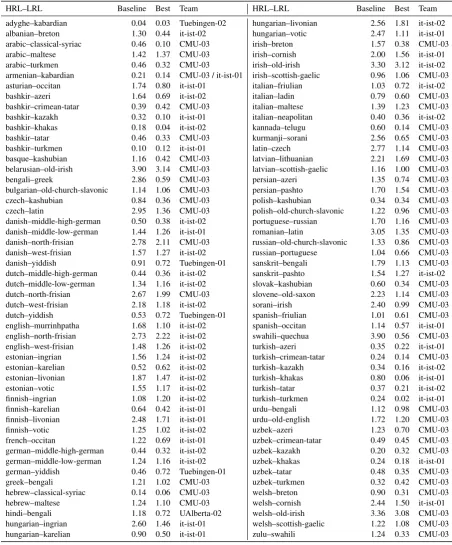
HRL–LRL Baseline Best Team HRL–LRL Baseline Best Team
adyghe–kabardian 0.04 0.03 Tuebingen-02 hungarian–livonian 2.56 1.81 it-ist-02 albanian–breton 1.30 0.44 it-ist-02 hungarian–votic 2.47 1.11 it-ist-01 arabic–classical-syriac 0.46 0.10 CMU-03 irish–breton 1.57 0.38 CMU-03 arabic–maltese 1.42 1.37 CMU-03 irish–cornish 2.00 1.56 it-ist-01 arabic–turkmen 0.46 0.32 CMU-03 irish–old-irish 3.30 3.12 it-ist-02 armenian–kabardian 0.21 0.14 CMU-03 / it-ist-01 irish–scottish-gaelic 0.96 1.06 CMU-03 asturian–occitan 1.74 0.80 it-ist-01 italian–friulian 1.03 0.72 it-ist-02 bashkir–azeri 1.64 0.69 it-ist-02 italian–ladin 0.79 0.60 CMU-03 bashkir–crimean-tatar 0.39 0.42 CMU-03 italian–maltese 1.39 1.23 CMU-03 bashkir–kazakh 0.32 0.10 it-ist-01 italian–neapolitan 0.40 0.36 it-ist-02 bashkir–khakas 0.18 0.04 it-ist-02 kannada–telugu 0.60 0.14 CMU-03 bashkir–tatar 0.46 0.33 CMU-03 kurmanji–sorani 2.56 0.65 CMU-03 bashkir–turkmen 0.10 0.12 it-ist-01 latin–czech 2.77 1.14 CMU-03 basque–kashubian 1.16 0.42 CMU-03 latvian–lithuanian 2.21 1.69 CMU-03 belarusian–old-irish 3.90 3.14 CMU-03 latvian–scottish-gaelic 1.16 1.00 CMU-03
bengali–greek 2.86 0.59 CMU-03 persian–azeri 1.35 0.74 CMU-03
bulgarian–old-church-slavonic 1.14 1.06 CMU-03 persian–pashto 1.70 1.54 CMU-03 czech–kashubian 0.84 0.36 CMU-03 polish–kashubian 0.34 0.34 CMU-03 czech–latin 2.95 1.36 CMU-03 polish–old-church-slavonic 1.22 0.96 CMU-03 danish–middle-high-german 0.50 0.38 it-ist-02 portuguese–russian 1.70 1.16 CMU-03 danish–middle-low-german 1.44 1.26 it-ist-01 romanian–latin 3.05 1.35 CMU-03 danish–north-frisian 2.78 2.11 CMU-03 russian–old-church-slavonic 1.33 0.86 CMU-03 danish–west-frisian 1.57 1.27 it-ist-02 russian–portuguese 1.04 0.66 CMU-03 danish–yiddish 0.91 0.72 Tuebingen-01 sanskrit–bengali 1.79 1.13 CMU-03 dutch–middle-high-german 0.44 0.36 it-ist-02 sanskrit–pashto 1.54 1.27 it-ist-02 dutch–middle-low-german 1.34 1.16 it-ist-02 slovak–kashubian 0.60 0.34 CMU-03 dutch–north-frisian 2.67 1.99 CMU-03 slovene–old-saxon 2.23 1.14 CMU-03 dutch–west-frisian 2.18 1.18 it-ist-02 sorani–irish 2.40 0.99 CMU-03 dutch–yiddish 0.53 0.72 Tuebingen-01 spanish–friulian 1.01 0.61 CMU-03 english–murrinhpatha 1.68 1.10 it-ist-02 spanish–occitan 1.14 0.57 it-ist-01 english–north-frisian 2.73 2.22 it-ist-02 swahili–quechua 3.90 0.56 CMU-03 english–west-frisian 1.48 1.26 it-ist-02 turkish–azeri 0.35 0.22 it-ist-01 estonian–ingrian 1.56 1.24 it-ist-02 turkish–crimean-tatar 0.24 0.14 CMU-03 estonian–karelian 0.52 0.62 it-ist-02 turkish–kazakh 0.34 0.16 it-ist-02 estonian–livonian 1.87 1.47 it-ist-02 turkish–khakas 0.80 0.06 it-ist-01 estonian–votic 1.55 1.17 it-ist-02 turkish–tatar 0.37 0.21 it-ist-02 finnish–ingrian 1.08 1.20 it-ist-02 turkish–turkmen 0.24 0.02 it-ist-01 finnish–karelian 0.64 0.42 it-ist-01 urdu–bengali 1.12 0.98 CMU-03 finnish–livonian 2.48 1.71 it-ist-01 urdu–old-english 1.72 1.20 CMU-03 finnish–votic 1.25 1.02 it-ist-02 uzbek–azeri 1.23 0.70 CMU-03 french–occitan 1.22 0.69 it-ist-01 uzbek–crimean-tatar 0.49 0.45 CMU-03 german–middle-high-german 0.44 0.32 it-ist-02 uzbek–kazakh 0.20 0.32 CMU-03 german–middle-low-german 1.24 1.16 it-ist-02 uzbek–khakas 0.24 0.18 it-ist-01 german–yiddish 0.46 0.72 Tuebingen-01 uzbek–tatar 0.48 0.35 CMU-03
greek–bengali 1.21 1.02 CMU-03 uzbek–turkmen 0.32 0.42 CMU-03
[image:6.595.71.524.130.676.2]hebrew–classical-syriac 0.14 0.06 CMU-03 welsh–breton 0.90 0.31 CMU-03 hebrew–maltese 1.24 1.10 CMU-03 welsh–cornish 2.44 1.50 it-ist-01 hindi–bengali 1.18 0.72 UAlberta-02 welsh–old-irish 3.36 3.08 CMU-03 hungarian–ingrian 2.60 1.46 it-ist-01 welsh–scottish-gaelic 1.22 1.08 CMU-03 hungarian–karelian 0.90 0.50 it-ist-01 zulu–swahili 1.24 0.33 CMU-03
The Tuebingen University submission (Tuebin-gen) aligned source and target to learn a set of edit-actions with both linear and neural classifiers that independently learned to predict action sequences for each morphological category. Adding in the cross-lingual data only led to modest gains.
AX-Semantics combined the low- and high-resource data to train an encoder-decoder seq2seq model; optionally also implementing domain adap-tation methods to focus later epochs on the target language.
The CMU submission first attends over a decou-pled representation of the desired morphological sequence before using the updated decoder state to attend over the character sequence of the lemma. Secondly, in order to reduce the bias of the de-coder’s language model, they hallucinate two types of data that encourage common affixes and charac-ter copying. Simply allowing the model to learn to copy characters for several epochs significantly out-performs the task baseline, while further improve-ments are obtained through fine-tuning. Making use of an adversarial language discriminator, cross lingual gains are highly-correlated to linguistic sim-ilarity, while augmenting the data with hallucinated forms and multiple related target language further improves the model.
The system from IT-IST also attends separately to tags and lemmas, using a gating mechanism to interpolate the importance of the individual atten-tions. By combining the gated dual-head attention with a SparseMax activation function, they are able to jointly learn stem and affix modifications, im-proving significantly over the baseline system.
The relative system performance is described inTable 5, which shows the average per-language accuracy of each system. The table reflects the fact that some teams submitted more than one system (e.g. Tuebingen-1 & Tuebingen-2 in the table).
5.2 Task 2 Results
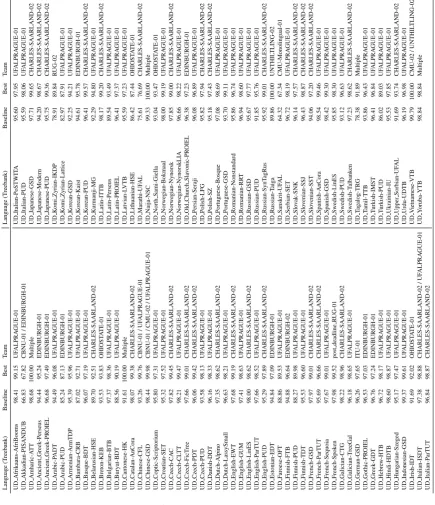
Nine teams submitted system papers for Task 2, with several interesting modifications to either the baseline or other prior work that led to modest improvements.
Charles-Saarland achieved the highest overall tagging accuracy by leveraging multi-lingual BERT embeddings fine-tuned on a concatenation of all available languages, effectively transporting the cross-lingual objective of Task 1 into Task 2. Lem-mas and tags are decoded separately (with a joint
encoder and separate attention); Lemmas are a se-quence of edit-actions, while tags are calculated jointly. (There is no splitting of tags into features; tags are atomic.)
CBNU instead lemmatize using a transformer network, while performing tagging with a mul-tilayer perceptron with biaffine attention. Input words are first lemmatized, and then pipelined to the tagger, which produces atomic tag sequences (i.e., no splitting of features).
The team from Istanbul Technical University (ITU) jointly produces lemmatic edit-actions and morphological tags via a two level encoder (first word embeddings, and then context embeddings) and separate decoders. Their system slightly im-proves over the baseline lemmatization, but signifi-cantly improves tagging accuracy.
The team from the University of Groningen (RUG) also uses separate decoders for lemmati-zation and tagging, but uses ELMo to initialize the contextual embeddings, leading to large gains in performance. Furthermore, joint training on related languages further improves results.
CMU approaches tagging differently than the multi-task decoding we’ve seen so far (baseline is used for lemmatization). Making use of a hierar-chical CRF that first predicts POS (that is subse-quently looped back into the encoder), they then seek to predict each feature separately. In partic-ular, predicting POS separately greatly improves results. An attempt to leverage gold typological information led to little gain in the results; experi-ments suggest that the system is already learning the pertinent information.
The team from Ohio State University (OHIOSTATE) concentrates on predicting tags; the baseline lemmatizer is used for lemma-tization. To that end, they make use of a dual decoder that first predicts features given only the word embedding as input; the predictions are fed to a GRU seq2seq, which then predicts the sequence of tags.
The UNT HiLT+Ling team investigates a low-resource setting of the tagging, by using parallel Bible data to learn a translation matrix between English and the target language, learning morpho-logical tags through analogy with English.
tag-Team Lemma Accuracy Lemma Levenshtein Morph Accuracy Morph F1
CBNU-01† 94.07 0.13 88.09 91.84
CHARLES-MALTA-01 74.95 0.62 50.37 58.81
CHARLES-SAARLAND-02† 95.00 0.11 93.23 96.02
CMU-02 92.20 0.17 85.06 88.97
CMU-DataAug-01‡ 92.51 0.17 86.53 91.18
Edinburgh-01 94.20 0.13 88.93 92.89
ITU-01 94.46 0.11 86.67 90.54
NLPCUBE-01 91.43 2.43 84.92 88.67
OHIOSTATE-01 93.43 0.17 87.42 92.51
RUG-01† 93.91 0.14 90.53 94.54
RUG-02 93.06 0.15 88.80 93.22
UFALPRAGUE-01† 95.78 0.10 93.19 95.92
UNTHILTLING-02† 83.14 0.55 15.69 51.87
EDINBURGH-02* 97.35 0.06 93.02 95.94
CMU-Monolingual* 88.31 0.27 84.60 91.18
CMU-PolyGlot-01*† 76.81 0.54 60.98 75.42
[image:8.595.80.525.64.307.2]Baseline 94.17 0.13 73.16 87.92
Table 5: Task 2 Team Scores, averaged across all treebanks; * indicates submissions were only applied to a subset of languages, making scores incomparable. †indicates that additional external resources were used for training, and‡indicates that training data were shared across languages or treebanks.
ging). Although they predict complete tags, they use the individual features to regularize the decoder. Small gains are also obtained from joining multi-lingual corpora and ensembling.
CUNI–Malta performs lemmatization as oper-ations over edit actions with LSTM and ReLU. Tagging is a bidirectional LSTM augmented by the edit actions (i.e., two-stage decoding), predicting features separately.
The Edinburgh system is a character-based LSTM encoder-decoder with attention, imple-mented in OpenNMT. It can be seen as an extension of the contextual lemmatization system Lematus (Bergmanis and Goldwater,2018) to include mor-phological tagging, or alternatively as an adaptation of the morphological re-inflection system MED (Kann and Sch¨utze,2016) to incorporate context and perform analysis rather than re-inflection. Like these systems it uses a completely generic encoder-decoder architecture with no specific adaptation to the morphological processing task other than the form of the input. In the submitted version of the system, the input is split into short chunks corresponding to the target word plus one word of context on either side, and the system is trained to output the corresponding lemmas and tags for each three-word chunk.
Several teams relied on external resources to
improve their lemmatization and feature analysis. Several teams made use of pre-trained embeddings. CHARLES-SAARLAND-2 and UFALPRAGUE-1 used pretrained contextual embeddings (BERT) provided by Google (Devlin et al.,2019). CBNU-1 used a mix of pre-trained embeddings from the CoNLL 2017 shared task and fastText. Further, some teams trained their own embeddings to aid performance.
6 Future Directions
In general, the application of typology to natu-ral language processing (e.g., Gerz et al., 2018; Ponti et al.,2018) provides an interesting avenue for multilinguality. Further, our shared task was designed to only leverage a single helper language, though many may exist with lexical or morpholog-ical overlap with the target language. Techniques like those ofNeubig and Hu(2018) may aid in de-signing universal inflection architectures. Neither task this year included unannotated monolingual corpora. Using such data is well-motivated from an L1-learning point of view, and may affect the performance of low-resource data settings.
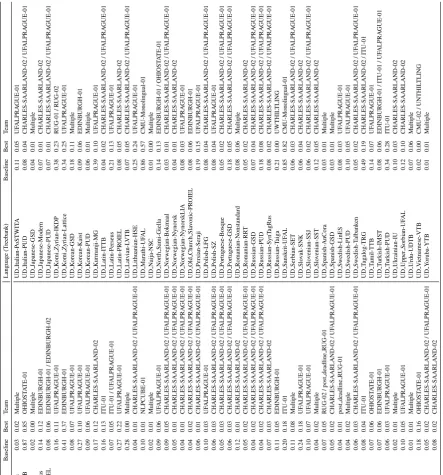
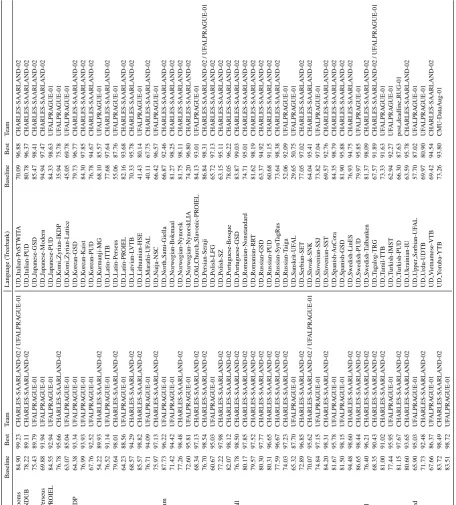
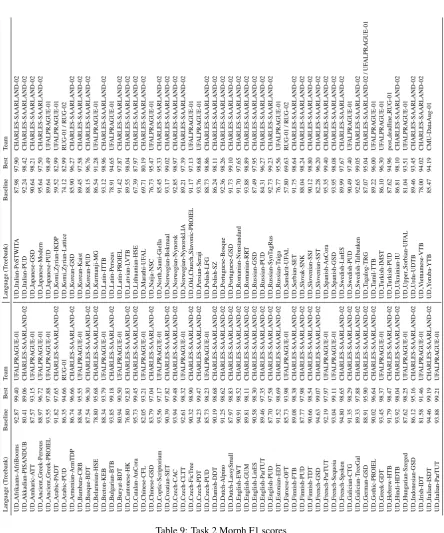
Differ-Language (T reebank) Baseline Best T eam Language (T reebank) Baseline Best T eam UD Afrikaans-AfriBooms 98.41 99.15 UF ALPRA GUE-01 UD Italian-PoSTWIT A 95.60 97.95 UF ALPRA GUE-01 UD Akkadian-PISANDUB 66.83 67.82 CBNU-01 / EDINB U RGH-01 UD Italian-PUD 95.59 98.06 UF ALPRA GUE-01 UD Amharic-A TT 98.68 100.00 Multipl e UD Japanese-GSD 97.71 99.65 CHARLES-SAARLAND-02 UD Ancient Greek-Perseus 94.44 95.24 EDINB URGH-01 UD Japanese-Modern 94.20 98.67 CHARLES-SAARLAND-02 UD Ancient Greek-PR OIEL 96.68 97.49 EDINB URGH-01 UD Japanese-PUD 95.75 99.36 CHARLES-SAARLAND-02 UD Arabic-P ADT 94.49 96.08 UF ALPRA GUE-01 UD K omi Zyrian-IKDP 78.91 89.84 R UG-02 UD Arabic-PUD 85.24 87.13 EDINB URGH-01 UD K omi Zyrian-Lattice 82.97 87.91 UF ALPRA GUE-01 UD Armenian-ArmTDP 95.39 95.96 UF ALPRA GUE-01 UD K orean-GSD 92.25 94.21 UF ALPRA GUE-01 UD Bambara-CRB 87.02 92.71 UF ALPRA GUE-01 UD K orean-Kaist 94.61 95.78 EDINB URGH-01 UD Basque-BDT 96.07 97.19 UF ALPRA GUE-01 UD K orean-PUD 96.41 99.57 CHARLES-SAARLAN D-02 UD Belarusian-HSE 89.70 92.51 CHARLES-SAAR LAND-02 UD K urmanji-MG 92.29 94.80 UF ALPRA GUE-01 UD Breton-KEB 93.53 93.83 OHIOST A TE-01 UD Latin-ITTB 98.17 99.20 CHARLES-SAARLA ND-02 UD Bulg arian-BTB 97.37 98.36 UF ALPRA GUE-01 UD Latin-Perseus 89.54 93.49 UF ALPRA GUE-01 UD Buryat-BDT 88.56 90.19 UF ALPRA GUE-01 UD Latin-PR OIEL 96.41 97.37 UF ALPRA GUE-01 UD Cantonese-HK 91.61 100.00 Multipl e UD Latvian-L VTB 95.59 97.23 UF ALPRA GUE-01 UD Catalan-AnCora 98.07 99.38 CHARLES-SAAR LAND-02 UD Lithuanian-HSE 86.42 87.44 OHIOST A TE-01 UD Chinese-CFL 93.26 99.76 CBNU-01 / UF A LPRA GUE-01 UD Marathi-UF AL 75.61 76.69 CHARLES-SAARLAN D-02 UD Chinese-GSD 98.44 99.98 CBNU-01 / CM U-02 / UF ALPRA GUE-01 UD Naija-NSC 99.33 100.00 Multiple UD Coptic-Scriptorium 95.80 97.31 UF ALPRA GUE-01 UD North Sami-Giella 93.04 93.47 OHIOST A TE-01 UD Croatian-SET 95.32 97.52 UF ALPRA GUE-01 UD Norwe gian-Bokmaal 98.00 99.19 UF ALPRA GUE-01 UD Czech-CA C 97.82 99.45 CHARLES-SAAR LAND-02 UD Norwe gian-Nynorsk 97.85 99.00 CHARLES-SAARLAND-02 UD Czech-CL TT 98.21 99.47 UF ALPRA GUE-01 UD Norwe gian-NynorskLIA 96.66 98.22 UF ALPRA GUE-01 UD Czech-FicT ree 97.66 99.01 CHARLES-SAAR LAND-02 UD Old Church Sla v onic-PR OIEL 96.38 97.23 EDINB URGH-01 UD Czech-PDT 96.06 99.42 CHARLES-SAA RLAND-02 UD Persian-Seraji 96.08 96.89 UF ALPRA GUE-01 UD Czech-PUD 93.58 98.13 UF ALPRA GUE-01 UD Polish-LFG 95.82 97.94 CHARLES-SAARLA ND-02 UD Danish-DDT 96.16 98.33 UF ALPRA GUE-01 UD Polish-SZ 95.18 97.43 CHARLES-SAARLA ND-02 UD Dutch-Alpino 97.35 98.62 CHARLES-SAA RLAND-02 UD Portuguese-Bosque 97.08 98.69 UF ALPRA GUE-01 UD Dutch-LassySmall 96.63 98.21 UF ALPRA GUE-01 UD Portuguese-GSD 93.70 99.11 UF ALPRA GUE-01 UD English-EWT 97.68 99.19 CHARLES-SA ARLAND-02 UD Romanian-Nonstandard 95.86 96.74 UF ALPRA GUE-01 UD English-GUM 97.41 98.63 UF ALPRA GUE-01 UD Romanian-RR T 96.94 98.60 UF ALPRA GUE-01 UD English-LinES 98.00 98.62 CHARLES-SA ARLAND-02 UD Russian-GSD 95.67 97.77 UF ALPRA GUE-01 UD English-P arTUT 97.66 98.52 UF ALPRA GUE-01 UD Russian-PUD 91.85 95.76 UF ALPRA GUE-01 UD English-PUD 95.29 97.89 CHARLES-SAA RLAND-02 UD Russian-SynT agRus 95.92 99.01 CHARLES-SAARLAND-02 UD Estonian-EDT 94.84 97.09 EDINB URGH-01 UD Russian-T aig a 89.86 100.00 UNTHIL TLING-02 UD F aroese-OFT 88.86 89.53 UF ALPRA GUE-01 UD Sanskrit-UF AL 64.32 67.34 CMU-Monolingual -01 UD Finnish-FTB 94.88 96.64 EDINB URGH-02 UD Serbian-SET 96.72 98.19 UF ALPRA GUE-01 UD Finnish-PUD 88.27 89.98 UF ALPRA GUE-01 UD Slo v ak-SNK 96.14 97.57 CHARLES-SAARLAN D-02 UD Finnish-TDT 95.53 96.60 UF ALPRA GUE-01 UD Slo v enian-SSJ 96.43 98.87 CHARLES-SAARLAN D-02 UD French-GSD 97.97 99.01 CHARLES-SAA RLAND-02 UD Slo v enian-SST 94.06 97.20 CHARLES-SAARLAN D-02 UD French-P arTUT 95.69 96.66 CHARLES-SAAR LAND-02 UD Spanish-AnCora 98.54 99.46 UF ALPRA GUE-01 UD French-Sequoia 97.67 99.01 UF ALPRA GUE-01 UD Spanish-GSD 98.42 99.30 UF ALPRA GUE-01 UD French-Spok en 97.98 99.52 post deadline R UG-01 UD Swedish-LinES 95.85 98.30 UF ALPRA GUE-01 UD Galician-CTG 98.22 98.96 CHARLES-SAAR LAND-02 UD Swedish-PUD 93.12 96.63 UF ALPRA GUE-01 UD Galician-T reeGal 96.18 98.65 UF ALPRA GUE-01 UD Swedish-T albank en 97.23 98.62 CHARLES-SAARLAND-02 UD German-GSD 96.26 97.65 ITU-01 UD T ag alog-TRG 78.38 91.89 Multiple UD Gothic-PR OIEL 96.53 97.03 EDINB URGH-01 UD T amil-TTB 93.86 96.43 UF ALPRA GUE-01 UD Greek-GDT 96.76 97.24 EDINB URGH-01 UD T urkish-IMST 96.41 96.84 UF ALPRA GUE-01 UD Hebre w-HTB 96.72 98.17 UF ALPRA GUE-01 UD T urkish-PUD 86.02 89.03 UF ALPRA GUE-01 UD Hindi-HDTB 98.60 98.87 UF ALPRA GUE-01 UD Ukrainian-IU 95.53 97.85 UF ALPRA GUE-01 UD Hung arian-Sze ged 95.17 97.47 UF ALPRA GUE-01 UD Upper Sorbian-UF AL 91.69 93.74 CHARLES-SAARLAND-02 UD Indonesian-GSD 99.37 99.61 UF ALPRA GUE-01 UD Urdu-UDTB 96.19 96.98 UF ALPRA GUE-01 UD Irish-IDT 91.69 92.02 OHIOST A TE-01 UD V ietnamese-VTB 99.79 100.00 CMU-02 / UNTHIL TLING-02 UD Italian-ISDT 97.38 98.88 CHARLES-SA ARLAND-02 / UF ALPRA GUE-01 UD Y oruba-YTB 98.84 98.84 Multiple UD Italian-P arTUT 96.84 98.87 CHARLES-SAA RLAND-02
Language (T reebank) Baseline Best T eam Language (T reebank) Baseline Best T eam UD Afrikaans-AfriBooms 0.03 0.02 Mult iple UD Italian-PoSTWIT A 0.11 0.05 UF ALPRA GUE-01 UD Akkadian-PISANDUB 0.87 0.85 OHIOST A TE-01 UD Italian-PUD 0.08 0.04 CHARLES-S AARLAND-02 / UF ALPRA GUE-01 UD Amharic-A TT 0.02 0.00 Mul tiple UD Japanese-GSD 0.04 0.01 Multi ple UD Ancient Greek-Perseus 0.14 0.12 EDINB URGH-01 UD Japanese-Modern 0.07 0.01 CHARLES-S AARLAND-02 UD Ancient Greek-PR OIEL 0.08 0.06 EDINB URGH-01 / EDINB URGH-02 UD Japanese-PUD 0.07 0.01 CHARLES-S AARLAND-02 / UF ALPRA GUE-01 UD Arabic-P ADT 0.16 0.11 UF ALP RA GUE-01 UD K omi Zyrian-IKDP 0.38 0.23 R UG-01 / R UG-02 UD Arabic-PUD 0.41 0.37 EDINB U RGH-01 UD K omi Zyrian-Lattice 0.34 0.25 UF ALPRA GUE-01 UD Armenian-ArmTDP 0.08 0.07 UF ALP RA GUE-01 UD K orean-GSD 0.18 0.11 Multi ple UD Bambara-CRB 0.27 0.10 UF ALP RA GUE-01 UD K orean-Kaist 0.09 0.06 EDINB URGH-01 UD Basque-BDT 0.09 0.06 UF ALP RA GUE-01 UD K orean-PUD 0.06 0.01 Multi ple UD Belarusian-HSE 0.17 0.12 CHARL ES-SAARLAND-02 UD K urmanji-MG 0.39 0.10 UF ALPRA GUE-01 UD Breton-KEB 0.16 0.13 ITU-01 UD Latin-ITTB 0.04 0.02 CHARLES-SAARLAND-02 / UF ALPRA GUE-01 UD Bulg arian-BTB 0.07 0.05 ITU-01 / UF ALPRA GUE-01 UD Latin-Perseus 0.21 0.13 UF ALPRA GUE-01 UD Buryat-BDT 0.27 0.22 UF ALP RA GUE-01 UD Latin-PR OIEL 0.08 0.05 CHARLES-S AARLAND-02 UD Cantonese-HK 0.28 0.00 Mult iple UD Latvian-L VTB 0.07 0.05 CHARLES-S AARLAND-02 / UF ALPRA GUE-01 UD Catalan-AnCora 0.04 0.01 CHARLE S-SAARLAND-02 / UF ALPRA GUE-01 UD Lithuanian-HSE 0.25 0.24 UF ALPRA GUE-01 UD Chinese-CFL 0.10 0.01 NLPCU BE-01 UD Marathi-UF AL 0.86 0.57 CMU-Monol ingual-01 UD Chinese-GSD 0.02 0.01 Mul tiple UD Naija-NSC 0.01 0.00 Multi ple UD Coptic-Scriptorium 0.09 0.06 UF ALP RA GUE-01 UD North Sami-Giella 0.14 0.13 EDINB URGH-01 / OH IOST A TE-01 UD Croatian-SET 0.09 0.05 CHAR LES-SAARLAND-02 / UF ALPRA GUE-01 UD Norwe gian-Bokmaal 0.03 0.01 CHARLES-SA ARLAND-02 / UF ALPRA GUE-01 UD Czech-CA C 0.05 0.01 CHARL ES-SAARLAND-02 / UF ALPRA GUE-01 UD Norwe gian-Nynorsk 0.04 0.01 CHARLES-S AARLAND-02 UD Czech-CL TT 0.04 0.01 CHAR LES-SAARLAND-02 / UF ALPRA GUE-01 UD Norwe gian-NynorskLIA 0.08 0.03 UF ALPRA GUE-01 UD Czech-FicT ree 0.04 0.02 CHARL ES-SAARLAND-02 / UF ALPRA GUE-01 UD Old Church Sla v onic-PR OIEL 0.08 0.06 EDINB URGH-01 UD Czech-PDT 0.06 0.01 CHAR LES-SAARLAND-02 / UF ALPRA GUE-01 UD Persian-Seraji 0.19 0.15 UF ALPRA GUE-01 UD Czech-PUD 0.10 0.03 UF ALP RA GUE-01 UD Polish-LFG 0.08 0.04 CHARLES-SAARLAND-02 / UF ALPRA GUE-01 UD Danish-DDT 0.06 0.03 CHAR LES-SAARLAND-02 / UF ALPRA GUE-01 UD Polish-SZ 0.08 0.04 UF ALPRA GUE-01 UD Dutch-Alpino 0.05 0.03 CHAR LES-SAARLAND-02 / UF ALPRA GUE-01 UD Portuguese-Bosque 0.05 0.02 CHARLES-S AARLAND-02 / UF ALPRA GUE-01 UD Dutch-LassySmall 0.06 0.03 CHARLE S-SAARLAND-02 / UF ALPRA GUE-01 UD Portuguese-GSD 0.18 0.05 CHARLES-S AARLAND-02 / UF ALPRA GUE-01 UD English-EWT 0.12 0.01 CHAR LES-SAARLAND-02 UD Romanian-Nonstandard 0.08 0.06 Multipl e UD English-GUM 0.05 0.02 CHAR LES-SAARLAND-02 / UF ALPRA GUE-01 UD Romanian-RR T 0.05 0.02 CHARLES-S AARLAND-02 UD English-LinES 0.04 0.02 CHAR LES-SAARLAND-02 / UF ALPRA GUE-01 UD Russian-GSD 0.07 0.04 CHARLES-S AARLAND-02 / UF ALPRA GUE-01 UD English-P arTUT 0.04 0.02 CHAR LES-SAARLAND-02 / UF ALPRA GUE-01 UD Russian-PUD 0.18 0.08 CHARLES-S AARLAND-02 / UF ALPRA GUE-01 UD English-PUD 0.07 0.03 CHAR LES-SAARLAND-02 UD Russian-SynT agRus 0.08 0.02 CHARLES-SA ARLAND-02 / UF ALPRA GUE-01 UD Estonian-EDT 0.11 0.05 EDINB U RGH-01 UD Russian-T aig a 0.21 0.00 UWTHIL TLING UD F aroese-OFT 0.20 0.18 ITU-01 UD Sanskrit-UF AL 0.85 0.82 CMU-Monol ingual-01 UD Finnish-FTB 0.11 0.08 Mul tiple UD Serbian-SET 0.06 0.03 CHARLES-SAARLAND-02 / UF ALPRA GUE-01 UD Finnish-PUD 0.24 0.18 UF ALP RA GUE-01 UD Slo v ak-SNK 0.06 0.04 CHARLES-SAARLAND-02 UD Finnish-TDT 0.10 0.07 UF ALP RA GUE-01 UD Slo v enian-SSJ 0.06 0.02 CHARLES-S AARLAND-02 / UF ALPRA GUE-01 UD French-GSD 0.04 0.02 Mul tiple UD Slo v enian-SST 0.12 0.05 CHARLES-SAARLAND-02 UD French-P arTUT 0.07 0.05 R UG-02 / pos t deadline R UG-01 UD Spanish-AnCora 0.03 0.01 Multi ple UD French-Sequoia 0.05 0.02 CHAR LES-SAARLAND-02 / UF ALPRA GUE-01 UD Spanish-GSD 0.03 0.01 Multi ple UD French-Spok en 0.04 0.01 post deadline R UG-01 UD Swedish-LinES 0.08 0.03 UF ALPRA GUE-01 UD Galician-CTG 0.04 0.02 Mul tiple UD Swedish-PUD 0.10 0.05 UF ALPRA GUE-01 UD Galician-T reeGal 0.06 0.03 CHARLE S-SAARLAND-02 / UF ALPRA GUE-01 UD Swedish-T albank en 0.05 0.02 CHARLES-SA ARLAND-02 / UF ALPRA GUE-01 UD German-GSD 0.08 0.04 ITU-01 UD T ag alog-TRG 0.49 0.19 CHARLES-S AARLAND-02 / ITU-01 UD Gothic-PR OIEL 0.07 0.06 OHIOS T A T E-01 UD T amil-TTB 0.14 0.07 UF ALPRA GUE-01 UD Greek-GDT 0.07 0.06 EDINB U RGH-01 UD T urkish-IMST 0.08 0.06 EDINB URGH-01 / ITU-01 / UF ALPRA GUE-01 UD Hebre w-HTB 0.06 0.03 UF ALP RA GUE-01 UD T urkish-PUD 0.34 0.28 ITU-01 UD Hindi-HDTB 0.02 0.01 Mul tiple UD Ukrainian-IU 0.10 0.03 CHARLES-S AARLAND-02 UD Hung arian-Sze ged 0.10 0.05 UF ALPR A G UE-01 UD Upper Sorbian-UF AL 0.12 0.10 CHARLES-SA ARLAND-02 UD Indonesian-GSD 0.01 0.01 Mult iple UD Urdu-UDTB 0.07 0.06 Multi ple UD Irish-IDT 0.18 0.16 OHIOS T A TE-01 UD V ietnamese-VTB 0.02 0.00 CMU-02 / UNT HIL TLING UD Italian-ISDT 0.05 0.02 CHAR LES-SAARLAND-02 / UF ALPRA GUE-01 UD Y oruba-YTB 0.01 0.01 Multi ple UD Italian-P arTUT 0.08 0.02 CHAR LES-SAARLAND-02
Language (T reebank) Baseline Best T eam Language (T reebank) Baseline Best T eam UD Afrikaans-AfriBooms 84.90 99.23 CHARLES-SAARLAND -02 / UF ALPRA GUE-01 UD Italian-PoSTWIT A 70.09 96.88 CHARLES -SAARLAND-02 UD Akkadian-PISANDUB 78.22 89.11 CHARLES-SAARLAND -02 UD Italian-PUD 80.78 96.37 CHARLE S-SAARLAND-02 UD Amharic-A TT 75.43 89.79 UF ALPRA GUE-01 UD Japanese-GSD 85.47 98.41 CHARLES -SAARLAND-02 UD Ancient Greek-Perseus 69.88 91.94 UF ALPRA GUE-01 UD Japanese-Modern 94.94 97.47 CHARLES -SAARLAND-02 UD Ancient Greek-PR OIEL 84.55 92.94 UF ALPRA GUE-01 UD Japanese-PUD 84.33 98.63 UF ALPR A GU E-01 UD Arabic-P ADT 76.78 95.66 CHARLES-SAARLA ND-02 UD K omi Zyrian-IKDP 35.94 75.78 UF ALPRA GUE-01 UD Arabic-PUD 63.07 85.04 UF ALPRA GUE-01 UD K omi Zyrian-Lattice 45.05 69.78 UF ALPRA GUE-01 UD Armenian-ArmTDP 64.38 93.34 UF ALPRA GUE-01 UD K orean-GSD 79.73 96.77 CHARLES -SAARLAND-02 UD Bambara-CRB 76.99 93.93 UF ALPRA GUE-01 UD K orean-Kaist 84.30 97.85 CHARLES -SAARLAND-02 UD Basque-BDT 67.76 92.52 UF ALPRA GUE-01 UD K orean-PUD 76.78 94.67 CHARLES -SAARLAND-02 UD Belarusian-HSE 54.22 89.93 CHARLES-SAARLAN D-02 UD K urmanji-MG 68.10 85.57 UF ALPR A G UE-01 UD Breton-KEB 76.52 91.14 UF ALPRA GUE-01 UD Latin-ITTB 77.68 97.64 CHAR LES-SAARLAND-02 UD Bulg arian-BTB 79.64 98.01 CHARLES-SAARLAN D-02 UD Latin-Perseus 55.06 87.76 UF ALPR A G UE-01 UD Buryat-BDT 64.23 88.56 UF ALPRA GUE-01 UD Latin-PR OIEL 82.16 93.68 CHARL ES-SAARLAND-02 UD Cantonese-HK 68.57 94.29 CHARLES-SAARLAN D-02 UD Latvian-L VTB 70.33 95.78 CHARLE S-SAARLAND-02 UD Catalan-AnCora 85.57 98.82 CHARLES-SAARLAN D-02 UD Lithuanian-HSE 41.43 80.14 UF ALPR A GUE-01 UD Chinese-CFL 76.71 94.09 UF ALPRA GUE-01 UD Marathi-UF AL 40.11 67.75 CHARLE S-SAARLAND-02 UD Chinese-GSD 75.97 97.13 CHARLES-SAARLAN D-02 UD Naija-NSC 66.42 96.57 UF ALPR A GUE-01 UD Coptic-Scriptorium 87.73 96.22 UF ALPRA GUE-01 UD North Sami-Giella 66.87 92.46 CHARLES-S AARLAND-02 UD Croatian-SET 71.42 94.42 UF ALPRA GUE-01 UD Norwe gian-Bokmaal 81.27 98.25 CHARLES -SAARLAND-02 UD Czech-CA C 77.26 98.48 CHARLES-SAARLAN D-02 UD Norwe gian-Nynorsk 81.75 98.11 CHARLES -SAARLAND-02 UD Czech-CL TT 72.60 95.81 UF ALPRA GUE-01 UD Norwe gian-NynorskLIA 74.20 96.80 CHARLES-SAARLAND-02 UD Czech-FicT ree 68.34 97.13 CHARLES-SAARLAN D-02 UD Old Church Sla v onic-PR OIEL 84.13 93.01 UF ALPRA GUE-01 UD Czech-PDT 76.70 98.54 CHARLES-SAARLA ND-02 UD Persian-Seraji 86.84 98.31 CHARLE S-SAARLAND-02 / UF ALPRA GUE-01 UD Czech-PUD 60.67 95.03 UF ALPRA GUE-01 UD Polish-LFG 65.72 97.13 CHAR LES-SAARLAND-02 UD Danish-DDT 77.22 97.98 CHARLES-SAARLA ND-02 UD Polish-SZ 63.15 95.11 CHAR LES-SAARLAND-02 UD Dutch-Alpino 82.07 98.12 CHARLES-SAARLA ND-02 UD Portuguese-Bosque 78.05 96.22 CHARLES -SAARLAND-02 UD Dutch-LassySmall 76.78 98.50 CHARLES-SAARLAN D-02 UD Portuguese-GSD 83.87 99.03 CHARLES -SAARLAND-02 UD English-EWT 80.17 97.85 CHARLES-SAARL AND-02 UD Romanian-Nonstandard 74.71 95.01 CHARLES-SAARLAND-02 UD English-GUM 79.57 97.52 CHARLES-SAARLA ND-02 UD Romanian-RR T 81.62 98.19 CHARLES -SAARLAND-02 UD English-LinES 80.30 97.77 CHARLES-SAARL AND-02 UD Russian-GSD 63.37 94.92 CHARLES -SAARLAND-02 UD English-P arTUT 80.31 96.65 CHARLES-SAARLA ND-02 UD Russian-PUD 60.68 91.15 CHARLES -SAARLAND-02 UD English-PUD 77.59 96.67 CHARLES-SAARLA ND-02 UD Russian-SynT agRus 73.64 98.38 CHARLES -SAARLAND-02 UD Estonian-EDT 74.03 97.23 CHARLES-SAARLA ND-02 UD Russian-T aig a 52.06 92.09 UF ALPR A GU E-01 UD F aroese-OFT 65.32 87.70 UF ALPRA GUE-01 UD Sanskrit-UF AL 29.65 50.75 UF ALPR A GUE-01 UD Finnish-FTB 72.89 96.85 CHARLES-SAARL AND-02 UD Serbian-SET 77.05 97.02 CHARL ES-SAARLAND-02 UD Finnish-PUD 70.07 95.62 CHARLES-SAARLA ND-02 / UF ALPRA GUE-01 UD Slo v ak-SNK 64.04 95.41 CHARLES -SAARLAND-02 UD Finnish-TDT 74.84 97.15 UF ALPRA GUE-01 UD Slo v enian-SSJ 73.82 97.04 UF ALPR A GU E-01 UD French-GSD 84.20 98.31 CHARLES-SAARLA ND-02 UD Slo v enian-SST 69.57 92.76 CHARLES -SAARLAND-02 UD French-P arTUT 81.67 95.78 UF ALPRA GUE-01 UD Spanish-AnCora 84.35 98.79 CHARLES -SAARLAND-02 UD French-Sequoia 81.50 98.15 UF ALPRA GUE-01 UD Spanish-GSD 81.90 95.88 CHARLE S-SAARLAND-02 UD French-Spok en 94.48 98.60 CHARLES-SAARLAN D-02 UD Swedish-LinES 76.93 94.75 CHARLE S-SAARLAND-02 UD Galician-CTG 86.65 98.44 CHARLES-SAARLAN D-02 UD Swedish-PUD 79.97 95.85 UF ALPR A G UE-01 UD Galician-T reeGal 76.40 96.21 CHARLES-SAARLAND -02 UD Swedish-T albank en 81.37 98.09 CHARLES -SAARLAND-02 UD German-GSD 68.35 90.43 CHARLES-SAARLA ND-02 UD T ag alog-TRG 67.57 91.89 CHARLES -SAARLAND-02 / UF ALPRA GUE-01 UD Gothic-PR OIEL 81.00 91.02 CHARLES-SAARLA ND-02 UD T amil-TTB 73.33 91.63 UF ALP RA GUE-01 UD Greek-GDT 77.44 95.95 UF ALPRA GUE-01 UD T urkish-IMST 62.94 92.27 UF ALP RA GUE-01 UD Hebre w-HTB 81.15 97.67 CHARLES-SAARLAN D-02 UD T urkish-PUD 66.30 87.63 post deadline R UG-01 UD Hindi-HDTB 80.60 93.65 CHARLES-SAARLA ND-02 UD Ukrainian-IU 63.59 95.78 CHARLE S-SAARLAND-02 UD Hung arian-Sze ged 65.90 95.03 UF ALPRA GUE-01 UD Upper Sorbian-UF AL 57.70 87.02 UF ALPRA GUE-01 UD Indonesian-GSD 71.73 92.48 CHARLES-SAARLAN D-02 UD Urdu-UDTB 69.97 80.90 UF ALPR A GUE-01 UD Irish-IDT 67.66 86.37 UF ALPRA GUE-01 UD V ietnamese-VTB 69.42 94.54 CHARLES -SAARLAND-02 UD Italian-ISDT 83.72 98.49 CHARLES-SAARL AND-02 UD Y oruba-YTB 73.26 93.80 CMU-DataAug-01 UD Italian-P arTUT 83.51 98.72 UF ALPRA GUE-01
Language (T reebank) Baseline Best T eam Language (T reebank) Baseline Best T eam UD Afrikaans-AfriBooms 92.87 99.40 UF ALPRA GUE-01 UD Italian-PoSTWIT A 87.98 97.90 CHAR LES-SAARLAND-02 UD Akkadian-PISANDUB 80.41 89.06 CHARLES-S AARLAND-02 UD Italian-PUD 92.24 98.42 CHA RLES-SAARLAND-02 UD Amharic-A TT 87.57 93.15 UF ALPRA GUE-01 UD Japanese-GSD 90.64 98.21 CHAR LES-SAARLAND-02 UD Ancient Greek-Perseus 88.97 96.72 UF ALPRA GUE-01 UD Japanese-Modern 95.64 97.50 CHAR LES-SAARLAND-02 UD Ancient Greek-PR OIEL 93.55 97.88 UF ALPRA GUE-01 UD Japanese-PUD 89.64 98.49 UF ALP RA GUE-01 UD Arabic-P ADT 91.82 97.65 CHARLES-SAARLAND-02 UD K omi Zyrian-IKDP 59.52 82.99 UF ALPRA GUE-01 UD Arabic-PUD 86.35 94.66 R UG-01 UD K omi Zyrian-Lattice 74.12 82.99 R UG-01 / R UG-02 UD Armenian-ArmTDP 86.74 96.66 CHARLES-S AARLAND-02 UD K orean-GSD 85.90 96.27 CHAR LES-SAARLAND-02 UD Bambara-CRB 88.94 95.55 UF ALPRA GUE-01 UD K orean-Kaist 89.45 97.58 CHAR LES-SAARLAND-02 UD Basque-BDT 87.54 96.30 CHARLES-SAARLAND-02 UD K orean-PUD 88.15 96.76 CHAR LES-SAARLAND-02 UD Belarusian-HSE 78.80 95.68 CHARLES-SAARLAND-02 UD K urmanji-MG 86.54 91.28 UF AL PRA GUE-01 UD Breton-KEB 88.34 93.79 UF ALPRA GUE-01 UD Latin-ITTB 93.12 98.96 CH ARLES-SAARLAND-02 UD Bulg arian-BTB 93.85 99.18 CHARLES-S AARLAND-02 UD Latin-Perseus 78.91 94.65 UF AL PRA GUE-01 UD Buryat-BDT 80.94 90.50 UF ALPRA GUE-01 UD Latin-PR OIEL 91.42 97.87 CHA RLES-SAARLAND-02 UD Cantonese-HK 76.80 92.83 CHARLES-S AARLAND-02 UD Latvian-L VTB 89.55 98.04 CHA RLES-SAARLAND-02 UD Catalan-AnCora 95.73 99.45 CHARLES-S AARLAND-02 UD Lithuanian-HSE 67.39 87.97 CHA RLES-SAARLAND-02 UD Chinese-CFL 82.05 93.21 UF ALPRA GUE-01 UD Marathi-UF AL 69.71 80.19 CHA RLES-SAARLAND-02 UD Chinese-GSD 83.79 97.04 CHARLES-SAARLAND-02 UD Naija-NSC 76.73 95.47 UF A LPRA GUE-01 UD Coptic-Scriptorium 93.56 97.17 UF ALPRA GUE-01 UD North Sami-Giella 85.45 95.33 CHARLES -SAARLAND-02 UD Croatian-SET 90.39 97.82 CHARLES-SAARLAND-02 UD Norwe gian-Bokmaal 93.17 99.02 CHAR LES-SAARLAND-02 UD Czech-CA C 93.94 99.48 CHARLES-SAARLAND-02 UD Norwe gian-Nynorsk 92.85 98.97 CHAR LES-SAARLAND-02 UD Czech-CL TT 92.61 98.32 UF ALPRA GUE-01 UD Norwe gian-NynorskLIA 89.21 97.39 CHARL ES-SAARLAND-02 UD Czech-FicT ree 90.32 98.90 CHARLES-S AARLAND-02 UD Old Church Sla v onic-PR OIEL 91.17 97.13 UF ALPRA GUE-01 UD Czech-PDT 94.23 99.47 CHARLES-SAARLAND-02 UD Persian-Seraji 93.76 98.68 UF A LPRA GUE-01 UD Czech-PUD 85.73 98.23 UF ALPRA GUE-01 UD Polish-LFG 88.73 98.86 CH ARLES-SAARLAND-02 UD Danish-DDT 90.19 98.68 CHARLES-SAARLAND-02 UD Polish-SZ 86.24 98.11 CH ARLES-SAARLAND-02 UD Dutch-Alpino 91.25 98.62 CHARLES-SAARLAND-02 UD Portuguese-Bosque 92.36 98.26 CHAR LES-SAARLAND-02 UD Dutch-LassySmall 87.97 98.83 CHARLES-S AARLAND-02 UD Portuguese-GSD 91.73 99.10 CHAR LES-SAARLAND-02 UD English-EWT 90.91 98.52 CHARLES -SAARLAND-02 UD Romanian-Nonstandard 91.70 97.65 CHARL ES-SAARLAND-02 UD English-GUM 89.81 98.11 CHARLES-SAARLAND-02 UD Romanian-RR T 93.88 98.89 CHAR LES-SAARLAND-02 UD English-LinES 90.58 98.30 CHARLES -SAARLAND-02 UD Russian-GSD 87.49 97.95 CHAR LES-SAARLAND-02 UD English-P arTUT 89.46 97.35 CHARLES-SAARLAND-02 UD Russian-PUD 84.31 96.27 CHAR LES-SAARLAND-02 UD English-PUD 87.70 97.58 CHARLES-SAARLAND-02 UD Russian-SynT agRus 92.73 99.23 CHAR LES-SAARLAND-02 UD Estonian-EDT 91.52 98.69 CHARLES-SAARLAND-02 UD Russian-T aig a 76.77 95.56 UF ALP RA GUE-01 UD F aroese-OFT 85.73 93.98 UF ALPRA GUE-01 UD Sanskrit-UF AL 57.80 69.63 R UG-01 / R UG-02 UD Finnish-FTB 89.08 98.38 CHARLES -SAARLAND-02 UD Serbian-SET 91.75 98.64 CHA RLES-SAARLAND-02 UD Finnish-PUD 87.77 97.98 CHARLES-SAARLAND-02 UD Slo v ak-SNK 88.04 98.24 CHAR LES-SAARLAND-02 UD Finnish-TDT 90.66 98.54 CHARLES -SAARLAND-02 UD Slo v enian-SSJ 90.12 98.80 CHAR LES-SAARLAND-02 UD French-GSD 94.63 99.07 CHARLES-SAARLAND-02 UD Slo v enian-SST 82.28 96.20 CHAR LES-SAARLAND-02 UD French-P arTUT 92.19 97.97 UF ALPRA GUE-01 UD Spanish-AnCora 95.35 99.40 CHAR LES-SAARLAND-02 UD French-Sequoia 93.04 99.11 UF ALPRA GUE-01 UD Spanish-GSD 93.95 98.08 CHA RLES-SAARLAND-02 UD French-Spok en 94.80 98.65 CHARLES-SAARLAND-02 UD Swedish-LinES 89.99 97.67 CHA RLES-SAARLAND-02 UD Galician-CTG 91.35 98.29 CHARLES-SAARLAND-02 UD Swedish-PUD 90.49 97.40 UF AL PRA GUE-01 UD Galician-T reeGal 89.33 97.88 CHARLES-S AARLAND-02 UD Swedish-T albank en 92.65 99.05 CHAR LES-SAARLAND-02 UD German-GSD 88.91 95.90 CHARLES-SAARLAND-02 UD T ag alog-TRG 87.07 95.04 CHAR LES-SAARLAND-02 / UF ALPRA GUE-01 UD Gothic-PR OIEL 90.02 96.64 CHARLES-SAARLAND-02 UD T amil-TTB 89.22 96.00 UF A LPRA GUE-01 UD Greek-GDT 93.45 98.37 UF ALPRA GUE-01 UD T urkish-IMST 86.10 96.30 UF A LPRA GUE-01 UD Hebre w-HTB 91.79 98.47 CHARLES-SAARLAND-02 UD T urkish-PUD 87.62 94.96 post deadline R UG-01 UD Hindi-HDTB 93.92 98.04 CHARLES-SAARLAND-02 UD Ukrainian-IU 86.81 98.10 CHA RLES-SAARLAND-02 UD Hung arian-Sze ged 87.62 98.25 UF ALPRA GUE-01 UD Upper Sorbian-UF AL 81.04 93.51 UF ALP RA GUE-01 UD Indonesian-GSD 86.12 95.16 CHARLES-S AARLAND-02 UD Urdu-UDTB 89.46 93.45 CHA RLES-SAARLAND-02 UD Irish-IDT 81.58 91.46 UF ALPR A GUE -01 UD V ietnamese-VTB 78.00 94.02 CHAR LES-SAARLAND-02 UD Italian-ISDT 94.46 99.19 CHARLES -SAARLAND-02 UD Y oruba-YTB 85.47 94.19 CM U-DataAug-01 UD Italian-P arTUT 93.88 99.21 UF ALPRA GUE-01
ent languages, in particular those with idiosyncratic orthographies, may offer new challenges in this re-spect.7
Only one team tried to learn inflection in a multi-lingual setting—i.e. to use all training data to train one model. Such transfer learning is an interest-ing avenue of future research, but evaluation could be difficult. Whether any cross-language transfer is actually being learned vs. whether having more data better biases the networks to copy strings is an evaluation step to disentangle.8
Creating new data sets that accurately reflect learner exposure (whether L1 or L2) is also an important consideration in the design of future shared tasks. One pertinent facet of this is informa-tion about inflecinforma-tional categories—often the inflec-tional information is insufficiently prescribed by the lemma, as with the Romanian verbal inflection classes or nominal gender in German.
As we move toward multilingual models for mor-phology, it becomes important to understand which representations are critical or irrelevant for adapt-ing to new languages; this may be probed in the style of (Thompson et al.,2018), and it can be used as a first step toward designing systems that avoid “catastrophic forgetting” as they learn to inflect new
languages (Thompson et al.,2019).
Future directions for Task 2 include exploring cross-lingual analysis—in stride with both Task 1 andMalaviya et al.(2018)—and leveraging these analyses in downstream tasks.
7 Conclusions
The SIGMORPHON 2019 shared task provided a type-level evaluation on 100 language pairs in 79 languages and a token-level evaluation on 107 tree-banks in 66 languages, of systems for inflection and analysis. On task 1 (low-resource inflection with cross-lingual transfer), 14 systems were submitted, while on task 2 (lemmatization and morphological feature analysis), 16 systems were submitted. All used neural network models, completing a trend in past years’ shared tasks and other recent work on morphology.
In task 1, gains from cross-lingual training were generally modest, with gains positively correlating with the linguistic similarity of the two languages.
7Although some work suggests that working with IPA or phonological distinctive features in this context yields very similar results to working with graphemes (Wiemerslage et al.,
2018).
8This has been addressed byJin and Kann(2017).
In the second task, several methods were im-plemented by multiple groups, with the most suc-cessful systems implementing variations of multi-headed attention, multi-level encoding, multiple decoders, and ELMo and BERT contextual embed-dings.
We have released the training, development, and test sets, and expect these datasets to provide a useful benchmark for future research into learn-ing of inflectional morphology and strlearn-ing-to-strlearn-ing transduction.
Acknowledgments
MS has received funding from the European Re-search Council (ERC) under the European Union’s Horizon 2020 research and innovation programme (grant agreement No 771113).
References
ˇ
Zeljko Agi´c and Natalie Schluter. 2017. How (not) to train a dependency parser: The curious case of jack-knifing part-of-speech taggers. In Proceedings of the 55th Annual Meeting of the Association for Com-putational Linguistics (Volume 2: Short Papers), pages 679–684, Vancouver, Canada. Association for Computational Linguistics.
Inaki Alegria, Izaskun Etxeberria, Mans Hulden, and Montserrat Maritxalar. 2009. Porting Basque mor-phological grammars tofoma, an open-source tool. In International Workshop on Finite-State Methods and Natural Language Processing, pages 105–113. Springer.
Toms Bergmanis and Sharon Goldwater. 2018. Con-text sensitive neural lemmatization with Lematus. In
Proceedings of the 2018 Conference of the North American Chapter of the Association for Computa-tional Linguistics: Human Language Technologies, Volume 1 (Long Papers), pages 1391–1400, New Orleans, Louisiana. Association for Computational Linguistics.
Ryan Cotterell, Christo Kirov, John Sylak-Glassman, G´eraldine Walther, Ekaterina Vylomova, Arya D. McCarthy, Katharina Kann, Sebastian Mielke, Gar-rett Nicolai, Miikka Silfverberg, David Yarowsky, Jason Eisner, and Mans Hulden. 2018.The CoNLL– SIGMORPHON 2018 shared task: Universal mor-phological reinflection. In Proceedings of the CoNLL–SIGMORPHON 2018 Shared Task: Univer-sal Morphological Reinflection, pages 1–27, Brus-sels. Association for Computational Linguistics.
CoNLL-SIGMORPHON 2017 shared task: Uni-versal morphological reinflection in 52 languages.
Proceedings of the CoNLL SIGMORPHON 2017 Shared Task: Universal Morphological Reinflection, pages 1–30.
Jacob Devlin, Ming-Wei Chang, Kenton Lee, and Kristina Toutanova. 2019. BERT: Pre-training of deep bidirectional transformers for language under-standing. In Proceedings of the 2019 Conference of the North American Chapter of the Association for Computational Linguistics: Human Language Technologies, Volume 1 (Long and Short Papers), pages 4171–4186, Minneapolis, Minnesota. Associ-ation for ComputAssoci-ational Linguistics.
Daniela Gerz, Ivan Vuli´c, Edoardo Ponti, Jason Narad-owsky, Roi Reichart, and Anna Korhonen. 2018. Language modeling for morphologically rich lan-guages: Character-aware modeling for word-level prediction.Transactions of the Association for Com-putational Linguistics, 6:451–465.
Huiming Jin and Katharina Kann. 2017. Exploring cross-lingual transfer of morphological knowledge in sequence-to-sequence models. InProceedings of the First Workshop on Subword and Character Level Models in NLP, pages 70–75, Copenhagen, Den-mark. Association for Computational Linguistics.
Katharina Kann and Hinrich Sch¨utze. 2016. MED: The LMU system for the SIGMORPHON 2016 shared task on morphological reinflection. InProceedings of the 14th SIGMORPHON Workshop on Computa-tional Research in Phonetics, Phonology, and Mor-phology, pages 62–70, Berlin, Germany. Associa-tion for ComputaAssocia-tional Linguistics.
Aleksandr E. Kibrik. 1998. Archi. In Andrew Spencer and Arnold M. Zwicky, editors, The Handbook of Morphology, pages 455–476. Oxford: Blackwell Publishers.
Christo Kirov, Ryan Cotterell, John Sylak-Glassman, G´eraldine Walther, Ekaterina Vylomova, Patrick Xia, Manaal Faruqui, Sebastian J. Mielke, Arya D. McCarthy, Sandra K¨ubler, David Yarowsky, Jason Eisner, and Mans Hulden. 2018. UniMorph 2.0: Universal Morphology. InProceedings of the 11th Language Resources and Evaluation Conference, Miyazaki, Japan. European Language Resource As-sociation.
Thang Luong, Hieu Pham, and Christopher D. Man-ning. 2015. Effective approaches to attention-based neural machine translation. InProceedings of the 2015 Conference on Empirical Methods in Natu-ral Language Processing, pages 1412–1421, Lis-bon, Portugal. Association for Computational Lin-guistics.
Chaitanya Malaviya, Matthew R. Gormley, and Gra-ham Neubig. 2018. Neural factor graph models for cross-lingual morphological tagging. In Proceed-ings of the 56th Annual Meeting of the Association
for Computational Linguistics (Volume 1: Long Pa-pers), pages 2653–2663, Melbourne, Australia. As-sociation for Computational Linguistics.
Chaitanya Malaviya, Shijie Wu, and Ryan Cotterell. 2019.A simple joint model for improved contextual neural lemmatization. InProceedings of the 2019 Conference of the North American Chapter of the Association for Computational Linguistics: Human Language Technologies, Volume 1 (Long and Short Papers), pages 1517–1528, Minneapolis, Minnesota. Association for Computational Linguistics.
John Mansfield. 2019. Murrinhpatha morphology and phonology, volume 653. Walter de Gruyter GmbH & Co KG.
Arya D. McCarthy, Miikka Silfverberg, Ryan Cotterell, Mans Hulden, and David Yarowsky. 2018. Marrying Universal Dependencies and Universal Morphology. In Proceedings of the Second Workshop on Univer-sal Dependencies (UDW 2018), pages 91–101, Brus-sels, Belgium. Association for Computational Lin-guistics.
Thomas M¨uller, Ryan Cotterell, Alexander Fraser, and Hinrich Sch¨utze. 2015. Joint lemmatization and morphological tagging with LEMMING. In Proceed-ings of the 2015 Conference on Empirical Meth-ods in Natural Language Processing, pages 2268– 2274, Lisbon, Portugal. Association for Computa-tional Linguistics.
Graham Neubig and Junjie Hu. 2018. Rapid adapta-tion of neural machine translaadapta-tion to new languages. In Proceedings of the 2018 Conference on Empiri-cal Methods in Natural Language Processing, pages 875–880, Brussels, Belgium. Association for Com-putational Linguistics.
Etienne, Rich´ard Farkas, Hector Fernandez Al-calde, Jennifer Foster, Cl´audia Freitas, Katar´ına Gajdoˇsov´a, Daniel Galbraith, Marcos Garcia, Moa G¨ardenfors, Sebastian Garza, Kim Gerdes, Filip Ginter, Iakes Goenaga, Koldo Gojenola, Memduh G¨okırmak, Yoav Goldberg, Xavier G´omez Guino-vart, Berta Gonz´ales Saavedra, Matias Grioni, Nor-munds Gr¯uz¯ıtis, Bruno Guillaume, C´eline Guillot-Barbance, Nizar Habash, Jan Hajiˇc, Jan Hajiˇc jr., Linh H`a M˜y, Na-Rae Han, Kim Harris, Dag Haug, Barbora Hladk´a, Jaroslava Hlav´aˇcov´a, Florinel Hociung, Petter Hohle, Jena Hwang, Radu Ion, Elena Irimia, O. l´aj´ıd´e Ishola, Tom´aˇs Jel´ınek, An-ders Johannsen, Fredrik Jørgensen, H¨uner Kas¸ıkara, Sylvain Kahane, Hiroshi Kanayama, Jenna Kan-erva, Boris Katz, Tolga Kayadelen, Jessica Ken-ney, V´aclava Kettnerov´a, Jesse Kirchner, Kamil Kopacewicz, Natalia Kotsyba, Simon Krek, Sooky-oung Kwak, Veronika Laippala, Lorenzo Lam-bertino, Lucia Lam, Tatiana Lando, Septina Dian Larasati, Alexei Lavrentiev, John Lee, Phuong Lˆe H`ˆong, Alessandro Lenci, Saran Lertpradit, Her-man Leung, Cheuk Ying Li, Josie Li, Keying Li, KyungTae Lim, Nikola Ljubeˇsi´c, Olga Logi-nova, Olga Lyashevskaya, Teresa Lynn, Vivien Macketanz, Aibek Makazhanov, Michael Mandl, Christopher Manning, Ruli Manurung, C˘at˘alina M˘ar˘anduc, David Mareˇcek, Katrin Marheinecke, H´ector Mart´ınez Alonso, Andr´e Martins, Jan Maˇsek, Yuji Matsumoto, Ryan McDonald, Gus-tavo Mendonc¸a, Niko Miekka, Margarita Misir-pashayeva, Anna Missil¨a, C˘at˘alin Mititelu, Yusuke Miyao, Simonetta Montemagni, Amir More, Laura Moreno Romero, Keiko Sophie Mori, Shinsuke Mori, Bjartur Mortensen, Bohdan Moskalevskyi, Kadri Muischnek, Yugo Murawaki, Kaili M¨u¨urisep, Pinkey Nainwani, Juan Ignacio Navarro Hor˜niacek, Anna Nedoluzhko, Gunta Neˇspore-B¯erzkalne, Lu-ong Nguy˜ˆen Thi., Huy`ˆen Nguy˜ˆen Thi. Minh, Vitaly Nikolaev, Rattima Nitisaroj, Hanna Nurmi, Stina Ojala, Ad´edayo. Ol´u`okun, Mai Omura, Petya Osen-ova, Robert ¨Ostling, Lilja Øvrelid, Niko Partanen, Elena Pascual, Marco Passarotti, Agnieszka Pate-juk, Guilherme Paulino-Passos, Siyao Peng, Cenel-Augusto Perez, Guy Perrier, Slav Petrov, Jussi Piitu-lainen, Emily Pitler, Barbara Plank, Thierry Poibeau, Martin Popel, Lauma Pretkalnin¸a, Sophie Pr´evost, Prokopis Prokopidis, Adam Przepi´orkowski, Ti-ina Puolakainen, Sampo Pyysalo, Andriela R¨a¨abis, Alexandre Rademaker, Loganathan Ramasamy, Taraka Rama, Carlos Ramisch, Vinit Ravishankar, Livy Real, Siva Reddy, Georg Rehm, Michael Rießler, Larissa Rinaldi, Laura Rituma, Luisa Rocha, Mykhailo Romanenko, Rudolf Rosa, Davide Rovati, Valentin Roca, Olga Rudina, Jack Rueter, Shoval Sadde, Benoˆıt Sagot, Shadi Saleh, Tanja Samardˇzi´c, Stephanie Samson, Manuela Sanguinetti, Baiba Saul¯ıte, Yanin Sawanakunanon, Nathan Schneider, Sebastian Schuster, Djam´e Seddah, Wolf-gang Seeker, Mojgan Seraji, Mo Shen, Atsuko Shi-mada, Muh Shohibussirri, Dmitry Sichinava, Na-talia Silveira, Maria Simi, Radu Simionescu, Katalin Simk´o, M´aria ˇSimkov´a, Kiril Simov, Aaron Smith,
Isabela Soares-Bastos, Carolyn Spadine, Antonio Stella, Milan Straka, Jana Strnadov´a, Alane Suhr, Umut Sulubacak, Zsolt Sz´ant´o, Dima Taji, Yuta Takahashi, Takaaki Tanaka, Isabelle Tellier, Trond Trosterud, Anna Trukhina, Reut Tsarfaty, Francis Tyers, Sumire Uematsu, Zdeˇnka Ureˇsov´a, Larraitz Uria, Hans Uszkoreit, Sowmya Vajjala, Daniel van Niekerk, Gertjan van Noord, Viktor Varga, Eric Villemonte de la Clergerie, Veronika Vincze, Lars Wallin, Jing Xian Wang, Jonathan North Washing-ton, Seyi Williams, Mats Wir´en, Tsegay Wolde-mariam, Tak-sum Wong, Chunxiao Yan, Marat M. Yavrumyan, Zhuoran Yu, Zdenˇek ˇZabokrtsk´y, Amir Zeldes, Daniel Zeman, Manying Zhang, and Hanzhi Zhu. 2018. Universal dependencies 2.3. LIN-DAT/CLARIN digital library at the Institute of For-mal and Applied Linguistics ( ´UFAL), Faculty of Mathematics and Physics, Charles University.
Edoardo Maria Ponti, Helen O’Horan, Yevgeni Berzak, Ivan Vulic, Roi Reichart, Thierry Poibeau, Ekaterina Shutova, and Anna Korhonen. 2018. Modeling lan-guage variation and universals: A survey on typo-logical linguistics for natural language processing.
CoRR, abs/1807.00914.
John Sylak-Glassman, Christo Kirov, Matt Post, Roger Que, and David Yarowsky. 2015a. A universal feature schema for rich morphological annotation and fine-grained cross-lingual part-of-speech tag-ging. In Cerstin Mahlow and Michael Piotrowski, editors, Proceedings of the 4th Workshop on Sys-tems and Frameworks for Computational Morphol-ogy (SFCM), Communications in Computer and In-formation Science, pages 72–93. Springer, Berlin.
John Sylak-Glassman, Christo Kirov, David Yarowsky, and Roger Que. 2015b. A language-independent feature schema for inflectional morphology. In Pro-ceedings of the 53rd Annual Meeting of the Associ-ation for ComputAssoci-ational Linguistics and the 7th In-ternational Joint Conference on Natural Language Processing (Volume 2: Short Papers), pages 674– 680, Beijing, China. Association for Computational Linguistics.
Wilson L Taylor. 1953. “Cloze procedure”: A new tool for measuring readability. Journalism Bulletin, 30(4):415–433.
Brian Thompson, Jeremy Gwinnup, Huda Khayrallah, Kevin Duh, and Philipp Koehn. 2019. Overcoming catastrophic forgetting during domain adaptation of neural machine translation. InProceedings of the 2019 Conference of the North American Chapter of the Association for Computational Linguistics: Hu-man Language Technologies, Volume 1 (Long and Short Papers), pages 2062–2068, Minneapolis, Min-nesota. Association for Computational Linguistics.
ma-chine translation. InProceedings of the Third Con-ference on Machine Translation: Research Papers, pages 124–132, Belgium, Brussels. Association for Computational Linguistics.
G´eraldine Walther and Benoˆıt Sagot. 2010. Develop-ing a large-scale lexicon for a less-resourced lan-guage: General methodology and preliminary exper-iments on Sorani Kurdish. InProceedings of the 7th SaLTMiL Workshop on Creation and use of basic lex-ical resources for less-resourced languages (LREC 2010 Workshop), Valetta, Malta.
G´eraldine Walther, Benoˆıt Sagot, and Kar¨en Fort. 2010. Fast development of basic NLP tools: Towards a lex-icon and a POS tagger for Kurmanji Kurdish. In In-ternational conference on lexis and grammar.
Adam Wiemerslage, Miikka Silfverberg, and Mans Hulden. 2018. Phonological features for morpho-logical inflection. In Proceedings of the Fifteenth Workshop on Computational Research in Phonetics, Phonology, and Morphology, pages 161–166, Brus-sels, Belgium. Association for Computational Lin-guistics.
Shijie Wu and Ryan Cotterell. 2019. Exact hard monotonic attention for character-level transduction.
arXiv preprint arXiv:1905.06319v1.
Shijie Wu, Pamela Shapiro, and Ryan Cotterell. 2018. Hard non-monotonic attention for character-level transduction. In Proceedings of the 2018 Confer-ence on Empirical Methods in Natural Language Processing, pages 4425–4438, Brussels, Belgium. Association for Computational Linguistics.