Electrical and Computer Engineering Publications
Electrical and Computer Engineering
2015
Second order phase transition temperature of single
crystals of Gd5Si1.3Ge2.7 and Gd5Si1.4Ge2.6
Ravi L. Hadimani
Iowa State University, [email protected]
Yevgen Melikhov
Cardiff University
Deborah L. Schlagel
Ames Laboratory, [email protected]
Thomas A. Lograsso
Iowa State University, [email protected]
Kevin W. Dennis
Iowa State University, [email protected]
See next page for additional authors
Follow this and additional works at:
http://lib.dr.iastate.edu/ece_pubs
Part of the
Electromagnetics and Photonics Commons
,
Engineering Physics Commons
, and the
Metallurgy Commons
The complete bibliographic information for this item can be found at
http://lib.dr.iastate.edu/
ece_pubs/49
. For information on how to cite this item, please visit
http://lib.dr.iastate.edu/
howtocite.html
.
Second order phase transition temperature of single crystals of
Gd5Si1.3Ge2.7 and Gd5Si1.4Ge2.6
Abstract
Gd5(Six Ge 1−x)4 has mixed phases in the composition range 0.32 < x < 0.41, which have not been widely studied. In this paper, we have synthesized and indexed single crystal samples of Gd5Si1.3 Ge 2.7 and Gd5Si1.4 Ge 2.6. We have investigated the first order and second orderphase transition temperatures of these samples using magnetic moment vs. temperature andmagnetic moment vs. magnetic field at different temperatures. We have used a modified Arrott plot technique that was developed and reported by us previously to determine the “hidden” second order phase transition temperature of the orthorhombic II phase.
Keywords
Ames Laboratory, Materials Science and Engineering, Germanium, Magnetic phase transitions, Single crystals, Magnetic fields, Phase diagrams
Disciplines
Electromagnetics and Photonics | Engineering Physics | Metallurgy
Comments
The following article appeared in J. Appl. Phys. 117, 17D106 (2015) and may be found athttp://dx.doi.org/ 10.1063/1.4907190.
Rights
Copyright 2015 American Institute of Physics. This article may be downloaded for personal use only. Any other use requires prior permission of the author and the American Institute of Physics.
Authors
Second order phase transition temperature of single crystals of Gd5Si1.3Ge2.7 and
Gd5Si1.4Ge2.6
R. L. Hadimani, Y. Melikhov, D. L. Schlagel, T. A. Lograsso, K. W. Dennis, R. W. McCallum, and D. C. Jiles
Citation: Journal of Applied Physics 117, 17D106 (2015); doi: 10.1063/1.4907190 View online: http://dx.doi.org/10.1063/1.4907190
View Table of Contents: http://scitation.aip.org/content/aip/journal/jap/117/17?ver=pdfcov
Published by the AIP Publishing
Articles you may be interested in
Growth and characterisation of Gd5(SixGe1−x)4 thin film
J. Appl. Phys. 113, 17A935 (2013); 10.1063/1.4799975
Entropy changes due to the first-order phase transition in the Gd 5 Si x Ge 4 − x system
Appl. Phys. Lett. 88, 212505 (2006); 10.1063/1.2201879
Thermal Property of DyxEr1−xAl2 and Gd5(SixGe1−x)4 for Hydrogen Magnetic Refrigeration
AIP Conf. Proc. 711, 11 (2004); 10.1063/1.1774546
Thermal expansion studies on the unusual first order transition of Gd 5 Si 2.09 Ge 1.91 : effects of purity of Gd
J. Appl. Phys. 93, 8486 (2003); 10.1063/1.1540060
Electronic structure and magnetic properties of Gd 5 ( Si 1−x Ge x ) 4
J. Appl. Phys. 91, 8540 (2002); 10.1063/1.1455614
Second order phase transition temperature of single crystals of Gd
5Si
1.3Ge
2.7and Gd
5Si
1.4Ge
2.6R. L. Hadimani,1,2,a)Y. Melikhov,3,4D. L. Schlagel,2T. A. Lograsso,2,5K. W. Dennis,2 R. W. McCallum,2,5and D. C. Jiles1,2
1
Department of Electrical and Computer Engineering, Iowa State University, Ames, Iowa 50011, USA 2
Division of Materials Science & Engineering, Ames Laboratory, U.S. Department of Energy, Ames, Iowa 50011, USA
3
Wolfson Center for Magnetics, Cardiff University, Cardiff CF24 3AA, United Kingdom 4
Institute of Physics, Polish Academy of Science, Warsaw 02-668, Poland 5
Department of Materials Science & Engineering, Iowa State University, Ames, Iowa 50011, USA
(Presented 5 November 2014; received 22 September 2014; accepted 16 October 2014; published online 30 January 2015)
Gd5(SixGe1x)4has mixed phases in the composition range 0.32<x<0.41, which have not been widely studied. In this paper, we have synthesized and indexed single crystal samples of Gd5Si1.3Ge2.7 and Gd5Si1.4Ge2.6. We have investigated the first order and second order phase transition temperatures of these samples using magnetic moment vs. temperature and magnetic moment vs. magnetic field at different temperatures. We have used a modified Arrott plot technique that was developed and reported by us previously to determine the “hidden” second order phase transition temperature of the orthorhombic II phase.VC 2015 AIP Publishing LLC. [http://dx.doi.org/10.1063/1.4907190]
INTRODUCTION
Gd5(SixGe1x)4 still remains a magnetocaloric material of great interest due to its giant magnetocaloric effect near room temperature. The material has been widely studied over the composition range 0.41<x<0.51, where the coupled magnetic and structural first order phase transitions occur close to room temperature.1–5 Gd5(SixGe1x)4 has a mixed phase region in the phase diagram with both Sm5Ge4 type (orthorhombic I) and Gd5Si4 type (orthorhombic II) phases for compositions 0.32<x<0.41.6 There has been little research on specific composition in this region. Arrott plots have been widely used to determine the nature of phase tran-sitions in many magnetic materials.7 Previously, we have used modified Arrott plots to determine the second order phase transition temperature when it is suppressed by the first order phase transition in samples with compositions x<0.51.8,9In our previous work, we also used these modified Arrott plots on the mixed phase composition of Gd5Si1.5Ge2.5 (x¼0.375) to determine the second order phase temperatures of both the monoclinic and the orthorhombic II phases.10In the present work, we have investigated two more single crys-tal samples of Gd5Si1.3Ge2.7and Gd5Si1.4Ge2.6whose compo-sitions fall in the mixed phase regions of orthorhombic I and orthorhombic II in the phase diagram. The second order phase transition temperatures of the samples were estimated to be 383 K for Gd5Si1.3Ge2.7 and 365 K for Gd5Si1.4Ge2.6. These temperatures are much higher than the expected second order phase transition temperature of orthorhombic II phase (280 K). This may be due to the presence of the orthorhombic I phase in larger volume fraction.
EXPERIMENTAL DETAILS
Single crystal samples of Gd5Si1.3Ge2.7(x¼0.325) and Gd5Si1.4Ge2.6(x¼0.35) were prepared by the tri-arc crystal pulling method at the Materials Preparation Center of Ames Laboratory.11 The samples were heat treated at 1273 K for 24 h to reduce or eliminate the amount of orthorhombic I phase present in the sample. They were then cooled at a rate of 10/min. It is our experience that slow cooling produces a more phase pure sample than quenching. The ingots were cut using an electrical discharge machine (EDM) to limit any stress on the final cut sample. The samples were indexed using Laue X-ray diffraction technique. The Laue patterns of “a” and “c” axes were not distinguishable by this method due to their similar lattice parameters, so, they were distin-guished by additional XRD measurements of the faces of the bulk samples. Magnetization measurements were carried out on a SQUID magnetometer. For the M vs. T measurements, the rate of heating/cooling of the samples was 10/min and the applied field was 100 Oe (8 kA/m).
RESULTS AND DISCUSSION
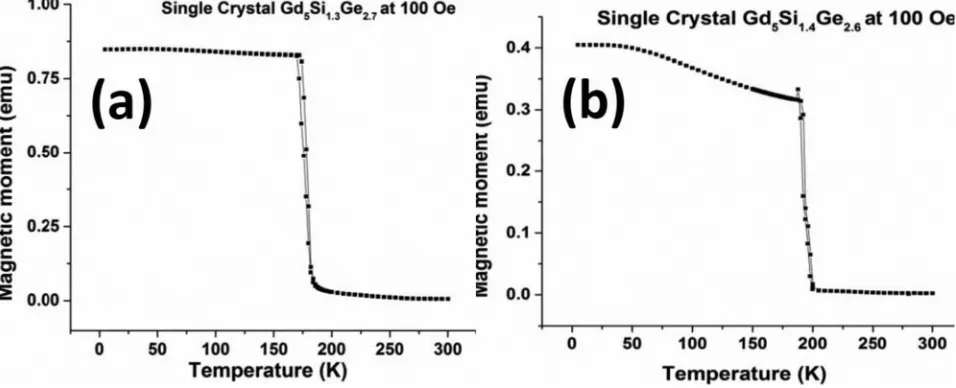
Figs.1(a)and1(b)show magnetization vs. temperature at an applied magnetic field of 100 Oe (8 kA/m) along the “a” axis of single crystal samples of Gd5Si1.3Ge2.7 and Gd5Si1.4Ge2.6. In both samples, the transition has a small thermal hysteresis and is abrupt, indicating that it is a first order phase transition. Gd5Si1.4Ge2.6shows a change in mag-netic moment below the first order phase transition tempera-ture, between 50 and 150 K, which may be due to the presence of a secondary phase of orthorhombic I phase.
Magnetic moment as a function of magnetic field for several temperatures near the first order phase transition
a)Author to whom correspondence should be addressed. Electronic mail:
measurements for (a) Gd5Si1.3Ge2.7 (x¼0.325) and (b) Gd5Si1.4Ge2.6(x¼0.35) single crystal samples. A prominent feature of the MH isotherms is the large hysteresis indicating that these samples undergo a magnetic field induced first order phase transition. The hysteresis area within the forward sweep and reverse sweep of the magnetic field reduces with increase in the temperature similar to other samples that undergo first order phase transition temperature.12,13 The rate of change of transition temperature with respect to applied field is reported to be 5–7/T.14Low magnetic field regions have a different slope from high magnetic field regions during the transition indicating that there is the pres-ence of a residual phase in the samples.
[image:5.612.68.546.67.261.2]M vs. H measurements at various temperatures close to the first order phase transition temperature were used in the Arrott plots, which show a set of parallel lines as shown in Fig. 3. Some of the isotherms have negative slope at lower magnetic fields indicating the presence of more than one phase transition10 and hence were not included here. The critical exponentsbandcused in these plots were 0.5 and 1 giving straight lines in the high field region indicating that the interaction between the spins follows mean-field behav-ior. These modified Arrott plots were used to estimate the second order phase transition temperatures of the samples similar to Hadimani et al.8,9 Figs. 3(a) and 3(b) show the Arrott plots for Gd5Si1.3Ge2.7 and Gd5Si1.4Ge2.6, FIG. 1. Magnetic moment as a function of temperature at an applied field of 100 Oe (8 kA/m) along the “a” axis on single crystal samples of (a) Gd5Si1.3Ge2.7
[image:5.612.51.407.310.443.2](x¼0.325) showing a transition temperature of 172 K and (b) Gd5Si1.4Ge2.6(x¼0.35) showing a transition temperature of 190 K.
FIG. 2. Magnetic moment as a func-tion of magnetic field for temperatures close to the first order phase transition on single crystal samples of (a) Gd5Si1.3Ge2.7 (x¼0.325) and (b)
[image:5.612.53.407.629.768.2]Gd5Si1.4Ge2.6(x¼0.35).
FIG. 3. Modified Arrott plots are used to estimate the second order phase transition temperatures for single crys-tal samples of (a) Gd5Si1.3Ge2.7
(x¼0.325) showing a transition
tem-perature of 383 K and (b)
Gd5Si1.4Ge2.6 (x¼0.35) showing a
transition temperature of 365 K.
17D106-2 Hadimaniet al. J. Appl. Phys.117, 17D106 (2015)
respectively. The projected second order phase transition temperatures are estimated to be 383 K for Gd5Si1.3Ge2.7and 365 K for Gd5Si1.4Ge2.6. These estimated second order phase transition temperatures are significantly higher than the tran-sition temperatures of sample with compositions 0.375<x<0.51, which may be due to presence of the ortho-rhombic I phase in the samples. In addition, one can also see that the transition temperature increases with decreasing amount of Si for this phase as opposed to the Si-rich region of Gd5(SixGe1x)4. In the mixed phase region of the phase diagram of Gd5(SixGe1x)4, single crystal sample of Gd5Si1.5Ge2.5 obeys the modified Arrott plot technique to determine the “hidden” second order phase transition tem-perature of the orthorhombic II and monoclinic phases10but not the compositions of Gd5Si1.3Ge2.7 and Gd5Si1.4Ge2.6 as shown in Fig.4.
CONCLUSION
We have investigated the first and second order phase transition temperatures of single crystal samples of Gd5Si1.3Ge2.7and Gd5Si1.4Ge2.6 whose compositions fall in a mixed phase region of the phase diagram. The second order phase transition temperatures of the orthorhombic II phase of the samples were determined to be 365 K for Gd5Si1.4Ge2.6 and 383 K for Gd5Si1.3Ge2.7. These temperatures are much higher than the expected second order phase transition tem-perature of the orthorhombic II phase due to the presence of orthorhombic I phase as a residual phase in the samples. The estimated second order phase transition temperatures did not follow the trend in the phase diagram similar to the single
crystal sample of Gd5Si1.5Ge2.5, which also falls in the mixed phase region.
ACKNOWLEDGMENTS
Work at Ames Laboratory was supported by the U.S. Department of Energy, Office of Basic Energy Sciences, Division of Materials Science and Engineering. Ames Laboratory is operated for DOE by Iowa State University under Contract No. DE-AC02-07CH11358. This work was also supported by the Barbara and James Palmer Endowment at the Department of Electrical and Computer Engineering of Iowa State University and at Cardiff University by the Royal Society under a Wolfson Research Merit Fellowship.
1
V. K. Pecharsky and K. A. Gschneidner, Jr., “An extremum material,” Adv. Mater.13(9), 683–686 (2001).
2Y. Mudryk, V. K. Pecharsky, and K. A. Gschneidner, “R5T4 compounds:
An extraordinary versatile model system for the solid state science,” in Handbook on the Physics and Chemistry of Rare Earths(Elsevier, 2014), Chap. 262, Vol. 44, pp. 283–449.
3R. L. Hadimani, Y. Melikhov, J. Snyder, and D. Jiles, “Determination of
Curie temperature by Arrott plot technique in Gd5(SixGe1x)4 for
x>0.575,”J. Magn. Magn. Mater.320(20), e696–e698 (2008).
4R. L. Hadimani and D. C. Jiles, “Irrecoverable and recoverable resistivity
resulting from the first order magnetic-structural phase transition in Gd5(SixGe1x)4,”IEEE Magn. Lett.1, 6000104 (2010).
5
R. L. Hadimani, Y. Melikhov, J. E. Snyder, and D. C. Jiles, “Anomalous behavior in electrical transport properties in single-crystal Gd5Si1.8Ge2.2
and polycrystalline Gd5Si2.09Ge1.91,” IEEE Trans. Magn. 45(10),
4368–4371 (2009).
6
A. O. Pecharsky, K. A. Gschneidner, V. K. Pecharsky, and C. E. Schindler, “The room temperature metastable/stable phase relationships in the pseudo-binary Gd5Si4-Gd5Ge4 system,”J. Alloys Compd.338(1–2),
126–135 (2002).
7
B. M. Wang, L. Wang, Y. Liu, and B. C. Zhao, “A second-order ferromag-netic transition in the martensitic state of Ni49.5Mn32.5Cu4Sn14: A critical
behavior study,”J. Appl. Phys.105(2), 023913 (2009).
8
R. L. Hadimani, Y. Melikhov, J. E. Snyder, and D. C. Jiles, “Field induced structural phase transition at temperatures above the Curie point in Gd5(SixGe1x)4,”J. Appl. Phys.105(7), 07A927 (2009).
9
R. L. Hadimani, Y. Melikhov, J. E. Snyder, and D. C. Jiles, “Estimation of second order phase transition temperature of the orthorhombic phase of Gd5(SixGe1x)4using Arrott plots,”J. Appl. Phys.103, 33906 (2008). 10R. L. Hadimani, Y. Melikhov, D. L. Schlagel, T. A. Lograsso, and D. C.
Jiles, “Study of the second-order ‘hidden’ phase transition of the mono-clinic phase in the mixed phase region of Gd5(SixGe1x)4,”IEEE Trans.
Magn.48(11), 4070–4073 (2012).
11See www.mpc.ameslab.gov for “Single crystal synthesized at the
Materials Preparation Center,” Ames Laboratory, U.S. Department of Energy.
12
F. Casanova, X. Batlle, A. Labarta, J. Marcos, L. Manosa, and A. Planes, “Scaling of the entropy change at the magnetoelastic transition in Gd5(SixGe1x)4,”Phys. Rev. B66(21), 212402 (2002).
13
A. M. Pereira, C. Magen, J. P. Araujo, P. A. Algarabel, L. Morellon, M. E. Braga, R. P. Pinto, M. R. Ibarra, and J. B. Sousa, “Effect of rare earth ion in the thermopower of R5(SixGe1x)4compounds with x0.5 and R¼Gd
and Tb,”J. Magn. Magn. Mater.310(2), e580–e582 (2007).
14
M. Han, J. A. Paulsen, J. E. Snyder, D. C. Jiles, T. A. Lograsso, and D. L. Schlagel, “Thermal expansion of single-crystal Gd5(Si1.95Ge2.05) showing
[image:6.612.54.293.62.232.2]unusual first-order transformation,”IEEE Trans. Magn.38(5), 3252–3254 (2002).
FIG. 4. Updated phase diagram with the measured first order phase transi-tion temperatures (FOPTT) of Gd5Si1.3Ge2.7and Gd5Si1.4Ge2.6. Calculated
second order phase transition temperatures (SOPTT) of the orthorhombic II phase were plotted on the phase diagram, which did not follow the trend of the second order phase transition line of the orthorhombic II.