Graduate Theses and Dissertations Iowa State University Capstones, Theses and Dissertations
2016
Synergy among Business Processes: The Construct,
Drivers, Consequences and Managerial
Implications
Linlin Chai
Iowa State University
Follow this and additional works at:https://lib.dr.iastate.edu/etd
Part of theAdvertising and Promotion Management Commons, and theMarketing Commons
This Dissertation is brought to you for free and open access by the Iowa State University Capstones, Theses and Dissertations at Iowa State University Digital Repository. It has been accepted for inclusion in Graduate Theses and Dissertations by an authorized administrator of Iowa State University Digital Repository. For more information, please [email protected].
Recommended Citation
Chai, Linlin, "Synergy among Business Processes: The Construct, Drivers, Consequences and Managerial Implications" (2016). Graduate Theses and Dissertations. 16510.
Synergy among business processes:
The construct, drivers, consequences and managerial implications
by
Linlin Chai
A dissertation submitted to the graduate faculty
in partial fulfillment of the requirements for the degree of
DOCTOR OF PHILOSOPHY
Major: Business and Technology (Marketing)
Program of Study Committee:
Sridhar Ramaswami, Major Professor
Sanjeev Agarwal
Stephen Kim
Aditya Gupta
Pol Herrmann
Iowa State University
Ames, Iowa
2016
ii
TABLE OF CONTENTS
ACKNOWLEDGEMENTS ... iv
ABSTRACT ... v
CHAPTER 1: INTRODUCTION ... 1
CHAPTER 2: WHAT IS SYNERGY? ... 6
CHAPTER 3: SYNERGISTIC IMPACT OF CRM AND OTHER CORE BUSINESS PROCESSES ON FIRM EFFICIENCY AND EFFECTIVENESS ... 17
Abstract ... 17
Introduction ... 18
From Market Orientation to Firm Performance ... 21
Methods ... 27
Results ... 32
Discussion ... 36
References ... 41
CHAPTER 4: IMPACT OF SUPPLY CHAIN AND NEW PRODUCT PROCESS DECISIONS ON CRM CAPABILITY AND FIRM PERFORMANCE ... 50
Abstract ... 50
Introduction ... 51
Conceptual Model ... 55
Literature Review ... 57
Theoretical Framework ... 60
Research Methods ... 71
Results ... 77
Discussion ... 79
References ... 85
CHAPTER 5: SYNERGY BETWEEN CRM PROCESS AND SUPPLY CHAIN PROCESS ... 97
Abstract ... 97
Introduction ... 98
Conceptual Background ... 101
Synergy Index Value ... 113
Consequences of Synergy ... 116
Methodology ... 125
Results ... 130
Discussion ... 134
References ... 140
Appendix A: Companies and Titles of Interviewees ... 153
Appendix B: In-depth Interview Questions ... 154
Appendix C Survey for Construct Measurement ... 155
Appendix D: Measures of the status of the relationship between CRM and SCM processes ... 157
Appendix E: Conjoint Experimental Cards ... 158
CHAPTER 6: CONCLUSION ... 176
iv
ACKNOWLEDGEMENTS
I would like to express the deepest appreciation to my committee chair, Dr. Sridhar Ramaswami,
who has the attitude and the substance of a genius: he continually and convincingly conveyed a
spirit of adventure in regard to research and scholarship. Without his guidance and persistent
help this dissertation would not have been possible.
I would like to thank my committee members, Dr. Sanjeev Agarwal, Dr. Stephen Kim,
Dr. Aditya Gupta and Dr. Pol Herrmann for their guidance and support throughout the course of
this research.
I would like to thank Dr. Swaminathan Arunachalam for his advice and support.
I would like to thank Dr. Wei Zhang and Dr. John Wong for their encouragement and
support.
A thank you to my parents, Jungui Chai and Xiuhua You, and my Indian Amma, Rama
Sridhar for their love.
Thanks to my best friends, Deborah Martinez, and Melika Kordrostami for making my
time at Iowa State University enjoyable.
Finally, I also want to offer my appreciation to those who were willing to participate in
ABSTRACT
Despite the widely acknowledged importance of creating synergy among key business processes,
both researchers and practitioners know little about the drivers of synergy and how synergy
effects can be captured. Several questions remain: what is the meaning of process synergy? Why
are some firms better than others in achieving process synergy? And does process synergy add
value to firm performance? The literature reflects remarkably little effort to develop a framework
for understanding these questions. This dissertation synthesizes extant knowledge on the subject
and empirically demonstrates the inter-relationships among three key business processes:
customer relationship management (CRM), supply chain management (SCM) and new product
development (NPD). In addition, this dissertation provides a working definition of process
synergy, identifies major facilitators and develops a direct measure of synergy (we call it synergy
index value). Furthermore, this dissertation constructs an integrating framework on the
consequences of synergy and empirically tests the impacts of synergy on both process
1
CHAPTER 1: INTRODUCTION
The role of marketing has been fundamentally reshaped by broader environmental forces relating
to technology, globalization and competition in the last two decades. While the traditional role of
marketing has been to link the customer with the products of the firm, the new role of marketing
is to manage connections between customers and the firm’s constituents or stakeholders so as to
deliver superior customer value (Moorman and Rust, 1999). Interestingly, the notion of superior
customer value has a broader definition today than ever before; it is not only based on some
combination of price and quality, but also related to customers’ expectations on delivery, service,
ease of transaction and relationships. Therefore, the new role of marketing requires a
multi-functional interface.
However, much has been talked and critiqued about the tendency of functions to operate
in silos. For example, Stank, Daugherty, and Ellinger (1999) note that marketing and operational
functions do not talk to each other, but instead they complain a lot about each other’s role. To
overcome the silo mentality and achieve better cross-functional cooperation, many firms have
begun to transition from a functional structure to a process structure during the past two decades.
Of course, process structure helps achieve better communication among functional areas;
however, this shift has fallen short of expectations to achieve better integration and cooperation
among functions. Individual processes still tend to work in silos, just as functions do
(Ramaswami et al., 2009).
The critical questions then are why do processes still work in silos? Why do some firms
drivers? What does the term ‘synergy’ really mean in the context of business processes? How
can we operationalize it? Does synergy really benefit individual processes and the firm?
One might expect the concept of process synergy to have a clear meaning, a rich tradition
of theory development, and a related body of empirical findings. However, that is not the case.
The idea for this dissertation work grew from that same motivation. It is true that the importance
of process synergy was acknowledged almost twenty years ago by Srivastava, Shervani, and
Fahey (1999) who argued that synergy can occur spontaneously among three key business
processes, named customer relationship management process (CRM), supply chain management
process (SCM) and product development process (PDP). However, their postulates were purely
conceptual and have not been tested even to date (except for one study conducted by
Ramaswami, Srivastava, and Bhargava, 2009). Building on Srivastava et al’s (1999) theoretical
framework, Ramaswami et al., (2009) empirically tested the synergy among CRM, SCM and
NPD on firm performance. In their study, they used the interaction of performance of business
processes as the proxy to indirectly capture process synergy. Their results suggested that process
synergy may not occur automatically, but has to be built diligently by firms.
Building on Srivastava et al.’s (1999) and Ramaswami et al.’s (2009) work, this
dissertation begins by empirically testing the impact of synergy among CRM, SCM and NPD on
firm performance using proxy measures of synergy. Chapter 2 examines the direct impact of
CRM on firm performance, as well as how the CRM process leverages the performance of the
firm’s new product development (NPD) and supply chain management (SCM) processes and
synergistically impacts firm performance.
Chapter 3 extends the synergy concept to capture the inter-relationship among the CRM,
3
work in silos and focus more on maximizing their respective objectives – customer satisfaction
in the case of CRM, efficiency of operations in the case of SCM, and innovativeness in the case
of NPD. The decisions taken in one process may go against or support the performance of the
other process. It is difficult to break down silo mentality until we show the interdependence
among processes. Therefore, this study examines how organizational actions relating to the SCM
process (e.g., network leadership and outsourcing) and NPD process (e.g., innovation investment
and customer co-creation) can affect firm’s capability with respect to the CRM process and
subsequently lead to superior firm financial performance.
Chapter 4 takes the ideas of chapter 2 and chapter 3 further to provide a foundation for
studying systematically the development of synergy between two major business processes,
CRM and SCM. Through in-depth interviews with CRM managers and SCM managers, this
chapter identifies five major facilitators: customer-centric management, shared cognition,
mandate from top management, relationship embeddedness and employee engagement. Using
these five factors, this chapter develops a measure of synergy between CRM and SCM and
empirically tests the consequences of this synergy index value on individual process performance
and firm performance.
Overall, the primary contribution of the dissertation is to extend the work on synergy by
developing a synergy metric that enables evaluation of the antecedents and consequences of
synergy. Most previous studies have used the interaction term as a proxy measure of synergy
between units; this dissertation will be the first to develop a synergy metric that is based on an
understanding of the importance of different factors that contribute to synergy and the degree to
which such factors are present and working in a firm. A key benefit of the experimental approach
(and not at the aggregate level as has been handled in all previous studies). This allows
examination of the underlying factors that can drive synergy and development of
recommendations for managers to enable and utilize these factors to positively drive firm
5
References
Moorman, C., & Rust, R. T. (1999). The role of marketing. The Journal of Marketing, 180-197.
Ramaswami, S. N., Srivastava, R. K., & Bhargava, M. (2009). Market-based capabilities and financial performance of firms: insights into marketing’s contribution to firm value. Journal of the Academy of Marketing Science, 37(2), 97-116.
Srivastava, R. K., Shervani, T. A., & Fahey, L. (1999). Marketing, business processes, and shareholder value: An organizationally embedded view of marketing activities and the discipline of marketing. The Journal of Marketing, 168-179.
CHAPTER 2: WHAT IS SYNERGY?
Synergism can be defined as the interaction or cooperative action of two or more organizations
or business units or discrete agencies to produce a combined effect that is greater than the sum of
their effects taken independently (Webster’s dictionary). The cooperation goes beyond simple
exchange of resources; it involves combining the individual perspectives, resources and skills of
the cooperating units to create something new and valuable (Lasker, Weiss, and Miller, 2001). In
business literature, synergy is frequently described as the ‘2+2=5’ effect to denote the fact that
firms seek a product/market posture that can yield a combined performance that is greater than
the sum of its parts (Ansoff and McDonnell, 1988). In marketing literature, synergy potential
among marketing variables is a well-accepted notion. For example, the marketing mix concept, a
core component of marketing, emphasizes that “marketing efforts create sales synergistically
rather than independently” (Gatignon and Hanssens, 1987; p. 247).
Early studies on synergy appeared in the acquisitions and mergers literature. When two
entities join and form a new one, the combined entity is expected to enjoy reduced costs (through
operational efficiency), the ability to charge higher prices (through an increase in market power),
or both. The combined entity is also expected to enable “increases in competitiveness and
resulting cash flows beyond what two companies are expected to accomplish independently”
(Sirower, 1997; p. 6). Overall, acquisitions and mergers are motivated by shareholders’ interests
to create economic value.
Several studies have examined synergy at the brand level. In a study relating to media,
Naik and Raman (2003) examine the benefits of harnessing synergy across media options to
7
two extension products in combination is the sum of the evaluation of the two products if they
were introduced not together but separately. The symbiotic relationship between two brand
names can help firms span multiple targets and gain promotional efficiency (Laforet and
Saunders, 1999).
Synergy is also an important concept in the economic debate about the role of public
versus private institutions. In the context of government and private institutions, Evans (1996)
identified two facets of synergy: complementarity and embeddedness. Complementarity is based
on the fact that while two agencies have clear division of labor, their combined and mutually
reinforcing actions are needed to achieve an outcome that cannot be achieved by either agency
acting alone. In an organizational context, different functions bring in different inputs; these
inputs when combined can increase effectiveness of actions with regards a common purpose.
Embeddedness refers to the effect of networks that exist at the boundary between two agencies
and the ties that connect representatives belonging to either side. The social capital generated by
these ties can be used to generate system-level outcomes that are superior.
Synergy has also been studied in the context of relationship between business units.
Using the work of Evans (1996), Tanriverdi (2005, 2006) extended the synergy idea to the area
of cross-unit knowledge synergy. He identified two sources of cross-unit synergy: resource
relatedness and resource complementarity. Resource relatedness refers to the exploitation of
common resources across business units. The use of common resources creates sub-additive
production cost synergies (Tanirvedi, 2006). Resource complementarity is present when the
returns to a resource vary based on the level of returns to other resources. They used knowledge
and IT as resources that have usefulness across business units. Their empirical results show that
Different from these studies, this dissertation attempts to investigate the potential for
synergy among business processes. It examines three key business processes: CRM, SCM and
NPD. In the context of business processes, synergy is defined as the interaction or cooperation of
business processes to produce a combined effect greater than the sum of their separate effects
(Srivastava et al., 1999; Ramaswami et al., 2009). Srivastava et al (1999) argued that CRM,
SCM and NPD are distinctive, but intertwined. The synergy potential, if achieved, can generate
superior shareholder value by (1) accelerating cash flows, (2) enhancing cash flows, and (3)
reducing the vulnerability and volatility of cash flows (Srivastava et al., 1999). Using a resource
based view of the firm, Ramaswami et al., (2009) offered the first empirical glimpse of the
interrelationship among the three business processes and their impact on the market value of firm.
In their study, they measured synergy as the interaction among the performance of business
processes. Interestingly, the nonsignificant relationship between synergy and firm performance
show that synergy may not occur magically inside firms. Studies on synergy at multiple levels
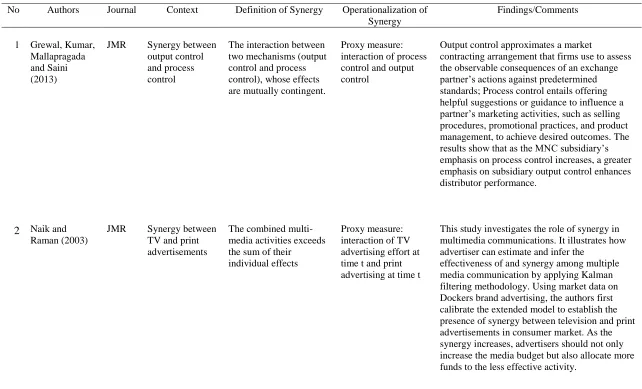
are summarized in Table: studies on synergy.
While these efforts have slowly helped build a body of knowledge in the area of synergy
among business processes, several important gaps in the literature remain at this time. These
include: (1) the postulates about synergy are purely conceptual and have not been fully tested; (2)
the literature lacks a good metric that measures synergy; (3) the literature lacks a theory that can
guide firms to understand the potential for synergy among their business processes. This
dissertation is designed to fill all these gaps. Using proxy measure of synergy, chapter 3 attempts
to provide empirical evidence to the postulates of Srivastava et al., (1999).
Finally, a special mention is needed for the synergy metric gap. All previous studies that
9
problem with this metric is that it is a black box that captures the combinative effect at the
aggregate level and does not say anything about what contributes to the observed overall effect.
It also does not allow evaluation of the relative importance of drivers of synergy. Like previous
studies, this dissertation uses the interaction term metric in chapter 3 and chapter 4. However, the
dissertation makes a specific effort to open the black box in chapter 5 in its attempt to understand
what causes synergy among business processes. Using inputs from managers, chapter 5 estimates
the salience of synergy-driving managerial and relationship factors and builds a synergy index at
the individual firm level. This effort is pioneering as it has not been attempted in any of the
10
Table 1 Studies on Synergy
No Authors Journal Context Definition of Synergy Operationalization of
Synergy
Findings/Comments
1 Grewal, Kumar, Mallapragada and Saini (2013)
JMR Synergy between
output control and process control
The interaction between two mechanisms (output control and process control), whose effects are mutually contingent.
Proxy measure: interaction of process control and output control
Output control approximates a market
contracting arrangement that firms use to assess the observable consequences of an exchange partner’s actions against predetermined standards; Process control entails offering helpful suggestions or guidance to influence a partner’s marketing activities, such as selling procedures, promotional practices, and product management, to achieve desired outcomes. The results show that as the MNC subsidiary’s emphasis on process control increases, a greater emphasis on subsidiary output control enhances distributor performance.
2 Naik and Raman (2003)
JMR Synergy between
TV and print advertisements
The combined multi-media activities exceeds the sum of their
individual effects
Proxy measure: interaction of TV advertising effort at time t and print advertising at time t
This study investigates the role of synergy in multimedia communications. It illustrates how advertiser can estimate and infer the
11
Table 1 Continued
No Authors Journal Context Definition of Synergy Operationalization
of Synergy
Findings/Comments
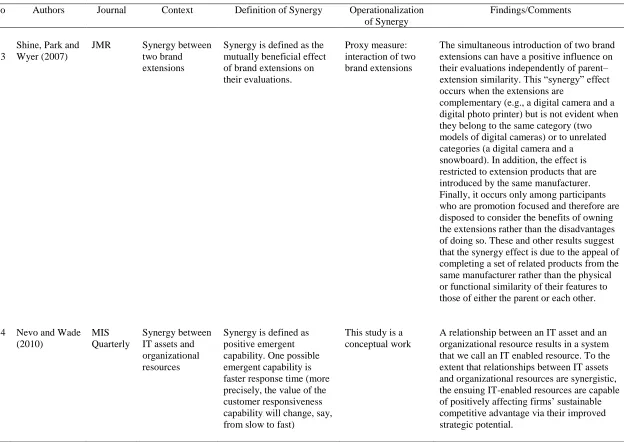
3
Shine, Park and Wyer (2007)
JMR Synergy between
two brand extensions
Synergy is defined as the mutually beneficial effect of brand extensions on their evaluations.
Proxy measure: interaction of two brand extensions
The simultaneous introduction of two brand extensions can have a positive influence on their evaluations independently of parent– extension similarity. This “synergy” effect occurs when the extensions are
complementary (e.g., a digital camera and a digital photo printer) but is not evident when they belong to the same category (two models of digital cameras) or to unrelated categories (a digital camera and a snowboard). In addition, the effect is restricted to extension products that are introduced by the same manufacturer. Finally, it occurs only among participants who are promotion focused and therefore are disposed to consider the benefits of owning the extensions rather than the disadvantages of doing so. These and other results suggest that the synergy effect is due to the appeal of completing a set of related products from the same manufacturer rather than the physical or functional similarity of their features to those of either the parent or each other.
4 Nevo and Wade (2010)
MIS Quarterly
Synergy between IT assets and organizational resources
Synergy is defined as positive emergent capability. One possible emergent capability is faster response time (more precisely, the value of the customer responsiveness capability will change, say, from slow to fast)
This study is a conceptual work
12
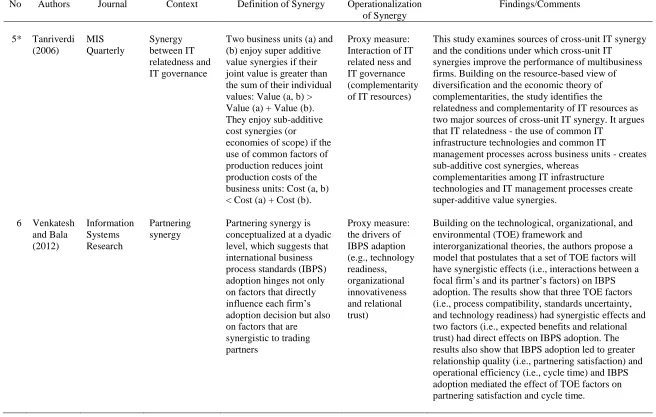
Table 1 Continued
No Authors Journal Context Definition of Synergy Operationalization
of Synergy
Findings/Comments
5* Tanriverdi (2006) MIS Quarterly Synergy between IT relatedness and IT governance
Two business units (a) and (b) enjoy super additive value synergies if their joint value is greater than the sum of their individual values: Value (a, b) > Value (a) + Value (b). They enjoy sub-additive cost synergies (or
economies of scope) if the use of common factors of production reduces joint production costs of the business units: Cost (a, b) < Cost (a) + Cost (b).
Proxy measure: Interaction of IT related ness and IT governance (complementarity of IT resources)
This study examines sources of cross-unit IT synergy and the conditions under which cross-unit IT
synergies improve the performance of multibusiness firms. Building on the resource-based view of diversification and the economic theory of complementarities, the study identifies the
relatedness and complementarity of IT resources as two major sources of cross-unit IT synergy. It argues that IT relatedness - the use of common IT
infrastructure technologies and common IT
management processes across business units - creates sub-additive cost synergies, whereas
complementarities among IT infrastructure technologies and IT management processes create super-additive value synergies.
6 Venkatesh and Bala (2012) Information Systems Research Partnering synergy
Partnering synergy is conceptualized at a dyadic level, which suggests that international business process standards (IBPS) adoption hinges not only on factors that directly influence each firm’s adoption decision but also on factors that are synergistic to trading partners
Proxy measure: the drivers of IBPS adaption (e.g., technology readiness, organizational innovativeness and relational trust)
Building on the technological, organizational, and environmental (TOE) framework and
13
Table 1 Continued
No Authors Journal Context Definition of Synergy Operationalization
of Synergy
Findings/Comments
7* Martin and Eisenhardt (2003)
AMJ Cross-business
synergy
Cross-business synergy is defined as “the value that is created and captured, over time, by the sum of the businesses together relative to what it would be separately
Qualitative study This study adds to the understanding of the nature of the corporation and its value by developing a preliminary theoretical
framework describing how managers of multi-business firms capture corporate value in dynamic markets through processes of corporate entrepreneurship. In particular, this study explores the changing role of the corporate center and the emerging role of the multi-business team (i.e., the general managers) — a new unit of governance that focuses on the relationships among the business-units.
8* Srivastava Shervani and Fahey (1999)
JM Synergy among
business processes
Process synergy is defined as the interaction or cooperation of business processes to produce a combined effect greater than the sum of their separate effects.
This study is a conceptual work
The authors develop a framework for understanding the integration of marketing with business processes and shareholder value. The framework redefines marketing phenomena as embedded in three core business processes that generate value for customers – product development
management, supply chain management and customer relationship management – which in turn creates shareholder values by (1)
14
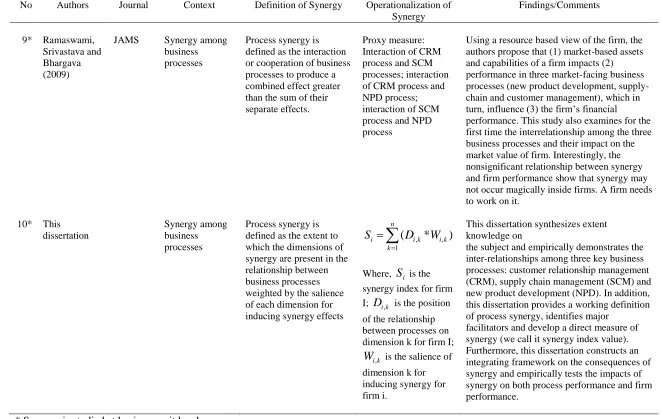
Table 1 Continued
No Authors Journal Context Definition of Synergy Operationalization of
Synergy
Findings/Comments
9* Ramaswami, Srivastava and Bhargava (2009)
JAMS Synergy among
business processes
Process synergy is defined as the interaction or cooperation of business processes to produce a combined effect greater than the sum of their separate effects.
Proxy measure: Interaction of CRM process and SCM processes; interaction of CRM process and NPD process; interaction of SCM process and NPD process
Using a resource based view of the firm, the authors propose that (1) market-based assets and capabilities of a firm impacts (2) performance in three market-facing business processes (new product development, supply-chain and customer management), which in turn, influence (3) the firm’s financial performance. This study also examines for the first time the interrelationship among the three business processes and their impact on the market value of firm. Interestingly, the nonsignificant relationship between synergy and firm performance show that synergy may not occur magically inside firms. A firm needs to work on it.
10* This dissertation
Synergy among business processes
Process synergy is defined as the extent to which the dimensions of synergy are present in the relationship between business processes weighted by the salience of each dimension for inducing synergy effects
, ,
1
( * )
n
i i k i k
k
S D W
Where, Si is the
synergy index for firm I; Di k, is the position of the relationship between processes on dimension k for firm I;
, i k
W is the salience of dimension k for inducing synergy for firm i.
This dissertation synthesizes extent knowledge on
the subject and empirically demonstrates the inter-relationships among three key business processes: customer relationship management (CRM), supply chain management (SCM) and new product development (NPD). In addition, this dissertation provides a working definition of process synergy, identifies major
facilitators and develop a direct measure of synergy (we call it synergy index value). Furthermore, this dissertation constructs an integrating framework on the consequences of synergy and empirically tests the impacts of synergy on both process performance and firm performance.
15
References
Ansoff, H. I., & McDonnell, E. J. (1988). The new corporate strategy. John Wiley & Sons Inc.
Evans, P. (1996). Government action, social capital and development: reviewing the evidence on synergy. World development, 24(6), 1119-1132.
Gatignon, H., & Hanssens, D. M. (1987). Modeling marketing interactions with application to salesforce effectiveness. Journal of Marketing Research, 247-257.
Grewal, R., Kumar, A., Mallapragada, G., & Saini, A. (2013). Marketing channels in foreign markets: Control mechanisms and the moderating role of multinational corporation headquarters-subsidiary relationship. Journal of Marketing Research, 50(3), 378-398.
Laforet, S., & Saunders, J. (1999). Managing brand portfolios: why leaders do what they do.Journal of Advertising Research, 39(1), 51-51.
Lasker, R. D., Weiss, E. S., & Miller, R. (2001). Partnership synergy: a practical framework for studying and strengthening the collaborative advantage. Milbank quarterly, 79(2), 179-205.
Martin, J. A., & Eisenhardt, K. M. (2003, August). CROSS-BUSINESS SYNERGY:
RECOMBINATION, MODULARITY AND THE MULTI-BUSINESS TEAM. In Academy of management proceedings (Vol. 2003, No. 1, pp. P1-P6). Academy of Management.
Naik, P. A., & Raman, K. (2003). Understanding the impact of synergy in multimedia communications. Journal of Marketing Research,40(4), 375-388.
Nevo, S., & Wade, M. R. (2010). The formation and value of IT-enabled resources: antecedents and consequences of synergistic relationships.Mis Quarterly, 163-183.
Ramaswami, S. N., Srivastava, R. K., & Bhargava, M. (2009). Market-based capabilities and financial performance of firms: insights into marketing’s contribution to firm value. Journal of the Academy of Marketing Science, 37(2), 97-116.
Shine, B. C., Park, J., & Wyer Jr, R. S. (2007). Brand synergy effects in multiple brand extensions. Journal of Marketing Research, 44(4), 663-670.
Srivastava, R. K., Shervani, T. A., & Fahey, L. (1999). Marketing, business processes, and shareholder value: An organizationally embedded view of marketing activities and the discipline of marketing. The Journal of Marketing, 168-179.
Sirower, M. L. (1997). The synergy trap: How companies lose the acquisition game. Simon and Schuster.
Tanriverdi, H. (2006). Performance effects of information technology synergies in multibusiness firms. Mis Quarterly, 57-77.
17
CHAPTER 3: SYNERGISTIC IMPACT OF CRM AND OTHER CORE BUSINESS PROCESSES ON FIRM EFFICIENCY AND EFFECTIVENESS
Modified from an article published in AMA Proceedings
Abstract
Linking market-based assets literature with the rich stream of literature on market orientation,
this study examines the direct impact of the performance of customer relationship management
(CRM) on firm performance, as well as how the CRM process leverages the performance of the
firm’s new product development (NPD) and supply chain management (SCM) processes.
Specifically, our results show that CRM process has a direct impact on market performance of
the firm, controlling for the other two processes. In addition, we investigate the performance
synergy effects between CRM and NPD/SCM on two types of firm performance, namely,
effectiveness (e.g., market share and sales) and efficiency (e.g., profitability and ROA). We find
that high CRM performance has a significant positive impact on the firm’s financial position (i.e.,
efficiency) in combination with the NPD process of the firm and a significant negative impact on
the firm’s financial position in combination with the SCM process of the firm. Besides the
contributions to CRM and marketing-finance literature, we also contribute to market orientation
literature by providing a broad understanding of process-based mechanisms through which
market orientation of a firm enables superior firm performance. Our results provide evidence that
the performance of CRM may have full mediating effects on both MO-firm effectiveness and
MO-firm efficiency relationships. Both theoretical and managerial implications of our study are
Introduction
There is a growing recognition that marketing needs to be embedded in a firm’s core business
processes that create and sustain value for customers (Srivastava, Shervani and Fahey 1999).
Consistent with this perspective, marketing literature has shown increasing interest in
understanding the integration of marketing within business processes. Srivastava et al (1999)
offered an exhaustive but untested theory relating marketing to activities and performance of
three core business processes - customer relationship management (CRM), new product
development (NPD) and supply chain management (SCM) - and further to their cash flow
consequences. Although the Srivastava et al. (1999) framework was proposed more than a
decade back, several important gaps still remain in our understanding of the relationships
involving marketing, business processes and performance consequences.
First, there is a lack of clear understanding of the unique contributions made by the CRM
processes of a firm toward firm performance controlling for performance of other critical
business processes. We address this gap by examining the direct impact of CRM performance on
firm performance, as well as how the CRM process leverages the performance of the firm’s NPD
and SCM processes. In this paper, we do not identify specific structures, platforms or types of
assets a firm uses in its business processes nor do we identify how the structures, platforms or
assets vary across firms; by capturing the performance impact of whichever structures, platforms
or assets used by firms and their variability across firms, we illustrate the important integration
role played by CRM. Results show that CRM process has a direct impact on market performance
of the firm, controlling for the other two processes. Moreover, we find that CRM positively
moderates the NPD-financial position relationship, but negatively moderates the SCM-financial
19
from their NPD processes than moderate or low CRM-oriented firms, but (b) high-CRM oriented
firms extract less value from their SCM processes. The latter finding is at odds with the results of
Mithas, Krishnan and Fornell (2005) who show that returns to CRM are enhanced when firms
share information with their supply chain members.
Second, more studies are needed to establish links between performance of business
processes and various types of firm performance (Boulding et al 2005). In line with this
reasoning, we investigate the performance synergy effects between CRM and NPD/SCM on two
types of firm performance, namely, effectiveness (e.g., market share and sales) and efficiency
(e.g., profitability and ROA). Our results show that controlling for the effects of NPD and SCM,
high CRM performance has a direct influence in generating greater effectiveness through
superior market position for the firm; further, it has a significant positive impact on the firm’s
financial position (i.e., efficiency) in combination with the NPD process of the firm and a
significant negative impact on the firm’s financial position in combination with the SCM process
of the firm. The first result is consistent with previous findings that higher performance on CRM,
as evidenced by high customer satisfaction and loyalty, should be able to drive a firm’s market
share and sales. The finding relating to CRM and NPD is also consistent with expectations. We
expect CRM to provide useful input information to the NPD process in both the value creation
and value extraction stages of new product offerings to the market. The finding relating to CRM
and SCM suggests that the goals of the two processes may be at odds with each other.
Attempting to maximize the goals of CRM may come at the expense of maximizing the goals of
the SCM process. Overall our findings confirm the view that CRM is better treated as an
Third, besides the contributions to CRM and marketing-finance literature, we also contribute
to market orientation literature by providing a broad understanding of process-based mechanisms
through which market orientation of a firm enables superior firm performance. Chain of
marketing productivity model (Rust et al. 2004) indicates that one of the strategic roles of
marketing is to guide the development of marketing assets which can then be leveraged within
the firm’s core business processes (e.g., CRM, NPD, and SCM) to affect its performance in both
the short and long run. Since market orientation is a strategic philosophy of the firm that
influences how it implements the marketing concept (Kohli and Jaworski 1990), we empirically
test Rust et al’s model in this paper with specific focus on the important role played by CRM in
intervening between a firm’s market orientation and its performance consequences. Additionally,
even though the primary focus of this paper is on CRM, we do examine the mediation role of
NPD and SCM simultaneously with CRM. Our results provide evidence that the performance of
CRM may have full mediating effects on both MO-firm effectiveness and MO-firm efficiency
relationships.
Fourth, there is a recognition that collective execution of business processes provides firms
with sustainable competitive advantage (Srivastava et al 1999). The only study examining the
effects of synergy among all three processes (Ramaswami et al 2009) did not find empirical
support for this proposition. We provide a replication of their test and investigate if synergy
21
In summary, drawing upon Srivastava et al’s (1999) marketing-business
processes-performance framework and Rust et al (2004)’s chain of marketing productivity model, the goals
of this paper are fourfold:
1. To provide an understanding on the contribution of CRM to a firm’s market and financial performance
2. To reveal the different synergy effects between CRM and NPD/SCM on firm effectiveness and firm efficiency.
3. To examine the important role played by CRM in intervening between a firm’s market orientation and its performance consequences.
4. To provide empirical support for the assertion that interaction among all three CRM, NPD and SCM positively contributes a firm’s financial performance.
The remainder of this article is organized as follows. To begin, we offer a theoretical
foundation to provide guidance to the study. Then we develop and set forth the research
hypotheses. Next, we detail the methods, including a discussion of the data collection and data
analysis procedures. Last, our study concludes with a discussion of findings and implications for
theory and practice, as well as for future research.
From Market Orientation to Firm Performance
Consistent with extant literature, we adopt the cultural perspective of market orientation, defined
as a set of organizational norms and values which help implement the ‘marketing concept’
(Narver and Slater 1990). During the past two decades, researchers have pursued intensive
research on the consequences of market orientation (MO). The most popular notion in the
literature has been that market orientation directly brings superior performance to a firm (e.g.,
Narver and Slater 1990, Slater and Narver 2000). However, the viability of such a direct
MO-firm performance linkage has met with increased skepticism due to the non-significant, even
negative effects of market orientation reported in recent empirical studies (e.g., Sandvik and
potential mediators of the relationship. For example, in a recent meta-analysis, Kirca et al (2005)
found that customer satisfaction, an indicator of the performance of CRM based on Srivastava et
al (1999), may play an important mediating role. Contributing to the same literature, this paper
investigates a more general CRM-based mechanism via which the value of MO can be
transferred to superior firm performance. Further, we also examine the mediating effects of
other two core processes in any organization, namely, NPD and SCM.
Hypotheses Development
CRM as a potential mediator. According to Slater and Narver (1999), a market-oriented firm
“seeks to understand customers’ expressed and latent needs and develop superior solutions to
those needs” (p. 165). On one hand, a market-oriented firm is more likely to exploit and explore
its knowledge to collect, analyze and apply the acquired customer information (Jayachandran et
al. 2005) in pursuit of creating superior value for customers as compared to competitors. For
example, through CRM, a market-oriented firm is more likely to create suitable advertising,
promotion, sales and customer service programs to improve customers’ perception and
experience. On the other hand, implementation of CRM solutions requires firms to have a
customer relational orientation (Jayachandran et al 2005; Srinivasan and Moorman 2005). In line
with this reasoning, we believe that performance of CRM is the direct consequence of market
orientation.
H1a: Market orientation is positively related to performance of CRM.
In addition, CRM performance also plays a critical antecedent role to firm effectiveness
and efficiency. On one hand, superior CRM performance, as evidenced by customer satisfaction
and customer loyalty, helps a firm generate a stable customer base (e.g., Noordeweir, John and
23
Kohli and Bharadwaj 2007). A firm with stable customer base and strong capability of learning
enjoys a competitive advantage by providing superior value than competitors. On the other hand,
superior CRM helps a firm reduce the costs of activity such as marketing-related costs, inventory
costs and customer service costs etc. For example, customer loyalty and word of mouth enhance
a firm’s advertising and promotional efficiency and thus reduce marketing-related costs (e.g.,
Luo and Homburg 2007). In addition, superior CRM helps a firm better adjust its production
cycle according to customer demand patterns to lower the mismatch between firm inventory and
customer orders and thus reduce its inventory costs (e.g., Bharadwaj, Bharadwaj, and Bendoly,
2007). Furthermore, superior CRM helps a firm reduce its customer service costs that might
occur because of the rejection of unsuitable offerings as a result of a poor understanding of
customer requirements (e.g., Anderson, Fornell and Lehman, 1994). In line with this reasoning,
we posit
H1b: Performance of CRM is positively related to market position.
H1c: Performance of CRM is positively related to financial position.
Synergy between NPD and CRM. At a macro-level, customer value creation and appropriation
necessitate the achievement of two central organizational tasks: exploiting existing competencies
and exploring new opportunities. The notion of exploitation and exploration (March 1991) has
been studied in several strategy disciplines including organizational learning and strategy (e.g.,
Levinthal and March 1993), innovation (e.g., Rothaermel and Deeds 2004) and entrepreneurship
(e.g., Shane and Venkataraman 2000). However, how the synergy of core business processes
contributes to a firm’s exploitative and explorative activities is still a mystery. We believe that
the synergy of CRM with NPD optimizes a firm’s execution of its exploitative and explorative
A firm may develop incremental innovations to exploit its existing competencies.
Incremental innovations involve small improvements to an existing product or product line that
helps maintain or improve a firm’s competitive position over time (Business Dictionary).
Although firms spend a great deal of energy and R&D budget on incremental innovations, the
magnitude of the linkage between incremental innovation and market share is still inconclusive.
While most managers believe that incremental innovation has relatively little impact on market
performance, Banbury and Mitchell (1995) found that a firm’s ongoing ability to introduce
important incremental innovations quickly has a major impact on its market share. Regardless of
whether the magnitude of the linkage is strong or weak, we believe that CRM could help
magnify this relationship by 1) increasing current customers’ usage of new products through
superior customer loyalty programs; 2) gaining new customers (especially non-users) through
superior WOM/referral program; and 3) providing insights on the needs of competitors’
customers to increase the number of switching customers.
On the other hand, a firm may introduce radical or breakthrough innovations, which
involve the application of significant new technology (Tushman and Nadler, 1986), to explore
new market opportunities. There is a strong and consistent support on the market-share rewards
to pioneers in extant research (e.g., Robinson and Fornell 1985, Urban et al. 1986). However, in
reality, firms face enormous failure rate with radical innovations due to risk arising from
customer and market uncertainties (Rice et al. 2001). As a result, effective NPD process can
reduce risk by developing products that match customer needs as closely as possible. CRM also
provides a tool for managers to minimize risks associated with customers and markets. In
addition, recent findings reveal that the major challenge of radical innovations lies not in the
25
(Christensen and Bower, 1996; Tushman and O’Reilly 1996). The commercialization stage of
NPD requires firms to have a superior customer-facing and learning function. Firms with
superior CRM are more likely to optimize the performance of commercialization by selecting the
right segments, picking the right launch time, providing suitable positioning strategy, and
creating effective advertising, promotion and sales campaigns etc. Last, providing valuable
insights on customers’ requirements on either incremental or radical innovations, CRM helps a
firm decrease the high costs associate with each stage of NPD, from idea generation, idea
evaluation, idea implementation to final idea commercialization. Thus we posit that
H2a: The synergy between CRM and NPD positively contributes to market position.
H2b: The synergy between CRM and NPD positively contributes to financial position.
Synergy between SCM and CRM. A supply chain is defined as “a set of three or more entities
directly involved in the upstream and downstream flows of products, services, finances, and/or
information from a source to a customer (Mentzer et al, 2001).” Like NPD, effective SCM
should be able to contribute to a firm’s exploitation and exploration activities and the synergy
between CRM and SCM may help it maximize the returns from these activities.
One of the exploitative strategies, for example, is market penetration. By significantly
decreasing the associated costs such as costs of raw materials, manufacturing costs, transaction
costs and customer service costs etc., superior SCM may help a firm quickly penetrate a market
in which current or similar products already exist. However, overly pursuing efficiency may be
very risky for a firm. Due to the conflicting goal of high customer value and low costs, the
short-term success of market penetration may be achieved at the cost of sacrificing a firm’s long-short-term
benefits. Without understanding the necessary level of customer requirements,
efficiency-oriented SCM may decrease usage from current customers and motivate customers to try
market penetration by providing updated and current insights from customers and thus maximize
the long-term returns to market penetration.
In addition, in order to achieve sustainable growth, a firm needs to continuously explore
new opportunities. One of the explorative strategies, for example, is market diversification. A
firm either modifies current products to meet new market opportunities or develops new products
to serve existing markets better. No matter which approach a firm selects, understanding current
customers’ latent needs and potential customers’ expectation is extremely critical for achieving
superior performance effects from diversification. In addition, customer insights can help firms
make the best choice on selecting and qualifying desired supply chain partners. In line with this
reasoning, we believe that the synergy of CRM and SCM leads to superior performance of a
firm’s explorative activities. Better the performance of explorative activities, better is likely to be
the firm’s market performance and financial performance. Thus, we posit
H3a: The synergy between CRM and SCM positively contributes to market position.
H3b: The synergy between CRM and SCM positively contributes to financial position.
Synergy among all CRM, NPD and SCM. Srivastava et al (1999) suggest that the synergy among
the three core processes, CRM, NPD and SCM, may likely yield superior performance for firms
than simply maximizing the outcomes of individual processes or the synergy effects among any
two of them. In addition, O’Reilly and Tushman (2004) also observe that few companies have
the capability to integrate all three processes well. It is not surprising that integration of all three
processes may provide competitive advantages that are much harder for competitors to imitate
(Ramaswami et al 2009). Consistent with the literature, we posit
H4: The synergy among all CRM, NPD and SCM positively contributes to a firm’s market
27
Methods Sample
Data for this study was collected with the help of the Zyman Institute of Brand Sciences
(ZIBS). A random sample of 400 firms from the ZIBS data base was generated. The sample
firms were contacted through the ZIBS newsletter and a brand conference that was organized by
the institute. The key informant was identified as the CMO of a firm (or the marketing manager
in case there was no CMO). A survey prepared for the study was mailed to CMOs/marketing
managers of the sample firms. To increase response rates, participating firms were promised a
descriptive report summarizing how assets were being utilized across firms and their impact on
firm performance. Of the 400 firms contacted, responses were obtained from 121 firms, yielding
a response rate of 30 percent. After accounting for missing data, the final sample for the study
was 82, giving an effective response rate of 20.5 percent. Although this number is low, it
compares favorably with response rates obtained in most academic studies in recent years.
Measures
Market orientation (α=.84). We followed Narver and Slater's (1990) procedure to assess the
extent of an organization's market orientation. This scale includes 8 items to assess the extent of
a firm's customer-orientation and competitor-orientation. The Cronbach's alpha coefficient of the
8 item scale is .84 - exceeding the .70 threshold recommended by Nunnally (1978) for the test of
scale reliability. (All survey items are reported in Appendix.)
Performance of CRM (α=.87). We used 4 items to measure this construct. These items
capture the performance of knowledge usage and leverage in CRM process. Knowledge of
competitors as well as increase the scope of relationship with customers by identifying and
addressing their needs across products. The Cronbach's alpha coefficient of the 4 item-scale
is .87.
Performance of NPD (α=.86). We used 3 items to measure this construct. These items
capture the performance of knowledge usage and leverage in NPD process. Intellectual assets
relating to the NPD process can help firms develop more new and differentiated products that are
successful in the market place. The Cronbach’s alpha coefficient of the 3 item-scale is .86.
Performance of SCM (α=.89).We used 3 items to measure this construct. These items
capture the performance of knowledge usage and leverage in SCM process. Intellectual assets in
the SCM domain enable companies to understand market demand dynamics better and thereby
contribute to reducing end-to-end costs that can either offer price-reduction potential or
profit-increasing potential for the firm. The Cronbach's alpha coefficient of the 3 item-scale is .89.
Performance measures (α=.840, 0.880). We measured market position using subjective
perceptions of market performance on sales and market share indicators and financial position
using similar measures of profitability and ROA. The Cronbach's alpha coefficient for market
position is .840, and .88 for financial position.
Control variables. We include firm size (number of employees) and firm type (B2B vs.
B2C) to control their effects on a firm's market position and financial position. In addition, we
also use the size of marketing area (number employees in marketing area) as a control variable to
the performance of CRM.
Common Method Bias
Common method bias could be a potential problem as we gather information on the study’s
29
design and estimation stages (Podsakoff, McKenzie, Lee, and Podsakoff 2003). Specifically we
use the following methods a) Harmon one-factor test, b) a latent factor-analytic approach to
Harman’s one-factor test (McFarlin and Sweeney 1992; Sanchez and Brock 1996), c)
questionnaire ordering, d) common variance between non-hypothesized pairs of constructs, e) a
full mediation test, and f) interaction effects.
If common method bias poses a serious threat to the analysis and interpretation of the data, a
single latent factor would account for all manifest variables (Podsakoff and Organ 1986). In our
case, we got a considerably worse fit for a single dimensional model than for the measurement
model. In addition, we had a similar failure of the one factor model using principal components
analysis. Additionally, in the questionnaire design ordering of dependent construct items was
interspersed with those of independent variables so that conclusive perceptions could not
consistently influence respondents’ answers. During estimation of the model freeing of
additional inter-construct covariance amongst non-hypothesized relationship didn’t improve
overall model fit. Further, the presence of full mediation (performance of CRM) suggests that the
single informant per firm reliably captured significant effects of the phenomena without bias. If
there were bias due to the common method or instrument, it would persist through partial direct
paths (mediation) neither which was observed in this study (Blalock 1964). Finally, significant
interaction effects between CRM and NPD/SCM provide further evidence that common method
bias was unlikely to be a serious concern.
Analysis
Table 1 provides the correlations, descriptive statistics, and psychometric properties of the
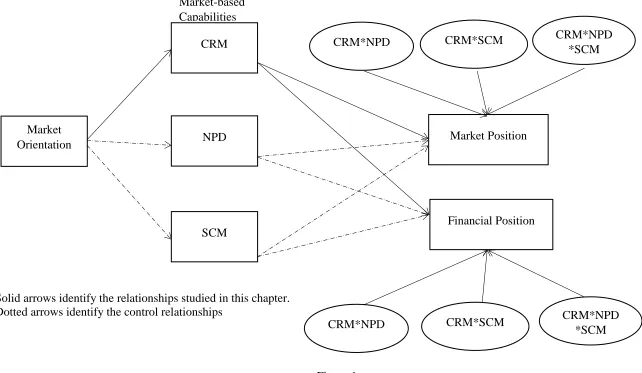
constructs used in the study. The complete conceptual model represented in Figure 1 was
Will 2005). PLS is a variance-based structural equation modeling (SEM) technique that
maximizes the explained variance of the endogenous latent constructs. It is a distribution free
non-parametric test based SEM that relies on bootstrap standard errors to test the statistical
significance of parameter estimates. Review of PLS SEM is beyond the scope of this article and
readers are referred to Hair, Ringle, & Sarstedt (2011) and Hair et al (2012) for a thorough
treatment of this topic.
Why PLS (and not CB-SEM)? The primary reason for using PLS SEM over
covariance-based structural equation modeling (CB-SEM) is that our study’s model focuses more on theory
development and prediction of direct and synergistic effects of market-based capabilities on firm
performance outcomes. Specifically, market-based capabilities (Srivastava, Shervani, and Fahey
1999) theory has remained mainly conceptual and to our best knowledge there is only one
empirical work (Ramaswami, Srivastava, and Bhargava 2009) that directly tests the relationship
between the three organizational capabilities (namely CRM, SCM, and NPD) and firm
performance. However, in their original conceptualization Srivastava, Shervani, and Fahey (1999)
not only argue for the independent direct effects of these three capabilities, but also provide
arguments in support of how these capabilities could come together in a dynamic fashion that
subsequently guarantees competitive advantage for the firm. So we attempt to validate these
conceptual propositions by trying to predict the synergistic impact of these capabilities on market
and firm performance. PLS-SEM provides a powerful environment to test the predictive
relevance of these causal relationships and also to verify the predictive validity of the overall
conceptual model of market-based capabilities. Apart from these conceptual and empirical
31
restriction (N = 82), many multi indicator latent constructs, and multiple latent variable
interactions. Such complexities make CB-SEM models inadmissible and non-identifiable.
Estimation. The estimation was carried out by running the complete structural model
simultaneously with all the hypothesized effects in SmartPLS 2.0. First, the outer or the
measurement model was evaluated, and second the inner or structural model was evaluated.
Measurement model was evaluated by checking the composite reliability, average variance
extracted, indicator loadings and discriminant validity of the latent constructs (Fornell and
Larcker 1984; Hair et al, 2012). Table 1 shows that the composite reliability values of the
constructs ranged between .89 - .94, the AVE ranged between .53 - .89, and the Cronbach’s-α
ranged between .84 - .89. Further all the standardized factor loadings were significant at p < .01
and the AVEs were greater than the squared correlations between the constructs. Overall the
measurement model fit indices show strong psychometric properties of the constructs used.
Structural model evaluation was carried out in a series of steps. First, to check whether
the parameter estimates were free from collinearity issues, we extracted the latent variables
scores and assessed the variance inflation factor (VIF). The VIF values ranged between 1.48 and
2.56, well below the threshold level of 5 thus providing evidence that collinearity might not be
an issue. Second, we checked the R2 values of the endogenous constructs. The results suggest
that R2 values were moderately high. Next, the statistical significance of the parameter estimates
was tested using bootstrapping. We ran bootstrapping using 5000 samples with no sign changes
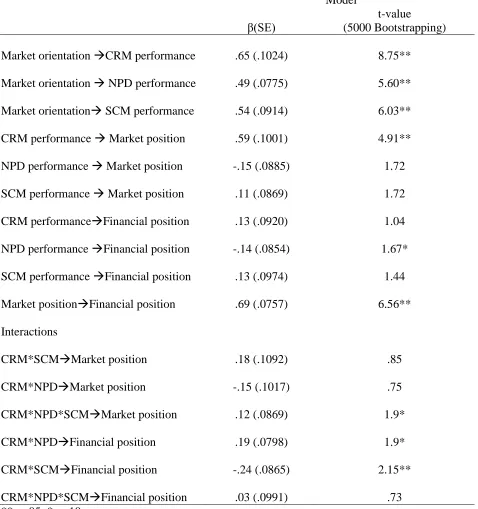
option. The t-values derived using bootstrapping is reported in the results in table 2. We discuss
the significance of the parameter estimates in the results section.
Next, we validate the predictive relevance of the model by assessing Stone-Geisser Q2
omission distance of 7, we applied blindfolding to the two performance variables financial
performance (FP) and market performance (MP) separately. The results of the cross-validated
redundancy showed that the Q2 values were considerably above zero for FP and MP with.62
and .45 respectively thus showing strong predictive relevance. Next, we checked for the effect
sizes by calculating f2. f2 is calculated as the change in R2 values after re-estimating the model
without the key exogenous variables. In this study CRM is the key antecedent to market and
financial performance. f2 values were .13 and .38 for FP and MP respectively showing
moderately high impact of CRM on the performance variables. Finally, unlike CB-SEM there is
no global fitness of index measure to evaluate the model; hence we calculated the goodness of fit
(GoF) measure suggested by Tenenhaus et al. (2005). GoF was calculated as the square root of
the product of average communalities and average R2 and the value was .582 indicating
moderately high overall goodness of fit.
In sum, diagnostics measures from evaluation of measurement and structural model
provide strong evidence of measurement and structural integrity of the study’s model. Having
established the validity of the inner and outer models we next report the results of test of our
hypotheses.
Results
We test the importance of CRM as the intermediate channel through which market orientation of
the firm impacts its market and financial performance. We test the significance of these effects
by assessing three indirect paths through CRM using bootstrapped standard errors (Preacher and
Hayes 2008). Specifically, we test whether the indirect pathways MOCRMMP,
MOCRMFP, and MOCRMMPFP are significant. Results show significant indirect
33
impact of MOCRMMPFP at .27 (.08, p < .01). Thus CRM seems to play a critical role in
intervening between a firm’s market orientation and its performance consequences. To further
validate that the effects are completely mediated, we ran several addition model, model only with
direct effects (MOMP and MOFP) and model with both direct and indirect effects. The
results show that by adding the CRM as a potential mediator, the direct effects MOMP and
MOFP are changed from significant to nonsignificnat, providing some evidence to support the
full mediating effect of CRM.
Overall, the standardized estimates of H1a (MO performance of CRM; β=0.65; t=8.75),
H1b (performance of CRMmarket position; β=0.59; t=4.91), H2b (CRM*NPDfinancial
performance; β=0.19; t=1.90 significant at 90% level). In addition, our results partially support
H4 because we found the positive impacts of the interaction among CRM*NPD*SCM on market
performance (β=.12; t=.19 significant at 90% level), but not on financial performance (β=.03;
t=.73). However, we failed to support H1c (performance of CRMfinancial performance), H2a
(CRM*NPDmarket position) and H3a (CRM*SCMmarket position). Surprisingly, we found
significant negative impact of CRM*SCM on firm performance (β=-0.24; t=2.15).
Additional Analysis
Response Surface Approach. To uncover more complex relationship in the synergistic impact of
CRM with the other two processes on financial position, we conduct a polynomial regression
based response surface analysis (RSA) (Edwards 2002).
Results from RSA have significant managerial relevance from a resource allocation
perspective. Specifically RSA helps answer questions such as 1) how does consistency in
resource allocation among processes impacts firm performance (e.g., CRM and SCM have
impact firm performance; 3) What is the optimal way of allocating resource across processes for
better profitability?
Response surface of CRM vs. SCM on financial position. General form of RSA is represented in
the polynomial regression form as:
FP = b0 + b1 CRM + b2 SCM + b3 CRM2 + b4 CRM*SCM + b5 SCM2 + e, (1)
Where, FP is financial position. First we conduct a lack of fit test to establish that the
above second order quadratic model is adequate to represent the relationship between predictors
(CRM and SCM) and the response variable (FP). The lack of fit diagnostic index was
insignificant with F-value 2.07 ( p = .2126 ; df = 71) thus showing evidence that the polynomial
model was adequate. Further the model showed evidence of significant linear (F = 34.94, p
< .001; R2 = .47 ) and cross-product ( F = 2.97, p = .08; R2 = .02 ) effects while insignificant
quadratic effect (F=.25, p = .78). These results were consistent with the PLS model results
obtained. Next, we test for the significance of the individual parameters estimates in equation (1)
using bootstrapped standard errors to be consistent with our PLS estimation of the overall model.
As seen from table 3 (Panel A) parameters b1, b2, b3, and b4 were significant.
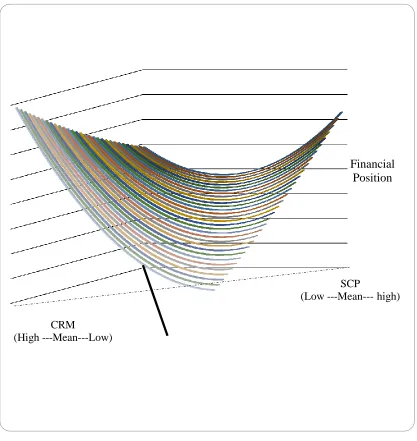
Using the estimated parameters we construct the three dimensional response-surface as
shown in figure 2. Interpretation of the surface is based on (a.) the alignment between the two
processes CRM and SCM along the ‘line of congruence’ and (b.) the discrepancy between the
two processes along the ‘line of incongruence’ (Shanock et al 2010). The surface is examined by
analyzing the slope and the curvature along these two lines to answer questions regarding
CRM-SCM fit (misfit) and how it favors (hinders) financial position. Following standard
recommendations of using RSA (see Edwards 2002 for derivations) the slope and curvature are
35
Line of perfect agreement or congruence or fit (i.e. setting ‘CRM = SCM’ in Equation 1):
Slope a1 = (b1 + b2); Curvature a2 = (b3 + b4 + b5) (2)
Line of perfect incongruence or misfit (i.e. setting ‘CRM = - SCM’ in Equation 1):
Slope a3 = (b1 – b2); Curvature a4 = (b3 – b4 + b5) (3)
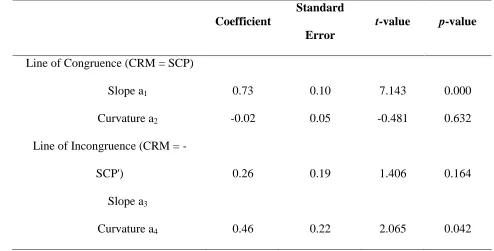
Table 3, panel B reports the calculated values, standard errors, and the significance. The
results show that slope (a1) along the line of fit and the curvature (a4) along the line of misfit are
both positive and significant. There are two key takeaways from these results interpreted along
with the response surface in figure 2. First, under the condition of fit, defined as similar
performance of CRM and SCM (shown as a solid line in the surface floor of the figure 2),
simultaneously improving the performance of both CRM and SCM positively leads increasing
financial performance in a linear way (as the curvature a2 is insignificant, we don’t have
evidence to support the non-linear relationship). Second, under condition of misfit, defined as the
performance of CRM and SCM are not similar (shown as a dotted line in the surface floor of the
figure 2), continuously increasing the performance discrepancies between these two processes
will improve financial performance in a curvilinear way. As seen from the figure 2, it appears
that maximum financial outcome is achieved when the performance of CRM is highest while the
performance of SCM is lowest. We conduct a ridge analysis to determine that maximum
financial leverage occurred at CRM=2.2 and SCM=-0.58 (where the average performance is
defined as 0). At first glance, these two findings seem to contradict to each other, the
implications for managers are further discussed in detail in the discussion section.
Response surface of CRM vs. NPD on financial position. For the response surface of
CRM vs. NPD on financial position, the lack of fit indices was still significant at F = 6.49 ( p
construct a response surface. However the significant lack of fit indicates that the quadratic
polynomial model with the existing predictors may not be sufficient to represent the synergies
between CRM and NPD. This might signal relevance of other potential variables or a more
complex polynomial model to represent the fuller complexities of CRM and NPD synergies.
Discussion
The three key motives of this study are to examine 1) the role that CRM plays in shaping the
MO-firm performance relationship; 2) the synergy effects of CRM with NPD/SCM on firm
effectiveness and firm efficiency; 3) the synergy effect among all three CRM, NPD and SCM on
firm performance. Overall, we found that market orientation leads to superior market
performance through superior performance of CRM. Importantly, our data shows that CRM may
fully mediate the MO-market performance linkage even after controlling for the intervening
influences of the other two core business processes, NPD and SCM. In addition, we found that
the synergy between CRM and NPD/SCM has significant impacts on firm efficiency (e.g., profit,
ROA); however, we didn’t observe the similar synergy impacts on firm effectiveness (e.g.,
market share, sales); more interestingly, we observed that CRM positively moderates the
NPD-financial position relationship, but negatively moderates the SCM-NPD-financial position relationship.
Last, our results confirm the notion that the synergy among all three CRM, NPD and SCM
positively leads to superior financial performance.
Theoretical Implications
Linking market-based assets literature with another rich stream of literature on MO, this study
provides the following contributions to enhance our understanding on the phenomena related to