Unit Training Management Guide
U.S. Marine Corps
Washington, DC 20380-1775
25 November 1996
FOREWORD
1. PURPOSE
Marine Corps Reference Publication (MCRP) 3-0A, Unit Training Management Guide, assists unit commanders and their staffs in the preparation of unit training programs. It provides a background on the philosophy, principles, and policies of the Marine Corps training manage-ment system. It also provides guidance on how to support and evaluate training plans.
2. SCOPE
This publication was prepared primarily for operations officers at the battalion/squadron level and above throughout the Fleet Marine Force. However, the philosophy and procedures con-tained herein may be applied by all training managers and trainers, regardless of the size of their unit. This publication reflects the methodology and techniques developed over the years to improve the Marine Corps' overall training effort. It may also be used as a reference tool to train the trainers and to evaluate unit training management.
3. SUPERSESSION
FMFM 0-1, Unit Training Management Guide, dated 15 April 1991.
4. CHANGES
Recommendations for improving this manual are invited from commands as well as directly from individuals. Forward suggestions using the User Suggestion Form format to—
Commanding General Doctrine Division (C 42)
Marine Corps Combat Development Command 3300 Russell Road Suite 318A
Reviewed and approved this date.
BY DIRECTION OF THE COMMANDANT OF THE MARINE CORPS
PAUL K. VAN RIPER
Lieutenant General, U.S. Marine Corps Commanding General
Marine Corps Combat Development Command
iii (reverse blank) From:
To: Commanding General, Doctrine Division (C 42), Marine Corps Combat Development Command, 3300 Russell Road, Quantico, Virginia 22134-5021
Subj: RECOMMENDATIONS CONCERNING MCRP 3-0A, UNIT TRAINING MANAGEMENT GUIDE
1. In accordance with the foreword to MCRP 3-0A, which invites individuals to submit suggestions concern-ing this MCRP directly to the above addressee, the followconcern-ing unclassified recommendation is forwarded:
____ __________________ _______ _______________
Page Article/Paragraph No. Line No. Figure/Table No.
Nature of Change:
❏
Add
❏
Delete
❏
Change
❏
Correct2. Proposed new verbatim text: (Verbatim, double-spaced; continue on additional pages as necessary.)
3. Justification/source: (Need not be double-spaced.)
iii (reverse blank)
Record of Changes
Change
No.
Date of
Change
Date of
Entry
Organization
Signature
Unit Training Management Guide
Table of Contents
Chapter 1
The Marine Corps' Philosophy and Principles of Training
Training Philosophy . . . 1-1 Training Mandate . . . 1-1 Training Imperative . . . 1-1 Principles. . . 1-2 Train as You Fight . . . 1-2 Make Commanders Responsible for Training . . . 1-2 Use Standards-Based Training . . . 1-3 Use Performance-Oriented Training . . . 1-3 Use Mission-Oriented Training . . . 1-3 Train the MAGTF to Fight as a Combined-Arms Team. . . 1-4 Train to Sustain Proficiency . . . 1-4 Train to Challenge . . . 1-4
Chapter 2
Marine Corps Unit Training Management
Overview. . . 2-1 Commander's Responsibilities . . . 2-2 Implementation . . . 2-3
Chapter 3
The Application of the Systems Approach to Training
SAT: The Concept Behind Unit Training Management. . . 3-1 Analysis Phase . . . 3-3 Design Phase . . . 3-3 Development Phase . . . 3-5 Implementation Phase . . . 3-5 Staging of Resources and Personnel . . . 3-5 Conducting the Scheduled Exercise . . . 3-5 Evaluation Phase . . . 3-6 Developing a Checklist . . . 3-6 Conducting an After Action Review . . . 3-6
Chapter 4
Training Standards
Overview . . . 4-1 Unit Training and School Training . . . 4-1 Individual Training Standards System . . . 4-2 Individual Training Standards . . . 4-3 The Task . . . 4-3 Conditions . . . 4-3 Standards . . . 4-3 Performance Steps . . . 4-3 Administrative Instructions . . . 4-3 References . . . 4-3 Collective Training Standards . . . 4-4 How to Use Training Standards in Units . . . 4-5 Determine Individual and/or Team Proficiencies and Deficiencies . . . 4-5 Determine Training Methods. . . 4-5 Specify Training Funding/Resources . . . 4-5 Evaluate Proficiencies as a Result of Training . . . 4-5
Chapter 5
Mission Essential Task List
Overview. . . 5-1 Combat-Focused Training. . . 5-1 METL Development . . . 5-2 Commander's Analysis . . . 5-2 METL Fundamentals . . . 5-3 Training Standards . . . 5-5 Training Assessment . . . 5-5 Evaluation of Proficiency . . . 5-5 Training Strategy . . . 5-6
Chapter 6
Training Plans
Section I. Fundamentals. . . 6-1 The Planning Process . . . 6-1 MCTEEP. . . 6-2 Types of Training Plans . . . 6-3 Establishing Training Priorities. . . 6-4 Training Techniques . . . 6-5 Multiechelon Training . . . 6-5 Individual Training During Collective Training. . . 6-5 Concurrent Training . . . 6-6 Prime Time for Training . . . 6-6 Hip-Pocket Training . . . 6-6
Section II. Long-Range Planning. . . 6-7 Requirement for Long-Range Planning . . . 6-7 Elements of a Long-Range Training Plan . . . 6-7 Command Training Guidance . . . 6-7 Long-Range Planning Calendar . . . 6-8 Training Events. . . 6-8 Training Resources . . . 6-9 Preparing the Long-Range Plan . . . 6-9 Step 1. List the METL . . . 6-10 Step 2. Publish Commander's Guidance. . . 6-10 Step 3. Establish Calendar . . . 6-10 Step 4. Coordinate and Review the Plan . . . 6-10
Section III. Midrange Planning . . . 6-11 Requirement for Midrange Planning . . . 6-11 Preparing the Midrange Plan . . . 6-12
Step 1. Assess Current Unit Proficiency, Resources, and
Training Environment. . . 6-12 Step 2. State the METL . . . 6-12 Step 3. Commander's Guidance. . . 6-12 Step 4. Review the Long-Range Training Plan . . . 6-13 Step 5. Review Previous Midrange Plans . . . 6-13 Step 6. Develop Midrange Planning Calendar . . . 6-13 Step 7. Coordinate with Subordinate and Higher Units . . . 6-14 Review the Midrange Training Plan . . . 6-14
Section IV. Short-Range Planning . . . 6-15 Purpose. . . 6-15 Training Schedules. . . 6-15
Chapter 7
Evaluation of Training
Overview . . . 7-1 Performance Evaluation . . . 7-1 Evaluation Programs . . . 7-2 Methodology of Evaluation . . . 7-2 Methods . . . 7-2 Continuous Process . . . 7-3 Testing Versus Evaluation . . . 7-4 Realism . . . 7-4 Proficient Evaluators . . . 7-4 Categories of Performance. . . 7-4 Individual and Collective Performance . . . 7-5 Quality of a Unit's Training Management Procedures . . . 7-5 Quality of Training . . . 7-5 Evaluation Results . . . 7-6 Training and Readiness Manuals . . . 7-7 Aviation . . . 7-8 Ground Combat . . . 7-8
Appendices
Appendix A. Recommended UTM Tasks by Grade . . . A-1 Appendix B. Example of a Battalion's METL and METL Assessment . . . B-1 Appendix C. Marine Corps Training Requirements . . . C-1 Appendix D. Example of a Commander's Training Philosophy
and Guidance Letter . . . D-1 Appendix E. Sample Planning Calendar. . . E-1 Appendix F. Sample Training Report . . . F-1 Appendix G. After Action Reviews and Reports . . . G-1 Appendix H. Glossary. . . H-1 Appendix I. References and Related Publications . . . I-1
Notes
The Marine Corps’ Philosophy and Principles of Training
Training Philosophy
The history of battle, a commander’s experience, and the wisdom of mili-tary philosophers all confirm the direct correlation between training and victory in war. Successful combat units train as they intend to fight and fight as they were trained. Marines base their future success on the battle-field on this philosophy. The Marine Corps undergirds this philosophy with a training mandate and a training imperative. This philosophy is fur-ther backed by a number of training principles.
Training Mandate
The Marine Corps’ mandate for training is simple and compelling: The nation must have units that are ready for combat! Because the Marine Corps trains for war, not for peace, the intended battle determines training directions and goals. War places rigorous physical, psychological, and moral demands on Marines, and a battle environment demands substantial dedication, perseverance, and motivation to ensure the highest possible chance of success. Success on the battlefield also demands the ability and willingness to fight. Combat-ready units are manned with motivated, dis-ciplined, and proficient Marines; led by tactically and technically compe-tent leaders; and conditioned through physically tough and mentally demanding training that ranges from individual Marine battle drills to joint combined-arms exercises. Pursuit of the highest possible quality of training must become a way of life in the Marine Corps.
Training Imperative
Training is a professional and moral imperative. It is the Marine Corps’ responsibility to ensure that both regular and reserve components are properly trained. Training encompasses the full range of duties, respon-sibilities, and missions of Marines, and it must be embedded in all that Marines do. It can be as simple as practicing an individual task or as complex as conducting a joint or combined field training exercise (FTX) with an opposing force. It can vary from a squad leader infor-mally making an on-the-spot correction, to a company commander teaching lieutenants how to apply tactical principles. Employing weap-ons, operating equipment, communicating information, maintaining vehicles, and rearming and resupplying units are all critical skills mas-tered only through training. From training comes the ability to follow
“You are either in contact, moving to contact, or train-ing!” 1
procedures, to execute techniques, to apply tactics, and to integrate the capabilities of arms and services.
Principles
Out of the Marine Corps’ philosophy of training emerges fundamental principles that are applicable to all levels of Marine Corps training. All Marines must understand and apply these principles at every level of training. These principles provide sound and proven direction and are flexible enough to accommodate the demands of local conditions and the judgment of commanders and other trainers. The principles of Marine Corps training are discussed in the following subparagaphs. These princi-ples are not inclusive, nor do they guarantee success. They are guides that commanders can use to assess unit training programs.
Train as You Fight
The battle is the ultimate test of training. To train as you will fight is the fundamental principle upon which all Marine Corps training is based. Therefore, all peacetime training must reflect battlefield requirements. All leaders are considered trainers and coaches, and they must ensure that individual Marines and units receive realistic training that simulates war-time conditions. Marines’ training should prepare them to perform their tasks and meet operational standards during the complex, stressful, and lethal situations they will encounter in war. If units and elements are to function together during combat, they should train together during peace-time exercises. The Marine Corps’ philosophy is to train well in peace so that it can fight well in war.
Make Commanders Responsible for Training
Commanders at all levels are responsible for the training and performance of their Marines and units. They do more than manage training. The com-mander’s personal presence and involvement demonstrate to all that train-ing is the number one priority. Senior commanders personally train each direct, subordinate commander; e.g., battalion commanders train com-pany commanders, comcom-pany commanders train platoon commanders, etc. This simple but practical approach allows for standardization from above and for flexibility at the trainer’s level.
also the opportunity to train other subordinate leaders. This delegation of authority fosters initiative throughout the chain of command and is vital to the teacher-trainer role.
Use Standards-Based Training
Training standards are published as individual training standards (ITSs) for each military occupational specialty (MOS) and as mission perfor-mance standards (MPSs) for each unit. All training must conform to these standards. Standards-based training is the use of common procedures and uniform operational methods to create a common perspective within the Marine Corps. This method of training is further reflected in Marine Corps doctrine, tactics, techniques, and procedures. This commonality allows Marines to train, operate, maintain, and fight from a common per-spective. Standards-based training—
• Provides a measurement of performance.
• Provides Marines with the ability to adjust rapidly to changing tacti-cal situations.
• Eliminates the need for retraining if units are cross-attached.
• Fosters flexibility in battle by reducing the need for complex orders. • Teaches Marines to respond to changes in combat in a reflexive and
automatic manner.
Since the Marine Corps’ standards-based training is used throughout the Total Force, it provides commanders with a firm foundation upon which to request needed resources that support training throughout the Marine Corps. These resources include funding, equipment, ammuni-tion, and ranges.
Appendix A is an example of the ITSs of individuals responsible for unit training management (UTM).
Use Performance-Oriented Training
Marines must be proficient in the basic skills required to perform their jobs under battlefield conditions. To achieve results, all training should be performance-oriented. Individual training occurs on a continual basis and is fully integrated into collective training. Marines are trained to meet published standards, not merely to occupy the time designated for training.
Use Mission-Oriented Training
specified and implied tasks, and is the foundation for the mission essen-tial task list (METL).
The unit's combat missions are the basis for the development of tasks and for the specific standards to which each task must be executed. A unit does not train for Marine Corps Combat Readiness Evaluation System (MCCRES) tasks that are not dictated by its combat mission. Units are taught these tasks according to prescribed collective and individual train-ing standards set forth in MCCRES and the Individual Traintrain-ing Standards System (ITSS).
Train the MAGTF to Fight as a Combined-Arms Team
The cornerstone of today’s Marine air-ground task force (MAGTF) is the combined-arms team. Combined-arms proficiency develops only when teams train together on a regular basis. Cross-attachment of units and rou-tine employment of the full spectrum of combat, combat support, and combat service support functions must be practiced regularly. At the com-pany, battalion, and regimental levels, combined-arms operations focus specific training requirements for combat support, combat service sup-port, and aviation elements to rearm, resupply, evacuate casualties, and recover equipment quickly and to integrate indirect fires, electronic war-fare, aviation, engineer, and air defense. Regimental and higher level commanders and their staffs must continually train to synchronize and integrate operations.
Train to Sustain Proficiency
Once units have trained to a required level of proficiency, they must sus-tain it. To sussus-tain proficiency, commanders must continuously evaluate performance and design training programs that correct weaknesses and reinforce strengths. This means training year round, not focusing training on one or two key events during the year. MCCRES allows for both multi-echelon and individual training, and it develops and sustains mis-sion proficiency. It is key to sustaining a high level of proficiency. MCCRES is the continuous process of training, evaluating results, ana-lyzing feedback, and training again to strengthen weak areas.
Train to Challenge
Marine Corps Unit Training Management
Overview
The Marine Corps’ traditional versatility and adaptability are being cha-lilenged by demands for a more frugal approach to operational excel-lence. To confront this challenge effectively, Marine Corps training programs must pursue warfighting requirements while meeting personnel and fiscal requirements. High personnel tempo, increased operational tempo, and decreased funding combine to present commanders with real challenges that directly impact unit readiness. Regardless of the chal-lenges, commanders must continue to meet their mission requirements. In order to meet these requirements, commanders must first identify exactly what a unit must do to accomplish its wartime mission. Once a unit’s war-time capabilities are identified, commanders then apply UTM principles to the unit’s training program. UTM focuses training on the tasks that are essential to a unit’s wartime capabilities. UTM is the use of the systems approach to training (SAT) (see chap. 3) and Marine Corps training prin-ciples in a manner that maximizes training results and focuses the training priorities of the unit on its wartime mission.
UTM governs the major peacetime training activity of the Marine Corps and applies to all echelons of the Total Force. It guides commanders in the development of a METL, which details the specific tasks a unit must
accomplish. It is also the process that combines Marine Corps training principles with SAT to ensure that essential tasks are incorporated into the unit’s training plan. This process maximizes training results by focusing a unit’s training priorities on the accomplishment of its wartime mission.
For UTM to succeed in the Marine Corps, it requires an environment that is receptive to change. This requires a departure from our traditional train-ing philosophy and a re-education of the Fleet Marine Force in how to focus training in order to obtain the benefits offered by UTM. The follow-ing points are critical to the Marine Corps’ understandfollow-ing and future application of UTM:
• Ensuring that every level of command understands the benefits that UTM provides to its training effort.
• Understanding that the principle force behind UTM is motivation and its principle message is that all Marines are a part of the process.
“In no other profession are the penalties for employing untrained personnel so appalling or so irrevocable as in the military.” 2
• Understanding that UTM is a top-down process that starts with the Commandant and that commanders at all levels must energize and sus-tain the process.
• Ensuring that the Marine Corps’ UTM effort meets its present needs and stays head of its future needs; that training corrects deficiencies that could undermine short-term, midterm, and long-term success; and that training remains the most important peacetime activity.
• Reducing the need for inspections by correcting deficiencies as they surface.
• Implementing managed on-the-job training at the unit level by using professionally-prepared job aids, teaching materials, training aids and devices, “train the trainer” mobile training teams, and doctrinal support. • Breaking down barriers among staff areas to enhance the selection of training priorities and allocation of assets. This is applied vertically within the chain of command and horizontally within all supporting commands.
Commanders’ Responsibilities
Commanders at all levels are responsible for all of their units’ training needs. To meet specific training needs, commanders develop overall unit training programs based on the best combination of available resources, materials, guidance, and time. Commanders must—
• Provide clear commander’s intent/guidance throughout the process. • Identify training objectives clearly.
• Plan training events and activities. • Arrange for support.
• Ensure that the resources needed to conduct training are available. • Ensure that training is conducted.
• Supervise and evaluate individual and unit proficiency.
• Supervise and evaluate training sessions, instructional quality, and UTM procedures.
Commanders and their staffs manage unit training along with other grams to ensure that they are mutually supporting. All command pro-grams must work together to accomplish a common set of goals. Maintenance, logistics, quality of life, base support, and other programs must be effectively managed so they do not disrupt the training program and consume funds/resources allocated for training.
Implementation
The Marine Corps' program to develop UTM skills consists of:
• Providing UTM instruction within the resident professional military education (PME) schools of the Marine Corps University and within the nonresident Marine Corps Institute (MCI) correspondence courses. • Providing UTM training programs designed to share training manage-ment concepts and ideas as a Total Force effort to enable more effec-tive and efficient use of training time and resources.
• Conducting mobile training teams to discuss UTM concepts, ideas, METL development, and related processes.
• Evaluating the UTM program as a whole and revising portions when necessary.
The Application of the Systems Approach to Training
SAT: The Concept Behind
Unit Training Management
UTM is the use of SAT and Marine Corps training principles in a manner that maximizes training results and focuses unit training priorities on the wartime mission. Units cannot achieve and sustain proficiency on every possible training task. The Marine Corps has neither the funds nor the time for such an endeavor. Therefore, Marine Corps training must focus on wartime tasks. SAT assists commanders in identifying critical warf-ighting tasks, both for the individual and the unit, and it guides the Marine Corps’ frugal application of limited resources. SAT is a systematic, prob-lem-solving model used by commanders to produce an effective training program, and it is used in the development of all Marine Corps’ training. For example, the application of SAT in the formal schools or operational units results in specific products that improve unit efficiency and maintain readiness. For instance, if applied in—
• A formal school setting, a program of instruction is generated. • An operational unit, a short-range training plan is generated.
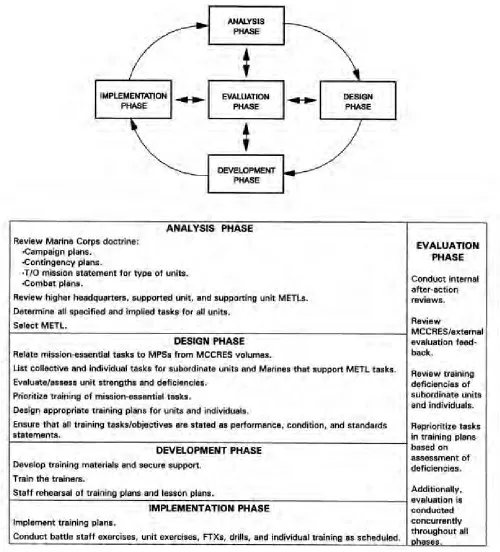
No matter how it is applied, SAT provides commanders with needed training management techniques to analyze, design, develop, implement, and evaluate performance-oriented training. It guides commanders in the use of scarce resources by identifying where resources are needed most in order to maintain readiness. The SAT process, in regards to UTM, con-sists of five phases: analysis, design, development, implementation, and evaluation (see fig. 3-1).
“Achieve, on a continuing and progressive basis, the effective integration of new weapons and equipment, new organization, and new techniques at all levels of command.” 3
Analysis Phase
The analysis phase determines the unit’s performance objectives. The unit’s performance objectives are written as tasks that the unit must be prepared to accomplish. The commander begins this phase with a detailed mission analysis. The inputs to this analysis include the commander’s higher headquarters’ METL, supported and supporting unit METLs, cam-paign plans, table of organization (T/O) mission statements, contingency plans, anticipated missions, and doctrine. Assistance available from the G-5 (plans) section should be sought in order to conduct a comprehensive analysis. If the analysis is conducted properly, the commander deduces a listing of all the unit’s specified and implied tasks. The commander fur-ther analyzes this comprehensive listing of tasks to determine the unit’s mission-essential, warfighting tasks. By doing this, the commander iden-tifies a core listing of tasks that the unit must be capable of performing in a warfighting environment, vice a huge listing of tasks they could accom-plish if unconstrained by time or resources. This smaller, detailed listing of mission-essential tasks is the product of the analysis phase. The METL is the tool the commander uses to prioritize and focus unit training. The METL, once approved by higher headquarters, becomes the descriptive training document for the unit and provides a clear, warfighting-focused description of the highest level collective actions needed to execute war-time mission proficiency. The METL is the starting point for the design phase of SAT.
Design Phase
The purpose of the design phase is to design or layout a training plan for a unit. Different plans may be designed for similar units. The design of each unit’s training plan is based primarily on the unit’s level of profi-ciency in its METL tasks. Unit training plans may consist of long-range, midrange, and short-range plans (see chap.6 for additional information on training plans):
• Long-range planning focuses on major exercises and the training needed to meet the commander’s METL for the next 18-24 months. Facilities, logistics, evaluation of resources and personnel, and other factors must be included in the long-range plan.
• Midrange (annual) planning details how major subordinate unit METLs support the unit commander’s METLs. It further refines the details of major exercises. It plans for required facilities, logistics, etc. Acquisitions/arrangements that require 8-12 months lead time for training are included.
During the design phase, the unit develops training plans that will result in the successful accomplishment of all mission-essential tasks. The unit’s METL is the foundation used to develop its training plans. The METL is also supported by many other subordinate tasks from within the unit. Therefore, the unit training plan must address both unit METLs and sub-ordinate tasks.The unit must plan for and schedule its training so that it successfully completes all of its mission-essential tasks. Appendix B pro-vides an example of a battalion's METL and METL assessment.
The first step in the design phase is to relate mission-essential tasks from the METL to one or more published MPSs from the unit’s applicable MCCRES volume in the MCO 3501.XX series. An MPS is a unit or col-lective performance objective that contains a performance statement, a condition statement, and a standard statement. An MPS strives to define an observable action that is a critical part of the unit’s mission. Collec-tively, all of a unit’s MPSs should cover all its potential missions. A unit should be trained to perform all its published MPSs, however no unit has the resources to train and sustain proficiency on every task. Therefore, a unit trains to the MPS that supports its METL, then it trains to other MPSs as time and resources allow.
Note
Contact Commanding General, Marine Corps Combat Development Command (C 461) if a mission-essential task can-not be related to a published MPS.
The second step in the design phase is to prioritize the training of mission-essential tasks. Mission-mission-essential tasks are not prioritized, they are all equally essential. But, the training of the skills necessary to achieve profi-ciency in the performance of mission-essential tasks is prioritized. Train-ing priorities are determined by the commander’s assessment of a unit’s ability to perform a task when compared to its associated MPSs. Evalua-tion of a unit’s past performance aids a commander in determining a unit’s future training priorities. For example, if a unit successfully accomplished one mission-essential task, but did not perform another mission-essential task to standard, the unit must schedule training to correct the identified deficiency.
The third step in the design phase is to relate further subordinate, collec-tive, and individual tasks to the MPSs that have been associated to each mission-essential task. Individual tasks are published as ITSs. ITSs are tasks that specify the individual proficiency requirements that support unit mission performance. Formalized listings of ITSs have been devel-oped over the years based on identification of individual tasks that must be accomplished in order to accomplish collective and unit tasks. These ITSs are found within the ITSS, a series of orders that provide guide-lines as to the tasks an individual Marine should be able to do by grade and MOS.
Development Phase
During the development phase, commanders ensure that all logistical and background preparations are completed prior to the actual start of the training evolution. The generation, submission, and follow through on requests for transportation, budgeting, ammunition, and other items that support the scheduled training are a critical part of this phase. All person-nel and resources are allocated so that preparatory work can be conducted that will allow for the smooth execution of the training plans. Preparatory work may require the generation of letters of instruction (LOI) from the commander that direct specific implementation of training plans. Such LOIs serve to provide guidance and direction for preparation for training.
It is also during this phase that trainers are trained to meet the needs of the particular training evolution. Trainers should review their instructional procedures and the materials they will present during assigned periods of instruction. Officers and SNCOs, who will lead units through training exercises, should review/define training objectives and goals in accor-dance with the guiaccor-dance provided from the commander.
Implementation Phase
Training plans are executed during the implementation phase. Trainers should understand the desired performance, the standards, and the condi-tions under which training should occur. The implementation phase has three basic steps.
Staging of Resources and Personnel
This step involves the transition from the development phase (which planned, coordinated, and arranged all support for the training evolution) into the implementation phase (where the training evolution actually begins). During this step, all resources and personnel needed to conduct the training are assembled at the training site. This may involve transpor-tation to the site, issue of weapons, placement of opposing force (OPFOR) units, etc., or it may be as simple as having a projector set up in a classroom and the troops assembled at the appropriate place at the scheduled start time.
Conducting the Scheduled Exercise
Evaluation Phase
Evaluation is a continuous process that occurs at all echelons and during every phase of SAT. SAT is the dynamic process that allows continuous improvement to the training program by the application of evaluation techniques at any point along the process, not solely upon completion of a phase.
Commanders constantly evaluate planning and resource actions to ensure they are mission-oriented and that they build toward combat readiness. Leaders at all echelons evaluate leader and individual training perfor-mance and provide feedback to the chain of command, trainers, and those being trained.
Evaluation of unit training is the process of determining if the unit can accomplish the training objectives related to a specific training event. The drills and training exercises for a squad or crew are aimed at accomplish-ing the collective task(s) practiced in that drill/exercise. Trainaccomplish-ing is evalu-ated when commanders, leaders, evaluators, or observers compare actual performance to the standards listed for that task. If evaluation indicates that a unit cannot perform to standard, that task becomes a priority for future training.
Developing a Checklist
The evaluator develops a checklist based on MPSs/ITSs and uses it to evaluate unit performance. A checklist can help to optimize training time by highlighting the strengths and deficiencies of the unit, therefore, focus-ing future trainfocus-ing on what and who needs to be trained, rather than retraining the entire unit/event needlessly. The checklist also provides the evaluator with a quick reference tool that identifies specific training stan-dards. During the training evolution, the evaluator can quickly refer to the checklist to ensure that training is being effectively carried out. This checklist usually states the objective (task/MPS) and the key substeps in the performance. Substeps include the collective tasks of subordinate units and the individual tasks of participating Marines. Substeps help the evaluator identify if a whole unit was deficient or if only a lower echelon unit needs additional training.
Conducting an After Action Review
Training Standards
Overview
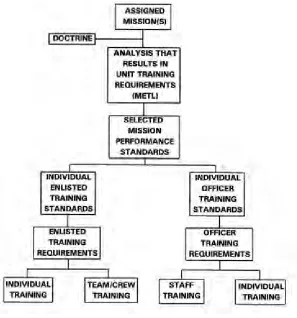
The Marine Corps’ training system is a standards-based system. This means that the entire training system and all training programs are built around established individual and unit performance standards for specific tasks. These standards are published as ITSs or MPSs. All training stan-dards derive from specific mission requirements and are based on current doctrine to ensure that Marines are trained for combat. A training stan-dard measures collective or individual performance based on task accom-plishment. It does this for each of the tasks that a unit or an individual Marine is expected to perform. A training standard also defines the level of proficiency required to satisfy the task. It is used to determine if Marines satisfactorily perform the assigned task to the standard. If the task is not performed to the standard, then a training deficiency exists. Once training deficiencies are identified, the commander can plan future training to address the deficiency. A training standard consists of three components: the task to be accomplished, the condition under which the task is performed, and the evaluation criteria used to determine if the task was performed at a satisfactory level. MPSs, ITSs, aviation syllabus sor-ties, and aviation maintenance tasks are all examples of training standards and all provide performance measures that are used as the basis for Marine Corp training.
Figure 4-1 illustrates the hierarchical breakdown of training standards and the relationship of mission requirements, training standards, training requirements, and unit training programs.
Unit Training and School Training
To be successful in combat, Marines must develop proficiency in a wide range of combat skills. Not everything required of Marines in combat can be taught in a formal school. Many of the skills depend on the cumu-lative effect of training within the units in which they will fight. Marine Corps Combat Development Command has developed a list of the various tasks that make up each military specialty. All of the tasks an individual needs to know to perform successfully are published in the MCO 1510 series by MOS. Unit tasks are reflected as MPSs and are found within the appropriate MCCRES manual by MOS. The MCCRES is published in the
“Untutored courage is use-less in the face of educated bullets.”4
MCO 3501 series and is composed of an introductory order and 13 vol-umes covering all elements of the MAGTF.
The formal schools and the unit commander share the responsibility for ensuring that Marines learn how to accomplish individual tasks. ITSs identify tasks that will be used by unit commanders to establish individ-ual training programs that complement formal school training. Addi-tionally, MPSs identify unit tasks that commanders use to build their unit training programs.
Individual Training Standards System
[image:25.612.231.528.71.389.2]ITSs are developed and published within the ITSS. This system ensures that all Marines within a given grade for a particular MOS are trained to perform the same tasks to a standard level of proficiency. ITSs are derived from the MCCRES MPSs and prescribe individual tasks that a Marine of
a particular MOS and grade must be able to perform for the unit to suc-cessfully execute the MPS. The ITSS is a tool used by the unit com-mander to develop individual training programs. It should also be available to Marines that plan or conduct training since it outlines what they are expected to teach.
Individual Training Standards
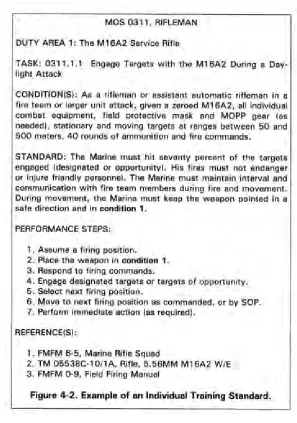
ITSs prescribe the individual tasks that a Marine of a particular MOS and grade must be able to perform in order for the unit to successfully execute the MPS. Each ITS contains six essential elements that assist both the training planner and the trainer. These elements provide detailed informa-tion on the condiinforma-tions, performance indicators, and references used by the planner and executor. The six elements of an ITS are as follows:
The Task
A unit of work usually performed over a short period of time. A task has a specific beginning and ending, can be measured, and is a logical and nec-essary unit of performance.
Conditions
Equipment, manuals, assistance/supervision, special physical demands, environmental conditions, and locations that describe the situation/en-vironment under which Marines perform the task.
Standards
Accuracy, time limits, sequencing, quality, product, process, restrictions, etc., that indicate how well a task should be performed. Simply stated, a measure of performance.
Performance Steps
Steps that must be performed in order to accomplish the training objective.
Administrative Instructions
Describe the relative amount of simulation involved with the behavior, con-ditions, and standards in the training environment. If there is no simulation, only pertinent administrative instructions will appear in this component.
References
Figure 4-2 contains an example of a ITS.
Collective Training Standards
action if mission area weaknesses are noted. They also help the com-mander determine the relative efficiency and effectiveness of the selected training by reviewing the evaluated performance against the training. Figure 4-3, located on pages 4-6 through 4-9, contains an example of an MPS.
How to Use Training Standards in Units
Training standards are used to guide the unit’s training program. At the unit level, both collective (MPS) and individual (ITS) training standards are used to:
Determine Individual and/or
Team Proficiencies and Deficiencies
The proficiency of an individual Marine is determined by administering a pretest on each task he/she is expected to perform; e.g., ITSs. Assessing team proficiencies is accomplished by conducting battle drills, training exercises, or battle simulator exercises using MPSs. Information on team proficiency can also be gathered by conducting inspections and reviewing information from previous training reports, including Marine Corps Com-bat Readiness Exercise (MCCRE) reports.
Determine Training Methods
Once training deficiencies are identified, a method to correct the defi-ciency can be selected. Training can include use of instruction, practical application, correspondence courses, training aids/devices, etc., to pro-vide the desired results.
Specify Training Funding/Resources
Commanders must determine the training funding/resources required to train individuals and units to master deficient skills. Planning must be done to ensure that instructors, ammunition, equipment, ranges, and class-room space are available as necessary.
Evaluate Proficiencies as a Result of Training
Mission Essential Task List
Overview
Marine Corps training programs are based on combat requirements. Units cannot achieve and sustain proficiency on every possible task. Therefore, commanders must selectively identify the tasks that are essential to accomplishing the unit’s combat mission. The compilation of tasks criti-cal to combat mission accomplishment is a unit’s METL. The METL pro-vides the warfighting focus to a unit’s training program by providing the commander with a listing of tasks the unit must be able to perform. It is the basis used to design the unit training plan and to develop the resources necessary to meet the training plan. The commander is key in the devel-opment and revision of the METL, which frames the outline of the unit’s training plans.
Combat-Focused Training
Peacetime training requirements must focus on a unit’s planned combat mission. Commanders can achieve a successful training program by con-sciously narrowing the unit’s training focus to a limited number of tasks that are essential to mission accomplishment during combat. These tasks make up the commander’s METL (see app. B for an example of a battal-ion's METL development). Each unit’s training program ensures that its members train as they are going to fight by focusing training proficiency on accomplishment of METL tasks. A combat focus is critical throughout the training process as it provides priority to training for combat roles, vice peacetime routines. By prioritizing training to meet METL tasks, the commander can now allocate resources to the training priorities. Training must be prioritized in the following order:
• Mission-oriented training (training that ensures the unit can fulfill combat requirements).
• Formal training (see app. C). • Ancillary training (see app. C).
Prioritization of training requirements is a crucial step in the com-mander’s development of a plan to meet the unit’s mission-essential tasks. Planning links the unit's METL with the subsequent execution and
evalu-“The unit commander must rec-ognize that, even after the elimi-nation of ‘nice to have’ activities, necessary functions remain which cannot be fully ex-ecuted within the resources available to him. His only re-course is ‘to do first things first.’ He must analyze his mission and determine the relative priority and the degree of interdepen-dence of the functions essential to mission accomplishment." 5
ation of training. A relatively centralized process, planning develops mutually-supporting, METL-based training at all levels within a unit. The commander provides three principal inputs to this planning process: the METL, the training assessment, and commander’s guidance.
METL Development
Commander’s Analysis
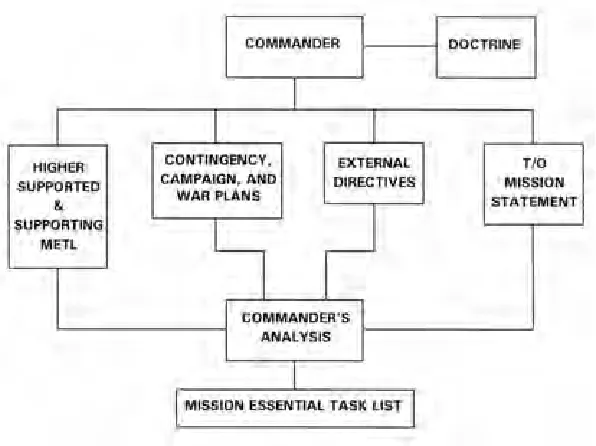
[image:34.612.230.528.402.625.2]The commander reviews all applicable tasks and identifies those tasks, for training priority, that are essential to accomplishment of the unit’s combat mission. The commander focuses the unit’s efforts and resources on train-ing for these essential tasks to achieve proficiency. The unit trains for all other tasks as resources allow. This process concentrates the unit’s peace-time training efforts on the most important collective training tasks required to accomplish the unit’s combat mission. Since units cannot achieve and sustain proficiency on every possible training task, this selec-tion process reduces the number of training tasks. Figure 5-1 depicts the process that leaders use to identify and select mission-essential tasks. Fig-ure 5-2 shows an example of a division mission essential task, with subor-dinate unit MPSs associated to it, derived from its mission statement. The mission statement depicts the start of the METL development process by determining the most important division training tasks.
METL Fundamentals
The following fundamentals apply to METL development:
• The METL is derived from the organization’s T/O mission statement, doctrinal employment, combat missions, and other related tasks. • Each organization’s METL must support and complement higher
headquarters’ METL.
• In similar types of units, mission-essential tasks may vary significantly because of different combat missions or geographical locations. • All units, from a Marine expeditionary force to individual battalions/
squadrons, prepare METLs. Command groups and staff elements at each level develop METLs to address mission-essential tasks in their areas of responsibility. Each unit’s METL is approved by the next higher commander in the operational chain of command. Command group METLs are approved by the commander. Staff METLs are approved by the unit’s commander or chief of staff.
• Units that conduct daily support functions also prepare a METL. The METL for these support units must address the differences between a peacetime operating environment and a combat operating environment that requires the support mission to be accomplished under austere conditions on an active battlefield.
• The METLs for combat, combat support, and combat service support organizations must be coordinated during the development process. This requirement supports the concept that, whenever possible, train-ing is conducted as combined-arms teams. A key component of the senior commander’s METL approval process is to determine if subor-dinate units and units that frequently accompany the command on operations have properly coordinated their METLs.
• Since the METL forms the basis for the funding and resourcing of a unit’s training plans, it is stabilized once approved. The METL is nor-mally modified only if changes occur in the unit’s missions. Since combat plans are the most critical input to the METL development process, senior commanders make every effort to stabilize combat missions. A significant revision of a unit’s mission can result in major changes to its METL and require subsequent major modifications to training plans.
• The commander has the responsibility for developing a training strat-egy that maintains unit proficiency for all tasks designated as mission-essential. There should be no attempt to prioritize tasks within the METL. By definition, all METL tasks are equally essential to ensure mission accomplishment.
• Commanders involve subordinate commanders and their senior SNCOs in METL development to create a team approach to mis- sion-oriented training. Subordinate participation develops a common understanding of the unit’s critical mission requirements so that METLs throughout the organization are mutually supporting.
Training Standards
After mission-essential tasks have been identified, commanders extract supporting conditions and evaluation criteria for each task from the appropriate MCCRES volume to provide clear statements of expected training performance. See figure 4-3, located on pages 4-6 through 4-9, for an example of a battalion-level training standard. The following docu-ments can assist commanders and their staffs in the selection of collective and ITSs that support training for the unit’s mission-essential tasks:
• MCOs 1510 series (ITSS).
• MCOs 3500 series (Training and Readiness [T&R]). • MCOs 3501 series (MCCRES).
• MCOs 4790 series (Maintenance Training Management and Evaluation Program [MATMEP]).
Training Assessment
The training assessment compares the organization’s current level of training proficiency with the desired level of combat proficiency. The desired level is defined in training standards within MCCRES volumes, ITSS, and T&R orders.
Evaluation of Proficiency
Leaders determine current training proficiency levels by reviewing all available training evaluations. Each evaluation applies only to a portion of the total proficiency of an organization at a specific time. Therefore, leaders must use all available evaluation data to develop an assessment of the organization’s overall capability to accomplish each task in the METL. In addition to past training evaluations, future events could influ-ence the assessment. For example, the projected personnel turnover rate or the fielding of new equipment could significantly affect the com-mander’s assessment of training proficiency status during the upcoming training period. Leaders update the training assessment at the beginning of each long-range and midrange planning cycle and after a major training event or unit deployment program rotation.
information and rely heavily on personal observations. Then, they com-pare the unit’s current task proficiency with the Marine Corps’ standards. The commander uses subordinate leaders’ inputs to determine a unit’s current proficiency on each task. Current task proficiency is indicated by rating the task as T (trained), P (partially trained/needs practice), U (untrained/unknown). The training requirement is the training necessary to achieve and sustain desired levels of training proficiency for each mis-sion-essential task. Refer to appendix B for an example of commander’s assessment of unit standards.
Training Strategy
The commander, assisted by the staff, develops a strategy to accomplish each training requirement. This includes improving proficiency on some tasks and sustaining performance on others. Through the training strategy, the commander establishes training priorities by determining the mini-mum frequency each mission-essential task will be performed during the upcoming planning period. The strategy also includes broad guidance that links the METL with upcoming exercise schedules. The initial training assessment leads to the commander’s guidance that starts the detailed planning process.
The training assessment of each separate mission-essential task enables the commander to develop the unit’s training vision. This is the broad concept for training that the unit will use to achieve and sustain combat proficiency. The key elements that shape a commander’s training vision are a thorough understanding of training and operations, doctrine, assessment of METL proficiency levels, and knowledge of potential enemy capabilities.
The commander’s training vision is supported by organizational goals that provide a common direction for all the commander’s programs and sys-tems. Senior leaders involve their staffs and their subordinate command-ers in goal development to ensure common undcommand-erstanding and to create an organizational team approach. The following are examples of organiza-tional goals:
• Establish and support a command climate conducive to developing a high level of individual, leader, and collective warfighting proficiency (all types of organizations).
Training Plans
Section I. Fundamentals
The Planning Process
Planning links the organizational METL with the subsequent execution and evaluation of training. Planning is a relatively centralized process in that the commander, the staff, subordinate commanders, and experienced SNCOs produce the training plan; it is not dictated by external agencies. The planning process results in mutually-supporting, METL-based train-ing at all levels within a unit.
The commander provides two principle inputs at the start of the planning process: the METL and the training assessment. The training assessment compares the unit’s current level of proficiency with the desired level of warfighting proficiency. Leaders determine current proficiency levels by reviewing all available training evaluations and assessing them against the desired level of proficiency as defined in training standards published in MCCRES volumes, ITSs, T&R manuals, and other doctrinal literature. The following key questions must be asked during the assessment of a unit’s training proficiency:
• What must the unit be able to do? (Identify unit missions and require-ments. Set or update unit goals.)
• What can the unit do now? (Determine individual and collective proficiency.)
[image:39.612.424.583.291.490.2]• How can shortfalls be corrected and strengths maintained? (Establish training priorities. Develop a unit training program. Prepare and issue a long-range planning calendar. Prepare and issue guidance needed to develop a long-range plan and supporting schedules.)
Figure 6-1 depicts the planning process used to develop training plans within the UTM model.
“Training is the key to combat effectiveness and therefore is the focus of effort of a peace-time military.” 6
FMFM 1, Warfighting
THE PLANNING PROCESS
METL TRAINING
ASSESSMENT
COMMANDER’S GUIDANCE
MCTEEP
[image:40.612.68.531.295.615.2]Marine Corps Training, Exercise, and Employment Plan (MCTEEP) pro-vides the Marine Corps with a standard scheduling/ planning tool. From its inception, MCTEEP software was designed to be a management tool that was capable of identifying unit, personnel, and resource conflicts prior to the execution of training exercises, deployments, or actual contin-gency operations. It standardizes training, exercise, and employment plan formats throughout the Marine Corps. This software program allows Fleet Marine Force commanders (battalion/squadron) and higher level staffs to plan and project training, exercises, and employment activities that fulfill mission requirements and ensure the prudent expenditure of resources (personnel, equipment, and money). MCTEEP capitalizes on the avail-ability of Windows-based computer hardware down to battalion and squadron command levels.
MCTEEP’s utility and strengths are as follows:
• It is an established, yet evolving, software tool developed by the Marine Corps. It was specifically designed to help the Fleet Marine Force commanders manage commitments, examine unit activity data, and reduce the tempo of operations.
• It uses a multifunctional Gantt display to graphically depict the con-tents of the underlying database.
• It uses standard and ad-hoc query reports, which were designed and standardized by the Marine Corps operations community, to sort and filter information. Force lists, deployment tempo, unit availa- bility, and conflict identification information can be readily accessed from the database.
• It can interface with several other automated information systems; including JULLS, EXSCHED, MDSS II, MAGTF II, and JOPES.
MCTEEP reporting requirements are as follows:
• Quarterly submission of a consolidated MCTEEP from the Com-mander, Marine Forces to HQMC Plans, Policies, and Operations (PPO) for the current fiscal year, plus two fiscal years out.
• Reports are submitted electronically via secure medium.
• The consolidated report contains information down to the battalion and squadron level.
• Reporting information must include actual manning levels of units; geographic location of exercise or deployment sites; and accurate fis-cal, equipment, and SORTS information.
• Out of cycle MCTEEP updates should also be collected from subordi-nate units when significant changes occur in scheduled or projected events/exercises.
Types of Training Plans
• Maintain a consistent combat focus. Each headquarters in the organ-ization involves its subordinate headquarters in the development of training plans. Based on the higher headquarters’ plan, subordinate commanders prepare plans that have a combat focus that is congru-ous throughout the unit.
• Coordinate between associated combat, combat support, and combat service support organizations. MAGTF commanders plan for coordi-nated combined-arms and services training of their task organizations. All MAGTF component commanders actively participate in this pro-cess and develop complementary training plans. MAGTF commanders require integrated training plans and must monitor and coordinate their efforts with component commanders during the planning process. • Focus on world lead times. Training plans must reflect the
real-world lead times required to cause the desired effect. If commanders want to influence the fiscal year program objective memorandum, their long-range plans must be submitted to the appropriate head-quarters in enough time for that headhead-quarters to incorporate the plan-ning requirements into the budget process. Commanders must look ahead to unit deployment program rotations, deployments, major exer-cises, and budget cycles, and then provide the appropriate guidance in their planning process.
• Address future proficiency. Training plans must focus on raising or sustaining the proficiency level of mission-essential tasks to Marine Corps standards.
• Use resources efficiently. Since time and resources are limited, the planning process must identify the time and resources needed to effec-tively achieve and sustain combat proficiency levels.
Establishing Training Priorities
If time or insufficient resources prevents the accomplishment of all the required training elements, the authority to defer and/or exempt training must come from the commanding generals of MARFORLANT, MARFORPAC, MARFORRES, and the supporting establishment commands. The authority to defer and/or exempt training may be delegated down the chain of command to battalion/squadron commanders.
Training Techniques
Training exercises must use time and training resources efficiently. There are several training techniques that commanders can use to meet the objectives of the unit training program. These techniques can be applied individually or they can be combined.
Multiechelon Training
Marines are grouped by echelon or position; then the groups are trained separately, but simultaneously, to meet specific training needs at their echelons. The tasks are trained individually, collectively, or both, and are not necessarily related. This technique is used to manage training that pre-cedes complex collective training or to sustain current levels of profi-ciency. An example of multiechelon training could be Marines receiving MOS training from selected noncommissioned officers (NCOs) at the squad, crew, or team level, while other NCOs and officers sharpen their leadership skills in a command post exercise (CPX).
Individual Training During Collective Training
Note
Training that involves the initial learning of a new skill or task is not a good candi-date for a collective training session. Ini-tial skills training is where Marines learn about the task, develop their skills, and obtain proficiency in the task. This type of training requires individualized study and close supervision by instructors.
Concurrent Training
During concurrent training, groups of Marines train simultaneously on different tasks. These tasks may or may not be related. For example, a leader may separate a unit at the rifle range into firing relays. Individuals who are not firing may train on preliminary marksmanship instructions, target detection, individual decontamination procedures, or map reading.
Prime Time for Training
Prime time for training is when specific blocks of time are set aside exclu-sively for training. Everything from capability exercises to guard duty compete for precious training time. Because of the necessity to support other requirements, not all units can be assigned prime time for training at the same time.
During training, a unit’s focus should be on its mission-essential tasks. Creating an environment that frees a unit from performing unnecessary nonmission-essential tasks during its planned training is critical. For example, while one unit focuses on mission-essential tasks, the com-mander can temporarily rotate the training unit’s responsibilities for non-mission-essential tasks (e.g., policing details, working parties) to another unit. The assignment of nonmission-essential tasks to another unit for a given period of time allows the training unit to focus on mission-essential training tasks.
Hip-Pocket Training
of the planned training event. This is often a good way to accomplish ancillary training.
Section II. Long-Range Planning
Requirement for Long-Range Planning
Commanders and their staffs conduct long-range planning to:
• Identify missions and assign priorities. • Develop command goals.
• Develop a strategy for accomplishing the training program. • Ensure resources are available to implement necessary training.
Long-range planning begins months before scheduled training. Unit com-manders above battalion/squadron level should prepare a long-range plan that covers a two year period and update it on a yearly basis. Long-range planning allows commanders to identify training needs, develop goals, program resources, and prepare guidance for both the training program and resources.
Elements of a Long-Range Training Plan
Command Training Guidance
• Commander’s training philosophy (see app. D for a sample com-mander’s training philosophy and guidance letter).
• METL.
• Combined-arms training.
• Major training events and exercises. • Leader training.
• Individual training.
• Formal training requirements. • Standardization.
• Training evaluation and feedback. • New equipment training.
• Resource allocation.
Long-Range Planning Calendar
All echelons, division and higher, publish a long-range planning calendar concurrently with the command training guidance. The calendar graphi-cally depicts the schedule of events described in the command training guidance. Commanders coordinate long-range planning calendars with higher and subordinate commanders, support agencies (such as medical commands), and any other organizations that impact the unit’s training plan. See appendix E for a sample planning calendar.
Training Events
Senior commanders link training strategies to executable training plans by designing and scheduling training events. By developing and coordinat-ing traincoordinat-ing events, the organization brcoordinat-ings together, at one time, traincoordinat-ing areas and facilities, OPFORs, controllers, evaluators, and other resources that create the most realistic and combat-focused training.
During long-range planning, commanders and their staffs—
• Make a broad assessment of the number, type, and duration of training events required to accomplish METL training.
• Develop combat, mission-related scenarios.
• Focus the entire organization on several METL tasks.
• Integrate all MAGTF elements into coordinated combined-arms and services training.
Large-scale training events must be planned so that senior commanders can exercise and integrate all MAGTF elements within their organiza-tions. The maximum training value of large-scale exercises is obtained when subordinate headquarters participate in the development of multi-echelon training objectives and scenarios. Each MAGTF unit’s METL should be exercised during the course of the exercise; this can only be accomplished if foresight is used in the design of the long-range plan. Integration of METL-related MPSs into major exercises will ensure effec-tive training at all levels.
The Marine Corps has increasingly emphasized externally supported training events in which an external agency provides assistance in the form of detailed planning, additional resources, and evaluation. Moun-tain warfare training center and Marine Corps air-ground combat center are examples of organizations that provide externally supported, com-bined-arms training. Support provided by these organizations usually includes a METL-derived scenario with associated OPFORs, ob- server-controllers, and evaluation support. Training events are developed based on each participating organization’s METL and try to mimic realistic combat conditions.
Training Resources
The commander uses METL assessment to determine resource priorities for training. During long-range planning, constrained resources may require deletion of low-priority training requirements, substitution of less costly training alternatives, or requests to higher headquarters for addi-tional resources. If possible, commanders should ensure resources are available before publishing training plans. Common sources for resource information include—
• Command operating budget. • Flying Hour Program. • Ammunition allocation. • Fuel allocations.
• Higher headquarters training plans.
• Local directives on training areas and facilities. • Reserve forces usage.
Preparing the Long-Range Plan
Development of planning data in the division long-range plan is initi-ated by the higher headquarters’ assignment of major exercises and deployments reflected in the MCTEEP. These higher level exercises provide the framework around which other training can be planned. Long-range plans provide subordinate commanders with a variety of requirements to be performed. Deployments, major exercises, CPXs, and a host of other events must be included in the long-range plan.
The following steps are performed during development of the long-range plan. They can be modified to fit the needs of the command.
Step 1. List the METL
See chapter 5 for specific guidance.
Step 2. Publish Commander’s Guidance
See appendix D for an example.
Step 3. Establish Calendar
Step 3 involves establishment of the planning calendar (see app. E). The following must also be addressed:
• Scheduling of training or activities controlled from outside the unit. Examples of outside activities include deployment schedules, major exercises, field supply and maintenance analysis office, etc..
• Scheduling of unit-controlled exercises and other training.
• Scheduling of selected formal and ancillary mandatory training re-quirements. See appendix C.
• Scheduling of additional requirements that impact on training.
Step 4. Coordinate and Review the Plan
The draft, long-range plan is staffed and coordinated with subordinate and higher commanders, the installation commander, and support units. Com-manders coordinate with higher headquarters to finalize requirements and resources and to obtain the next higher commander’s approval. The coor-dination should cover the following areas:
• Resource needs.
• Discussion on relation of commander’s METL to higher commander’s METL.
• A system for evaluating the training plan. • A method to manage distractions.
• Guidance concerning the training environment (e.g., no major FTX in March because the terrain is too soft).
• Coordination of changes.Discussion on problem areas.
Section III. Midrange Planning
Requirement for Midrange Planning
Commanders and their staffs are responsible for midrange planning. Midrange plans address the immediate future, usually up to 18 months, and are updated quarterly. If necessary, midrange plans can be extended. Midrange planning converts the long-range training plan into a practical series of training activities and events. It provides trainers with detailed guidance, including training standards. Resources identified during long-range planning are allocated and coordinated during midlong-range planning.
Midrange planning requires interaction among regiment/group, battal-ion/squadron, and lower echelons. Midrange planning includes:
• Monitoring the development of midrange plans by subordinate head-quarters.
• Coordinating and allocating resources to subordinate units.
Midrange planning also includes the following actions:
• Reviewing the training program, current unit proficiency, resources, and training environment.
• Developing a detailed plan of action for the midrange planning period. • Validating the need for scheduled events.
• Transferring valid events to a midrange planning calendar and annual training plan.
• Determining the desired outcomes for scheduled events.
• Preparing a midrange planning calendar, schedules, annual training plans and master activities list.
Preparing the Midrange Plan
The following steps are performed during development of the midrange plan. They can be modified to fit the needs of the command.
Step 1. Assess Current Unit Proficiency,
Resources, and Training Environment
Step 1 answers two of the questions previously addressed during planning:
• What must the unit be able to do? • What can the unit do now?
An assessment of the unit’s current proficiency and resources gives the commander insight into the unit’s overall condition and serves as the basis for the midrange plan. An assessment of resources allows the commander to base midrange plans on the resources allocated or on those the unit can reasonably expect to receive, as opposed to those requested during long-range planning. One tool that the commander can use during the assess-ment is the unit’s training reports, which provides the status on several training areas. A sample battalion training report is found in appendix F.
Step 2. State the METL
The commander is central to the process of METL development and guides the analysis required to develop the METL. The commander issues it to the staff and subordinate commanders. It is the foundation upon which further articulation of training requirements should be based.
Step 3. Commander’s Guidance
• Commander’s assessment of METL proficiency. • Training priorities.
• Combined-arms training.
• A cross-reference of training events and associated METL training standards.
• Individual training. • Leader development.
• Preparation of trainers and evaluators. • Training evaluation and feedback. • Resource guidance.
Step 4. Review the Long-Range Training Plan
The unit’s current long-range training plans, and those of higher echelons, are reviewed to identify entries that affect midrange planning. Entries on these plans are the starting points for more detailed entries on the midrange planning schedule.
Step 5. Review Previous Midrange Plans
Previous midrange plans should be reviewed for training accomplished and lessons learned. Training that was not accomplished is then scheduled for the current midrange period or programmed for future training.
Step 6. Develop Midrange Planning Calendar
Midrange planning calendars are based on the current long-range plan and are continually updated. They include both upcoming events and events not previously accomplished. The specific amount of time covered by the midrange planning calendar depends on the nature of events, such as FTXs and CPXs, and on the availability of information concerning each event. If future events are too complex to support or execute, midrange planning and resource actions may have to extend beyond an 18 month period.
In preparing a midrange planning calendar, the following information is derived from the long-range planning calendar and plan, and it is supple-mented with additional details:
• Training cycles or prime time for training.
• Required training events or activities (e.g., division FTX or CPX). • Significant events or activities (e.g., MCCRES/Marine Corps Birthday). • Planned unit-controlled exercises or training.
Appropriate notes should be made on the midrange calendar concerning suggested training standards or activities to be accomplished before or during training events. This will help in other steps of midrange planning; e.g., identifying or developing training standards and in assigning respon-sibilities. In most units, these notes are furthe