Non-Self-Embedding Linear
Context-Free Tree Grammars
Generate Regular Tree Languages
Mark-Jan Nederhof
School of Computer Science, University of St Andrews, North Haugh, KY16 9SX, UK e-mail: [email protected]
Markus Teichmann1
Department of Computer Science, Technische Universit¨at Dresden, 01062 Dresden, Germany e-mail: [email protected]
and
Heiko Vogler
Department of Computer Science, Technische Universit¨at Dresden, 01062 Dresden, Germany e-mail: [email protected]
ABSTRACT
For the class of linear context-free tree grammars, we define a decidable property called self-embedding. We prove that each non-self-embedding grammar in this class generates a regular tree language and show how to construct the equivalent regular tree grammar. Keywords: Context-Free Tree Grammar, Regular Tree Grammar, Self-Embedding, Natural Language Processing
1. Introduction
In natural language processing (NLP), formal string grammars are used to approximate the set of all syntactically valid sentences of a language. Two important and successful grammar classes are the regular grammars (REGs) and the context-free grammars (CFGs) [16]. For these two classes there is a clear trade-off between expressive power and cost of processing, e.g., for parsing. It is undecidable whether an arbitrary given CFG generates a regular language [13, Thm. 8.15], but one may approximate a given context-free language by a REG, for example, in order to achieve better parsing complexity [22]. Alternatively, one may restrict CFGs to satisfy a decidable property that guarantees that they generate regular languages. Chomsky [3] defined
B
A
ξ1
. . . ξk
⇒
B
ξ
ξi
xi
ξj
[image:2.612.129.440.142.258.2]xj
Figure 1:: An application of the ruleA(x1, . . . , xk)→ξ.
such a property called non-self-embedding. A CFG is self-embedding if there are a nonterminalAand non-empty stringsv andwover terminals and nonterminals such thatA⇒∗vAw. He proved that each non-self-embedding CFG generates a regular language [3, Thm. 11]. In [22] self-embedding was expressed as a syntactic criterion, accompanied by a direct construction of a REG from a non-self-embedding CFG.
It was found that CFGs are inadequate to describe the syntax of all natural languages [27]. To remedy this, mildly context-sensitive formalisms were introduced [14], which can capture more linguistic phenomena than REGs and CFGs. Examples of such mildly context-sensitive formalisms are linear context-free rewriting systems [29] and macro grammars [7]. Related formalisms generate tree languages, in order to explicitly describe the internal structure of sentences. These grammars also generate string languages; a string is obtained as the yield (or frontier) of a generated tree. Examples of relevant tree-generating formalisms are tree adjoining grammars [15] and context-free tree grammars (CFTG) [26, 6, 12]. There is a close relationship between tree adjoining grammars and monadic linear CFTGs [10, 20, 11]. Monadic CFTGs have been investigated in [8, 9]. In [21] it was proved that CFTGs lexicalize tree adjoining grammars. Synchronous context-free tree grammars have been proposed and investigated as syntax-based translation models for natural languages [23, 24]. The class of linear nondeleting CFTGs is considered in [18, 17].
Context-free tree grammars generalize regular tree grammars (RTG) [1] by allowing nonterminals to have arguments (or: parameters), which contain trees over nonter-minals and ternonter-minals. Thus, in a sentential form, nonternonter-minals may occur nested as indicated in Figure 1, whereAandB are nonterminals. This figure also illustrates the application of a ruleA(x1, . . . , xk)→ξ, which proceeds as follows. The variables
x1, . . . , xk are bound to thek subtreesξ1, . . . , ξk, respectively. Let ξ0 be the result of replacing all occurrences of these variables inξ by the subtrees they are bound to. Then,Atogether with its subtrees is replaced byξ0.
A(x1, x2)→
B
γ
x2
x1
σ
x1 x2
B(x1, x2)→
A
x1 x2
A
x1 x2
⇒
B
γ
x2
x1 ⇒
A
γ
x2
x1 ⇒
B
γ
x1
γ
x2
⇒
A
γ
x1
γ
[image:3.612.156.413.157.279.2]x2
Figure 2:: Part of a lnCFTGG1and one of its derivations.
each variable from the left-hand side occurs exactly once in the right-hand side. We define the decidable property of self-embedding for lnCFTGs and as our main result we construct for each non-self-embedding lnCFTG an equivalent RTG, thus, in particular we show that each non-self-embedding lnCFTG induces a regular tree language. We will extend these results to linear CFTG in which variables may be deleted by a rule application. The extended results follow directly from the facts that (i) each linear CFTG can be transformed into an equivalent lnCFTG and (ii) this transformation preserves the property of being non-self-embedding.
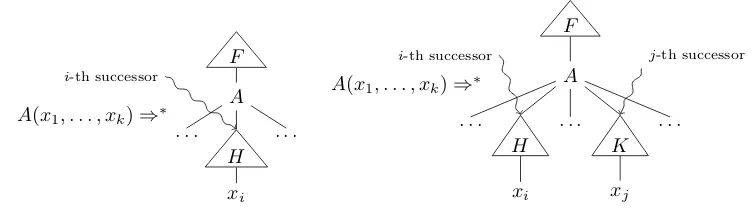
The path language of (the tree language generated by) a lnCFTG is a context-free string language, while the path language of a RTG is a regular string language [5, Thm. 7.13]. It is therefore tempting to try to define the notion of self-embedding for lnCFTGs in terms of the familiar notion of self-embedding for CFGs, applied to path languages of lnCFTGs. However, there is an additional source of non-regularity in lnCFTG that cannot be captured solely in terms of path languages. To illustrate this we consider rules of the lnCFTGG1(cf. Figure 2) and one of its derivations. Note that the numbers ofγ’s in the two argument positions ofAgrow in a synchronized manner, so that the tree language generated fromA(x1, x2) is not regular, even though its path language is a regular string language. We say that a lnCFTG is self-embedding if at least one of the two properties illustrated in Figure 3 is satisfied: Property (1) generalizes self-embedding from the string case (applied to paths), while Property (2) captures potential non-regularity due to different branches growing in a synchronized manner. In Section 4 we will formally define the concept of self-embedding and show that this property can be decided for each lnCFTG.
To simplify the proof, we transformGinto an equivalent lnCFTGH that satisfies the novel property of beingunique in argument positions. Roughly speaking, the effect of this transformation is that generation of symbols in distinct argument positions of one nonterminal ofGis done through several newly introduced nonterminals in
H. This transformation is possible because the negation of Property (2) guarantees that the generation of symbols in distinct argument positions of one and the same nonterminal is independent. In Section 5 we will formally define this property and provide the transformation with a proof of correctness.
Next, we analyze a non-self-embedding lnCFTGH which is unique in argument positions. We consider related nonterminals via analysis of a graph. We can see that, due to Property (1) of self-embedding, unboundedly many symbols can never be created synchronously above and below a nonterminal. Hence, we can divide the generation into two classes, namely top-recursion, which deals with unbounded generation below a nonterminal, and bottom-recursion, which deals with unbounded generation above a nonterminal.
Relying on the properties of non-self-embedding and uniqueness in argument posi-tions, top-recursion can be transformed to bottom-recursion. This is by a construction described in detail in Section 6.1. Subsequently, we show that a non-self-embedding lnCFTG which does not contain any top-recursion can be transformed into an equiva-lent RTG. This relies on the observation that the number of distinct values that may appear below a nonterminal is bounded. This is explained in detail in Section 6.2.
In Section 6.3 we prove our main theorem and in Section 7 we relate the definition of self-embedding for trees to the one used in the string case [22]. In Section 8 we show that our result can be extended to linear CFTG which may be deleting. In Section 9, we define the notion of weakly-self-embedding CFTG, i.e., for the full class of context-free tree grammars. This notion is inspired by self-embedding indexed grammars [25]. Each self-embedding lCFTG is a weakly-self-embedding lCFTG. We prove that each non-weakly-self-embedding CFTG induces a regular tree language. Section 10 concludes with a summary of the subclasses of CFTG relevant to this paper, and the inclusion relations between them.
A(x1, . . . , xk)⇒∗
F
A
. . . H
xi
. . .
i-th successor
(1):F andH are non-trivial trees.
A(x1, . . . , xk)⇒∗
F
A
. . . H
xi
. . . K
xj
. . .
i-th successor j-th successor
[image:4.612.95.472.532.637.2](2): H andKare non-trivial trees.
2. Preliminaries
Mathematical Notions. The set of natural numbers {0,1, . . .} is denoted byN
andN+=N\ {0}. The set of finite sequences overN+ is denoted byN∗+ (including the empty sequence). Forn∈N, we let [n] ={1, . . . , n}; hence [0] =∅. An alphabet
is a non-empty finite set. Theset of words over the alphabet Σ is denoted by Σ∗ with
εbeing theempty word. LetU be a set. ThenP(U) denotes thepowerset ofU. We fix an infinite list x1, x2, . . . of pairwise distinct variables. We let X =
{x1, x2, x3, . . .} and Xk = {x1, . . . , xk}. Furthermore, we abbreviate x1, . . . , xk to
x1..k. We apply this abbreviation also to sequences of other objects. Sometimes we will also use symbols different fromx1, x2, . . .to denote variables, such asz, z1, z2, . . ..
Trees. Aranked alphabetis a pair (∆,rk∆), where ∆ is an alphabet and rk∆: ∆→N
is a function. For everyδ∈∆, we call rk∆(δ) therank ofδ. Sometimes, we write δ(k) to indicate thatδ has rankk. We abbreviate the set rk−∆1(k) to ∆(k)and (∆,rk
∆) to ∆ assuming that rk∆is the rank function. In this paper, ∆ denotes an arbitrary ranked alphabet. We assume that ∆∩X =∅.
LetU be a set. We denote the set oftrees over∆ andU by T∆(U) and write T∆ for T∆(∅). Each subset of T∆is called atree language. Positions in trees are identified by Gorn addresses, represented as finite sequences overN+as usual. Formally, for each
ξ∈T∆(U), theset of positions ofξ, denoted by pos(ξ), is defined inductively as follows: (i) ifξ∈∆(0)∪U, then pos(ξ) ={ε}, and (ii) ifξ=δ(ξ1, . . . , ξk) for someδ∈∆(k),
k≥1 andξ1, . . . , ξk ∈T∆(U), then pos(ξ) ={ε} ∪ {iv|1≤i≤k, v∈pos(ξi)}. For a positionw∈pos(ξ), thelabel of ξ atw and thesubtree ofξ at ware denoted by
ξ(w) andξ|w, respectively. For everyV ⊆∆∪U, we denote theset of positions of ξ
labeled by an element ofV by posV(ξ); ifV is a singleton{v}, then we simply write posv(ξ). ForW ⊆pos(ξ) andw∈W, we say thatwisoutermost inW if there is no
u∈W such thatw=uvfor somev∈N∗+\ {ε}.
LetU be a finite set with ∆∩U =∅. Acontext over∆and U is a tree in T∆(U) in which each elementu∈U occurs exactly once. The set of all such contexts is denoted by C∆(U).
Letξ∈T∆(X),i∈N,xi∈X, andw∈pos(ξ). We say thatwisxi-dominating if
ξ|wcontains a position labeledxi. We callwvariable dominatingif it isxi-dominating for somexi ∈X.
Tree concatenation. Letk∈N, letu1..k ∈U∪∆(0) be pairwise distinct symbols, and letξ∈T∆(U) andξ1..k ∈T∆(X). We define thetree concatenation of ξwithξ1..k atu1..k, denoted by ξ[u1/ξ1, . . . , uk/ξk], inductively on the structure ofξas follows:
(i) ui[u1/ξ1, . . . , uk/ξk] =ξi and
(ii) δ(ζ1, . . . , ζ`)[u1/ξ1, . . . , uk/ξk] =δ(ζ1[u1/ξ1, . . . , uk/ξk], . . . , ζ`[u1/ξ1, . . . , uk/ξk]) for each`≥0 andδ∈∆(`)\ {u
1, . . . , uk}. Tree concatenation is associative [6, Cor 2.4.2].
This abbreviation is also used forξ∈T∆(U) whenU is a finite set other thanXk, provided that elements inU are ordered explicitly, or ifU is a singleton. Moreover, we may writeξ[ui/ξi|i∈[k]] instead ofξ[u1/ξ1, . . . , uk/ξk].
Graphs. Let Σ be an alphabet. A Σ-labeled directed graph (for short: graph) is a pair (V, E) where V is a finite set ofvertices andE is a finite set ofedges satisfying
E⊆V × P(Σ)×V. For an edgee= (v1, U, v2), we callU the label ofe. Let K be a graph. Sometimes we denote the set of vertices byVK and the set of edges by EK or, if no confusion arises, by→. Then (v1, U, v2)∈EK will also be abbreviated by
v1 U
→v2 or just byv1→v2.
We denote the set ofmaximal strongly connected components (SCC) of(V, E) by scc((V, E)).
Let (V, E) be a graph andM ⊆V. TheM-fragment of(V, E), denoted by (V, E)|M, is the graph (M, E∩(M× P(Σ)×M)).
3. Context-Free Tree Languages and Regular Tree Languages
Alinear nondeleting context-free tree grammar2(lnCFTG) is a tupleG= (N,∆, A0, R), whereN and ∆ are ranked alphabets (ofnonterminals andterminals, respectively) such that N ∩∆ = ∅, A0 ∈ N(0) (initial nonterminal), R is a finite set of rules of the form A(x1..k) → ξ with k ∈ N, A ∈ N(k), and ξ ∈ CN∪∆(Xk). In a rule
r: A(x1..k) → ξ the left-hand side (LHS) of r is A(x1..k) and the right-hand side (RHS) ofr isξ, denoted by lhs(r) and rhs(r), respectively. If lhs(r) =A(x1..k), then we callAtheLHS-nonterminal of r, also denoted by lhs(r)(ε). For eachA∈N, we abbreviateA(x1..rkN(A)) byA(x).
For technical convenience, we will also allow rules to use any finite combination of distinct variables instead of a prefix of the sequencex1, x2, x3, . . ., e.g.,A(x2, x5)→
σ(x2, x5). It is easy to see how to transform such a rule into the formally correct form (by renaming variables).
In the following letG= (N,∆, A0, R) be an arbitrary lnCFTG. The derivation relation⇒is defined as follows. For treesζ, ζ0 ∈TN∪∆(X) and a ruler:A(x1..k)→ξ inR, we have ζ ⇒r ζ0 if there is a position w ∈ pos(ζ) such that ζ(w) = A and
ζ0 is obtained from ζ by replacing the subtree at position w by ξ[ζ|w1, . . . , ζ|wk]. Thus if ζ is a context, then so is ζ0. Note that we do not impose any restriction on the order in which nonterminals are derived (unrestricted derivation [7]). We write ζ ⇒ ζ0 if there is an r ∈ R such that ζ ⇒r ζ0. We denote the reflexive, transitive closure of⇒by⇒∗. Forn∈
Nands∈R∗withs=r1r2. . . rn andri∈R for eachi ∈ [n], we write ζ ⇒s ζ0 if there are ζ1, . . . , ζn−1 ∈ TN∪∆(X) such that
ζ⇒r1 ζ1⇒r2 ζ2⇒r3 . . .⇒rn−1ζn−1⇒rnζ
0. In this case, we callsa derivation inG.
Fork∈Nandζ∈CN∪∆(Xk), thetree language induced byζ on Gis
L(G, ζ) ={ξ∈C∆(Xk)|ζ⇒∗ξ} .
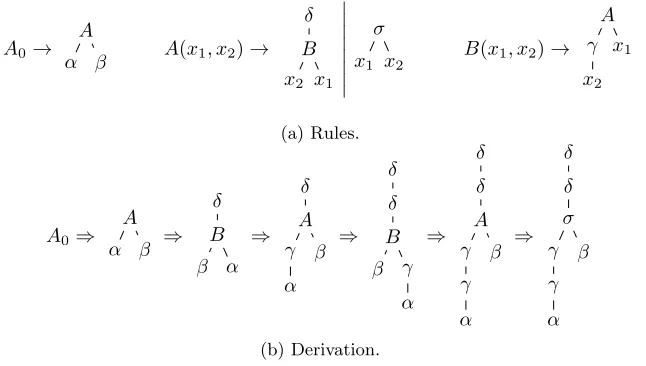
A0→
A
α β A(x1, x2)→ δ
B
x2 x1
σ
x1 x2
B(x1, x2)→
A
γ
x2
x1
(a) Rules.
A0⇒
A
α β ⇒ δ
B
β α
⇒
δ
A
γ
α β ⇒
δ
δ
B
β γ
α
⇒
δ
δ
A
γ
γ
α β ⇒
δ
δ
σ
γ
γ
α β
[image:7.612.124.447.154.337.2](b) Derivation.
Figure 4:: The lnCFTGG2 and an example derivation.
Thetree language ofG, denoted byL(G), is defined byL(G) =L(G, A0). Note that
L(G)⊆T∆. Two lnCFTGs GandG0 areequivalent3 ifL(G) =L(G0). Figure 4(a) presents an example lnCFTGG2 and Figure 4(b) an example derivation. It can be seen thatL(G2) ={δn(σ(γn(α), β))|n∈N}.
It is intuitively clear that rules of a lnCFTGGcan be applied in any order without affecting the resulting tree (cf. the proof of [19, Lm. 4]). This fact goes back to the structural theorems for macro grammars [7]. More precisely, letζ ∈TN∪∆(X) and
w1, w2 be distinct positions of ζ at which rules r1, r2 ∈ R, respectively, apply. If neitherw1 is a prefix ofw2 nor vice versa, then clearlyr1 andr2 can be applied in any order atw1, w2, respectively. If, e.g., w1 is a prefix ofw2, i.e., w2 =w1i ufor someiandu, then the application of r1 might change the position at whichr2 has to be applied. Letvbe the uniquely determined position of xi in rhs(r1). Then the application ofr1 atw1 followed by the application ofr2atw1v uleads to the same tree as the application ofr2atw2 followed by the application ofr1 atw1.
Sometimes, we fix an order where, in each derivation step, one of the nonterminals at an outermost position is derived. Such a derivation is called outside-in (cf. [7, pp. 2-15]).
Later we wish to analyze derivations in which, for some given subset N0 ⊆ N, only rules may be used of which the LHS-nonterminal is inN0. This is achieved by considering all symbols fromN\N0 as terminal symbols. Formally, theN0-fragment of
R, denoted byR|N0, is defined to be the set{r∈R|lhs(r)(ε)∈N0}. TheN0-fragment
3in the NLP-community, equality of induced tree languages is more specifically calledstrongly
of Gis the lnCFTG
G|N0 = (N0,∆∪(N\N0), , R|N0) .
where the initial nonterminal ofG|N0 is irrelevant, and we only address its language using an explicitly given initial treeζ viaL(G|N0, ζ).
As an example, we consider the lnCFTGGusing the set of nonterminals{A0, A, B}, the set of terminals ∆ = {σ(2), γ(1), α(0), β(0)}, and the rules A
0 → A(α, β),
A(x1, x2)→A(B(x1), x2)|σ(x1, x2), andB(x1)→γ(B(x1)). The{A}-fragment ofG has only the two rules with LHS-nonterminalA. The tree language induced byA(x1, x2) on the fragment is L G|{A}, A(x1, x2) = {σ(Bn(x1), x2) | n ∈ N} ⊆ C∆∪{B}(X2) whereBn(x
1) is a tree consisting of n B’s on top of each other followed by anx1. Aregular tree grammar (RTG) is a lnCFTG in which each nonterminal has rank 0. A tree languageL ⊆ T∆ is regular if there is a RTGG= (N,∆, A0, R) such that
L(G) =L.
4. Self-Embedding lnCFTG
In [3] it was proved that each context-free string grammar which is non-self-embedding generates a regular language, where self-embedding means the existence of a derivation of the formA⇒∗vAwwithv6=εandw6=εfor some stringsv andwover terminals and nonterminals. Here we generalize the notion of self-embedding to the tree case.
LetG= (N,∆, A0, R) be a lnCFTG. We say thatGisself-embedding if there is a
k≥1 and anA∈N(k) such that at least one of the following two properties holds (viewing the variables inXk as symbols with rank 0):
(1) There is ani∈[k] and there areF, A0, H ∈C
N∪∆∪Xk({z}) such that
• A(x1..k)⇒∗F[A0[H[xi]]],
• A0(ε) =A,A0(i) =z, and
• F 6=z andH 6=z.
(2) There are i, j ∈ [k] with i 6= j and there are F, H, K ∈ CN∪∆∪Xk({z}) and
A0∈CN∪∆∪Xk({z1, z2}) such that
• A(x1..k)⇒∗F[A0[H[xi], K[xj]]],
• A0(ε) =A,A0(i) =z1, andA0(j) =z2, and
• H 6=z andK6=z.
These two properties were depicted in Figure 3 and we illustrate them by three examples. Simultaneously we will motivate the introduction of a particular finite graph which allows us to check these properties.
A(x1, x2)→
δ
B
x2 x1
B(x1, x2)→
A
γ
x2
x1
(a) Rules.
A
x1 x2
⇒
δ
B
x2 x1
⇒
δ
A
γ
x1
x2
⇒
δ
δ
B
x2 γ
x1
⇒
δ
δ
A
γ
γ
x1
x2
(b) Derivation.
(A,0,1) (A,0,2) (A,1,2) (A,2,1)
(B,0,2) (B,0,1) (B,2,1) (B,1,2)
{1} {2} {1} {1} {2}
[image:9.612.108.444.148.364.2](c) Position pair graph.
Figure 5:: Part of the lnCFTGG2.
0, which represents the generation happening above the nonterminal; it may only occur in the first of the two argument positions. An edge from (A,0, j) to (B,0, m) indicates that there is a rulerwith LHS-nonterminal Asuch thatxj appears in the argument positionmof an occurrence ofB in the RHS. An edge can be labeled by any subset of{1,2}, where we drop the label∅in the figures. If there is at least one symbol above the occurrence ofB, then the label contains a 1; if at least one symbol occurs between the occurrences ofB andxm, then the label of this edge contains a 2. The 1 pertains to the first of the two argument positions in (A,0, j) and (B,0, m), which are both 0, while 2 pertains to the second argument positions, which arej and
m, respectively.
The leftmost two SCCs in Figure 5(c) show part of the position pair graph ofG2 dealing with this combination of generation above and below a nonterminal. (The rightmost two SCCs will become clear soon.) The first two steps of the derivation in Figure 5(b) induce in particular the path
(A,0,1)−→{1} (B,0,2)−→{2} (A,0,1)
through the position pair graph. Since (i) this path is cyclic, (ii) the union of the edge labels contains 1 and 2, and (iii) the position 0 is involved, Property (1) of self-embedding is satisfied.
A(x1, x2)→
B
γ
x2
x1
B(x1, x2)→
A
x1 x2
(a) Rules.
A
x1 x2
⇒
B
γ
x2
x1 ⇒
A
γ
x2
x1 ⇒
B
γ
x1
γ
x2
⇒
A
γ
x1
γ
x2
(b) Derivation.
(A,0,1) (B,0,1) (A,1,2) (B,1,2)
(B,0,2) (A,0,2) (B,2,1) (A,2,1)
{2} {2} {1}
[image:10.612.107.443.151.354.2](c) Position pair graph.
Figure 6:: Part of the lnCFTGG1.
γ’s are equal after each fourth step. To capture this in the position pair graph, we employ vertices with two argument positions different from 0. An edge from (A, i, j) to (B, `, m) (withi6=j and`6=m) indicates that there is a rulerwith LHS-nonterminal
Asuch thatxi appears in the argument position`of an occurrence ofB in the RHS andxj appears in the argument positionmof the same occurrence ofB. If at least one symbol occurs between the occurrences ofB andxi, then the edge label contains a 1. Likewise, if at least one symbol occurs between the occurrences ofB andxj, then the edge label contains a 2.
Thus, the position pair graph ofG1is the one shown in Figure 6(c). The derivation in Figure 6(b) induces in particular the path
(A,1,2)−→{2} (B,2,1)−→(A,2,1)−→{1} (B,1,2)−→(A,1,2)
through the rightmost SCC of the position pair graph. Since (i) this path is cyclic, (ii) its union of edge labels contains 1 and 2, and (iii) the position 0 is not involved,
Property (2) of self-embedding is satisfied.
In the third and last example, we show part of a lnCFTGG3 in Figure 7(a), which simultaneously satisfies Properties (1) and (2) of self-embedding. The lnCFTGG3 looks similar to G1, but the order of the variables in the second rule is swapped. Figure 7(b) shows an example derivation and Figure 7(c) the position pair graph. Note that there are two cycles and in each cycle the union of edge labels contains 1 and 2.
A(x1, x2)→
δ
B
x2 x1
B(x1, x2)→
A
γ
x1
x2
(a) Rules.
A
x1 x2
⇒
δ
B
x2 x1
⇒
δ
A
γ
x2
x1
⇒
δ
δ
B
x1 γ
x2
⇒
δ
δ
A
γ
x1
γ
x2
(b) Derivation.
(A,0,1) (B,0,1) (A,1,2) (B,1,2)
(B,0,2) (A,0,2) (B,2,1) (A,2,1) {2}
{1} {1}
{2} {1}
[image:11.612.109.442.156.384.2](c) Position pair graph.
Figure 7:: Part of a lnCFTGG3.
Definition 4.1 The position pair graph of G is the {1,2}-labeled directed graph ppg(G) = (V, E)where
V ={(A, i, j)|A∈N(k), i∈([k]∪ {0}), j ∈[k], i6=j}
andEis defined as follows. Let(A,0, j),(B,0, m)∈V andr∈R|{A}such that there is aw∈posB(rhs(r))for whichwmisxj-dominating. We let((A,0, j), U,(B,0, m))∈E
whereU ⊆ {1,2}is defined as follows:
• w6=εiff1∈U,
• rhs(r)(wm)6=xj iff2∈U.
Furthermore, let (A, i, j),(B, `, m) ∈ V with i 6= 0, ` 6= 0, and let r ∈ R|{A} be such that there exists a w ∈ posB(rhs(r)) for which w` is xi-dominating and wm
isxj-dominating. We let ((A, i, j), U,(B, `, m))∈E where U ⊆ {1,2} is defined as follows:
• rhs(r)(w`)6=xi iff 1∈U,
Observation 4.2 LetQ∈scc(ppg(G)). Then exactly one of the following two state-ments holds:
• For each vertex (A, i, j)∈VQ, we havei= 0.
• For each vertex (A, i, j)∈VQ, we havei6= 0.
Now we can characterize the property of a lnCFTG G being self-embedding in terms of the position pair graph ofG.
Theorem 4.3 A lnCFTGGis self-embedding iff ppg(G)contains a vertex (A, i, j) and a path from (A, i, j) to (A, i, j) such that the union of all its labels contains 1 and2.
Proof. [⇒]: IfGis self-embedding, then Property (1) or (2) holds. If Property (1) holds, there is a derivation starting from A(x1..k) resulting in a tree with an x i-dominating occurrence ofAwhich is not at the root, andxioccurs in itsi-th argument position but not as its direct descendant. This derivation corresponds to a cycle in ppg(G) of the same length. Since symbols are generated both aboveAand betweenA
andxi, the union of the edge labels contains 1 and 2.
Similarly, if Property (2) holds, there is a derivation that corresponds to a cycle in ppg(G). The union of the edge labels of this path contains 1 and 2, because symbols are synchronously generated under two different argument positions.
[⇐]: Suppose that there is a cycle in the position pair graph and the union of its edge labels contains 1 and 2. Then we can construct a derivation inGwhich satisfies Property (1) or (2): For each edge in the cycle, we apply a rule that gave rise to this
edge in the construction of ppg(G). 2
Corollary 4.4 For each lnCFTG G, it is decidable in polynomial time whether Gis self-embedding.
Proof. The position pair graph ofGcan be constructed in polynomial time in the following parameters ofG: number of nonterminals, the maximal rank of the nonter-minals, the number of rules, and the maximal number of occurrences of nonterminals in the RHS of any rule. One can enumerate all SCCs of ppg(G) in linear time [4, p. 617]. For a SCC in ppg(G) it can be determined in linear time whether the union of all its edge labels is{1,2}. By Theorem 4.3 this is all that is required to decide
whetherGis self-embedding. 2
The reader might have realized that none of our examples contains nested nonter-minals. This choice is reasonable, because the grammars remain self-embedding even if one replaces any occurrence of a terminal by a nonterminal (with arbitrary rules). However, applying this replacement to a non-self-embedding lnCFTG might lead to a non-self-embedding lnCFTG or a self-embedding lnCFTG. For instance, if in the non-self-embedding lnCFTG with the two rules
A(x1, x2)→
A
γ
x1 x2
α
A
β δ
x1 x2
κ
x1 x2
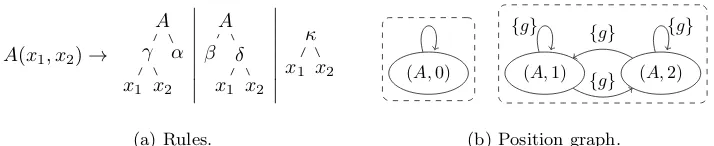
(a) Rules.
(A,0) (A,1) (A,2)
{g} {g}
{g} {g}
[image:13.612.104.461.151.224.2](b) Position graph.
Figure 8:: Part of a lnCFTGG4.
we replace the second rule by
G(x)→A(x) .
then the resulting grammar is self-embedding. Our formal investigation allows for nested nonterminals, but they will not be needed in our examples to illustrate various constructions and proofs.
5. Uniqueness in Argument Positions
In this section, we introduce a property called unique in argument positions. We prove that each non-self-embedding lnCFTG can be transformed into an equivalent lnCFTG which is unique in argument positions. This syntactic restriction will turn out to be useful to construct an equivalent RTG for each non-self-embedding lnCFTG. The definition of the property is based on the concept of the position graph, which we describe in the following. Subsequently, we will give a formal definition of the property.
In this section, we letG= (N,∆, A0, R) be a non-self-embedding lnCFTG.
Position Graph. The graph contains one vertex for each pair of nonterminal and argument position (including the special argument position 0 as in the case of the position pair graph). Its edges represent the movement of values across argument positions, and are labeled with{g} if new symbols are generated at the same time, and with∅ otherwise. For instance, Figure 8(b) depicts the position graph of the lnCFTGG4in Figure 8(a).
Definition 5.1 The position graph ofG is the{g}-labeled directed graph pg(G) = (V, E)where
V ={(A, i)|A∈N(k), i∈([k]∪ {0})} .
In order to obtainE, we first define the auxiliary mappingedg : R→ P(V×P({g})×V) as follows. Let A, B∈N andr∈R|{A} such that there exists a variable dominating
• If w6=ε, thenedg(r)contains the edge((A,0),{g},(B,0))and
• ifw=ε, then edg(r)contains the edge((A,0),∅,(B,0)).
Moreover, leti∈[rkN(A)]andj∈[rkN(B)] such thatwj isxi-dominating.
• If rhs(r)(wj)6=xi, thenedg(r)contains the edge((A, i),{g},(B, j))and
• ifrhs(r)(wj) =xi, then edg(r)contains the edge((A, i),∅,(B, j)).
Furthermore, edg(r) does not contain any other elements. Then we define E = S
r∈Redg(r).
If an edge is labeled by {g}, then we call it generating. We call P ∈ scc(pg(G)) generating ifP contains a generating edge. Sometimes we will also be interested in the set of rules which have induced edges in a particularP ∈scc(pg(G)). Formally, we define the set ofrules ofP, denoted by rules(P), to be the set
rules(P) ={r∈R|EP∩edg(r)6=∅} .
Letn∈Nandr1, r2, . . . , rn ∈R. We say that the sequencer1r2. . . rn induces a path
p: (A0, i0)→(A1, i1)→. . .→(An, in)
in pg(G) if for each k∈[n] the set edg(rk) contains the edge (Ak−1, ik−1)→(Ak, ik). For instance consider the rules in Figure 8(a), which we denote byr1, r2, and r3, respectively. The sequence of ruless=r1r2r2induces the paths
p1: (A,0) ∅
→(A,0)→∅ (A,0)→∅ (A,0) ,
p2: (A,1) {g}
→ (A,1){g}→ (A,2){g}→(A,2) , and
p3: (A,2) {g}
→ (A,1){g}→ (A,2){g}→(A,2) .
We make three observations concerning the position graph, which will help us later.
Observation 5.2 LetP ∈scc(pg(G)). Then exactly one of the following two state-ments holds:
• For each vertex (A, i)∈VP, we have i= 0.
• For each vertex (A, i)∈VP, we have i6= 0.
Observation 5.3 Let A, B ∈N and r ∈R. Then (A, i)→ (B, j) is in edg(r) for somei∈[rkN(A)]andj∈[rkN(B)] iff(A,0)→(B,0) is inedg(r).
ForP∈scc(pg(G)), we denotethe set of all nonterminals occurring inP byMP, i.e.,MP ={A|k∈N,(A, k)∈VP}.
Since G is non-self-embedding, the rules of a generating SCC of pg(G) which does not contain references to 0 have a particular form. This will be crucial while transforming the grammar.
Lemma 5.5 LetP ∈scc(pg(G))be generating such that(C,0)∈/ VP for eachC∈N. Then each rule inrules(P)has the formA(x1..k)→B(ζ1..`)for someA, B∈MP and
ζ1..`∈TN∪∆(Xk).
Proof. The proof is by contradiction.
Assume that there is a ruler in rules(P) such that rhs(r)(ε) ∈/ MP. Sincer ∈ rules(P) and (C,0) ∈/ VP for each C ∈ N, it follows that there are A, B ∈ MP,
i∈[rkN(A)], j∈[rkN(B)], and U ⊆ {g} such that ((A, i), U,(B, j))∈EP ∩edg(r). From Definition 5.1, we get that there is a positionw∈posB(rhs(r)) such thatwj is
xi-dominating. By the assumption, we have thatw6=ε.
Since (A, i) and (B, j) are vertices in the same generating SCC P, there are
C, D∈ MP, m∈ [rkN(C)], andn ∈[rkN(D)] such that ((C, m),{g},(D, n)) ∈EP and thus the following path exists inP:
p: (A, i)→(B, j)→. . .→(C, m){g}→ (D, n)→. . .→(A, i)
where the first edge is induced byr.
We will now usepand construct a cycle in ppg(G). For each edge (A0, i0)→(B0, j0) inp, there arer0 ∈rules(P) andw0∈posB0(rhs(r0)) such thatw0j0 isxi0-dominating. Then, by Definition 4.1, there is an edge ((A0,0, i0), U0,(B0,0, j0)) in ppg(G) for some
U0 ⊆ {1,2}. Hence, we obtain the cycle
p0 : (A,0, i)→U (B,0, j)→. . .→(C,0, m)U 0
→(D,0, n)→. . .→(A,0, i) .
We now investigate U andU0. First consider the edge ((A,0, i), U,(B,0, j)). This edge is induced using the rulerat positionwin rhs(r). By Definition 4.1, we have that 1∈ U, becausew 6=ε. Second, consider the edge ((C,0, m), U0,(D,0, n)). It was constructed on the basis of ((C, m),{g},(D, n)), for a ruler0 ∈rules(P) and a positionw0∈posD(rhs(r0)) such that w0nisxm-dominating and rhs(r0)(w0n)6=xm. Hence, by Definition 4.1, we have 2∈U0.
Sincep0 is a cycle in ppg(G) such that the union of its labels contains 1 and 2, the lnCFTGGis self-embedding by Theorem 4.3. This contradicts the assumption onG. 2
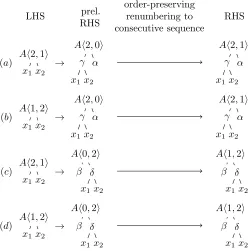
Uniqueness in argument positions. Consider the rules of the lnCFTGG4 in
LHS prel. RHS
order-preserving renumbering to consecutive sequence
RHS
(a) Ah2,1i
x1x2
→
Ah2,0i
γ
x1x2
α
Ah2,1i
γ
x1x2
α
(b) Ah1,2i
x1x2
→
Ah2,0i
γ
x1x2
α
Ah2,1i
γ
x1x2
α
(c) Ah2,1i
x1x2
→
Ah0,2i
β δ
x1x2
Ah1,2i
β δ
x1x2
(d) Ah1,2i
x1x2
→
Ah0,2i
β δ
x1x2
Ah1,2i
β δ
[image:16.612.159.410.154.405.2]x1x2
Figure 9:: Rules fromG4 with annotated relative ages.
using the second rule repeatedly, an unbounded number ofδ’s can be generated in the second argument position. But, by switching from the generation in argument positioni(withi∈ {1,2}) to the generation in the other argument position, the value of argument positioni is reset to a constant tree (β if i = 1; α if i = 2). Hence, there is nosynchronized generation of symbols in different argument positions of one nonterminal.
In the following, we transform a non-self-embedding lnCFTG in such a way that such unsynchronized generation below one nonterminal is distributed over distinct nonterminals and thus, each nonterminal generates unbounded material in at most one argument position. Before we present our method of transformation, we first give a formal characterization of the desired property.
Definition 5.6 Let P ∈ scc(pg(G)) be generating. We call P unique in argument positionsif(A, j)∈VP and(A, j0)∈VP impliesj=j0. We callGunique in argument positionsif each generatingP ∈scc(pg(G))is unique in argument positions.
sequenceh2,1i, which is a permutation of [2], states that the first position has relative age 2 and the second one has relative age 1. The intuition is that the value in the second position was ‘born’ after the value in the first position.
Upon applying a rule, the variables determine how relative ages are transferred from the LHS to positions of the root nonterminal in the RHS, say an occurrence ofB with rank `. This is subject to the following two constraints. First, if a new value is ‘born’ in argument positionj ofB, which is when there are no variables in that position, it receives a unique relative age that is smaller than any position that does have variables; we assign 0 as a preliminary value. This is exemplified by 0 in
h4,0iin the preliminary RHS in Figure 9(a), and 0 in h0,4iin the preliminary RHS of Figure 9(c). Second, if an argument position ofB contains several variables, we take the maximum of the relative ages of the corresponding LHS positions as preliminary value. This is exemplified by 2 inh2,0iin the preliminary RHS in Figure 9(a), where 2 = max{2,1}, and similarly 2 in h0,2i in Figure 9(c). We then assign the final ages represented as a permutation according to the following rules. The higher the preliminary value of an argument position is, the higher its final age will be. The argument positions with preliminary value 0 are assigned decreasing values from left to right. Thus, the newly born argument positions obtain the smallest relative ages, whereas the argument positions obtain the smallest relative ages, whereas the argument positions that contain older subtrees obtain strictly higher relative ages. Hence,h0,2i
is turned intoh1,2i. This transformation yields the RHS of the newly constructed rule, as depicted in Figure 9.
Lemma 5.7 For each non-self-embedding lnCFTGG, there is an equivalent lnCFTG
H that is non-self-embedding and unique in argument positions.
Proof. Assume thatGis not unique in argument positions. Then there is a generating
P∈scc(pg(G)) such thatP is not unique in argument positions. We note that, for eachA∈N, the vertex (A,0) is not inP (cf. Observation 5.2).
The following construction splits each nonterminal involved inP into new nontermi-nals of the formAhπiwhereπis a permutation of the argument positions of A. Each number inπrepresents the relative age of the corresponding argument with respect to the other arguments. The lower the number of an argument, the more recently its corresponding value was introduced, as explained above Lemma 5.7.
Formally, let r:A(x1..k) → B(ζ1..`) be a rule in rules(P) for some A, B ∈ MP (cf. Lemma 5.5). Furthermore, let π be a permutation of [k]. This determines a
permutation πr of the argument positions of B. For this, we define the auxiliary mappingρ: [`]→Nas follows. For eachj∈[`], letVj denote the set of alli∈[k] such thatxi occurs in ζj and letρ(j) = max({π(i)|i∈Vj}) where max(∅) = 0. Then, we define the permutationπrof [`] as the unique permutation such thatπr(j)< πr(j0) if
(i) ρ(j)< ρ(j0), or
(ii) ρ(j) =ρ(j0) andj > j0.
• N0= (N\M
P)∪N˜ and ˜N ={Ahπi (k)
|A∈MP(k), π is a permutation of [k]},
• R0 = enr((R\R|MP)∪R˜1∪R˜2), and ˜R1, ˜R2, and enr are defined as follows. For each rule r: (A(x1..k) → B(ζ1..`)) in rules(P) and for each permutation
πof [k] andπr as constructed above, letAhπi(x1..k)→Bhπri(ζ1..`) be in ˜R1. Furthermore, for each rule r ∈ (R|MP \rules(P)) with lhs(r)(ε) = A
(k), let
Ahπi(x1..k)→rhs(r) be in ˜R2for each permutationπ.
The set of rules (R\R|MP)∪R˜1∪R˜2 is ‘enriched’ by the function enr, which replaces each occurrence of a nonterminalA∈MP(k)in the RHS of each rule by
Ahπ˜iwhere ˜πis the reversal of [k], i.e., for eachi∈[k] we haveπ(i) =k−i+ 1.
Due to the use of the maximum in the definition of the permutations, we have that if there is a path from (Bhπi(k), i) to (B0hπ0i(`), i0) in pg(H), thenk−π(i)≥`−π0(i0).
Claim 1: GandH are equivalent. Moreover,H is non-self-embedding.
Proof of Claim 1: For each derivation of G, there is precisely one way to add permutations to turn it into a derivation ofH, as LHS permutations uniquely determine RHS permutations, and all permutations are allowed. Thus,GandH are equivalent. Furthermore, since each derivation inH can be projected onto a derivation inG,
the lnCFTGH is non-self-embedding.
Claim 2: H|N˜ is unique in argument positions.
Proof of Claim 2: We already stated that if there is an edge from (Bhπi(k), i) to (Bhπ0i(`), i0), thenk−π(i)≥`−π0(i0). Recall that this property holds due to the use
of the maximum in the construction ofπ0.
Consider any generatingP0 ∈scc(pg(H|N˜)),A
(k)∈M
P, a permutation π of [k], and i, j ∈ [k] such that (Ahπi, i) ∈ VP0 and (Ahπi, j) ∈ VP0. Since (Ahπi, i) and (Ahπi, j) are in the same SCCP0 we can deduce that (i) there is a path from (Ahπi, i) to (Ahπi, j) and (ii) there is a path in the other direction. We can thus conclude that
k−π(i)≥k−π(j) andk−π(j)≥k−π(i). Sinceπis a permutation, we havei=j.
Therefore,H|N˜ is unique in argument positions.
The above process can be repeated until the resulting grammar is unique in argument positions. Termination is guaranteed, because in the transformation we only introduce SCCs which are unique in argument positions and thus, the total number of SCCs which are not unique in argument positions decreases in each step. 2
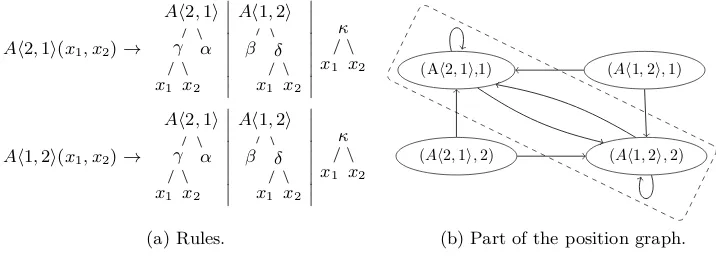
If we apply the construction of Lemma 5.7 to the rules ofG4in Figure 8(a), then we obtain the lnCFTG depicted in Figure 10(a). Figure 10(b) shows the relevant part of the corresponding position graph where each edge is generating (edge labels were omitted). The non-trivial SCC of Figure 10(b) is marked by a dashed box. It can be seen that each generating SCC contains, for each involved nonterminal, a unique argument position.
6. Proving Regularity of Non-self-embedding lnCFTG
Ah2,1i(x1, x2)→
Ah2,1i
γ
x1 x2
α
Ah1,2i
β δ
x1 x2 κ
x1 x2
Ah1,2i(x1, x2)→
Ah2,1i
γ
x1 x2
α
Ah1,2i
β δ
x1 x2 κ
x1 x2
(a) Rules.
(Ah2,1i,1)
(Ah2,1i,2)
(Ah1,2i,1)
(Ah1,2i,2)
[image:19.612.99.457.154.285.2](b) Part of the position graph.
Figure 10:: The lnCFTG obtained by applying the construction of Lemma 5.7 toG4.
Consider the position graph ofH. We classify a generating SCCP ∈scc(pg(H)) according to whether nonterminals involved inP generate unbounded material below them, or above them. Formally, for each SCCP ∈scc(pg(H)) we say thatP is
• bottom-recursive ifP is generating and contains (A,0) for someA∈N,
• top-recursive ifP is generating and does not contain (A,0) for everyA∈N.
As a running example, we consider the non-self-embedding lnCFTG
H1= ({A (0) 0 , A
(3), B(2)},{α(0), β(0), σ(2), κ(3)}, A 0, R)
whereR consists of the following four rules:
A0→A(α, α, α) ,
A(x1, x2, x3)→
B
σ
x1 x2
x3 κ
x1 x2 x3
, B(x1, x2)→
A
β x1 x2
.
Figure 11 depicts the position graph ofH1, which shows thatH1is unique in argument positions. Furthermore, pg(H1) contains five SCCs, from which three are non-trivial. The non-trivial SCCs are marked by dashed boxes. The SCCP is top-recursive, since it is generating and does not contain (A,0), (B,0), or (A0,0). All other SCCs are not generating and thus neither top-recursive nor bottom-recursive.
6.1. Transforming a Top-Recursive SCC into Bottom-Recursive SCCs
[image:19.612.130.441.462.526.2](A0,0) (A,0)
(B,0)
(A,1) (A,2) (A,3)
(B,1) (B,2)
{g}
{g}
[image:20.612.127.443.146.247.2]P
Figure 11:: The position graph ofH1.
Definition 6.1 The top-recursive rankofH, denoted bytopRank(H), is the number of vertices in top-recursive SCCs in pg(H), or formally
topRank(H) = X
P∈scc(pg(H)) P is top-recursive
|P| .
For the running example lnCFTGH1(cf. Figure 11 for its position graph), we have topRank(H1) = 2, since (A,2) and (B,1) are in the only top-recursive SCCP.
We recall Lemma 5.5 stating that, for each top-recursive SCC P, each rule r∈
rules(P) has the form A(x) → B(ξ1..`), where A, B ∈ MP. The following two observations will be needed later.
Observation 6.2 We letr∈R be of the formA(x1..k)→B(ξ1..`). Then, for each
i∈[k], there is a unique ji ∈[`] such thatxi occurs in ξji. Thus, there is an edge (A, i)→(B, ji)in edg(r).
Given an outside-in derivationsconsisting exclusively of rules from a top-recursive SCCP and given a vertex (A, i)∈Vpg(H) whereA∈MP andA(x)⇒s ξfor some
ξ ∈ TN∪∆(XrkN(A)), there are uniquely determined B ∈ MP, j ∈ [rkN(B)], and
p: (A, i)→∗(B, j) such that each edge along the pathpis determined according to Observation 6.2. In this case, we say thatstop-induces the pathp.
Observation 6.3 Let r ∈ R be of the form A(x) → B(ξ1..`). If there are i, j ∈ [rkN(A)] with i 6= j and k ∈ [`] such that xi and xj both occur in ξk, then edg(r) contains the edges((A, i),{g},(B, k))and((A, j),{g},(B, k)).
The proof of the following lemma incorporates two constructions and is rather lengthy. A full example can be found after the proof and may be consulted alongside.
Lemma 6.4 Let H be a non-self-embedding lnCFTG which is unique in argument
Proof. Since topRank(H) ≥ 1, there is a P ∈ scc(pg(H)) which is top-recursive and not reachable from any other top-recursive SCC. LetP now be fixed. For each
B∈MP, we denote the unique indexj∈[rkN(B)] such that (B, j)∈VP byjB. We will construct a setK of items of the formhA, B, ξ1..(jB−1),d, ξ(jB+1)..`i. Each item represents the fact that there is anξjB such thatA(x)⇒
∗B(ξ
1..`). Intuitively, an item inK captures a context in which treesξjB can be generated. We usedas a placeholder for the dynamic position. We will show that K is finite and use the elements ofK as nonterminals for new rules that will replace the rules from rules(P) and thereby decrease the top-recursive rank.
Formally, we defineKthrough a family (Ki |i∈N) as follows.
• K0={hA, A, x1..(jA−1),d, x(jA+1)..ki |k∈N, A∈M (k) P }.
• We leti∈N. ThenKi+1 is the smallest setK0 satisfying the following condition. If there arehA, B, ξ1..(jB−1),d, ξ(jB+1)..`i ∈Ki, r ∈rules(P)|{B}, m ∈N,C ∈
MP(m) and ξ10..m ∈ TN∪∆(XrkN(A)) such that B(ξ1..(jB−1), xjB, ξ(jB+1)..`) ⇒r
C(ξ10..m) is an outside-in derivation, thenhA, C, ξ01..(j
C−1),d, ξ 0
(jC+1)..miis inK 0.
• K=S i∈NKi.
Claim 1: Letn∈N. Furthermore, letA∈MP(k) andB ∈M (`)
P withk, `∈N+, and
ξ1..(jB−1), ξ(jB+1)..`∈TN∪∆(Xk). The following are equivalent.
(i) There are aξjB∈TN∪∆(Xk) and an outside-in derivationssuch that |s|=n andA(x)⇒sB(ξ1..`).
(ii) hA, B, ξ1..(jB−1),d, ξ(jB+1)..`i ∈Kn.
Proof of Claim 1: (i)⇒(ii): We can show this claim by well-founded induction onn. Clearly, for each A ∈ MP, we have that A(x) derives to A(x) within zero rule application steps and also by definitionhA, A, x1..(jA−1),d, x(jA+1)..ki ∈K0.
Now assume that the claim holds for derivations of lengthnfor somen∈N. Assume
a derivationsof lengthnand a ruler∈Rsuch that A(x)⇒sB(ξ1..`)⇒rC(ξ01..m). By the induction hypothesis, we havehA, B, ξ1..(jB−1),d, ξ(jB+1)..`i ∈Kn and thus, by definition ofKn+1, it follows thathA, C, ξ10..(jC−1),d, ξ(0jC+1)..mi ∈Kn+1.
(ii) ⇒ (i): For each A ∈ MP we have hA, A, x1..(jA−1),d, x(jA+1)..ki ∈ K0 and it holds that A(x) derives to A(x) within zero rule application steps. Now let n ∈ N and assume that the claim holds for each element in Kn.
Further-more, assume hA, C, ξ10..(jC−1),d, ξ(0jC+1)..mi ∈Kn+1. By definition of Kn+1, there are hA, B, ξ1..(jB−1),d, ξ(jB+1)..`i ∈ Kn, a rule r : B(x) → C(ζ1..m), and some
ξj0
C ∈ TN∪∆(Xk) such that B(ξ1..(jB−1), xjB, ξ(jB+1)..`) ⇒r C(ξ 0
1..m). By the in-duction hypothesis, there areξjB∈TN∪∆(Xk) and a derivationA(x)⇒sB(ξ1..`) of lengthn. Then, we extendswithrand obtain
A(x)⇒sB(ξ1..`)⇒rC(ξ10..(jC−1), ξ 0
jC[xjB/ξjB], ξ 0
(jC+1)..m) .
Proof of Claim 2: In this proof letn1= max{|pos∆∪(N\MP)(rhs(r))| |r∈rules(P)},
n2=|MP|, andn3= max{rkN(C)|C∈MP}. We prove the claim by contradiction. Assume thatKis an infinite set. Then there arehA, B, ξ1..(jB−1),d, ξ(jB+1)..`i ∈K,
i, m∈[`]\ {jB}, and rule sequencess,s1, ands2of rules in rules(P) such that
(1) |pos(ξi)|> n1·n2·n3,
(since ∆ andN are finite sets, there is such a treeξi)
(2) sis an outside-in derivation and there is aξjB withA(x)⇒sB(ξ1..`), (cf. Claim 1)
(3) s1is a subsequence ofssuch thats1top-induces a generating cyclep1: (B, m)→∗ (B, m) in a SCC of pg(H) different fromP,
(since ξi is sufficiently large, there must be a generating cycle)
(4) s2is an outside-in derivation and it top-induces a generating cyclep2: (B, jB)→∗ (B, jB) inP.
(since P is a top-recursive SCC, there must be such a generating cycle)
We show the following statement by induction.
Statement (†): For eachn∈N, there is anmn∈[rkN(B)] such that
(i) for each i∈ [n], the sequence s1s2 top-induces a path (B, mi−1)→∗ (B, mi), and
(ii) mn∈ {/ jB, m0, . . . , mn−1}.
For the induction base (n = 0), we let m0 = m and recall that m 6=jB. For the induction step, we assume that (†) holds forn∈N. A consequence of Observation 6.2
is that there is a uniquem0 such thats1s2 top-induces the path (B, mn)→∗(B, m0). We letmn+1=m0. Then, (i) holds formn+1. Now, we show thatmn+1satisfies (ii). If
mn+1=jB, then (B, m)→∗(B, jB), but because (B, m) is in a generating SCC, this would contradict the assumption thatP is not reachable from any other generating SCC. It remains to provemn+1∈ {/ m0, . . . , mn}.
Assume that mn+1 = mj for some j ∈ {0,1, . . . , n}. The sequence (s1s2)n−j+1 top-induces
p: (B, mj)→(s1s2)n−j (B, mn)→s1s2 (B, mj)
p0: (B, jB)→(s1s2)n−j (B, jB) →s1s2 (B, jB) .
We show that p and p0 are generating. If j = 0, then the cycle p is generating, because it containsp1. Ifj6= 0, thens1s2top-inducesp00: (B, mn)→s1s2 (B, mj) and
p000: (B, mj−1)→s1s2 (B, mj), and, by Observation 6.3,p
00is generating and therefore
pis generating. Thus pis generating regardless of the choice of j. The path p0 is generating, because it containsp2.
Observation 6.2 and sincemj 6=jB, we have thati1=6 j1andi26=j2. By Definition 4.1, there is an edge ((B1, i1, j1), U0,(B2, i2, j2)) in ppg(H). Furthermore, we have that 1∈U0 ifU1={g} and 2∈U0 ifU2={g}.
Hence, frompandp0, we obtain the following path ˜pin ppg(H):
˜
p: (B, mj, jB)→(s1s2)n−j (B, mn, jB)→s1s2 (B, mj, jB) .
Sincepandp0 are both generating, ˜pis a cycle such that the union of all its path labels contains 1 and 2. By Theorem 4.3, this contradictsH being non-self-embedding and thus, (ii) holds formn+1. This proves (†).
However, (†) conflicts with the finiteness of rkN(B) and thus,K is a finite set.
We modifyH with the help ofK to construct a lnCFTGH0. We let H0 contain all original rules, except the ones of rules(P). We further add copies of the rules from rules(P) after transforming them into bottom-recursive rules. This is done by reversing the rules, i.e., ifH appliesr1 and afterwardsr2(r1, r2∈rules(P)), thenH0 applies firstr2 and thenr1.
Reversing a rule is achieved by considering the rule in the context of a derivation. This context is represented by using the elements from K as nonterminals for H0. As an example, consider the rule r: A(x1, x2, x3) → B(σ(x1, x2), x3) from H1 (cf. the running example). We have jA = 2 and jB = 1 and we consider the context
k1=hA, A, β,d, x3iinK. If we considerrin the context ofk1 we obtain
A(β, x2, x3)→B(σ(β, x2), x3) .
In the RHS, we obtain the contextk2=hA, B,d, x3i. We reverse the rule and construct a new rule with LHSk2(x1, x2), wherex1 andx2 are those variables ofXrkN(A) not present ink2. The RHS of the new rule is obtained from the subtree of rhs(r) at positionjB as follows. We replacexjA byk1(x1, x2) where again,x1and x2 are the variables ofXrkN(A)not present ink1. Hence,ris turned into the rule
hA, B,d, x3i(x1, x2)→σ(β,hA, A, β,d, x3i(x1, x2), x3) .
We add some rules which handle the connection to rules outside of rules(P). For eachhA, B, ξ1..(jB−1),d, ξ(jB+1)..`i ∈Kand each ruler:B(x)→ζinR|MP\rules(P), we create the rule
A(x)→ζ[ξ1..(jB−1),hA, B, ξ1..(jB−1),d, ξ(jB+1)..`i(x`1, . . . , x`d), ξ(jB+1)..`] . Intuitively, the nonterminal from K generates all symbols that would have been generated by an iteration of rules in rules(P) below the dynamic position of B. By the substitution intoζ, we ensure that the result of the recursion is placed outside of the nonterminal and argument position participating inP.
Formally, we constructH0 = (N0,∆, A0, R0) as follows. We letN0 =N∪Kwhere, for eachhA, B, ξ1..(jB−1),d, ξ(jB+1)..`i ∈ K, we define its rank to be the number of variables from XrkN(A) not present in ξ1..(jB−1), ξ(jB+1)..`. We define R
0 using the
following rules.
(2) for eachhA, B, ξ1..(jB−1),d, ξ(jB+1)..`i ∈Kand eachB(x)→ζinR|MP\rules(P), we let
A(x)→ζ[ξ1..(jB−1),hA, B, ξ1..(jB−1),d, ξ(jB+1)..`i(x`1, . . . , x`d), ξ(jB+1)..`]
be inR0 wherex`1, . . . , x`d are those variables ofXrkN(A)that do not occur in
ξ1..(jB−1), ξ(jB+1)..` in ascending order;
(3) for eachA∈MP, we let
hA, A, x1..(jA−1),d, x(jA+1)..rkN(A)i(xjA)→xjA
be a rule inR0;
(4) for each hA, B, ξ1..(jB−1),d, ξ(jB+1)..`i ∈ K and r ∈ rules(P)|{B} of the form
B(x) → C(ζ1..m) such that B(ξ1..(jB−1), xjB, ξ(jB+1)..`) ⇒r C(ξ 0
1..m) is an outside-in derivation, we let
hA, C, ξ10..(j
C−1),d, ξ 0
(jC+1)..mi(xm1, . . . , xmd0)
→ζjC[ξ1..(jB−1),hA, B, ξ1..(jB−1),d, ξ(jB+1)..`i(x`1, . . . , x`d), ξ(jB+1)..`]
be in R0 where xm1, . . . , xmd0 and x`1, . . . , x`d are those variables of XrkN(A) which are not present in ξ01..(jC−1), ξ(jC+1)..m and ξ1..(jB−1), ξ(jB+1)..`, respec-tively, in ascending order of their indices;
(5) no other rules are inR0.
By inspecting all newly introduced rules, it can be verified that H0 is non-self-embedding.
Claim 3a: Let A, B ∈ MP, ` = rkN(B), and ξ1..` ∈TN∪∆(XrkN(A)). Then the following are equivalent.
(i) There is an outside-in derivation s consisting exclusively of rules in rules(P) such thatA(x)⇒sB(ξ1..`).
(ii) There is a derivation s0 of rules inH0 created due to (4) such that
hA, B, ξ1..(jB−1),d, ξ(jB+1)..`i(x`1, . . . , x`d)
⇒s0 ξj
B[xjA/hA, A, x1..(jA−1),d, x(jA+1)..rkN(A)i(xjA)]
wherex`1, . . . , x`dare those variables ofXrkN(A)that do not occur in the sequence of treesξ1..(jB−1), ξ(jB+1)..`.
Proof of Claim 3a: We abbreviatex1..(jA−1),d, x(jA+1)..rkN(A)byxd.
(i)⇒(ii): We prove the claim by induction on the length of s. For |s| = 0, we trivially get|s0|= 0. Now we assume thats=s1r for some sequences1 of rules from rules(P) andr:B(x)→C(ζ1..m) in rules(P)|{B}(cf. Lemma 5.5) such thatA(x)⇒s1
B(ξ1..`)⇒rC(ξ10..m). Note thatξjC0 =ζjC[ξ1..`]. By the induction hypothesis, there is a derivations01 such that
Furthermore, by Claim 1, we havehA, B, ξ1..(jB−1),d, ξ(jB+1)..`i ∈K. Then, by (4), there is a rule
r0:hA, C, ξ10..(j
C−1),d, ξ 0
(jC+1)..mi(xm1, . . . , xmd0)
→ζjC[ξ1..(jB−1),hA, B, ξ1..(jB−1),d, ξ(jB+1)..`i(x`1, . . . , x`d), ξ(jB+1)..`] .
It can be seen that
hA, C, ξ10..(jC−1),d, ξ(0j
C+1)..mi(xm1, . . . , xmd0)
⇒r0s0
1 ζjC[ξ1..(jB−1), ξjB[xjA/hA, A, xdi(xjA)], ξ(jB+1)..`] = ζjC[ξ1..`][xjA/hA, A, xdi(xjA)] .
Hence,s0=r0s01is the desired derivation of rules created due to (4).
(ii)⇒(i): We prove this by induction on the length of s0. For the base case|s0|= 0, we trivially get|s|= 0. For|s0| ≥1, we lets0 =r0s01and
hA, C, ξ10..(j
C−1),d, ξ 0
(jC+1)..mi(xm1, . . . , xmd0)⇒r0s01 ξ 0
jC[xjA/hA, A, xdi(xjA)] wherer0 is a rule due to (4) of the form
r0:hA, C, ξ10..(j
C−1),d, ξ 0
(jC+1)..mi(xm1, . . . , xmd0)
→ζ[z/hA, B, ξ1..(jB−1),d, ξ(jB+1)..`i(x`1, . . . , x`d)]
for some ζ ∈ CN∪∆∪X({z}), hA, B, ξ1..(jB−1),d, ξ(jB+1)..`i ∈ K, and r: B(x) →
C(ζ1..m) in R such that B(ξ1..(jB−1), xjB, ξ(jB+1)..`) ⇒r C(ξ 0
1..(jC−1), ξ 0, ξ0
(jC+1)..m) is an outside-in derivation. We note that ξ0 = ζ[z/x
jB] and ξ0 =
ζjC[ξ1..(jB−1), xjB, ξ(jB+1)..`].
Furthermore, there is someξjB∈TN∪∆(XrkN(A)) such that
hA, B, ξ1..(jB−1),d, ξ(jB+1)..`i(x`1, . . . , x`d)⇒s01ξjB[xjA/hA, A, xdi(xjA)] .
By the induction hypothesis, there is an outside-in derivations1 such thatA(x)⇒s1
B(ξ1..`). Consider the outside-in derivationA(x)⇒s1 B(ξ1..`)⇒rC(ξ 00
1..m). It can be seen that, for each i ∈ [m]\ {jC}, we have ξ00i = ξi0. We furthermore have
ξj00
C =ζjC[ξ1..`] =ζ[z/ξjB] =ξ 0
jC. Hence,s1ris the desired outside-in derivation.
Claim 3b: Let A, B ∈ MP, ` = rkN(B), and ξ1..` ∈ TN∪∆(XrkN(A)). Then the following are equivalent.
(i) There is an outside-in derivation s consisting exclusively of rules in rules(P) such thatA(x)⇒sB(ξ1..`).
(ii) There is a derivation s0 of rules in H0 created due to (3) and (4) such that
hA, B, ξ1..(jB−1),d, ξ(jB+1)..`i(x`1, . . . , x`d)⇒s0 ξjB wherex`1, . . . , x`d are those variables ofXrkN(A)that do not occur in the sequence of treesξ1..(jB−1), ξ(jB+1)..`. Proof of Claim 3b: This claim follows directly from Claim 3a by using exactly one
Claim 4: L(H) =L(H0).
Proof of Claim 4: L(H)⊆ L(H0): We letξe∈T∆ andsbe a derivation such that
A0 ⇒sξeholds in H. If s contains no rules fromR|MP, thenA0 ⇒s ξeholds inH 0
as well, since all rules are inR0 due to (1). Now we assume that a rule fromR|MP occurs ins. Then we may reorderssuch that rules ofR|MP are executed in sequence as follows. There areA, B∈MP and someζ∈C∆({z}) such that
A0⇒s0ζ[A(ξ1..k)]⇒s1ζ[B(ξ 0
1..`)]⇒rζ[ζ0[ξ01..`]]⇒s2 ξe
wheres0 is a sequence of rules such thatA0⇒s0ζ[A(ξ1..k)] holds in bothH andH 0,
s1is an outside-in derivation consisting of rules from rules(P),r:B(x)→ζ0 is a rule inR|{B}\rules(P), ands2is the remaining sequence of rules inR. Note that rules in
s0can be due to (1) or they can be chosen recursively by the following argument. We consider the outside-in derivationA(x)⇒s1 B(ζ1..`). We note thatξ
0
i=ζi[ξ1..k] for eachi∈[`], i.e., the derivation is independent from its context. By Claim 1, we havehA, B, ζ1..(jB−1),d, ζ(jB+1)..`i ∈K. Note thatrhas LHS-nonterminalB and thus there is a rule due to (2) usinghA, B, ζ1..(jB−1),d, ζ(jB+1)..`iandr.
By Claim 3, there is a derivationhA, B, ζ1..(jB−1),d, ζ(jB+1)..`i(x)⇒s01ζB. Hence, we replaces0s1rby
A0⇒s0 ζ[A(ξ1..k)] =ζ[A(x1..k)][ξ1..k]
⇒ζ[ζ0[ζ1..(jB−1),hA, B, ζ1..(jB−1),d, ζ(jB+1)..`i(x`1, . . . , x`d), ζ(jB+1)..`]][ξ1..k] (2)
⇒s0
1 ζ[ζ 0[ζ
1..`]][ξ1..k] (Claim 3b)
=ζ[ζ0[ξ01..`]] .
Note that the above derivation does not use any rules from rules(P). By applying the above method repeatedly, we can replace the remaining rules from rules(P) ins2 and obtain a derivation inH0.
L(H)⊇ L(H0): A derivation inH0 consists either of rules also present inH or can be reordered to contain rule sequences described by the following regular expression
(1)∗ (2) (4)∗(3) | {z }
use Claim 3b (1)∗∗
where (i) stands for a rule due to the item (i) in the construction ofR0. Using Claim 3b, it can be seen that we can replace each underbraced sequence by a sequence of rules
inH with the same effect.
Next we prove that the top-recursive rank ofH0 is smaller than the top-recursive rank ofH and show that H0 is unique in argument positions. For this, we observe two properties of pg(H0), based on the construction of the rules ofH0.
(P1) For each top-recursiveP0∈scc(pg(H0)), we haveMP0∩K=∅.
(Intuition: A generating cycle (A, i)→∗(A, i) in pg(H0) whereA∈N can be translated into a generating cycle in pg(H). In addition, an edge on such a path from a nonterminal hA, B, ξ1..(jB−1),d, ξ(jB+1)..`i ∈K to a nonterminal
occurrence ofA (cf. rules due to (4)). In a top-recursive SCCP0∈scc(pg(H0)), this contradictsH being non-self-embedding and henceMP0∩K=∅.)
(P2) We let (A, i),(B, j)∈Vpg(H). If (A, i)6→∗(B, j) in pg(H), then (A, i)6→∗(B, j) in pg(H0).
Claim 5a: For each top-recursive SCC P0 ∈ scc(pg(H0)) and each (A, i) ∈ VP0, there is a top-recursive SCCPe∈scc(H) such that (A, i)∈V
e
P.
Proof of Claim 5a: LetP0 ∈scc(pg(H0)) be top-recursive and (A, i)∈VP0. By (P1),
A∈N and thus, there is a uniquely determinedPe∈scc(pg(H)) such that (A, i)∈Pe. We show thatPe is top-recursive.
There is a rule sequences0 of rules fromR0 such thats0 induces a generating path
p0: (A, i)→s0 (A, i) in P0. We transform p0 into a pathp: (A, i)→∗ (A, i) in pg(H) with the following case distinction on rules ins0. Letr0 be a rule ins0.
Ifr0 ∈R, then the induced edge is not changed. Trivially, ifr0 induces a generating edge inp0, then it induces a generating edge inp. Now assume thatr0 ∈R0\R and
r0 induces the edge (B1, i1)→r0 (B2, i2) inpwhereB1, B2∈N,i1∈[rkN(B1)], and
i2∈[rkN(B2)]. In this case,r0 is due to (2). By Claims 1 and 3b, there is a sequence
sof rules in Rsuch that p1: (B1, i1)→s(B2, i2). Furthermore, it can be seen thats is generating ifr0 is. We replace (B1, i1)→r0 (B2, i2) byp1.
We transforms0 rule by rule as described above and obtain the pathp: (A, i)→ p (A, i) in pg(H). We have thatpis generating, becausep0 is. Thus,Pe is top-recursive.
Claim 5b: For each (A, i)∈VP andP0 ∈scc(pg(H0)) such that (A, i)∈VP0, we have thatP0 is not top-recursive.
Proof of Claim 5b: Let (A, i)∈VP andP0 ∈scc(pg(H0)) such that (A, i)∈VP0. We assume thatP0 is top-recursive. Then there is a generating path p0: (A, i)→∗(A, i) inP0. Furthermore, there are (B, j)∈Vpg(H0)andr0 ∈R0 such that (A, i)→r0 (B, j) is the first edge of p0. By (P1), we have B ∈ N. Since A ∈ MP, we have that
r0 is due to (2) and, by the construction of H0, we have (B, j) ∈/ VP. Thus, we have (B, j)6→∗ (A, i) in pg(H) and thus, by (P2), (B, j)6→∗ (A, i) in pg(H0). This contradicts the existence ofp0. Since there is no generating path (A, i)→(A, i) in pg(H), we obtain a contradiction toP0 being top-recursive.
Claim 6: topRank(H0)<topRank(H).
Proof of Claim 6: This is a consequence of Claims 5a and b.
Claim 7: The lnCFTGH0 is unique in argument positions.
Proof of Claim 7: We analyze newly introduced generating SCCs. Let P0 ∈
scc(pg(H0)) be generating. IfP0 is bottom-recursive, then by Observation 5.2,P0 is trivially unique in argument positions.
by a rule due to (2) is replaced by the path induced by the corresponding sequence of rules in rules(P) (cf. Claim 1) followed by the single rule outside of rules(P). Hence,
p: (A, i) →∗ (A, j) →∗ (A, i) is a path in pg(H). Since H is unique in argument positions, we havei=j and thus,H0 is unique in argument positions.
2
We illustrate the constructions from the proof of Lemma 6.4 using the example lnCFTGH1 from the beginning of Section 6. It is clear thatP (cf. Figure 11) is the selected SCC since it is the only top-recursive SCC. We note thatP is reachable from one other SCC, which is not top-recursive.
The setK contains the contexts of trees that can be generated in the generating argument positions using rules from rules(P). We note thatjA= 2 andjB = 1. The setK contains the following items:
K={ hA, A, x1,d, x3i , hA, B,d, x3i , hA, A, β,d, x3i ,
hB, B,d, x2i , hB, A, β,d, x2i }
We now present the rules constructed by (3) and (4).
(3)hA, A, x1,d, x3i(x2)→x2 (3)hB, B,d, x2i(x1)→x1
(4)hB, A, β,d, x2i(x1)→
hB, B,d, x2i
x1
(4)hA, B,d, x3i(x1, x2)→
σ
x1 hA, A, x1,d, x3i
x2
(4)hA, A, β,d, x3i(x1, x2)→
hA, B,d, x3i
x1 x2
(4)hA, B,d, x3i(x1, x2)→
σ
β hA, A, β,d, x3i
x1 x2
(4)hB, B,d, x2i(x1)→
σ
β hB, A, β,d, x2i
x1
With the help of these rules we can illustrate Claim 3a and b. Consider the following two derivations fromH1 andH10. For easier comparison we denote the derivation of
H1:
A
x1 x2 x3
⇒
B
σ
x1 x2
x3 ⇒
A
β σ
x1 x2
x3 ⇒
B
σ
β σ
x1 x2
x3
H10:
σ
β σ
x1 x2
⇐
σ
β σ
x1 E
x2
⇐
σ
β C
x1 x2
⇐
σ
β D
x1 x2
⇐ C
x1 x2
We use the abbreviations C = hA, B,d, x3i, D = hA, A, β,d, x3i, and E =
hA, A, x1,d, x3i.
We will now present the rules ofH10 created due to (1) and (2).
(1) There is only one rule not inR\R|MP: A0→A(α, α, α).
(2) There is only one rule in R|MP\rules(P), viz.r:A(x1, x2, x3)→κ(x1, x2, x3). Hence, we create rules for items inK where the second component is A, viz.,
hA, A, x1,d, x3i,hA, A, β,d, x3i, andhB, A, β,d, x2i. The context information from these elements is incorporated intor.
A(x1, x2, x3)→
κ
x1 hA, A, x1,d, x3i
x2 x3 κ
β hA, A, β,d, x3i
x1 x2
x3
B(x1, x2)→
κ
β hB, A, β,d, x2i
x1
[image:29.612.147.432.402.514.2]x2
Figure 12 shows part of pg(H0
1) using the abbreviations C, D, and E as before. The SCC formed by nonterminals fromK is bottom-recursive. We observe that the resulting lnCFTGH10 does not have any top-recursive SCC and thus topRank(H10) = 0. Claims 5a and b are trivial for this example and Claim 6 is illustrated. It can be seen that pg(H10) is unique in argument positions and this is an example for Claim 7.
Theorem 6.5 Let H be a non-self-embedding lnCFTG which is unique in argument positions. Then there is a non-self-embedding lnCFTGH0 which is unique in argument positions, L(H0) = L(H), and pg(H0) does not contain top-recursive SCCs, i.e., topRank(H0) = 0.
Proof. This theorem follows immediately from the repeated application of Lemma 6.4 toH. Since topRank(H) is finite and in every application the top-recursive rank
(A0,0) (A,0) (A,1) (A,2) (A,3)
(E,0) (E,1)
(D,0) (D,1) (D,2)
(C,0) (C,1) (C,2)
{g}
{g}
[image:30.612.117.428.133.277.2]{g}
Figure 12:: Part of the position graph ofH10.
6.2. Transforming Top-Recursion-Free lnCFTG into RTG
In this section, we consider a non-self-embedding lnCFTGHsuch that pg(H) does not contain a top-recursive SCC. Hence, for each rulerinH, exactly one of the following three cases holds:
• r∈rules(P) for some bottom-recursive SCCP,
• r ∈ rules(P) for some SCC P which is not generating, and r is of the form
A(x1..k)→B(xj1, . . . , xjk) wherej1. . . jk is a permutation of [k],
• r∈R\(S
P∈scc(pg(H))rules(P)), i.e.,ris not in the rules of any SCC and thus,
ris not involved in any recursion.
We note that each non-self-embedding lnCFTGH such that pg(H) does not contain a top-recursive SCC, is unique in argument positions.
Lemma 6.6 Let H be a non-self-embedding lnCFTG andtopRank(H) = 0. We can
construct a RTGG0 such thatL(H) =L(G0).
Proof. LetH = (N,∆, A0, R). We will show that, sinceH contains no top-recursion, in any outside-in derivation, no unboundedly large trees will occur in any argument position of any nonterminal. In other words, the set
K={hξ|wi |A0⇒dξ, w∈posN(ξ), dis outside-in}
is finite.
We will construct K and use its elements as nonterminals of the RTG G0. The subtrees from the nonterminals inK can then be used to construct rules that derive the same language asH.
As an auxiliary tool we define, for everyξ∈TN∪∆(X),
We letP0={hA0i} and define inductively, for eachi∈N,
Pi+1=Pi∪ [
hξi∈Pi r∈R|ξ(ε)
cutN(rhs(r)[ξ|1, . . . , ξ|`])
where in each case`= rkN(ξ(ε)). Note thatPi is finite for everyi∈N.
Claim 1: There is ann∈N such thatK=Pn=Pn+1.
Proof of Claim 1: SinceHis not top-recursive, each SCCPinvolving (B, j) withj6= 0 is non-generating, i.e., considering all outside-in derivations using rules from rules(P), the set of trees generated below a nonterminal is finite. Hence, an item inK is a nonterminal plus a choice of argument values drawn from a finite set. We use a saturation process to find all relevant argument values.
Furthermore, sinceP0={hA0i}, it can be seen thatPn=K.
Now we let n ∈ N be such that Pn = Pn+1. We construct the desired RTG
G0 = (Pn,∆,hA0i, R0) where R0 is defined as follows. For each hξi ∈ Pn with
` = rkN(ξ(ε)) and r ∈ R|ξ(ε), let hξi → ζ be in R0 where ζ is obtained from rhs(r)[ξ|1, . . . , ξ|`] by replacing the subtree at each outermost positionv∈posN(rhs(r)) byhrhs(r)[ξ|1, . . . , ξ|`]|vi. We denote the rule constructed in this way by [r,hξi].
Claim 2: For eachm∈Nandξ∈TN∪∆, the following are equivalent.
(i) There is an outside-in derivationdsuch that|d|=mandA0⇒dξ.
(ii) There is a ξ0 ∈ T
∆(K) and a derivation d0 such that |d0| =m, hA0i ⇒d0 ξ0, andξ = removeBrackets(ξ0) where removeBrackets(ξ0) is obtained from ξ0 by replacing each position labeledhB(ξ1..`)iby the tree B(ξ1..`).
Proof of Claim 2: We assume thatdandd0 are of the form
d: A0=ζ0⇒r1 ζ1⇒r2 . . .⇒rm−1 ζm−1⇒rm ξ and
d0:hA0i=ζ00 ⇒[˜r1,hξ1i]ζ 0
1⇒[˜r2,hξ2i]. . .⇒[˜rm−1,hξm−1i]ζ 0
m−1⇒[˜rm,hξmi]ξ 0 .
(i)⇒(ii): Assume that, for eachi∈[m], the ruleri is applied at positionwi inζi−1. We obtaind0 by defining, for each i∈[m], that [˜ri,hξii] = [ri, ζi−0 1(wi)]. Then, we can show by induction that, for eachi∈[m], we have ζi−1= removeBrackets(ζi−0 1). Furthermore, sinceA0⇒r1..(i−1) ζi−1 holds we have by Claim 1 that hζi−1|wii ∈Pn and it can be seen thathζi−1|wii=ζi−0 1(wi).
(ii)⇒(i): For each i∈[m], we can defineri = ˜ri. It can be shown by induction onmthat, for eachi∈[m], we haveζi−1= removeBrackets(ζi−0 1).
As discussed in Section 3, the rule applications in a lnCFTG can be reordered without changing the language. Hence, any derivation d can be turned into an outside-in derivation. Thus, by Claim 2, we haveL(H) =L(G0). 2
We illustrate the construction of this section by considering the following lnCFTG
H2= ({A (0) 0 , A