doi:10.4236/iim.2011.34016 Published Online July 2011 (http://www.SciRP.org/journal/iim)
Rough Computational Approach to UAR based on
Dominance Matrix in IOIS
Xiaoyan Zhang, Weihua Xu 1
Chongqing University of Technology, Chongqing, China E-mail: [email protected], [email protected]
Received March 28, 2011; revised June 30, 2011; accepted July 7, 2011
Abstract
Rough set theory is a new mathematical tool to deal with vagueness and uncertainty. The classical rough set theory based on equivalence relation has made a great progress, while the equivalence relation is too harsh to meet and is extended to dominance relation in real world. It is important to investigate rough computational methods for rough set theory, which is one of the bottleneck problems in the development of rough set theory. In this article, rough computational approach to upper approximation reduction (UAR) is discussed based on dominance matrix in inconsistent ordered information systems (IOIS). The algorithm of upper approximation reduction is obtained, from which we can provide approach to upper approximation reduction operated sim-ply in inconsistent systems based on dominance relations. Finally, an example illustrates the validity of this method, and shows the method is excellent to a complicated information system.
Keywords:Dominance Relation, Information System, Rough Set, Upper Approximation Reduction
1. Introduction
The rough set theory, proposed by Pawlak in the early 1980s [1], is an extension of the classical set theory for modeling uncertainty or imprecision information. The re-search has recently roused great interest in the theoretical and application fronts, such as machine learning, pattern recognition, data analysis, and so on.
Attributes reduction is one of the hot research topics of rough set theory. Much study on this area had been re-ported and many useful results were obtained until now [2-7]. However, most work was based on consistent infor-mation systems, and the main methodology has been de-veloped under equivalence relations (indiscernibility rela-tions). In practice, most of information systems are not only inconsistent, but also based on dominance relations because of various factors. The ordering of properties of attributes plays a crucial role in those systems. For this reason, Greco, Matarazzo, and Slowinski [8-13] proposed an extension rough sets theory, called the dominance-based rough sets approach (DRSA) to take into account the or-dering properties of attributes. This innovation is mainly based on substitution of the indiscernibility relation by a dominance relation. In DRSA, where condition attributes and classes are preference ordered. And many studies have been made in DRSA [14-19]. But simpler results of
knowl-edge reductions are very poor in inconsistent ordered in-formation systems until now.
In this paper, the method operated simply for upper ap-proximation reduction is introduced in inconsistent is ob-tained, from which we can provide new approach to know-ledge reductions in inconsistent systems based on domi-nance relations. Finally, an example illustrates the validity of this method, and shows the method is excellent to a complicated information system.
2. Rough Sets and OIS
The following recalls necessary concepts and prelimi-naries required in the sequel of our work. Detailed de-scription of the theory can be found in [4,5].
An information system with decisions is an ordered quadruple
U A, D F G, ,
, where
1, 2, , n
U x x x is a non-empty finite set of ob-jects;
AD is a non-empty finite attributes set;
1, 2, , p
A a a a denotes the set of condition at-tributes;
1, 2, , q
D d d d denotes the set of decision attrib-utes, and A D ;
k| k,
, k
k | k,
, k
G g UV kq g x is the value of dk on xU V, k is the domain of dk,dkD.
In an information system, if the domain of a attribute is ordered according to a decreasing or increasing pref-erence, then the attribute is a criterion.
Definition 2.1 (See [4]) An information system is called an ordered information system (OIS) if all condi-tion attributes are criterions.
Assumed that the domain of a criterion aA is complete pre-ordered by an outranking relation a, then
a
x y means that x is at least as good as y with respect to criterion a. And we can say that x domi-natesy. In the following, without any loss of generality, we consider condition and decision criterions having a numerical domain, that is, Va ( denotes the set of real numbers).
We define xy by f x a
, f y a
,
according to increasing preference, where aA andx y, U . For a subset of attributesBA, xB y means thata
x y for any aB. That is to say x dominates y with respect to all attributes in B. Furthermore, we de-note xB y by xR yB
. In general, we indicate a or-dered information systems with decision by
U A, D F G, ,
.
Thus the following definition can be obtained.
Let
U A, D F G, ,
be an ordered informa-tion system with decisions, for BA, denote
, | ,
B i j l i l j l
R x x U U f x f x a B
, | ,
D i j m i m j m
R x x U U g x g x d D
.
B
R and RD
are called dominance relations of in-formation system .
If we denote
[ ]xi B{xjU| (x xj, i)RB} {xjU| f xl( j) f xl( ),i al B};
[ ]xi D {xjU| (x xj, i)RD} {xjU g| m(xj)gm( ),xi dm D},
then the following properties of a dominance relation are trivial.
Proposition 2.1 (See [4]) Let RA
be a dominance relation. The following hold.
1) RA
is reflexive, transitive, but not symmetric, so it is not a equivalence relation.
2) If BA, then RA RB
.
3) If BA, then
xi A xi B
.
4) If xj
xi A
, then xj A
xi A
and
xi A
|
j A j i A
x x x
.
5) xj A
xi A
iff
i,
j,
f x a f x a a A .
6)
|
A
x x U
constitute a covering of U.
For any subset X of U , and A of define
|
;A A
R X xU xX
|
A A
R X xU xX
AR X and RA
x
are said to be the lower and up-per approximation of X with respect to a dominance relation RA
. And the approximations have also some properties which are similar to those of Pawlak approxi-mation spaces.
Definition 2.2 (See [4]) For a ordered information system with decisions
U A, D F G, ,
, ifA D
RR, then this information system is consistent, otherwise, this information system is inconsistent.
For simple description, the following information sys-tems with decisions are based on dominance relations, i.e. ordered information systems.
Let
U A, D F G, ,
be an inconsistent or-dered information system, and denote
, 1, 2, ,
k D
D U R k r
1 2
( ( ), ( ), , ( ))
B RB D RB D RB Dr
the following definition is gave.
Definition 2.3 (See [5]) IfB A , for all BA, we
say that B is an upper approximation consistent set of
. If B is an upper approximation consistent set, and no proper subset of B is upper approximation consis-tent set, then B is called an upper approximation con-sistent reduction of .
From the above, we can find that an upper approxima-tion consistent set preserves the upper approximaapproxima-tion of every decision class.
Theorem 2.1 (See [5]) Let =
U A, D F G, ,
be an information system, BA, then B is an upper approximation consistent set if and only if there existbB such that fb
x fb
y when xRA
Dk
and yRA
Dk
for every
k D
D U R
k1, 2,,r
.3. Rough Computational Approach to UAR
Based on Dominance Matrix
3.1. Dominance Matrices and Upper Approximation Decision Matrices
In this section, the dominance matrices and upper ap-proximation decision matrices are proposed, and some properties are obtained.
Definition 3.1 Let
U A, D F G, ,
be an or-dered information system, and denote
,B ij n n
M m
where
1, ,
0, otherwise.
j i B ij
x x
m
The matrix MB is called dominance matrix of attrib-utes setBA. If |B|l, we say that the order of MB is l.
Definition 3.2 Let
U A, D F G, ,
be an or-dered information system, and dominance matricesMB,C
M of attributes sets ,B CA. The intersection of B
M and MC is defined by
B C ij n n ij
n n
M M m m
min
ij,
.ij n n
m m
The following properties are obviously.
Proposition 3.1 Let MB, MC be dominance matri-ces of attributes sets ,B CA, the following results always hold.
1) mii 1.
2) If MB, MC, then MB C MBMC.
Definition 3.3 Let
U A, D F G, ,
be an or-dered information system, and denote
,D ij n n
M r
where
0 0
0
0, and hold
at same time for some 1, 2, , .
1, otherwise.
i A k j A k ij
x R D x R D
r k r
The matrix MD is called upper approximation deci-sion matrix of .
From the above, we can see that the dominance rela-tion of objects is decided by dominance matrices, and different decisions of objects is decided by upper ap-proximation decision matrix.
Definition 3.4 Let
a a1, 2,,an
and
b b1, 2,,bn
be two n dimension vectors. If
, 1, 2, ,
i i
a b i n , we say vector is less than vector , denoted by .
Definition 3.5 Let
1, 2, ,
T
A n
M and
B
M
1, 2,,n
T, be two matrices, i and ibe row vectors respectively. If i i, we say MA is
less than MB, denoted by MAMB.
By the definitions, dominance matrices have the fol-lowing properties straightly.
Proposition 3.2 Let
U A, D F G, ,
be an ordered information system, and BA. If MA andB
M are the dominance matrices, then MAMB.
3.2. Theories of Matrix Computation for Upper Approximation Reduction
In the following, we will give the theory of matrix com-putation for upper approximation reduction in ordered information systems.
Theorem 3.1 Let =
U A, D F G, ,
be an infor-mation system, BA, then B is an upper approxi-mation consistent set if and only if MBMD.Proof “” quad we need prove that ifB A
holds for BA then MBMD. So we only proverij 1, when
1 ij
m . In fact, we can have that
1ij j i B
m x x j
iB B
x x
One can obtain that if
0
i A k
x R D then
0j A k
x R D for k0
1, 2,,r
That is to say
0i A k
x R D and xiRA
Dk0 don not hold at same
time. Hence, we have rij 1.
“” Suppose B be not an upper approximation co- nsistent set, then there must exist some
0
k
D U R/ D,
k0
1, 2,,r
such that
0A k
R D
0
B k R D .
That is to say there
0
i A k
x R D , but
0
i B k
x R D . So we have
xi ADk0
and
xi BDk0
.
On the other hand, we know that
xi A xi B
. So there exists xj
xi B
and
0 j k
x D . Since
j j A
x x , so
0
j A k
x D
.
Thus
0j A k
x R D .
From above, we have
0i A k
x R D and xj RA
Dk0
That means rij 0. Since MBMD, so we have 0
ij
m . However, we have obtainedxj
xi B
, which is a contradiction withmij 0.
Hence, B is an upper approximation consistent set of I if MBMD.
The theorem is proved.
Corollary 3.1 Let
U A, D F G, ,
be an or-dered information system, and BA. B is a upper approximation reduction of I if and only ifB D
M M and MB MD does not hold for all proper subset B'of B.
3.3. Algorithm of Matrix Computation for Upper Approximation Reduction
Let
U A, D F G, ,
be an ordered information system. We denote the dominance matrix of attributes sets B by
1, 2, ,
T
B n
M , and upper approxi-mation decision matrix of I by
1, 2, ,
T
D n
M , where i, i is the ith row vectors of MB and MD respectively, and T
X means transposed matrix of ma-trix X. So we can obtain the following algorithm by Theorem 3.1 and Corollary 3.1.
Algorithm Algorithm of matrix computation for upper approximation reduction in inconsistent ordered infor-mation systems is described as follows:
Input: An inconsistent ordered information sys-tem
U A, D F G, ,
, where U
x x1, 2,,xn
and A
a a1, 2,,ap
.Output: Upper approximation reductions of
U A, D F G, ,
.
Step 1. Simplify the system by combining the objects with same values of every attribute.
Step 2. Calculate upper approximation decision matrix of :
1, 2, ,
T
D n
M .
Step 3. For all alA, 1
l p
, calculate the first order dominance matrices,
(1) (1) (1) (1) { }l { }l 1 , 2 , ,
T
a a n
M M . For i1 to n.
If 0i(1)i, then let
(1)
0
i
,
Denote the new matrix by FM{ }(1)al , and turn into next
step.
Step 4. Call matrix { }(1)l
1(1), 2(1), , (1)
,T
a n
FM
, 1
l
a A l p to be the first order upper ap-proximation matrix. If FM{ }(1)al 0, then obtain an the
first order upper approximation reduction:
al .Other-wise, turn into next step.
Step 5. Calculate the intersection of all the first order nonzero matrix which are obtained in step 3, and call new matrices to be the second order dominance matrices, denoted by
(2) {a al s}
M ,
(2) (1) (2) (1)
{a al s} { }al , {a al s} {as}M M M M . Go back to step 3 and calculate all the second order upper approximation reductions.
Step 6. Obtain the higher order upper approximation reductions by repeating step 5. If the new matrices are zero matrices, then output all upper approximation re-ductions and terminate the algorithm.
From the above algorithm, we can know that the com-plication of times is O U
| 2| 2| |A
easily.3. An Example
Example Given an ordered information system in the following Table.
From the table, we can compute the dominance matrices and upper approximation decision matrices, which are
1
{ }
1 1 1 1 1 1 0 1 0 0 1 1 1 1 1 1 1 1 0 1 0 1 1 1 0 1 0 0 1 1 0 1 0 0 1 1 a
M
2
{ }
1 1 0 0 1 1 1 1 0 0 1 1 1 1 1 1 1 1 1 1 1 1 1 1 0 0 0 0 1 0 1 1 0 0 1 1 a
M
3
{ }
1 1 1 1 1 1 0 1 1 1 1 1 0 1 1 1 1 1 0 0 0 1 0 1 0 1 1 1 1 1 0 0 0 1 0 1 a
M
{ }
1 1 1 1 1 1 1 1 1 1 1 1 1 1 1 1 1 1 0 0 0 1 0 1 1 1 1 1 1 1 0 0 0 0 0 1
D d
M M
By comparing matrices M{a1},M{a2},M{a3} and M{ }d , we can find that vectors of the first, second, third, and 5th row in matrix M{a1} and M{a2} are less then those
Table 1. An ordered information system.
U a1 a2 a3 d
1
x 1 2 1 3
2
x 3 2 2 2
3
x 1 1 2 1
4
x 2 1 3 2
5
x 3 3 2 3
6
x 3 2 3 1
1
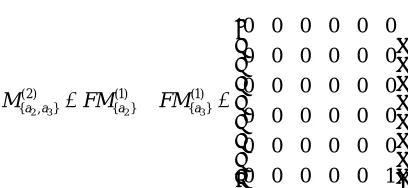
(1) { }
0 0 0 0 0 0 0 0 0 0 0 0 0 0 0 0 0 0 0 1 0 1 1 1 0 0 0 0 0 0 0 1 0 0 1 1 a
FM
;
2
(1) { }
0 0 0 0 0 0 0 0 0 0 0 0 0 0 0 0 0 0 1 1 1 1 1 1 0 0 0 0 0 0 1 1 0 0 1 1 a
FM
;
3
(1) { }
0 0 0 0 0 0 0 0 0 0 0 0 0 0 0 0 0 0 0 0 0 0 0 0 0 0 0 0 0 0 0 0 0 1 0 1 a
FM
Furthermore, the second order upper approximation matrices are
1 2 1 2
(2) (1) (1) { , } { } { }
0 0 0 0 0 0 0 0 0 0 0 0 0 0 0 0 0 0 0 1 0 1 1 1 0 0 0 0 0 0 0 1 0 0 1 1
a a a a
M FM FM
1 3 1 3
(2) (1) (1) { , } { } { }
0 0 0 0 0 0 0 0 0 0 0 0 0 0 0 0 0 0 0 0 0 0 0 0 0 0 0 0 0 0 0 0 0 0 0 1
a a a a
M FM FM
2 3 2 3
(2) (1) (1)
{ , } { } { }
0 0 0 0 0 0 0 0 0 0 0 0 0 0 0 0 0 0 0 0 0 0 0 0 0 0 0 0 0 0 0 0 0 0 0 1
a a a a
M FM FM
So, we can see that (2)1 3 (2)2 3 {a a} {a a}
M M , and the 6th row vectors of them are less then those of M{ }d respectively, by comparing (2)1 2
{a a}
M , (2)1 3 {a a}
M , (2)2 3 {a a}
M and M{ }d . Hence, we can obtain all the second order upper ap-proximation reductions, which are
a a1, 3
, a a2, 3
.In the next, we have
1 3 2 3
(2) (2) { , } { , }
0 0 0 0 0 0 0 0 0 0 0 0 0 0 0 0 0 0 0 0 0 0 0 0 0 0 0 0 0 0 0 0 0 0 0 0
a a a a
FM FM
So, the algorithm is terminated.
Thus, all upper approximation reductions are
a a1, 3
, a a2, 3
in the system of above example, which are consistent with ref.[5].From the example, we can find that the algorithm is valid, and operated simply, for systems with a great deal of objects and attributes
5. Conclusions
It is well known that most of information systems are based on dominance relations because of various factors in practice. Therefore, it is meaningful to study the knowledge reductions in inconsistent ordered informa-tion system. In this article, the dominance matrix and upper approximation decision matrix are introduced in information systems based on dominance relations. Fur-thermore, the algorithm of upper approximation reduc-tion is obtained, from which we can provide new ap-proach to knowledge reductions in inconsistent systems based on dominance relations. Finally, an example illus-trates the validity of this method, and shows the method is applicable to a complicated information system.
6. References
[1] Z. Pawlak, “Rough Sets,” International Journal of Computer and Information Science, Vol. 11, No. 5, 1982, pp. 341-356.HH0UUdoi:10.1007/BF01001956U
Re-search, Vol. 168, No. 1, 2006, pp. 164-180.
HH1UU
doi:10.1016/j.ejor.2004.03.032U
[3] W. H. Xu and W. X. Zhang, “Measuring Roughness of Generalized Rough Sets Induced by a Covering,” Fuzzy Sets and Systems, Vol. 158, No. 22, 2007, pp. 2443-2455.
HH2UU
doi:10.1016/j.fss.2007.03.018U
[4] W. X. Zhang, W. Z. Wu, J. Y. Liang and D. Y. Li, “Theory and Method of Rough Sets,” Science Press, Beijing, 2001.
[5] W. H. Xu, X. Y. Zhang and W. X. Zhang, “Upper Ap-proximation Reduction in Inconsistent Information Sys-tems Based on Dominance Relations,” Computer Engi-neering, Vol. 35, No. 18, 2009, pp. 191-193.
[6] W. H. Xu, X. Y. Zhang and W. X. Zhang, “Knowledge Granulation, Knowledge Entropy and Knowledge Uncer-tainty Measure in Information Systems,” Applied Soft Computing, Vol. 9, No. 4, 2009, pp. 1244-1251.
HH3UU
doi:10.1016/j.asoc.2009.03.007U
[7] W. H. Xu, X. Y. Zhang, J. M. Zhong and W. X. Zhang, “Attribute Reduction in Ordered Information Systems Based on Evidence Theory,” Knowledge and Information Systems, Vol. 25, No. 1, 2010, pp. 169-184.
HH4UU
doi:10.1007/s10115-009-0248-5U
[8] W. H. Xu and W. X. Zhang, “Knowledge Reduction and Matrix Computation in Inconsistent Ordered Information Systems,” International Journal Business Intelligence and Data Mining, Vol. 3, No. 4, 2008, pp. 409-425.
HH5UU
doi:10.1504/IJBIDM.2008.022737U
[9] W. H. Xu, M. W. Shao and W. X. Zhang, “Knowledge Reduction Based on Evidence Reasoning Theory in Or-dered Information Systems,” Lecture Notes in Artificial Intelligence, Vol. 4092, 2006, pp. 535-547.
[10] W. H. Xu and W. X. Zhang, “Methods for Knowledge Reduction in Inconsistent Ordered Information Systems,”
Journal of Applied Mathematics & Computing, Vol. 26, No. 1-2, 2008, pp. 313-323.
[11] W. Z. Wu, M. Zhang, H. Z. Li and J. S. Mi, “Attribute Reduction in Random Information Systems Via Demp-ster-Shafer Theory of Evidence,” Information Sciences,
Vol. 174, No. 3-4, 2005, pp. 143-164.
HH6UU
doi:10.1016/j.ins.2004.09.002U
[12] M. Zhang, L. D. Xu, W. X Zhang and H. Z. Li, “A Rough Set Approach to Knowledge Reduction Based on Inclu-sion Degree and Evidence Reasoning Theory,” Expert Systems, Vol. 20, No. 5, 2003, pp. 298-304.
HH7UU
doi:10.1111/1468-0394.00254U
[13] S. Greco, B. Matarazzo and R. Slowingski, “Rough Ap-proximation of a Preference Relatioin by Bominance Re-latioin,” European Journal of Operational Research, Vol. 117, No. 1, 1999, pp. 63-83.
HH8UU
doi:10.1016/S0377-2217(98)00127-1U
[14] S. Greco, B. Matarazzo and R. Slowingski, “A New Rough Set Approach to Multicriteria and Multiattribute Classificatioin. In: Rough Sets and Current Trends in Computing (RSCTC'98),” Springer-Verlag, Berlin, 1998. pp. 60-67.
[15] S. Greco, B. Matarazzo and R. Slowingski, “Rough Sets Theory for Multicriteria Decision Analysis,” European Journal of Operational Research, Vol. 129, No. 1, 2001, pp. 11-47. HH9UUdoi:10.1016/S0377-2217(00)00167-3U
[16] S. Greco, B. Matarazzo, R. Slowingski, “Rough Sets Methodology for Sorting Problems in Presence of Mul-tiple Attributes and Criteria,” European Journal of Op-erational Research, Vol. 138, No. 2, 2002, pp. 247-259.
HH1UU
U
[17] K. Dembczynski, R. Pindur and R. Susmaga, “Genera-tion of Exhaustive Set of Rules within Dominance- Based Rough Set Approach,” Electronic Notes Theory Compute Sciences, Vol. 82, No. 4, 2003.
[18] Y. Sai, Y. Y. Yao and N. Zhong, “Data Analysis and Mining in Ordered Information Tables,” IEEE Com-puter Society Press,San Jose, 2001, pp. 497-504.
[19] M. W. Shao and W. X. Zhang, “Dominance Relation and Rules in an Incomplete Ordered Information System,”
International Journal of Intelligent Systems, Vol. 20, No. 2005, pp. 13-27.
HH1UU