WEED SCIENCE
Interactive Effects of Tank-mixed Application of Insecticide, Glyphosate, and
Pendimethalin on Growth and Yield of Second-Generation Glyphosate-Resistant Cotton
Donnie K. Miller*, Robert G. Downer, and Daniel O. Stephenson, IV
D.K. Miller*, LSU AgCenter Northeast Research Station, P.O. Box 438, St. Joseph, LA 71366; R.G. Downer, Dept. of Statistics, Grand Valley State University, A-1-178 Mackinas Hall, Allendale, MI 49401; D.O. Stephenson, IV, LSU AgCenter Dean Lee Research Station, 8105 Tom Bowman Dr., Alexandria, LA 71302
*Corresponding author: [email protected] ABSTRACT
Research has documented the effects of tank-mixing glyphosate with numerous insecticides on cotton growth and yield; however, no infor-mation is available concerning the addition of a residual herbicide such as an aqueous capsule suspension (ACS) formulation of pendimethalin to glyphosate plus an insecticide. Mixtures such as this are important as producers continue to search for costs savings in cotton production and the inclusion of residual herbicides in the planting regimen is needed to mitigate the de-velopment and spread of glyphosate-resistant (GR) weeds. Therefore, this research during 2006 and 2007 determined the effects of poste-mergence (POST) combinations of glyphosate applied alone or plus the ACS formulation of pendimethalin with eight different insecticides on second-generation GR cotton. Glyphosate (®Roundup Weathermax) was applied at 1058 g ha-1 alone or tank-mixed with pendimethalin
(®Prowl H2O) at 1064 g ha-1. The insecticides
acephate (®Orthene 90 SP) at 560 g ha-1 , beta-cyfluthrin (®Baythroid XL) at 37 g ha-1 ,
dicro-tophos (®Bidrin 8 E) at 448 g ai ha-1, dimethoate
(®Dimethoate 4E) at 280 g ha-1, imidacloprid (®Trimax) at 53 g ai/ha-1, lambda-cyhalothrin (®Karate Z) at 37 g ha-1, oxamyl (®Vydate C-LV)
at 448 g ha-1, thiamethoxam (®Centric 40 WG) at 53 g ha-1, or zeta-cypermethrin (®Mustang Max) at 25 g ai/ha were also tank-mixed with
glyphosate and pendimethalin. Results indicate that visual crop response in the form of minor malformation and veinal yellowing of contacted leaves can be observed following a POST
co-ap-plication of pendimethalin with glyphosate (3 to
16%). Addition of insecticides to the glyphosate plus pendimethalin mixture did not affect visual injury. Plant growth and seedcotton yield were not impacted by treatments.
C
otton cultivars resistant to glyphosate have been widely accepted in cotton producing states since from 4% in 1997 to 68% in 2008; however, 98 % of the cotton planted in the southeastern commercialization (Sankula and Blumenthal, 2004). The area seeded to glyphosate-resistant (GR) cotton cultivars has increased and mid-southern U.S. wasGR, indicating a regional influence (USDA, 2009a).
Glyphosate controls a wide spectrum of grass and broadleaf weeds (Clewis et al., 2006) and a glyphosate-based weed management system in GR crops may require fewer herbicide applications and
greater weed management flexibility (Culpepper
and York, 1998).
Due to the increase in GR cotton hectares and ability to provide broad spectrum control of numerous weedy species, the percentage of cotton hectares treated with glyphosate in the U.S. in-creased from 17% in 1996 to 82% in 2005 (USDA, 2009b). As a consequence of increased glyphosate use, applications of herbicides with different modes
of action have decreased significantly, particularly
Italian ryegrass [Lolium perenne L. spp. multiflo -rum (Lam.) Husnot] Palmer amaranth (Amaranthus palmeri S. Wats), and others (Heap, 2009).
Pendimethalin is a dinitroaniline herbicide that inhibits mitosis by binding to tubulin, the major microtubule protein leading to a loss of micro-tubule structure and function (Sensemen, 2007). Pendimethalin may be applied preplant surface, preplant incorporated, preemergence (PRE), or postemergence-directed (PD) in cotton (Anony-mous, 2009b). The addition of pendimethalin PD in cotton improved overall control of barnyardgrass [Enchinochloa crus-galli (L.) Beauv.] and yellow nutsedge (Cyperus esculentus L.) and reduced weed dry biomass at time of cotton harvest when compared to postemergence (POST) applications of glyphosate (Koger et al., 2007). Pendimethalin PRE increased control of annual grasses and Amaranthus species to greater than 90% and increased cotton yields 59 to 75% (Wilson et al., 2007). Richardson et al. (2007) observed increased control of an-nual grass species, smooth pigweed (Amaranthus hybridus L.) and common lambsquarters ( Cheno-podium album L.) with pendimethalin compared
to applications of trifloxysulfuron-sodium alone
POST. Tank mixtures of glufosinate plus
pendi-methalin or flumioxazin provided residual control
of horseweed 56 d after application (Steckel et al., 2006). Past research has shown that the residual activity of pendimethalin will provide control of numerous weeds.
A number of insect pests infest cotton through-out the entire season and often result in yield loss and increased direct management costs (Williams, 2004). Due to the possible season-long infestations of insects necessitating insecticide applications and the development of second-generation GR cotton that can tolerate POST glyphosate applications throughout the season (Keeling et al., 2003; Martens et al., 2003), the co-application of glyphosate and an insecticide is probable. However, research has
shown contradictory results on efficacy of herbicides
on weeds when mixed with insecticides. Control of barnyardgrass was reduced following a mixture of imidacloprid and glyphosate and a reduction in pitted morningglory (Ipomoea lacunosa L.) control was noted when glyphosate was mixed with
chlor-pyrifos, fipronil, methamidophos, and imidacloprid (Mascarenhas and Griffin, 1997). Miller et al. (2005)
reported a reduction in control of common lambs-quarters, Palmer amaranth, and smooth pigweed
when trifloxysulfuron-sodium was mixed with acephate, oxamyl, lambda-cyhalothrin, acetaminprid, thiamethoxam, endosulfan, indoxacarb, emanectin benzoate, methoxyfenozide, and spinosad as
com-pared to trifloxysulfuron-sodium applied alone. In
contrast, Scroggs et al. (2005) observed no reduction in control of barnyardgrass, Johnsongrass [Sorghum halepense (L.) Pers.], and sicklepod [Senna obtusifo-lia (L.) H. S. Irwin & Barneby] when glyphosate was combined with insecticides acetamiprid, bifenthrin,
cyfluthrin, cypermethrin, dicrotophos, dimethoate,
emamectin benzoate, imidacloprid, indoxacarb, lambda-cyhalothrin, methoxyfenozide, spinosad, thiamethoxam, or zeta-cypermethrin and the plant growth regulator mepiquat pentaborate.
Past research has shown the effects of mixing glyphosate with numerous insecticides; however, no information is available concerning the addition of a residual herbicide such as pendimethalin to glyphosate plus an insecticide. Previous research has shown that oil or water-based formulations of pendimethalin applied POST to 4-leaf cotton did not result in seedcotton yield reduction when compared to glyphosate applied alone (Dodds et al., 2010). Research of this issue is important because produc-ers continue to search for costs savings in cotton production and the inclusion of residual herbicides in the planting regimen is needed to minimize the expansion of GR weeds. A POST application of pendimethalin in second-generation GR cotton is allowed under supplemental registration with rates ranging from 532 to 1064 g ha-1 at the 4- through 8-leaf growth stage (Anonymous, 2009a). Therefore, research was conducted to determine the effects of POST combinations of glyphosate applied alone or with pendimethalin plus eight different insecticides on second-generation GR cotton.
MATERIALS AND METHODS
rows and a non-treated row, each 7.6-m long with a row spacing of 102 cm. Plots were planted to ‘DP 164 B2RF’ cotton on May 3 and May 1 in 2006 and 2007, respectively. Soil type was a Mhoon
silt loam (fine-silty, mixed nonacid, thermic Typic
Fluvaquent).
Glyphosate (®Roundup Weathermax5.5 SL; Monsanto Company, St. Louis, MO) was applied at 1058 g ha-1 alone or tank-mixed with the ACS for-mulation of pendimethalin (®Prowl H2O 3.8 ASC; BASF Ag Products, Research Triangle Park, NC) at 1064 g ha-1. The insecticides acephate (®Orthene 90 SP; Valent USA Corporation Agricultural Products, Walnut Creek, CA ) at 560 g ha-1, beta-cyfluthrin (®Baythroid XL; Bayer CropScience, Research Tri-angle Park, NC) at 37 g ha-1, dicrotophos (®Bidrin 8 E; Amvac Chemical Corporation, Los Angeles, CA) at 448 g ai ha-1, dimethoate (®Dimethoate 4E; Cheminova, Inc., Research Triangle Park, NC) at 280 g ha-1, imidacloprid (®Trimax; Bayer CropScience) at 53 g ai/ha-1, lambda-cyhalothrin (®Karate Z; Syngenta Crop Protection Inc., Greensboro, NC ) at 37 g ha-1, oxamyl (®Vydate C-LV; DuPont Crop Protection, Wilmington, DE) at 448 g ha-1, thiameth-oxam (®Centric 40 WG; Syngenta Crop Protection Inc.) at 53 g ha-1, and zeta-cypermethrin (®Mustang Max; FMC Corporation Agricultural Products Group, Philadelphia, PA) at 25 g ai/ha were also tank-mixed according to individual labels with glyphosate plus pendimethalin. Insecticides were selected on the basis of recommended uses on troublesome cotton insect pests encountered during the growing season (Bagwell et al., 2003).
Applications were made to cotton at the 4-leaf growth stage using a tractor-mounted compressed air sprayer delivering 140 L ha-1 at 220 kPa with
four flat fan nozzles spaced 51 cm apart. Parameters
measured included visual crop response, on a scale of 0 = no injury to 100 = plant death, 5 and 14 d after treatment (DAT) and plant height at 7 and 21 DAT. Plots were machine harvested following chemical defoliation to determine seedcotton yield.
Plant height data were analyzed as a RCB design with a factorial arrangement of treatments and growth stages with repeated measures over the evaluation intervals. Data analysis for this variable was conducted using mixed model analysis with estimates of means and standard errors generated using least square means and experiments desig-nated as random effects in the model. Means were separated using the Dunnett’s adjustment
(glypho-sate alone compared with each chemical tank-mix)
at the 0.05 level of significance. For crop response
data, 100% of the injury values were 0 for the 5 DAT evaluation intervals in 2006. This made the
estimation/fitting of a logistic repeated measures model difficult. A difference in the injury percent -age was taken (injury 14 DAT – injury 5 DAT) over each observation in a replicate. The resulting set of differences resulted in 10 distinct values and the occurrences of these values (across treatments and replicates) were symmetric. As a result, a repeated measures ANOVA model in which tests involved the equality of mean percentage was considered ap-propriate. The residuals of the resulting model were also reasonable. Means were separated using the Dunnett’s adjustment (glyphosate alone compared with each chemical co-application) at the 0.05 level
of significance. For yield data, PROC GLM was
used as it was not repeated measure on the same experimental unit and means were separated as described for crop height variable.
RESULTS AND DISCUSSION
Crop Height. Statistical analysis did not indicate
a significant treatment by evaluation interval interac -tion, therefore results were pooled over evaluation intervals. In both years, cotton plant heights when treated with glyphosate alone were similar to those when treated with glyphosate plus pendimethalin or pendimethalin plus insecticide (data not shown).
with pendimethalin alone or mixed with insecticides was not evident late season and was not manifested in reductions in plant height or seedcotton yield compared to glyphosate applied alone. Results in-dicate that when applied according to the herbicide label, glyphosate/ACS formulation of pendimethalin/ insecticide mixtures offer producers the ability to integrate pest management strategies and limit
ap-plication costs without sacrificing crop tolerance.
REFERENCES
Anonymous. 2010. LSU AgCenter Cotton Web Page. http:// www.lsuagcenter.com/en/crops_livestock/crops/cotton/. Accessed: October 6, 2010.
Anonymous. 2009a. Supplemental label: Prowl H2O for
preemergence weed control in cotton when applied pos-temergence. http://www.cdms.net/LDat/ld6CT010.pdf.
(verified 9 Oct. 2010).
Anonymous. 2009b. Prowl H2O herbicide product label.
BASF Corporation Publication No. NVA 2008-04-195-0353. BASF Corporation,Research Triangle Park, NC. Seedcotton Yield. In 2006, seedcotton yield
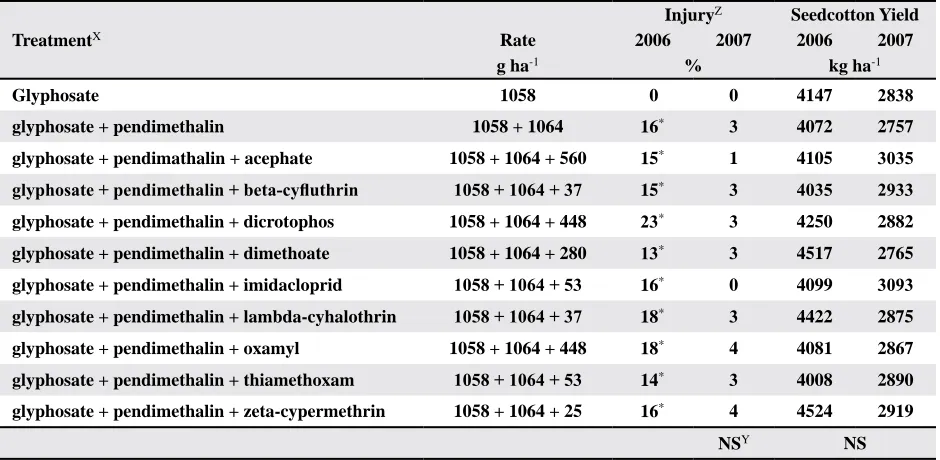
averaged 4147 kg ha-1 following application with glyphosate applied alone and a similar yield of 4072 kg ha-1 when mixed with pendimethalin (Table 1). Addition of insecticides resulted in yield ranging from 4008 to 4524 kg ha-1 and did not influence yield. Results were similar in 2007 with yield rang-ing from 2765 to 3093 kg ha-1 following mixed with insecticides and no reduction in yield when compared with glyphosate applied alone (2838 kg ha-1) or mixed with pendimethalin (2757 kg ha-1) (Table 1). Dodds et al. (2010) reported no reduction in seedcotton yield following POST application of an oil or water-based formulation of pendimethalin to 4-leaf cotton.
Results indicate that visual crop response in the form of veinal yellowing and leaf malformation can be observed following a POST combination of pendi-methalin with glyphosate to 4-leaf second-generation GR cotton. Response is limited to contacted leaves. Addition of insecticides evaluated in this study to the herbicide tank-mixture did not increase response observed. Visual crop response following glyphosate
Table 1. Cotton response and seed-cotton yield following topically applied mixtures of glyphosate and pendimethalin with
insecticides at St. Joseph, LA.
InjuryZ Seedcotton Yield
TreatmentX Rate 2006 2007 2006 2007
g ha-1 % kg ha-1
Glyphosate 1058 0 0 4147 2838
glyphosate + pendimethalin 1058 + 1064 16* 3 4072 2757
glyphosate + pendimathalin + acephate 1058 + 1064 + 560 15* 1 4105 3035
glyphosate + pendimethalin + beta-cyfluthrin 1058 + 1064 + 37 15* 3 4035 2933
glyphosate + pendimethalin + dicrotophos 1058 + 1064 + 448 23* 3 4250 2882
glyphosate + pendimethalin + dimethoate 1058 + 1064 + 280 13* 3 4517 2765
glyphosate + pendimethalin + imidacloprid 1058 + 1064 + 53 16* 0 4099 3093
glyphosate + pendimethalin + lambda-cyhalothrin 1058 + 1064 + 37 18* 3 4422 2875
glyphosate + pendimethalin + oxamyl 1058 + 1064 + 448 18* 4 4081 2867
glyphosate + pendimethalin + thiamethoxam 1058 + 1064 + 53 14* 3 4008 2890
glyphosate + pendimethalin + zeta-cypermethrin 1058 + 1064 + 25 16* 4 4524 2919
NSY NS
Z Means analyzed using a repeated measures ANOVA model for the 5- and 14-d after treatment visual crop response
estimate. Response means followed by an asterisk (*) are significantly different from the response observed following
treatment with glyphosate alone using the Dunnett’s adjustment (glyphosate alone compared with each chemical
tank-mixture) at the 0.05 level of significance.
Y NS: No significant difference among treatments.
X Glyphosate(Roundup Weathermax); pendimethalin (Prowl H
2O); acephate (Orthene 90 SP); beta-cyfluthrin (Baythroid
Bagwell, R.D., B.R. Leonard, G. Burris, S. Stewart, J. Fair-cloth, S. Kelly, C. Pinnell-Alison, T. Erwin, M. Farris, and S. Micinski. 2003. Cotton Insect Control 2003. Louisiana Cooperative Extension Service, Pub. 1083. LSU
AgCenter, Baton Rouge, LA.
Clewis, S.B., J.W. Wilcut, and D. Porterfield. 2006. Weed
management with S-metolachlor and glyphosate mixtures in glyphosate-resistant strip-and conventional tillage cotton (Gossypium hirsutum). Weed Technol. 20:232–241.
Culpepper, A.S. and A.C. York. 1998. Weed management in glyphosate-tolerant cotton. J. Cotton Sci. 2:174–185. Dodds, D.M., D.B. Reynolds, J.A. Huff, and J.T. Irby. 2010.
Effect of pendimethalin formulation and application rate on cotton fruit partitioning. Weed Technol. 24:77–84. Heap, I. 2009. The International Survey of Herbicide
Resis-tant Weeds. [Online] Available at
http://www.weed-science.org. (verified 9 Oct. 2010).
Heap, I., and H. LeBaron. 2001. Introduction and overview of resistance. p. 1–22. In S.B. Powles and D.L. Shaner (ed.). Herbicide Resistance and World Grains. CRC, Washing-ton, D.C.
Keeling, J.W., T.A. Baughman, J.D. Everitt, L.L. Lyon, and P.A. Dotray. 2003. Tolerance and weed management in Roundup Ready Flex cotton. p. 2244. In Proc. Beltwide Cotton Conf. Nashville, TN. 6-10 Jan.2003. Nat. Cotton Counc. Am. Memphis, TN.
Koger, C.H., A.J. Price, J.C. Faircloth, J.W. Wilcut, and S.P. Nichols. 2007. Effect of residual herbicides used in last POST-directed application on weed control and cotton yield in glyphosate- and glufosinate-tolerant cotton. Weed Technol. 21:378–383.
Martens, A., J. Hart, B. Sammons, E. Cerny, S. Huber, and M. Oppenhuizen. 2003. 2002 Results of Roundup Ready Flex cotton trials. p. 2245. In Proc. Beltwide Cotton Conf. Nashville, TN. 6-10 Jan.2003. Nat. Cotton Counc. Am. Memphis, TN.
Mascarenhas, V.J. and J.L. Griffin. 1997. Weed control
interactions associated with Roundup and insecticide mixtures. p. 799–800. In Proc. Beltwide Cotton Conf. New Orleans, LA. 7-10 Jan. 1997. Nat. Cotton Counc. Am. Memphis, TN.
Miller, D.K., J.W. Wilcut, E. Burris, R.G. Downer, and D.R.
Cook. 2005. Trifloxysulfuron and insecticide combina -tion effects on broadleaf weeds and thrips control in cotton. Weed Technol. 19:762–767.
Powles, S.B. 2008. Evolved glyphosate-resistant weeds around the world: lessons to be learnt. Pest Manage. Sci. 64:360–365.
Richardson, R.J., H.P. Wilson, and T.E. Hines. 2007.
Preemer-gence herbicides followed by trifloxysulfuron postemer -gence in cotton. Weed Technol. 21:1–6.
Sankula, S. and E. Blumenthal. 2004. Impacts on US Agricul-ture of biotechnology-derived crops planted in 2003 – an update of eleven case studies. National Center for Food and Agricultural Policy,Washington, D.C.
Scroggs, D.M., D.K. Miller, J.L. Griffin, J.P. Geaghan, P.R. Vidrine, and A.M. Stewart. 2005. Glyphosate efficacy
on selected weeds species is unaffected by chemical co-application. Weed Technol. 19:1012–1016.
Sensemen, S.A., ed. 2007. Herbicide Handbook. 9th ed. Weed
Science Society of America, Champaign, IL.
Shaner, D.L. 2000. The impact of glyphosate-tolerant crops on the use of other herbicides and on resistance manage-ment. Pest Manage. Sci. 56:320–326.
Steckel, L.E., C.C. Craig, and R.M. Hayes. 2006. Glyphosate-resistant horseweed (Conyza canadensis) control with glufosinate prior to planting no-till cotton (Gossypium hirsutum). Weed Technol. 20:1047–1051.
USDA, United States Department of Agriculture. 2009a. Na-tional Agricultural Statistics Service. Acreage [Online]. Available at http://usda.mannlib.cornell.edu/MannUsda/
viewDocumentInfo.do?documentID=1000. (verified 9
Oct. 2010).
USDA, United States Department of Agriculture. 2009b. National Agricultural Statistics Service. Agricultural Chemical database [Online]. Available at http://www. pestmanagement.info/nass/. Accessed: September 28, 2010.
Williams, M.R. 2004. Cotton insect losses 2003. p. 1249– 1257. In Proc. Beltwide Cotton Conf. San Antonio, TX. 5-9 Jan. 2004.Nat. Cotton Counc. Am. Memphis, TN. Wilson, D.G., A.C. York, and D.L. Jordan. 2007. Effect of row spacing on weed management in glufosinate-resis-tant cotton. Weed Technol. 21:489–495.