STRUCTURE SENSE IN SOLVING EQUATIONS
1,*
Ronit Bassan
1
Ph.D. in Mathematics Education, Kibbutzim College of Education, Tel Aviv,
2M.Ed. in Mathematics Education, Alliance High School, Tel Aviv, Israel
ARTICLE INFO ABSTRACT
The present study aims to explore whether there are gender performance when solving equations which require the
mathematics one can identify that learners lack a competence of logical observation of algebraic expressions. This deficiency results in the learners' technical approach to exercises, the time they require for obtaining
competence is called 'the
the inability to identify a familiar structure in its simplest form,
comprised as a unit as well as identify a familiar structure in its more complex way so that it can be effectively substituted. Gender
research populati
research instrument comprised six mathematical questions, all of them could be effectively solved by means of a structure sense, except for one question which did not require
solution. Findings of the present research illustrate that the success rates are not particularly high. In most questions, the boys' rate of correct answers exceeds that of the girls. Moreover, there are differences in the choice
whereas the boys tend to apply an algorithm, namely the effective solution method. It is recommended integrating in the teaching process the strategy of searching special features questions in addition to the common algorithms studied in mathematics lessons. As part of a systematic teaching programme, it is advised adding to each study chapter several special questions in order to develop the pupils' appropriate competences.
Copyright © 2018, Ronit Bassan-Cincinatus and Ravit Feldman which permits unrestricted use, distribution, and reproduction
INTRODUCTION
An exercise about series which has been erroneously copied by a pupil led to the following equation: 1 −
The pupil acted according to the rules of the algorithms he had studied: multiplied and brought both sides into a common denominator, opened brackets, collected similar terms and obtained = −2 as the solution. If we disregard the fact that he failed to relate to the domain of definition of the equation (the numbers enabling the expression to be definite) and the fact that the solution had to be a natural number, the pupil was not wrong. His solution attests to a reasonable mastery of algebraic technique yet it is obvious he lacks another competence. He did not notice that a difference of two identical expressions appears on the left side so he reached an equation with the following structure:
*Corresponding author: Ronit Bassan-Cincinatus,
Ph.D. in Mathematics Education, Kibbutzim College of Education, Tel Aviv, Israel.
DOI:https://doi.org/10.24941/ijcr.30920.06.2018
ISSN: 0975-833X
Article History:
Received 18th March, 2018
Received in revised form 24th April, 2018
Accepted 09th May, 2018
Published online 30th June, 2018
Citation: Ronit Bassan-Cincinatus and Ravit Feldman Research, 10, (06), 70495-70504.
Key Words:
Structure Sense, Number Sense, Algebraic Expressions, Gender Differences.
RESEARCH ARTICLE
STRUCTURE SENSE IN SOLVING EQUATIONS - GENDER DIFFERENCES
Ronit Bassan-Cincinatus and
2Ravit Feldman
Ph.D. in Mathematics Education, Kibbutzim College of Education, Tel Aviv,
Mathematics Education, Alliance High School, Tel Aviv, Israel
ABSTRACT
The present study aims to explore whether there are gender
performance when solving equations which require the application of a structure sense. In mathematics one can identify that learners lack a competence of logical observation of algebraic expressions. This deficiency results in the learners' technical approach to exercises, the time they require for obtaining the solution, numerous errors and difficulty in finding the solution. This absent competence is called 'the structure sense'. When studying algebra in high school, this is manifested by the inability to identify a familiar structure in its simplest form,
comprised as a unit as well as identify a familiar structure in its more complex way so that it can be effectively substituted. Gender-oriented studies attest to gaps between the sexes in mathematics. The research population consisted of 48 pupils, 23 boys and 25 girls, learning in the 10
research instrument comprised six mathematical questions, all of them could be effectively solved by means of a structure sense, except for one question which did not require
solution. Findings of the present research illustrate that the success rates are not particularly high. In most questions, the boys' rate of correct answers exceeds that of the girls. Moreover, there are differences in the choice of solution strategy. The girls opt for the safe and familiar technical way whereas the boys tend to apply an algorithm, namely the effective solution method. It is recommended integrating in the teaching process the strategy of searching special features questions in addition to the common algorithms studied in mathematics lessons. As part of a systematic teaching programme, it is advised adding to each study chapter several special questions in order to develop the pupils' appropriate competences.
Cincinatus and Ravit Feldman. This is an open access article distributed under the reproduction in any medium, provided the original work is properly cited.
An exercise about series which has been erroneously copied by
− 1 − = .
The pupil acted according to the rules of the algorithms he had plied and brought both sides into a common denominator, opened brackets, collected similar terms and the solution. If we disregard the fact that he failed to relate to the domain of definition of the equation (the numbers enabling the expression to be definite) and the fact that the solution had to be a natural number, the pupil was on attests to a reasonable mastery of algebraic technique yet it is obvious he lacks another competence. He did not notice that a difference of two identical expressions appears on the left side so he reached an equation
Ph.D. in Mathematics Education, Kibbutzim College of Education, Tel Aviv,
zero equals a number different from zero. Consequently, the equation solution is the empty group without making any calculation. This absent competence is called 'the structure sense' (Hoch and Dreyfus 2004).
(Linchevski and Livneh 1999) relates to difficulties learners encounter in using an arithmetic structure for solving problems when they start learning algebra. Learners should be exposed to the exercise structure already during their arithmetic studies. Thus, they develop a structure sense by means of which they can effectively apply equivalent structures of algebraic expressions. Learners are considered as demonstrating a structure sense in high school algebra if they can identify a familiar structure in its simplest way, deal with complex algebraic expressions as a unit, identify a more complex familiar structure by appropriate substit
operations to be performed while using the structure for solving the given problem. These four competences are hierarchically ranked and in order to master any competence one has to be versed in its predecessors.
display of a structure sense emerge at a young age while International Journal of Current Research
Vol. 10, Issue, 06, pp.70495-70504, June, 2018
Cincinatus and Ravit Feldman. 2018. “Structure Sense in Solving Equations-Gender Differences
GENDER DIFFERENCES
Ph.D. in Mathematics Education, Kibbutzim College of Education, Tel Aviv, Israel
Mathematics Education, Alliance High School, Tel Aviv, Israel
The present study aims to explore whether there are gender-oriented differences in learners' application of a structure sense. In mathematics one can identify that learners lack a competence of logical observation of algebraic expressions. This deficiency results in the learners' technical approach to exercises, the time they the solution, numerous errors and difficulty in finding the solution. This absent structure sense'. When studying algebra in high school, this is manifested by the inability to identify a familiar structure in its simplest form, deal with an algebraic expression comprised as a unit as well as identify a familiar structure in its more complex way so that it can be oriented studies attest to gaps between the sexes in mathematics. The on consisted of 48 pupils, 23 boys and 25 girls, learning in the 10th grade. The
research instrument comprised six mathematical questions, all of them could be effectively solved by means of a structure sense, except for one question which did not require a structure sense for its solution. Findings of the present research illustrate that the success rates are not particularly high. In most questions, the boys' rate of correct answers exceeds that of the girls. Moreover, there are of solution strategy. The girls opt for the safe and familiar technical way whereas the boys tend to apply an algorithm, namely the effective solution method. It is recommended integrating in the teaching process the strategy of searching special features in the questions in addition to the common algorithms studied in mathematics lessons. As part of a systematic teaching programme, it is advised adding to each study chapter several special questions in
Creative Commons Attribution License, cited.
zero equals a number different from zero. Consequently, the equation solution is the empty group without making any calculation. This absent competence is called 'the structure sense' (Hoch and Dreyfus 2004). The lack of a structure sense (Linchevski and Livneh 1999) relates to difficulties learners encounter in using an arithmetic structure for solving problems ey start learning algebra. Learners should be exposed to the exercise structure already during their arithmetic studies. Thus, they develop a structure sense by means of which they can effectively apply equivalent structures of algebraic ers are considered as demonstrating a structure sense in high school algebra if they can identify a familiar structure in its simplest way, deal with complex algebraic expressions as a unit, identify a more complex familiar structure by appropriate substitutions and identify operations to be performed while using the structure for solving the given problem. These four competences are hierarchically ranked and in order to master any competence one has to be versed in its predecessors. Indications of a future display of a structure sense emerge at a young age while
INTERNATIONAL JOURNAL OF CURRENT RESEARCH
learning arithmetic and are referred to by the empirical literature as 'a number sense'. That is, the ability to understand the relations between the numbers and the four rules of arithmetic, use the number in a flexible way, make estimation and judge the magnitudes of numbers and the logic of the answers, shift between number representations and connect answers to reality. Thus learners can intelligently use the numbers (Markovits, Hershkowitz and Bruckheimer 1989).
Literature review
Learners' difficulties in algebra: One of the reasons for the
difficulties in the implementation of algebraic technique is that the contents are studied in a technical way rather than being based on understanding (Booth 1981; Hoch and Dreyfus 2004). When solving equations and inequalities, learners need to combine technical performance knowledge, understanding as well as planning and control. In order to succeed they should acquire a varied mathematics knowledge and develop proper habits for solving problems (Fey 1984; Mats 1980; Schoenfeld 1985). Learners prefer a safer computational solution which leads to a technical work routine (Steinberg, Sleeman and Ktorza 1990). There are cases whereby learners cope with a task for which there is no ready algorithm. Since this algorithm entirely defines the solution method, learners hesitate, choosing the model which they consider to be the most convenient. The hesitation and choice are referred to as 'using mathematical insight' and the application of the mathematical model is called 'a solving strategy'. An appropriate choice of a strategy is part of the problem solving process. A strategy is adequate if its choice leads to an effective direction whereas it is inadequate if its choice leads to a dead-end (Arbel 1991). Learners usually opt for the first idea which seems suitable for the solution, without an in-depth planning of the problem features (Schoenfeld 1992). While making decisions, we naturally tend to apply what we have learnt in the past, even when this choice is inappropriate. Wrong solution approaches are the result of a hasty planning which might entail an incorrect or ineffective solution. Learners' immediate choice of such solutions is made in an instinctive or intuitive manner (Ginat 2007).
Mathematics teaching: Mathematics educators constantly
hesitate between two approaches to learning in class. The first approach highlights the importance of inculcating mathematical contents while focusing on the procedural knowledge (for example, using the four rules and algebraic manipulations). The second underscores the development of thinking processes needed for coping with problems and with building mathematical models of varied situations (Kieran 2004; Star 2005, 2007). Learning algebraic competences constitutes a considerable part of the 7th-12th grade mathematics curriculum and numerous exercise textbooks were developed for accomplishing this goal (Ministry of Education 2013). Their main features are: a focused engagement in acquiring algebraic competences which are decomposed into small components; a high number (tens or hundreds) of exercises very similar to each other; emphasis on mathematical operations on a low cognitive level (technical knowledge and reconstruction ability); diversified difficulty levels, manifested by technical aspects and not necessarily by various thinking levels; grounding of the learning in a repeated practice of many exercises whose solution is sampled at the beginning of each chapter in the textbook, and/or by the teacher in class. These features confront learners with many difficulties – from a cognitive aspect (e.g. consolidating the learning on
remembering a long series of algorithms without understanding their meanings) and from emotional aspect (recoiling from large amounts of a monotonous exercise which reduces the interest in the subject). It is not necessary to neglect mathematical competences in order to apply thinking and vice versa, it is unnecessary to neglect the application of thinking processes in order to acquire mathematical competences. Skemp (1976) found that many educators teach rapidly in order to cover a lot of material. He distinguished between relational understanding – knowing what to do and why – and instrumental understanding – general knowledge without understanding the reasons and without any flexible implementation ability. This researcher argues that numerous teachers and learners encounter difficulties in teaching and learning whose objective is relational understanding (Skemp 1976).
Gender: In Israel, boys' attainments in mathematics and exact
sciences significantly exceed those of girls. The gaps between the genders emerge already during the initial education stages and are manifested by achievements starting in elementary school and up to higher education institutions. The Trends in International Mathematics and Science Study of 1999 found that only in four countries, Israel among them, the results indicated a significant gap in mathematics achievements between boys and girls in favour of the boys. In other countries around the world no meaningful differences were found and in most countries there were no differences at all. According to data of the Israeli Central Bureau of Statistics (2013), the rate
of women among undergraduates ranges between
hemisphere. This accounts for males' advantage in spatial skills, mathematics and logic problems solution. Other researchers maintain that the origin of mathematical thinking is biological. It develops on a similar cognitive basis among males and females and hence does not predict gender-oriented differences. Zorman (1996) emphasises that genetic dissimilarities between the genders do not justify the wide gaps in boys and girls' achievements. Similarly, Abrahami-Einat (1994) claims that there are no differences in between boys and girls' capabilities but rather in their approach, tendency and level of self-confidence. Generally speaking, it is hard to determine to what extent the gaps stem from a biological difference since experiences also impact cognitive functioning. The empirical literature describes the following environmental reasons for gender-oriented gaps and for girls' relatively low level of success as compared to that of boys.
Social factors: Since infancy, boys and girls are surrounded by
games, figures, books, movies and representations in commercials (Abrahami-Einat, 1994). These representations perpetuate the division into male and female professions and the capabilities associated with each sex. They attribute to boys (but not to girls) a technical skill, problem solving ability, initiative and success.Many parents educate their boys to be independent and achieving while the girls are educated for discipline, responsibility and mutual help. Parents encourage their sons more than their daughters to engage in science-related activities. In kindergarten and school, teachers treat boys and girls in the same way they are treated at home. Consequently, girls do not exert the efforts for exhausting their potential. Parents tend to dedicate more time to a verbal relation with the girls whereas they prefer playing more vigorous and violent games with the boys. Boys play in a more competitive style and girls are usually more intimate in their relationships, encouraging and supporting each other. Through childhood games, children acquire competences and behavioural patterns which affect their socialisation in society. This process differs among boys and girls and therefore impacts their preferences and coping methods in mathematics. Mathematics teachers believe that girls who choose to study mathematics at an advanced level are special and they transmit this message to their pupils sometimes in a covert and unconscious manner. Abrahami-Einat (1994) found that male and female teachers relate in an unequal way to boys and girls and their level of expectations from the girls is lower than from the boys. Similarly, Tiedmann (2002) found that teachers' perceptions stemmed from gender stereotypes rather than from objective indicators associated with the children's average and low performance. Gender-oriented differences were identified in the teachers' beliefs about the abilities of their pupils. The teachers expressed a biased opinion which could be more harmful to the girls' achievements than to those of the boys. Hence, parents and teachers are responsible for the gender-oriented difference manifested in the beliefs of the children themselves about their own mathematical capabilities and by doing that they can affect their children's attainments. Great importance is attributed to the social group. In the children's society, girls who succeed in science studies lose their popularity and are considered less feminine. Zorman (1996) describes that the gifted girl knows she can be a high-achiever. However, she is afraid this will make her unpopular among the boys. Moreover, the various communication media lead to stereotypical expectations (Zorman 1996). Another factor is the lack of relevant figures of women engaging in science with whom girls can identify.
Apparently, except for Marie Kiri, no other names of female scientists are known, although throughout history there lived great mathematicians who were hardly mentioned in documents related to the history of mathematics (Rubin, Bar and Cohen 2002).
Personality and style differences: Checking girls' attainments
in mathematics studies towards the matriculation exams attests that the difference between boys and girls is manifested by the girls' choice of mathematics study levels. More girls are tested on mathematics literacy level (not an advanced level), boys and girls are equally tested on a semi-advanced level and almost twice as many more boys than girls are tested on an advanced mathematics level. Conversely, on the advanced mathematics level, the rate of excelling girls is somewhat higher than that of boys. Some of the excelling girls on the semi-advance mathematics level could have succeeded also on the advanced level. However, girls settle for high scores in a limited scope of studies whereas many boys do not give themselves any concessions, coping with high study levels (Ben-Sasson-Furstenberg 2001; Gazit 2012). Differences between boys and girls were illustrated also in the reasons for success and failure in mathematics and sciences and this has implications for their behaviour. When boys were asked to explain the reasons for their success, they attributed success to themselves and failure to others (e.g. 'I succeeded in mathematics because I knew the material' versus 'I failed because the exam was difficult'). Girls on the other hand attributed the success to others and the failure to themselves (i.e. 'I succeeded because I had a good teacher' as opposed to 'I failed because I have no talent for mathematics'). Individuals with a high self-image tend to attribute their success to internal factors and their failures to external factors. Unlike them, individuals with a low self-image usually attribute their success less to internal factors, namely to themselves. However, they definitely attribute their failure to internal factors (Reyes 1984). An additional factor for the differences in boys and girls' attainments is associated with their difference learning style. Fennema and Carpenter (1998) showed that girls tended to apply tangible solution strategies such as models and counting. Conversely, boys usually used more abstract solution strategies (e.g. conclusion drawing or algorithm definitions) which reflected perceptional understanding. The girls applied a large number of standard algorithms in comparison to boys. Using tangible strategies might entail less comprehension of principles and concepts on which mathematics studies are based later on (Harel and Sowder 1998). Zorman (1998) claims that boys are usually more competitive, impulsive and risk-taking and therefore they hesitate less than girls to deal with difficult problems the solution of which is unfamiliar to them. When they do not know the answer they dare to guess, preferring problems which require a short answer. On the other hand, girls are more reflective and prefer giving a long answer and provide arguments (Zorman 1998).
Research questions
Are there any differences in boys and girls' attainments when solving equations which require a structure sense?
MATERIALS AND METHODS
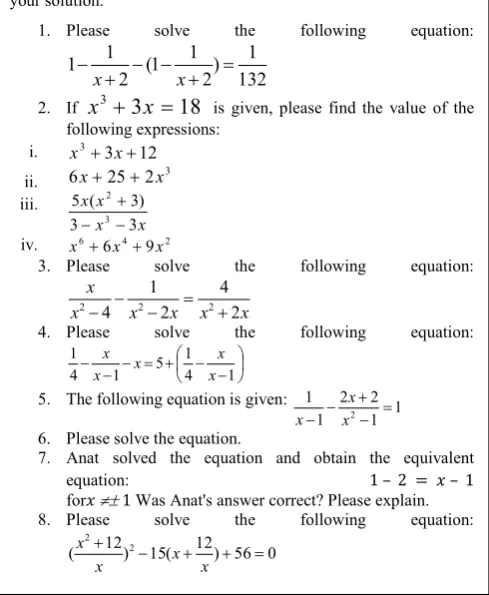
The present study was conducted in both a quantitative and qualitative approach. The research population consisted of 48 pupils, 23 boys and 25 girls, learning in the 10th grade of a 6-year middle and high school. Answers to the tasks were analysed by basic instruments and individual interviews were conducted with eight pupils. The research instrument comprised six mathematical questions. All of them could be effectively solved by means of a structure sense, except for question No. 3 – a routine equation which did not require a structure sense for its solution. Questions Nos. 1, 4 and 5 could also be solved without applying a structure sense. However, when used, the structure sense made the solution method more effective and rapid. Question No. 2 required identification of a given algebraic structure and the application thereof in order to obtain the correct answer. Question No. 6 necessitated an algebraic manipulation and identification of the structure. Without identification of the structure it would have been difficult to respond to this question (the pupils did not have the proper algebraic instruments for solving the equation in another way).
Figure 1. The questionnaire the pupils were asked to solve
RESULTS
The first research question examined whether there were differences in boys and girls' attainments in the solution of equations which required a structure sense. For that purpose, the rates of success in solving the tasks were checked by distribution into boys and girls. 'Success' was defined as a case whereby pupils solved the equation in the appropriate way, obtaining a complete and correct solution. Table No. 1
illustrates the rates of success in solving the questions. Apparently there is no significant differences in the mean values of success rates between boys and girls (42% among boys versus 39% among girls). Nevertheless, except for question Nos. 2a and 3, the boys' rate of success exceeded that of the girls. The second research question examined whether there were differences in the way boys and girls chose to solve equations which require a structure sense. In order to answer that question, the solution ways for each question were checked by distribution into boys and girls. First we focused on the findings obtained in those questions which could be solved in two ways yet were solved in a more effective and rapid way by pupils who applied a structure sense.
The pupils' solutions were classified into five categories
Correct solution while applying the structure sense – pupils who identified a familiar structure of the equation and solved it while using the identical structure. Thus they shifted to a simpler form of the equation.
Correct solution without applying the structure sense – pupils who solved the equation correctly. However, the solution included the use of brackets or multiplication of the common denominator without reference to the identical structure in the equation.
Correct technique with an error – pupils who solved the equation without reference to the identical structure in the exercise, acted according to a correct algorithm for solving the equation. However, their solution way included a miscalculation or their solution did not refer to the domain of definition.
Incorrect technique – pupils whose solution demonstrated lack of mastery of the rules of equation solution algorithms.
No solution – pupils who did not solve the question at all.
Table No. 2 presents the distribution (percentage) of the way the participants used for solving selected questions. The mean values indicate that the percentage of boys who solved the questions correctly by means of a structure sense was higher than the percentage of girls. Conversely, a higher percentage of girls managed to solve the questions correctly by using an algebraic technique without applying a structure sense. Almost half of the participants applied a correct technique without a structure sense and were mistaken in one of the stages of the solution. No significant difference in the application of an incorrect technique was found between the boys and girls. Nevertheless, a different trend is displayed in question No. 5 as opposed to the other questions in the same category. The reasons for that are discussed further on in the paper.
In question No. 5 the equation
1 1 2 2 1 1 2 x x x
Is given. As mentioned, this is a question which can be solved also without using the structure sense. However, when used, the structure sense renders the solution effective and rapid. Pupils who apply the structure sense will identify that a common factor can be taken out in the numerator of one of the terms and decompose the structure of that term by a short multiplication formula − = ( − )( + ), reducing thereafter the common expression. The obtained equation is equivalent and easier to solve within the range of the given equation definition.
Please explain in as detailed way as possible how did you obtain your solution.
1. Please solve the following equation:
132 1 ) 2 1 1 ( 2 1 1 x x
2. If
x
3
3
x
18
is given, please find the value of the following expressions:i. 3 3 12
x
x
ii. 6x252x3 iii. x x x x 3 3 ) 3 ( 5 3 2
iv. 6 4 2
9
6x x
x
3. Please solve the following equation:
x x x x x x 2 4 2 1
4 2 2
2
4. Please solve the following equation:
1 4 1 5 1 4 1 x x x x x
5. The following equation is given: 1
1 2 2 1 1 2 x x x
6. Please solve the equation.
7. Anat solved the equation and obtain the equivalent
equation: 1 – 2 = – 1
for ¹± 1 Was Anat's answer correct? Please explain.
8. Please solve the following equation:
[image:4.595.36.281.351.649.2]Table 1. Rate of success in solving the questions
Question No. Rates of success Boys Rates of success Girls Rates of success Entire population
Question No. 1 43 40 42
Question No. 2a 91 96 94
Question No. 2b 78 64 71
Question No. 2c 43 36 40
Question No. 2d 26 12 19
Question No. 3 22 40 31
Question No. 4 43 40 42
Question No. 5a 48 40 44
Question No. 5b 13 12 13
Question No. 6 9 8 8
[image:5.595.74.527.240.309.2]Mean values 42 39 40
Table 2. Distribution (percentage) of boys and girls' way of solving questions Nos 1, 4 and 5a
Question No. 1 Question No. 4 Question No. 5a Mean value
Solution way Boys Girls Boys Girls Boys Girls Boys Girls
Correct with a structure sense 17.4 0 34.8 16 8.7 0 20.3 5.3
Correct without a structure sense 26.1 40 8.7 24 39.1 40 24.6 34.7
Correct technique with a mistake 43.5 52 39.1 56 43.5 40 42 49.3
Incorrect technique 13 8 13 4 8.7 20 11.6 10.7
No solution 0 0 4.3 0 0 0 1.4 0
Table 3. Extent (%) of using the structure sense
Question No. Extent of applying the sense of structure –
Boys
Extent of applying the sense of structure - Girls
Difference
Question No. 1 17 0 17
Question No. 4 35 16 19
Question No. 5a 9 0 9
Question No. 5b 13 12 1
Question No. 6 17 16 1
Mean value of all the questions 38 29 9
Table 4. Rates of success among those applying the structure sense versus rates of success among those who solved the questions in another way
Question No. Applying a structure
sense
Applying a structure sense – success
Without a structure sense
Without a structure sense – success
Question No. 1 8 100 92 36
Question No. 4 25 100 75 22
Question No. 5a 4 100 96 41
Question No. 5b 13 100 88 0
Question No. 6 17 50 83 0
Mean value of all the questions 36 89 64 11
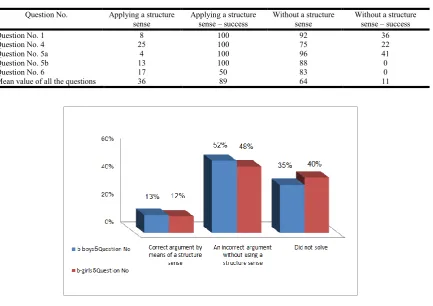
[image:5.595.75.527.349.428.2] [image:5.595.90.524.468.774.2]Question No. 5a examined whether the pupils will choose the way which applies a structure sense. Question No. 5b checks whether the pupils in item 5a who did not solve the question by means of a structure sense will be able, after getting guidance, to perform the required algebraic manipulation and obtain its equivalent equation 2 = − 1 for ¹± 1. In question No. 5b, the picture for the boys and girls is almost identical. 12% of the girls as opposed to 13% of the boys applied the structure sense while about half of the boys and the girls did not apply this sense and gave a wrong argument. Graph No. 1 presents the answers to question No. 5b by distribution into boys and girls.
In question No. 3, the following equation is given:
x x x x x
x
2 4 2 1
4 2 2
2 .
This equation calls for a solution by a routine algebraic technique without a structure sense. Apparently the girls were more versed than the boys in algebraic techniques and 40% of them managed to solve the question versus 22% of the boys.
Graph No. 2 illustrates the distribution of the solution of question No. 3 with an emphasis on the difference between boys and girls.
Question No. 6 is an equation:
0 56 ) 12 ( 15 ) 12
( 2
2
x x x
x
which is difficult to solve without identification of the algebraic structure. An almost identical picture of the boys and the girls can be identified. 18% of the boys applied the structure sense (9% solved correctly) as opposed to 16% of the girls (8% gave a correct solution). More than half of the boys and girls tried solving the question without a structure sense and were wrong. About one third of the boys and the girls did not try solving it at all. Graph No. 3 shows the ways of solution of question No. 6 with an emphasis on the difference between the boys and the girls Table No. 3 presents to what extent the pupils applied the structure sense as well as the differences between the boys and girls. Boys applied the structure sense more on average (38% of the boys versus 29% of the girls). Graph 2. Distribution of solutions given by boys and girls to question No. 3
All along the questionnaire the boys consistently used the structure sense in higher percentage than the girls, the gaps between the genders ranging between 1% and 19%. As the questionnaire advanced, these gaps tended to be reduced and in the complex questions the gap was diminished to 1% only. Table No. 4 illustrates the rates of success among those solving the questions by means of the structure sense versus those who did not solve in this way. The only exception was question No. 3 which cannot be solved by using the structure sense. On average, 36% of the pupils applied the structure sense and they had particularly high rates of success (89%). Conversely, 64% attempted to solve the questions without identifying the structure and had only 11% rates of success!. No significant difference was found in the two groups' achievements. However, while solving the questions, the boys and girls demonstrated a difference in their attitude, reference and learning style. Prior to the solution, several girls indicated that they had not revised the material and expressed their apprehension that the results of the questionnaire would be weighed in the final score. Moreover, while responding to the questionnaire several girls asked for an explanation how to solve a question in which they encountered difficulties. Since they received no response, they asked whether they had learnt this topic over the years and whether they were supposed to know it. The boys' approach was different – they filled in the questionnaire without any questions and queries regarding its effect on their score or its relation to the curriculum. This difference was found also in the analysis of the interview findings. Among the girls group, the findings illustrated a considerable dependence on receiving answers from the teacher and on the material learnt in class. The girls expected to get direct answers and less exercises requiring independent thinking. They pointed out that they solved the exercises in a schematic way according to what they had studied over the years and according to the curriculum. The girls frequently attributed the 'blame' to themselves because they had not noticed the exercise structure. One female-pupil solved the questionnaire in a technical manner, did not pay attention to the exercise structure and chose the familiar algebraic algorithm. In one of the interviews she was asked to explain why in her opinion she chose this way of solution. "At first I did not pay attention.
I did not look at the exercise… this way was 'stuck' too much in my head". She added that, "it is important not to solve like a robot" and "I think that if I had been given the exercise at a younger age, this is how I would have solved it. But since we were taught the methods of opening brackets and of a common denominator we got accustomed only to this method". Another female-student indicated that "frequently it is difficult to see… also in this exercise it took me a while to see what would be the shortest way. I sometimes don't see it immediately and it takes me a long time to discover it". An interesting aspect which emerged from the interviews was the dependence in the way of solution: "I wanted an answer and you did not give it to me […]. If we encounter a problem in the lessons then we usually ask the teacher and she tells us how we can solve […] and here […] you asked us to think…". Among the boys group, the findings indicated that they attributed the success or the failure mainly to personal capabilities and mathematical thinking. In their opinion it was due less to the curriculum and to the dependence on the delivery of material by the teacher and on her answers to their questions. In one of the interviews, when a male-pupil was asked to explain the reason for choosing the specific way of solution, he indicated that "we can solve the
exercise and we can have no success at all and this shows more mathematical thinking". The boys demonstrated a sense of not being dependent on the teacher and were less pressured by the uncertainty resulting from having to cope with material which was new and different from what they were used to in the curriculum.
DISCUSSION AND CONCLUSION
The present study aimed to examine whether there are gender-oriented differences in the pupils' solution of equations which require application of a structure sense. The first research question examined whether there were differences in boys and girls' attainments in the solution of equations which required a structure sense. Ben-Sasson-Furstenberg (2001) argues that in Israel boys' attainments in mathematics and exact sciences are significantly higher than those of the girls. This claim was only partly corroborated and no significant difference was found between the boys and the girls in the rate of success. Nevertheless, in almost all the questions, the boy's rate of success was higher than that of the girls. In the present study, many pupils technically solved the questions by arithmetic and algebraic procedures which they had studied and only about one third of them effectively solved the questions by identifying the structure. This low percentage indicates that the pupils have a limited tendency to exercise a judgement before the solution and they do not examine various ways for this purpose. This finding concurs with Schoenfeld (1992) who found that pupils usually apply the first idea which seems appropriate for the solution, without planning and in-depth analysis of the problem features and data. Apparently, our natural tendency as human beings is to make a decision based on what is familiar to us, even when the choice is not necessarily suitable (Ginat, 2007). The second research question examined whether there are differences in the way boys and girls choose to solve equations which require a structure sense. The research findings support the claim that the differences between boys and girls are only in the problem solution strategy and not in the test scores as shown by Fennema and Carpenter (1998). Boys and girls undergo a different socialisation process and this affects their preferences and coping ways in mathematics (Ben Sasson-Furstenberg 2001).
On the contrary, a higher percentage of girls managed to correctly answer by an algebraic technique without using the structure sense. This illustrates that in cases with two solution options, the girls choose the safe technical way whereas the boys usually choose another strategy. The boys succeeded to apply a suitable algorithm and chose the effective way of solution and the girls applied familiar and tangible ways which rendered very difficult the solution of the equation. This fact supports the findings of Fennema and Carpenter (1998), namely girls tended to use tangible solution strategies while boys usually used more abstract solution strategies.
This finding matches the study of Abrahami-Einat (1994) who specified that the differences between boys and girls are not differences of capability but rather of an approach, inclination and degree of self-defence. Similarly, Gazit (2012) maintained that men do better in solving problems in a verbal manner and women are better in computations. In the present study too the girls were inclined to turn to the place which is good and safe for them, i.e. computations. Since for some of the cases this strategy was unsuitable and by virtue of its use it tended to entail more errors in the way of solution, the girls were more mistaken. On the other hand, due to their high self-confidence and their ability to function better in a state of uncertainly, the boys tended more to apply the structure sense which gave them an advantage. However, when they failed to identify the structure, their rate of success in the computational algebraic method was lower or many of them got despaired and did not solve the question at all. Thus, on the whole, there were no significant differences in the attainments. Apparently in the first equation, in which the common denominator appeared in the same side of the equation, none of the girls applied the structure sense and only a small percentage of the boys (17%) used the structure sense. An increase in applying the structure sense is demonstrated by the boys and the girls in question No. 4 where the common denominator appeared in both sides of the equation. This finding corroborates the findings of Hoch and Dreyfus (2004). According to them, the percentage of boys who used the structure sense was lower when the variable appears in one side of the equation as opposed to a higher percentage when the variable is in both sides of the equation. Apparently the fact that the variable was included in both sides of the equation facilitated identification of similar terms.
A different tendency was observed in question No. 5 where a sharp decrease was demonstrated in the application of the structure sense among both boys and girls although here too there was a difference in favour of the boys. Explanation of this decrease might be due to the fact that when an algebraic manipulation is required for identifying the common denominator, the pupils find it difficult to identify it. The findings of question No. 6 support this explanation. This question manifested a continued prominent decrease in the application of the structure sense as well as in the rates of success. In this question, pupils had to examine the exercise structure, perform an algebraic manipulation in order to identify a similar structure and understand which manipulation should be performed in order to make use of the structure. Pupils who failed to do so obtained an algebraic expression from which they did not know how to continue. In other questions pupils could rely on another way. Conversely, in this question, those who did not rely on the structure sense could not continue with its solution. This might account for the low rates of success. Although no significant difference was found in the attainments, differences between the boys and girls were
identified in their attitude, reference and learning style during the question solution and after it. The questionnaires demonstrated that the boys were more confident of themselves and more daring. When asked to explain the reasons for their success, they attributed the success to themselves and the failure to others. Unlike them, the girls lacked confidence and responded in an opposite way. They attributed the success to others and the failure to themselves. They were less open to solve a questionnaire which deviated from the curriculum and was without a familiar algorithm. For example, one female-pupil pointed out: "I acted like a robot […] I know that I immediate have to open when I see an equation. The first way is confusing, you can make many mistakes when you don't pay attention. It happens to me all the time. I open and then everything becomes a mess when there are many numbers". This finding illustrates a difference between boys and girls in the reasons which they attributed to success and failure. These findings are essential since teachers, like parents, affect the pupils' beliefs about themselves and about their self-confidence, making an impact on their attainments and future choices. People who attribute success to a fixed and internal factor like a personal capability, will expect success to be recurrent in the future and will persevere in the area in which they were successful. Similarly, people who attribute failure to the lack of personal capabilities, anticipates the failure to be repeated. It is likely to assume that they will avoid continued engagement in a field where failure is to be expected (Tiedemann, 2002). This fact can have macro-social and economic implications. The issue of inter-gender differences in mathematics, in addition to reflecting the studies status at present, might also predict professional development later in life, choice of studies field, future wages, holding key positions and influence on society and the economy (Hyde and Lamon, 1990). The conclusion is that teachers should be aware of the gender-oriented differences in the way of thinking, learning style and chosen solution strategies. An emphasis should be put on an appropriate teacher education and curricula adaptation so that they respond to the different needs of boys and girls – in order to try minimising the gender-oriented gap. In the present study, about one third of the pupils applied the structure sense and their rates of success were particularly high (89%). On the other hand, about two thirds tried solving the questions without identifying the structure and their rates of success were low (11%).
process the strategy of searching special features in the questions in addition to the common algorithms studied in mathematics lessons. This strategy will encourage control and initial judgement in the solution process. As part of a systematic teaching programme, it is recommended adding to each study chapter several special questions in order to develop the pupils' appropriate competences.
Summary
Findings of the present study indicate that there is a conflict between two teaching approaches and in the current situation a greater emphasis is put on more instrumental understanding. Applying a structure sense is an interesting, enriching and vital solution strategy for a variety of learning topics in mathematics. Consequently, it is recommended devoting time to its formal inculcation in the teaching of mathematics. Pupils should learn when it should be used and discuss the foci of difficulty in its implementation. While teaching contents in which the structure sense is relevant, teachers should demonstrate its use and enhance the pupils' awareness of the effective potential encompassed in it. There are gender-oriented differences in the way of solution and the research findings indicate that girls tend more to implement formal solutions. The present study presents reasons for the gender-oriented differences and their future social implications. Attention should undoubtedly be paid to these findings and the curriculum and the teaching style should be adapted in order to establish a proper balance between the two teaching approaches, accommodating the teaching to the differences between boys and girls' learning style. This will enhance the awareness of the discrimination and stereotypes among teachers in the hope that this will entail the reduction of the gender-oriented gap.
REFERENCES
Abrahami-Einat, J. 1994. Hidden Messages, gendered interactions in Israeli schools. University of London Unpublished Ph.D. dissertation.
Arbel, B. 1991. Problem-solving Strategies. Tel-Aviv, Open University Press. [Hebrew]
Ben Sasson-Furstenberg, S. 2001. Background document for the discussion of the topic: Differences between the genders in the education system. Jerusalem: Knesset – Centre of Research and Information. [Hebrew]
Booth, L. R. 1981. Child-methods in secondary mathematics.
Educational Studies in Mathematics, 12(1), 29-41.
Buffery, A. and Gray, J. 1972. Sex differences in the development of spatial and linguistic skills. In: C. Ounsted, and Taylor (Eds.), Gender differences, their ontogeny and significance (pp. 123–158). Edinburgh: Churchill Livingstone.
Central Bureau of Statistics (2013). Women and men 1990-2011. Statistical, 132, 1-18. [Hebrew]
Fennema, E. and Carpenter T. P. 1998. New perspectives on gender differences in mathematics: An introduction.
Educational Researcher, 27(5), 4-5.
Fey, J T. 1984. Computing and Mathematics – The Impact on Secondary School Curricula (pp 1-30). Reston, VA: NCTM.
Gazit, A. 2012. Male and female created he them – mathematics teachers' attitudes towards gender differences in mathematical thinking. Hahinuch Usvivo, 34, 69-81. [Hebrew]
Ginat, D. 2007. Hasty design, futile patching and the elaboration of rigor. Proceedings of the 12th annual SIGCSE Conference on Innovation and Technology in Computer Science Education. DOI: 10.1145/1268784. 1268832. https://www.researchgate. net/publication/ 220807479
Harel, G. and Sowder, L. 1998. Students' proof schemes. In E. Dubinsky, A. Schoenfeld, and J. Kaput (Eds.), Research on Collegiate Mathematics Education, Vol. III. (pp. 234-283), A co-publication of the AMS and CBMS
Hoch, M. and Dreyfus, T. (2004). Structure sense in high school algebra: The effect of brackets. In M. J. Høines, and A. B. Fuglestad (Eds.), Proceedings of the 28th Conference of the International Group for the Psychology of Mathematics Education, 3, 49-56. Bergen, Norway: PME. Hyde, J. and Lamon, S.J. 1990. Gender Differences in
Mathematics Performance: A Meta Analysis. Psychological Bulletin, 107, 139-155.
Kieran, C. (2004). The core of algebra: Reflections on its main activities. In K. Stacey, H. Chick, and M. Kendal (Eds.),
The future of teaching and learning of algebra: 12th ICMI Study (pp. 21-34). Dordrecht, The Netherlands: Kluwer Academic Publishers.
Linchevski, L. and Livneh, D. 1999. Structure sense: The relationship between algebraic and numerical contexts.
Educational Studies in Mathematics, 40(2), 173-196. Markovits, Z., Hershkowitz, R. and Bruckheimer, M. 1989.
Number sense and nonsense. Arithmetic Teacher, 36(6), 53-55.
Mats, M. 1980. Toward a Computational Theory of Algebraic Competence. The Journal of Mathematical Behavior, 3(1) 93-166.
Ministry of Education and Culture 2013. The new mathematics curriculum for the 7th, 8th and 9th grades. Jerusalem: The State of Israel, Pedagogical Secretariat – Sciences, Department of Supervision on Mathematics Teaching. http://cms. education.gov.il/ Education CMS/Units/ Mazkirut_Pedagogit/Matematika/ChativatBenayim
[Hebrew]
Reyes, L.H. 1984. Affective variables in mathematics education. The Elementary SchoolJournal, 84, 558–581. Rubin, E., Bar, V. and Cohen, A. (2002). The Images of
Scientists and Science Among Hebrew- And Arabic-Speaking Pre Service Teachers In Israel. International Journal of Science Education (In Press).
Schoenfeld, A. H. 1985. Mathematical Problem Solving. Orlando: Academic Press.
Schoenfeld, A. H. 1992. Learning to think mathematically: Problem solving, metacognition, and sense-making in mathematics. In D. Grouws (Ed.), Handbook for Research on Mathematics Teaching and Learning (pp. 334-370).New York: MacMillan.
Skemp, R. 1976. Relational understanding and instrumental understanding. Mathematics Teaching, 77, 20–26.
Spelke, E. S. 2005. Sex Differences in Intrinsic Aptitude for Mathematics and Science?: A Critical Review. American Psychologist, 60(9), 950-958.
Star, J. R. 2005. Re-conceptualizing procedural knowledge.
Journal for Research in Mathematics Education, 36(5), 404-411.
Star, J. R. 2007. Foregrounding procedural knowledge. Journal for Research in Mathematics Education, 38(2), 132-135. Steinberg, R. M., Sleeman, D. H. and Ktorza, D. 1990. Algebra
Tiedemann, J. 2002. Teachers' gender stereotypes as determinants of teacher perceptions in elementary school mathematics. Educational Studies in Mathematics,50, 49-62.
Zorman, R. 1996. The long and winding road from promise to fulfillment in science among gifted females in Israel. High Ability Studies, 7(1), 39-50.
Zorman, R. 1998. Fulfilling the potential of gifted Israeli females to achieve in the sciences. In R. Zorman, and N. Krongold (Eds.). Nurturing Gifted Girls in the Natural Sciences. (pp. XLV-LXIII). Jerusalem: The Szold Institute.