doi:10.4236/nm.2010.11003 Published Online September 2010 (http://www.SciRP.org/journal/nm)
Normalizing the Arm Reaching Patterns after
Stroke through Forced Use Therapy
– A Systematic Review
Senthilkumar Jeyaraman1, Ganesan Kathiresan2, Kavitha Gopalsamy3
1
Physiotherapy, School of Therapeutic Sciences, Masterskill University College of Health sciences, Cheras, Malaysia; 2 Physiother-apy, School of Allied Health, Masterskill University College of Health sciences, Sabah, Malaysia; 3Physiotherapist, Cheras, Malay-sia.
Email: [email protected], {gans_therapist, gopalsamykavitha}@yahoo.co.in
Received June 10th, 2010; revised June 25th, 2010; accepted June 30th, 2010.
ABSTRACT
Hemiparesis is common following stroke. The ability to reach and grasp is a necessary component of many daily life functional tasks, hence reduced upper limb function has an impact on the ability to perform activities of daily living. In hemiparetic patients, the unrestricted and unguided repetition of a motor task may reinforce compensatory movements. Trunk restraint allowed the patients to use joint ranges that were present but not recruited during unrestrained reach-ing. Later, studies combined the trunk restraint training with additional therapeutic interventions. With the growing number of studies on this intervention in the stroke population, there is the need to consolidate this evidence to deter-mine the potential use of trunk restraint training in improving arm reaching in neurological rehabilitation particularly for stroke patients. A considerable research effort had assessed the effects of trunk restraint training on the recovery of reaching movements in hemiparetic patients. This review identified 5 relevant trials in which one trial is a pilot study. Among 5 trials, three trials recorded the movement kinematics (outcome measure) by Optotrak Motion analysis System, in the other two trials the movement kinematics (outcome measure) were analysed by a 6 – camera, 3D Motion analysis system and 10 – camera Motion Analysis System respectively. The effect size for the intervention was calculated by Cohen’s d. In this review, for the meta-analysis we used trunk displacement, trunk flexion, elbow extension, Smoothness and hand trajectory straightness (movement variables in kinematic analysis). The results of our review demonstrated that the use of trunk restraint as a treatment paradigm aimed at decreasing compensatory strategies has the potential of becoming an effective therapy. Further studies are necessary to determine the long term effect of the trunk restraint training.
Keywords: Stroke, Trunk Restraint, Reaching
1. Introduction
Research on the effectiveness of rehabilitation techniques for patients with stroke is important not only for stroke survivors but also for care givers, treatment providers and society alike. The ability to reach and grasp is a nec-essary component of many daily life functional tasks, hence reduced upper limb function has an impact on the ability to perform activities of daily living [1], which is likely to reduce independence and increase burden of care. In the months after stroke, function of the paretic arm can improve as reaching; grasping and manipulating ability is regained. Improvements in function can occur
in 2 ways. In one way, premorbid movement patterns may be regained because of true motor recovery. In an-other way, because of the redundancy in the number of degrees of freedom (DFs) of the body [2], actions can be accompanied by substitution of other DFs for movements of impaired joints. These alternative movements or motor compensations [3] are also observed in animals recover-ing from experimental stroke [4,5].
movement after 1 day of intensive training by incorpo-rating trunk anterior displacement, a movement not nor-mally needed for the task. Thus, in the short term, al-though compensatory movements may improve per-formance of the paretic arm, in the long term, these may be maladaptive by preventing recovery or reappearance of more efficient arm movement patterns [7].
Although neurorehabilitation research has recently demonstrated that structured, specific, and intensive trai- ning protocols increase the amount of hemiparetic limb use, less attention has been given to normalizing move-ment strategies poststroke [8]. Hence, Michaelsen et al.
evaluated movement patterns of the hemiparetic arm made with or without restriction of compensatory trunk movements during reach to grasp tasks and found restric-tion of compensatory trunk movements may encourage recovery of ‘normal’ reaching patterns in the hemiparetic arm when reaching for objects placed within arm’s length. During trunk restraint, patients improved active elbow extension, shoulder ranges and interjoint coordi-nation when reaching [9-11]. Trunk restraint thus al-lowed patients to use joint ranges that were present but not recruited during unrestrained reaching. Later, studies combined the trunk restraint training with additional therapeutic interventions [12,13].
With the growing number of studies on this interven-tion in stroke populainterven-tion, there is a need to consolidate this evidence to determine the potential use of trunk re-straint training in improving arm reaching in neurological rehabilitation particularly for stroke patients.
2. The Review
2.1. Aim
1) The primary aim is, to assess the effectiveness of trunk restraint training on the recovery of reaching movements in stroke patients.
2) Secondary aim is, to find out the effectiveness of trunk restraint training combined with other therapeutic inter-ventions.
2.2. Inclusion Criteria
2.2.1. Type of Studies
To determine the evidence of the effectiveness of trunk restraint practice in neurological rehabilitation of stroke patients, randomised controlled clinical trials (RCTs) was the study design of choice. Clinical controlled trials (CCTs), quasi experimental studies, descriptive studies were also considered in the absence of RCTs.
2.2.2. Types of Participants
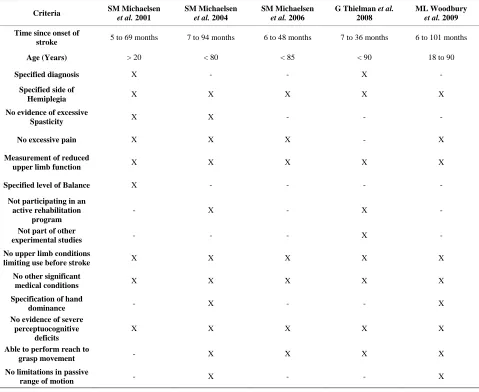
This review included any study involving any adult per-son with stroke, except those with pathology of the cere-bellum or the basal ganglia (Table 1).
2.2.3. Types of Interventions
Trunk restraint training, Trunk restraint training com-bined with other interventions (Table 2).
2.3. Outcome Measures
2.3.1. Clinical
Fugl—Meyer Assessment (arm section). TEMPA Scale.
Manual Dexterity (Box and Block Test).
Isometric Force (Handheld & handgrip Dyna-mometers).
AROM (Active Range of Motion). Composite Spasticity Index. Wolf Motor Function Test.
Motor Activity Log—Amount of Use Scale and Quality of Movement Scale.
2.3.2. Kinematic
Motion analysis system.
2.4. Search Strategy for Identification of Studies
2.4.1. Language
Published English language studies were sought.
2.4.2. Keywords
Chronic stroke, arm, reaching, trunk restraint training. Studies identified during the database searches from 2000 to 2009 were assessed for relevance from a review of the title, abstract and descriptors of the study. The databases that were searched included:
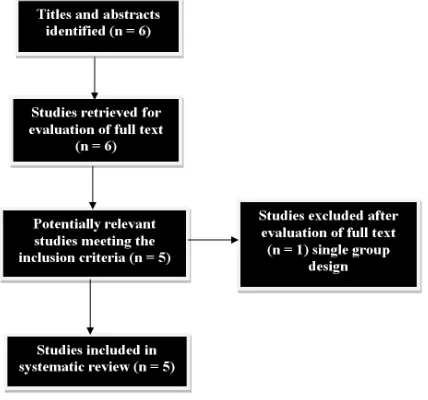
CINAHL,EMBASE, MEDLINE, Cochrane library, PEDro, Pubmed, Ovid (Figure 1).
2.5. Data Extraction
[image:2.595.318.532.508.708.2]Study outcome data were collected by one reviewer and
Table 1. Criteria for inclusion of participants in studies.
Criteria SM Michaelsen
et al. 2001
SM Michaelsen
et al. 2004
SM Michaelsen
et al. 2006
G Thielman et al. 2008
ML Woodbury
et al. 2009
Time since onset of
stroke 5 to 69 months 7 to 94 months 6 to 48 months 7 to 36 months 6 to 101 months
Age (Years) > 20 < 80 < 85 < 90 18 to 90
Specified diagnosis X - - X -
Specified side of
Hemiplegia X X X X X
No evidence of excessive
Spasticity X X - - -
No excessive pain X X X - X
Measurement of reduced
upper limb function X X X X X
Specified level of Balance X - - - -
Not participating in an active rehabilitation
program
- X - X -
Not part of other
experimental studies - - - X -
No upper limb conditions
limiting use before stroke X X X X X
No other significant
medical conditions X X X X X
Specification of hand
dominance - X - - X
No evidence of severe perceptuocognitive
deficits
X X X X X
Able to perform reach to
grasp movement - X X X X
No limitations in passive
range of motion - X - - X
Table 2. Description of trunk restraint procedures.
Author Restraint Procedures
SM Michaelsen et al. (2001) Trunk was secured to the chair back with the harness minimizing shoulder girdle movement
and preventing trunk flexion and rotation
SM Michaelsen et al. (2004)
Participants wore a harness consisting of breast and back plates connected by adjustable straps. An electromagnet attached to the wall was locked to the back electromagnetic plate at the interscapular level
SM Michaelsen et al. (2006) Trunk movements were prevented by body and shoulder belts attached to the chair back. Scapular elevation / protraction were not restricted.
G Thielman et al. (2008)
Restraining device (LL Bean Co, Freeport, ME) was attached to the chair’s back and had 2 padded shoulder straps that come across the glenohumeral joint, permitting approximately 3cm of scapula motion but limiting trunk flexion.
ML Woodbury et al. (2009)
checked by a second reviewer. The following study cha- racteristics were recorded on a data extraction form: set-ting and phase, study design and population, intervention, outcome and measurement.
2.6. Data Analysis
The effect size for the intervention was calculated by Cohen’s d [14,33]. The effect sizes are especially impor-tant because they allow us to compare the magnitude of experimental treatments from one experiment to another. Estimates from individual studies are combined to reflect the overall size of the effect of the independent variable. The larger the difference, the greater the ‘effect’ of the intervention. If the effect size is >= –0.15 and <0.15, the effect is negligible, if the effect size >= 0.40 and < 0.75, it is said to be medium effect, while the effect size is > 1.45, the effect is said to be huge. The size of percentage change is also calculated.
In this review, for the meta-analysis we used the fol-lowing movement variables in kinematic analysis (out-come measure),
trunk displacement, trunk flexion, elbow extension,
Smoothness and hand trajectory straightness.
2.7. Results
The search yielded 6 full text articles, following the ex-clusion based on the criteria; 5 articles were included. Among the 5 articles included, one was done in Canada with 11 healthy and 11 hemiparetic individuals [9], the another two studies were studied in Canada with 28 hemiparetic patients and 30 patients respectively [10,11]. The fourth one was done in New York with 11 patients [12]; fifth study was done with 12 strokes, 5 health indi-viduals in Florida [13].
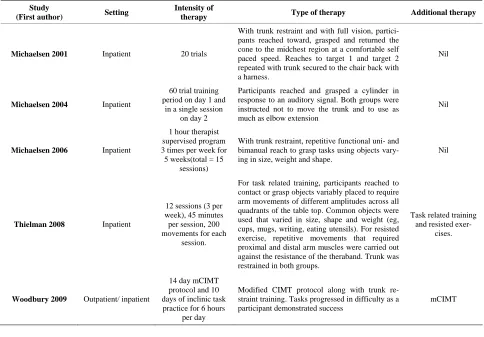
Michaelson SM et al. [9-11] studied the effect of trunk restraint training on the recovery of reaching movements in chronic hemiparetic patients. Thielman G. et al. [12] studied the task related training and resisted exercise combined with trunk restraint training. Woodbury ML et al. [13] combined the trunk restraint training with inten-sive task practice and studied its effects on reach and function.
Participants across all the trails had similar diagnosis of hemiparesis with more upper limb involvement. All the trails exclude the patients with hemispatial neglect or apraxia, shoulder pain or neurologic or orthopaedic con-ditions affecting the arm or trunk.
The duration of the trail, setting type, intensity and type of therapy varied across trails which are described in
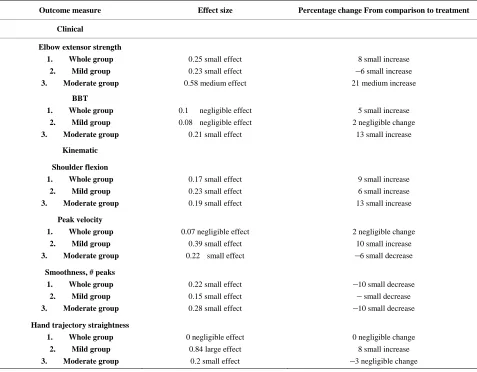
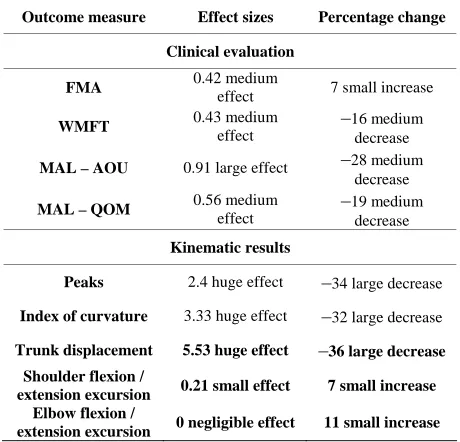
Table 3. The effect sizes and percentage change for the outcome measure was calculated for both treatment and control groups. It was described in the Tables 4, 5, 6, 7, 8, which revealed negligible effect to very large effect sizes and negligible change to large decrease respec-tively.
2.7.1. Trunk Restraint Training and Recovery of Reaching
Three of the five trials studied the effect of trunk restraint training on reaching movements in patients with chronic stroke. All the three trials were done by SM. Michaelson
et al. [9-11]. In the first trial, he included 11 healthy and 11 hemiparetic individuals. Data was collected with the use of an Optotrak Motion Analysis System. He con-cluded that trunk restraint decreases the number of joints involved in reaching. The effect sizes for elbow exten-sion is 1.24 (Very large effect) in trunk restraint training. The percentage changes from comparison to treatment groups for elbow extension are –15 (Medium decrease). In this study, elbow extension was increased on an aver-age of 14 degrees.
In the second study, 28 hemiparetic were assigned into two groups. The outcome measure was Optotrak motion Analysis system. The author concluded that restriction of compensatory trunk movements during practice may lead to greater improvements in reach – to – grasp movements in patients with chronic stroke than practice alone. The effect sizes for trunk displacement is 0.58 (Medium ef-fect) and elbow extension is 0.29 (small efef-fect). The per-centage changes from comparison to treatment group for trunk displacement is –33 (Large decrease) and elbow extension is 7 (Small increase). Individual analysis of hemiparetic patients in trunk restraint group showed an increase in elbow extension (> 10 degrees) between pre-test and retention test; Anterior trunk displacement was decreased significantly more (by 52 mm) in trunk restraint patients.
In the third trial, Michaelsen randomly assigned 30 pa-tients into trunk restraint group and control group. The author concluded that treatment should be tailored to arm impairment severity with particular attention to control-ling excessive trunk movements if the goal is to improve arm movement quality and function. The effect sizes for smoothness (in whole group) is 0.22 (Small effect) and hand trajectory straightness (in whole group) is 0 (negli-gible effect). The percentage changes from comparison to treatment group for smoothness is –10 (Small decrease) and hand trajectory straightness is 0 (negligible change). Kinematic analysis revealed that trunk restraint de-creased mean trunk displacement by 32.8 mm at post-test; at the same time trunk restraint increased elbow
Table 3. Summary of trial design features.
Study
(First author) Setting
Intensity of
therapy Type of therapy Additional therapy
Michaelsen 2001 Inpatient 20 trials
With trunk restraint and with full vision, partici-pants reached toward, grasped and returned the cone to the midchest region at a comfortable self paced speed. Reaches to target 1 and target 2 repeated with trunk secured to the chair back with a harness.
Nil
Michaelsen 2004 Inpatient
60 trial training period on day 1 and
in a single session on day 2
Participants reached and grasped a cylinder in response to an auditory signal. Both groups were instructed not to move the trunk and to use as much as elbow extension
Nil
Michaelsen 2006 Inpatient
1 hour therapist supervised program 3 times per week for 5 weeks(total = 15
sessions)
With trunk restraint, repetitive functional uni- and bimanual reach to grasp tasks using objects vary-ing in size, weight and shape.
Nil
Thielman 2008 Inpatient
12 sessions (3 per week), 45 minutes per session, 200 movements for each
session.
For task related training, participants reached to contact or grasp objects variably placed to require arm movements of different amplitudes across all quadrants of the table top. Common objects were used that varied in size, shape and weight (eg, cups, mugs, writing, eating utensils). For resisted exercise, repetitive movements that required proximal and distal arm muscles were carried out against the resistance of the theraband. Trunk was restrained in both groups.
Task related training and resisted
exer-cises.
Woodbury 2009 Outpatient/ inpatient
14 day mCIMT protocol and 10 days of inclinic task practice for 6 hours
per day
Modified CIMT protocol along with trunk re-straint training. Tasks progressed in difficulty as a participant demonstrated success
mCIMT
Table 4. Effect sizes for the trial 1 (SM Michaelsen et al. 2001).
Effect sizes From comparison to treatment Percentage change
Outcome measure
Trunk free Trunk restrained Trunk free Trunk restrained
Elbow extension 1.32 very large effect 1.24 very large effect –27 medium decrease –15 medium decrease
Shoulder horizontal
adduction 1.89 huge effect 2.19 Huge effect –41 large decrease –44 large decrease
Shoulder flexion 1.63 huge effect 1.27 very large effect –54 very large decrease –30 large decrease
Peak velocity 0.84 large effect 1.40 very large effect –22 medium decrease –38 large decrease
No. Of peaks 1.26 very large effect 1.89 huge effect 87 huge increase 100 huge decrease
Index of curvature 0.83 large effect 0.76 large effect 12 small increase 11 small increase
Slope of angle 1.17 very large effect 0.44 medium effect –54 very large decrease –17 medium decrease
Angle correlation 0.9 large effect 0.53 medium effect –22 medium decrease –5 small decrease
2.7.2. Trunk Restraint Training Combined with Task Related Training and Resisted Exercise
G. Thielman et al. [12] in his study included 5 stroke patients in task related training group and 6 stroke pa-tients in resisted exercise group. After the training, 3D Motion analysis system was used for testing. He
[image:5.595.63.540.457.635.2]Table 5. Effect sizes for the trial 2 (SM Michaelsen et al. 2004).
Outcome measure Effect sizes Percentage change
From comparison to treatment
Performance outcome measures
Velocity peaks 0.04 negligible effect 2 negligible change
Movement time 0.02 negligible effect 1 negligible change
Wrist peak velocity 0.16 small effect 4 negligible change
Time to peak velocity 0.46 medium effect 17 medium increase
Movement variable
Trunk displacement 0.58 medium effect -33 large decrease
Trunk rotation 0 negligible effect 0 negligible change
Elbow extension 0.29 small effect 7 small increase
Shoulder horizontal adduction 0.33 small effect 19 medium increase
Shoulder flexion 0.31 small effect 19 medium increase
Table 6. Effect sizes for the trial 3 (SM Michaelsen et al. 2006).
Outcome measure Effect size Percentage change From comparison to treatment
Clinical
Elbow extensor strength
1. Whole group
2. Mild group
3. Moderate group
0.25 small effect 0.23 small effect 0.58 medium effect
8 small increase –6 small increase 21 medium increase
BBT
1. Whole group
2. Mild group
3. Moderate group
0.1 negligible effect 0.08 negligible effect
0.21 small effect
5 small increase 2 negligible change
13 small increase
Kinematic
Shoulder flexion
1. Whole group
2. Mild group
3. Moderate group
0.17 small effect 0.23 small effect 0.19 small effect
9 small increase 6 small increase 13 small increase
Peak velocity
1. Whole group
2. Mild group
3. Moderate group
0.07 negligible effect 0.39 small effect 0.22 small effect
2 negligible change 10 small increase –6 small decrease
Smoothness, # peaks
1. Whole group
2. Mild group
3. Moderate group
0.22 small effect 0.15 small effect 0.28 small effect
–10 small decrease – small decrease –10 small decrease
Hand trajectory straightness
1. Whole group
2. Mild group
3. Moderate group
0 negligible effect 0.84 large effect
0.2 small effect
[image:6.595.59.536.347.719.2]Table 7. Effect sizes for the trial 4 (Thielman et al. 2008).
Effect sizes Percentage change
Measures
Ipsilateral Midline Contra lateral Ipsilateral Midline Contra lateral
Movement time 0.33 small effect 0.12 negligible effect 0.03 negligible effect 13 small increase 4 negligible change 1 negligible change
First velocity peak
0.41 medium effect
0 negligible effect
0.49 medium
effect 8 small increase
0 negligible
change 7 small increase
Elbow extension 0.27 small effect 0.08 negligible
effect 0.29 small effect 9 small increase
2 negligible
change 11 small increase
Trunk flexion 0.37 small effect 0.8 large effect 0.71 medium
effect
–17 medium decrease
–32 large
decrease –42 large decrease
Trunk rotation 0.74 medium
effect
0.4 medium effect
0.65 medium effect
–33 large de-crease
–15 medium
decrease –36 large decrease
Scapula 1.9 huge effect 1.15 very large
effect 0.9 large effect
–186 huge decrease
–300 huge
decrease 90 huge increase
Independent arm 0 negligible effect 0.49 medium
effect 0.39 small effect
2 negligible change
16 medium
increase 9 small increase
Table 8. Effect sizes for the trial 5 (Woodbury et al. 2009).
Outcome measure Effect sizes Percentage change
Clinical evaluation
FMA 0.42 medium effect 7 small increase
WMFT 0.43 medium
effect
–16 medium decrease
MAL – AOU 0.91 large effect –28 medium
decrease
MAL – QOM 0.56 medium
effect
–19 medium decrease
Kinematic results
Peaks 2.4 huge effect –34 large decrease
Index of curvature 3.33 huge effect –32 large decrease
Trunk displacement 5.53 huge effect –36 large decrease
Shoulder flexion /
extension excursion 0.21 small effect 7 small increase
Elbow flexion /
extension excursion 0 negligible effect 11 small increase
ment group for elbow extension is 2 (Negligible change) and trunk flexion is –32 (Large decrease). The elbow extension increased significantly from pre-test to post test in trunk restraint group (55 degrees to 64 degrees).
2.7.3. Trunk Restraint Training Combined with Intensive Task Practice
ML. Woodbury et al.[13] did a pilot study in which he included 11 chronic stroke patients and 5 healthy indi-viduals. Data were collected with 10 – camera motion analysis system. He concluded that intensive task prac-tice structured to prevent compensatory movements and promote shoulder flexion – elbow extension coordination may reinforce development of normal reaching
kinemat-ics. The effect sizes for trunk displacement are 5.53 (Huge effect). The percentage changes from comparison to treatment group trunk displacement are –36 (Large decrease). In mCIMT +Trunk restraint group, the trunk displacement is 0.13(0.01) in pre-test & 0.04(0.01) in post-test; the elbow flexion/extension excursion is –7.48 (6.69) in pre-test & 1.87 (1.93) in posttest.
3. Discussion
A considerable research effort has assessed the effects of trunk restraint training on the recovery of reaching movements in hemiparetic patients. This review identi-fied 5 relevant trials in which one trial is a pilot study. Among 5 trials, three trials recorded the movement kinematics (outcome measure) by Optotrak Motion analysis System, in the other two trials the movement kinematics(outcome measure) were analysed by a 6 – camera, 3D Motion analysis system and 10 – camera Motion Analysis System respectively. The effect sizes for the outcome measure (Kinematic analysis) were ana-lysed which shows medium effect to very large effect favouring the trunk restraint group. There is variability in the result of the studies included in this review, since the studies included mildly to moderately affected patients there is lack of improvement resulted from the training not being challenging enough.
[image:7.595.57.287.325.546.2]trunk restraint training on arm recovery in stroke patients and demonstrated that trunk restraint is a treatment para-digm which decreases the compensatory strategies.
Since task related training [19,20] and resisted exer-cise21 demonstrated enhanced recovery in stroke patients, Thielman et al. [12] compared the effects of task related training and resisted exercise combined with trunk re-straint training in his recent trial. His results added one more stone in the crown of trunk restraint training. Ex-tensive practice using task related training with truncal restraint appears to be a more effective approach to reha-bilitate reaching with the hemiparetic arm.
3.1. How Trunk Restraint Training Improves Arm Reaching?
The effects of trunk restraint indicate that hemiparetic patients did not use their potential joint range for free arm movements. A likely explanation stems from the findings of Levin et al. [16]. They defined articular ranges in which hemiparetic patients could make isolated elbow flexion and extension movements by using a reciprocal muscle activation pattern. The increase in joint ranges with trunk restraint may be partly due to an adaption in-volving anticipation of changed external load conditions.
Another possibility is that the adaptation was triggered by somatosensory input from the trunk or shoulder caused by the trunk restraint [17]. In other words, pa-tients are forced to make movements “out of synergy”, which probably involves a focussed and greater effort on their part. This is similar to the strategy of constraining the unaffected arm [18] to force the patient to make more use of the affected arm with the additional feature that reduction of compensatory movement patterns is also targeted. This was proved by the recent findings of ML. Woodbury et al. [13]. Physical trunk restraint can be con-sidered similar to “Manual guidance” in which spatial constraints are used to promote use of more optimal movement patterns [10].
In this training paradigm, external feedback, that is, explicit information was inherently built into the task practice with trunk restraint context both as knowledge of results (KR) and knowledge of performance (KP). For example, the participant received KR by either achieving or failing to achieve the task- goal. Additionally, the par-ticipants received KP via an afferent cue from the trunk restraint if he/she leaned forward [13].
3.2. Trunk Restraint Training in Future
Findings of Hsu WL et al. [22] suggest that the muscles in the affected ankle cannot be recruited timely and effi-ciently for the reaching task in stroke patients, as with relative recovery in lower limbs. In other words, they do not generate normal motor recruitment patterns to
ac-complish the motor task. It has been reported that even when the recovery is scored high in test situations, stroke patients do not spontaneously use their paretic side in daily living situations [23]. Future studies should empha-size some interventions to the hemiplegic lower limb while giving trunk restraint training to the hemiplegic upper limb.
The interaction between arm and trunk movements may also be altered in patients with hemiparesis due to the excessive displacement of the trunk for arm transport as has been previously reported during unimanual reach-ing and graspreach-ing [9-26]. The increased role of the trunk for arm transport and problems of trunk control in indi-viduals with hemiparesis may represent additional chal-lenges to inter-segment coordination and result in a de-stabilization of posture during tasks requiring arm movements from a standing position [27]. In daily living, reaching is more likely to be performed in a standing position [28,29]. In future, we recommend to study the influence of trunk restraint training in arm reaching in standing position.
It has long been recognized by clinicians [7,30] that once compensation has been learned, it is very difficult to modify. Indeed, prolonged use of compensatory trunk movements to reach targets placed within arm’s length may result in the system learning not to use arm joints for reaching and grasping (learned nonuse) [18]. So that re-covery of independent use of these joints would be dis-couraged. Compensatory movement strategies may be very difficult to unlearn[31], frustrating efforts to im-prove movement for both patient and therapist. Though all the trials included in this review demonstrated posi-tive results for trunk restraint training on arm reaching movements, for maintaining the training effects for the rest of the day we suggest to study the effects of addi-tional usage of strapping or splints or brace with trunk restraint training.
It is already known that stroke patients are decondi-tioned; hence training programs should combine physical conditioning and motor learning principles which will give the best and most permanent effect on motor recov-ery [32]. Trunk restraint training didn’t address whether the intervention improved functional capacity of the arm, because it was expected that longer term practice would be necessary to affect change in this dimension. Hence in future, studies on trunk restraint training can also include physical conditioning program along with long term practice.
4. Limitations
The limitations of this review are,
1) Among the studies included in this review, only one study is randomized controlled trial which is suitable to find out the clinical efficacy.
2) The study quality of included papers is not evalu-ated, because we included descriptive studies in the ab-sence of randomized controlled trials.
3) The kinematic analysis done in the studies included in this review used different movement variables; hence it is difficult to summarize the results.
5. Conclusions
This review identified 5 full text trials of trunk restraint training in stroke patients. The results of our review demonstrated that the use of trunk restraint as a treatment paradigm aimed at decreasing compensatory strategies has the potential of becoming an effective therapy. It shows that under lying “normal” patterns of movement coordination are not entirely lost after stroke and that appropriate treatments may be applied to uncover them to maximize function. One cost of this recovery may be a short-term decrease in movement speed. Our review also suggests that trunk restraint training + other rehabilitation program encouraged near to normal coordination patterns which were not seen in the absence of trunk restraint training in the rehabilitation protocol. Further researches with randomized control trials are necessary to determine the long term effect and the clinical efficacy of the trunk restraint training.
REFERENCES
[1] S. J. Page, S. Sisto, P. Levine and R. E. Mcgrath, “Effi-cacy of Modified Constraint-Induced Movement Therapy in Chronic Stroke: A Single-Blinded Rendomized Con-trolled Trial,” Archives of Physical Medicine and
Reha-bilitation, Vol. 85, No. 1, 2004, pp. 14-18.
[2] N. A. Bernstein, “The Coordination and Regulation of Movement,” Pergamon Press, Oxford, UK, 1967.
[3] M. C. Cirstea and M. F. Levin, “Compensatory Strategies for Reaching in Stroke,” Brain, Vol. 123, No. 5, 2000, pp. 940-953.
[4] I. Q. Whishaw, “Loss of the Innate Cortical Engram for Action Patterns Used in Skilled Reaching and the Devel-opment of Behavioural Compensation Following Motor Cortex Lesions in the Rat,” Neuropharmacology, Vol. 39, No. 5, pp. 788-805.
[5] K. M. Friel and R. J. Nudo, “Recovery of Motor Function after Cortical Injury in Primates: Compensatory Movement Patterns Used During Rehabilitative Training,”
Somato-sensory and Motor Research, Vol. 15, No. 3, 1998, pp.
173-189.
[6] M. C. Cirstea, A. Ptito and M. F. Levin, “Arm Reaching
Improvements with Short Term Practice Depend on the Severity of the Motor Deficit in Stroke,” Experimental
Brain Research, Vol. 152, No. 4, 2003, pp. 476-488.
[7] L. Ada, C. Canning, J. H. Carr, S. L. Kilbreath and R. B. Shepherd, “Task—Specific Training of Reaching and Manipulation,” In: K. M. B. Bennet, U. Castiello, Eds.,
Insights into Reach and Grasp Movement,
El-sevier–Biosoft, Cambridge, UK, 1994, pp. 239-265.
[8] J. W. Krakauer, “Motor learning: Its Relevance to Stroke Recovery and Neurorehabilitation,” Current Opinion in
Neurology, Vol. 19, No. 1, 2006, pp. 84-90.
[9] S. M. Michelsen, A. Lutta, A. Roby-Brami and M. F. Levin, “Effect of Trunk Restraint on the Recovery of Reaching Movements in Hemiparetic Patients,” Stroke, Vol. 32, No. 8, 2001, pp. 1875-1883.
[10] S. M. Michaelsen, D. E. A. and M. F. Levin, “Short Term Effects of Practice with Trunk Restraint on Reaching Movements in Patients with Chronic Stroke,” Stroke, Vol. 35, No. 8, 2004, pp. 1914-1919.
[11] S. M. Michaelsen, R. Dannenbawn and M. F. Levin, “Task–Specific Training with Trunk Restraint on Arm Recovery in Stroke,” Stroke, Vol. 37, No. 1, 2006, pp. 186-192.
[12] G. Thielman, T. Kaminski and A. M. Gentile, “Rehabili-tation of Reaching after Stroke: Comparing 2 Training Protocol Utilizing Trunk Restraints,” Neurorehabil
Neu-ral Repair, Vol. 22, No. 6, 2008, pp. 697-705.
[13] M. L. Woodbury, D. R. Howland, T. E. Mcguirk, S. B. Davis, C. R. Senesac, S. Kautz and L. G. Richards, “Ef-fects of Trunk Restraint Combined with Intensive Task Practice on Poststroke Upper Extremity Reach and Func-tion: A Pilot Study,” Neurorehabil Neural repair, Vol. 23, No. 1, 2009, pp. 78-91.
[14] J. Cohen, “Statistical Power Analysis for the Behavioural Sciences,” 2nd Edition, Academic Press, New York, 1977. [15] J. Carr and R. Shepherd, “Movement Science: Founda-tions for Physical Therapy in Rehabilitation,” 2nd Edition, Aspen Publishers, Gaithersburg, 2000.
[16] M. F. Levin, R. W. Selles, M. H. G. Verheul and O. G. Meijer, “Deficits in the Range of Regulation of Central Control over Arm Movement in Stroke Patients,” Brain
Research, Vol. 853, 2000, pp. 352-369.
[17] S. V. Adamovich, P. Archambault, M. Ghafouri, M. F. Levin, H. Poizner and A. G. Feldman, “Hand Trajectory Variance in Reaching Movements Involving the Trunk,”
Experimental Brain Research, Vol. 138, No. 3, 2001, pp.
288-303.
[18] E, Taub, N. E. Miller, T. A. Novack, E. W. Cook III, W. C. Fleming, C. S. Neomuceno, J. S. Connell and J. E. Crago, “Technique to Improve Chronic Motor Deficit af-ter Stroke,” Archives Physical Medicine Rehabilitation, Vol. 74, No. 4, pp. 347-354.
[20] C. M. Dean and R. B. shepherd, “Task Related Training Improves Performance of Seated Reaching Tasks after Stroke,” Stroke, Vol. 28, No. 4, 1997, pp. 722-728.
[21] S. L. Morris, K. J. Dodd and M. E. Morris, “Outcomes of Progressive Resistance Strength Following Stroke: A Systematic Review,” Clinical Rehabilitation, Vol. 18, No. 1, 2004, pp. 27-39.
[22] W. L. Hsu, Y. R Yang, C. T. Hong and R. V. Wang, “An-kle Muscle Activation during Functional Reach in Hemi-paretic and Healthy Subjects,” American Journal of
Physical Medicine and Rehabilitation, Vol. 84, No. 10,
2005, pp. 749-755.
[23] K, Andrews and J, Stewart, “Stroke Recovery: He Can But Does He?” Rheumatology Rehabilitation, Vol. 18, No. 1, 1979, pp. 43-48.
[24] C. M. Cirstea and M. F. Levin, “Compensatory Strategies for Reaching in Stroke,” Brain, Vol. 123, No. 5, 2000, pp. 940-953.
[25] M. F. Levin, S. M. Michaelsen, C. M. Cirstea and A. B. Roby, “Use of the Trunk for Reaching Targets Placed within and Beyond the Reach in Adult Hemiparesis,”
Ex-perimental Brain Research, Vol. 143, No. 2, pp. 171-
180.
[26] A. B. Roby, A. Feydy, M. Combeaud, E. V. Biryukova, B. Bussel and M. F. Levin, “Motor Compensation and Re-covery for Reaching in Stroke Patients,” Acta
Neu-rologica Scandinavica, Vol. 107, No. 5, 2003, pp. 369-381.
[27] K. L. Ustinova, V. M. Goussev, R, Balasubramaniam and
M. F. Levin, “Disruption of Coordination between Arm, Trunk and Centre of Pressure Displacement in Patients with Hemiparesis,” Motor control, Vol. 8, No. 2, 2004, pp. 139-159.
[28] J. Carr and R. Shepherd, “Stroke Rehabilitation: Guide-lines for Exercise and Training to Optimize Motor Skill,” Elsevier, New York, 2003.
[29] P. Vanvliet, M. Sheriddan, D. G. Kerwin, et al., “The Influence of Functional Goals on the Kinematics of Reaching Following Stroke,” Neurology Report, Vol. 19, No. 1, 1995, pp. 11-16.
[30] N. A. Bernstein, “The Coordination and Regulation of Movement,” Pergamon Press, Oxford, UK, 1967.
[31] N. A. Bernstein and G. R. Buravtseva, “Coordination Disturbances and Restitution of the Biodynamics of Gait after Brain Damage,” Thesis, 7th session, Academy of
Medical Science, Institute of neurology, Moscow, 1954.
[32] J. Whitall, “Stroke Rehabilitation Research: Time to Answer More Specific Questions?” Neurorehabil Neural
Repair, Vol. 18, No. 1, 2004, pp. 3-8.
[33] W. Thalheimer and S. Cook, “How to Calculate Effect Sizes from Published Research: A Simplified Methodol-ogy,” A Work-Learning Research Publication, November 2009. http://work-learning.com/effect_sizes.htm