Advance Access publication 2019 January 29
OGLE-2014-BLG-1186: gravitational microlensing providing evidence for
a planet orbiting the foreground star or for a close binary source?
M. Dominik ,
1†
E. Bachelet,
2,3V. Bozza,
4,5R. A. Street,
2C. Han,
6M. Hundertmark,
1,7,8A. Udalski,
9D. M. Bramich,
10K. A. Alsubai,
3S. Calchi Novati,
11S. Ciceri,
12G. D’Ago ,
4,13,14,15R. Figuera Jaimes,
1,2,16,17T. Haugbølle,
7T. C. Hinse,
18,19K. Horne,
1U. G. Jørgensen,
7D. Juncher,
7N. Kains ,
20H. Korhonen ,
21L. Mancini,
12,22,23J. Menzies ,
24A. Popovas ,
7M. Rabus ,
12,15S. Rahvar ,
25G. Scarpetta,
4,13R. Schmidt,
8J. Skottfelt,
7,26C. Snodgrass ,
27,28,29J. Southworth,
30D. Starkey,
1I. A. Steele,
31J. Surdej,
32Y. Tsapras,
2,8,33J. Wambsganss,
8,34O. Wertz,
32P. Pietrukowicz,
9M. K. Szyma´nski,
9P. Mr´oz,
9J. Skowron ,
9I. Soszy´nski,
9K. Ulaczyk,
9,35R. Poleski,
9,36Ł. Wyrzykowski
9and S. Kozłowski
9Affiliations are listed at the end of the paper
Accepted 2019 January 24. Received 2019 January 11; in original form 2018 August 8
A B S T R A C T
Discussing the particularly long gravitational microlensing event OGLE-2014-BLG-1186 with a time-scale tE ∼300 d, we present a methodology for identifying the nature of localised
deviations from single-lens point-source light curves, which ensures that (1) the claimed signal is substantially above the noise floor, (2) the inferred properties are robustly determined and their estimation is not subject to confusion with systematic noise in the photometry, (3) alternative viable solutions within the model framework are not missed. Annual parallax and binarity could be separated and robustly measured from the wing and the peak data, respectively. We find matching model light curves that involve either a binary lens or a binary source, and discover hitherto unknown model ambiguities. Our binary-lens models indicate a planet of massM2=(45±9) M⊕, orbiting a star of massM1=(0.35±0.06) M, located
at a distanceDL=(1.7±0.3) kpc from Earth, whereas our binary-source models suggest a
brown-dwarf lens ofM=(0.046±0.007) M, located at a distanceDL =(5.7±0.9) kpc,
with the source potentially being a (partially) eclipsing binary involving stars predicted to be of similar colour given the ratios between the luminosities and radii. Further observations might resolve the ambiguity in the interpretation in favour of either a lens or a source binary. We experienced that close binary source stars pose a challenge for claiming the detection of planets by microlensing in events where the source passes very close to the lens star hosting the planet.
Key words: gravitational lensing: micro – methods: data analysis – methods: statistical – planets and satellites: detection – (stars:) binaries: eclipsing – Galaxy: kinematics and dynamics.
E-mail:[email protected] †Royal Society University Research Fellow.
1 I N T R O D U C T I O N
The vast majority of claimed microlensing planet detections are based on a pretty obvious signal in the acquired photometric data (e.g. Bond et al.2004; Udalski et al.2005; Beaulieu et al.2006; Sumi et al. 2010; Gaudi et al.2008; Muraki et al. 2011). This
makes one wonder why detections from less obvious signals (e.g. Dong et al.2009; Janczak et al.2010) are scarce, given that more subtle features should be quite common. Clearly, if more subtle features are discarded altogether, we lose out on the significance of the planet population statistics arising from the acquired data, and we lose sensitivity particularly to low-mass companions. Moreover, sampling events more densely than necessary can be quite a waste of telescope resources, and strongly diminish the overall detection efficiency of follow-up campaigns (e.g. Dominik et al.2002,2007, 2010; Horne, Snodgrass & Tsapras2009; Tsapras et al.2009). The detection efficiency (e.g. Gaudi & Sackett2000; Rhie et al.2000) is a crucial characteristic, with planets probabilistically escaping their detection through microlensing even with perfectly sampled and precise photometric light curves (Mao & Paczy´nski 1991), depending on where they happen to be located along their orbit during the course of a microlensing event.
If we assume a photometric time-series composed ofNdata points (ti,Fi,σi) with measured fluxesFiand estimated uncertaintiesσi, as well as a theoretical light curveF(ti), one finds the sum of the squared standardised residuals as
χ2≡
N
i=1
Fi−F(ti)
σi 2
. (1)
As compared to gravitational microlensing by a single isolated lens star (Einstein 1936; Paczy´nski 1986), a quasi-static binary-lens system (e.g. a star with a single planet) is characterised by an additional three parameters (Mao & Paczy´nski1991). Moreover, a planetary signature also usually reveals the angular size of the source star, described by a further parameter. For such a signature, one therefore finds only a small probabilityP4(χ2≥20)=4×10⁻⁴ for a difference inχ2in excess of 20 for 4 additional degrees of freedom. This means that a likelihood ratio test suggests a clear signal for e.g. as few as 5 data points at the 2σ level, under the provision that the measurement uncertainties are accurately estimated, uncorrelated, and follow a Gaussian profile.
However, in reality it cannot be tacitly assumed that these con-ditions hold, and we rather need to be careful about false positives lurking in the actual noise of the photometric measurements. Even a high detection threshold does not provide an insurance policy on this because correlated noise (or ‘red noise’) can lead to ‘pseudo-detections’ at arbitrarily large χ2 if just the cadence of the photometric time-series is high enough. In fact, in at least one case, the careful analysis of an observed gravitational microlensing event arrived at the conclusion that a putative planetary signal is likely due to red noise (Bachelet et al.2015).
A consistent interpretation of data requires to demonstrate that putative signals are not likely to arise from noise, and adequate criteria are required to distinguish signals from the noise floor. It would be obviously inconsistent to claim a detection of a signal from data that show deviations that are similar to what is being considered ‘noise’ for other data. It is therefore indicated to establish a suitable ‘noise’ model and estimate some ‘noise’ statistics.
Blind searches in high-dimensional non-linear parameter spaces bear a substantial risk of confusing true signals in the data with noise. It is rather straightforward to find a good match between noise patterns and models describing small localised deviations, as previous analyses of microlensing events explicitly demonstrated (e.g. Bozza et al.2012).
Signals of low-mass planets and satellites may be subtle, but fortunately these are well localised. In other words, the vast majority of photometric data provide no relevant constraint to the model
parameters that describe the anomaly. Moreover, all the other parameters can usually be well determined from the data not containing the anomaly. This permits splitting up parameter space into two subspaces with disjoint associated data sets. Looking at the effect of the anomaly region on the anomaly-independent parameters provides a valuable consistency check, while the data not covering the putative anomaly can be used to infer parameters describing noise statistics that do not depend on any assumptions about the anomaly. It should however be noted that while such an approach works well for weak anomaly features, strong features (e.g. due to caustic passages) can be highly sensitive to the track of the source relative to the lens system, thereby substantially affecting a large number of model parameters.
In this article, we discuss the microlensing event OGLE-2014-BLG-1186, which not only is of exceptionally long duration but also shows a putative anomaly in the form of a close double peak. We explicitly demonstrate how this anomaly can be systematically and robustly identified and present viable interpretations of its physical nature. Gravitational microlensing events that show a photometric light curve involving two peaks can result from either (or both) a lens binary (Mao & Paczy´nski1991; Gould & Loeb1992; Griest & Safizadeh 1998) or a source binary (Griest & Hu 1992). Gaudi (1998) discussed an ambiguity between planetary binary-lens and binary-source models for putative planetary signatures that arise from the source passing close to one of the ‘planetary caustics’ (see Section 3.3.1), so that the light ray passes close to the planet (Erdl & Schneider 1993). In the case of OGLE-2014-BLG-1186, we are however facing a different situation, where the source passes close to the central caustic of the putative binary-lens system, located near the position of the planet’s host star.
In Section 2, we describe our data acquisition and original identification of a putative anomaly over the peak of the light curve, while Section 3 is devoted to a detailed account of our modelling efforts. We discuss the physical nature of the lens and source objects and the wider significance of our findings in Section 4. We draw final conclusions in Section 5.
2 DATA AC Q U I S I T I O N
2.1 Survey and follow-up
Soon after Mao & Paczy´nski (1991) demonstrated that the grav-itational microlensing effect could be used to detect extra-solar planets, Gould & Loeb (1992) argued that a combination of survey and follow-up would be an efficient way to do so. With the implementation of the ‘Early Warning System’ (EWS; Udalski et al. 1994) by the Optical Gravitational Lensing Experiment (OGLE) team, the real-time detection of microlensing events became public information, enabling a wider scientific community to engage in harvesting the scientific returns of these transient phenomena.
In 2014, the fourth phase of OGLE (OGLE-IV; Udalski, Szyma´nski & Szyma´nski2015) was in operation, using the 1.3 m Warsaw University Telescope at Las Campanas Observatory in Chile and a mosaic camera of 32 E2V44-82 2048×4102 CCD chips with I- and V-band filters, delivering a total field of view of 1.4 deg2 at 0.26 arcsec pixel−1.1 The current implementation of the OGLE-IV EWS, using a photometric data pipeline based on Difference Image Analysis (DIA) photometry (Alard & Lupton 1998; Alard2000; Wo´zniak2000), assesses about 380 million stars
1http://ogle.astrouw.edu.pl/main/OGLEIV/mosaic.html
in 85 Galactic bulge fields, leading to 2049 microlensing events announced in 2014.
2.2 The RoboNet campaign
The RoboNet microlensing campaign makes use of the Las Cumbres Observatory (LCO) network2of globally distributed 1 m and 2 m telescopes, operated by LCOGT Inc. (Goleta, California). Three of the southern 1 m telescopes are owned by the University of St Andrews, which in turn holds a respective fraction of observing time on the network. LCO’s 1 m telescopes are organised in clusters at four sites in the network. Due to the location of the Galactic bulge, we are using only the three telescopes at the Cerro-Tololo Interamerican Observatory (CTIO, Chile), the three at the South African Astronomical Observatory (SAAO, South Africa), and two installed alongside LCO’s 2 m telescope (Faulkes Telescope South, FTS) at the Siding Spring Observatory (SSO, Australia).
All of the telescopes are robotically operated. At the time of these observations, most 1 m telescopes hosted SBIG STX-16803 cameras with Kodak KAF-16803 front illuminated 4096×4096 pix CCDs. These instruments have a field of view of 15.8 arcmin2and a pixel scale of 0.464 arcsec pixel−1 when used in the standard bin 2×2 mode. Two 1m telescopes in Chile supported Sinistro cameras, which consist of 4096×4096 pixel Fairchild CCD486 back-illuminated CCDs operated in bin 1×1 mode to produce a 26.5 arcmin2field with a pixel scale of 0.387 arcsec pixel−1. The 1 m telescopes are designed to be as identical as possible to facilitate networked observations and all feature the same complement of filters. The majority of these observations were made in SDSS-i, with some images taken in Bessell-Vand -R.
Observations on the 2m network telescopes made use of the Spectral imagers, which are also 4096 × 4096 pixel Fairchild CCD486 CCDs but have a field of view of 10.5 arcmin2, and a pixel scale of 0.304 arcsec pixel−1in bin 2×2 mode.
LCOGT operates a network-wide scheduler, which dynamically allocates resources to meet observation requests in real time. The advantage of this system lies in its robust and graceful accom-modation of outages due to weather or technical problems at any given telescope. Observations are immediately and automatically re-assigned to an alternative telescope wherever possible.
The RoboNet microlensing programme exploits this flexibility in real-time with a system of software designed to respond auto-matically to digital alerts of transient phenomena (Tsapras et al. 2009). Based on all available data (from both surveys and follow-up campaigns), the SIGNALMEN anomaly detector (Dominik et al.2007), part of the Automated Robotic Terrestrial Exoplanet Microlensing Search (ARTEMiS) system (Dominik et al.2008a,b), quasi-continuously produces up-to-date point-source-single-lens models of all microlensing events, updates being triggered by any new incoming data, while departures of data from such models are flagged as microlensing ‘anomalies’. Using a metric to determine the expected return of observing any specific event (Horne et al.2009; Dominik et al.2010), a TArget Prioritisation (TAP) algorithm (Hundertmark et al. 2018) then selects those events that are most valuable, giving special attention to anomalies flagged by SIGNALMEN, while considering the time available and the capabilities of the resources. The Observation Control (OBSCONTROL) software interprets TAP’s target recommendations into network observing requests and also handles the returned
2https://lco.global
stream of imaging data, preparing them for reduction. This stage is also fully robotic, depending on LCOGT’s ORAC-based pipeline to remove the instrumental signatures from the images prior to DIA performed by a pipeline based around DANDIA (Bramich 2008). The resulting photometric light curves were immediately made available to the community to facilitate event analysis.
2.3 The MiNDSTEp campaign
The MiNDSTEp observations were performed from the Danish 1.54m telescope at ESO’s La Silla observatory in Chile. The telescope is equipped with a two-colour 512×512 pixel EMCCD camera (Harpsøe et al.2012; Skottfelt et al.2015) with 0.09 arc-sec pixel−1, corresponding to a 45 arcsec× 45 arcsec field of view on the sky. A dichroic beam splitter sends light shortward and longward of 655 nm to a ‘visual’ and a ‘red’ camera, respectively, allowing simultaneous two-colour photometry. A second beam splitter sends the light shortward of 466 nm into a continuous focusing camera. In order to obtain maximum intensity, and since microlensing is achromatic, there are no filters. In this way, the visual and the red colours are determined by the sensitivity function of the CCD plus the combined throughput of the atmosphere and the telescope. Evans et al. (2016) provide the final sensitivity function, a comparison with the Sloan and Johnson systems, as well as the calibration toward stellar parameters. During the 2014 microlensing observations, the camera was operated at 10 Hz with a gain setting of 300 e−/photon, which typically results in photometric accuracy of the order 1 per cent per 2 min spools. The individual frames in each spool are re-centred during the online reduction (corresponding to a ‘tip-and-tilt’ hardware compensation for the atmospheric turbulence in adaptive optics), and then sorted into 10 quality classes according to point spread function (PSF). Under good weather conditions, the best PSF groups approach the diffraction limit of the telescope. These are used as templates for the reduction of the full set of exposures, which is performed by use of the DanDIA pipeline (Bramich2008). While real-time photometric data immediately become publicly available, final data sets are prepared after more careful manual inspection of the process and the tuning of parameters in order to optimise the data quality.
Despite the fact that an observer is present for the operation of the Danish 1.54 m telescope, the monitoring of the sequence of microlensing events during the night is fully automated, with the observer just pressing a ‘start microlensing’ button on the telescope control system. The telescope then directly follows the target recommendations provided by the ARTEMiS system (Dominik et al. 2008a,b), according to the adopted MiNDSTEp strategy (Dominik et al.2010) and incorporating any suspected or detected anomalies identified by the SIGNALMEN detector (Dominik et al. 2007).
2.4 Monitoring the OGLE-2014-BLG-1186 microlensing event
On 2014 June 20 UTC, the OGLE survey announced the dis-covery of event OGLE-2014-BLG-1186, at RA=17h.41m.59s.63, Dec.= −34◦.17.18.1 (J2000), in tile BLG509 of its low-cadence zone (about one observation every one to two nights). The event brightened relatively slowly given a rather long event time-scale of tE∼100 d (predicted at that time) as compared to a median oftE∼20 d across all Galactic bulge microlensing events. OGLE-2014-BLG-1186 achieved a sufficient priority to make it into the list of events to be monitored by RoboNet and MiNDSTEp consistently both on 2014 September 20 UTC. At that time of the year, the
Galactic bulge remains low above the horizon from the observing sites, limiting the target visibility to at most∼4 h per night.
The SIGNALMEN anomaly detector first spotted behaviour not matching the predictions based on real-time RoboNet data on 2014 September 22 UTC, and consequently an e-mail alerting all teams carrying out regular Galactic bulge microlensing observations was circulated. On 2014 September 26 UTC, SIGNALMEN then con-cluded that a microlensing anomaly was in progress, automatically triggering more intense follow-up from the RoboNet and MiND-STEp campaigns, as well as fully-automated real-time binary-lens model analysis of the light-curve data by the RTMODELsystem,3run at the University of Salerno and based on the VBBINARYLENSING contour integration code (Bozza2010). Rather than just providing a single best-fitting model, RTMODELproduces a range of alternatives, which narrows down as the anomaly progresses. While initially following the SIGNALMEN trigger, a large variety of models appeared to match the data reasonably well, by 2014 October 6 UTC, it was only models with a mass ratio corresponding to a planet orbiting the lens star that remained feasible (V. Bozza, private communication). An independent assessment (C. Han, private communication) arrived at the same conclusion by 2014 October 20 UTC. The detection timeline of the features of OGLE-2014-BLG-1186 is illustrated in Fig.1along with the acquired data.
Our preliminary analyses left us with substantial apparent dis-crepancies between the models and some of the acquired data, and most notably, OGLE and RoboNet data appeared to favour different scenarios. We therefore had to consider the possibility that the putative planetary ‘signal’ was due to systematic noise in the data. Consequently, this prompted a more careful analysis of the photometric noise in order to be able to consistently claim a signal and to ensure a meaningful interpretation (or to rather reject such a claim).
As it turned out, SIGNALMEN concluded anomalous behaviour being in progress based on the prominent annual parallax signature (due to the Earth’s revolution), causing an asymmetry between the rising and falling wing of the light curve, rather than on binarity. Unfortunately, 2014 September 28 UTC was the last night of the annual observing season with the Danish 1.54 m telescope, so that the MiNDSTEp observations missed the binary signature and provided data only on the rising part of the light curve. By the end of the 2014 observing season, the light curve of event OGLE-2014-BLG-1186 was still within the falling wing, about 2 mag above the (I-band) baseline magnitude. While a substantial part of the falling wing was missed due to lack of observability of the target from our sites during the southern summer, a further fading was measured over the full course of the 2015 observing season, and it was only in 2016 that the event reached its baseline magnitude, from which it started to depart already in 2013.
Table1provides an overview of the photometric data acquired for microlensing event OGLE-2014-BLG-1186.
3 M O D E L L I N G T H E P H OT O M E T R I C L I G H T C U RV E
3.1 Methodology
Our preliminary assessment obviously showed that OGLE-2014-BLG-1186 is strongly affected by annual parallax, and there is a putative further deviation near the peak, potentially caused by a
3http://www.fisica.unisa.it/GravitationAstrophysics/RTModel.htm
planet orbiting the lens star. However, we also found that the data show some substantial systematic noise. Clearly, we must not take noise for a planetary signal, nor must we let noise corrupt the parallax measurement, which provides valuable information on the properties of the lens star and its planet (should there be one).
Given that previous studies have shown that low-level deviations could be due to red noise instead of real signal (Bachelet et al. 2015), we decided to conduct a similar study on the RoboNet data acquired for OGLE-2014-BLG-1186, which correlates and corrects common brightness patterns of stars in the field of view with various quantities (airmass, CCD position, etc.). Using aPYTHON implementation of Bramich & Freudling (2012),4we found that any systematics are at least one magnitude smaller than the deviations around the peak.
We also should not confuse features in the putative anomaly over the peak with features due to parallax. Given the long event time-scale, the parallax signal is clearly evident in the wings of the light curve, and measuring it from the wings alone should give pretty much the same result as measuring it from the full data set. The wing region however is not affected by binarity, considered to cause a visible anomaly over the peak. If we were to find a model for the full light curve that successfully describes the peak region, but suggests a significantly different parallax measurement than the wing region does, we would find a clear indication for our interpretation being inconsistent.
We therefore divide the data set into ‘peak’ and an ‘off-peak’ subsets, with visual inspection suggesting to define the ‘peak’ region as the epoch range 6928.8≤HJD−2 450 000≤6934.0. Moreover, we adopt an effective noise model, involving a global systematic error and an error bar scaling factor, while a robust fitting procedure prevents parameter estimates being driven by data outliers. We find it fair to assume that the off-peak region is well described by a point-source single-lens model with annual parallax, so that we can construct an effective model for the data residuals with respect to such a model and subsequently apply it to the peak region. With an established model for the noise, we can then assess the significance of a putative anomaly over the peak. Successively determining dominant model parameters, we therefore find full viable models describing event OGLE-2014-BLG-1186 as follows:
(i) Rough estimation of point-source single-lens parameters from off-peak OGLE data.
(ii) Measurement of parallax parameters from off-peak data by means of robust fitting and simultaneous estimation of global systematic error and error bar scaling factor for each data set.
(iii) Application of the estimated global systematic error and error bar scaling factor to the peak data.
(iv) Assessment whether putative peak anomaly is significantly above noise floor and check for consistency between data sets.
If there is evidence for the putative peak anomaly, we consider binary-lens or binary-source interpretations by
(v) grid search for model parameters characterizing a binary lens and establishment of a complete set of all potential viable solutions, (vi) robust fitting of point-source binary-lens models to all data, (vii) fitting of finite-source binary-lens models to all data, (viii) fitting of binary-point-source single-lens models to all data, (ix) fitting of binary-finite-source single-lens models to all data.
4https://github.com/ebachelet/RoboNoise
Figure 1. Detection timeline of features of event OGLE-2014-BLG-1186 along with photometric data from various telescopes (colour-coded). The error bars have been adjusted according to the procedure described in Section 3.2 and refer to theu0<0 model, while the photometric baseline and blend have been aligned according theu<0 close-binary point-source model discussed in Section 3.3. Please note that the SIGNALMEN anomaly detector triggered on the parallax effect apparent in the photometric light curve rather than the binarity.
Table 1. Number of data points acquired with the various telescopes on gravitational microlensing event OGLE-2014-BLG-1186. The ‘peak region’ is defined as the epoch range 6928.8≤HJD−2 450 000≤6934.0.
3.2 Parallax measurement and noise model
3.2.1 Ordinary microlensing light curves
A light ray passing a body of massM at the impact distanceξ experiences a gravitational bending by the angle (Einstein1915)
α(ξ)= 4GM
c2ξ , (2)
whereGis the universal gravitational constant, andcis the vacuum speed of light. If we observe a background object (‘source’) at distanceDSin close angular proximity to the deflecting body (‘lens’) at distanceDL, it appears at angular image positionsxiθE, measured relative to the lens position, rather than its true angular positionu θE,
related by
u(x)=x−1
x, (3)
withθEbeing the angular Einstein radius
θE=
4GM c2
πLS
1 au, (4)
where
πLS=1 au
D−1 L −D−
1 S
(5)
is the relative parallax of lens and source with respect to the observer. Gravitational microlensing events show a transient brightening of an observed source star that results from the gravitational bending of its light by an intervening object, which follows from equation (3)
[image:5.595.48.537.409.548.2]as
A(u)=
i u(xi)
xi
du dx(xi)
−1. (6)
For single point-like source and lens stars, one finds two images
x1/2= 1 2(u± u
2+4), (7)
so that the observed magnification, equation (6), evaluates to the analytic expression (Einstein1936)
A(u)= u
2+2
u√u2+4. (8)
If we assume a uniform relative proper motionμbetween lens and source star, the separation parameterubecomes (Paczy´nski1986)
u(t;t0, u0, tE)=
u2 0+
t−t0
tE 2
, (9)
wheretE =θE/μis the event time-scale, and the closest angular approachu0θEis realised at timet0.
WithFS[j]being the unmagnified flux of the observed target star, andFB[j]the flux contributed by other light sources, corresponding to a specific detector and labelled by the indexm, the total observed flux becomes
F[j](t)=FS[j]A[u(t;ppp)]+F [j] B
=FS[j]{A[u(t;ppp)]−1} +F [j]
base, (10)
whereFbase[j] =F [j] S +F
[j]
B is the baseline flux andpppdenotes the set of parameters characterising the magnification functionA[u(t;ppp)]. The total flux can also be written as
F[j](t)=Fbase[j] A [j]
obs(t;ppp), (11)
where
A[obsj][u(t;ppp)]=
A[u(t;ppp)]+g[j]
1+g[j] (12)
is the observed magnification, with
g[j]=FB[j]/F [j] S =F
[j] base/F
[j]
S −1 (13)
being the blend ratio for the given detector.
Because ofA(u) monotonically increasing asu→0, the light curves of ordinary microlensing events, assuming a single isolated lens star and a point-like source star as well as uniform relative proper motion, reach a peak att0, where the closest angular approach between lens and sourceu(t0)=u0is realised, and are symmetric in time with respect to this peak. They are fully characterised by ppp=(t0, u0, tE) and the set of (F
[j]
base, g[j]) for each detector. While (Fbase[j], F
[j]
S ) follow analytically from linear regression, the magnification function A[u(t;ppp)] is generally non-linear in the parametersppp.
3.2.2 Annual parallax
An annual parallax effect is caused by the revolution of the Earth, leading to a change of the line of sight, which alters the observed microlensing magnification. Letγγγ(t) (1 au) denote the projection of the Earth’s orbit on to a plane perpendicular to the direction towards the source star. WithμμμSandμμμLdenoting the proper motions of the source and lens stars, respectively, whileπS andπLdenote their
parallaxes, the apparent geocentric positions of source and lens star may be written (c.f. An et al.2002; Gould2004) as
θθθS(t)=θθθS,0+(t−t0)μμμS−πSγγγ(t),
θθθL(t)=θθθL,0+(t−t0)μμμL−πLγγγ(t), (14)
so that
θθθ(t)≡θθθS(t)−θθθL(t)=(θθθS−θθθL)0−(t−t0)μμμLS+πLSγγγ(t),(15)
withμμμLS≡μμμL−μμμS and πLS ≡ πL − πS denoting the relative proper motion and relative parallax between lens and source, while (θθθS−θθθL)0≡θθθS,0−θθθL,0.
Hence, foruuu(t)=θθθ(t)/θEwe find with the microlensing parallax parameterπE≡πLS/θE,
u u
u(t)=uuu0+(t−t0) ˙uuu0+πEδγγγ(t), (16)
where
u u
u0≡uuu(t0)=
(θθθS−θθθL)0
θE
+πEγγγ(t0), (17)
˙ u u
u0≡uuu˙(t0)= −
μμμLS
θE
+πEγγγ˙(t0), (18)
δγγγ(t)=γγγ(t)−γγγ(t0)−(t−t0) ˙γγγ(t0). (19)
Given that by constructionδγγγ(t0)=0 andδγγγ˙(t0)=0, one explicitly sees that for epochs neart0, the lowest order local effect of the annual parallax distorting the symmetric light curve of a single lens arises from the Earth’s acceleration along its orbit, corresponding to the curvature of the effective source trajectoryuuu(t)θE.
With (ˆeeen,eeeˆe) denoting unit vectors in the direction of ecliptic north and east, respectively,
δγγγ(t)=δγn(t) ˆeeen+δγe(t) ˆeeee, (20)
while uuu(t) can be written in terms of components parallel and perpendicular to the effective source trajectory as
u(t;t0, tE, πππE)=
t−t0
tE
+πE,Nδγn(t)+πE,Eδγe(t),
u⊥(t;u0, πππE)=u0−πE,Eδγn(t)+πE,Nδγe(t), (21)
wheretE=θE/|μμμ|with
μ μ
μ=uuu˙0θE= −μμμLS+πEθEγγγ˙(t0) (22)
and
πE=
π2 E,N+π
2
E,E, (23)
so that (πE,N,πE,E) form components of a vectorπππE.
Hence, accounting for annual parallax, the microlensing light curve due to a single lens star can be characterised by the param-etersppp=(t0, u0, tE, πE,N, πE,E), with the magnification given by equation (8) and
u(t;t0, u0, tE, πππE)=
u(t;t0, tE, πππE) 2
+u⊥(t;u0, πππE) 2
.
(24)
3.2.3 Noise model for photometric measurements and robust fitting
Let us considerMdata sets, one for each detector, labelled by the index j∈ {1, . . . , M}, containingN[j] data points, respectively,
labelled by the index i ∈ {1, . . . ,N[j]}, so that the data tuple (ti[j], F
[j] i , σ
[j]
i ) denotes the time the measurement was taken, the
measured flux, and the uncertainty of the measured flux.
In order to describe the measurement uncertainties of our pho-tometric data, we adopt a model that combines error bar rescaling with a robust-fitting procedure that applies weights to effectively correct for outliers and wide tails.
Similar to Tsapras et al. (2003), we adopt a scaling factorκ[j] for the reported uncertaintyσi[j], as well as a constant fractional
systematic uncertaintys0[j]in the reported fluxF [j]
i (equivalent to a
constant systematic uncertainty in the reported magnitude), so that
˜ σi[j]
σi[j], κ [j]
, s0[j]
=κ[j]σ[j] i
2
+s[0j]F [j] i
2
(25)
is assumed to represent the standard deviation of a Gaussian distribution. This leads to the standardised residuals
ri[j]
F[j]ti[j]
, Fi[j],σ˜ [j] i
= F
[j] i −F[j]
ti[j]
˜
σi[j] . (26)
With the modified uncertainties ˜σi[j]depending on the parameters
κ[j] ands[j]
0 , a maximum-likelihood estimate is then obtained by minimising
˜
χ2=
M
i=1 N[j]
j=1
ri[j] 2
+2 ln ˜σi[j]
, (27)
which is a modification of the ordinaryχ2, which differs by an additional term due to the non-constant ˜σi[j]and does not followχ2
statistics.
Accounting for scaling factorsκ[j]and systematic uncertainties
s0[j]according to equation (25) does not account for the distribution of the standardised residuals being more tail-heavy than a Gaussian distribution. While this could be achieved by using Student’st -distribution (with an additional parameter), we adopt a procedure that uses a pseudo-Gaussian distribution involving a weight fac-tor, similar to that used by the SIGNALMEN anomaly detector (Dominik et al. 2007). Robust fitting procedures (e.g. Hoaglin, Mosteller & Tukey1983; Huber & Ronchetti 2009) enforce the model functionF[j](t) to follow the bulk of the data rather than being substantially effected by outliers in the data set. Like Dominik et al. (2007), we determine the median of the absolute standardised residuals ˜r[j]and apply a bi-square weight
w[ij]= ⎧ ⎪ ⎨ ⎪ ⎩ 1− ri[j] Kr˜[j]
22
for|ri[j]|< Kr˜[j]
0 for|ri[j]| ≥Kr˜[j]
(28)
to each data point, where we adoptK=6 for the tuning constant. In principle, we could have chosen β ≡ K−1 as a further free parameter, withβ=0 corresponding to a Gaussian without any data downweighting, i.e.w[ij]=1 for alln. However,β is not strictly
constrained by our data, and thus the exact choice does not make a significant difference, and we can accept that our procedure would enforce downweighting even to data that perfectly match a Gaussian distribution. We explicitly choose a continuous weight function in order to ensure that our numerical minimization procedures behave well rather than getting confused by discontinuities. The weightwi[j]
becomes zero for data points whose absolute standardised residuals exceedsKtimes their median.
With the weightsw[ij], we estimate model parameters by min-imising
˜
χ2=
M
i=1 N[j]
j=1
wi[j]
ri[j] 2
+2 ln ˜σi[j]
, (29)
which is repeated for subsequent sets of standardised residuals until ˜
χ2converges.
3.2.4 Off-peak parallax model for OGLE-2014-BLG-1186 We used the modelling capabilities of the SIGNALMEN anomaly detector (Dominik et al.2007), which itself calls the CERN library routine MINUIT (James & Roos1975) for non-linear minimisation, in order to fit a point-source single-lens parallax model to the off-peak data while establishing an effective noise model of our data.
A rough estimate of the fundamental parameters (t0,u0,tE) can be obtained from simple maximum-likelihood fitting of a point-source single-lens model to the OGLE data, starting at any seed that roughly locates the peak, e.g. (t0,u0,tE)=(6932.0, 0.3, 20 d). This gave us the parameters listed in the first column of Tables3and4, which were then used to construct seeds for models including the annual parallax, where, in order to account for potential ambiguities, we used all permutations of signs for the parameters (u0,πE,N,πE,E), specifically (u0,πE,N,πE,E)= (±0.009275,±0.1,±0.1). Using the robust fitting procedure with the noise model outlined above, i.e. by minimising ˜χ2as defined by equation (29), we found two classes of local minima, corresponding to a ‘good’ fit withχ2∼ 1050 for 645 data points withtE∼300 d and a ‘bad’ fit withχ2
∼ 3050 for 645 data points with tE ∼ 180 d. We accepted the former and rejected the latter due to not reasonably matching the data. This left us with the two viable options (u0,πE,N,πE,E)=(− 0.0052±0.0018,−0.367±0.012,−0.143±0.015) and (u0,πE,N,
πE,E) = (0.0054± 0.0017, −0.354 ± 0.010,−0.138 ± 0.014), distinguished by the sign ofu0.
While the OGLE data provides a coverage of all event phases (except for the epochs that correspond to the gaps in between the annual seasons) and therefore should provide a good esti-mate of the parallax parameters, other data sets cover the event more densely over substantial parts of the wings, but all data might suffer from some systematics. With all data sets, except for the Danish 1.54 m (which cover only the rising part and therefore lack of relevant information), we find (u0,πE,N,πE,E)= (−0.0065±0.0004,−0.354±0.009,−0.178±0.008) and (u0, πE,N,πE,E)=(0.0061±0.0004,−0.343±0.009,−0.165±0.009), so that the parallax appears to be robustly measured, with the further data giving a tighter constraint. We determined the er-ror bar rescaling for the Danish 1.54 m data based on these models.
In Table2, we report the inferred systematic errorss0[j]and scaling factors κ[j] for the various data sets, based on the standardised residuals of the two robust single-lens point-source models with parallax to all data (except for the Danish 1.54 m), while Fig.2 shows the weighted cumulative distribution functions (CDFs) of the standardised residuals and CDF of the data weights, quoting p-values of an Anderson–Darling (AD) test (Anderson & Darling 1952) comparing the weighted distribution of standardised residuals with a standard Gaussian. Some of the reported uncertainties ons0[j] andκ[j]are large, and for some of the data sets, we find an ambiguity between the systematic error and the scaling factor. In fact, if the reported error bars on the magnitude do not vary much, there is no difference between adding a systematic error in quadrature and
Table 2. Adopted error bar scaling factorκand systematic errors0for the various data sets, as defined by equation (25), determined from the standardised residuals arising for the point-source single-lens parallax models to all off-peak data (except for Danish 1.54 m) foru0<0 oru0>0, respectively, whose parameters are listed in Tables3and4. Range constraintsκ≥0.1 ands0≥10−5have been adopted, and the asterisk () marks bouncing against the range boundary. Several data sets do not hold sufficient information to constrain bothκands0, leaving us with parameter ambiguities for our effective noise model.
u0<0 u0>0
κ s0 κ s0
OGLE I 0.99±0.07 0.021±0.006 0.99±0.07 0.021±0.005
LSC B I 3.8±0.5 10−5() 3.8±0.5 10−5()
LSC C I 0.1 () 0.022±0.003 0.1 () 0.023±0.003
CPT A I 0.1 () 0.032±0.004 0.1 () 0.032±0.004
CPT B I 0.1 () 0.0124±0.0014 0.1 () 0.0123±0.0014
CPT C I 1.10±0.16 0.004±0.003 1.08±0.16 0.004±0.003
COJ A I 1.5±0.2 0.002±0.003 1.5±0.2 0.002±0.004
COJ B I 1.51±0.16 10−5() 1.45±0.15 10−5()
FTS I 0.1 () 0.0094±0.0012 0.1 () 0.0094±0.0012
LSC C V 0.30±0.05 10−5() 0.30±0.05 10−5()
Dk1.54m Z 0.8±0.3 0.003±0.002 0.8±0.3 0.004±0.002
Table 3. Successive construction of models foru0<0 in five steps: (1) rough maximum-likelihood estimation oft0,tE, andu0 from the off-peak OGLE data on the basis of the reported error bars and a single-lens point source model, (2) measurement of parallax parameters from the off-peak OGLE data (assumingu0<0) by means of robust fitting and simultaneous estimation of global systematic error and error bar scaling factor, with refinement oft0,tE, andu0 estimates, (3) confirmation of robustness of parallax measurement and refinement of parameters by including all off-peak data (except for Danish 1.54 m), followed by determination of the systematic error and error bar scaling factor for the Danish 1.54 m data based on the arising model parameters, (4) inclusion of the peak data using the established modification of error bars, and robust fitting of a binary-lens point-source model to all data (including Danish 1.54 m), with seed values for the binary parameters (d,q,α) arising from a grid search with the other parameters fixed, (5) finding a corresponding solution with a wide binary lens (d>1 rather thand<1) by using the previously determined parameter values as seed, and just flipping the separation parameter d↔d−1.
Model Single Single, parallax Single, parallax Binary, parallax Binary, parallax
Data selection Off-peak Off-peak Off-peak All All
Data sets OGLE (I) OGLE (I) All except Dk1.54m All All
Data scaling None None None u0<0 off-peak u0<0 off-peak
Minimisation ML ML robust rescale ML robust rescale ML robust ML robust
Option – u0<0 u0<0 u0<0, close u0<0, wide
t0 6931.685±0.005 6931.39±0.09 6931.359±0.006 6931.429± 0.003 6931.477±0.003
tE[d] 179.13±0.39 300±20 287±16 286± 18 279±7
u0 0.009275±0.000011 −0.0052±0.0018 −0.0065±0.0004 −0.0067± 0.0004 −0.0067±0.0002
πE, N – −0.367±0.012 −0.354±0.009 −0.364± 0.009 −0.353±0.007
πE, E – −0.143±0.015 −0.178±0.008 −0.171± 0.009 −0.171±0.006
d – – – 0.713± 0.006 1.428±0.009
q – – – (3.6± 0.3)×10−4 (3.8±0.2)×10−4
α – – – 4.023± 0.002 4.022±0.002
scaling the error bars by a common factor. For some data sets, the photometric uncertainty can pretty much be described just by a constant systematic error, regardless of the reported error bar, while for some other data sets, a systematic error is rejected, but a substantial scaling factor is suggested. For most data sets, the small number of data points prevents the establishment of a noise model that is more detailed than a simple effective model, particularly given the small number of large absolute standardised residuals (which are relevant in order to provide such statistics). Comparing the CDF of the weighted standardised residuals with a Gaussian distribution (see Fig.2) shows that our effective model provides a reasonable description. The distribution of the weights reveals that the distribution of the standardised residuals is generally more tail-heavy than a Gaussian distribution, where the weight of the tail differs amongst the data sets. Hence, a Gaussian profile with just an increased error bar would not be a good description. However,
a student-tdistribution would provide an alternative to our adopted weight function.
It is worth stressing that we adopt a simple effective model for describing the measurement uncertainties such that these reasonable match the acquired data. We neither claim that our specific choice is without alternatives nor that it is the most appropriate one. We find that the parameters of our model are already rather poorly constrained, while we in particular neglect any dependence of the statistics on the brightness of the object. By essentially adding a constant systematic uncertainty to the magnitude, we may overestimate the uncertainty as our target brightens, but our main goal is in not underestimating the uncertainty so that ‘noise’ patterns are not mistaken as signals. The reported s0 = 0.021 ± 0.006 for OGLE seems rather large, but its uncertainty is substantial and it is not dramatically out of line with other observatories. Its estimation is dominated by the measurements of the unbrightened
[image:8.595.46.550.384.538.2]Table 4. Successive construction of models foru0>0, analogous to theu0<0 case presented in Table3. Step 1 is identical to the procedure foru0<0 (given that it the single-lens point-source light curve without parallax depends on|u0|only), whereas for the other steps the opposite sign foru0has been enforced, leading to a flip in sign of the trajectory angleα(or respectivelyα↔α±π), while all other parameters differ slightly.
Model Single Single, parallax Single, parallax Binary, parallax Binary, parallax
Data selection Off-peak Off-peak Off-peak All All
Data sets OGLE (I) OGLE (I) All except Dk1.54m All All
Data scaling None None None u0>0 off-peak u0>0 off-peak
Minimisation ML ML robust rescale ML robust rescale ML robust ML robust
Option – u0>0 u0>0 u0>0, close u0>0, wide
t0 6931.685±0.005 6931.37± 0.09 6931.356±0.006 6931.444±0.004 6931.516±0.005
tE[d] 179.13±0.39 310± 20 289±19 288±18 292±18
u0 0.009275±0.000011 0.0054± 0.0017 0.0061±0.0004 0.0063±0.0004 0.0059±0.0004
πE, N – −0.354± 0.010 −0.343±0.009 −0.354±0.009 −0.352±0.009
πE, E – −0.138± 0.014 −0.165±0.009 −0.160±0.009 −0.157±0.008
d – – – 0.681±0.006 1.483±0.013
q – – – (4.3±0.3)×10−4 (4.3±0.3)×10−4
α – – – 2.308±0.003 2.305±0.002
source, and such a value is not an atypical scatter for OGLE measurements of stars as faint asI∼19. Therefore, we particularly do not consider it to be indicative of intrinsic variability of the source. A detailed discussion of the photometric uncertainties of the OGLE-IV data has recently been carried out by Skowron et al. (2016).
The respective model light curves for the two single-lens point-source models with parallax to all data along with the data with modified error bars are shown in Fig.3foru0<0 and Fig.4for u0>0, respectively, whereas Tables3and4list the corresponding model parameters.
3.2.5 Significance of putative anomaly
Given our robust measurement of parallax and our noise model from the off-peak data, we can assess the putative anomaly in the peak region, assuming that the inferred systematic errors and scale factors reasonably apply to the peak data as well. If we consider only OGLE data, there is no obvious hint of an anomaly, as illustrated in Fig.5, which shows single-lens point-source models with parallax for all OGLE data for the two casesu0<0 andu0>0, respectively.
The situation however becomes dramatically different once one considers the RoboNet data. The top panels of Fig.6show the respective single-lens point-source model with parallax for the off-peak data only, along with the off-peak data, for which the baseline magnitudeFbase[j] and blend ratiog[j] also follow the fit to the off-peak data only. Apparently, the RoboNet data over the off-peak from three telescopes in South Africa and two telescopes in Australia, for which the baseline magnitude and blend ratio are well determined (in contrast to the FTS and Chilean data), consistently line up to very high precision without the modelling process ever having involved these data. Moreover, a microlensing anomaly is clearly visible, much above the noise level.
3.3 Binary-lens models
3.3.1 Constraining binary-lens parameter space
With the presence of a real anomaly over the peak firmly established, let us systematically find all potentially viable binary-lens models, which include the case of a star orbited by a planet (with the effect of other planets neglected).
Given that the peak anomaly lasts only about 5 d, we can at first neglect the binary orbital motion, assuming that the orbital period is much longer. With regard to its effect on the gravitational bending of light, a binary lens composed of constituents with massesM1and M2is then fully characterised by its total massM=M1+M2, the mass ratioq=M2/M1, and the separation parameterd, whered θE is the angle on the sky between the primary and the secondary as seen from the observer with the angular Einstein radiusθE, as given by equation (4), referring to the total massM.
Let us choose a coordinate frame with the origin at the centre of mass of the lens system and the coordinate axes (eee1, eee2) spanning a plane orthogonal to the line of sight so thateee1⊥eee2andeee1×eee2 points towards the observer. Witheee1being along the orthogonally projected separation vector fromM2toM1, the primary of massM1 is at the angular coordinate [d q/(1+q),0]θEand the secondary of massM2is at the angular coordinate [−d/(1+q),0]θE.
In contrast to a single lens, the microlensing light curve depends on the orientation of the source trajectory, where we measure the trajectory angleαfrom the axiseee1. We can then describe the source trajectory by
u u u(t)=u0
−sinα cosα
+ t−t0
tE cosα sinα , (30)
where the source most closely approaches the centre of mass of the lens system at epocht0and angular separationu0θE.
For weak gravitational fields, one finds a linear superposition of the deflection terms that arise for each point-like deflector with massMkat angular positionxxx(k)θE, so that the relation between the source and image positions (cf. equation 3) becomes
u u
u(xxx)=xxx−
k
Mk
M
xxx−xxx(k)
xxx−xxx(k)2, (31) while the magnification is given by
A(uuu)=
i det
∂uuu ∂xxx
(xxxi)
−1, (32)
where the sum is taken over all images at angular positionsxxxiiiθE. Binary (and multiple) lenses create line causticsC, defined by
C=
u
uu(xxx)det
∂uuu ∂xxx xxx
=0
(33)
on which the point-source magnification diverges,A(uuu)→ ∞. The features of the diverse morphologies of microlensing light curves
Figure 2. Weighted CDFs of the standardised residuals and CDF of data weights for the various off-peak data sets using the described robust-fitting procedure with single-lens point-source parallax models (see Tables3and4) foru0<0 andu0>0, respectively. The distribution of the standardised residuals is compared to a standard Gaussian distribution, quoting thep-value of an AD test (Anderson & Darling1952). For the distribution of weights, cumulative probabilities of 5 per cent, 32 per cent, 50 per cent, and 68 per cent are indicated.
Figure 3. Acquired off-peak data on event OGLE-2014-BLG-1186 with the various telescopes together with a model light curve that assumes an isolated single lens as well as a point-like source and accounts for the annual parallax, whereu0<0 (see Table3). The error bars displayed include a systematic error s0and scaling factorκ, as listed in Table2and determined with respect to the adopted model.
arising for binary (and multiple) lenses are characterised by the track of the source relative to the caustics, providing a type classification (Liebig et al.2015).
The possible topologies of caustics are the same for all binary lenses (Erdl & Schneider1993), discriminated by the separation parameter d for any given mass ratio q. For small mass ratios q, the intermediate topology with a single caustic curve with six
cusps, occupies only a small range neard∼1, essentially leaving a close-binary (d<1) and a wide-binary (d>1) case (Griest & Safizadeh1998; Dominik1999). In both of these cases, one finds a ‘central caustic’ around the centre of mass of the binary (i.e. factually near the host star for a star–planet system), which has two cusps along the binary axis, and a further two cusps symmetrically above and below. Asq→0, the central caustics for pairs of
Figure 4. Acquired off-peak data on event OGLE-2014-BLG-1186 with the various telescopes together with a model light curve that assumes an isolated single lens as well as a point-like source and accounts for the annual parallax, similar to Fig.3, but now foru0>0 (see Table4). The error bars displayed include a systematic errors0and scaling factorκ, as listed in Table2, and determined with respect to the adopted model.
and wide-binary models with d↔d−1 become identical, which causes a model ambiguity. Moreover, near a location that has an image under gravitational lensing by the star at the position of the planet, one finds ‘planetary caustics’. In the case of a wide binary, there is a single diamond-shaped caustic with four cusps (two on the star–planet axis, and two above and below), whereas a close binary has two off-axis triangular-shaped caustics with three cusps
each, where the longest side is close to parallel to the star–planet axis.
The magnification functionA[uuu(t;ppp)] for a binary lens, where p
p
p=(t0, u0, tE, d, q, α), neglecting the finite extent of the source
star, is no longer an analytic function, but can be numerically evaluated by solving a fifth-order complex polynomial for the image positions (Witt & Mao1995; Skowron & Gould2012).
Figure 5. Single-lens point-source models with parallax fitted to OGLE data only, using either the off-peak data only (blue) or the full data set (green). The OGLE data do not obviously hint at an anomaly in event OGLE-2014-BLG-1186.
With the parameters (t0, u0, tE, πE, N, πE, E) already being reasonably well determined from the off-peak data, we searched the complementary parameter sub-space (d,q,α), characterizing the lens binarity, for viable models incorporating the peak data. In fact, for fixed (t0,u0,tE,πE,N,πE,E) and the adopted scaling of error bars (according to Table2), we evaluatedχ2for a dense grid of (d, q,α) for the peak data, just adjusting the baseline fluxesFbase[j] and the blend ratiosg[j], so thatχ2is minimised. The resultingχ2maps for the both casesu0<0 andu0>0 are shown in Fig.7.
Moreover, the binary-lens parameter space can be constrained straightforwardly from the morphology of the light curve. While we find an impact parameteru0<0.01, the observed light curve does not exhibit any strong features arising from the source passing over a caustic. This immediately rules out any configuration with an intermediate caustic, while the size of the central caustic for a close or wide binary is restricted by the small impact parameter. Moreover, the shape of the anomaly over the peak suggests that the source first reaches a closest approach to the central caustic, producing the first (main) peak, and then passes close to one of the cusps of the central caustic, producing the further second peak. As illustrated in Fig.8, this leaves us with only three options for the angle of the source trajectory with respect to the binary axis for eachu0< 0 andu0 >0, which are identifiable asχ2valleys in Fig.7. Namely, the second peak can arise from the source passing near the cusp on the binary axis at the ‘pointy end’ towards the secondary (type 1), or the source passing near the off-axis cusp, with the trajectory either close to perpendicular to the binary axis (type 2) or close to parallel to the binary axis (type 3). The acquired data rule out configurations for which the source trajectory gets near the cusp on the binary axis that is opposite the secondary, because such would hit the caustic near at least one of the off-axis cusps. Theχ2maps (Fig.7) also explicitly reveal the ambiguityd↔d−1 between close- and wide-binary models for small mass ratiosq.
3.3.2 The only viable binary-lens models and parameter ambiguities
With our χ2 maps for (d, q, α) and our further assessment of possible configurations, viable models must reside within a local minimum that corresponds to one of the 12 options given byu0
<0 oru0> 0,d<1 ord>1, and one of the three trajectory types shown in Fig.8. Localχ2optimisation of the full parameter space (t0, tE, u0,πE,N,πE,E, d, q, α, FFFbase, ggg) for all data shows that type 2 and 3 trajectories cannot reasonably account for the data,
given that best-fitting model light curves are clearly visually off the data, leaving us with the four models listed in Tables3and4, whose light curves are shown together with the peak data in Fig.6, and no further possible options. Type 2 and 3 trajectories fail on the requirement that in order to match the data, the impact parameter u0, the trajectory angleα, and the time-scaletEmust meet the size of the caustic and the time interval between the two observed peaks. We find that the values (tE,u0,πE,N,πE,E) are essentially identical to what we estimated from the off-peak data, passing the check of robustness and consistency of our approach.
Visual inspection of the model light curves and the peak data (as shown in Fig. 6) reveals a few low-level discrepancies: (1) most significantly, over the second peak, the slope of the model light curve is not in agreement with what two data sets (COJ B and FTS) independently suggest, (2) between the two peaks, the model favours the LSC B and LSC C data, while substantially disfavouring the OGLE data, (3) the CPT C and OGLE data over the main peak are systematically above the model light curve, (4) the OGLE, LSC B, LSC B, and FTS data just ahead of the main peak are all below the model light curve, (5) the FTS data just after the first peak are all above the model light curve.
At this stage, we looked into the effect of the finite size of the source star on the light curve, which becomes significant for strong differential magnification with substantial second derivatives. It can be described by means of a dimensionless parameter ρ, where
ρθEis the angular source radius, and to first order the star can be approximated as being uniformly bright. For the evaluation of the magnification for given model parameters, we have adopted a contour integration algorithm (Dominik1993; Gould & Gaucherel 1997; Dominik1998c) improved with parabolic correction, optimal sampling and accurate error estimates, as described in detail by Bozza (2010).
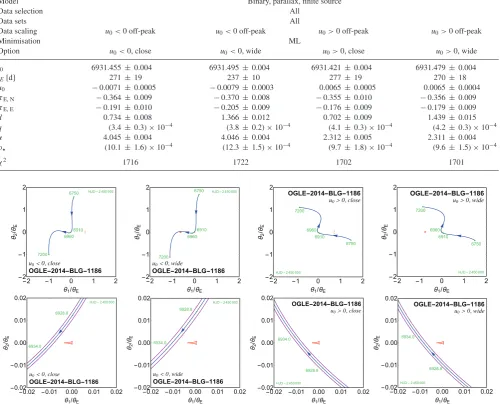
Considering the finite source star size with our binary-lens point-source parallax models, we find that the major differences arise over the second peak, which deforms into a shoulder at around ρ ∼ 2 ×10⁻³, whereas a light curve for 5 × 10⁻⁴ is rather
close to the point-source case. We apply the PYLIMA software suite (Bachelet et al.2017), using differential evolution, to find the binary-lens finite-source parallax models, whose parameters are given in Table5. For these models, we also show the binary-lens caustics and the respective source trajectory in Fig.9.
The model light curves over the peak region are shown in Fig.10, which do not exhibit any visible differences amongst the four ambiguous models. Comparing the models with finite source size
Figure 6. Peak anomaly of microlensing event OGLE-2014-BLG-1186. The upper panels show the single-lens point-source parallax models to the off-peak data foru0<0 oru0>0, respectively (c.f. Tables3and4) with the peak data, aligned according to the baseline fluxesFFFbaseand blend ratiosgggsuggested by the models for the off-peak data. Only those data sets for which these parameters could be well determined are shown. These align very well, giving a clear and consistent picture of the anomaly over the peak. The middle and lower panels compare binary-lens point-source parallax models for the four casesu0< 0 oru0>0 as well asd<1 ord>1 (c.f. Tables3and4) with the acquired peak data, showing that such models can account for the major features of the double-peak light curve, but most notably do not match the slope indicated by the COJ A and FTS data over the second peak.
with those with a point-like source star, we find that considering the finite size of the star successfully removes the previously found problem with the wrong slope over the second peak. Moreover, the discrepancy of the OGLE point just before the second peak is reduced. However, the finite size of the source star has little effect on the first peak. We have neglected any orbital motion or effects from any further massive bodies within the lens system. These would cause only quite small changes to the photometric light curve, at a level potentially comparable with systematic noise, preventing a reliable measurement of the underlying parameters. Given that we
cannot do any better within the adopted model, we regard the model parameters as robust.
The fourfold ambiguity corresponds to close or wide binaries (d < 1 or d > 1), as well as u0 < 0 or u0 > 0, where (u0, α, πππE)↔(−u0,−α, πππE). We explicitly note that we do not find any of the parallax ambiguities described by Skowron et al. (2011), in particular not (u0, α, πππE)↔(−u0,−α,−πππE), which holds if the parallax affects the microlensing light curve mainly by a local effective acceleration near the peak. In contrast, we find this acceleration to be small and of opposite sign in ouru0<0 and
Figure 7. Exploration of binary-lens parameter space. Colour-coded values ofχ2for the peak data as a function of the binary-lens parameters (d,q,α) as three diagrams ofχ2as a function of (lgq, α), (lgd,lgq), and (lgd, α), where each reported value ofχ2corresponds to the minimum over the remaining third parameter. These diagrams have been positioned so that all three parameters corresponding to local minima can readily be identified. The parameters (t0,tE,u0,
[image:15.595.101.227.393.531.2]πE,N,πE,E) have been kept fixed to values suggested by single-lens point-source parallax models for the off-peak data foru0<0 oru0>0, respectively (c.f. Tables3and4), and only the baseline fluxesFbase[j] and the blend ratiosg[j]have been adjusted for each (d,q,α) in order to minimizeχ2. The colour scale has been normalized, so that the absolute minimum corresponds to the red end, while a single lens or any configuration with a largerχ2corresponds to the purple end. While for small mass ratiosq, one finds an ambiguityd↔d−1for the separation parameter, the valleys distinguished by the trajectory angleαcorrespond to the three possible types for the specific morphology observed in the light curve, illustrated in Fig.8.
Figure 8. Schematic illustration of the three possible types of trajectories that can produce a light curve with the observed features. These are to arise from a very close approach of the source to a central caustic (first peak), with a subsequent approach to one of its cusps producing the second peak. The small impact parameteru0rules out intermediate topologies. For each type of trajectory, there are two realisations for the impact parameteru0and trajectory angleα, distinguished by (u0,α)↔(−u0,−α). The three different types are clearly seen in theχ2plots exploring the binary-lens parameter space, as shown in Fig.7.
u0>0 models, while the parallax results in a substantial distortion of the wings of the light curve over 4 yr. In fact, Fig.11illustrates the effect of parallax in the 2013 and early 2014 data, as well as in the late 2015 and 2016 data.
For the u0< 0 wide-binary model, the source trajectory gets close to the planetary caustic, resulting in a further small feature (see Fig.12), most of it falling into a gap of data coverage. For this reason, this model appears to stand out slightly from the others with
respect to the parameters. However, the details of the approach to the planetary caustic depend on the orbital motion which is present but cannot be reliably determined. Therefore, this potential feature does not provide us with an opportunity to distinguish between the four models.
3.4 Binary-source models
Double-peaked microlensing events can also arise if the source rather than the lens object is a binary (Griest & Hu 1992). We should therefore carefully consider a binary-lens interpretation of the observed data as an alternative to our binary-lens models.
The gravitational magnification of a binary source is straightfor-wardly given as the linear superposition of the magnification of its components, i.e.
ABS(uuu(1), uuu(2), ωλ, πππE)=(1−ωλ)A
u(t , t0(1), u (1) 0 , tE, πππE)
+ωλA
u(t , t0(2), u(2)0 , tE, πππE)
, (34)
withu(t;t0, u0, tE, πππE) given by equation (24) and
ωλ=
L2,λ
L1,λ+L2,λ
(35)
being the luminosity offset ratio depending on the wavelength filter used, whileL1,λandL2,λdenote the luminosities of the two source
stars. For a uniformly bright source of angular radius ρθE, the magnificationA(u,ρ) due to a point-mass lens can be computed
efficiently in terms of complete elliptic integrals (Witt & Mao1994). Given that all data acquired over the peak of event OGLE-2014-BLG-1186 are inIband and the effect of binarity on the photometric light curve is negligible for other epochs, we describe single-lens