EFFECT OF CHELATED TRACE-ELEMENTS (ZINC, MANGANESE, IRON) ADMINISTERED IN DAIRY
COWS FEED RATION ON PRODUCTIVITY, MILK COMPOSITION
Jean Bassil and
Lebanese University, Faculty of Agricultural Engineering and Veterinary Medicine, Animal Production
ARTICLE INFO ABSTRACT
Trace elements are essential elements despite their name and organism, as they have many important effects on well
elements, naturally present in cattle feed ration in an inorganic form, are not well assimilated by the animal and therefore
environment and human. Knowing that the organic form of trace elements is more absorbed than the inorganic one; for this reason, this study aimed to evaluate the influence of o
supplementation on their absorption, milk yield and composition, by adding Zinc (0.026%), Manganese (0.016%) and Iron (0.04%) to the basic feed ration.16 dairy cows were divided randomly into 4 groups: control, zinc, manganese and iro
3 months. Milk composition (fat, protein, Solid
monthly using Milkana. In order to assess the quantities of the studied trace elements in cattles diet and feces, Atomic Absorption Spectrometer was used.
data in the second month of the study has decreased, while a significant (P<0.05) decrease was seen for iron and manganese treatment; meanwhile for the third mont
control. Zinc treatment had the best effect on milk yield. Concerning milk fat, the treated groups showed a higher fat yield than control with iron treated group have a significantly (P<0.05) higher fat yield. For m
for the first two months of the study, no significant difference (P>0.05) was seen among groups; meanwhile for the last month, milk density was significantly lower
when compared to control group; we concluded that zinc group has the best effect on milk density between treatments. For milk Solid Non Fat, for the first two months there was no significant difference (P>0.05) among all group
(P<0.05) lower Solid Non Fat. The amount of trace elements absorbed by the cows was significantly (P<0.05) higher in treatment group when compared to each corresponding element in control one, while zinc was the best assimilated element. We can conclude that zinc has the best effect and absorption on dairy cows.
Copyright © 2018, Jean Bassil and Georges Abi Rizk. unrestricted use, distribution, and reproduction in any medium,
INTRODUCTION
Following the rapid development for food demand, in animal sector nutritionists formulate a
well-meet the animal requirements in nutrients. Between these nutrients, trace elements (TE) are important nutrients to be insured for cows, despite their small required quantities, they are important for growth, production, reproduction, and health
(Yatoo et al., 2013).
*Corresponding author:Georges Abi Rizk
Lebanese University, Faculty of Agricultural Engineering and Veterinary Medicine, Animal Production Department, Beirut Lebanon.
ISSN: 0975-833X
Vol. 10, Issue,
Article History:
Received 28th August, 2018 Received in revised form 19th September, 2018 Accepted 10th October, 2018 Published online 29th November, 2018
Citation: Jean Bassil and Georges Abi Rizk. 2018.
on Productivity, Milk Composition and Bioavailability Key Words:
Zinc, Manganese, Iron, Milk, Cow, Absorption.
RESEARCH ARTICLE
ELEMENTS (ZINC, MANGANESE, IRON) ADMINISTERED IN DAIRY
COWS FEED RATION ON PRODUCTIVITY, MILK COMPOSITION AND BIOAVAILABILITY
Jean Bassil and *Georges Abi Rizk
Lebanese University, Faculty of Agricultural Engineering and Veterinary Medicine, Animal Production
Department, Beirut-Lebanon
ABSTRACT
Trace elements are essential elements despite their name and quantity that is required by the animal organism, as they have many important effects on well-being and performance of cows. These elements, naturally present in cattle feed ration in an inorganic form, are not well assimilated by the animal and therefore the majority of them will be present in the feces; leading to a toxicity to the environment and human. Knowing that the organic form of trace elements is more absorbed than the inorganic one; for this reason, this study aimed to evaluate the influence of o
supplementation on their absorption, milk yield and composition, by adding Zinc (0.026%), Manganese (0.016%) and Iron (0.04%) to the basic feed ration.16 dairy cows were divided randomly into 4 groups: control, zinc, manganese and iron. Milk yield data was collected weekly for a period of 3 months. Milk composition (fat, protein, Solid-Non-Fat percentages and density) were measured monthly using Milkana. In order to assess the quantities of the studied trace elements in cattles diet d feces, Atomic Absorption Spectrometer was used. The obtained results showed that milk yield in the second month of the study has decreased, while a significant (P<0.05) decrease was seen for iron and manganese treatment; meanwhile for the third month, it increased in all groups except the control. Zinc treatment had the best effect on milk yield. Concerning milk fat, the treated groups showed a higher fat yield than control with iron treated group have a significantly (P<0.05) higher fat yield. For milk protein, treatment has no significant (P>0.05) effect on this factor. For milk density, for the first two months of the study, no significant difference (P>0.05) was seen among groups; meanwhile for the last month, milk density was significantly lower
when compared to control group; we concluded that zinc group has the best effect on milk density between treatments. For milk Solid Non Fat, for the first two months there was no significant difference (P>0.05) among all groups but for the last month, manganese group has a significantly (P<0.05) lower Solid Non Fat. The amount of trace elements absorbed by the cows was significantly (P<0.05) higher in treatment group when compared to each corresponding element in control one, hile zinc was the best assimilated element. We can conclude that zinc has the best effect and absorption on dairy cows.
This is an open access article distributed under the Creative Commons medium, provided the original work is properly cited.
development for food demand, in the -balanced ration to meet the animal requirements in nutrients. Between these nutrients, trace elements (TE) are important nutrients to be required quantities, they are important for growth, production, reproduction, and health
Lebanese University, Faculty of Agricultural Engineering and Department,
Beirut-Many studies were done to determine the needed amount of TE (Nordberg and Nordberg, 2016). In Lebanon, the use of TE is developing, as farmers are using these minerals but not all of them. TE aren’t easily assimilate
them are naturally unavailable for absorption (Garrett, 2011). TE can be divided into two sources: organic and inorganic. Inorganic sources are the common sulphates, oxides, chlorides, carbonates, that may interact in the gastroin
being originally linked in the feed to other nutrients, resulting in a reduction of their absorption. The other category referred to chelates, are organic trace minerals designed to improve bioavailability because they are protected from interactions, as the bound to chelating agents allow them to become more stable and less reactive
International Journal of Current Research
Vol. 10, Issue, 11, pp.74981-74986, November, 2018
DOI: https://doi.org/10.24941/ijcr.32968.11.2018
“Effect of Chelated Trace-Elements (Zinc, Manganese, Iron) Administered in Dairy Cows Feed Ration on Productivity, Milk Composition and Bioavailability.”, International Journal of Current Research, 10, (11), 74981-74986
ELEMENTS (ZINC, MANGANESE, IRON) ADMINISTERED IN DAIRY
AND BIOAVAILABILITY
Lebanese University, Faculty of Agricultural Engineering and Veterinary Medicine, Animal Production
quantity that is required by the animal being and performance of cows. These elements, naturally present in cattle feed ration in an inorganic form, are not well assimilated by the the majority of them will be present in the feces; leading to a toxicity to the environment and human. Knowing that the organic form of trace elements is more absorbed than the inorganic one; for this reason, this study aimed to evaluate the influence of organic trace elements supplementation on their absorption, milk yield and composition, by adding Zinc (0.026%), Manganese (0.016%) and Iron (0.04%) to the basic feed ration.16 dairy cows were divided randomly n. Milk yield data was collected weekly for a period of Fat percentages and density) were measured monthly using Milkana. In order to assess the quantities of the studied trace elements in cattles diet The obtained results showed that milk yield in the second month of the study has decreased, while a significant (P<0.05) decrease was seen h, it increased in all groups except the control. Zinc treatment had the best effect on milk yield. Concerning milk fat, the treated groups showed a higher fat yield than control with iron treated group have a significantly (P<0.05) higher fat ilk protein, treatment has no significant (P>0.05) effect on this factor. For milk density, for the first two months of the study, no significant difference (P>0.05) was seen among groups; meanwhile for the last month, milk density was significantly lower for manganese and iron groups when compared to control group; we concluded that zinc group has the best effect on milk density between treatments. For milk Solid Non Fat, for the first two months there was no significant s but for the last month, manganese group has a significantly (P<0.05) lower Solid Non Fat. The amount of trace elements absorbed by the cows was significantly (P<0.05) higher in treatment group when compared to each corresponding element in control one, hile zinc was the best assimilated element. We can conclude that zinc has the best effect and
Commons Attribution License, which permits
Many studies were done to determine the needed amount of TE , 2016). In Lebanon, the use of TE is developing, as farmers are using these minerals but not all of TE aren’t easily assimilated by the cow’s as most of them are naturally unavailable for absorption (Garrett, 2011). TE can be divided into two sources: organic and inorganic. Inorganic sources are the common sulphates, oxides, chlorides, that may interact in the gastrointestinal tract or being originally linked in the feed to other nutrients, resulting in a reduction of their absorption. The other category referred to chelates, are organic trace minerals designed to improve bioavailability because they are protected from many interactions, as the bound to chelating agents allow them to become more stable and less reactive (Pal and Gowda, 2015).
OF CURRENT RESEARCH
Lack in some of these minerals may cause deficiencies in dairy cows leading to decrease milk yield. However, all TE have low bioavailability; therefore they are often excessively added to the diet. These excesses end up mainly in the feces but in lesser quantities, in urine and milk. This can lead to toxicities for the cows, consumers and agricultural parcels spread with this manure (Pal and Gowda, 2015). Organic TE are more absorbed by the animal leading to a reduction of their excretion (Garrett, 2011). This study objects were to compare the effect of TE (Zinc, Manganese and Iron) quantities between that found in dairy cows feed ration to the organic mineral supplemented one and to realize the effect of these minerals on milk yield, milk composition and amount absorbed after measuring the excreted amount in feces.
MATERIALS AND METHODS
Animals and their management: This experiment was
conducted at El Sayegh farm, where cows are confined in El Ghine-Ftouh-Keserwan- Lebanon region, located at an altitude of 950 m above the sea. The farm includes a small outdoor court where cows are allowed to rest. The experiment started on March till June 2018 and based on 16 dairy cows of a crossed Holstein with the local breed, and divided into four groups. The age of the cows ranged between 2 and 4 years. The cows were distributed in the farm as seen in Fig.1.
Fig.1. Cow’s pen distribution inside the farm, as follow: C: Cow from the control group; Iron group; Zn: Zinc group; Mn:
Manganese group; X:Cow not included in the study
Alimentation: The cows were offered feed twice per day. The
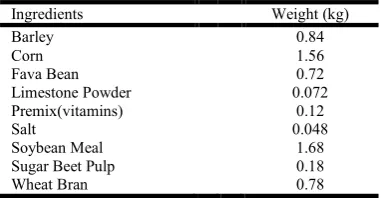
feed ration of each cow contained in total: 6kg of a complete concentrate mixture as listed in Table 1, 6kg of corn silage and 3kg hay. Each group was receiving his TE supplement by mixing those elements in their concentrates feeds and offered individually in the feeder of each cow as listed below:
Control group (C) fed the basic ration.
Iron group (Fe) fed the basic ration + supplemented
with chelated Fe at a level of 0.04%.
Zinc group (Zn) fed the basic ration + supplemented
with chelated Zn at a level of 0.026%.
Manganese group (Mn) fed the basic ration +
supplemented with chelated Mn at a level of 0.016%.
A buffering period of 2 weeks was adapted before the
beginning of the sampling.
Samples collection
Milk performance
The milk produced by each cow was collected weekly,
individually (Fig.2) in the afternoon.
Milk samples (milk composition): Milk samples was done for
each cow monthly using plastic containers, then placed in a
portable refrigerator to decrease their temperature to around 12°C, then transferred into the laboratory. The samples were tested using Milkana (Superior plus, Turkey) machine for the determination of milk composition. The machine used measures milk protein (%), solid non-fat (%), fatness (%) and density.
Feces samples
Feces collection: Feces samples were taken from each cow and
feed sample also collected monthly. At the laboratory, 6g of feces were weighed using a weighing balance, then placed in aluminum cups and moved inside an oven (Wells, USA) to be dried for 4 hours at 105°C. After the drying process, the samples are moved to the furnace (Selecta Horn, Greece), that is gradually heated from room temperature to 500°C, and left for 6 hours for the ashing process following some
modifications to the procedure of Abbruzzini et al.(2014). Each
ashed sample was moved into a beaker with an addition of 8 ml
of 60% HNO₃ solution and agitated at an 80°C temperature
over a heated agitator while adding 3 drops of 30% H₂O₂. The
remaining mix was then solubilized in 10 ml of 1% HNO₃.
Then the digest were filtered into falcon tubes, than tested using the Atomic Absorption Spectroscopy device.
Atomic Absorption Spectroscopy device: The measurement
of TE concentration was done using the protocol of Beaty and Kerber (1993). The following calculation was used to obtain the amount of TE absorbed by the organism of the animal (in mg/day):
Amount of TE Ingested (Feed + Supplementation) – Amount of TE Excreted (in feces) = Amount of TE absorbed by the animal.
Statistical analysis: For the statistical analysis, the program
SPSS 23.0 and Excel 2010 were used. A test of normality was done to make sure that our data is normally distributed. Then, the statistical design T-test was used to determine if there was a significant difference between collected data of different groups during different periods. Also, correlations between factors were determined using the Pearson’s correlation coefficients. The results were expressed as mean ± standard deviation and considered significantly different when p<0.05.
RESULTS
Milk Yield: As seen in Fig.3., for the first month of the study
Fig. 2. Milking machine and the graduated milk container
ᵃ,ᵇ,c,ᵈ,ᵉ: different letters between groups in same period indicate significant difference at
[image:3.595.338.529.86.185.2]P<0.05. Values for MY are means ± Standard Deviation (SD
Fig. 3. Effect of diets supplemented with organic chelated TE (Zn, Mn and Fe)on milk yield (MY) of dairy cows
ᵃ,ᵇ,c,d: different letters between groups in same period indicate significant difference at
[image:3.595.313.551.223.285.2]P<0.05 Values for milk density are means ± Standard Deviation (SD)
Fig.4. Effect of diets supplemented with organic chelated TE (Zn, Mn and Fe) on the amount of milk density of dairy cows
ᵃ,ᵇ,c,d: different letters between groups in same period indicate significant difference at
P<0.05 Values for milk Solid Non Fat are means ± Standard Deviation (SD)
Fig.5. Effect of diets supplemented with organic chelated TE (Zn, Mn and Fe)on the amount of milk Solid Non Fat (SNF) of dairy cows
Table 1. The concentrate mixture of the dairy cows (Kg concentrate/cow/day)
Ingredients Weight (kg)
Barley 0.84
Corn 1.56
Fava Bean 0.72
Limestone Powder 0.072
Premix(vitamins) 0.12
Salt 0.048
Soybean Meal 1.68
Sugar Beet Pulp 0.18
Wheat Bran 0.78
Table 2. Effect of diets supplemented with organic chelated TE (Fe, Zn and Mn) on milk fat yield for dairy cows.
S1 S2 S3
Milk fat
(%)
Ctrl 2.53±0.6a 3.51±0.67a 3.18±0.81a Fe 3.46±0.03b 5.22±0.47b 5.37±1.29b Zn 2.77±0.57ab 4.13±0.96ab 3.5±0.87ab Mn 3.01±0.75ab 4.79±1.42ab 3.97±0.83ab
ᵃ,ᵇ: different letters in same column indicate a significant difference at P<0.05
[image:3.595.50.282.226.348.2]Values for milk fat percentage are Means ± SD
Table 3. Effect of diets supplemented with organic chelated TE (Zn, Mn and Fe)on the amount of protein in milk of dairy cows.
S1 S2 S3
Milk Pr
o
te
in
(%) Ctrl 3.16±0.11a 3.2±0.13a 3.14±0.09a
Fe 3.24±0.13a 3.24±0.09a 3.09±0.1a Zn 3.1±0.21a 3.14±0.14a 3.08±0.17a Mn 3.19±0.1a 3.05±0.21a 3.03±0.39a
ᵃ,ᵇ: different letters in same column indicate a significant difference at P<0.05 Values for milk protein percentage are Mean ± SD
Table 4. Pearson’s correlations, generated for the study, between fat, protein, Solid Non Fat, density and milk yield (N= 16)
Fat SNF Density Protein MY
Fat 1
SNF 0.011 1
Density -0.413 0.834** 1
Protein 0.430 0.302 -0.105 1
MY -0.522* 0.456 0.667** -0.262 1
[image:3.595.309.558.341.426.2]*P<0.05, **P<0.01
Table 5. Effect of diets supplemented with organic chelated TE (Zn, Mn and Fe)on the amount absorbed of TE (in mg/day) in
dairy cows
S1 S2 S3
TE
a
bsorbed
(mg/day
) Control(Zn) 830.5±412.51a 2801.75±745.21a 1627±746.3a
Zn 7311.25±1007.61b 3973±1066.28a 5763±1510.29b
Control(Fe) 3063±693.27a 3404±459.88a 3295.5±749.97a
Fe 6390.25±2560.43a 9958.25±451.89b 9972.25±1120.63b
Control(Mn) 497.5±226.37a 872±374.22a 417.75±235.87a
Mn 1427.25±468.03b 898±231.05a 1189.5±500.52b
ᵃ,ᵇ: different letters in same column for same element, indicate a significant difference at P<0.05; Values for TE absorption are Means ± SD
Milk composition
Fat: For the three months of the study, milk fat is higher for Fe
[image:3.595.48.284.386.543.2] [image:3.595.305.561.598.688.2] [image:3.595.46.288.601.749.2]Protein: The amount of milk protein during S1 and S2, is higher for Fe group (3.24±0.13; 3.24±0.09) followed by Mn (3.19±0.1; 3.05±0.21), control (3.16±0.11; 3.2±0.13) and Zn (3.1±0.21; 3.14±0.14) groups; while in S3, the highest milk protein is for control group (3.14±0.09) followed by Fe (3.09±0.1), Zn (3.08±0.17) and Mn (3.03±0.39) groups as seen in Table 3. For the three months of the study, no significant difference (P>0.05) seen between milk protein of all groups.
Density: Milk density during the three months of the study is
considered the highest for control group (31.75±1.23; 31.23±0.96; 30.96±0.70); while for the other elements, in S1 it is followed by Fe (31.73±1.44), Mn (31.58±0.51) and Zn (30.9±1.82). In S2, it is followed by Fe (29.92±1.26), Zn (28.85±1.48) and Mn (28.43±3.76). In S3, followed by Zn (29.95±2.47), Mn (28.73±1.03) and Fe (28.13±1.77) as figured in Fig.4.
Solid Non Fat: For S1, SNF for Fe group is higher (8.59±0.36)
followed by Mn (8.46±0.25), control (8.39±028) and Zn (8.23±0.48) groups; In S2, Fe group still having the higher (8.53±0.26) SNF followed by control (8.48±0.33), Zn (8.29±0.36) and Mn (8.05±0.53) groups; while in S3, control group (8.34±0.23) is having the higher SNF followed by Zn (8.15±0.43), Fe (8.11±0.28) and Mn (7.96±0.19) (Fig.5).
AAS results: When comparing amount of TE absorbed by
control group in S1, S2 and S3 to the amount absorbed by supplemented groups (Zn, Mn and Fe), the amount of absorption is always higher for TE groups (Table 5).
DISCUSSION
Milk Yield: According to Weiss et al. (2010), no effect for
organic Fe supplementation on dairy cow’s milk production, this is the case in our study in S1 as no significant difference (P>0.05) between Fe and control group, but that wasn’t the case in S2 and S3, as control group produced significantly (P<0.05) more milk than Fe group. But when comparing the amount of milk produced by Fe group between S1 and S2,there is a significant (P<0.05) decrease; while between S2 and S3 an increase that wasn’t significant (P>0.05) was seen. Following a
study done by Kellogg et al. (2004), there is a significant
increase (P<0.05) in milk yield between cows fed Zn-Met and cows without Zn supplementation; this wasn’t the case in our study as in S1, S2 and S3 a non-significant (P>0.05) decrease was observed. If we compare the milk produced by Zn group following the study, between S1 and S2 a non-significant decrease (P>0.05), meanwhile between S2 and S3 a non-significant (P>0.05) increase was seen. A non-non-significant (P>0.05) increase in milk yield was seen in cows fed Mn in a
study done by Wang et al. (2011); this study is in accordance
with our results in S1 as no significant difference (P>0.05) between these two groups, but contradict our results in S2 and S3 were a significant increase (P<0.05) between Mn and control group was seen. When comparing milk yield for Mn group following the study, a significant (P<0.05) decrease in S1 and S2. But in S3, milk produced has increased but not significantly (P>0.05) than that in S2. Results of studies done
by Baliyan (2015) and Hackbart et al. (2010) showed an
increase in milk yield after a TE supplementation, those studies contradict our results between S1 and S2 for all treatment groups that have showed a decrease in milk yield, this was caused by external factors present in the farm, as climatic condition in S2 has led to increase stress of the animals,
because they were kept in their pen without access to the outdoor court following rainy and cold weather. In addition, forS2also, a bad quality corn silage caused a reduction of milk produced by stressed cows. While between S2 and S3, milk yield has increased in all treated groups, this could be caused by TE supplementation. This result is in accordance with the mentioned two studies above. Regarding the higher milk produced remained for control group among Fe, Zn and Mn groups following all the study; but we should take into consideration that cows of control group originally produce higher milk yield than other groups; in addition, milk yield for control group has decreased from initial quantity in S1 till S3, while it has increased for treatment groups (Fe, Zn, and Mn) between S2 and S3, showing their important effect on MY specially concerning Zn group that showed a significant (P<0.05) increase in milk yield in S3. Between the three supplemented groups, we can conclude that Zn treatment has showed an increase in milk yield higher than other studied groups.
Milk composition
Fat: Following a study done by DeFrain et al. (2016), a
significant difference (P<0.05) between fat yield of cows from Fe group and non-treated cows yielded more fat; this result disclaim our results as there is a significant difference (P<0.05) between fat milk of control and Fe group as the last group yielded more fat during all the study. When comparing the yielded fat for Fe group between S1 and S2, we can see a significant increase (P<0.05) between those 2 months. Meanwhile, for S3 a non-significant (P>0.05) difference is
seen. According to Sobhanirad et al. (2010), no significant
difference (P>0.05) between groups supplemented with Zn-Meth and non-supplemented group in milk fat. The result of the previous study is in accordance with our results, as no significant difference (P>0.05) between milk fat of Zn and control group, with Zn group having a higher amount of fat. If we compare the amount of fat produced by Zn group between S1 and S2, a significant(P<0.05) increase of fat in S2 was seen. While a significant (P<0.05) decrease in S3.
A study done by El Esawy et al. (2017), has concluded that
feeding organic Mn can lead to a significant increase (P<0.05) of fat in cow’s milk when compared to a control group. Our
results weren’t in accordance with El Esawy et al.(2017) during
all the study, whereas a higher fat yield in Mn group was seen but that wasn’t significantly (P>0.05) higher than that of control group. When comparing the amount of fat produced by Mn group between S1 and S2, we can find a significant increase (P<0.05) of fat, while for S2 and S3, no significant difference is present (P>0.05) for the fat produced.A significant negative correlation (r=-0.522; P<0.05) between fat yield and MY figured in Table 4. This negative correlation explains that when MY decreased, milk fat has increased for Fe group especially in S2. For Zn and Mn groups, fat decrease in S3 could be caused by the fact that when milk yield increase, milk fat decrease as in accordance with a study done by Hamad and El-Raghi (2015). Concerning milk fat, Fe group is the best element above others elements studied that increased this component.
Protein: For Fe, De Frain et al. (2016) concluded that control
significantly (P>0.05) higher than Fe group. Following all the study, the amount of protein of Fe group wasn’t significantly
different (P>0.05). For Zn, a study done by Sobhanirad et al.
(2010), found that there is no significant difference (P>0.05) between organic Zn supplemented and non-supplemented group, in the level of protein in milk. This study is in relation with our results as no significant difference (P>0.05) between control and Zn groups following all the study. When comparing milk protein for Zn group for S1, S2 and S3, we conclude that no significant difference (P>0.05) was seen. Finally for Mn,
Wang et al. (2011), showed that there is no significant
difference (P>0.05) between groups supplemented with organic Mn and non-supplemented group (control) for their amount in protein. The obtained results are related to the previous study as no significant difference (P>0.05) is seen between control and Mn group following all the study. For Mn group, the period of the study did not affect the milk protein of this group as no significant difference (P>0.05) was present. A study done
by Del Valle et al. (2015), showed that no effect of
supplementing organic TE on milk protein. As in accordance to this study, we can conclude that these evaluated TE have no effect on milk protein.
Density: Weiss et al. (2010) has shown that no effect for
organic Fe supplementation on milk composition. This study is related to our results in S1 and S2 with no significant difference (P>0.05) when comparing control to Fe groups; while it is not the case in S3, as milk density of Fe group is significantly (P<0.05) lower than control group. Milk density of Fe group has decreased in S2 when compared to S1 and was significant (P<0.05), and it continue to drop in S3 but wasn’t
significant (P>0.05) when compared to S2. Sobhanirad et al.
(2010) has proved that no significant (P>0.05) effect of Zn supplementation on milk density. The results of our study are in accordance with this study as the density of milk between control and Zn group wasn’t significantly different (P>0.05) in S1, S2 and S3. If we compare the milk density of Zn group following the study, we conclude that a significant difference (P<0.05) is seen when comparing S1 and S2 as milk density decreased, but in S3 density has increased with no significant
difference (P>0.05) with S2. According to El Esawy et al.
(2017), feeding Mn-met has improved milk composition; as the results of our study has shown no significant difference (P>0.05) between control and Mn group when comparing S1 to S2, but a significant difference (P<0.05) was seen in S3, as Mn group has a lower milk density than control group. The factor of time affected the milk density of Mn group, as when we compare S1 to S2, the difference was significant (P<0.05) and has dropped in S2. Whereas between S2 and S3, no significant difference (P>0.05) in milk density is seen. Between milk density and MY, a strong positive correlation (Table 4) that is highly significant (r=0.667; P<0.01) is present. We can find that when MY increased, milk density increased as this finding also figured by a study done by Ueda (1999). As for milk density, treatment with these TE showed no effect on this factor.
SNF: Weiss et al. (2010) founded that no significant difference
(P>0.05) between Fe supplemented group and control group. This result is in accordance with our results, where no significant difference (P>0.05) between Fe and control groups following all the study. Concerning Fe group, when comparing S1,S2 and S3 for SNF amount, we can see a small reduction in S2 but a higher decrease in S3, but still those differences weren’t significant (P>0.05).
According to Sobhanirad et al. (2010), there is no significant
difference (P>0.05) between groups supplemented with organic Zn and control group in the amount of SNF in milk. This study is in accordance with our study, as no significant difference (P>0.05) in SNF for Zn and control groups.
The density of milk produced by Zn group for the 3 months of the study isn’t significantly different (P>0.05). A study done by
Wang et al. (2011) has concluded that no significant difference
(P>0.05) between groups supplemented with organic Mn and non-supplemented group in SNF of milk; this result is in conformity with our study for S1 and S2 as no significant difference (P>0.05) between control and Mn groups; while it contradict the results in S3 where there is a significant difference (P<0.05) with Mn group having a lowest level of SNF. Following the months of the study, SNF for Mn group has decreased but the decrease isn’t significant (P>0.05). Pearson correlation between SNF and milk density (Table 8.) is considered a perfect positive correlation that is significant (r=0.834; P<0.01), this is seen when SNF and milk density decreased in S3 especially for Fe group. This is also found in a study done by Ueda (1999). We can conclude that the three tested supplementations (Zn, Mn and Fe) didn’t affect the amount of SNF in milk.
AAS results: For Zn absorption, a significant difference
(P<0.05) between Zn and control group during S1 and S3, with Zn group having higher amount absorbed. Concerning S2, the amount of Zn absorbed by treated group is greater but isn’t significantly (P>0.05) higher than control group. The amount of Fe absorbed by Fe treated group is higher than control group but isn’t significant (P>0.05) in S1. Meanwhile for S2 and S3, the difference is significant (P<0.05) with major amount of Fe absorbed. Finally, for Mn absorption, a significant (P<0.05) difference in the amount absorbed of TE when comparing Mn to control group in S1 and S3; but wasn’t significant (P>0.05) in S2 despite the higher amount absorbed by Mn group. The amount absorbed of each studied elements was higher for the treatment groups compared to the control group, those results where predicted as in the basal diet, most of TE are in a unavailable form or interact with other nutrients in the gastro-intestinal tract, meanwhile highly absorbable and protected organic TE, allow the cow a better use of these elements with reduction of their excretion in the environment.
As the amount of TE absorbed in treated groups is higher than that found in feces, than they will not found in the soil after being applied to it, avoiding soil and ground water pollution that leads to toxicities for plants, animals and humans (Goselink and Jongbloed, 2012). From the results obtained, we can conclude that, despite the higher amount of TE absorbed from Fe, the uptake of Zn was better because we compared the
initial ingested amount with the amount absorbed.
Furthermore, Grace (1975) showed that inorganic source of Zn found in the basal ruminant diet is absorbed in a rate of 26.5%, so 73.5% are non-assimilated and excreted. Also, according to
Eren et al. (2013), concerning the comparison between organic
Conclusion
TE are essential elements for dairy cow’s production and health, but their absorption is low. This study objective was to evaluate the absorption of chelated Zn, Mn and Fe elements and their effect on cow’s milk production and composition. Collected results confirmed that supplementation with organic TE have many positive effects on cow’s milk performance, as the results showed a small increase in milk produced by supplemented groups compared to control in the third month of the study. In addition, they showed some effects on milk components, as Fe has increased significantly milk fat; while an increase was also observed for Mn and Zn groups but wasn’t significant, yet still higher than control’s group milk fat. And finally, organic TE supplementations have reduced large amounts of unabsorbed TE in the environment, by making them a dissipated form in the body of the ruminants. Those effects highlight the addition of these elements in dairy cows feeding practices and to replace inorganic unavailable forms. Our study showed that Zn element has best effect on cow’s milk (quantity and quality) and absorption.
Acknowledgements: I am thankful to Dr Jamal Khazaal
(Liban Vet), Dr Salem Hayar and Dr Beshar Soukaria (Lebanese University) for their care and support.
Conflict of Interest statement: No conflict of interest
List of Abbreviations
AA Amino Acid
AAS Atomic Absorption Spectroscop
et al. And others
Fe Iron
Fig. Figure
g gram
Kg kilogram
Mn Manganese
Milk Yield
S1 First month of the study S2 Second month of the study S3 Third month of the study
SD Standard of Deviation
SNF Solid Non Fat
TE Trace Elements
Zn Zinc
REFERENCES
Abbruzzini, T.H., Silva, C.A., De Andrare, D.A. and De Oliveira Carneiro, W.J. 2014. Influence of Digestion Methods on the Recovery of Iron, Zinc, Nickel, Chromium, Cadmium and Lead Contents in 11 Organic Residues. Revista Brasileira de Ciencia do Solo, 38(1), 166-176. Baliyan, A. 2015. Effect of supplementation of trace mineral
and vitamins during transition phase on energy status, productive and reproductive performance of Deoni heifers. ICAR- National dairy research institute, Karnal, 155 p. Beaty R.D. and Kerber J.D. 1993. Concepts, Instrumentation
and Techniques in Atomic Absorption Spectrophotometry. The Perkin-Elmer Corporation, Norwalk, CT, U.S.A. 96 p. DeFrain, J.M., Kleinschmit, D.H. and Tomlinson D.J. 2016.
Case Study: Effect of iron amino acid complex on the performance of lactating dairy cows on a commercial dairy.
The Professional Animal Scientist, 32(3): 375-381.
Del Valle, T., Ferreira De Jesus, E., Paiva, P.G., Bettero, V.P., Zanferari, F., et al. 2015.Effect of organic sources of minerals on fat-corrected milk yield of dairy cows in confinement. Revista Brasileira de Zootecnia, 44(3): 103-108.
El Esawy, G.S., Riad, W.A., Mohy El-Din, A.M.A., Ali, M.F.E. and Gaafar, H. 2017. Effect of supplementary zinc and manganese methionine chelates on productive and reproductive performance of dairy Friesian cows. Archiva Zootechnica, 20(2): 69-83.
Eren, V., Gokdal, O., Aksit, H., Atay, O. and Özugur, A. 2013. The effects of additional organic copper and organic zinc trace minerals on accumulation and elimination levels in female kids. Ankara University Vet Fak Derg, 60: 89-92. Garrett, J. 2011. Organic minerals allow for greater absorption.
Feedstuffs Journal, 83(28), 2 p.
Goselink, R. and Jongbloed, A. 2012. Zinc and copper in dairy cattle feeding. WUR Livestock Research, 31 p.
Grace, N.D.1975. Studies on the flow of zinc, cobalt, copper and manganese along the digestive tract of sheep given
perennial ryegrass, or white or red clover. British Journal
of Nutrition, 34(73).
Hackbart, S., Ferreira, M., Dietsche, A., Socha, T., Shaver, D., et al.2010. Effect of dietary organic zinc, manganese, copper, and cobalt supplementation on milk production, follicular growth, embryo quality, and tissue mineral
concentrations in dairy cows. Journal of Animal Science,
88(12):3856-3870.
Kellogg, D.W., Tomlinson, D.J., Socha, M.T. and Johnson, A B. 2004. Review: Effects of zinc methionine complex on milk production and somatic cell count of dairy cows: Twelve-trial summary. Professional Animal Scientist, 20(4): 295-301.
Nordberg, M. and Nordberg, GF. 2016. Trace element research-historical and future aspects. Journal of Trace Elements in Medicine and Biology, 38: 46-52.
Pal, D. and Gowda, N. 2015. Organic trace minerals for
improving livestock production. Feedipedia
INRA(Broadening Horizons N°17).
Rabiee, A.R., Lean, I.J., Stevenson, M.A. and Socha, M.T. 2010. Effects of feeding organic trace minerals on milk production and reproductive performance in lactating dairy
cows: a meta-analysis. Journal of Dairy Sciences, 93(9):
4239-4251.
Sobhanirad, S., Carlson, D. and Kashani,R.B. 2010. Effect of zinc methionine or zinc sulfate supplementation on milk production and composition of milk in lactating dairy
cows. Ncbi (National Center for Biotechnology
Information), 136(1): 48-54.
Ueda, A. 1999. Relationship Among Milk Density,
Composition, and Temperature. National Library of
Canada, 129 p.
Wang, F., Wang, L., Li, S., Wang, W., Jin, X. et al. 2011.
Evaluating Methionine Hydroxyl Manganese and
Manganese Sulfate Sources for Dairy Cows During
Peak-and Mid-lactation Stage. Asian Journal of Animal and
Veterinary Advances, 6: 978-991.
Weiss,W.P., Pinos-Rodriguez, J.M. and Socha, M.T. 2010.Effects of feeding supplemental organic iron to late
gestation and early lactation dairy cows. Journal of Dairy
Science, 93(5): 2153-2160.
Yatoo, M.I., Saxena, A., Deepa, P.M., Habeab, B.P., Devi, S., et al. 2013. Role of trace elements in animals: a review.
Veterinary World, 6(12): 963-967.