1
Running head: Unified root system architecture language
Xavier Draye
Croix du Sud, 2-L7.05.11 1348 Louvain-la-Neuve Belgium
Tel : +32 10 47 20 92
e-mail : [email protected]
Journal research area:
2
Root System Markup Language: toward an unified root architecture
description language
Guillaume Lobet1*, Michael P Pound2*, Julien Diener3*, Christophe Pradal3,4*, Xavier Draye5†, Christophe Godin3, Mathieu Javaux5,9, Daniel Leitner6, Félicien Meunier5, Philippe Nacry7, Tony P Pridmore8, Andrea Schnepf9.
1.
PhytoSYSTEMS, Université de Liège, Boulevard du Rectorat, 27, 4000 Liège, Belgium 2. Centre for Plant Integrative Biology, School of Biosciences, University of Nottingham, Sutton Bonington, LE12 5RD, UK.
3. Virtual Plants, INRIA, CIRAD, INRA, 34095 Montpellier France 4. Institut de Biologie Computationnelle, F-34095 Montpellier, France
5. Earth and Life Institute, Université catholique de Louvain, Croix du Sud 2 – L7.05.11, 1348, Louvain-la-Neuve, Belgium
6. Computational Science Center, University of Vienna, Oskar Morgenstern-Platz 1, 1090 Vienna, Austria
7. Biochemistry and Plant Molecular Physiology, UMR 5004 CNRS/INRA/SupAgro-M/UM2. Institut de Biologie Intégrative des Plantes. Place Viala, 34060 Montpellier Cedex 1, France. 8. School of Computer Science, University of Nottingham, Jubilee Campus, Wollaton Rd, Nottingham, NG8 1BB, UK
9.
Institut für Bio- und Geowissenschaften : Agrosphäre (IBG-3), Forschungszentrum Jülich GmbH, D-52425 Jülich, Germany
* These authors contributed equally to this work
† Corresponding author
Note: The first four authors contributed equally to this work. Others were ordered alphabetically.
One-Sentence summary:
Introducing a unified format for root system architecture description
3
This work was supported by the Belgian Science Policy Interuniversity Attraction Poles Program (grant P7/29 to G.L., X.D), by the Fonds National de la Recherche Scientifique (G.L. and F.M.), by the French National Research Agency (HydroRoot project, grant ANR-11-BSV6-0018 to C.P., C.G.), by EU FP7-KBBE-2011-5 project (EURoot: Enhancing resource Uptake from roots under Stress in Cereal Crops to P.N., T.P.P., M.P.P and X.D.), by the Agropolis Foundation Montpellier France ( Rhizopolis grant to P.N., C.P., J.D. and C.G.), by the German research association (DFG, Transregio Collaborative Research Center 32, Patterns in Soil–Vegetation– Atmosphere Systems: Monitoring, Modelling and Data Assimilation to A.S.) and by the Austrian Academy of Sciences (APART-fellowship of the at the Computational Science Center at the University of Vienna to D.L.).
Corresponding author :
4
Abstract
The number of image analysis tools supporting the extraction of architectural features of root systems has increased over the last years. These tools offer a handy set of complementary facilities, yet it is widely accepted that none of these software tool is able to extract in an efficient way growing array of static and dynamic features for different types of images and species. .
We describe the Root System Markup Language (RSML) that has been designed to overcome two major challenges: (i) to enable portability of root architecture data between different
software tools in an easy and interoperable manner allowing seamless collaborative work, and (ii) to provide a standard format upon which to base central repositories which will soon arise following the expanding worldwide root phenotyping effort.
RSML follows the XML standard to store 2D or 3D image metadata, plant and root properties and geometries, continuous functions along individual root paths and a suite of annotations at the image, plant or root scales, at one or several time points. Plant ontologies are used to describe botanical entities that are relevant at the scale of root system architecture. An xml-schema describes the features and constraints of RSML and open-source packages have been developed in several languages (R, Excel, Java, Python, C#) to enable researchers to integrate RSML files into popular research workflow.
5
Introduction
By securing access to water and nutrients, root systems are generally recognized as having a critical influence on plant productivity (Lynch, 1995). As an example, in maize, historical increases in yield in the U.S. Corn Belt have been linked to an increase in root system size (Hammer et al., 2009). Tailoring root architecture is therefore thought to be a critical step
towards dealing with extreme environmental conditions such as drought (Comas, 2013; Lobet et al., 2014) or nutrient-poor soils (Lynch, 2007; Postma and Lynch, 2011).
While precise root system architecture characterization methods have been studied in woody plant research for many years (Danjon et al., 1999; Danjon and Reubens, 2007; Danjon et al., 2013) physiological studies on smaller plants (e.g. Arabidopsis) have often neglected detailed root architecture, using mainly global estimators, such as total root length or the maximal depth of the root system convex hull (Galkovskyi et al., 2012). However, an increasing number of research questions now require precise quantification of root system architecture. As an example, nutrient or water deficiencies can have strong effects on root development (Al-Ghazi et al., 2003; Hammer et al., 2009; Péret et al., 2012; Gruber et al., 2013; Kellermeier et al., 2014) and only accurate root reconstruction allow the quantification of these effects. In addition, functional structural plant models are becoming increasingly popular to investigate the
belowground ecophysiology of crops (Draye et al., 2010; Comas, 2013; Dunbabin et al., 2013; Lobet et al., 2014) and models require a precise quantification of root system architecture, either to evaluate root developmental parameters or as a direct model input.
Root systems architecture is generally described at three main levels (Godin and Sinoquet, 2005; Lynch, 2007; Postma and Lynch, 2011). The geometry of a root system describes the physical position, in space and time, of its component root axes. The topology describes the root system as a network and can be seen as the backbone, or skeleton of the root system. Finally, the successive segments which comprise individual root axes can be further characterized by their properties, such as the local root diameter, color, or the
presence/absence of root hairs.
6
performed on 2D images of root projections, recent years have seen the development of 3D acquisition devices (Danjon et al., 1999; Danjon and Reubens, 2007; Iyer-Pascuzzi et al., 2010; Clark et al., 2011; Mooney et al., 2012; Danjon et al., 2013) which solve the issues of object occlusion, yet increase the complexity of the root system description (fig. 1B). Finally, the recourse to dynamic traits and the tracking of individual roots in root development studies requires elaborated time series data representation (fig. 1C).
The past few years have seen the development of a variety of solutions for the analysis of root system images (see Lobet et al. (2013) for an updated listing). Several of these solutions deal with root architecture per se and consider explicitely the morphological and topological
properties of the root system (Table 1). Such a variety of software solutions reflects the coexistence of complementary approaches to the analysis of root systems. As a direct
consequence of this diversity, many independent root system architecture representation and storage have been implemented, leading to multiple datasets lacking common structure, which restricts the possibilities to compare root system architecture structures or measurements obtained using different tools, or to validate new algorithms.
The Multi-Scale Tree Graph formalism (MTG, Godin and Caraglio (1998)) is a formalism used to represent the topology and the geometry of any type of plant architecture at different levels of organisation. This formalism has become a de-facto standard in the plant architecture
7
complexity, external software must implement and manage this complexity in their own programming environment and language.
Now, a new step must be taken to further improve the ability of researchers to acquire plant architecture data using different software, and to exchange and share this data. To achieve this, the research community needs to agree on a common biological language to build up shared databases and quantitative tools and to compare hypotheses and approaches. This is unfeasible at the level of genericity that was used in the design of MTGs. However, genericity can be achieved at the level of particular plants, plant parts (such as roots) or applications by developing specific ontologies on the top of MTGs.
This work introduces the Root System Markup Language (RSML), a unified language that enables root system architecture information storage based on the MTG formalism and XML standards. RSML aims to (i) accommodate the richness of root system architecture types and complexities (2D, 3D, time-series) and (ii) be open, cross platform and easy to implement in new tools and software.
8
Results and discussions
Description of the RSML format
The RSML format defines an xml file in which the topological, geometrical and numerical information describing a root system is stored.
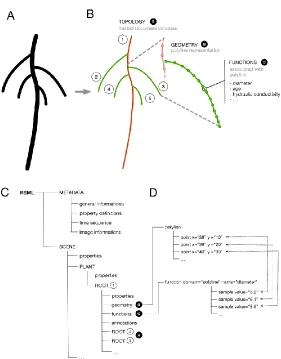
In practice, the RSML format is split into metadata and the scene elements (Fig. 2). The metadata store experimental and technical information relevant to the scene, while the scene itself contains the root system representation. Supplementary data can be stored using properties (at the scene, plant or root level), functions along the root axes and annotations.
A brief outline of the main components of the RSML format is presented in the following
sections. The RSML website (http://rootsystemml.github.io/) provides technical specifications of the format, as well as RSML examples and related image files which illustrate the possibilities offered by the RSML format. It also includes links to all software reading and writing RSML files.
Metadata
The metadata specifies the experimental context in which an RSML file was constructed. It also provides a concise description of the file content, allowing documents to be quickly scanned, filtered or classified without reading the entirety of each file.
Included in the metadata element are a unique identifier for the scene, file information, and the real-world unit and resolution for the root conversion of pixel data. The <software> and <last-modified> elements allow tracking of changes when multiple software tools have handled the same document. <Property> and <function> definitions describe the associated properties or functions that will appear in the document. If the RSML file is one of many in a time series dataset, a <time-sequence> element identifies this set and the position of the file in the sequence.
Scene and topology
9
least one root. Finally, roots may also contain additional child roots, i.e. lateral roots. RSML documents mimic this structure: the scene element will contain one or more plant elements, which in turn will contain one or more root elements. Further levels of root elements are used to show lateral roots of higher orders (fig. 2C).The topological aspects of the root system, such as the connexions between a primary root and its child lateral roots, are therefore represented through the nested structure of the scene element in the RSML document itself. All geometry and other measurements are stored as data attached to the relevant elements throughout the document (fig. 2C).
In order to ensure a uniform naming of the different root types and terms across different files, root type descriptors used in RSML refer to The Plant Ontology Database (Avraham et al. 2008), a plant ontology widely accepted within the plant community. The current root type terminology in the PO database is presented in table 2. The list is not exhaustive and could might be extended with other terms from the PO database.
Root geometry
While the topology of the scene is implicit in the hierarchy of the document, geometric information is defined explicitly. Root elements contain a geometry element in which the root geometry is detailed as a polyline – a succession of linear segments. Scenes and plants contain no geometrical information; their geometries are the combined geometries of all child root elements.
RSML has been designed to allow sharing of root architecture between different software
packages, where these systems may contain different representations of root geometry. We use the polyline as the primary geometric structure (each root element must include a polyline geometry). Each software that makes use of RSML is responsible for conversion between a polyline and any alternative structures that the software may use, such as continuous splines. Inside the geometrical description of a root, a polyline element contains an ordered list of points that provide the endpoints of the successive segments that make up the root. Each point element contains x and y attributes for 2D scenes, and an optional z attribute for 3D
10
It may be the case that the conversion to polyline form comes at the expense of accuracy in a given software package. Should a certain application store geometry in spline form, for
example, the conversion to a polyline will only approximate the curve. In this case additional geometries are permitted alongside, but not instead of, the polyline. These can take any form as long as they are contained within a single child of the geometry element. It should be noted that additional geometry types are included for the convenience of individual software developers. Other software that reads the RSML format need only examine the polyline form of the
geometry, and may disregard any additional information. In this way, the portability of geometric information between software is ensured, but more specific structures are available if the RSML files are being used as a storage format for a particular application.
Root functions
It will often be desirable to attach additional information along the polyline. This would be the case of, e.g. the root diameter, the root hair length or the presence of nodules. In RSML, continuous functions are used to describe quantitative information as a function of the
longitudinal position along the root axis.. The function domain is explicitly defined, and specifies the mapping between observed function values and their corresponding positions along the root (see supplemental figure 1 for a graphical example). Depending on the software
implementation, the sample points of a function can be uniformly spread over a root length, or attached to a given position on the polyline, either using an index, or a length..
Through the use of functions, quantifiable variables can be added within an RSML document. Information that is not directly associated with a root geometry, or categorical information that cannot be provided as a function are instead stored in separate entities within the RSML specification that are described below.
Properties
Many aspects of root systems cannot be linked directly to root geometry, and are instead
11
parsing of the RSML document, enabling analysis tools to directly retrieve these pre-calculated properties without having to compute them from the topological and geometrical information.
Annotations
It may be useful to attach general information such as user observations to a given scene. For example, a region of a given scene could be marked as “out of focus”, letting software know that image analysis performed in this area may be less reliable. As properties, annotations are added as elements located within the corresponding scene, plant or root element. Each
annotation includes a list of one or more points, representing the point, line or region of interest to which the annotation applies. A <value> element provides the text or numerical content of the annotation, and finally a <software> element specifies the software used to add that annotation.
Root Development
Root developmental processes (e.g. growth rate) are often analyzed using time lapse image sequences. Preserving time series information is an important factor in many root phenotyping applications and requires maintaining an explicit link between successive images of the same plant. The RSML format allows images of a time lapse sequence to be linked through the use of the <time-sequence> element in the metadata. The <index> element indicates its position in the time series.
Software that provides an explicit mapping between geometries in a time series can use the metadata can use to indicate this. Some software use such information to calculate change in parameters over time, e.g. elongation rate. Others (SmartRoot, RootSystemAnalyser) use previous time steps information to initialize subsequent reconstructions, improving root tracing efficiency by focusing on incremental information in the following image.
RSML Thesaurus
The RSML format does not impose a restricted set of properties or functions. However, a thesaurus has been defined to promote the use of standardized terms. Any supporting software is not required to process these terms. So, unlike the main RSML definition, new terms may be added to this thesaurus without changing the format itself. Addition to the thesaurus follows a traditional open-source protocol as described on the RSML website
(http://rootsystemml.github.io).
12
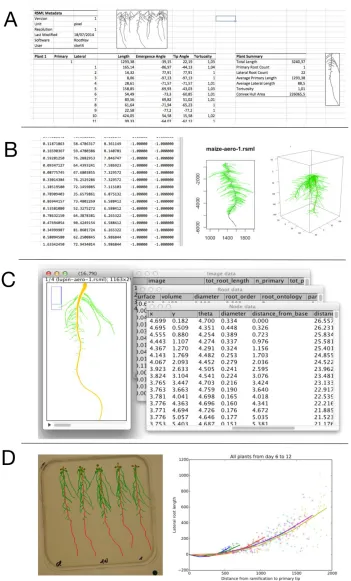
Five open-source APIs have been created to read and parse RSML datafiles from within C#, Excel (fig. 3A), R (fig. 3B), ImageJ (fig. 3C) and Python (fig. 3D). The aim of these packages is not to carry the analysis of the root system data, but to provide end-users with commonly used data structures within popular data analysis pipelines. These packages have been released as open-source to allow users to adapt them to their needs. They are available through the RSML website.
RSML enables common pipelines for root systems analysis and modeling
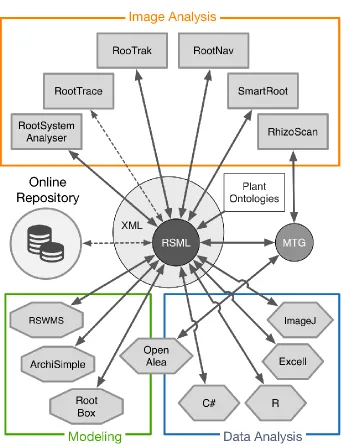
The RSML format provides plant researchers with a central paradigm connecting image analysis tools, data analysis pipelines and modeling platforms (fig. 4). Data generated by RSML-compliant tools can be reused in others, facilitating data transfer between researchers and groups. We provide here three examples where RSML is used to interface different analysis pipelines.
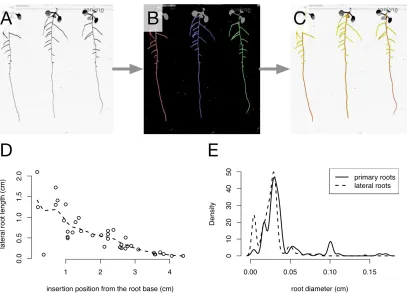
In the first example, RSML was used to transfer root architecture information between root image analysis tools (fig. 5). A root image, containing several plants (fig. 5A), was traced using RootNav (fig. 5B). RootNav features an efficient root tracing algorithm, but does not compute a measure of root diameter along each root, a measurement that might be required in some experiment. The RSML file generated by RootNav was imported in SmartRoot, which automatically computes diameter measurements upon loading an RSML file that does not contain that information (fig. 5C). The resulting RSML file was imported into the R statistical computing environment (R Core Team) for analysis. The profile of lateral root length along the primary root axis (fig. 5D) was computed using the tracing originally performed by RootNav. The primary and lateral root diameters distributions (fig. 5E) were computed using the data
computed by SmartRoot. This example illustrates the complementarity of existent root image analysis tools and how the RSML format enables this complementarity to be exploited by researchers.
13
length, lateral root length, lateral insertion angles and lateral insertion positions for each software. This example illustrates how a shared format can streamline the validation of new algorithms and the creation of benchmark datasets with which to validate them.
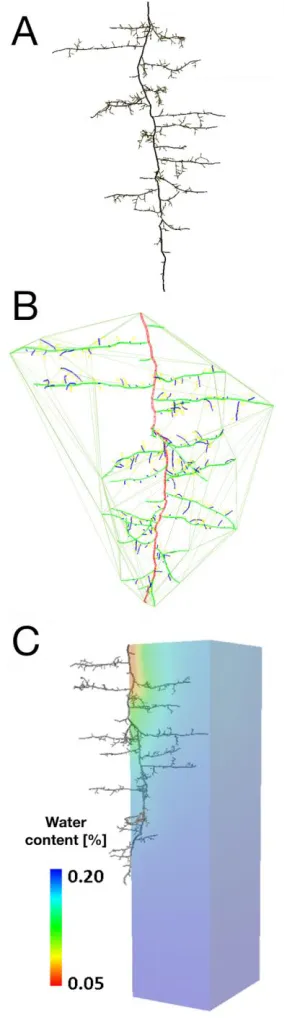
In the third example, we illustrate the use of RSML for data storage and sharing between modeling tools. Figure 6A shows the visual output of an Anagallis femina root system simulated by RootBox (Leitner et al., 2010). The simulated root architecture was stored as an RSML data file, and converted into the MTG data-structure (Godin and Caraglio, 1998) in the OpenAlea platform (Pradal et al., 2008). Taking advantage of the geometric modules of PlantGL (Pradal et al., 2009), the 2D or 3D convex hull of the root system can easily be calculated (fig. 6B). The same RSML file was used in R-SWMS (Javaux et al. 2008) to simulate water flow in the soil-root system, hence allowing the testing of the functional performance (in this case water uptake) of the simulated root system.
These three examples highlight the potential role of the RSML format as a cornerstone in analysis pipelines and show how it can hasten data (both simulated and experimental) exchange between researchers.
RSML promotes the use of a central repository for root architecture data
Many experiments on root architecture, and so a great number of software tools developed to analyze them, focus on the limited number of root architecture parameters that can be
calculated without an explicit root model. To extract other parameters of interest (e.g. lateral root length), a complete tracing of the root system is often required, including a hierarchical model of the root structure. However, the tracing of a complete root system can be time consuming. It is therefore highly beneficial to reuse previous root datasets in the quantification of other traits demanded in different experiments. Due to the lack of compatibility between many historic datasets, this re-analysis is often only possible by re-construcing the complete dataset, which is at best time-consuming and, at worst, impossible. By storing root architecture in a common format, desired root traits can be calculated quickly over large datasets captured with a variety of software, regardless of the traits that were considered when that dataset was first analyzed.
14
queried by the scientific community. The development of similar public database for costly and valuable root architecture data would increase the pace and efficiency of root research.
This central repository can also be used as a benchmark to compare and evaluate computer programs used to reconstruct architectural data. New algorithms and software could be
assessed to ensure that the datasets produced are scientifically valid. This benchmark will also greatly accelerate the impact and the adoption of new, independently developed algorithms for automatic digital reconstruction of root system architecture. In neuroscience, the DIADEM Challenge (DIgital reconstructions of Axonal and DEndritic Morphology) addresses a similar need (Parekh and Ascoli, 2013).
Using RSML format to store root system data without architectural information
The RSML format was initially defined an efficient storage mechanism for detailed root system representations. As such, the explicit topology and geometry of the root system can be
encoded. However, it is important to note that the RSML format can also be used for the storage of root system data that does not contain geometrical and/or topological information. As an example, the recently developed DIRT image analysis toolbox (Bucksch et al. , 2014) is able to extract multiple metrics from images of field-grown crown roots. The RSML format could still be used in this case, by taking advantage of its underlying multiscale formalism, i.e. the fact that properties may be set at any level of detail (scene, plant, root).
Conclusions
The Root System Markup Language (RSML) presented in this paper facilitates the sharing of root architectures between software, experiments and research groups. RSML accommodates for a wide array of root architecture complexity (ranging from 2D projections of single roots through to 3D representations of complete root systems), at varying levels of detail. The RSML format stores root topology (parent-child relationships), morphological properties (positions in space and time, length), and virtually any type of additional information used to describe root segments (e.g. diameter, color, age) separately, linking them to form a coherent representation.
15
models (RootBox, ArchiSimple and R-SWMS), and is based on the MTG format used in the OpenAlea platform. Five open-source packages were developed for the analysis and
visualisation of RSML datafiles (in C#, R, Excel, Java and Python). We believe the availability of RSML will encourage the creation of common analysis pipelines for root architecture
information, enabling better data sharing between root researchers, and will facilitate the creation of shared database of root architecture information.
16
Literature cited
Al-Ghazi Y, Muller B, Pinloche S, Tranbarger TJ, Nacry P, Rossignol M, Tardieu F, Doumas P (2003) Temporal responses of Arabidopsis root architecture to phosphate starvation: evidence for the involvement of auxin signalling. Plant, Cell and Environment 26: 1053–1066
Armengaud P, Zambaux P, Hills A, Sulpice R, Pattison RJ, Blatt MR, Amtmann A (2009) EZ-Rhizo: integrated software for the fast and accurate measurement of root system architecture. The Plant Journal 57: 945–956
Avraham, S., Tung, C.-W., Ilic, K., Jaiswal, P., Kellogg, E.A., Mccouch, S., Pujar, A., Reiser, L., Rhee, S.Y., Sachs, M.M., Schaeffer, M., Stein, L., Stevens, P., Vincent, L., Zapata, F., Ware, D. (2008) The Plant Ontology Database: A community resource for plant structure and developmental stages controlled vocabulary and annotations. Nucleic Acids Research, 36 (SUPPL. 1): D449-D454.
Barthelemy D, Caraglio Y (2007) Plant Architecture: A Dynamic, Multilevel and
Comprehensive Approach to Plant Form, Structure and Ontogeny. Annals of Botany 99: 375–407
Boudon F, Pradal C, Cokelaer T, Prusinkiewicz P, Godin C (2012) L-py: an L-system simulation framework for modeling plant architecture development based on a dynamic language. Frontiers in Plant Science 3: 1–20
Bucksch A, Burridge J, York LM, Das A, Nord E, Weitz JS, Lynch JP (2014). Image-based high-throughput field phenotyping of crop roots. Plant Physiology. in press
Clark RT, Famoso AN, Zhao K, Shaff JE, Craft EJ, Bustamante CD, McCouch SR, Aneshansley DJ, Kochian LV (2012) High-throughput 2D root system phenotyping platform facilitates genetic analysis of root growth and development. Plant, Cell and Environment 36: 454–466
Clark RT, MacCurdy R, Jung J, Shaff J, McCouch SR, Aneshansley D, Kochian L (2011) 3-Dimensional Root Phenotyping with a Novel Imaging and Software Platform. Plant
Physiology 156: 455–465
Comas LH (2013) Root traits contributing to plant productivity under drought. Frontiers in Plant Science 4: 1–16
Danjon F, Khuder H, Stokes A (2013) Deep Phenotyping of Coarse Root Architecture in R. pseudoacacia Reveals That Tree Root System Plasticity Is Confined within Its Architectural Model. PLoS ONE 8: e83548
Danjon F, Reubens B (2007) Assessing and analyzing 3D architecture of woody root systems, a review of methods and applications in tree and soil stability, resource acquisition and allocation. Plant and Soil 303: 1–34
Danjon F, Sinoquet H, Godin C, Colin F, Drexhage M (1999) Characterisation of structural tree root architecture using 3D digitising and AMAPmod software. Plant and Soil 211: 241–
17
Diener J, Nacry P, Périn C, Dievart A, Draye X, Boudon F, Gaujon A, Godin C (2013) An automated image-processing pipelinefor high-throughput analysis of root architecture in OpenAlea. In 7th International Conference on Functional-Structural Plant Models. pp 85–87
Draye X, Kim Y, Lobet G, Javaux M (2010) Model-assisted integration of physiological and environmental constraints affecting the dynamic and spatial patterns of root water uptake from soils. Journal of Experimental Botany 61: 2145–2155
Dunbabin VM, Postma JA, Schnepf A, Pagès L, Javaux M, Wu L, Leitner D, Chen YL, Rengel Z, Diggle AJ (2013) Modelling root–soil interactions using three–dimensional
models of root growth, architecture and function. Plant and Soil 372: 93–124
Fournier C, Pradal C, Louarn G, Combes D, Soulié J-C, Luquet D, Boudon F, Chelle M
(2010) Building modular FSPM under OpenAlea: concepts and applications. 6th International Workshop on Functional-Structural Plant Models 109–112
French AP, Ubeda-Tomas S, Holman T, Bennett M, Pridmore T (2009) High-Throughput Quantification of Root Growth Using a Novel Image-Analysis Tool. Plant Physiology 150: 1784–1795
Galkovskyi T, Mileyko Y, Bucksch A, Moore B, Symonova O, Price CA, Topp CN, Iyer-Pascuzzi AS, Zurek PR, Fang S, et al (2012) GiA Roots: software for the high throughput analysis of plant root system architecture. BMC Plant Biology 12: 116
Garin G, Fournier C, Andrieu B, Houlès V, Robert C, Pradal C (2014) A modelling framework to simulate foliar fungal epidemics using functional–structural plant models. Annals of botany114: 795–812.
Godin C, Caraglio Y (1998) A Multiscale Model of Plant Topological Structures. Journal of theoretical Biology 191: 1–46
Godin C, Costes E, Sinoquet H (1999). A method for describing plant architecture which integrates topology and geometry. Annals of Botany, 84(3), 343–357.
Godin C, Costes E, Sinoquet H (2005). Plant architecture modelling. In C. G. N. Turnbull, Plant architecture and its manipulation. Wiley-Blackwell.
Godin C, Sinoquet H (2005) Functional-structural plant modelling. New Phytologist 166: 705–
708
Griffon S, de Coligny F (2013) AMAPstudio: An editing and simulation software suite for plants architecture modelling. Ecological Modelling 1–8
Gruber BD, Giehl RFH, Friedel S, Wiren von N (2013) Plasticity of the Arabidopsis root system under nutrient deficiencies. Plant Physiology 163: 161–179
Guédon Y, Barthelemy D, Caraglio Y, Costes E (2001) Pattern analysis in branching and axillary flowering sequences. Journal of theoretical Biology 212: 481–520
Hammer G, Dong Z, Mclean G, Doherty A, Messina C, Schussler J, Zinselmeier C, Paszkiewicz S, Cooper M (2009) Can Changes in Canopy and/or Root System
Architecture Explain Historical Maize Yield Trends in the U.S. Corn Belt? Crop Science 49: 299–312
Iyer-Pascuzzi A, Symonova O, Mileyko Y, Hao Y, Belcher H, Harer J, Weitz J, Benfey PN
18
Root Systems. Plant Physiology 152: 1148–1157
Javaux M, Schroeder T, Vanderborght J, Vereecken H (2008). Use of a three-dimensional detailed modeling approach for predicting root water uptake. Vadose Zone Journal, 7, 1079–1088
Kellermeier F, Armengaud P, Seditas TJ, Danku J, Salt DE, Amtmann A (2014) Analysis of the Root System Architecture of Arabidopsis Provides a Quantitative Readout of Crosstalk between Nutritional Signals. The Plant Cell 26: 1480–1496
Le Bot J, Serra V, Fabre J, Draye X, Adamowicz S, Pagès L (2010) DART: a software to analyse root system architecture and development from captured images. Plant and Soil
326: 261–273
Leitner D, Felderer B, Vontobel P, Schnepf A (2013) Recovering root system traits using image analysis - Exemplified by 2-dimensional neutron radiography images of lupine. Plant Physiology 164: 24–35
Leitner D, Klepsch S, Bodner G, Schnepf A (2010) A dynamic root system growth model based on L-Systems. Plant and Soil 332: 117–192
Lobet G, Couvreur V, Meunier F, Javaux M, Draye X (2014) Plant Water Uptake in Drying Soils. Plant Physiology 164: 1619–1627
Lobet G, Draye X, Périlleux C (2013) An online database for plant image analysis software tools. Plant Methods 9: 1–7
Lobet G, Pagès L, Draye X (2011) A Novel Image Analysis Toolbox Enabling Quantitative Analysis of Root System Architecture. Plant Physiology 157: 29–39
Lynch JP (1995) Root Architecture and Plant Productivity. Plant Physiology 109: 7
Lynch JP (2007) Roots of the second green revolution. Australian Journal of Botany 55: 493–
512
Mairhofer S, Zappala S, Tracy S, Sturrock C, Bennett MJ, Mooney SJ, Pridmore TP (2013) Recovering complete plant root system architectures from soil via X-ray mu-Computed Tomography. Plant Methods 9: 1–7
Mairhofer S, Zappala S, Tracy SR, Sturrock C, Bennett M, Mooney SJ, Pridomore T (2012) RooTrak: Automated Recovery of Three-Dimensional Plant Root Architecture in Soil from X-Ray Microcomputed Tomography Images Using Visual Tracking. Plant Physiology 158: 561–569
Mooney SJ, Pridmore TP, Helliwell J, Bennett MJ (2012) Developing X-ray Computed Tomography to non-invasively image 3-D root systems architecture in soil. Plant and Soil
352: 1–22
Mundermann L, Erasmus Y, Lane B, Coen E, Prusinkiewicz P (2005). Quantitative modeling of Arabidopsis development. Plant Physiology, 139(2), 960–968
Negrón C, Contador L (2013) Systematic Analysis of Branching Patterns of Three Almond Cultivars with Different Tree Architectures. Journal of the American Society for Horticultural Science 138: 407–415
19
evaluation of ArchiSimple, a simple model of root system architecture. Ecological Modelling
290: 76–84.
Parekh R, Ascoli GA (2013) Neuronal Morphology Goes Digital: A Research Hub for Cellular and System Neuroscience. Neuron 77: 1017–1038
Péret B, Li G, Zhao J, Band LR, Voss U, Postaire O, Luu D-T, Da Ines O, Casimiro I, Lucas M, et al (2012) Auxin regulates aquaporin function to facilitate lateral root emergence. Nat Cell Biol 14: 991–998
Postma JA, Lynch JP (2011) Root Cortical Aerenchyma Enhances the Growth of Maize on Soils with Suboptimal Availability of Nitrogen, Phosphorus, and Potassium. Plant Physiology
156: 1190–1201
Pound MP, French AP, Atkinson J, Wells DM, Bennet JM, Pridmore T (2013) RootNav: Navigating images of complex root architectures. Plant Physiology 162: 1802–1814 Pradal C, Dufour-Kowalski S, Boudon F, Fournier C, Godin C (2008) OpenAlea: a visual
programming and component-based software platform for plant modelling. Functional Plant Biol 35: 751–760
Pradal C, F B, Nouguier C, Chopard J, Godin C (2009) PlantGL: A Python-based geometric library for 3D plant modelling at different scales. Graphical Models 71: 1–21
R Core Team R: A Language and Environment for Statistical Computing. R Foundation for Statistical Computing, Vienna, Austria
Rustici G, Kolesnikov N, Brandizi M, Burdett T, Dylag M, Emam I, Farne A, Hastings E, Ison J, Keays M, et al (2012) ArrayExpress update--trends in database growth and links to data analysis tools. Nucleic Acids Research 41: D987–D990
Silva D, F B, Godin C, Puech O, Smith C, Sinoquet H (2006) A Critical Appraisal of the Box Counting Method to Assess the Fractal Dimension of Tree Crowns. In G Bebis, R Boyle, B Parvin, D Koracin, P Remagnino, A Nefian, G Meenakshisundaram, V Pascucci, J Zara, J Molineros, et al., eds, Lecture Notes in Computer Science. Springer Berlin Heidelberg, pp 751–760
The Plant Ontology Consortium (2002) The Plant Ontology™ Consortium and Plant
20
Tables
Table 1: Description of existing root system architecture image analysis tools
Software Automation Image type Storage Topology Diameter Time series RSML support Reference
EZ-Rhizo automated 2D SQL yes no no no (Armengaud et al.,
2009)
DART manual 2D TXT yes no no no (Le Bot et al., 2010)
OpenAlea.RhizoScan automated 2D MTG yes no yes yes (Diener et al., 2013)
RootNav semi-automated 2D … yes no no yes (Pound et al., 2013)
RootReader2D automated 2D XML yes no no no (Clark et al., 2012)
RootReader3D automated 3D XML yes no no no (Clark et al., 2011)
RootSystemAnalyser automated 2D MAT yes yes yes yes (Leitner et al., 2013)
RooTrak automated 3D … yes no no in progress (Mairhofer et al., 2012)
RootTrace automated 2D … yes no yes in progress (French et al., 2009)
21
Table 2: Plant Ontology terms currently used into the RSML format. This list is not exhaustive as any term contained into the Plant Ontology database (www.plantontology.org) could be used.
Plant Ontology name Plant Ontology accession
root PO:0009005
basal root PO:0025002
embryo root PO:0000045
lateral root PO:0020121
primary root PO:0020127
shoot-borne root PO:0000042
22
Figures
Figure 1. Root system architecture description. A. Single root image: I. single root, II. single root axis and III. root system (e.g. for monocots). B. 3D image stack. C. Time series. D. Example of parameters used to described root architecture parameters. First order roots are shown in red,
23
Figure 2: visual representation of the RSML structure. A. Original image B. Graphical representation of the structure. Topology (primary root in red and lateral roots in green), geometry and properties are represented at different levels. C. Schematic representation of an
RSML file structure. D. Representation of the coupling between the root geometry and its associated functions (here the diameter). Dotted lines represent data from the same point in a
24
25
26
Figure 5: Example workflow enabled by the RSML format. A. Original image of Arabidopsis plants grown in petri dish. B. Screenshot of a root tracing done using RootNav. C. The RSML generated by RootNav was opened using SmartRoot, that computed the root diameter (which is not calculated by RootNav). D. R-generated graph showing lateral root length depending on the insertion position from the primary root base. These data were computed by RootNav. Dashed line representing the moving average across the dataset. E. R-generated histograms comparing
27
Figure 6: Using the RSML format to share data between modeling tools. A. Root system of
Anagallis femina, simulatedusing RootBox (Leitner et al., 2010). B. The RSML file exported by RootBox was opened in PlantGL (Pradal et al., 2009) to compute the convex hull of the root system (yellow lines). C.The same RSML file was used by R-SWMS (Javaux et al. 2008) to
28
29
Supplemental figure 2. Comparison of root system traits obtained using RhizoScan (plain line), RootNav (dashed line), RootSystemAnalyser (dotted line) and SmartRoot (dashed-dotted line).
A. Primary root length. B. Lateral root length. C. Lateral root insertion angle. D. Lateral root insertion position. No significant difference were found between the estimation of the different