RESEARCH ARTICLE
Birds build camouflaged nests
Ida E. Bailey,1* Felicity Muth,1,2Kate Morgan,1 Simone L. Meddle,3 and Susan D. Healy1
1
School of Biology, University of St. Andrews, Fife, United Kingdom 2
Department of Ecology and Evolutionary Biology, University of Arizona, Tucson, Arizona, USA 3
The Roslin Institute and Royal (Dick) School of Veterinary Studies, University of Edinburgh, Edinburgh, United Kingdom * Corresponding author:[email protected]
Submitted April 7, 2014; Accepted July 20, 2014; Published October 1, 2014
ABSTRACT
It is assumed that many birds attempt to conceal their nests by using camouflage. To our knowledge, however, no previous experimental studies have explicitly tested this assumption. To explore whether birds choose materials that match the background colors of nest sites to reduce the conspicuousness of their nests, we offered nest-building male Zebra Finches (Taeniopygia guttata) a choice of nest materials that either matched or did not match the color of their nest cup and the surrounding cage walls. Males chose to nest predominantly with material that matched the background color of the cage. To our knowledge, this is the first experimental evidence that birds actively select materials that camouflage their nests.
Keywords:background matching, birds, camouflage, choice, nest, Zebra Finch
Las aves construyen nidos camuflados
RESUMEN
Se piensa que muchas aves intentan ocultar sus nidos usando camuflajes. Hasta donde sabemos, sin embargo, no hay estudios experimentales que hayan evaluado expl´ıcitamente esta hip ´otesis. Para evaluar si las aves eligen materiales que hacen juego con el color de fondo del sitio de ubicaci ´on del nido, de modo de reducir su visibilidad, les ofrecimos a machos deTaeniopygia guttataque estaban construyendo el nido la posibilidad de elegir entre materiales del nido que hicieran juego o no con el color de sus nidos y con las paredes de sus jaulas. Los machos eligieron predominantemente materiales que coincidieron con el color de fondo de sus jaulas. Hasta donde sabemos, este es la primera evidencia experimental de que las aves seleccionan activamente material que camufla sus nidos.
Palabras clave:aves, camuflaje, hacer juego con el color de fondo, nido, selecci ´on,Taeniopygia guttata
INTRODUCTION
Predation of eggs is a major threat to birds’ reproductive success, and it has been suggested that birds may choose to camouflage their nests. For example, the outer layers of the nests of many species are ‘‘decorated’’ with materials— such as lichen and spider cocoons, in the case of Long-tailed Tits (Aegithalos caudatus) and some hummingbird species (Hansell 1996, Calvelo et al. 2006)—that may reduce the visual detectability of these nests by predators. Although it is clear that birds learn to choose nest sites that reduce their risk of predation (e.g., Haas 1998, Hoi et al. 2012) and that well-concealed nest sites tend to suffer lower predation rates (McGuire and Kleindorfer 2007), there is surprisingly little direct evidence of the benefits of building a well-camouflaged nest. For example, Diamond Firetail (Stagonopleura guttata) nests that were more heavily decorated with colorful, visually conspicuous flowers did not suffer greater predation than less
generously decorated nests (McGuire and Kleindorfer 2007). Furthermore, in an experiment using artificial nests, Japanese Quail (Coturnix japonica) eggs placed in undecorated wicker baskets lined with leaves suffered lower rates of predation than eggs in the same kind of basket decorated with moss inside and out to match their surroundings (Martin 1987). It is also unclear whether birds actively choose the material with which they build their nest in order to reduce the ease of visual detection by potential predators. A nest may appear camouflaged to a human observer simply because a bird chooses local materials that, by chance, match the nest’s surroundings.
are used to create the impression of false boundaries and edges in the object, breaking up its shape and making its outline less easily identifiable (Stevens et al. 2006a, 2006b, Fraser et al. 2007, Stevens and Merilaita 2011). In the present study, we are concerned primarily with back-ground matching.
We used Zebra Finches (Taeniopygia guttata) to test the hypothesis that nest-building birds choose nest material to match the background of the nest site. Wild male Zebra Finches typically build a nest with an outer layer of dry grass stems or fine twigs situated in dense shrubs (Immelmann 1962, Zann 1996). Predation is a serious threat to their reproductive success, with predation rates of
66% having been recorded (Zann 1994). Birds, which often depend more on their vision than on their olfactory capacities to locate prey, are key predators of Zebra Finches (Zann 1996). It seems plausible, then, that Zebra Finches might choose nest material to minimize the visual conspicuousness of their nests.
Zebra Finches are also a logistically useful study species for testing this hypothesis, in that they readily build nests in captivity, have good color vision, and show strong preferences for one color over another (in nest-building materials: Sargent 1965, Muth and Healy 2011, 2012, Muth et al. 2013; in mate choice: e.g., Burley et al. 1982; and in foraging: Guillette et al. 2014). Although these color preferences are context dependent (i.e. males prefer different colors when choosing among materials for nest building than they do when choosing among differently colored food items), the cause of these preferences is still far from clear (Muth et al. 2013). It is possible that some of the variation in their color preference for building materials occurs because they attempt to build with materials that reduce the visual conspicuousness of their nests.
METHODS
The subjects in the experiment were 21 pairs of captive-bred adult Zebra Finches, sourced from the University of Glasgow (United Kingdom) and a local pet store. They were paired 6–10 days prior to the start of the experiment. Each pair was kept in a wooden cage with one side made of wire mesh (91 cm length331 cm width339 cm height). The birds were maintained on a 14:10 light:dark cycle (standard fluorescent light) at 218C with humidity around 50%. They were given ad libitum birdseed (Haiths, Grimsby, United Kingdom), water supplemented with calcium and vitamin D3, and cuttlefish bone. To assess the birds’ health and welfare, we visually inspected them daily without handling.
Six to 10 days after pairing, we presented breeding pairs with nest cups covered in colored paper. Each nest cup was open-topped (11 cm length312 cm width34.5
cm height) and was placed in the center of either the left- or right-hand half of the cage, halfway up the back wall. We covered both the inside and outside of the nest cup with colored paper. Using the same colored paper, we covered the 2 walls (back and side) in the half of the cage in which the nest cup was hung. The remaining solid wooden walls and ceiling were left uncovered. Once we had added the paper-covered nest cup to the cage and covered the cage walls with the matching paper, we gave the birds 24 hr to acclimatize to their new surroundings.
We then presented each pair of birds with 50 strips of colored paper (each 1530.7 cm and 80 g) with which to build a nest; 25 of the strips matched the background color of their nest site and 25 were of another, contrasting color. The colors we used were pale yellow, pale pink, mint green, cream, and pale blue. Each color was paired with every other color twice, once as the background color and once as the contrasting color. This resulted in 20 color combinations, with each color being used 8 times across the birds. The 21st pair had pink as their background color and green as the contrasting color. We deliberately chose colors that bore little resemblance to natural nest materials in order to provide a stronger test of choice of camouflage, rather than confounding the data with possible ‘‘innate’’ nest-material color preferences (Muth et al. 2013).
Paper strips of each color were placed in adjacent bundles on the floor at equal distance from the nest cup. We digitally recorded the birds’ nest-building behavior using video cameras until the male had taken a minimum of 10 strips of paper to the nest cup. In analyzing the data, we used the percentage of these 10 strips that were one color as a measure of a male’s color preference. We assessed color preference only in the males because the males take the material to the nest box.
Data Analysis
We analyzed the data using a variety of tests in the statistical package JMP version 7.0.2 (SAS institute, Cary, North Carolina, USA), witha¼0.05.
To examine whether birds chose material that matched the color of the background, we compared the percentage of the first 10 paper strips taken by each male to his nest cup that were the background color to the percentage predicted by chance (50%), using a Wilcoxon signed-rank test. Each bird contributed only 1 data point to this analysis.
with those chosen during choices 11–20. For this analysis, we used data only from the 18 males that took20 pieces of paper to the nest box.
RESULTS
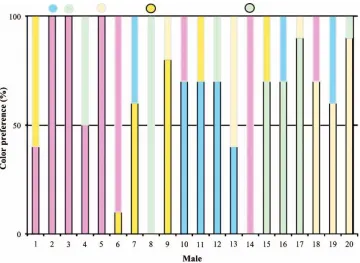
Twenty of our 21 male Zebra Finches built with the colored paper. Males tended to choose nest material of the same color as the nest site’s background, rather than a contrasting color, more often than expected by chance (median preference¼70, maximum¼100, minimum¼
[image:3.612.127.487.71.334.2]0.0, Q1¼47.5, Q3¼82.5%; Wilcoxon signed-rank test [one-tailed]:Z19¼43.00,P¼0.041; Figure 1).
Pink appeared to be a preferred color: It was chosen, on average, 7.1 times out of 10 choices when available. Yellow seemed not to be preferred: It was chosen, on average, 3.8 times out of 10 choices when available, regardless of the color of the background of the nest site. These differences were not significant, however, and none of the 5 colors stood out as being strongly preferred or avoided compared with the others (v24¼4.76,P¼0.312).
When we excluded the data from those pairs presented with pink as one of the options, the results remained virtually unchanged (percentage of paper strips chosen that were the background color: median preference¼70.0,
maximum¼90.0, minimum¼0.0, Q1¼60.0, Q3¼80.0; Wilcoxon signed-rank test [one-tailed]: Z10¼20.00, P¼ 0.040). Finally, there was no difference in the birds’ color preference between choices 1–10 and 11–20 (Wilcoxon signed-rank test:Z17¼13.50,P¼0.430).
DISCUSSION
Nest-building male Zebra Finches chose material that matched the background color of the nest site. It appears, then, that birds can both choose the location of their nest in order to reduce predation risk and also choose nest materials that reduce the visual conspicuousness of the nest.
Because our laboratory birds were many generations removed from active selection for any nest-camouflaging tendency and never exposed to any real predation threat, it is possible that this preference for camouflaged nest-building material is even stronger in wild birds. This possibility requires direct testing in the field, not least because it is also possible that selection on nest-material color choice may not be strong in the field if nest-site selection and social-defense behaviors (e.g., mobbing; Lombardi and Curio 1985) are more effective for reducing nest predation (Stoddard et al. 2011). It is also possible that
although our results show that Zebra Finches will choose materials of a color to camouflage their nests, in the field they may choose materials that aid in camouflaging their nests by matching the textural components of the background.
We tested only the possibility that these birds build their nests to match the background. Background color matching, however, often appears to be more effective when combined with disruptive coloration (Schaefer and Stobbe 2006, Stevens et al. 2006b, Dimitrova et al. 2009, Magellan and Swartz 2013). It seems plausible that in the field, some birds might also choose materials in order to exploit the visual effects on possible predators conferred by disruptive coloration. Furthermore, in the context of nesting, this combination of camouflaging approaches has already been shown to be an effective form of concealment for eggs against their background (Lovell et al. 2013).
With the increasing sophistication of visual analyses being conducted on the relationship between visual marking of eggs and their backgrounds (Hoi et al. 1994, Barber et al. 2001, Quader 2006), it is now possible to collect data on the extent to which birds building nests in the wild camouflage their nests and how they do so. It will also be possible to examine how some species trade off the risk of predation with the benefits that might be accrued through increasing nest size or via nest ornamentation in order to signal individual quality (Hansell 1996) and/or influence mate choice (Sergio et al. 2011).
ACKNOWLEDGMENTS
This work was supported by the Biotechnology and Biological Sciences Research Council (BBSRC) (BB/I019502/1 to S.D.H. and S.L.M.) and by Roslin Institute Strategic Grant funding from the BBSRC (to S.L.M). We thank the anonymous reviewers for their very useful comments on the manuscript.
LITERATURE CITED
Barber, I., D. Nairn, and F. A. Huntingford (2001). Nests as ornaments: Revealing construction by male sticklebacks. Behavioral Ecology 12:390–396.
Burley, N., G. Krantzberg, and P. Radman (1982). Influences of colour-banding on the conspecific preferences of Zebra Finches. Animal Behaviour 30:444–445.
Calvelo, S., A. Trejo, and V. Ojeda (2006). Botanical composition and structure of hummingbird nests in different habitats from northwestern Patagonia (Argentina). Journal of Natural History 40:589–603.
Dimitrova, M., N. Stobbe, H. M. Schaefer, and S. Merilaita (2009). Concealed by conspicuousness: Distractive prey markings and backgrounds. Proceedings of the Royal Society of London, Series B 276:1905–1910.
Fraser, S., A. Callahan, D. Klassen, and T. N. Sherratt (2007). Empirical tests of the role of disruptive coloration in reducing detectability. Proceedings of the Royal Society of London, Series B 274:1325–1331.
Guillette, L. M., K. V. Morgan, Z. J. Hall, I. E. Bailey, and S. D. Healy (2014). Food preference and copying behaviour in Zebra Finches, Taeniopygia guttata. Behavioural Processes 105. In press.
Haas, C. A. (1998). Effects of prior nesting success on site fidelity and breeding dispersal: An experimental approach. The Auk 115:929–936.
Hansell, M. H. (1996). The function of lichen flakes and white spider cocoons on the outer surface of birds’ nests. Journal of Natural History 30:303–311.
Hoi, H., A. Kriˇst´ın, F. Valera, and C. Hoi (2012). Traditional versus non-traditional nest-site choice: Alternative decision strate-gies for nest-site selection. Oecologia 169:117–124.
Hoi, H., B. Schleicher, and F. Valera (1994). Female mate choice and nest desertion in Penduline Tits, Remiz pendulinus: The importance of nest quality. Animal Behaviour 48:743–746.
Immelmann, K. (1962). Beitr ¨age zu einer vergleichenden Biologie australischer Prachtfinken (Spermestidae). Zoologische Jahrb ¨ucher. Abteilung f ¨ur Systematik, ¨Okologie und Geo-graphie der Tiere 90.
Lombardi, C. M., and E. Curio (1985). Influence of environment on mobbing by Zebra Finches. Bird Behaviour 6:28–33. Lovell, P. G., G. D. Ruxton, K. V. Langridge, and K. A. Spencer
(2013). Egg-laying substrate selection for optimal camouflage by quail. Current Biology 23:260–264.
Magellan, K., and E. R. Swartz (2013). Crypsis in a heterogeneous environment: Relationships between changeable polymor-phic colour patterns and behaviour in a galaxiid fish. Freshwater Biology 58:793–799.
Martin, T. E. (1987). Artificial nest experiments: Effects of nest appearance and type of predator. The Condor 89:925–928. McGuire, A., and S. Kleindorfer (2007). Nesting success and
apparent nest-adornment in Diamond Firetails (Stagono-pleura guttata). Emu 107:44–51.
Muth, F., and S. D. Healy (2011). The role of adult experience in nest building in the Zebra Finch,Taeniopygia guttata. Animal Behaviour 82:185–189.
Muth, F., and S. D. Healy (2012). Zebra Finches build nests that do not resemble their natal nest. Avian Biology Reseach 5: 218–226.
Muth, F., M. Steele, and S. D. Healy (2013). Colour preferences in nest-building Zebra Finches. Behavioural Processes 99:106–111. Quader, S. (2006). What makes a good nest? Benefits of nest choice to female Baya Weavers (Ploceus philippinus). The Auk 123:475–486.
Sargent, T. D. (1965). The role of experience in the nest building of the Zebra Finch. The Auk 82:48–61.
Schaefer, M. H., and N. Stobbe (2006). Disruptive coloration provides a camouflage independent of background match-ing. Proceedings of the Royal Society of London, Series B 273: 2427–2432.
Stevens, M., I. C. Cuthill, C. A. Parraga, and T. Troscianko (2006a). The effectiveness of disruptive coloration as a concealment strategy. Progress in Brain Research 155:49–64.
Stevens, M., I. C. Cuthill, A. M. M. Windsor, and H. J. Walker (2006b). Disruptive contrast in animal camouflage. Pro-ceedings of the Royal Society of London, Series B 273:2433– 2438.
Stevens, M., and S. Merilaita. (2011). Animal Camouflage: Mechanisms and Function. Cambridge University Press, Cambridge, UK.
Stoddard, M. C., K. L. A. Marshall, and R. M. Kilner (2011). Imperfectly camouflaged avian eggs: Artefact or adaptation? Avian Biology Reseach 4:196–213.
Zann, R. (1994). Reproduction in a Zebra Finch colony in south-eastern Australia: The significance of monogamy, precocial breeding and multiple broods in a highly mobile species. Emu 94:285–299.