1
3D Printing of five-in-one dose combination polypill with defined immediate and
1sustained release profiles
2Shaban A. Khaleda, Jonathan C. Burleya, Morgan R. Alexandera, Jing Yangb and Clive J. Robertsa* 3
aLaboratory of Biophysics and Surface Analysis, School of Pharmacy, The University of Nottingham,
4
Nottingham, NG7 2RD, UK 5
bDivision of Drug Delivery and Tissue Engineering, School of Pharmacy, The University of
6
Nottingham, Nottingham, NG7 2RD, UK 7
*Correspondence to: Clive J Roberts
8
Address: School of Pharmacy, The University of Nottingham, University Park, NG7 2RD, UK 9
Tel: +44 115 951 5048 10
Fax: +44 115 951 5102 11
Email: [email protected] 12
13
14
15
16
17
18
19
2
Abstract
21
We have used three dimensional (3D) extrusion printing to manufacture a multi-active solid dosage 22
form or so called polypill. This contains five compartmentalised drugs with two independently 23
controlled and well-defined release profiles. This polypill demonstrates that complex medication 24
regimes can be combined in a single personalised tablet. This could potentially improve adherence for 25
those patients currently taking many separate tablets and also allow ready tailoring of a particular drug 26
combination/drug release for the needs of an individual. The polypill here represents a cardiovascular 27
treatment regime with the incorporation of an immediate release compartment with aspirin and 28
hydrochlorothiazide and three sustained release compartments containing pravastatin, atenolol, and 29
ramipril. X-ray powder diffraction (XRPD) and Attenuated Total Reflectance Fourier Transform 30
Infrared Spectroscopy (ATR-FTIR) were used to assess drug-excipient interaction. The printed 31
polypills were evaluated for drug release using USP dissolution testing. We found that the polypill 32
showed the intended immediate and sustained release profiles based upon the active/excipient ratio 33
used. 34
Keywords
353D printing; Polypill; Sustained release; Immediate release; Personalised medicine 36
Chemical compounds studied in this article
37Aspirin (PubChem CID: 2244); Hydrochlorothiazide (PubChem CID: 3639); Atenolol (PubChem 38
CID: 2249); Pravastatin sodium (PubChem CID: 16759173); Ramipril (PubChem CID: 5362129) 39
40
3
1.
Introduction
42
The use of multiple medications to control complex diseases such as cancer and heart diseases is an 43
increasingly used therapeutic strategy [1, 2]. Each active pharmaceutical ingredient is traditionally 44
administered via a separate dosage form [2]. This is inconvenient, can lead to errors in medication and 45
presents significant patient compliance issues [2, 3]. Combining multiple actives into a single tablet 46
with appropriate release profiles and doses (potentially optimised for individuals) is an attractive 47
alternative [3-5]. 48
The term "polypill" refers to a tablet that is composed of a combination of several medicines [5], and 49
has been previously studied as a concept to treat and prevent cardiovascular disease and high blood 50
pressure [6-9]. This polypill (in fact a capsule) manufactured by Cadila Pharmaceuticals Limited 51
under trade name of PolycapTM is the only polypill formulation commercially available [7, 8, 10].
52
Cardiovascular disease is the most common cause of death globally and requires managing as a 53
chronic condition in many people during large portions of their lifetime [11]. Based on previous work, 54
we suggest that additive manufacturing or 3D printing is potentially well suited to producing a 55
multicomponent polypill formulation [4, 8, 9]. As an approach 3D printing also offers the opportunity 56
to produce personalised medicines and is adaptable to a distributed manufacturing model [4]. The 57
freedom to form specific geometries in comparison to the restrictions of traditional tableting via 58
powder compression can be used to separate incompatible substances and to enable different release 59
rates using shape and size as well as excipient manipulation [4, 12]. Here we have designed a 5-60
component polypill based upon the currently available “polycap” commercial formulation with three 61
sustained release compartments containing pravastatin, atenolol, and ramipril, which were physically 62
separated by a hydrophobic cellulose acetate shell designed to act as a permeable carrier, and covered 63
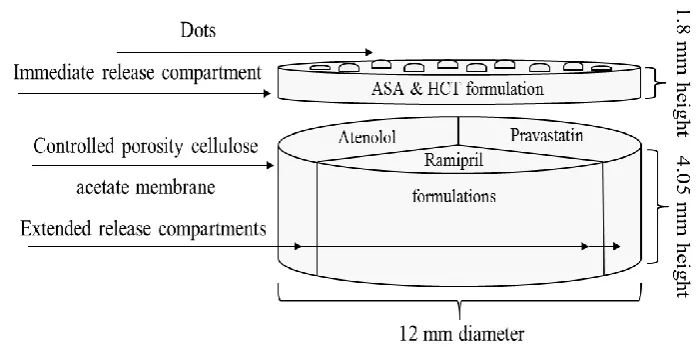
with an immediate release aspirin and hydrochlorothiazide compartment (Fig. 1.). Atenolol is a beta-64
blocker agent which is used to treat hypertension and also prevent and/or treat heart attack [13]. 65
Hydrochlorothiazide is a thiazide diuretic used to prevent absorption of too much salt and to treat 66
4
cirrhosis [14]. Ramipril is an angiotensin converting enzyme (ACE) used for treatment of 68
hypertension and congestive heart failure which improves heart function after a heart attack [15]. 69
Aspirin is an antiplatelet used to reduce the risk of blood clotting and reduce heart attacks or strokes 70
[16]. Pravastatin is a 3-hydroxy-3-methylglutaryl–coenzyme A (HMG-CoA) reductase inhibitors used 71
to reduce blood cholesterol and triglycerides in hyperlipidaemic patients and lower rates of strokes 72
and heart attacks [17]. 73
3D printing is a process used to fabricate 3D objects by laying down successive material layers in 74
different shapes taken directly from a digital file [18]. There has been a significant recent growth in 75
interest of 3D printing as a tool in pharmaceutics and personalised medicine [19-23]. For example, a 76
heat based fused deposition modelling 3D printer (> 200 °C) has been used to extrude 5-77
aminosalicylic acid (5-ASA, mesalazine), and 4-aminosalicylic acid (4-ASA) and prednisolone loaded 78
poly (vinyl alcohol) (PVA) filaments and produce simple solid tablets [19, 24]. However, this 79
approach would not be suitable generally due to the possibility of heat induced degradation of 80
thermally sensitive drugs. Also, there are not many reports of printing a single drug formulation with 81
multiple release mechanisms [4, 25]. Katstra et al. employed multi-steps 3D printing to deposit 82
chlorphenaramin maleate (antihistamine used in the prevention of symptoms of allergic conditions 83
such as rhinitis and urticaria) as a binder onto powdered excipients (the amount of drug deposited was 84
5.45 mg) [25, 26]. However, issues such as ink bleeding, migration, and capillary effect due to 85
drug/binder oversaturation are difficult to avoid for printing of larger drugs doses such as 500 mg of 86
paracetamol or ibuprofen [25, 26]. Problems with this approach include long drying times (in excess 87
of 50 hours) and high friability (> 1 %) of the resultant tablet [25, 26]. 88
To address the above mentioned issues of drug degradation and the complexity in published 3D 89
printing processes we have employed a 3D extrusion system operated at room-temperature to 90
manufacture a polypill capable of delivering the five drugs via two predictable release mechanisms. A 91
hydrophobic cellulose acetate shell was first extruded then the active drugs atenolol, pravastatin, and 92
5
compartments of cellulose acetate to form sustained release compartments. Aspirin and 94
hydrochlorothiazide were mixed with a disintegrant; sodium starch glycolate and other excipients and 95
extruded directly on the top of the sustained release compartments, to give an immediate release 96
compartment. A series of raised dots were also printed onto the top of the tablet to facilitate 97
identification of the formulation both visually and by touch, the composition of these was the same as 98
the upper “immediate release” layer. The printed tablets were tested for drug release and drug-99
excipients interaction using United States Pharmacopeia Convention (USP) Type I apparatus 100
dissolution tester, X-Ray Powder Diffraction (XRPD), and Attenuated Total Reflectance Fourier 101
Transform Infrared Spectroscopy (ATR-FTIR). 102
2.
Materials and methods
1032.1. Materials 104
Ramipril and pravastatin sodium were supplied by Kemprotec Limited (Cumbria, UK). Atenolol, 105
aspirin, and hydrochlorothiazide, polyvinylpyrrolidine (PVP) and lactose were supplied by Sigma– 106
Aldrich (Gillingham, UK). D-mannitol 99 % was purchased from VWR International Ltd. 107
(Leicestershire, UK). Sodium starch glycolate (Primojel®) was kindly supplied as a gift from DFE
108
Pharma. Hydroxypropyl methylcelloluse (HPMC K100M CR) (Methocel TM) was a gift from 109
Colorcon®. Milli-Q water (resistivity 18.2 MΩ cm) was used for all formulations and solutions. All
110
other reagents were of either HPLC or analytical grade. 111
2.2. Methods 112
2.2.1. Design of polypill 113
A segmented tablet strategy was chosen to ensure that the actives were separated and could achieve 114
the desired independent control of their release (Fig. 1). This concept provides flexibility in 115
production of a 3D printed polypill with tunable drug release based on modifying the drug loading 116
and excipient composition in the separate parts of the formulation. The dimensions of the polypill 117
were selected according to the drug loading in respect of selected excipients (5.85 mm (height) × 6 118
6
regenHU Villaz-St-Pierre, Switzerland). The combined drugs and their loadings in the polypill 120
described in the experimental set up were adapted from clinical studies based on assessment of effect 121
combination therapy on healthy middle aged individuals with one or more risk factors [8]. 122
123
Fig. 1. Schematic structural diagram of the polypill design, showing the aspirin and 124
hydrochlorothiazide immediate release compartment and atenolol, pravastatin, and ramipril sustained 125
release compartments. 126
2.2.2. Materials for printing of polypill 127
All powders were mixed using a mortar and pestle for 15 minutes. The printable paste used to form 128
the barrier for the sustained release actives was prepared by mixing 3.15 g from the blended powder 129
mixture; cellulose acetate (hydrophobic membrane/shell), D-mannitol (a filler), and polyethylene 130
glycol (PEG 6000) (plasticizer) with 1.7 ml of the binder (acetone and dimethyl sulfoxide (DMSO)) 131
until a smooth homogenous paste was achieved according to the formulae in Table 1. DMSO was 132
used to increase the boiling point of the binder system and avoid nozzles blockage due to acetone 133
evaporation (low boiling point) during the extrusion process. We used acetone/DMSO at a ratio of 3:1 134
v/v. The volume of DMSO per tablet was approximately 28 µl, equivalent to 30.8 mg (3080 ppm) 135
which is considered a very small volume/quantity in respect to DMSO human toxicity and was within 136
the limit of the class 3 solvents (5000 ppm/day) which stated in ICH Harmonised Tripartite Guidance 137
[image:6.595.123.472.152.328.2]7
Table 1. The weight percentage composition of various ingredients in cellulose acetate shell for 139
sustained release formulation in feed stock. 140
141
142
143
144
Powders of atenolol, pravastatin, and ramipril were separately blended using a mortar and pestle for 145
15 min with the required excipients, to ensure homogeneous powder blend. Ultra-pure water was 146
added to the powder and mixed as above method according to the formulae shown in Table 2. The 147
immediate release layer was composed of aspirin and hydrochlorothiazide (active ingredients), 148
sodium starch glycolate (disintegrant), and polyvinylpyrrolidone (PVP K30) (binder). The powder 149
was blended and mixed with ultra-pure water to form a smooth and soft paste according to the 150
formulae shown in Table 3. 151
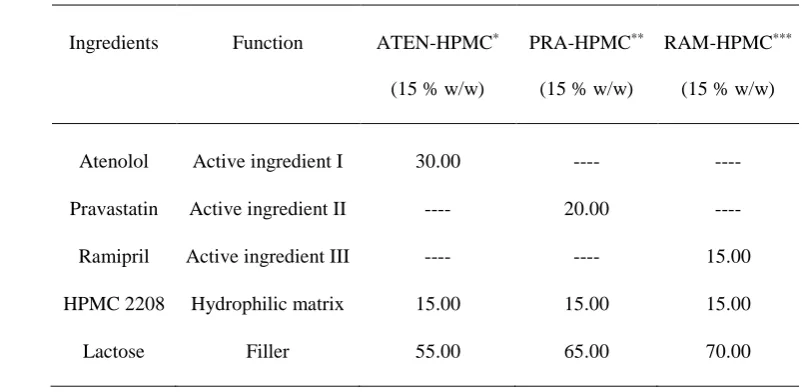
Table 2. The weight percentage composition of various ingredients in atenolol, pravastatin, and 152
ramipril formulation feed stock for the sustained release compartments of the polypill. 153
154
155
156
157
158
159
160
161
*ATEN = atenolol, **PRA = pravastatin, and ***RAM = ramipril 162
Ingredients Function Coating (% w/w)
Cellulose acetate Hydrophobic shell 22.64
D-mannitol Filler 62.26
PEG (6000) Plasticizer 15.10
Ingredients Function ATEN-HPMC*
(15 % w/w)
PRA-HPMC**
(15 % w/w)
RAM-HPMC***
(15 % w/w)
Atenolol Active ingredient I 30.00 ---- ----
Pravastatin Active ingredient II ---- 20.00 ----
Ramipril Active ingredient III ---- ---- 15.00
HPMC 2208 Hydrophilic matrix 15.00 15.00 15.00
[image:7.595.98.471.123.246.2] [image:7.595.82.484.497.693.2]8
Table 3. The weight percentage composition of various ingredients in aspirin and hydrochlorothiazide 163
immediate release formulation feed stock for the immediate-release compartment of the polypill. 164
165
166
167
168
169
*ASA = acetylsalicylic acid (aspirin), HCT = hydrochlorothiazide, and IR = immediate release 170
2.2.3. 3D based extrusion printing process 171
All the pastes were loaded into separate ink cartridges for extrusion through a 500 µm print tip. The 172
cellulose acetate shell was first extruded (no drying step needed), followed by extrusion of sustained 173
release pastes inside the segmented cellulose acetate shell. The immediate release layer was then 174
extruded on the top to cover the sustained release compartments, with the addition of identifying 175
raised dots to illustrate the ability to provide integrated identification (visual and feel based) of the 176
polypill (Fig. 2). The total printing time was 25 min followed by being placed in a vacuum dryer at 40 177
°C for 24 hours for complete drying. 178
179
Fig. 2. Photograph of regenHU 3D printer (left) [32], and image of multi-active tablet (right) (5.85 180
mm (height) × 6 mm (radius) composed of sustained release compartments (bottom), and immediate 181
release dotted compartment (top). 182
Ingredients Function ASA_HCT-IR* compartment
Aspirin Active ingredient 28.62
Hydrochlorothiazide Active ingredient 5.86
Sodium starch glycolate Disintegrant 55.18
[image:8.595.98.494.519.655.2]9 2.2.4. Dissolution studies
183
A HP Agilent 1050 HPLC equipped with an ACE C18-AR analytical column (100 mm x 4.6 mm) 184
with 5 µm particle size was used to analyse dissolution release media for drug content. The auto-185
sampler was set up to make 40 μl injections, every 25 minutes. The flow rate of the mobile phase was 186
1 ml / min, the column temperature was 40 °C and the UV detection wavelength was 215 nm. The 187
mobile phase (acetonitrile and water containing 0.1 % v/v of trifluoroacetic acid) was degassed and 188
filtered through a 0.45 µm membrane filter. A mixture of actives (75 mg of aspirin, 12.5 mg of 189
hydrochlorothiazide, 25 mg of atenolol, 20 mg of pravastatin, and 5 mg of ramipril) was dissolved in 190
the dissolution medium and separated using the above HPLC method (Supplementary data, Appendix 191
A, Fig. S.I. 1). 192
In vitro drug release studies of the 3D printed polypill were performed using USP Type I apparatus 193
(rotation speed at 50 rpm, 900 ml phosphate buffer, pH 6.8 containing 0.5 % of tween 80 (v/v) as the 194
dissolution media at 37°C ± 0.5°C). 5.0 ml samples were withdrawn at 5, 15, 30, 60, 120, 240, 360,
195
480, 600, 720 min. The samples were centrifuged and a small volume from the supernatant was drawn 196
and filled into HPLC amber glass vials. The samples were kept at 4 °C (to decrease drug degradation) 197
until tested. Drug dissolution studies were conducted in triplicate and the average of percentage of 198
cumulative drug release as a function of time was determined. 199
2.2.5. X-Ray Powder Diffraction (XRPD) 200
The XRPD patterns of pure atenolol, pravastatin, ramipril, hydrochlorothiazide, and aspirin and their 201
formulations (immediate and sustained release formulations) were obtained at room temperature using 202
an X’Pert PRO (PANalytical, Almelo, Netherlands) setup in reflection mode using Cu Kα1 (lambda =
203
1.54 Å) operating in Bragg–Brentano geometry. The generator voltage was set to 40 kV and the 204
current to 40 mA and the samples were scanned over 2θ range of 5˚ until 30˚ in a step size of 0.026˚. 205
206
10 2.2.6. ATR-FTIR
208
In order to investigate possible interactions between the actives and the selected excipients in their 209
formulations, infrared spectra of pure active ingredients and their formulations were obtained using an 210
ATR-FTIR (Agilent Cary 630 FTIR) spectrometer. 211
3. Results and discussion
2123.1. In vitro drug dissolution
213Dissolution data from the polypill (Fig. 3) show that more than 75 % of the aspirin and 214
hydrochlorothiazide were released within the first 30 minutes. This drug release is attributed to the 215
inclusion of the disintegrant, sodium starch glycolate, which rapidly absorbs water and swells leading 216
to rapid disintegration of this portion of the polypill and fast drug release. The same figure also shows 217
that atenolol, pravastatin, and ramipril displayed sustained release over a period of 720 min as 218
required; with 69 %, 81 %, and 66 % released respectively. This release is consistent with the effects 219
of rapid hydration of the HPMC leading to a gel like formation and swelling to form a hydrophilic 220
matrix that slows drug release and also to the presence of the permeable cellulose acetate shell which 221
is expected to retard drug release [33-35]. 222
11
Fig. 3.In vitro cumulative drug release profile of each drug from the five drug-loaded compartments 224
of the polypill. 225
These data clearly illustrate the potential to achieve different drug release profiles from the same 226
tablet for different drugs. As the three drugs that require sustained release are in separate 227
compartments this also clearly shows the opportunity that 3D printing provides to vary loading and 228
the fine detail of each drug release. 229
3.2. Physical characterisation of immediate and sustained release formulations 230
3.2.1. XRPD 231
XRPD data were collected on the pure as-received drugs before printing, and on the mixed 232
formulations (immediate and sustained release formulations) containing the drugs after printing, in 233
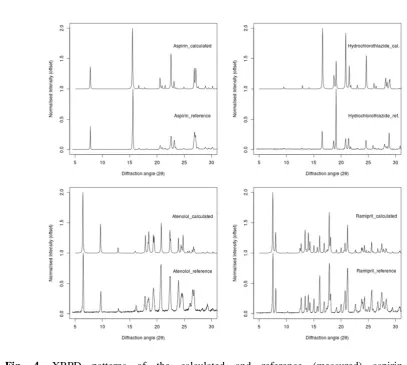
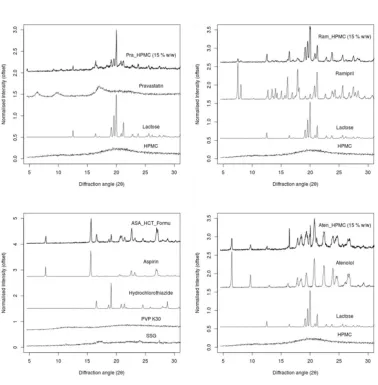
order to investigate any changes in physical form on printing (Figs. 4 and 5). All as-received materials 234
exhibit multiple sharp Bragg peaks in their XRPD patterns related to their crystalline nature, except 235
pravastatin which exhibits no sharp Bragg peaks indicating that it is exist in an amorphous state. The 236
patterns for the crystalline materials match those reported in the Cambridge Structural Database (Fig. 237
4) [36-39]. After formulation and printing, the Bragg peaks for ramipril, aspirin, hydrochlorothiazide, 238
and atenolol are still present, with peaks also observed as expected from the excipients. For example, 239
the appearance of a sharp peaks due to lactose are clearly visible at 20, 19, and 18 degrees 2-theta for 240
the pravastatin, ramipril, and atenolol formulations, and the broad feature due to HPMC is visible at 241
around 20 degrees 2-theta for the atenolol formulation. There is therefore no evidence of a change in 242
physical form for the drugs in these three formulations. The situation is comparable for pravastatin, 243
for which no obvious Bragg peaks from pravastatin are visible in both as-received and in the final 244
12 246
Fig. 4. XRPD patterns of the calculated and reference (measured) aspirin (top-left), 247
[image:12.595.67.475.71.436.2]13 249
Fig. 5. XRPD patterns of Pra-HPMC (15 % w/w), pure pravastatin, lactose, and HPMC (top-left), 250
Ram-HPMC (15 % w/w), pure ramipril, lactose, and HPMC (top-right), ASA-HCT-Formu, pure 251
aspirin, pure hydrochlorothiazide, (polyvinylpyrrolidine) PVP k30, and sodium starch glycolate 252
(bottom-left), and Aten-HPMC (15 % w/w), pure atenolol, lactose, and HPMC (bottom-right). 253
3.2.2. ATR-FTIR 254
The major diagnostic infrared peaks of the actives did not change within the formulations as 255
compared to control spectra of the drugs alone, indicating that there were no detectable interactions 256
[image:13.595.104.483.71.457.2]14 258
Fig. 6. FTIR spectra of pure actives; aspirin and hydrochlorothiazide (top left), pravastatin (top right), 259
atenolol (bottom left), and ramirpil (bottom right) and their formulations. 260
It should be noted that all the polypills were printed to the expected size, mechanically stable, and can 261
be handled readily without any loss of structural integrity. 262
A relationship has been shown between heart disease and renal failure and various modifiable risk 263
factors, such as hypertension, dyslipidaemia, and platelet capacity [40-43]. Therefore, patients over 55 264
years old with one or more risk factors, including hypertension, obesity, and diabetes can benefit from 265
a combined medications such as that demonstrated here that includes an antiplatelet, cholesterol and 266
blood pressure lowering agents [44-46]. To use a combined medication approach successfully a 267
number of challenges need to be considered, including; making the novel dosage form acceptable to 268
health professionals and patients; formulation issues; additional cost; achieving regulatory approval; 269
ensuring this becomes a first-line therapy (should be more effective and have no more side effects 270
than drugs taken individually) [3]. The polypill demonstrated here addresses some of these issues, it is 271
15
since only one tablet needs to be taken [4], and also should reduce risk of mistakes by patients who 273
forget to take a certain medicine within a combination of different tablets [3]. Issues such as cost and 274
regulatory approval are beyond the scope of the current work. 275
Furthermore, application of 3D printing in pharmaceutics could offer a flexible tool to tailor the 276
combined drug doses according to the patient’s needs. For example, control of tablet size and shape 277
for children and elderly patient with difficulty handling tablets or swallowing, and printing ‘specials’ 278
for tablets with allergies to certain excipients. We have demonstrated in this paper that a simple 279
visual/tactile identifier can readily be added to 3D printed tablets to aid sight-compromised patient as 280
well. 281
4. Conclusions
282We have successfully demonstrated 3D extrusion printing of a novel complex geometry five-in-one 283
polypill. We have also proved that the polypill is able to deliver five actives via two different and well 284
defined release mechanisms: immediate and sustained release. The drugs were physically separated in 285
the polypill to avoid incompatibility issues and allow maximum flexibility in manipulating the 286
environment of each drug. XRPD and FTIR data were used to show that there was no detectable 287
interaction between the drugs and the chosen excipients, and that our method of 3D printing did not 288
lead to a detectable change in the physical form of the drugs (e.g. polymorphism, hydration etc). Such 289
a combination of actives as used here has been shown to be important in prevention and treatment of 290
cardiovascular diseases. The drugs combined as a polypill provide the prospect of improved 291
adherence to such combination therapies due to the convenience of a single tablet and the potential to 292
optimise and personalise dosages and release for each drug independently in such multi-drug dosage 293
forms. 294
Acknowledgments
295We gratefully acknowledge Libyan government for the project grant to support a PhD studentship for 296
16
Cooling, Colin Wills and Michael Wallis for technical assistance. Maureen Alexander is thanked for 298
inspiring the interest of MRA in the application of 3D printing in polypharmacy. 299
17
References
301
[1] J. Gao, C. Chen, J.-X. Chen, L.-M. Wen, G.-L. Yang, F.-P. Duan, Z.-Y. Huang, D.-F. Li, D.-R. 302
Yu, H.-J. Yang, S.-J. Li, Synergism and Rules of the new Combination drug Yiqijiedu Formulae 303
(YQJD) on Ischemic Stroke based on amino acids (AAs) metabolism, Sci. Rep., 4 (2014) 1-11. 304
[2] S. Bangalore, A. Shahane, S. Parkar, F.H. Messerli, Compliance and fixed-dose combination 305
therapy, Curr. Hypertens. Rep., 9 (2007) 184-189. 306
[3] P. Sleight, H. Pouleur, F. Zannad, Benefits, challenges, and registerability of the polypill, Eur. 307
Heart J., 27 (2006) 1651-1656. 308
[4] S.A. Khaled, J.C. Burley, M.R. Alexander, C.J. Roberts, Desktop 3D printing of controlled release 309
pharmaceutical bilayer tablets, Int. J. Pharm., 461 (2014) 105-111. 310
[5] M. Lafeber, D.E. Grobbee, M.L. Bots, S. Thom, R. Webster, A. Rodgers, F.L. Visseren, W. 311
Spiering, The Evening versus Morning Polypill Utilization Study: the TEMPUS rationale and design, 312
Eur. J. Prev. Cardiol., 4 (2013) 425-433. 313
[6] J.D. Spence, Polypill: for Pollyanna*, Int. J. Stroke, 3 (2008) 92-97. 314
[7] K.M. Carey, M.R. Comee, J.L. Donovan, A.O. Kanaan, A polypill for all? Critical review of the 315
polypill literature for primary prevention of cardiovascular disease and stroke, Ann. Pharmacother., 316
46 (2012) 688-695. 317
[8] S. Yusuf, P. Pais, R. Afzal, D. Xavier, K. Teo, J. Eikelboom, A. Sigamani, V. Mohan, R. Gupta, 318
N. Thomas, Effects of a polypill (Polycap) on risk factors in middle-aged individuals without 319
cardiovascular disease (TIPS): a phase II, double-blind, randomised trial, Lancet, 373 (2009) 1341-320
1351. 321
[9] J. Hippisley-Cox, C. Coupland, Effect of combinations of drugs on all cause mortality in patients 322
with ischaemic heart disease: nested case-control analysis, BMJ, 330 (2005) 1059-1063. 323
[10] C.P. Limited. (2015). Polycap Retrieved 26/06/2015, from http://www.polycap.org/index.html 324
[11] D.M. Lloyd-Jones, E.P. Leip, M.G. Larson, R.B. d’Agostino, A. Beiser, P.W. Wilson, P.A. Wolf, 325
D. Levy, Prediction of lifetime risk for cardiovascular disease by risk factor burden at 50 years of age, 326
18
[12] E. Lonn, J. Bosch, K. Teo, P. Pais, D. Xavier, S. Yusuf, The polypill in the prevention of 328
cardiovascular diseases: key concepts, current status, challenges, and future directions, Circulation, 329
122 (2010) 2078-2088. 330
[13] J. Jia, C. Dong, W. Zhang, Y. Cui, J. Liu, Evaluation of pharmacokinetic and pharmacodynamic 331
relationship for oral sustained-release atenolol pellets in rats, J. Pharm. Biomed. Anal., 55 (2011) 342-332
348. 333
[14] N.A. VH, G. Niharika, P. Deepak, S. Nazan, S.A. Mohammed, Formulation design, 334
characterisation and in vitro evaluation of bilayered tablets containing telmisartan and 335
hydrochlorthizide, Int. J. Bio., 1 (2013) 1-9. 336
[15] S. Shafiq, F. Shakeel, S. Talegaonkar, F.J. Ahmad, R.K. Khar, M. Ali, Development and 337
bioavailability assessment of ramipril nanoemulsion formulation, Eur. J. Pharm. Biopharm., 66 338
(2007) 227-243. 339
[16] A.T. Cohen, S. Imfeld, J. Markham, S. Granziera, The use of aspirin for primary and secondary 340
prevention in venous thromboembolism and other cardiovascular disorders, Thromb. Res. , 135 (2015) 341
217-225. 342
[17] S.C. Halbert, B. French, R.Y. Gordon, J.T. Farrar, K. Schmitz, P.B. Morris, P.D. Thompson, D.J. 343
Rader, D.J. Becker, Tolerability of Red Yeast Rice (2,400 mg Twice Daily) Versus Pravastatin (20 344
mg Twice Daily) in Patients With Previous Statin Intolerance, Am. J. Cardiol., 105 (2010) 198-204. 345
[18] W. Liu, Y. Li, J. Liu, X. Niu, Y. Wang, D. Li, Application and Performance of 3D Printing in 346
Nanobiomaterials, J. Nanomater., 2013 (2013) 1-7. 347
[19] J. Skowyra, K. Pietrzak, M.A. Alhnan, Fabrication of extended-release patient-tailored 348
prednisolone tablets via fused deposition modelling (FDM) 3D printing, Eur. J. Pharm. Sci. , 68 349
(2015) 11-17. 350
[20] C.L. Ventola, Medical Applications for 3D Printing: Current and Projected Uses, Pharm. Ther., 351
39 (2014) 704-711. 352
[21] N. Scoutaris, M. Snowden, D. Douroumis, Taste masked thin films printed by jet dispensing, Int. 353
19
[22] N. Scoutaris, A.L. Hook, P.R. Gellert, C.J. Roberts, M.R. Alexander, D.J. Scurr, ToF-SIMS 355
analysis of chemical heterogenities in inkjet micro-array printed drug/polymer formulations, J. Mater. 356
Sci: Mater. Med., 23 (2012) 385-391. 357
[23] N. Scoutaris, M.R. Alexander, P.R. Gellert, C.J. Roberts, Inkjet printing as a novel medicine 358
formulation technique, J. Control. Release, 156 (2011) 179-185. 359
[24] A. Goyanes, A.B.M. Buanz, G.B. Hatton, S. Gaisford, A.W. Basit, 3D printing of modified-360
release aminosalicylate (4-ASA and 5-ASA) tablets, Eur. J. Pharm. Biopharm., 89 (2015) 157-162. 361
[25] C.W. Rowe, W.E. Katstra, R.D. Palazzolo, B. Giritlioglu, P. Teung, M.J. Cima, Multimechanism 362
oral dosage forms fabricated by three dimensional printing™, J. Control.Release, 66 (2000) 11-17. 363
[26] W.E. Katstra, R.D. Palazzolo, C.W. Rowe, B. Giritlioglu, P. Teung, M.J. Cima, Oral dosage 364
forms fabricated by Three Dimensional Printing™, J. Control. Release, 66 (2000) 1-9. 365
[27] R.D. Brobyn, The human toxicology of dimethyl sulfoxide, Ann. N. Y. Acad. Sci. , 243 (1975) 366
497-506. 367
[28] S.W. Jacob, C. Jack, Dimethyl Sulfoxide (DMSO) in Trauma and Disease, CRC Press, Florida, 368
2015. 369
[29] H. Changqin, L. Ying, Quality Control in Pharmaceuticals: Residual Solvents Testing and 370
Analysis, in: I. Akyar (Eds.) Wide Spectra of Quality Control, InTech, 2013, pp. 184-210. 371
[30] L.K. Wong, E.L. Reinertson, Clinical considerations of dimethyl sulfoxide, Iowa State University 372
Veterinarian, 46 (1984) 89-95. 373
[31] International Conference on Harmonization of Technical Requirements for the Registration of 374
Pharmaceuticals for Human Use, Q3C (R4) Impurities: Guideline for Residual Solvents, 2009. 375
[32] RegenHU. (2015). 3D Discovery® instrument, 3D Bio-Printer [Photograph] Retrieved April 04
376
2015, from http://www.regenhu.com/products/3d-bio-printing.html 377
[33] P. Ige, B. Swami, T. Patil, J. Pradhan, P. Patil, P. Nerkar, S.J. Surana, Design and Development 378
of Sustained Release Swelling Matrix Tablets of Glipizide for Type II Diabetes Mellitus Farmacia, 61 379
20
[34] J.L. Ford, Design and Evaluation of Hydroxypropyl Methylcellulose Matrix Tablets for Oral 381
Controlled Release: A Historical Perspective, in: R.P. Samuel, T. Peter, D.M. Colin (Eds.) 382
Hydrophilic Matrix Tablets for Oral Controlled Release, Springer, New York, 2014, pp. 17-51. 383
[35] S.A. Khaled, J.C. Burley, M.R. Alexander, J. Yang, C.J. Roberts, 3D printing of tablets 384
containing multiple drugs with defined release profiles, Int. J. Pharm., (In Press 2015). 385
[36] C.C. Wilson, Interesting proton behaviour in molecular structures. Variable temperature neutron 386
diffraction and ab initio study of acetylsalicylic acid: characterising librational motions and 387
comparing protons in different hydrogen bonding potentials, New J. Chem., 26 (2002) 1733-1739. 388
[37] R. Esteves de Castro, J. Canotilho, R.M. Barbosa, M.R. Silva, A.M. Beja, J. Paixao, J.S. 389
Redinha, Conformational isomorphism of organic crystals: racemic and homochiral Atenolol, Cryst. 390
Growth Des., 7 (2007) 496-500. 391
[38] N. Nagel, H. Schweitzer, H. Urbach, W. Heyse, B. Müller, H. Berchtold, Ramipril, Acta Cryst. 392
Section B, 57 (2001) 463-465. 393
[39] L. Dupont, O. Dideberg, Structure cristalline de l'hydrochlorothiazide, C7H8ClN3O4S2, Acta 394
Cryst. Section B, 28 (1972) 2340-2347. 395
[40] P.S. Collaboration, Age-specific relevance of usual blood pressure to vascular mortality: a meta-396
analysis of individual data for one million adults in 61 prospective studies, Lancet, 360 (2002) 1903-397
1913. 398
[41] T. Pedersen, Randomised trial of cholesterol lowering in 4444 patients with coronary heart 399
disease: the Scandinavian Simvastatin Survival Study (4S), Atheroscler. Suppl. , 5 (2004) 81-87. 400
[42] JAMA Network Webcasts, Executive summary of the third report of the National Cholesterol 401
Education Program (NCEP) expert panel on Detection, Evaluation, and Treatment of high blood 402
cholesterol in adults (Adult Treatment Panel III), JAMA, 285 (2001) 2486-2497. 403
[43] Antithrombotic Trialists’ Collaboration, Collaborative meta-analysis of randomised trials of 404
antiplatelet therapy for prevention of death, myocardial infarction, and stroke in high risk patients, 405
21
[44] N.J. Wald, M.R. Law, A strategy to reduce cardiovascular disease by more than 80%, BMJ, 326 407
(2003) 1419. 408
[45] M. Law, N. Wald, J. Morris, R. Jordan, Value of low dose combination treatment with blood 409
pressure lowering drugs: analysis of 354 randomised trials, BMJ, 326 (2003) 1427. 410
[46] M.R. Law, N.J. Wald, A. Rudnicka, Quantifying effect of statins on low density lipoprotein 411
cholesterol, ischaemic heart disease, and stroke: systematic review and meta-analysis, BMJ, 326 412
(2003) 1423. 413
414