Effects of Soil Cover and Protective Measures on Reducing
Runoff and Soil Loss under Artificial Rainfall
Yan ZHANG
1, Mingming FENG
2, Jianying YANG
1Tingning ZHAO
1,
Hailong WU
3,
Changqing SHI
1and Yi SHEN
41College of Soil and Water Conservation, Beijing Forestry University, Beijing, P.R. China; 2Broadvision Engineering Consultants, Kunming, P.R. China; 3College of Environmental
Science and Security Engineering, Tianjin University of Technology, Tianjin, P.R. China;
4Research Institute of Highway Ministry of Transport, Beijing, P.R. China
Abstract
Zhang Y., Feng M.M., Yang J.Y., Zhao T.N., Wu H.L., Shi C.Q., Shen Y. (2015): Effects of soil cover and protective measures on reducing runoff and soil loss under artificial rainfall. Soil & Water Res., 10: 198–205.
The hazards from wind, sand, and soil erosion caused by human activities, such as residue slopes in abandoned urban mines, have resulted in a vicious circle of environmental degradation. Selecting the optimal protective en-gineering method in mountainous areas has become a major difficulty in recent years, and the primary goal of our research is to accelerate the process of ecosystem reconstruction to maintain water and soil quality. In this study, cover soil of 10, 20, and 30 cm in depth was spread on the 30° accumulation slopes composed of loose residue from the Huangyuan Quarry, Beijing, and combined with two protection measures: eco-bags and bamboo fences. Runoff and soil loss from the aboveground, soil and residue layers were measured under rainfall intensities of 30, 60 and 120 mm/h generated with a rainfall simulator. The results indicated that both eco-bags and bamboo fences decreased runoff and soil loss. Bamboo fences were better at intercepting water under low runoff, whereas soil loss was more strongly reduced by eco-bags. The analysis also demonstrated that the depth of soil cover had an effect on runoff and soil loss. These findings will enrich the understanding of the effects of human activities on surface mines and provide a scientific basis for the ecological restoration of mines using engineering methods. Keywords: bamboo fence; eco-bags; mine; protective measures; soil cover
Rainstorms can threaten the residents of rocky, mountainous areas through hazards such as debris flow and landslides. Beijing is a city with rapidly increasing human activities that have increased soil erosion and other environmental problems and at-tracted worldwide attention (Teo et al. 2006). Min-ing is a necessary activity that is accompanied by increased construction, and after years of mining, many environmental problems appear. In particular, bare slopes with damaged soil structure are subjected to serious runoff, soil loss, landslides, debris flow, and potential soil erosion disasters, which threaten
human life and social stability especially under the pressures of a large population and limited availability of land (Andrews-Speed et al. 2003; Bhebhe et al. 2013; Dai et al. 2013; Silva et al. 2013). According to the city planners of Beijing (Zhang et al. 2011, 2014), all mines have been closed since 2008, and ar-tificial restoration has been undertaken at abandoned urban mines to improve environmental governance.
The rehabilitation of abandoned mines was designed as a solution to prevent potential soil erosion and to improve the environmental conditions needed for vegetation restoration (Duque et al. 1998; Hancock
2004). Much research has been done on the use of soil cover, i.e. covering the residue layer with soil (O’kane et al. 1998; Mbonimpa et al. 2003; Swan-son et al. 2003; Song & Yanful 2010). Basically, the infiltration rate is high and horizontal movement is scarce in mine residue due to its macro-pores, so soil cover with lower permeability may hinder infiltration and thus produce more runoff (Beven & Germann 1982; Walter et al. 2000). However, soil cover provides the nutrients and water storage required for plant growth that are otherwise not available in mine residue with a high number of macro-pores. Woyshner and Yanful (1995) sug-gested that soil cover was favourable for soil water conservation at mine sites, so soil cover of a certain depth may be beneficial to the slope water balance and vegetation restoration.
Many techniques have been used during the past few years to prevent soil erosion, e.g. eco-bags, bamboo fences, flat-to-sloping roof conversion, and eco-stick slope protection technologies (Wang et al. 2011; Wang & He 2012; Zheng et al. 2012; Bauer 2013; Tong et al. 2014). Based on previous research in the Huangyuan quarry, loose mine residue deposits more easily produce runoff and soil loss than natural slopes, and different protective measures have dif-ferent protective effects.
The purpose of this paper was to examine (1) the variations in runoff and soil loss under different protective measures, (2) the effect of the depth of the covering soil on the amount of runoff and soil loss, and (3) the optimal combination of slope-protective measures and soil cover thickness. The results will
improve the process of slope stabilization in surface mines thus providing better conditions for vegeta-tion restoravegeta-tion.
MATERIAL AND METHODS
Experimental samples. Experimental soil samples were collected from the loose mine residue deposits in the Huangyuan quarry, Fangshan District, Beijing, China (115°25'–116°15'E, 39°30'–39°55'N, 70–250 m a.s.l.) (Zhang et al. 2013a). The soil properties are shown in Table 1, and the residue was composed of 11.37% soil (< 2 mm) and 88.63% gravel (> 2 mm). According to the United States Department of Ag-riculture (USDA) classification system, the residue was sandy loam, and the covering soil was clay loam. Bulk density of the soil cover was 1.12 g/cm3, and that
of the residue was 1.76 g/cm3. The total porosities
of the residue and soil cover were 35.88 and 45.15%, respectively, and the maximum water-holding ca-pacities of the residue and soil cover were 18.13 and 46.73%, respectively. The higher total porosity and maximum water-holding capacity of the soil cover mean that it contains more space to hold water and air. The initial soil moisture content ranged from 20 to 25%.
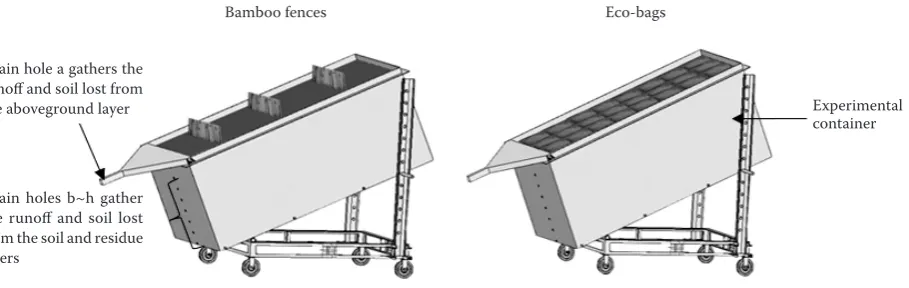
Characteristics of the experimental containers. The experimental containers were 1 m wide, 0.8 m deep, and 2 m long with the same 30° gradient (Fig-ure 1). Drain holes were set every 0.1 m at the front of the container and were used to obtain the runoff and soil erosion data for the aboveground, soil, and residue layers independently (Table 2).
Table1. Soil properties of the Huangyuan quarry
Samples
Soil particles composition (%)
pH Organic matter (g/kg)
Bulk density (g/cm3)
Total
porosity Maximum water-holding capacity Soil texture clay
< 0.002 mm
silt 0.002–0.05
mm
sand 0.05–2.0
mm (%)
Residue 12.11 31.79 56.10 8.34 4.54 1.76 35.88 18.13 sandy loam
[image:2.595.63.532.560.646.2]Soil cover 21.41 25.62 52.97 8.11 10.56 1.12 45.15 46.73 sandy clay loam
Table 2. Drain holes a~h for collecting the runoff and sediment lost from the aboveground, soil, and residue layers
Depth of soil layer Depth of residue layer Drain holes for the collection of runoff and sediment aboveground layer soil layer residue layer
10 60 a b c~h
20 50 a b, c d~h
[image:2.595.60.532.682.758.2]Rainfall simulator. Rainfall simulators have been widely used in the studies of soil erosion and have played an important role in understanding its mechanisms (Hsu et al. 2010; Luo et al. 2013). The experimental rainfall hall was situated at the Re-search Institute of Highway, Ministry of Transport, Beijing. Rainfalls were simulated with a spray rainfall system with a median drop size diameter range of 0.5–4.3 mm, and the whole process was controlled by a computer with a data recording function. The height of the rainfall was 8 m above the floor, and the simulated rainfalls were similar to natural rainfall. The intensity of the rainfall simulator ranged from 12 to 180 mm/h, and the terminal velocity ranged from 2 to 2.7 m/s. Clean water was used, and the experiment was protected from wind interference to ensure accuracy.
Slope protection measures. Eco-bags and bamboo fences were chosen for the study because of their wide application in slope protection as shown in Figure 1 (Zheng et al. 2012; Zhang et al. 2013b). Eco-bags were composed of non-woven fabric (which is mainly made of polypropylene) that conserved soil and water. They were 20 cm wide and 30 cm long, and the size of the openings was 0.18 mm. Eco-bags were spread out on the slope surface and fixed in place with steel chisels. Bamboo fences were 20 cm long and 5 cm wide with sharp cutting edges, so
they could be installed without damaging the soil structure. Three rows of bamboo fences were in-serted vertically into the soil, and one half was left above the ground.
Experimental procedure. Simulated rainfall ex-periments were performed for 3 rainfall intensities (30, 60, and 120 mm/h) (Balacco 2013), 3 models of soil-mine residue mixing (10 cm soil + 60 cm residue, 20 cm soil + 50 cm residue, and 30 cm soil + 40 cm residue), 1 slope degree (30°), and 2 protec-tive measures (eco-bags and bamboo fences) plus 1 control group. Each test had 3 replications, so there were 81 combinations in total (3 rainfall intensities × 3 models of soil-mine residue mixing × 1 slope degree × (2 protective measures groups + 1 control group) × 3 replications).
[image:3.595.74.529.97.241.2]The experimental procedures were as follows. In the area of the surface mine, protective engineering measures, i.e. eco-bags and bamboo fences, had to be taken to protect the slopes from soil erosion, and adding soil cover was an effective method for im-proving nutrient storage and water retention. Three soil cover depths were selected (Table 2, Figure 2), and models 1, 2, and 3 corresponded to 10 cm soil + 60 cm residue, 20 cm soil + 50 cm residue, and 30 cm soil + 40 cm residue, respectively. The soil and mine residue were separated by wire netting with a 5-mm mesh aperture to limit the movement of gravel and
[image:3.595.66.527.664.738.2]Figure 1. Experimental containers for the eco-bag and bamboo fence protective measures
Figure 2. Different combinations of soil depth and residue mixture
Bamboo fences Eco-bags
Drain hole a gathers the runoff and soil lost from the aboveground layer
Drain holes b~h gather the runoff and soil lost from the soil and residue layers
Experimental container
10cm soil + 60cm residue 20cm soil + 50cm residue 30cm soil + 40cm residue
Soil layer
reinforce the stability of the slopes. The prepared experimental containers were then settled for three days to approach natural conditions.
Each rainfall lasted for 60 min at a fixed rainfall intensity. Runoff and sediment samples were col-lected through drain holes a~h after 10, 20, 30, 40, 50, and 60 min. After collection, samples were left standing for 12 h, and the runoff was then separated from the sediment using a pipette while the volume of runoff was determined in a measuring cylinder. The sediment was oven-dried at 105°C for 24 h and weighed using an electronic scale.
RESULTS AND DISCUSSION
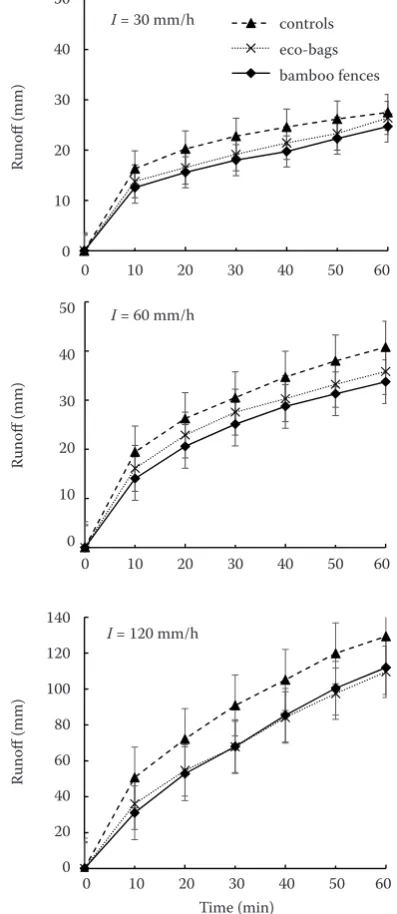
Impacts of protective measures on runoff. The mean runoff (combined values of the 3 layers) with error bars for the slopes with eco-bags, bamboo fences, and the controls are shown in Figure 3. The results showed that runoff increased under higher rainfall intensity, and this was most likely due to the balance between rainfall intensity and infiltra-tion. When the intensity was 30 mm/h, the rainfall intensity was close to the infiltration rate and thus produced less runoff. As the intensity increased, it became greater than the infiltration rate and pro-duced greater runoff.
For rainfall intensities of 30, 60, and 120 mm/h, the runoff on slopes with eco-bags and bamboo fences was generally lower than that of the controls. This indicated that these protective measures were able to enhance soil infiltration and reduce runoff, which is consistent with the results of He et al. (2010).
Under different rainfall intensities, the experimental results were influenced by how the water was parti-tioned (Hawke et al. 2006; Liu et al. 2014). Bamboo fences had a better protective effect under rainfall of 30 mm/hand 60 mm/h compared with the eco-bags, whose surfaces were composed of non-woven fabric that had relatively small infiltration rates. In spite of this slow infiltration, eco-bags showed heightened runoff outflow prevention while bamboo fences better intercepted runoff by changing the water movement process and increasing the duration of the runoff on the slope.
However, when the rainfall intensity reached 120 mm/h, the average runoff amounts with eco-bags and bamboo fences were 74.95 and 74.94 mm/h, respectively. This suggests that the effects of the two protective measures did not differ under such high rainfall intensity.
[image:4.595.312.511.264.722.2]Effects of varying the depth of soil cover on runoff. To investigate the effectiveness of soil cover in protection from soil erosion, the runoff from the aboveground, soil, and residue layers was collected. As shown in Figure 4, the volume of the aboveground runoff was greater than that of the soil and residue layers in the slopes with eco-bags and the controls. The aboveground runoff from model 3 with bam-boo fences and controls was higher than for models 1 and 2 because less water infiltration likely occurred, and more runoff accumulated. With eco-bags, the
Figure 3. Effect of rainfall intensity on runoff under different protective measures
0 10 20 30 40 50
0 1 0 2 0 3 0 4 0 5 0 60
R
unof
f (
m
m
/h
)
Time /min
I= 30 mm/h controls eco-bags bamboo fences
0 10 20 30 40 50
0 1 0 2 0 3 0 4 0 5 0 6 0
Runo
ff (m
m
/h
)
Time /min
I=60 mm/h
controls
eco-bags
bamboo fences
0 20 40 60 80 100 120 140
0 1 0 2 0 3 0 4 0 5 0 6 0
R
un
of
f (
m
m
/h
)
Time /min I=120 mm/h
controls
eco-bags
bamboo fences
Runoff (mm)
Time (min)
I = 30 mm/h controls
eco-bags bamboo fences
I = 60 mm/h
I = 120 mm/h
Runoff (mm)
Runoff (mm)
0 10 20 30 40 50 60 0 10 20 30 40 50 60 0 10 20 30 40 50 60 50
40
30
20
10
0
140
120
100
80
60 40
20
0 50
40
30
20
10
aboveground runoff showed little difference between the slopes with different thicknesses of soil cover.
The results also indicated that the runoff from the soil layer with or without protective measures was much less than that of the aboveground and residue layers, which implies that the depth of the soil cover does not significantly affect the runoff.
In particular, the runoff of model 3 was lower than that of models 1 and 2 in the residue layer. Because the water-holding capacity of the residue was poor, the thicker the residue, the higher the runoff.
In mountainous regions, runoff volume is one of the main factors affecting soil erosion (Bradford et al. 1987; Balacco 2013), and spreading different depths of soil on the surface of mine residues is an effective method to reduce runoff.
Impacts of protective measures on soil loss.
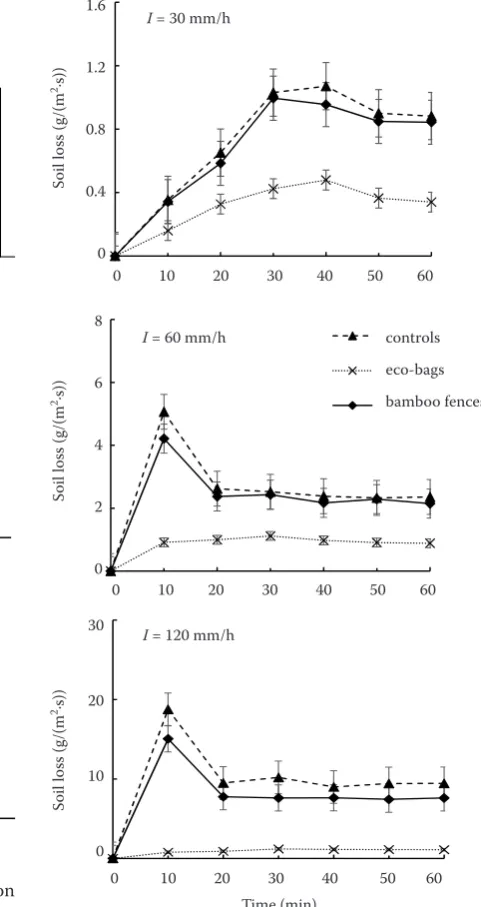
Fig-ure 5 shows the dynamic change in soil loss (mean
values of the 3 layers combined) of eco-bags, bamboo fences, and controls during one hour of artificial rainfall. In general, the process of soil loss followed two patterns, with or without a peak. Soil losses 0 10 20 30 40 50
Eco-bags Bamboo fences Controls
Ru nof f ( mm) Aboveground layer model 1 model 2 model 3
a a ab
b b b
a a a
0 1 2 3 4 5
Eco-bags Bamboo fences Controls
Runoff (mm ) Soil layer model 1 model 2 model 3
a a a a
b ab b a b
0 10 20 30 40 50
Eco-bags Bamboo fences Controls
Ru no ff (m m) Residue layer model 1 model 2 model 3 a a a b b
b b a b
0 10 20 30 40 50
Eco-bags Bamboo fences Controls
Ru nof f ( mm) Aboveground layer model 1 model 2 model 3
a a ab
b b b
[image:5.595.64.522.88.540.2]a a a
Figure 4. Effects of the 3 depths of engineered soil cover on runoff under different protective measures
Error bars indicate standard deviations; bars with different letters indicate significant differences at P = 0.05.
Figure 5. Effects of rainfall intensity on soil loss under different protective measures
0 0.4 0.8 1.2 1.6
0 1 0 2 0 3 0 4 0 5 0 6 0
So il lo ss ( g/( m 2·s) ) Time (min)
I = 3 0 mm/h
controls eco-bags bamboo fences 0 2 4 6 8
0 1 0 2 0 3 0 40 50 6 0
So
il
lo
ss (
g/(m
2·s))
Time (min)
I = 60 mm/ h
controls eco-bags bamboo fences 0 10 20 30
0 1 0 2 0 3 0 4 0 5 0 6 0
So il lo ss ( g/( m 2·s)) Time (min)
I= 1 2 0 mm/h
controls eco-bags bamboo fences 0 0.4 0.8 1.2 1.6
0 1 0 2 0 3 0 4 0 5 0 6 0
So il lo ss ( g/( m 2·s) ) Time (min)
I = 3 0 mm/h
controls eco-bags bamboo fences Soil lo ss ( g/(m 2∙s)) Time (min)
I = 30 mm/h
controls eco-bags bamboo fences
I = 60 mm/h
I = 120 mm/h
[image:5.595.283.524.100.554.2]with bamboo fences and controls were enhanced by higher rainfall intensities in the early stage of the rainfall and then declined to a constant value after reaching the peak, which can be explained as follows. During the period of rising soil loss, soil erosion was caused by the splash of the raindrops on the superficial soil structure, which caused large amounts of soil loss. With the gradual stabilization of the soil structure, soil loss was reduced until it reached a constant value. The soil loss dynamics of the slopes with eco-bags did not have a peak, sug-gesting that soil loss on these slopes increased slowly due to the barrier function of the eco-bags. When the soil reached full saturation, the amount of soil loss per unit time tended to stabilize.
For slopes with eco-bags, the average values of soil loss at rainfall intensities of 30, 60, and 120 mm/h were 0.35, 0.97, and 1.03 g/(m2·s), respectively. The
small amount of soil loss due to eco-bags indicates their outstanding soil conservation and soil structure protection properties.
The soil loss on the slopes with bamboo fences was less than that of the controls under different rainfall intensities, which was most likely due to sediment interception. According to the results, the slopes with bamboo fences produced less runoff than the controls, which may have resulted in less soil loss. Additionally, the time at which the amount of soil loss reached its peak, occurred much later under the rainfall intensity of 30 mm/h compared with that under 60 and 120 mm/h. When the rainfall intensity increased, soil saturated faster, and peak soil loss happened earlier.
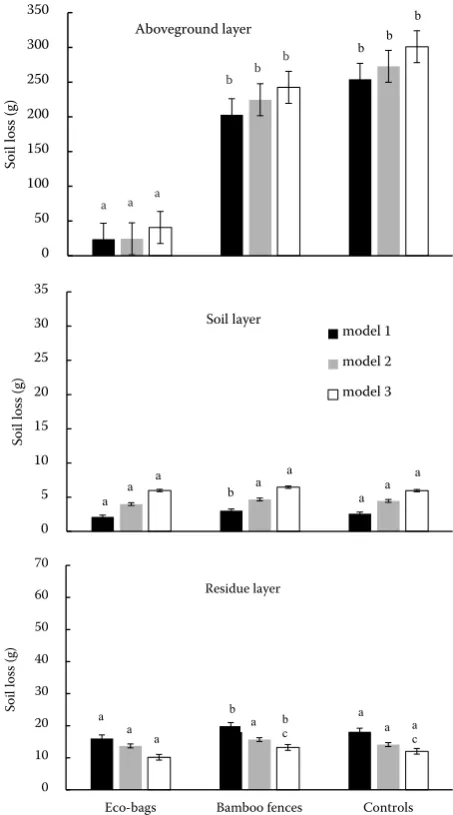
Effects of varying the depth of engineered soil cover on soil loss. In order to analyze the effects of the 3 soil cover thicknesses, the soil loss from the aboveground, soil, and residue layers was plotted as shown in Figure 6. The graph indicates that the thickness of soil cover strongly affects the amount of soil loss from the aboveground layer. The soil loss from the aboveground layer of model 3 was larger than that of models 1 and 2. The main reason could be that a thicker soil cover contains larger quantities of topsoil, or the higher aboveground runoff carries the aboveground soils away.
However, in the soil and residue layers, soil loss was less affected by the thickness of the soil cover or the protective measures. In part, this was because runoff was the major cause of soil loss; when the runoff was low, less sediment was carried away. However, the residue layer also contained large pores, through
which more water moved vertically by gravity, lead-ing to the low degree of soil loss.
Comprehensive prevention-control effects of protective measures. The purpose of this study was to find ways to dissipate raindrop energy and lower runoff and soil loss, namely, to provide a compre-hensive prevention-control system. Slope protec-tive measures can be divided into two types: runoff interception and soil loss prevention.
The reductions in runoff and soil loss are shown
in Table 3. Runoff (or soil loss) reduction was
[image:6.595.306.533.278.686.2]de-fined as the amount of runoff (or soil loss) in the controls minus the amount of runoff (or soil loss)
Figure 6. Effects of 3 depths of soil cover on soil loss under different protective measures
Error bars indicate standard deviations; bars with different letters indicate significant differences at P = 0.05
0 50 100 150 200 250 300 350
Eco-bags Bamboo fences Controls
Soi
l l
oss
(g
)
Aboveground layer
model 1 model 2 model 3
b b
b
0 5 10 15 20 25 30 35
Eco-bags Bamboo fences Controls
So
il
lo
ss (g
)
Soil layer
model 1 model 2 model 3
a a
a
b a
a
a a
a
0 10 20 30 40 50 60 70
Eco-bags Bamboo fences Controls
Soi
l l
os
s (g)
Residue layer
model 1 model 2 model 3
a a
a
b
a b
c
a
a a
c
0 50 100 150 200 250 300 350
Eco-bags Bamboo fences Controls
Soi
l l
oss
(g
)
Aboveground layer
model 1 model 2 model 3
b b
b
b b
b
in the slopes with protective measures divided by the amount of runoff (or soil loss) in the controls under the same rain intensity. The table indicates that when the rain intensities were 30, 60, and 120 mm/h, the soil loss values of the slopes with eco-bags were reduced by 57.14, 66.48, and 90.68%, respectively. The soil loss reductions provided by eco-bags were over four times those provided by bamboo fences. Conversely, bamboo fences had a greater effect on runoff reduction than eco-bags, reducing runoff by 17.98, 19.06, and 20.85% under the three different rainfall intensities. Therefore, the results suggest that eco-bags are better at reducing soil loss, but bamboo fences are better at reducing runoff.
CONCLUSION
The effects of 3 soil cover depths and 2 protective measures on soil and water conservation were stud-ied using experimental containers of 30° slope under three rainfall intensities. In general, both eco-bags and bamboo fences had the capacity to reduce runoff and soil loss even though their mechanisms differed. Bamboo fences were able to intercept water, and their conservation effect was more obvious than that of the eco-bags. However, eco-bags performed well in protecting soil structure and reducing soil loss. The results also illustrated that soil cover thickness had an effect on runoff and soil loss. With bamboo fences, aboveground runoff and soil loss values in model 3 were higher than those of models 1 and 2, but the runoff values of the aboveground layer differed little among the 3 soil cover depths in slopes with eco-bags. The runoff and soil loss values were higher in the residue layer compared to the soil layer but lower compared to the aboveground layer with either eco-bags or bamboo fences. In the residue layer of both protected slopes, the runoff and soil loss values under model 3 were lower than those of models 1 and 2.
Acknowledgements. The research was supported by the R&D Special Fund for Forestry Public Welfare Industry
(Program 201104109) and funded by CRSRI Open Research Program (Program CKWV2013203/KY).
References
Andrews-Speed P., Yang M.Y., Shen L., Cao S. (2003): The regulation of China’s township and village coal mines: a study of complexity and ineffectiveness. Journal of Cleaner Production, 11: 185–196.
Balacco G. (2013): The interrill erosion for a sandy loam soil. International Journal of Sediment Research, 28: 329–337. Bauer K. (2013): Are preventive and coping measures enough to avoid loss and damage from flooding in Udayapur Dis-trict, Nepal? International Journal of Global Warming, 5: 433–451.
Beven K., Germann P. (1982): Macropores and water flow in soils. Water Resources Research, 18: 1311–1325. Bhebhe D., Kunguma O., Jordaan A., Majonga H. (2013): A
case study of the perceived socio-environmental problems caused by illegal gold mining in Gwanda district, Zimba-bwe. Disaster Advances, 6: 70–76.
Bradford J.M., Ferris J.E., Remley P.A. (1987): Interrill soil erosion processes: I. Effect of surface sealing on infiltra-tion, runoff, and soil splash detachment. Soil Science Society of America Journal, 51: 1566–1571.
Dai Z.H., Feng X.B., Zhang C., Shang L.H., Qiu G.L. (2013): Assessment of mercury erosion by surface water in Wan-shan mercury mining area. Environmental Research, 125: 2–11.
Duque J.F., Pedraza J., Dıez A., Sanz M.A., Carrasco R.M. (1998): A geomorphological design for the rehabilitation of an abandoned sand quarry in central Spain. Landscape and Urban Planning, 42: 1–14.
Hancock G.R. (2004): The use of landscape evolution mod-els in mining rehabilitation design. Environmental Geol-ogy, 46: 561–573.
Hawke R.M., Price A.G., Bryan R.B. (2006): The effect of initial soil water content and rainfall intensity on near-surface soil hydrologic conductivity: a laboratory inves-tigation. Catena, 65: 237–246.
[image:7.595.64.533.113.193.2]He J.J, Cai Q.G., Li G.Q., Wang Z.K. (2010): Integrated ero-sion control measures and environmental effects in rocky Table 3. Influence of prevention-control effects under eco-bags and bamboo fences (in %)
Rainfall intensity (mm/h)
Eco-bags Bamboo fences
runoff reduction soil loss reduction runoff reduction soil loss reduction
30 12.36 57.14 17.98 6.54
60 12.53 66.48 19.06 9.59
mountainous areas in northern China. International Journal of Sediment Research, 25: 294–303.
Hsu C.L., Dai S.Y., Chiang S.W., Chan C.Y. (2010): Erosion control for mudstone soil with ventilation and watertight resin. International Journal of Sediment Research, 25: 194–201.
Liu Q.J., Shi Z.H., Yu X.X., Zhang H.Y. (2014): Influence of microtopography, ridge geometry and rainfall intensity on soil erosion induced by contouring failure. Soil and Tillage Research, 136: 1–8.
Luo H., Zhao T.N., Dong M., Gao J., Peng X.F., Guo Y., Wang Z.M., Liang C. (2013): Field studies on the effects of three geotextiles on runoff and erosion of road slope in Beijing, China. Catena, 109: 150–156.
Mbonimpa M., Aubertin M., Aachib M., Bussière B. (2003): Diffusion and consumption of oxygen in unsaturated cover materials. Canadian Geotechnical Journal, 40: 916–932.
O’Kane M., Wilson G.W., Barbour S.L. (1998): Instrumenta-tion and monitoring of an engineered soil cover system for mine waste rock. Canadian Geotechnical Journal, 35: 828–846.
Silva E.F., Avila P.F., Salgueiro A.R., Candeias C., Pereira H.G. (2013): Quantitative-spatial assessment of soil con-tamination in S. Francisco de Assis due to mining activity of the Panasqueira mine (Portugal). Environmental Sci-ence and Pollution Research, 20: 7534–7549.
Song Q., Yanful E.K. (2010): Effect of channelling on water balance, oxygen diffusion and oxidation rate in mine waste rock with an inclined multilayer soil cover. Journal of Contaminant Hydrology, 114: 43–63.
Swanson D.A., Barbour S.L., Wilson, G.W., O’Kane M. (2003): Soil atmosphere modelling of an engineered soil cover for acid generating mine waste in a humid, alpine climate. Canadian Geotechnical Journal, 40: 276–292. Teo J.A., Ray C., El-Swaify S.A. (2006): Screening of
poly-mers on selected Hawaii soils for erosion reduction and particle settling. Hydrological Processes, 20: 109–125. Tong L.Y., Liu L., Yu Q. (2014): Highway construction across
heavily mined ground and steep topography in southern China. Bulletin of Engineering Geology and the Environ-ment, 73: 43–60.
Walter M.T., Kim J.S., Steenhuis T.S., Parlange J.Y., Heilig A., Braddock R.D., Selker J.S., Boll J. (2000): Funneled flow mechanisms in a sloping layered soil: laboratory investiga-tion. Water Resources Research, 36: 841–849.
Wang A.H., He H.S. (2012): The application of three di-mensional drainage flexible and ecological reinforced construction in high-speed railway station roadbed. Ad-vanced Materials Research, 594–597: 2025–2029. Wang Q., Gu Z.Y., Zhou L.B. (2011): Discussing on the
projection of ecological restoration of acid mine waste rock of Shuilong mountain Dexing copper mine. China Mining Magazine, 20: 64–66. (in Chinese)
Woyshner M.R., Yanful E.K. (1995): Modelling and field measurements of water percolation through an experi-mental soil cover on mine tailings. Canadian Geotechni-cal Journal, 32: 601–609.
Zhang Y., Zhao T.N., Shi C.Q., Wu H.L., Li D.X. (2013a): Dynamic research on vegetation recovering in abandoned mine slopes in Beijing mountainous areas. Journal of Arid Land Resources and Environment, 27: 61−66. (in Chinese) Zhang Y., Zhao T.N., Shi C.Q., Wu H.L., Li D.X., Sun Y.K.
(2013b): Evaluation of vegetation and soil characteristics during slope vegetation recovery procedure. Transactions of the Chinese Society of Agricultural Engineering, 29: 124–131. (in Chinese)
Zhang Y., Yang J.Y., Wu H.L., Shi C.Q., Zhang C.L., Li D.X., Feng M.M. (2014): Dynamic changes in soil and vegeta-tion during varying ecological-recovery condivegeta-tions of abandoned mines in Beijing. Ecological Engineering, 73: 676–683.
Zhang Z.G., Shen N.Q., Wang Y.S., Li Y.C., Song Y.Y., He T. (2011): Geological environment problems and counter-measures of Shijiaying mine in Western Beijing. Procedia Environmental Sciences, 11: 1245–1252.
Zheng D., Zhou J.Y., Yang J.L., Zhu Z.X. (2012): Applied re-search on the eco-bags structure for the Riverside collapse slope in seasonal frozen soil zone. Procedia Engineering, 28: 855–859.
Received for publication June 12, 2014 Accepted after corrections December 18, 2014
Corresponding author: