Farmer - A Smart Agrarian Device
Abhishek Anand1, Alok Anand21, 2
Robert Bosch Engineering and Business Solution Private Limited, Bengaluru, India
Abstract: Farmer - A Smart Agrarian Device provides a smart and autonomous way for crop cultivation. Crop cultivation at small or large scale involves an intense process which has to be taken with care and requires great human resources in terms of efforts, which consists of repetitive and standardized tasks with daily monitoring making the whole process labor-intensive. Our smart agrarian device provides a unique solution to the problem by providing automation at every step of cultivation right from a beginning process starting from land preparation through ploughing, seed sowing, irrigation, health monitoring, and harvesting. Smart farmer device incorporates a different control unit at each stage with sensors embedded, which receives control signals from the control unit and from user to provide smart control of the cultivation process. Sensors and control unit collects the data from various sources and intimate back to the user, main control unit and cloud data services for analyzing data for future needs. Data obtained from embedded sensors and control unit are stored at cloud services and available to users and are utilized in machine learning algorithm and internet of things, IOT to control planning in advance to the farming’s next steps. This device also helps in minimizing the crop failures results from various reasons as the device learns and improves each step of farming by using previous data and parameters. The main control unit, field control unit and units installed at different stages of farming works collectively and helps to respond effectively to needs of the crop with minimal human resource involvement which help in higher crop yield, and quality of the crop. The smart agrarian device once installed and learned with data, helps to provide self-sustaining and fully controlled techniques at each farming stage, which makes it suitable for extra-terrestrial farming possible on another planet like Mars.
Keywords: IOT, Internet of Things, Farmer, Smart Agrarian Device, Main Control Unit, Field Control Unit, Machine Learning Algorithm, Sensor, Extra-Terrestrial
I. INTRODUCTION
Ever since the dawn of civilization, mankind has spent a lot of energy and resource for satisfying one of its basic need that is food. For growing crops, humans look for the land which is suitable for cultivation. After getting the proper land, it needs to be made suitable for growing crops by performing various processes for land preparation like ploughing, leveling, manuring. The crop is selected. The healthy seed of the crop is selected. After the land preparation is completed, the seeds are sown. After sowing, the next main process is irrigation. It is the processes which utilizes one of the most valuable resources – water. Then the farmers have to wait and take care of the crop to grow with the simultaneous process of fertilizing. After crop grows completely, the crop is harvested and this ends the cycle of cultivation. After cultivation crops are taken care until it is used for consumption. Form the beginning, till now, cultivation involves great human effort, a large amount of natural resource. The mismanaged use of resources like human, natural resources, chemical-like fertilizers, dependence on environmental factors like rain, along with uncertainties in the output makes complete process complex. Mankind did a lot of growth in technology to make lives easier. Even though technologies are intermingled with our day to day activities. Still, there is very less involvement of technology in agriculture process. The technologies present for crop cultivation are large machines that assist in the various cultivation processes but still, it involves great human effort and dependencies on environmental factors. Technologies must be developed so to make cultivation process autonomous and independent of environmental factors. Since mankind is looking for new habitat in the form of a new plant, automated cultivation satisfies the need of food on those planets and capable of producing food even before human reach at their new home an all these without involving any human effort in the cultivation process and assist in making human civilization multi-planetary.
II. RELATEDWORKS
With the advent of new advanced technologies into existing farming techniques has led to a fundamental shift in increasing food production. Various stages involved in farming is made automated using sensor embedded systems in a quite scattered way. It has helped to ramp up the production yield but it doesn’t include a connected feedback mechanism to improve different steps. The existing system doesn’t have different stages connected together which lacks exchange of data to analyze making the whole farming process ineffective and unreliable to control.
In automated tractors which helps in preparation of land without human involvement, works without data from the previous plantation and upcoming plantation. Lacking in an interconnected network of the system provides improper or no data like about depth of ploughing for a particular type of crop yield. This leads to affecting the crop yield and productivity and in-turn makes the automated ploughing process cost and yield ineffective in return of investment.
Human is planning to reach others and extend its civilization to other planets but still, there are big questions that need an answer like, What about the food and How we are going to satisfy our need for food on that planet? There is very less development done to answer the previous two question. The only solution we are looking for the two questions are, we will send the food supply from earth to the planet.
III. SYSTEMDESIGN
The proposed system is the integrated structure involves various devices, equipment, and machinery which perform all the processes of cultivation processes from land preparation to harvesting, with minimum or no involvement of humans.
The system consists of ten separate autonomously working unit that interacting with each other in real-time to perform the cultivation process.
A. Ploughing Unit
B. Irrigation and Manure, Fertilizer Unit
C. Soil Monitoring Unit
D. Sowing unit
E. Crop Health monitoring Unit
F. Harvesting unit
G. Climate control Unit
H. Communication unit
I. Field Control Unit
J. Main control unit
IV. PROTOTYPE DESIGN
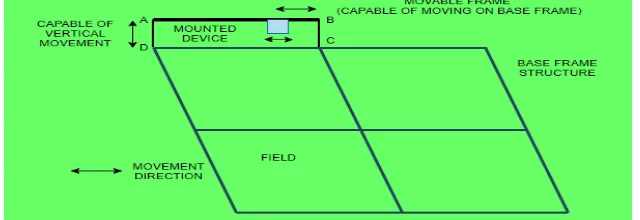
[image:2.612.147.467.613.723.2]The prototype consists of a base frame structure which is firmly laid in the field. Another frame structure as shown in fig, capable of moving on the base frame. The movable frame has the capability to move vertically and on the frame, to access the full field area. Different devices are mounted on the movable frame depend on its uses. Each unit of the system is developed on the embedded technologies involving different sensors according to the jobs performed by them. The system uses cloud storage for storing data and instruction. Communication unit capable of two way communication helps to connected the hardware with cloud storage. The heart of the system which is main control unit located far from the field consists of a machine learning algorithm capable of learning from its task and with the help of IOT, direct various devices, and equipment to perform the assigned task. The main control unit is located far from the field. It communicates with cloud storage using the main communication unit. The field control unit is installed on the land with all the other units like Ploughing Unit, Irrigation and manure, fertilizer unit, soil monitoring unit, seed sowing unit, crop health monitoring unit, crop harvesting unit, climate control unit, communication unit. It communicates with cloud storage using field communication unit.
V. BLOCKDIAGRAM
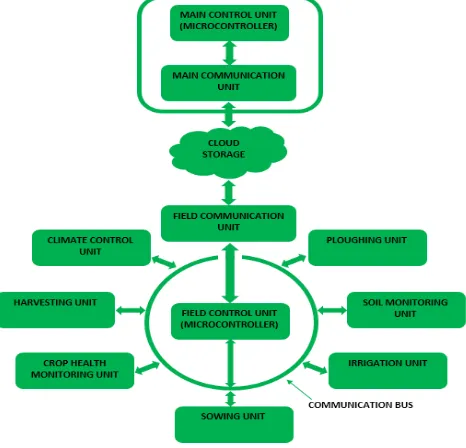
[image:3.612.191.424.175.399.2]It shows the different units are connected to each other and data is exchanged between units. The main control unit and field control unit communicate with each other through cloud storage. Field control communicates with all the devices using a bus communication system. The field control unit puts the data and instruction on the bus, and the devices automatically pick it from the bus which is relevant to them. Units like ploughing unit, irrigation and manure, fertilizer unit, soil monitoring unit, seed sowing unit, crop health monitoring unit, crop harvesting unit, climate control unit also put their field data on the bus and field control unit picks all the data and send it to cloud for storage.
Fig. 2.Block diagram
A. Ploughing Unit
Ploughing unit is consists of a microcontroller which receives a signal from the field control unit to perform ploughing and parameter related to the direction and depth of ploughing. Effective ploughing is achieved using coordinate data send by the field control unit. It checks and maintains the depth and quality of ploughing as according to required and as per instruction received. Ploughing unit sends field data related to the quality of ploughing to field control unit which saves the data in the cloud storage, which is used by the main control unit machine algorithm for analysis.
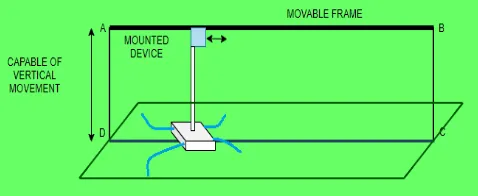
Ploughing unit consists of the main plough mainly moldboard plough mounted on a frame structure as shown in fig. 3 provides the ability to plough to move in the field. Since mounted on the frame, Plough has the ability to move from point A to point B along with frame has the capability to move from point B to point C as shown in fig. 3.
The frame structure is a linear motor or a screw mechanism which help in the movement of plough mounted on it. Plough uses hydraulic mechanism, can apply enough force on the land for proper ploughing of the field.
Since this unit has been mounted on the frame structure, it provides autonomous operation with the control signals. It provides the user the desired control over the number of cycles, direction, time and depth of ploughing.
[image:3.612.160.453.593.716.2]B. Soil Monitoring Unit
Soil monitoring unit consists of a microcontroller to control the working of all the devices it has and also communicates with the field control unit. The data from all the devices present in this unit are collected and assayed. This unit takes the data from multiple locations in the field and sends to the cloud storage for analyzing. It consists of three devices.
1) Mineral And Nutrients Measuring Device: This device measures the presence of essential minerals and nutrients like nitrogen, phosphorus, and potassium as these are the main components of soil throughout the life cycle of the crop starting after ploughing.
2) pH Measuring Device: A pH meter measures the pH level of soil determine its acidic and alkaline nature as it is a key factor of crop health. pH affects the soil chemically as it affects nutrient availability and uptake of soil and biologically, enzyme content and bacterial content of the soil.
3) Moisture Level Sensor: Moisture level sensor measures the volume of water content in the soil. Determining the soil moisture level helps to Control the quantity and time of irrigation required and effective utilization of valuable resource - water.
This unit starts monitoring the soil when the ploughing process has started and repeat the process at a regular interval until the harvesting process started. The field soil data related to its mineral, nutrient, pH, and moisture taken by soil monitoring unit and stored in cloud storage is compared by the main control unit using machine learning algorithm with the reference soil data. Based on the comparison data, the next action is decided.
C. Irrigation and Manure, Fertilizer Unit
Irrigation and manure fertilizer unit has microcontroller which receives instruction related to irrigation, and fertilizer, and manuring based on the analysis done by the main control unit on the soil quality data send by a soil monitoring unit.
It uses the methods of drip irrigation with little additive, for the proper, effective and efficient and less use of water and fertilizer. The device consists of a pipe structure whose one end is connected to the water supply while other to the device with four nozzles as shown in the fig. 4.
The complete unit is mounted in frame structure which is capable to move vertically as well as horizontally. The frame can move easily from the height of the crop to the soil level. Since the crop is sown properly and systematically and using crop sowing data, frame properly move from the crop height level to soil level between the rows of crop. The output is fitted with the device which provides proper access to the root of the crops using sowing location data and irrigates four plants at a time.
[image:4.612.188.427.493.591.2]The system uses data from the wireless sensor placed on trees and soil to determine the need for the water. The data obtained in the real-time send for processing. It provides an optimal irrigation plan which farmers can monitor and stored in the cloud storage for future reference. The goal of the system is to reduce the water consumption and irrigate precisely in accordance with the weather condition and actual need which increases yields at the plantation. The data stored at cloud helps the user, in the beginning, to decide which crop to cultivate based on soil present chemistry and how it can be improved to well suit the desired nutritional value required for the crop by adding a minimum and proper nutrients. Based on the soil data analysis, and the crop needs to grow, the proper action is taken for controlling mineral, nutrients, pH level and moisture content of the soil.
Fig. 4.Irrigation and manure, fertilizer model
D. Sowing unit
Sowing unit is consists of a microcontroller unit which receives a signal from the field control unit to perform sowing processes as per instruction received.
Sowing unit has a digging device which digs for seed and small plant, a leveler and a water sprinkler as a single unit and this unit is mounted on a frame structure which helps in sowing and gets the location of seed and plant placed using a reference point and store it for future uses.
User has desired control on the number of seeds over the field area. Further, it also helps to autonomously control the depth of seed sowing and distance to be maintained between individual seed sowing. The data provided by the unit help the user to get the exact number of seed or plant required to be loaded to the unit.
E. Crop Health Monitoring Unit
Crop health monitoring unit starts monitoring once its microcontroller receives a monitoring signal from the field control unit usually when the sowing process ends. It monitors the growth of the seed, the health of plants, growth of weeds in the fields at a regular interval, starting after the sowing process ends till the time before harvesting.
With the increasing food demand, an increase in failures of large scale crop produces for farmers caused by improper crop health and weeds. Sensors installed to measure temperature, leaf moisture, sunlight, and carbon dioxide. Real-time pictures are taken from the field and saved in cloud storage for analysis and future reference.
This unit incorporates spraying technology that uses camera sensors to distinguish between crops and weeds and specifically targets the weeds with weedicides. This will enable crop protection agents to target the weeds and protect the environment.
In addition to environmental influences or even natural catastrophes, pathogens and pest are also a major risk factor which is not always evident to the eye.
This unit analyses and records and compare the real-time data regarding the spatial arrangement of crop and with sensors installed on the plants to register the environmental data and to warn farmers if diseases are likely to affect the plants. Cloud-based data solutions and machine learning algorithm with previous data and analyze these values, combines them with weather forecasts, and sends warnings to farmers.
F. Harvesting Unit
Harvest unit monitors the quality of crop over time and intimates the user, precise information on the right times to harvest. Algorithms compile and analyze the data. The system is an enormous improvement that greatly reduces harvest failures. Harvesting unit select the harvesting device based on the crop need to be harvested as some crop grows in the ground and some grow above the ground. This selection is autonomous. It is capable of distinguishing the crops which have ripened and ready for harvest. It harvests the crop and put it a proper place specified by the user.
This technique provides relief from obsolete methodologies where harvests are monitored by official agencies and prohibited in cases of doubt, even if measurements are made hundreds of kilometer away and are correspondingly imprecise.
G. Climate Control Unit
The climate control unit consists of a controller which is interfaced with sensors to read the environment data. Humidity sensors, temperature sensors along with ambient pressure sensor provides the real-time environment data to the controller. The controller monitors the real-time data and analyses the pattern over a long duration. This helps the user to adopt the best-suited strategy for providing environment control.
In closed environment farming practices on other planets, climate control unit plays a major role. Consider farming on Mars, this unit creates a self-sustaining the environment for the crops to grow by regulating its parameters.
H. Communication Unit
There is two communication unit which interacts with cloud storage to store and retrieve data.
One is the main communication unit with the main control unit capable of doing two-way communication. It communicates with the cloud storage to store and retrieve data whenever needed by the main control unit.
Another unit is the field communication unit present in the field with the field control unit, capable of two-way communication. It communicates with the cloud storage to transfer the data between the field control unit and cloud storage. This unit sends the various equipment data from device to cloud storage using a field control unit.
I. Field Control Unit
The field control unit communicates with all the devices present in the field and communicates with cloud storage. It assigns the tasks to various field devices as decided by the main control unit and saved in the cloud.
J. Main Control Unit
The main control unit performs the analysis of the field device data. Using microcontrollers and machine learning algorithm, it is capable of analyzing the cultivation processes and learn it, to work autonomously. It fetches all the cultivation data stored in the cloud through the main communication unit. The instruction related to working and parameter required for each cultivation process, and for all the field devices is decided and send to the cloud through the main communication unit.
Once the main control unit learn all the process of cultivation for the crops through machine learning algorithm, and the same crop is decided to cultivate again, Main unit is capable of implementing all the cultivation process autonomously without any human interaction
VI. WORKINGOFDEVICE
In the new field, the base frame structure needs to lay down with a movable frame on the base frame. An integrated box keeps all the devices and equipment and automatically mounted on the movable frame.
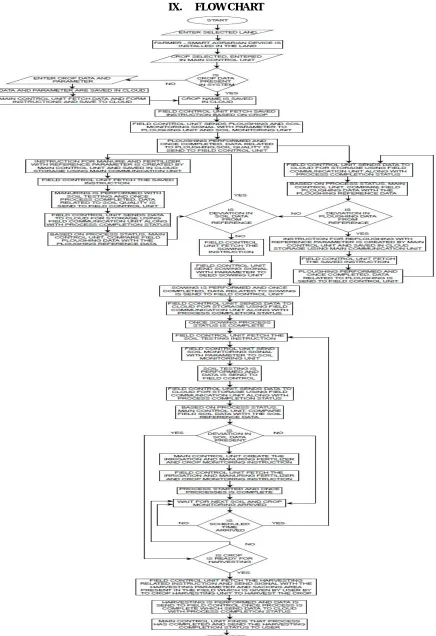
If the crop and cultivation process data are not present in the database, the system asks the user to enter all the data, the parameters, and instruction for each cultivation processes. Once it receives all the required data from the user, or if it has all the crop-related data, the system starts performing autonomously without human interventions.
At first, ploughing unit and soil monitoring unit is mounted on the movable frame. When ploughing unit, move on the movable frame, keeping the proper height above the soil, to maintain proper depth and quality while ploughing. The soil monitoring unit, take the ploughed soil and analyze it based on its content level, and send it to cloud for analyzing the soil quality. After ploughing and soil testing, the irrigation and manure, fertilizer unit mounted on the movable frame, manure and fertilizer are spread with water, only in the area where there is a deficiency of mineral and nutrients, destabilized pH level. This will help in optimal and save the land from over manuring and fertilization.
Once the field has proper nutrients, the land is ready for sowing. Now, sowing unit is mounted on the frame. The sowing unit moves along the moving frame and with the base frame to access complete field area. It digs a hole into the soil, put seed and plant in the hole, level the soil and water it. After the required showing is completed in the field, irrigation and manure, fertilizer unit and crop health monitoring unit are mounted on the field. Irrigation unit irrigated the crops, keeping the use of water to the minimum quantity and irrigated on a need basis.
Crop health monitoring unit monitors and take pictures of crops and send to the cloud for analyzing.
When crop gets ripened, and ready for harvesting, Crop harvesting unit mounted on the movable frame based on the crop type as some crop grows towards the soil and some away from the soil. The unit harvests the crop and places it on the prescribed space as directed by the user. The harvesting unit has the autonomous capability to select the harvesting device based on crop type.
The climate control unit is used when it needs to control the climate for crop growth. Due to the frame structure, it provides the base structure for climate control in the field. Covering is provided by the user whenever needed. The unit provides the permanent structure if it is needed for the crop and has the capability to deploy without human effort.
VII. APPLICATIONSOFTHEPROJECT
A. The first application is in crop cultivation in which each cultivation stage is autonomously carried out and reduce the human effort
nearly to zero.
B. In the second application, is to provide sustainable food production using climate control technology to the planet like Mars where
mankind is trying to make a new habitat.
C. In the third application, it helps to grow crops without being dependent on various factors which affect the farming techniques.
VIII. ADVANTAGES
1) It makes cultivation autonomous without human effort.
2) It helps the users to respond and prepare with next plans in advance based on the field data.
3) It helps to achieve sustainable food production.
4) It controls the use of chemicals used during cultivation.
5) It reduces the use of natural resource like water to a minimum.
6) It helps in optimal and efficient use of land.
IX. FLOWCHART
X. CONCLUSIONS
The design & development of FARMER – A Smart Agrarian Device for cultivation, is being used to make cultivation processes autonomous and reduce the human effort to nearly zero. All the processes of cultivation are monitored using a feedback mechanism to achieve optimal, effective and minimum use of the resource.
This system uses a machine learning algorithm to work autonomously by learning from previous cultivation cycles and involve the internet of things to control all the farming devices located remotely in the field without any human intervention.
The ability to work autonomously, it is used for crop monitoring and accessibility at each farming stage.
Ideally, this system is developed by introducing by intensively introducing the advanced technologies in the farming practices to decrease the human labour and the use of natural resources. Automated cultivation processes enhance food production to satisfy the increasing demand by optimal use of the resource. Automation in framing helps us to use the same technologies, to produce crops on other planets where mankind planning to set up human colonies.
REFERENCES
[1] Smart farming system using sensors for agricultural task automation Chetan Dwarkani M ; Ganesh Ram R ; Jagannathan S ; R. Priyatharshini 2015 IEEE Technological Innovation in ICT for Agriculture and Rural Development (TIAR)
[2] Design of an autonomous seed planting robot Nandagopal Srinivasan ; Prithviraj Prabhu ; S Sanjana Smruthi ; N Vivek Sivaraman ; S Joseph Gladwin ; R Rajavel ; Abeshek Ram Natarajan 2016 IEEE Region 10 Humanitarian Technology Conference (R10-HTC)
[3] Autonomous Farming: Modeling and Control of Agricultural Machinery in a Unified Framework R. Eaton ; J. Katupitiya ; K. W. Siew ; B. Howarth 2008 15th International Conference on Mechatronics and Machine Vision in Practice
[4] Design and Implementation of an IoT based Automated Agricultural Monitoring and Control System Md Shadman Tajwar Haque ; Khaza Abdur Rouf ; Zobair Ahmed Khan ; Al Emran ; Md. Saniat Rahman Zishan 2019 International Conference on Robotics,Electrical and Signal Processing Techniques (ICREST) [5] Smart Farm Monitoring via the Blynk IoT Platform : Case Study: Humidity Monitoring and Data Recording Peerasak Serikul ; Nuttapun Nakpong ; Nitigan