Citrine: A Methodology for Application-Specific
Network-on-Chips Design
Majid Janidarmian1, Ahmad Khademzadeh2, Atena Roshan Fekr1, Vahhab Samadi Bokharaei3
Abstract— This paper presents a novel and efficient mapping algorithm, called Citrine. It generates a set of mappings which have nearly minimum possible distance between related cores results in reduction of communication cost in Network-on-Chip (NoC), while improving other performance metrics. Comparison of the communication cost results makes it obvious that final solutions found by our proposed approach outperform the results of other methods which proposed in literature. Vulnerability index is introduced and defined as a criterion for evaluating routing fault tolerance. Reducing the vulnerability index optimizes fault tolerant properties of NoC. Then by using the Citrine solutions, a total cost function is used to customize and prioritize the impact of metrics, i.e. communication cost and vulnerability index. The experimental results reveal the power of Citrine in generating different solutions with low bandwidth requirements that spread through the explored design space.
Keywords: Application-Specific Network on Chip, Mapping, Routing, Fault-Tolerance, Vulnerability Index, Robustness Index
I. INTRODUCTION
The ever-increasing complexity of system on chip (SoC) design, and non-efficiency of electric bus to exchange data between IP cores in Giga scale, the Network on Chip (NoC) is presented with more flexible, scalable and reliable infrastructure. Different mapping algorithms for NoCs are presented to decide which core should be linked to which router. Mapping an application to on-chip network is the first and the most important step in the design flow as it will dominate the overall performance and cost [1]. Another factor which affects the overall performance of an NoC is the routing algorithm [2,3].The Routing algorithms are classified as deterministic or adaptive. In deterministic routing the path from the source to the destination is completely determine by the source and the destination addresses. In adaptive routing multiple paths from the source to the destination are possible. Thus, generally, it provides packets with a better chance to avoid hot spot or faulty regions in the network as compared to deterministic routing [2]. Although the deterministic routing algorithms are simple and have less complexity in hardware design, they are not able to efficiently consume bandwidth of links. Since reliability and fault-tolerance of network are two important issues in scaling of NoCs, the adaptive algorithms are the recommended solution. These algorithms can tolerate the network failures better than deterministic algorithms by using multiple paths.
Available bandwidth of links is a limitation in NoC design which is known as bandwidth constraints. Links exceeding threshold bandwidth in network should be avoided in order to maximize the system performance [4]. Routing and mapping algorithms play important roles to achieve this goal. The main purpose of this article is to present a new mapping model that optimizes the results in accordance to communication costs and fault-tolerance considerations. Although the approach proposed in the paper is not topology-dependent, it is illustrated and evaluated for 2D mesh topology due to its simplicity and scalability.
The rest of this paper is organized as follows. In section 2 we discuss related research work. Section 3 is composed of four subsections. The proposed mapping algorithm, Citrine, and related formulation and results are presented in 3.1. The used routing algorithm is described in 3.2. Vulnerability index is defined in 3.3 as a criterion to evaluate fault-tolerance. 3.4 introduces a total cost function and experimental results and design space exploration are done in this subsection. The conclusion is drawn in the last section.
II. RELATED WORK
Several approaches have been proposed in literature in the context of topological mapping in NoCs. The current researches mostly focus on mapping techniques for NoC platform with two dimension mesh topology. The NMAP method that runs mapping with regard to bandwidth constraints and minimizing communication delay is selected as the criterion in most projects, and is highly efficient as far as communication cost is considered [5] . In [1] a binomial mapping method is introduced. The latter comes along with an optimal algorithm aiming at minimizing total traffic on network, the number of hops, and hardware costs. The Branch-and-Bound algorithm, presented in [6] has been able to map IP cores on tiled-based NoC architecture, and it has tried to minimize total energy consumption, and to overcome bandwidth constraints. The proposed mapping algorithm in [7] is basically a genetic algorithm, which takes the advantages of the chaotic systems by using them instead of random process in the GA. Chain-Mapping [8] is an algorithm for mapping cores onto a mesh-based Network-on-Chip architecture that its main aim is to produce chains of connected cores in order to introduce a new method to prioritize IP cores. Onyx is a heuristic method for mapping the cores onto a tile-based NoC architecture. Onyx defines four movements to assign priorities to the tiles on a lozenge-shaped path and obtains better communication cost compared with previous mapping algorithms [9]. Also, the mapping of clusters onto the physical topology of processors has been studied in the field of parallel processing. In [10], PMAP, a two phase mapping algorithm for placing clusters onto processors is presented. It is clear to understand that all mapping algorithms try to minimize hop count between related cores as much as possible. This way results in better communication cost, energy consumption, latency and other performance metrics [9].
1CE Department, Science and Research Branch of Islamic Azad University,
Tehran, Iran
{jani, a.rashan }@srbiau.ac.ir
2Iran Telecommunication Research Center, Tehran, Iran,
3ECE Department, Shahid Beheshti University, Tehran, Iran,
III. THE PROPOSED METHODOLOGY
The objective of this study is to achieve an application-specific NoC design that minimizes the communication cost and improves the fault tolerant properties. This section is consisted of four subsections; the first subsection presents a heuristic mapping algorithm that produces a set of different mappings in a reasonable time. Although this mapping does not explore the design space thoroughly, it considers a part of design space, which in general minimizes the communication costs of solutions while yielding optimum communication costs in some cases. The second subsection deals with routing algorithm used in this paper. Furthermore, the new concept, vulnerability index, which is considered as a criterion for estimating the fault-tolerance of mapped application, is presented in details in the third subsection. In order to yield a mapping which considers trade-offs between communication cost and fault-tolerance, a total cost function is defined and introduced at last subsection.
A. Citrine: Mapping Algorithm
To formulate mapping problem in a more formal way, we need to first introduce the following two concepts borrowed from [9]:
Definition 1: The core graph is a directional graph 𝐺(𝑉, 𝐸), whose each vertex 𝑣𝑖 ∈ 𝑉 shows a core, and a directional
edge 𝑒𝑖,𝑗 ∈ 𝐸 illustrates connection between 𝑣𝑖 and 𝑣𝑗. The
weight of 𝑒𝑖,𝑗 that is shown as 𝑐𝑜𝑚𝑚𝑖,𝑗, represents the
bandwidth requirement of the communication from 𝑣𝑖 to 𝑣𝑗 .
We display an IP core along with a router connected to it by Resource Network Interface (RNI) as a tile.
Definition 2: The NoC architecture graph is a directional graph 𝐴(𝑇, 𝐿), whose each vertex 𝑡𝑖 ∈ 𝑇 represents a tile in the
NoC architecture, and its directional edge that is shown by 𝑙𝑖,𝑗 ∈ 𝐿 shows a physical link from 𝑡𝑖 to 𝑡𝑗. The routing path
from 𝑡𝑖 to 𝑡𝑗 is denoted by 𝑟𝑖,𝑗 and 𝐿(𝑟𝑖,𝑗) is the set of links that
make up the path 𝑟𝑖,𝑗.
In core graph each edge is treated as a flow of single commodity, represented as 𝑐𝑘 and its value which indicates the
require bandwidth for each edge is displayed with 𝑣𝑙(𝑐𝑘). The
set of all commodities represented as 𝐶 is achieved as follow:
𝐶 = 𝑐
𝑘: 𝑣𝑙 𝑐𝑘 = 𝑐𝑜𝑚𝑚
𝑖,𝑗, 𝑘 = 1,2, … 𝐸 , ∀𝑒𝑖,𝑗 ∈ 𝐸,
𝑤𝑖𝑡ℎ 𝑠𝑜𝑢𝑟𝑐𝑒 𝑐𝑘 = 𝑚𝑎𝑝(𝑣
𝑖), 𝑑𝑒𝑠𝑡 𝑐𝑘 = 𝑚𝑎𝑝(𝑣𝑗)
The core graph mapping 𝐺(𝑉, 𝐸) on NoC architecture graph 𝐴(𝑇, 𝐿) is defined by a one to one mapping function.
[image:2.595.50.296.573.710.2]𝑚𝑎𝑝 ∶ 𝑉 → 𝑇, 𝑠. 𝑡. 𝑚𝑎𝑝 𝑣𝑖 = 𝑡𝑗, ∀ 𝑣𝑖 ∈ 𝑉, ∃𝑡𝑗 ∈ 𝑇, 𝑉 ≤ 𝑇
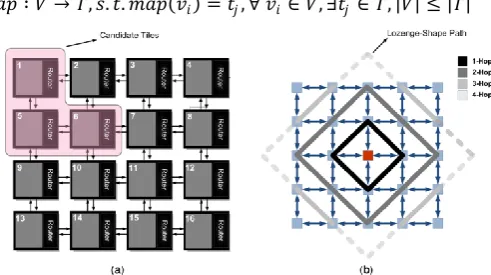
Figure 1. (a) Candidate tiles for mapping the first core (b) concept of lozenge-shape path
The proposed algorithm in [6], searches the optimal solution by alternating branch and bound steps, but it consumes a long run time due to large searching space. By increasing the number of cores, this method becomes unusable as the run time increases significantly. Onyx [9] is one of the best algorithms in mapping of cores onto mesh-based NoC architecture in terms of communication costs. Onyx defines four movements to assign priority to the tiles on a lozenge-shape path and obtains minimum hop count among the directly connected cores in the core graph. The disadvantage of the Onyx algorithm is the priority assignment process, which skips many valuable solutions and generates multiple identical mappings in some cases.
Hence, a new mapping algorithm ―Citrine1‖ is proposed by combination of [6] and [9] to better explore design space and using lozenge-shape path to improve run time. In this study, although proposed mapping algorithm is not limited by a specific topology, the mesh topology is selected as a platform for mapping cores due to its flexibility, scalability, and easiness of implementation. Citrine uses Onyx to retrieve the order of cores which should be mapped and branch-tree tries to search different permutation among those defined by lozenge shaped rule of Onyx. Citrine is composed of two steps:
Step1: Mapping of 1st core
A core with the highest priority for mapping is determined by the ℎ𝑖𝑔ℎ𝑒𝑠𝑡_𝑝𝑟𝑖𝑜𝑟𝑖𝑡𝑦 𝐺 𝑉, 𝐸 function. First, the function finds 𝑐𝑜𝑚𝑚𝑖,𝑗 such that it has the highest value,
followed by selecting the core with higher 𝑅𝑎𝑛𝑘𝑖𝑛𝑔(𝐶𝑖) as the
first core between the source and destination of that communication.
𝑅𝑎𝑛𝑘𝑖𝑛𝑔 𝐶𝑖 = ∀𝑗 =1,2,⋯, 𝑉 𝑐𝑜𝑚𝑚𝑖,𝑗+ 𝑐𝑜𝑚𝑚𝑗 ,𝑖
𝑖≠𝑗
After selecting the first core, 𝑖
𝑛 2
𝑖=1 , different tiles can be
selected as the candidates for the location of first core in a
𝑛 × 𝑛 mesh. Due to the symmetry of the 2D mesh networks,
other tiles are just mirrors of these candidate tiles. The first core should be mapped onto one of the candidate locations and finally the most appropriate location will be determined. As presented by Fig. 1-a Citrine has selected candidate tiles for mapping the first core like Onyx. Each candidate position will be used as a root for a branch-tree.
Step2: Branch the tree
After mapping of the first core in one of the candidate tiles, unmapped cores are selected for mapping upon Onyx priority order. Onyx priority order defines that for mapping the next core, a core with the largest 𝑐𝑜𝑚𝑚𝑝,𝑐+ 𝑐𝑜𝑚𝑚𝑐,𝑝 should be
selected, in which 𝑣𝑝 is a mapped core and 𝑣𝑐is the next core
to be mapped for all possible values of 𝑐 and 𝑝. In other words, a core is selected for mapping which is not mapped yet and requires the largest bandwidth to communicate with one of the mapped cores among others. As the 𝑣𝑐 is selected by its
relation to the 𝑣𝑝, the 𝑣𝑝 is called the parent and 𝑣𝑐 as the child.
After selecting a child to be mapped, different permutations should be searched for the child. The search will be carried out using the idea of lozenge-shape path of Onyx presented in Fig. 1-b. The searching algorithm is such that a
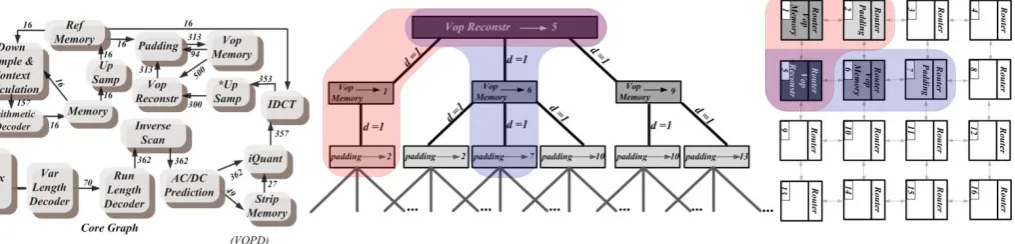
Figure 2. (a) VOPD Core Graph (b) Branch-Tree of VOPD core graph in Citrine (c) Mapping of the smaple branch-tree
child should be mapped with the nearest possible tiles to the parent. This rule defines that if 𝑑 is the minimum possible distance between a child, 𝑣𝑐 , and its parent,𝑣𝑝, then all
available tiles with distance 𝑑 from the parent, 𝑣𝑝, should be
considered as possible permutations for the child, 𝑣𝑐. It is
worth noting that the available tiles are those, which are not occupied by a previously mapped tile. Citrine continues the procedure of selecting the next core to map and finds all possible permutations until completing the mappings. Fig. 2 shows in detail mapping of a real core graph, VOPD, for the first three cores.
1) Experimental results of Citrine
VOPD and MPEG-4 real core graphs are used to compare Citrine algorithm with other algorithms. The results of Citrine are compared with BMAP[1], results of NMAP, Partial Branch-and-Bound, GMAP, PMAP mentioned in [5], CGMAP[7], CHMAP[8] and Onyx[9].
Communication cost is the main criteria for comparing these algorithms and is calculated according to the following equation:
𝑐𝑜𝑚𝑚𝑐𝑜𝑠𝑡 = 𝑣𝑙 𝑐𝑘 × ℎ𝑜𝑝_𝑐𝑜𝑢𝑛𝑡 𝑠𝑟𝑐 𝑐𝑘 , 𝑑𝑠𝑡 𝑐𝑘
𝐸
𝑘=1
where 𝑠𝑟𝑐 𝑐𝑘 is source and 𝑑𝑠𝑡 𝑐𝑘 is destination of 𝑐𝑘.
In Fig.3 and Fig. 4 the minimum communication cost for all algorithms are presented. Communication costs of PMAP and GMAP are exceeding the upper bounds in charts so they are not shown completely in these figures. As illustrated in these figures, Citrine mapping algorithm and Onyx show the minimum communication cost. Lower communication cost is the result of smaller hop count between related cores. Reducing the hop counts is one of the most significant approaches for decreasing energy consumption and other performance metrics like latency [9]. As illustrated in Fig.3 and Fig. 4, Onyx and Citrine show similar best results in VOPD and MPEG-4 core graphs.
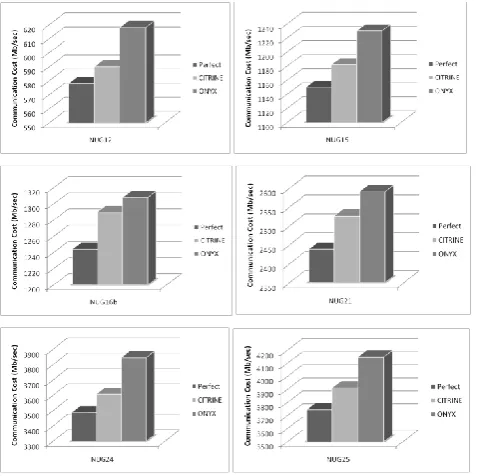
[image:3.595.300.558.211.349.2]In order to better estimate Citrine abilities, much more complicated graphs are applied to the Citrine and the Onyx. The results of applying the Citrine and the Onyx as well as the perfect results are listed in Table 1. For NUG12, NUG15, NUG16b, NUG21,NUG24 and NUG25 [11] the Citrine shows 4.75%, 4.06%, 1.40%, 2.53%, 6.60% and 6.03% improvements over Onyx, respectively. Figure 5 illustrates the results which demonstrated in Table 1.
[image:3.595.299.562.372.490.2]Figure 3. Communication cost of different mapping algorithms on VOPD core graph
[image:3.595.314.540.545.625.2]Figure 4. Communication cost of different mapping algorithms on MPEG-4 core graph
TABLE I. COMPARISON OF THE COMMUNICATION COST OF CITRINE AND ONYX VS. PERFECT RESULTS
Case Study
Perfect Results
CITRINE ONYX
NUG12 578 590 618
NUG15 1150 1182 1230
NUG16b 1244 1290 1308
NUG21 2438 2526 2590
NUG24 3488 3608 3846
NUG25 3744 3912 4148
B. Routing
link utilization than deterministic routing algorithm. Another advantage of using the adaptive routing algorithm is the fault-tolerant NoCs by providing multiple alternative paths through network.
Figure 5. Communcation cost of Citrine, Onyx and perfect answers for NUG12, NUG15, NUG16b, NUG21, NUG24, NUG25
One of the best algorithms customized for routing in application-specific NoCs was presented by [2] which uses a highly adaptive deadlock-free routing algorithm. This routing algorithm takes into account the communication bandwidth requirements among core pairs which are mapped on different network nodes. The algorithm splits the communication, 𝑐𝑘, over multiple paths provided by routing function, between the source, 𝑆, and the destination, 𝐷, as shown in Fig.6. The routing function presented in [2] uses fully adaptive minimal routing.
Figure 6. Splitting of bandwidth based on fully adpative minimal routing for a communication from node S to node D at 60 Mb/s
In general, every routing algorithm should include deadlock freedom feature. Nevertheless, more considerations are required when implementing the fully adaptive routing algorithms. The adaptive routing algorithm is prone to deadlocks, so channel dependency graphs (CDG) concept is used in [2] to avoid any possible deadlocks. The CDG is a directed graph with the network channels as the vertices and the direct dependencies between the two channels as the edges. A dependency exists between the links 𝑙𝑖,𝑗 and 𝑙𝑗 ,𝑘 whenever
there is a path to route packets from 𝑣𝑖 to 𝑣𝑘 through 𝑣𝑗 which
uses those links. An extension to CDG as a sub graph is the concept of application specific channel dependency graph (ASCDG) introduced in [12]. The ASCDG is a sub graph of the CDG and an edge in CDG between channels, 𝑙𝑖,𝑗 and 𝑙𝑗 ,𝑘 is
removed if there was no application-specific dependency between 𝑙𝑖,𝑗 and 𝑙𝑗 ,𝑘. Deadlock is not inevitable when there are
any cycles through ASCDG graph. A cycle in the ASCDG is a succession of application specific direct dependencies, 𝐷 = {𝑑1, 𝑑2, ⋯ , 𝑑𝑛}, where 𝑑 ∈ 𝐷 is a pair (𝑙𝑖,𝑗, 𝑙𝑗 ,𝑘) with
𝑙𝑖,𝑗 , 𝑙𝑗 ,𝑘 ∈ 𝐿. The challenge is how to select the most
appropriate dependencies to be removed from ASCDG graph to break the cycle, 𝐷. By removing a dependency, all of the corresponding paths to that dependency will be removed. Using this method guarantees that routing algorithm is deadlock free still with high levels of adaptivity. Palesi et al.
also presented a technique to break cycles in the ASCDG which is bandwidth aware. As soon as a path is removed, the fraction portion of the bandwidth that passes through it must be redistributed over the remaining paths. The idea is to remove the dependency, 𝑑, such that the overhead of bandwidth that should be allocated to the remaining paths is minimized. The condition for removing the edge from the ASCDG is to minimize the cost 𝑑 , as:
cost 𝑑 = 𝑣𝑙 𝑐
𝑘 × 𝑃𝑇2(𝑐𝑘, 𝑑)
𝜌(𝑐𝑘) × ( 𝜌 𝑐𝑘 − 𝑃𝑇2 𝑐𝑘, 𝑑 )
𝑐𝑘∈𝐶
where, 𝑣𝑙 𝑐𝑘 represents bandwidth requirements for
communication, 𝑐𝑘,𝜌 𝑐𝑘 denotes the set of minimal paths
admitted by the routing function for 𝑐𝑘, and 𝑃𝑇2 𝑐𝑘, 𝑑 is the
path through dependency set that is the set of paths of 𝑐𝑘 which
use the dependency 𝑑.
Due to its inherent application-specific nature and high adaptivity provided by algorithm proposed by [2], this algorithm is used for routing of application-specific NoCs, which previously mapped by Citrine in section 3.1. Fault-tolerant properties are also considered in the proposed methodology to include the advantage of adaptivity in routing algorithms.
Next section deals with fault-tolerance by introducing the concept of vulnerability index.
C. Vulnerability Index
As the number of transistors on chip increases, the problem associate with deep sub-micron will become more pronounced. Moreover, the router and link failures will be more probable. Therefore, the NoCs need to be designed with high level of built-in fault tolerance [13]. Vulnerability index is considered as a criterion for estimating fault-tolerant properties of NoCs. By reducing the vulnerability index in an NoC, the NoC design will become more fault-tolerant. The vulnerability index has the inverse relation to the robustness index introduced in [14] and definitions and formulations of robustness index are also extracted from the same reference. So first we define the robustness index and then definition of vulnerability index is proposed.
The robustness index, 𝑅𝐼, is based on the extension of the concept of path diversity [15]. For a given communication, 𝑐𝑘 ∈ 𝐶, an NoC architecture graph, 𝐴(𝑇, 𝐿), a
[image:4.595.101.237.487.606.2]the robustness index for communication 𝑐𝑘 , 𝑅𝐼(𝑐𝑘), as the
average number of routing paths available for communication, 𝑐𝑘 , if a link belonging to the set of links used by communication 𝑐𝑘 is faulty. Formally,
𝑅𝐼 𝑐𝑘 = 1
𝐿(𝑐𝑘) 𝜌 𝑐
𝑘 \𝜌(𝑐𝑘, 𝑙 𝑖,𝑗) 𝑙𝑖,𝑗∈𝐿
where, 𝜌 𝑐𝑘 is the set of paths provided by R for
communication, 𝑐𝑘, 𝜌(𝑐𝑘, 𝑙
𝑖,𝑗) is the set of paths provided by
R for communication, 𝑐𝑘,that uses link 𝑙
𝑖,𝑗, and 𝐿(𝑐𝑘) is the
[image:5.595.122.221.213.352.2]set of links belonging to paths in 𝜌(𝑐𝑘).
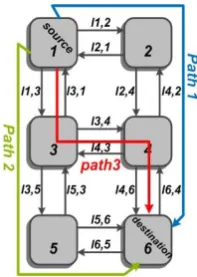
Figure 7. Routing paths provided by two different routing functions for the communicating pair (source, destination)
Suppose that there are two routing functions, 𝐴 and 𝐵, which routing function 𝐴 selects path 1 and 𝑝𝑎𝑡ℎ2 and routing function 𝐵 selects 𝑝𝑎𝑡ℎ2 and 𝑝𝑎𝑡ℎ3 to route packets between source and destination as shown in Fig. 7 . The routing function 𝐴 selects two disjoint paths such that the presence of a faulty link in one path dose not compromise communication from source to destination since another path is fault-free. However, when the routing function 𝐵 is used as shown in Fig. 7, the communication will not occur. As the alternative paths share the link, 𝑙1,3, any fault in the link, 𝑙1,3, makes the
communication from ―source‖ to ―destination‖ impossible. Consequently, the NoC which uses routing function 𝐴, 𝑁𝑂𝐶1,
is more robust than the NoC which uses routing function 𝐵, let call it 𝑁𝑂𝐶2. Such situation is reflected by the robustness
index. The robustness index for the above two cases are:
𝑅𝐼 𝑁𝑂𝐶1 (source → destination) =1+1+1+1+1+1
6 = 1 ,
𝑅𝐼 𝑁𝑂𝐶2 (source→destination) =0+1+1+1+1
5 = 0.8 .
The 𝑁𝑂𝐶1using 𝑝𝑎𝑡ℎ1 and 𝑝𝑎𝑡ℎ2 is more robust than the
𝑁𝑂𝐶2 using 𝑝𝑎𝑡ℎ2 and 𝑝𝑎𝑡ℎ3 for communication from
“𝑠𝑜𝑢𝑟𝑐𝑒” to “𝑑𝑒𝑠𝑡𝑖𝑛𝑎𝑡𝑖𝑜𝑛” as 𝑅𝐼 𝑁𝑂𝐶1 > 𝑅𝐼 𝑁𝑂𝐶2 .
The global robustness index, which characterizes the network, is calculated using the weighted sum of the robustness index of each communication. For a communication, 𝑐𝑘, the
weight of 𝑅𝐼(𝑐𝑘) is the degree of adaptivity [16] of 𝑐𝑘. The
degree of adaptivity of a communication, 𝑐𝑘, is the ratio of the
number of allowed minimal paths to the total number of possible minimal paths between the source node and the destination node associated to 𝑐𝑘 . Thus, given a core
graph 𝐺(𝑉, 𝐸), NoC architecture graph 𝐴(𝑇, 𝐿), a mapping function M, and a routing function R, the robustness index is defined as:
𝑅𝐼 𝑁𝑂𝐶 = 𝛼 𝑐𝑘 𝑅𝐼 𝑁𝑂𝐶 (𝑐𝑘) 𝑐𝑘∈𝐶
where 𝛼 𝑐𝑘 indicates the degree of adaptivity of
communication 𝑐𝑘.
So after defining 𝑅𝐼 𝑁𝑂𝐶 , the Vulnerability index,
𝑉𝐼 𝑁𝑂𝐶 , defined as:
𝑉𝐼 𝑁𝑂𝐶 = 1
𝜀 + 𝑅𝐼 𝑁𝑂𝐶
where 𝜀 is a constant to be defined. Note that 𝑅𝐼 𝑁𝑂𝐶 is
always equal or greater than zero, therefore the maximum possible value of 𝑉𝐼 𝑁𝑂𝐶 is equal to 1
𝜀 which happens in case
𝑅𝐼 𝑁𝑂𝐶 is equal to zero. In this paper 𝜀 was set to 0.01. If we want to set an upper bound for 𝑉𝐼 𝑁𝑂𝐶 , let call it
𝑉𝐼_𝑈𝑝𝑝𝑒𝑟_𝐵𝑜𝑢𝑛𝑑, 𝜀 will be calculated as follow:
𝜀 = 1
𝑉𝐼_𝑈𝑝𝑝𝑒𝑟_𝐵𝑜𝑢𝑛𝑑
Following section deals with a cost function that its objective is to find a mapping such that the sum of weighted communication cost and vulnerability index are to be minimized under previously mentioned routing algorithm.
D. Total cost function
As previously mentioned, lower communication cost leads to an NoC with better metrics such as energy consumption and latency. Another introduced metric was vulnerability index which is used as a measurable criterion for fault tolerant properties. A cost function is to be introduced in order to minimize the sum of weighted communication cost and the vulnerability index.
Given a core graph 𝐺(𝑉, 𝐸) , NoC architecture graph 𝐴(𝑇, 𝐿), and a routing function R, a mapping function, 𝑀, is introduced from 𝐺 𝑉, 𝐸 → 𝐴(𝑇, 𝐿) to minimize the following:
𝑇𝑜𝑡𝑎𝑙 𝐶𝑜𝑠𝑡 𝐹𝑢𝑛𝑐𝑡𝑖𝑜𝑛 = 1 − 𝛼
𝛽 × 𝑐𝑜𝑚𝑚𝑐𝑜𝑠𝑡 +
𝛼 𝛾× 𝑉𝐼
𝑁𝑂𝐶
where, 𝑐𝑜𝑚𝑚𝑐𝑜𝑠𝑡 is the communication cost and 𝑉𝐼 𝑁𝑂𝐶 is the vulnerability index of NoC after applying mapping function.
1) Experimental Results
In order to better investigate the capabilities of Citrine mapping algorithm and for better understanding of total cost function, we have done some experiments. As mentioned before, one of the advantages of Citrine over other algorithms is its diversity of solutions which have near to optimum communication costs. Although Citrine explores a wide range of solutions, its runtime for examined real core graphs, VOPD and MPEG-4, was a fraction of a second.
We have run Citrine for core graphs VOPD and MPEG-4 to evaluate the generated mappings by using total cost function.
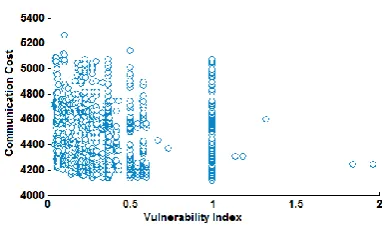
[image:6.595.338.541.70.179.2]Citrine generates 6420 and 2808 different mappings for MPEG-4 and VOPD, respectively. Some mappings have the same communication cost and vulnerability index values. So by dismissing the duplicate items, the unique values for MPEG-4 and VOPD were extracted among whole results. Results of running Citrine for MPEG-4 and VOPD core graphs and evaluating the values in our 2D design space, i.e. communication cost and vulnerability index shown in Fig. 8 and Fig. 9, respectively for extracted set of results.
[image:6.595.337.539.73.312.2]Figure 8. Citrine mappings of MPEG-4 core graph
Figure 9. Citrine mappings of VOPD core graph
Although the communication costs for most of mappings are spread in a range near to optimal, there are wide ranges of total cost for mappings due to different vulnerability index values, as it can be seen in some extreme points in design space which have small communication cost but having large total cost and vulnerability indices. Notice that Citrine does not take vulnerability index into account while generating mapping but by providing a large design space, we can achieve different total costs which is one of the good points about Citrine.
For better analyzing the correlation of different parameters in our design space, Fig. 10 to Fig. 13 are shown for results of VOPD core graph.
Figure 10. Commnication Cost vs. Total Cost Function
[image:6.595.336.535.206.328.2]Figure 11. Commnication Cost vs. Total Cost Function – detailed
Figure 12. Total Cost Function vs. Vulnerability Index
Figure 13. Communication Cost vs. Vulnerability
[image:6.595.56.298.299.420.2] [image:6.595.340.527.356.482.2] [image:6.595.53.297.380.571.2] [image:6.595.344.538.506.619.2]Fig. 12 illustrates total cost vs. vulnerability index. Description of this figure is like two former described figures, Fig. 10 and Fig. 11.
At last, Fig. 13 depicts communication cost vs. vulnerability index without noticing total cost function. As you can see, the power of Citrine is to generated different mappings with diverse set of features, e.g. mappings with same communication costs but different vulnerability indices and vice versa.
IV. CONCLUSION
Considering the importance of mapping algorithm as one of three aspects of NoC design, in this paper, a novel mapping algorithm was proposed, called Citrine. It was able to obtain the best communication cost among a number of efficient mapping algorithms. Vulnerability index was also introduced and defined as a criterion for evaluating routing fault tolerance. Then by using a total cost function as a metric, results which generated by Citrine were evaluated. Due to wide range of solutions provided by Citrine it is possible to minimize the total cost function through the design space.
ACKNOWLEDGMENT
This paper was supported by the Iran Telecommunication Research Center (ITRC).
REFRENCES
[1] W. Shen, C. Chao, Y. Lien, A. Wu,‖ A NEW BINOMIAL MAPPING AND OPTIMIZATION ALGORITHM FOR REDUCED-COMPLEXITY MESH-BASED ON-CHIP NETWORK,‖, Networks-on-Chip, NOCS 2007, pp.317 – 322, 7-9 May 2007.
[2] M. Palesi, G. Longo, S. Signorino, R. Holsmark, S. Kumar, V. Catania, ―Design of Bandwidth Aware and Congestion Avoiding Efficient Routing Algorithms for Chip Platforms‖, Networks-on-Chip, NoCS 2008. Second ACM/IEEE International Symposium on, pp. 97 – 106, April 2008.
[3] U.Y.Ogras,J.Hu, and R.Marculescu.‖ : A holistic perspective. In International Confeence on Hardware-Software‖, Key research problems in noc design Codesign Synthesis,pp. 69-74, Sept. 2005.
[4] Chen-Ling Chou, R. Marculescu, ― Contention-aware Application Mapping for Network-on-Chip Communication Architectures‖, Computer Design, ICCD , IEEE International Conference on ,pp. 164 – 169, Oct. 2008.
[5] S.Murali, V.De Micheli, ―bandwidth constrained mapping of cores onto NoC architectures‖, Design, Automation and Test in Europe Conference and Exhibition, Proceedings, Vol.2,pp. 896- 901, Feb. 2004.
[6] Hu Jingcao, R. Marculescu, ―Energy aware mapping for tile-based NoC architectures under performance constraints‖, Design Automation Conference, Proceedings of the ASP-DAC 2003. Asia and South Pacific,pp. 233- 239, Jan. 2003.
[7] Fahime Moein-darbari, Ahmad Khademzade and Golnar Gharooni-fard, ―CGMAP: a new approach to Network-on-Chip mapping problem‖, IEICE Electron. Express, Vol. 6, No. 1, pp.27-34, (2009) .
[8] Misagh Tavanpour, Ahmad Khademzadeh and Majid Janidarmian, ―Chain-Mapping for mesh based Network-on-Chip architecture‖, IEICE Electron. Express, Vol. 6, No. 22, pp.1535-1541, (2009) .
[9] M. Janidarmian, A. Khademzadeh, M. Tavanpour, ―Onyx: A new heuristic bandwidth-constrained mapping of cores onto tile based Network on Chip‖, IEICE Electron. Express, Vol. 6, No. 1, pp.1-7, January 2009.
[10] N. Koziris et al.,‖ An efficient Algorithm for the physical mapping of clustered Task Graphs onto Multiprocessor Architectures ,‖ Proceedings of 8th EuroPDP, pp.406-413, Jan.2000.
[11] http://www.seas.upenn.edu/qaplib/inst.html
[12] M. Palesi, R.Holsmark, S.Kumar, ―a methodology for design of application specific deadlock-free routing algorithms for NoC systems‖, Hardware/Software Codesign and System Synthesis, CODES+ISSS '06. Proceedings of the 4th International Conference,pp. 142-147, Oct. 2006. [13] M. Ali, M. Welzl, S. Hessler, S. Hellebrand, ―A Fault tolerant
mechanism for handling Permanent and Transient Failures in a Network on Chip,‖ Information Technology, 2007. ITNG '07. Fourth International Conference on, p.p. 1027-1032, 2007
[14] Rafael Tornero, Valentino Sterrantino, Maurizio Palesi ,Juan M. Orduna,‖ A Multi-objective Strategy for Concurrent Mapping and Routing in Networks on Chip‖ Proceedings of the 2009 IEEE International Symposium on Parallel&Distributed Processing‖,pp. 1-8 ,2009.
[15] W. J. Dally and B. Towles, Principle and Practice of Interconnection Network. San Francisco, CA : Morgan Kaufmann, 2004