Performance Improvement of Application Specific
Network on Chip Design using Genetic Algorithm
Mahnaz Rafie
Department of Computer Engineering, Ramhormoz Branch,
Islamic Azad University, P.O. Box 151-63825, Tohid Square, Ramhormoz, Iran Emails: [email protected], [email protected]
Abstract – This paper presents a technique which finds a
mapping of the vertices of a task graph to the tiles of a mesh based network on chip (NoC) architecture. The proposed algorithm is basically a genetic algorithm. The algorithm helps us achieve optimal or near optimal solutions in large size applications with reasonable time. In this process different types of Genetic algorithms are applied in the basic framework for solving the mapping problem on two real core graphs Video Objective Plan Decoder and mp3encmp3dec. The experimental results show the comparisons of these different meta heuristic algorithms with each other. It show that the proposed algorithm performs as well as the most previously proposed mapping algorithms considering the communication cost parameter. It is a common metric in evaluation of different mapping algorithms which have direct impact on power consumption and performance of mapped NoC.
Keywords – Communication Cost, Core Graph, Genetic Algorithm, Mapping, Network on Chip.
I.
I
NTRODUCTIONNetwork on chip (NoC) is a developing and promising on chip communication paradigm that improves scalability and performance of system on chips. NoC design flow contains many problems from different areas, for example networking, embedded design and computer architecture [1]. Application mapping is one of the most important dimensions in NoC research. It maps the cores of the application to the routers of the NoC topology, affecting the overall performance and power requirement of the system [2]. It should be noted that many mapping algorithms have been recently proposed to improve several parameters used in the NoC design. One of the most important parameters is the communication cost. Using small hop counts between related cores will significantly drop the communication cost. Moreover, small hop counts will reduce the energy consumption and other performance metrics like latency. So, in this paper, the modified genetic algorithm is used to achieve the best solution of this parameter.
II.
R
ELATEDW
ORKSThe current researches mostly focus on mapping techniques for NoC platforms with two dimension mesh topology. The NMAP method that runs mapping with regard to bandwidth constraints and minimizing communication delay is selected as the criterion in most projects, and is highly efficient as far as communication cost is considered [3]. In [4] a binomial mapping method
is introduced. The latter comes along with an optimal algorithm aiming at minimizing total traffic on network, the number of hops, and hardware costs. The Branch-and Bound algorithm, presented in [5] has been able to map IP cores on tile-based NoC architecture, and it has tried to minimize total communication energy. The performance constraint was handled via bandwidth reservation. Also, the mapping of clusters onto the physical topology of processors has been studied in the field of parallel processing. In [6], PMAP, a two-phase mapping algorithm for placing clusters onto processors is presented. In this field, the mappings produced by the PMAP algorithm are shown to have lower communication costs than mappings with previous algorithms.
Copyright © 2014 IJECCE, All right reserved architecture has been proposed in [16], which reduces
energy consumption and total bandwidth requirement of NoC. GAMR [17], a genetic algorithm based mapping and routing approach addresses a two phase mapping of IP cores onto NoC architecture and generates a deterministic dead-lock free minimal routing path for each communication to minimize the total communication energy and maximize link bandwidth utilization of the NoC architecture. In [18], authors have proposed Architecture-Aware Analytic Mapping algorithm (A3MAP) for NoC with homogeneous and heterogeneous cores on regular and irregular mesh or custom architecture. The task mapping problem is solved by two effective heuristics, a successive relaxation algorithm as a fast algorithm and a genetic algorithm to find better mapping solutions. In [19], a genetic algorithm based mapping technique has been proposed for customized NoC architecture to reduce the communication energy. The same authors in [20] proposed a GA based congestion aware mapping technique for irregular customized NoC architecture to reduce the communication energy. A Multi-objective Adaptive Immune Algorithm (MAIA), based on evolutionary approach has been proposed in [21], which maps the application tasks onto NoC to reduce the power consumption and overall network latency. The adaptive immune algorithms integrate a wide set of features that improve local search while preventing the premature convergence by preserving the diversity of solutions in the population. The same authors in [22] have proposed an improved version of MAIA to solve the multi-application NoC problem. It produces a set of mapping alternatives by exploring the mapping space. The main drawback of such genetic approach is the slow rate of convergence. It often requires the GA to evolve a large number of generations to converge to a solution. The best solution at the end is taken to be the solution of the mapping problem. To accelerate the rate of convergence, the mutation rate can be increased. However, it mostly converges to local best solutions, rather than finding the global best.
III.
P
ROBLEM ANDC
OMMUNICATIONC
OSTFollowing two concepts are introduced to formulate a mapping problem [23]:
Definition 1:
The core graph is a directional graph, G (V,E), whose each vertex, vi∈ V shows a core, and a directional edge, ei,j∈ E illustrates connection between vi and vj. The weight of ei,j that is shown as commi,j, represents the bandwidth requirement of the communication from vi to vj. An IP core is showed along with a router connected to it by Resource Network Interface as a tile.Definition 2:
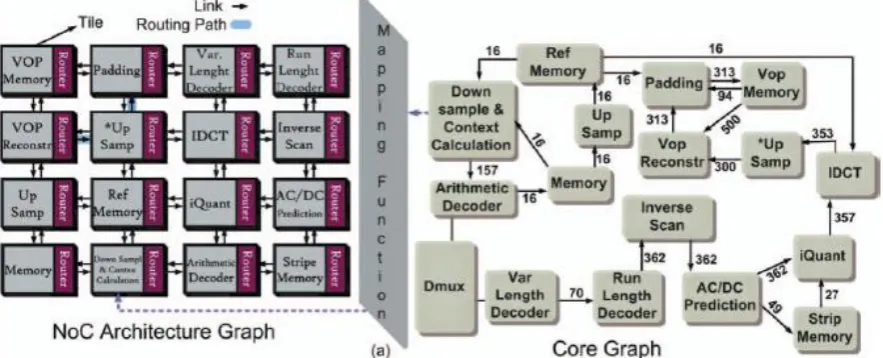
The NoC architecture graph is a directionalgraph, A(T, L), whose each vertex, ti∈ T, represents a tile in the NoC architecture, and its directional edge which is shown by li,j ∈ L shows a physical link from ti to tj. The definitions are presented in fig 1. In core graph each edge is treated as a flow of single commodity, represented as ck and its value which indicates required bandwidth for each
edge is displayed with vl(ck). The set of all commodities represented as 𝐶 is achieved as follows:
C = c
k: vl ck = comm
i,j, k = 1,2, … E , ∀ei,j∈ E, with source ck = map v
i , dest ck = map vj (1) The core graph mapping G(V, E) on NoC architecture graph A(T, L) is defined by a one to one mapping function (Eq. (2)).
map ∶ V → T, s. t. map vi = tj, ∀vi∈ V, ∃tj∈ T, V ≤ T (2) Communication cost is calculated according to the Eq. (3):
commcost = vl ck × hop count E
k=1 src ck , dst ck (3) Where src(ck) is source and dst(ck) is destination of ck.
IV.
G
ENETICA
LGORITHMGenetic algorithms are inspired by Darwin's theory about evolution. Solution to a problem solved by genetic algorithms is evolved. The Algorithm is started with a set of solutions (represented by chromosomes) called population. Solutions from one population are taken and used to form a new population. This is motivated by a hope, that the new population will be better than the old one. Solutions which are selected to form new solutions (offspring) are selected according to their fitness – the more suitable they are the more chances they have to reproduce. This is repeated until some condition (for example number of populations or improvement of the best solution) is satisfied. The basic operations of the genetic algorithm are simple and straight-forward [10]:
Reproduction:
the act of making a copy of a potentialsolution:
Crossover:
The act of swapping gene values betweentwo potential solutions, simulating the "mating" of the two solutions.
Mutation:
the act of randomly altering the value of a gene in a potential solution.There are several methods for crossover operator. Some of them are as follows:
Single point:
chooses a random integer n between 1 and number of variables, and selects the vector entries numbered less than or equal to n from the first parent, selects genes numbered greater than n from the second parent, and concatenates these entries to form the child.Two points:
selects two random integers m and nbetween 1 and number of variables. The algorithm selects genes numbered less than or equal to m from the first parent, selects genes numbered from m+1 to n from the second parent, and selects genes numbered greater than n
from the first parent. The algorithm then concatenates these genes to form a single gene.
Intermediate:
creates children by a random weightedaverage of the parents. It was shown as follows:
Scatter:
creates a random binary vector. It then selects the genes where the vector is a 1 from the first parent, and the genes where the vector is a 0 from the second parent, and combines the genes to form the child.The different methods for mutation operator are like:
Uniform:
it is a two-step process. First, the algorithm selects a fraction of the vector entries of an individual for mutation, where each entry has the same probability as the mutation rate of being mutated. In the second step, the algorithm replaces each selected entry by a random number selected uniformly from the range for that entry.Gaussian:
adds a random number to each vector entryof an individual. This random number is taken from a Gaussian distribution centered on zero. The standard deviation of this distribution can be controlled with two parameters. The Scale parameter determines the standard deviation at the first generation. The Shrink parameter controls how standard deviation shrinks as generations go by. If the Shrink parameter is 0, the standard deviation is constant. If the Shrink parameter is 1, the standard deviation shrinks to 0 linearly as the last generation is reached.
The selection function chooses parents for the next generation based on their scaled values from the fitness scaling function. During the past two decades, many selection methods have been proposed, examined and compared [10]. The common types are as follows:
Uniform:
selects parents at random from a uniformdistribution using the expectations and number of parents. This results in an undirected search. Uniform selection is not a useful search strategy, but it can be used to test the genetic algorithm.
Tournament:
selects each parent by choosingindividuals at random, the number of which you can specify by Tournament size, and then choosing the best individual out of that set to be a parent.
Roulette wheel:
simulates a roulette wheel with the area of each segment proportional to its expectation. The algorithm then uses a random number to select one of the sections with a probability equal to its area.Migration in genetic algorithms is the movement of individuals between subpopulations. The best individuals from one subpopulation replace the worst individuals in another subpopulation. Direction specifies the direction in which migration can take place.
If you set Direction to Forward, migration takes place toward the last subpopulation. That is the nth subpopulation migrates into the (n+1)th subpopulation. If you set Direction to Both, the nth subpopulation
migrates into both the (n–1)th and the (n+1)th subpopulation.
In this paper several kinds of genetic algorithms are carried out in this study and are shown in Table I.
Fig.1. Mapping of VOPD core graph on NoC Architecture graph Table I: Different operators of genetic algorithms
Migration Crossover
Mutation Selection
Both Intermediate
Gaussian Roulette
GA1
Both Single-point
Gaussian Roulette
GA2
Both Two-point
Gaussian Roulette
GA3
Both Scatterd
Gaussian Roulette
GA4
Both Intermediate
Uniform Roulette
GA5
Both Single-point
Uniform Roulette
GA6
Both Two-point
Uniform Roulette
GA7
Both Scatterd
Uniform Roulette
GA8
Both Intermediate
Gaussian Tournament
GA9
Both Single-point
Gaussian Tournament
GA10
Both two-point
Gaussian Tournament
Copyright © 2014 IJECCE, All right reserved
Both Scatterd
Gaussian Tournament
GA12
Both Intermediate
Uniform Tournament
GA13
Both Single-point
Uniform Tournament
GA14
Both two-point
Uniform Tournament
GA15
Both Scatterd
Uniform Tournament
GA16
Both Intermediate
Gaussian Uniform
GA17
Both Single-point
Gaussian Uniform
GA18
Both two-point
Gaussian Uniform
GA19
Both Scatterd
Gaussian Uniform
GA20
Both Intermediate
Uniform Uniform
GA21
Both Single-point
Uniform Uniform
GA22
Both two-point
Uniform Uniform
GA23
Both Scatterd
Uniform Uniform
GA24
V.
E
XPERIMENTALR
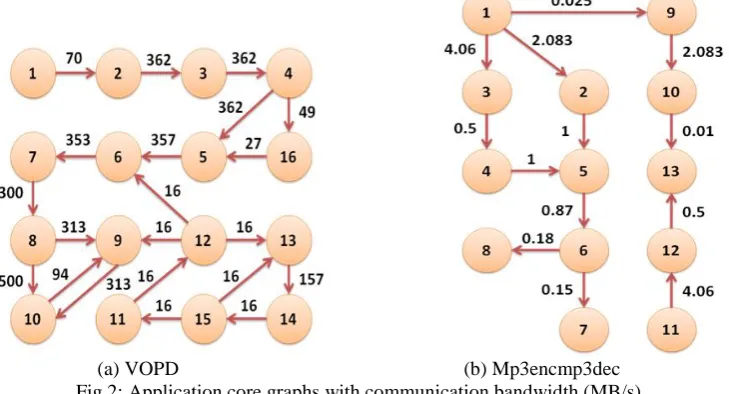
ESULTSIn this section, we present the results of the execution of the genetic algorithm with different operators on two benchmark applications, Video Object Plane Decoder (VOPD) with 16 IP-cores and 20 links and Mp3encmp3dec with 13 nodes and 13 links, which the
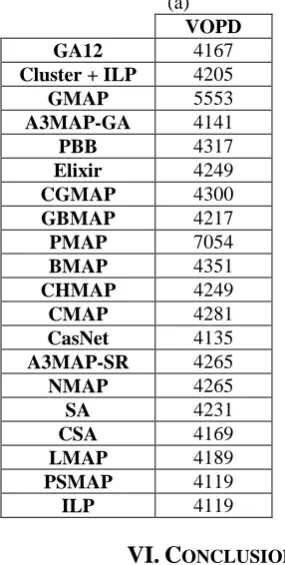
core graphs are shown in fig 2 and the results are illustrated in table II. After wards we compare the best results of the genetic algorithms with those of previous mapping algorithms such as NMAP [24], BMAP [25], PBB [26], etc. using the same routing and scheduling characteristics. The results are presented in table III.
(a) VOPD (b) Mp3encmp3dec Fig 2: Application core graphs with communication bandwidth (MB/s)
Table II: the results of different genetic algorithms for (a) VOPD and (b) mp3encmp3dec (a) (b)
Mean Best
mp3encmp3dec Mean
Best VOPD
17.246 17.246
GA1 4189.455
4125 GA1
20.598 17.196
GA2 4238.455
4141 GA2
17.6595 17.396
GA3 4465.555
4151 GA3
18.9453 17.066
GA4 4257.92
4183 GA4
18.6036 17.546
GA5 4409.135
4215 GA5
18.0634 17.416
GA6 4351.12
4205 GA6
18.2118 17.726
GA7 4310.8
4221 GA7
17.5837 17.066
GA8 4543.79
4323 GA8
18.8842 17.076
GA9 4295.13
4173 GA9
17.962 17.531
GA10 4307
4307 GA10
17.3722 17.346
GA11 4403
4403 GA11
17.179 17.046
GA12 4167
4167 GA12
17.9506 17.531
GA13 4224.625
4167 GA13
18.0034 17.756
GA14 4343.265
4325 GA14
17.5976 17.091
GA15 4357.655
4301 GA15
17.9934 17.726
GA16 4364.98
30.2494 17.601
GA17 7142.785
4613 GA17
32.9243 17.346
GA18 8911.145
4247 GA18
36.6797 17.691
GA19 9215.98
4285 GA19
38.87 17.436
GA20 7653.36
4269 GA20
33.4358 17.761
GA21 7469.005
4339 GA21
36.6493 17.086
GA22 7225.255
4337 GA22
33.745 17.396
GA23 7721.94
4281 GA23
33.1403 17.081
GA24 8609.8
4437 GA24
Table III: the results of different mapping algorithms for (a) VOPD and (b) mp3encmp3dec (a) (b)
Mp3encmp3dec VOPD
17.046 GA12
4167 GA12
18.171 NMAP
4205 Cluster + ILP
17.856 LMAP
5553 GMAP
17.021 PSMAP
4141 A3MAP-GA
17.021 ILP
4317 PBB
4249 Elixir
4300 CGMAP
4217 GBMAP
7054 PMAP
4351 BMAP
4249 CHMAP
4281 CMAP
4135 CasNet
4265 A3MAP-SR
4265 NMAP
4231 SA
4169 CSA
4189 LMAP
4119 PSMAP
4119 ILP
VI.
C
ONCLUSIONIn this paper to validate our approaches, some experiments are done on real core graphs VOPD and Mp3encmp3dec. All of the evolutionary algorithms were carried out for 10 times with 200 initial population and 200 generations. Table II indicates the best and mean results of all proposed algorithms on two real core graphs. Based on the results, it can be concluded that the GA12 is relatively better than the rest of the algorithms in terms of mean communication cost. Also, Table III shows that, our proposed algorithm performs as well as the most algorithms considering their communication costs. In fact, GA12 achieves lower communication cost than the most algorithms. The obtained results have been modeled and simulated by MATLAB, and communication cost parameter has been calculated for the evolutionary algorithms.
A
CKNOWLEDGMENTThis paper is based on the result of the research project named "Improving Communication Cost in Mapping of Application Specific Network-on-Chips Using Machine Learning" which is implemented with financial support of the Islamic Azad University Ramhormoz branch.
R
EFERENCES[1] C. Celik, and C. F. Bazlamacci, “Effect of application mapping on network on chip performance”, in Proceedings of the 20th Euromicro International Conference on Parallel, Distributed and Network-Based Processing (PDP), pp. 465-472, 2012. [2] P. K. Sahu, and S. Chattopadhyay, “A survey on application
mapping strategies for Network-on-Chip design”, in Proceedings of the Journal of Systems Architecture, Vol. 59, No. 1, pp. 60-76, 2013.
[3] S. Murali and G. De Micheli, “Bandwidth Constrained Mapping of Cores onto NoC Architectures”, in Proceedings of the Design, Automation and Test in Europe Conference and Exhibition (DATE), Vol. 2, pp. 896-901, Feb. 2004.
[4] T. Shen, C. H. Chao, Y.K. Lien, and A. Y. Wu, “A New Binomial Mapping and Optimization Algorithm for Reduced-Complexity Mesh-based on-chip Network”, in Proceedings of the First International Symposium Network-on-Chip (NOCS'07), pp. 317-322, May 2007.
[5] J. Hu, and R. Marculescu, “Energy-aware mapping for tile-based NoC architectures under performance constraints”, Asia and South Pacific Proceedings of the ASP-DAC on Design Automation Conference, pp. 233-239, 2003.
[6] N. Koziris et al., “An Efficient Algorithm for the Physical Mapping of Clustered Task Graphs onto Multiprocessors Architectures”, in Proceedings of the 8th Euromicro Workshop on Parallel and Distributed Processing, pp.406-413, 2000. [7] T. Lei, and S. Kumar, “A Two-Step Genetic Algorithm for
Copyright © 2014 IJECCE, All right reserved [8] G. Ascia, V. Catania, and M. Palesi, “Multi-Objective Mapping
for Mesh-Based NoC Architectures”, in Proceedings of the ICHSC/ICSS, 2004.
[9] G. Ascia, V. Catania, and M. Palesi, “A Multi-Objective Genetic Approach to Mapping Problem on Network-on-Chip”, in Proceedings of the JUCS, Vol. 22, No. 4, 2006.
[10] A. H. Benyamina, and P. Boulet, “Multi-objective mapping for NoC architecture”, in Proceedings of the Journal of Digital Information Management, Vol. 5, pp. 378–384, 2007.
[11] R.K. Jena, and G.K. Sharma, “A multi-objective evolutionary algorithm based optimization model for Network-on-Chip synthesis”, in Proceedings of the IEEE International Conference on Information Technology (ITNG), pp. 977–982 , 2007. [12] K. Bhardwaj, and R.K. Jena, “Energy and bandwidth aware
mapping of IPs onto regular NoC architectures using multi-objective genetic algorithms”, in Proceedings of the International Symposium on System-on-Chip (SOC), pp. 27–31, 2009.
[13] F. M. Darbari, A. Khademzadeh, and G. G. Fard, “Evaluating the performance of a chaos genetic algorithm for solving the network on chip mapping problem, in Proceedings of the International Conference on Computational Science and Engineering, pp 366–373, 2009.
[14] F. M. Darbari, A. Khademzadeh, and G. G. Fard, “CGMAP: a new approach to Network-on-Chip mapping problem”, in Proceedings of the IEICE Electronics Express, Vol. 6, No. 1, pp. 27–34, 2009.
[15] G. G. Fard, A. Khademzadeh, and F. M. Darbari, “Evaluating the performance of one dimensional chaotic maps in Network-on-Chip mapping problem”, in Proceedings of the IEICE Electronics Express, Vol. 6, No. 12, pp. 811–817, 2009. [16] M. Tavanpour, A. Khademzadeh, S. Pourkiani, and M. Yaghobi,
“GBMAP: an evolutionary approach to mapping cores onto a mesh-based NoC architecture”, in Proceedings of the Journal of Communication and Computer, Vol. 7, No. 3, pp. 1–7, 2010. [17] G. Fen, W. Ning, “Genetic algorithm based mapping and routing
approach for network on chip architectures”, in Proceedings of the Chinese Journal of Electronics, Vol. 19, No.1, pp. 91–96, 2010.
[18] W. Jang, and D.Z. Pan, “A3MAP: Architecture-aware analytic mapping for Network-on-Chip”, in Proceedings of the Asia and South Pacific Design Automation Conference (ASP-DAC), pp. 523–528, 2010.
[19] N. Choudhary, M.S. Gaur, V. Laxmi, and V. Singh, “Energy aware design methodologies for application specific NoC”, in Proceedings of the NORCHIP, pp. 1–4, 2010.
[20] N. Choudhary, M.S. Gaur, V. Laxmi, V. Singh, “GA based congestion aware topology generation for application specific NoC”, in Proceedings of the IEEE International Symposium on Electronics Design, Test, and Application, pp. 93–98, 2011. [21] M. J. Sepulveda, M. Strum, and W. J. Chau, “A multi-objective
adaptive immune algorithm for NoC mapping”, in Proceedings of the International Conference on Very Large Scale Integration (VLSI-SOC), pp. 193–196, 2009.
[22] M. J. Sepulveda, M. Strum, W. J. Chau, and G. Gogniat, “A multi-objective approach for multi-application NoC mapping”, in Proceedings of the IEEE Latin American Symposium on Circuits and Systems (LASCAS), pp. 1–4, 2011.
[23] M. Janidarmian, A. Khademzadeh, and M. Tavanpour, “Onyx: A new heuristic bandwidth-constrained mapping of cores onto tile based Network on Chip”, in Proceedings of the IEICE Electron. Express, Vol. 6, No. 1, pp.1-7, January 2009.
[24] S. Murali and G.D.Micheli, “Bandwidth-Constrained Mapping of Cores onto NoC Architectures”, in Proceedings of the DATE'04, Vol. 2, pp. 896-901, Feb. 2004.
[25] W. T. Shen, C. H. Chao, Y. K. Lien, and A. Y. Wu, “A new binomial mapping and optimization algorithm for reduced-complexity mesh-based on-chip-network”, in Proceedings of the 1st International Symposium on Network-on-Chip (NOCS'07), June 2007.
[26] J. Hu and R. Marculescu, “Energy-Aware Mapping for Tile-based NoC Architectures Under Performance Constraints”, in Proceedings of the ASP-DAC, pp. 233-239, Jan. 2003.