A Robust PSS Design using GWO in a 3 Machine 9
Bus System
Hema Mali
1, Sagar Trivedi
2, Kapil Parkh
31M.tech Scholar, 2, 3Assistant Professor, Electrical Engineering, SITE,Nathdwara
Abstract: Disturbances due to low frequency oscillations are quite common in power system and it has been dealt with many methods. The most popular among is the inclusion of Conventional Power System Stabilizers (CPSS). Also, the problem has been addressed with other devices too. In the current context of work, CPSS is used too for addressing the low frequency oscillation problems. The CPSS with two stage lead lag block is employed here. As it is well known that to have the better performance from it number of optimization methods has already been used so as to optimize its parameters. Here, the use of novel technique named Grey Wolf Optimization (GWO) has been used for the same.
To test the combination of above two the system considered is 3 machine 9 bus system. Hence power system is modeled as 3 machine 9 bus. It has been tested under three different scenario each with four cases namely base case, case 1, case 2 and case 3. The scenarios are 6 cycle three phase fault disturbances, step increase in mechanical power and combination of two at extreme loading conditions. For each case power values and loadings are different. Here, a deviation of speed is considered in the operation of two machines out three.
The simulation of model has been done through MATLAB/Simulink. The test system has been simulated without any controller, with CPSSs and with GWOCPSSs controller. The results obtained in the different case of studies has been compared and tabulated so as to check and verify how quickly system settles and stabilizes for wide range of operating conditions. In the given way the given controller effectiveness and robustness was tested too.
Keywords: Power System:Power System Stabilizers (CPSSs); 3 machine 9 bus System: Grey Wolf Optimization (GWO)
I. INTRODUCTION
A. Introduction
In today’s world to cope up with the consumer end power demand power systems are interconnected together. Hence, making it a complex network and therefore susceptible to many problems. Also, it is needed to install large generating units and using extra high voltage tie lines as per the today’s requirement. One such problem is the case of instability in power system due to low frequency oscillations ranging from 0.1Hz to 3Hz. In the event of disturbances, power system becomes unstable and the ability of power system to come out of instability is known power system stability. The common disturbances are short circuit, loss of tie line or sudden change in load. But whenever power system encounters such disturbances it variables like rotor angle, power flows and speed deviates from their original value. Hence, analysis of the system is carried regularly so as to get the data on such disturbance and to get the good solution to improve its stability [13].
The power system stability problem can be a concerning issue due to its insufficiency of damping such oscillations. Therefore, generator excitation system is provided with conventional lead lag power system stabilizer (CPSS). It damps out these low frequency oscillationsby introducing a damping torque into generator rotor torque oscillations. It is derived from its speed, power or frequency. There have been many researches on PSS design and methods to tune it’s parameters. Some of the optimization techniques are Genetic Algorithm (GA), Particle Swarm Optimization (PSO), Fuzzy logic, Teacher learner based optimization (TLBO) etc.
Ki ≤ Ki≤ Ki (2)
T1imin ≤T1i≤T1imax (3)
T2imin ≤T21i≤T2imax (4)
T3imin ≤ T31i≤T3imax (5)
T4imin ≤ T4i≤T4imax (6)
II. SYSTEM MODEL
A. Stability of 3 Machine 9 Bus System
To study and understand the power system stability synchronous machine classical model can be utilized during the time where system response mostly relies on rotating masses stored kinetic energy. The time period is oft the order of 1 sec or less than it. It is a very simple model. It can be carried out within a short span of time at minimum cost and also it needs minimum data.
Furthermore, these studies can provide useful information. For example, they may be used as preliminary studies to identify problem areas that require further study with more detailed modeling. Thus, a large number of cases for which the system exhibits a definitely stable dynamic response to the disturbances under study are eliminated from further consideration.
Fig.1 3 Machine 9 Bus System Single Line Diagram
In the above fig.1 shows single line diagram there are three generating units G1, G2 and G3. Also, there are 9 buses in the system (B1, B2, B3, B4, B5, B6, B7, B8 and B9). G1 is considered to be the largest unit out of the three which is connected to B1 and hence it is the slack bus. G2 and G3 are connected on bus B2 and B3 respectively. A, B and C are the loads connected on bus bar 5, 6 and 8.
To understand the stability of present system some data is required. First of all it requires load flow study of the network so as to get Pm of the generators and then to have ∠ for all the units. Load bus data is utilized to obtain loads equivalent impedances. Then, to have system data which is H inertia constant and xd’ direct axis transient reactance. For initial network conditions transmission network impedances and sub transient switching. Also, to know the location and type of disturbance, its switching time and maximum time for the required solution[11].
B. Power System Stabilizer (PSS)
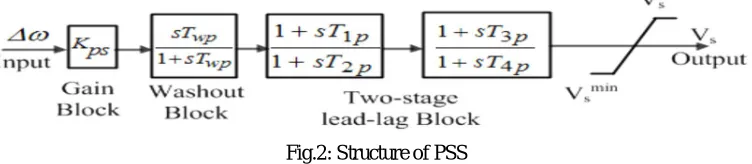
Fig.2: Structure of PSS
The output of PSS VPSS is provided to excitation system where it will add to Vref which is the reference voltage of excitation system.
= K ∆ ̇ − V (7)
= + V − V (8)
= + V − V (9)
III. PSS TUNED BY GWO A. Grey Wolf Optimization (GWO)
This optimization technique is given by Mirjalili. It imitates the grey wolf hierarchy leadership as they are known for group hunting[12]. It is among the newest set of meta-heuristic optimization algorithms. It was developed for solving the double layer grids problem which takes into account the non linearity. Its results are superior to the other algorithms in set. For the first time to learn Multi Layer Perception (MLP) it was used. With reference to the above statement these wolfs live pack and are basically from canidae family. As these, live in pack they have a leader who is Alpha indicating their strict social dominant hierarchy. As Alpha is the leader, most of the decision for group is taken by him. And, hence his decision should be followed by other members of the pack. The common decision involves sleeping place, hunting, waking time etc. The Alpha may not be the strongest member of the pack but the best to manage the whole group. This implies that the discipline and organization in the pack is considered prior to the strength[10]. The pack has subordinates too. These are Betas helping Alpha in the process of making a decision. It means they are advisor. Also, they maintain the discipline in pack. These are also the next in line to become Alpha if the present Alpha passes away or has become old. It obeys the Alpha and gives command to other wolfs. Beta also provides feedback to the Alpha[14].
Wolfs which are at the lowest rank are Omega, which follows all other dominant wolfs. These play the role of scapegoat. They are the last to eat in pack. Omega may be considered least to give any significance but if the pack looses them it may cause an internal fighting. It is because of absence of all frustration and violence of all wolfs by Omegas. It helps in maintaining the dominance structure in the pack as well as satisfaction among them. IN many cases, Omega also plays the role of babysitter.
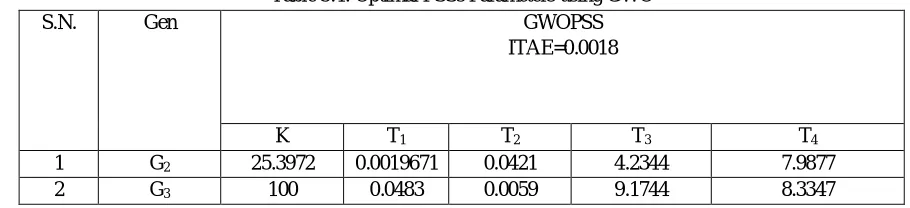
[image:3.595.123.476.611.732.2]If wolf doesn’t belong to any rank then they comes under Delta wolfs which are above Omega wolfs and it means these follows other two ranks in the pack. Wolf falls under this category are Hunters, elders, sentinels, caretakers and scouts. Keeping watch on pack territory and alerting for danger is the responsibilities of Scouts. The duty of guard and providing protection to the pack is done by Sentinels. Elder wolfs are the one who once were Alpha or Beta in their life time and most experienced ones. Hunters Assists Alpha and Beta while hunting and arranging food for the pack. As the name suggest caretakers wolfs take care of wolfs which are weak or ill or wounded in the pack.Fig.3 and table 1 shows convergence of objective function and optimal parameter of PSS tuned by GWO.
K T1 T2 T3 T4
1 G2 25.3972 0.0019671 0.0421 4.2344 7.9877
2 G3 100 0.0483 0.0059 9.1744 8.3347
Group hunting is among the many features of their social environment. The main phases in hunting are, 1) Tracking the prey, then chasing them and at last approaching them.
2) The act of pursuing, encircling and harassing of prey until it stop moving. 3) Last is attack on prey.
B. Algorithm Pseudo code and GWO Flow Chart
1) Grey wolves population is created initially let it be Xi (i=1,2, . . . ., n) 2) α, A and C is initialized.
3) Search agent fitness is calculated,
Xα= best search agent Xβ= 2nd best search agent Xδ= 3rd best search agent 4) while (t< maximum iteration count)
for each search agent
Current search agent position is updated by
⃗( + 1) = ⃗ ⃗ ⃗
end for
α, A and C are updated
all search agents are fitness are calculated Xα, Xβ and Xδ are updated
t=t-1 end while return Xα
IV. RESULT AND DISCUSSIONS
In this section the results of the developed simulation model under different contingencies are presented and discussed. The developed model is simulated without control and with CPSSs & with GWOPSS controller. The responses without and with controller are accessed to test the effectiveness and toughness of the CPSS and GWOPSS controller damping controller and its concert for a wide range of operating conditions for unlike faults.
The Simulation studies are carried out is multi-machine power system 3 machine 9 bus systems. The behavior of system response examined at no control, with CPSS and with GWOPSS controller under different effective conditions viz. base case & other extreme loading condition and obtain various graph as speed deviation of generator (G2, G3).
[image:4.595.67.522.119.223.2]A. MATLAB/SIMULINK Implementation of the no control and CPSS and GWOPSS Damping Controller
Fig. 4: MATLAB/SIMULINK Implementation of the 3 Machine 9 Bus Systems[15]
B. Nonlinear Time-Domain Simulation
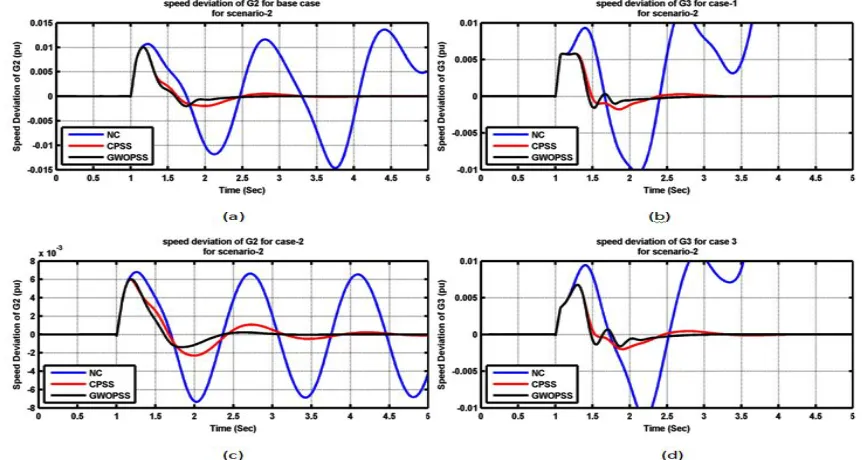
To assess the system performance we apply six-cycle three phase fault disturbance at bus 7 at the end of line 5–7 is considered. The proposed system tested with different scenario with different condition as base case and extreme loading conditions (case-1, case-2, and case-3). The various graphs are shows of speed deviation of generator G2 & G3. The different performance is defined as no control, with CPSSs & GWOPSSs shown by blue, red, black line. Finally we found GWOPSSs shows superior response than other. The system is use objective function of Integral of the Time multiplied Absolute value of the Error (ITAE).The system study with three scenario.The three scenario at three different cases.
1) Scenario 1: To assess the system performance we apply six-cycle three phase fault disturbance at bus 7 at the end of line 5–7 is considered. The proposed system tested with different operating conditions as base case and extreme loading conditions (case-1, case-2, and case-3). The various graphs are shows of speed deviation of generator G2 & G3.
Fig. 5 Scenario 1 for test system 1. a Base case; b case 1; c case 2; d case 3
2) Scenario 2: To assess the system performance we apply at scenario-2, with 0.2 p.u. step increase in mechanical power is
considered. The proposed system tested with different operating conditions as base case and extreme loading conditions (case-1, case-2, and case-3). The various graphs are shows of speed deviation of generator G2 & G3.
The different performance is defined as no control, with CPSSs & GWOPSSs shown by blue, red, black line. Finally we found GWOPSSs shows superior response than other. Fig. 6 shows various graph at different loading conditions.
Fig. 6: Scenario 2 for test system 1. a Base case; b case 1; c case 2; d case 3
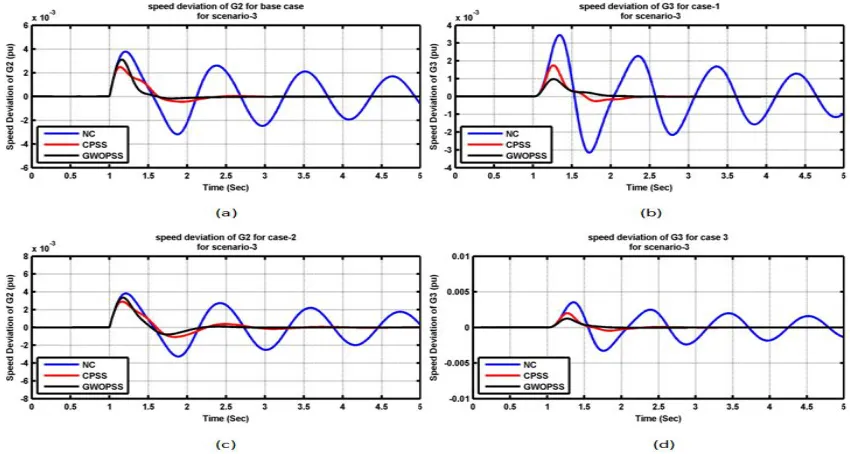
3) Scenario 3:To assess the system performance we apply two types of fault combination of seenario-1 and 2 as 6 cycle fault
[image:6.595.83.514.445.675.2]The various graphs are shows of speed deviation of generator G2 & G3. The different performance is defined as no control, with CPSSs & GWOPSSs shown by blue, red, black line. Finally we found GWOPSSs shows superior response than other. Fig. 7 shows various graph at different loading conditions.
Fig. 7: Scenario 3 for test system 1. a Base case;b case 1; c case 2; d case 3
[image:7.595.50.550.437.758.2]Table 2 shows comparision various settling time at various scenario and different loading conditions.
Table 2: Three Machine 9 Bus Systems at without Controller and with CPSS and GWOPSS Controller at Scenario-1,2 & 3
S.N
. Generator Deviation
Without Controller (Settling Time)
Seconds
With CPSS Controller (Settling Time) Seconds
With Coordinated (GWO PSS) Tuned (Settling Time) Seconds
Scenario1 Scenario2 Scenario3 Scenario1 Scenario2 Scenario3
Base Case
1 Speed deviation G2 Highly
Oscillatory
2.9970 3.1502 2.3786 2.0849 2.4283 2.3261
2 Speed deviation G3 Highly
Oscillatory
3.4738 3.1605 2.7391 2.3255 2.6256 2.6416
Case-1
1 Speed deviation G2 Highly
Oscillatory
2.8766 2.9337 2.3666 2.0607 2.3866 2.2663
2 Speed deviation G3 Highly
Oscillatory
2.8827 3.0274 2.3071 2.3531 2.7151 2.1834
Case-2
1 Speed deviation G2 Highly
Oscillatory
4.4932 4.5972 3.3902 2.8441 2.9046 2.5755
2 Speed deviation G3 Highly
Oscillatory
4.5036 4.5707 3.7499 3.0137 3.0365 2.7364
Case-3
1 Speed deviation G2 Highly
Oscillatory
3.0196 3.1685 2.2890 2.1178 2.5243 2.1848
2 Speed deviation G3 Highly
Oscillatory
scenario 1. In the scenario 2, mechanical power is increased by step of 0.2 pu. As the speed deviates the GWO PSS settles and stabilizes the system fast by 25% to 35% than CPSS for each case. In scenario 3, the combination of above two was put on bus 5 with step increase of 2 pu in mechanical power. With this too GWO PSS is faster than CPSS but in this particular case the former can take the lead by 10% to 20% only for every case shown. Therefore, it was observed that the system with GWO PSS has better and quick response than conventional controller and can stabilize the system quickly.
REFERENCES
[1] SR Paital, PK Ray and A Mohanty, "A review on stability enhancement in SMIB system using artificial intelligence based techniques." In 2018 IEEMA Engineer Infinite Conference (eTechNxT), pp. 1-6. IEEE, 2018.
[2] E Hadavandi, S Mostafayi and P Soltani, "A Grey Wolf Optimizer-based neural network coupled with response surface method for modeling the strength of siro-spun yarn in spinning mills." Applied Soft Computing 72, pp. 1-13, 2018.
[3] AM Baraean and HN Al-Duwaish, "Coordinated Design of a Fuzzy Logic Power System Stabilizer and an SVC-based Stabilizer for Single-Machine Infinite-Bus Power System." In 2018 5th International Conference on Control, Decision and Information Technologies (CoDIT), pp. 464-469. IEEE, 2018.
[4] R Jena, S Chirantan, SC Swain and PC Panda. "Load flow analysis and optimal allocation of SVC in nine bus power system." In 2018 Technologies for Smart-City Energy Security and Power (ICSESP), pp. 1-5. IEEE, 2018.
[5] A Saxena, BP Soni, R Kumar and V Gupta, "Intelligent Grey Wolf Optimizer–Development and application for strategic bidding in uniform price spot energy market." Applied Soft Computing 69, pp. 1-13, 2018.
[6] A. Haldera, N. Palb and D. Mondalc, “Transient Stability Analysis of a Multimachine Power System with TCSC Controller – A Zero Dynamic Design Approach”, Electrical Power and Energy Systems 97, 2018, pp. 51–71.
[7] X Mi, J Wang and R Wang, "Stochastic small disturbance stability analysis of nonlinear multi-machine system with Itô differential equation." International Journal of Electrical Power & Energy Systems 101, pp. 439-457, 2018.
[8] T Guesmi, A Farah, HH Abdallah and A Ouali, "Robust design of multimachine power system stabilizers based on improved non-dominated sorting genetic algorithms." Electrical Engineering, pp. 1-13, 2017.
[9] Sreedivya KM, P A Jeyanthy and D Devaraj, "Fuzzy logic based power system stabilizer for damping low frequency oscillations in power system." In 2017 International Conference on Innovations in Electrical, Electronics, Instrumentation and Media Technology (ICEEIMT), pp. 201-205. IEEE, 2017.
[10] L Rodríguez, O Castillo and J Soria, "Grey wolf optimizer with dynamic adaptation of parameters using fuzzy logic." In 2016 IEEE Congress on Evolutionary Computation (CEC), pp. 3116-3123. IEEE, 2016.
[11]G Ravibabu and T GowriManohar, "Comparative study of FACTS devices used for stability enhancement of off shore integrated multi machine system." In 2016 IEEE 7th Power India International Conference (PIICON), pp. 1-6. IEEE, 2016.
[12] S. S. Shingare, “ Modelling and Analysis of Single Machine Infinite Bus System with and without UPFC for Different Locations of Unsymmetrical Fault”, International Journal of Engineering Research and General Science, Volume 3, Issue 1, pp 418-426, January-February, 2015.
[13] S Sharma and S Narayan, "Damping of low frequency oscillations using robust PSS and TCSC controllers." In Computing, Communication and Networking Technologies (ICCCNT), 2017 8th International Conference on, pp. 1-7. IEEE, 2017.
![Fig. 4: MATLAB/SIMULINK Implementation of the 3 Machine 9 Bus Systems[15]](https://thumb-us.123doks.com/thumbv2/123dok_us/1245716.650965/5.595.38.522.92.550/fig-matlab-simulink-implementation-machine-bus-systems.webp)