3712
©IJRASET: All Rights are Reserved
Façade Cleaning Robotic System
Subhash Sajja
1, Maithili Mhatre
2, Chetana Shinde
3, Prof. Prathamesh Mestry
4, Prathamesh Morye
51, 2, 3, 4, 5EXTC, Vidyalankar Institute Of Technology, Mumbai, India
Abstract: Façade cleaning in most places includes human cleaner therefore studies were conducted to demonstrate the feasibility of a robotic system to act and mimic the human operation. Several robots for façade cleaning have been designed over the years; however, most of the robotic systems are too expensive to be introduced in the market or are incompatible with the shape or height of the facade. Also, most automated systems can only cope with very simple completely flat glass façade. Our project aims at construction of a fully automated façade cleaning robotic system at a lower cost. Since the robotic system is fully automated there is no human intervention required.
Keywords: Façade cleaning robot, Automatic cleaning, Climbing robot, Low cost robotic system
I. INTRODUCTION
The number of buildings with large glass of flat facades is increasing nowadays all over the World. The contemporary high rise buildings with facades require regular cleaning and maintenance of facades due to excessive pollution and dust. The general conventional methods of cleaning of facades usually rely on human worker with gondolas that are suspended by cable driven systems. In these methods the workers work under heavy risk condition and inherently dangerous conditions. The cost of cleaning depends on a lot of factors such as the façade characteristic/material, the cleaning periodicity or the total surface to be cleaned, cost per sq. meter, etc. In India, the cost for façade cleaning varies between Rs.50 to Rs.80 per square meter. The use of automatic or semi-automatic system can lead to around 50% saving over existing practice. There are a lot of problems and risks associated with the current facade cleaning method which is difficult and dangerous. To overcome all these problems we must undertake automated robotic technologies. The robotic technology allows an environmentally friendly façade cleaning service, thus reducing the cost and the current worker safety systems difficulties and dangers. Since there has been a massive increase in the high rise building a lot of effort have been taken place in the previous few years to develop automated cleaning systems.
One example can be considered of World’s tallest building with the total height of 829.8m and a roof of height of 828 m, the Bhurj Khalifa has its facades cleaned in a more traditional way with workers, gondolas, cables not only is extremely dangerous and risky even for a skilled worker but also involves a lot of time. It was estimated that it take about 3months to complete this task. Majority of these systems are in use or in testing phase in Europe, Japan and China. The first automated cleaning system for high-rise building was used in Japan in the middle of the 80’s. Systems like these are mainly designed for specific buildings, meaning, they are designed in such a way that they can be used to clean only that particular building and not the other ones. In the past 10 years, development has been excelled in the field of cleaning automated system. Previously a lot of practical applications of this system mostly failed because of either improper safety concept, expensive initial or operating costs or poor cleaning quality.
II. STRUCTUREOFTHEROBOT
The system completely revolves around the mechatronics zone. The automatic cleaning robotic system consists of a mobile climbing robot, two vacuum pumps, and a bristle brush system.
3713
©IJRASET: All Rights are Reserved
[image:2.595.224.371.122.253.2]Robot structure created using SolidWorks software
[image:2.595.217.381.278.445.2]Figure 1 : Basic Robot Structure
Figure 2 : Testing of the robot
III. COMPONENTSUSED
The major components required in making automatic façade cleaner are:
A. Suction Cups
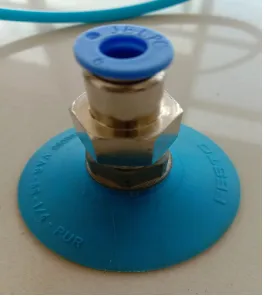
The system uses four suction cups, one in each direction. The suction cups are of FESTO VAS-55-1/4-PUR. These cups are used for adhesion of robot on to the facades of the building. Each cup can hold weight up to 2.5 kg which means four cups can hold a weight on 10 kg. The diameter of each cup is 55 mm. The most comfortable ambient temperature is between -20 to 60oC. The operating
medium is atmospheric air and the operating pressure is -0.95 to 0 bar. The suction cups are made of Polyurethane (PUR) which give a long service life and is useful for a wide range of application.
[image:2.595.233.365.588.736.2]3714
©IJRASET: All Rights are Reserved
B. DC Motor
It is a simple DC motor featuring metal gearbox for driving the shaft of the motor. Basically it is a mechanically commutated electric motor supplied with DC power. The Johnson motor comes with side shaft also known as an off-centered shaft. The shaft of the motor equips metal brushes which makes these dc gear motors Shaft wear resistant. The shaft has a through and through hole for better coupling.
Our system uses a 12 volt 200 rpm Grade A Johnson DC motor is used for the rotational movement of brush.
We use two more Johnson A Grade motor of 60 rpm that operates on 12V. These motors are used to control the horizontal and vertical motion of the robot.
C. Vacuum Pump
The robotic system includes two KYK50BPM 12V DC micro air pump with current rating less then 850mA.the inflammation time required way less than 8.5s (from 0 to 300mmHg in 100CC tank). Ambient temperature for the micro air pump is 0-50oC.
Each pump controls two suction cups. Its main function is to removes air molecules from a sealed volume and leave a partial vacuum behind. Basically, it is used to pull out air and gases from a sealed or cxonfined space due to which the space is left out of any gas and air molecules.
D. Motor Driver
The robotic system implements a Cytron MD13S motor driver to control the speed and the direction of the motors with the help of microcontrollers. We made use of 5 motor drivers, one for each motor. The S in MD13S stands for SMD (Surface Mount Device). It uses a Bi-directional control for 1 brushed DC motor which supports motor voltage range from 6 to 30 V. The maximum current is up to 13A continuous and 30A peak (10 seconds). The speed control PWM frequency is up to 20 kHz.
E. Timing Belt
A timing belt could be a non-slipping mechanical drive belt. The belt itself is made of durable materials like shaped polyurethane, synthetic rubber or welded ester with numerous standard or metric pitches.
3715
©IJRASET: All Rights are Reserved
F. Lithium Polymer battery (LIPO)
12V 8000 mAh LIPO is used to provide power to the DC motor controlling the brush and the two vacuum pumps controlling the 4 suction pads (2 controlled by each pump).
G. Arduino Mega
The Arduino Mega is a microcontroller board based on the ATmega1280. It contains everything needed to support the microcontroller. It is used to control the overall movement of the robot with the help of Arduino coding.
H. Sensor
IR infrared Obstacle Avoidance Sensor Module has a pair of infrared transmitting and receiving sections. The reflected IR waves from the obstacle are received by the receiving system. The on-board comparator circuit does the processing and flashes the green LED. The distance range is from 2 cm to 80 cm. The sensor has a potentiometer which can be adjusted to change the detection distance.
FourInfrared Obstacle Avoidance Sensors are used in the four ends of the robot to detect presence of surface. These sensors help in detecting the end of façade/wall.
IV. ROBOTMECHANISM
The system has two parallel rods both in horizontal and vertical direction. There is a suction pad at each end of the rods to stick and hold the device on the façade. The rods are aligned using sliders. The sliders ensure smooth movement of respective rods. At the center of the system a cleaning brush is placed which is driven by 200 rpm Grade A Johnson DC Motor. The batteries, Arduino mega, vacuum pumps are on the plate placed in the center of the system above the brush.
3716
©IJRASET: All Rights are Reserved
The above steps help in the robotic system to climb and stick to façade.
The infrared obstacle avoidance sensors are used to detect presence or absence of a surface. These sensors will be placed at the end of the rods and will help the system to detect an absence on surface or an end of façade wall. This will help the robot to decide its next direction of motion.
An 8000 mAh LIPO will provide power to the system. The system will be automated and hence every motion of the system will be controlled with an Arduino Mega along with the use of other components.
V. CONCLUSION
The study presents an application of the rising of an on façade cleaning robot for glass and wall clean-up service. It is built with 2 frames, suction cups and motor and will stick to the vertical surface with ease. The suction pads create vacuum pressure used to keep won the vertical wall.
The product of this research is economical and risk-free as compared to other cleaning systems available in the market. This system won’t require any human help to clean the high rise buildings therefore, it avoids any kind of risk or danger to human kind. The system is designed and developed in such a way that it will be inexpensive as compared to the other systems available in the market. The small scale organizations working in glass buildings can easily afford this system since it is cost effective.
VI. ACKNOWLEDGEMENT
We are extremely grateful to our mentor Prof. Prathamesh Mestry and all the other faculty members of Electronics and Telecommunication Engineering Department, Vidyalankar Institute of Technology, Mumbai for their support. This project would never have been successful without their help and guidance.
REFERENCES
[1] Ernesto Gambao, Miguel Hernando and Dragoljub Surdilovic, “Development of a semi-automated cost-effective façade cleaning system” , robotics and automation in construction.
[2] Farsi M. ,Ratcliff K., Johnson P.J., Allen C.R., Karam K.Z., Pawson R.,”Robot control system for window cleaning”, University of Newcastle upon tyne. [3] E. Gambao, M. Hernandez and E. Pinilla, “Cost-effective robots for façade cleaning” .