Proposal for Integrated Rural Development
Programme for Anjaneri Village
Pritam Pagar
1, Rahul Jain
21, 2Town and Country planning Section, Civil Engg Department, SOET Sandip University, Nashik, India
Abstract: In this paper we are studying the integrated rural development is a program concept that covers most of our activities. This means helping rural communities sustainably improve living conditions in all areas of daily life. The aim of this program is to provide opportunities for the poor and develop their skills to improve their living conditions. The program is considered the best program to eradicate poverty-related problems by offering people who have fallen below the poverty line. The village under this project is Anjaneri. There are so many problems that people face in everyday life. The problem of poverty, unemployment, lowers participation of women in other activities, etc. Some of the ways to promote development include empowerment of women, employment opportunities and self-help groups. This concept was to formulate growth strategies for the village in order to make it self-sufficient for the protection of the native occupation and the heritage and monuments of the village. For an integrated program, residents should be trained in various services, and funding agencies, microfinance institutions and NGOs can be addressed to create a financial ecosystem for developing a development chain.
Keywords:Employment, Poverty, Self-help group, Women empowerment and Economic growth.
I. INTRODUCTION
Rural development generally refers to the process of improving the quality of life and economic well-being of people living in relatively isolated and sparsely populated areas. Rural development has traditionally focused on the use of land-intensive natural resources such as agriculture and forestry. Integrated rural development is a program concept that covers most of our activities. This means helping rural communities sustainably improve living conditions in all areas of daily life. The Integrated Rural Development Program (IRDP) was launched in 1978 by the Government of India and implemented in 1980. The aim of this program is to provide poor employment opportunities as well as opportunities to develop their skills to improve their living conditions. The program is considered to be the best program to tackle poverty-related problems by providing those who have fallen below the poverty line with the necessary subsidies linked to job opportunities.
India is a country of villages where more than 68% of the total population live in more than 5.97 lakh villages. As Mahatma Gandhi said, "India lives in its villages" or "India's soul is in villages", which form the backbone of Indian culture, heritage and economics. Agriculture has been practiced in the country since antiquity (from the Harappa civilization), where the communities have settled and civilized the structure of the villages. The social, economic and scientific developments in these communities contributed to the growth of such a village. The first concern of every village will be to cultivate its own food crops and cotton as a material. It should have a reserve for its livestock, recreation and playground for adults and children. As more land becomes available, useful money groups will grow. There will be no castes as we have today, with their graded untouchability. The IRDP is officially described as an important mechanism to combat rural poverty. The main objective of the IRDP is to educate families with target groups below the poverty line by creating sustainable opportunities for self-employment in the rural sector. The program is implemented in all blocks of the country as a centrally funded program, 50% funded by the centres and states. The program is being implemented by district development agencies for rural areas (DRDAs). The DRDA's governing body includes local MPs, MLA, chairmen of Zila Parishad and district development department leaders, SCs, STs and women representatives. At the grassroots level, block staff are responsible for running the program. The State Level Coordination Committee (SLCC) oversees the program at the country level, while the Ministry of Rural Areas and Employment is responsible for releasing the central portion of the funds, policymaking, general guidance, monitoring and evaluation of the program.
II. PROBLEMDEFINITION
C. The basic aim of the study is to find solution on village problems and improve the living standards of habitats in rural areas.
V. METHODOLOGY
This research starts with identifying problem. In first step, Objective should be decided and Literature studied. This will be followed by literature review to get and understand Comparative Study of integrated rural development programme. After identifying the problems and detail literature study, for study area Anjaneri village is selected. After selection of study area, various data are collected through local survey, various meeting with Sarpanch (elected member of village), Gramsevak (appointed by state government), Principal of primary school, local people and Grampanchayat of Anjaneri which includes maps and Basic data. Then Analysis has been done of that collected data. Based on this data analysis proposals have been prepared.
Chart 1 Methodology
VI.STUDYAREAPROFILE A. Study Area
Map 1 Study Area Location
VII. DATACOLLECTIONANDANALYSIS A. Survey Details
Survey and visit gives the real picture of the existing scenario of the village. For Every study data collection is the basic requirement. It is carried out through inventory data studies, field studies, personal interview of the beneficiaries etc. It involves collection of data for studying the past and existing social and demographic characteristics.
The main purpose of this chapter is to establish the study parameters for collection of data. Primary and secondary data is collected to fulfill the requirement.
1) Primary Data: Data which is collected by carrying out site surveys, questionnaire survey, informal questioning.
2) Secondary Data: Data which is collected from government reports, case studies, census data
Meeting with Village Representatives: A formal meeting with Sarpanch and Gramsevak for taking permission regarding the work to be conducted in the village
Preliminary Survey: A Survey to assess the existing conditions of village. The survey covered specific issues like percentage household having private toilets, solid waste management practices, clean surroundings, pure and safe drinking water Facilities. In data analysis the lack of women empowerment contribution has been seen. The percentage of participation of women in all sectors are so less. For that we are proving microfinance group to increase their courage and confidence.
As village having unemployment people, we are giving employment through pradhan mantri employment guarantee programme. In that most of people start their own business by taking loan through banks.
Starting programme of SHGs to empower the women living in the village and 30-35 SHGs can be created in the village and use funds for village development or personal use.
Due to increase percentage of open defecation we are providing community toilets for village. Under swachch bharat mission we are providing three blocks in those 5 cubicles for women, 4 cubicles for men and 2 urinals for men. The fund of 60% is giving by central government and 40% of fund giving by Grampanchayat.
VIII. PLANNINGPROPOSAL
In this chapter present Govt. policy, prepare a proposal on the basis of following policy, National policy for women empowerment, Self-help group, Self-employment under PMRY.
A. National Policy for women Empowerment
Empowerment of Women is a socio-political ideal intended for the broader framework of women's rights. It is a process that causes women to reach their full potential, their right to access opportunities, resources and choices, and the freedom to make decisions both inside and outside their home. Empowerment would only be achieved if the improvement in the living conditions of women is accompanied by their ability to influence the direction of social change achieved through equal opportunities in economic, social and political spheres of life.
A society in which women can develop their full potential and become involved as equal partners in all areas of life and influence the process of social change.
1) Health Including Food Security And Nutrition: The focus on pregnant and lactating women (P & L) will be continued by organizing special health camps to prevent and treat diseases affecting P & L women, such as anemia, low BMI, malnutrition, etc., and special mediation drives of health and nutrition education.
2) Education: Pre-school education in Anganwadi centers will be strengthened and efforts will be made to facilitate access to pre-primary education for girls by involving the community and raising awareness among parents. This improves children's communication and cognitive skills in preparation for entering primary school. This will help older children, especially girls, attend school and prevent their poor performance and early school leavers by relieving them of the responsibilities of sibling care.
3) Poverty: Women make up the majority of the population affected by poverty. Efforts are being made to assess the occurrence of poverty through gender assessments, as budget estimates do not provide estimates of gender poverty. The connection between gender and poverty dynamics is addressed. As poverty rates are not broken down by sex, alternative gender pilot surveys are conducted to examine the differences in well-being between households. All programs to eradicate poverty will focus on women's participation.
Chart 2 Women Perception On Their Rights Of Anjaneri Village
5) Household Empowerment in Anjaneri Village
Chart 3 Economic Development
The graphs above show the percentage of economic development of women with and without powers.
The current village scenario says that 10 to 20% do not decide how to spend money on unauthorized women. If we strengthen women, they decide to 70-80%.
The rights to buy furniture or other items are between 10 and 15% for women without their own authority, and between 75 and 80% for women with their own powers.
The purchase decision for gifts for social functions for unauthorized women is between 10 and 12%, with authorized women accounting for up to 85 to 90%.
6) Social Empowerment in Anjaneri
Chart 4 Social Empowerment
Chart 5 Percentage Of Categories In Anjaneri Village
Chart 6.Poverty Status Of Anjaneri Village
In Anjaneri village there are 77% people are below poverty level where as remaining 32% Are from above poverty level.
a) Strategy: Conceived as a holistic program of self-employment. It covers the areas of self-employment of the rural poor, viz. organizing them in SHGs, infrastructure building-up, technology and marketing support.
b) SHG Formation: In particular SHG members from BPL families, with some exceptions, for some marginal APL families, if acceptable to the BPL members of the group. Group size of 10-20 people, with the exception of deserts, hills and disabled people, where the number of members can vary between 5 and 20. Special attention is paid to the formation of self-help groups for women. 50% of the groups formed in each block should be exclusively for women. SHGs are generally formed by NGOs, CBOs, animators, community-based coordinator networks, or dedicated government officials.
c) Income generating activities (microenterprise selection):First and foremost, a single income generating activity of the group is preferred to the group loan. However, group can go for several activities also in the context of group lending. Thus, IGAs are taken up by the SHG members as group activity.
2) Steps Forming SHG
FIG.1 process of forming SHGs
C. Self-Employment under PMEGP
The Indian government has approved the introduction of a new loan-based subsidy program called PMEGP (Prime Minister's Employment Generation Program), which combines the Prime Minister's programs Rojgar Yojana (PMRY) and Rural Employment Generation Program (REGP) to create job opportunities through the establishment of micro-enterprises in rural and urban areas. PMEGP will be a central sector scheme managed by the Ministry of Micro, Small and Medium Enterprises (MoMSME).
1) Objectives
a) To generate employment opportunities in rural as well as urban through new self-employment /projects/micro enterprises.
b) To bring together artisans in rural and urban unemployed youth and give them self-employment opportunities at their place.
c) To provide continuous and sustainable, so as to help arrest migration of rural youth to urban areas.
2) Scope
a) The scheme is applicable to all viable projects in rural as well as urban areas, under Micro enterprises sector.
b) The maximum cost of the project under manufacturing sector is Rs.25 lakhs and services sector is RS.10 lakhs.
3) Employment status of Anjaneri village
Chart 7 Employment Status
people, NER, mountain and border areas, etc.
5) Financial Institutions a) Public Sector Banks.
b) Regional Rural Banks.
c) Co-operative Bank and Private Sector Scheduled Commercial Banks.
d) Small Industries Development Bank of India.
There are 344 sample projects in various sectors under PMEGP to provide employment in village.
D. Community Toilet For Anjaneri Village
Elimination of open defecation is important components in the development of a village. The provision of providing sanitation facilities through community toilet is suitable option for those who cannot afford Separate toilets.
Chart 8 Percentage Of Toilet In Village
1) Site Selection
a) Size of the toilet blocks as per the user population.
b) Accessibility to users throughout the year.
c) Convenience of the local community should be the main guiding factor in location of a toilet.
d) Site should be finalized with the community.
2) The Facilities To Be Provided a) Separate toilets for men and women.
b) Special seats for children and disabled.
c) Urinal facilities for men.
d) Sufficient storage of water – Overhead tank and sump.
e) The interior should be non-visible from the outside.
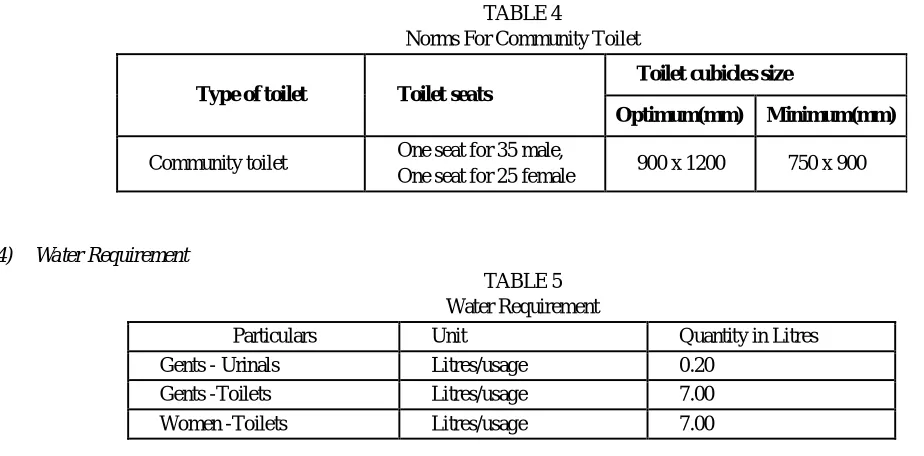
[image:8.595.157.432.412.561.2]3) Norms For Planning Of Community Toilets
TABLE 4
Norms For Community Toilet
Type of toilet Toilet seats
Toilet cubicles size
Optimum(mm) Minimum(mm)
Community toilet One seat for 35 male,
One seat for 25 female 900 x 1200 750 x 900
4) Water Requirement
TABLE 5 Water Requirement
Particulars Unit Quantity in Litres
Gents - Urinals Litres/usage 0.20
Gents -Toilets Litres/usage 7.00
Women -Toilets Litres/usage 7.00
Three toilet blocks with 5 toilet cubicles for women, 4 toilet cubicles for men and 2 urinals for men along with the septic tank are suggested.
IX.CONCLUSIONS
In this study different govt policies and schemes and guidelines for employment, poverty and women empowerment infrastructure. We are study to understand the infrastructure requirement in integrated planning to identify facing problem in the village and to solve them with the help of govt schemes and policies. In this physical planning the women empowerment is measuredly develop with the help of self-help group. Implemented the PMEGP in the village to reduce poverty. For increasing economic development of village we are creating SHGs and PMEGP in village. Providing toilets under Swachh bharat to reduce open defecation.
X. ACKNOWLEDGMENT
I acknowledge to Grampanchayat, anjaneri village Nashik for giving me the valuable data. I eamestly wish to express heartfelt thanks and a sense of gratitude to Mr. Rahul Jain, assistant professor Civil Engineering Department, Sandip University, Nashik.
REFERENCES
[1] Batliwala, Srilatha (1994). ―The meaning of Women‘s Empowerment: New Concepts from Action. ‘‘Pp. 127-138 in Population Policies Reconsidered: Health, Empowerment and Rights. G. Sen, A. Germain, and L.C. Chen, eds. Cambridge, MA: Harvard University Press. B. Bhatta; “Analysis of Urban Growth and Sprawl from Remote Sensing Data,” Springer Berlin Heidelberg (ISBN 978-3642262876)2010.
[2] DFID, (2000), ―Poverty Elimination and the Empowerment of Women: Strategies for Achieving the International Development Targets‖. Landon: DFID. [3] Ackerly, Brooke A. (1995), ―Testing the tools of Development: Credit Programmes, Loan involvement, and Women Empowerment.IDS Bulletin26 (3):56-68. [4] Government of India Guidelines for Swatchha Bharat Mission (Dec 2014).
[5] Acharya, Bennett, (1983), ―Women and the subsistence sector: Economic participation and Household decision making in Nepal. World Bank, Working paper, Number 526.Washington:
[6] NABARD Microfinance Status Report of India, 2011-12.
[7] Planning Commission of India, (2009) ‘A study on Kudumbshree project. A Poverty Eradication Programme in Kerala. Performance, Impact and Lessons for other states ’, Kerala Development Society (KDS-Delhi).