Optimization of Energy Efficiency Based on
Phase Change Materials used in Solar Collector
by Taguchi Method
Yakoob Kolipak1, M.Radhakrishna2, A.M.K Prasad3
1PhD Scholar, 3Professor (Retd), MED, Osmania University, Hyderabad, India 2Head & Chief Scientist-Mechanical Design Engineering Department
CSIR-Indian Institute of Chemical Technology, Hyderabad, India
Abstract— In this study, an attempt is made for optimizing the various Phase Change materials for enhancing the efficiency of Solar Box Collector using Taguchi method. An experimental investigation was carried out on Solar Box Collector using phase change materials. The operating and design parameters considered are Time, Ambient Temperature (oC), Solar Radiation (W/m2), Phase change material (PCM). The experimental runs have been set up using Taguchi Orthogonal array-based design of experiments and the results of temperature gain of the fluid or solid, and useful heat gain for each run has been optimized. The optimum combinations of the parameter for each response have been predicted with respect to Signal to Noise Ratios (S/N). The results have shown that the parameters chosen in this study have a significant influence on the responses chosen and the validation results have shown significant improvement on the Efficiency of the solar box collector.
Keywords: Energy, Efficiency, Phase change material, temperature gain, Solar Box Collector, Optimization, Taguchi method.
I. INTRODUCTION
Worldwide, by 2011 there were about 750 cooling systems with solar-driven heat pumps, and annual market growth was 40 to 70% over the prior seven years. It is a niche market because the economics are challenging, with the annual number of cooling hours a limiting factor. Respectively, the annual cooling hours are roughly 1527 in the Mediterranean, 2500 in Southeast Asia and only 50 to 200 in Central Europe. However, system construction costs dropped about 50% between 2007 and 2011. The International Energy Agency (IEA) Solar Heating and Cooling program (IEA-SHC) task groups working on further development of the technologies involved.[1]A solar chimney (or thermal chimney) is a passive solar ventilation system composed of a hollow thermal mass connecting the interior and exterior of a building. As the chimney warms, the air inside is heated causing an updraft that pulls air through the building. These systems have been in use since Roman times and remain common in the Middle East. Solar process heating systems are designed to provide large quantities of hot water or space heating for nonresidential buildings.[2] Evaporation ponds are shallow ponds that concentrate dissolved solids through evaporation. The use of evaporation ponds to obtain salt from sea water is one of the oldest applications of solar energy. Modern uses include concentrating brine solutions used in leach mining and removing dissolved solids from waste streams. Altogether, evaporation ponds represent one of the largest commercial applications of solar energy in use today.[3] Unglazed transpired solar collectors are perforated sun-facing walls used for preheating ventilation air. Transpired solar collectors can also be roof mounted for year-round use and can raise the incoming air temperature up to 22 °C and deliver outlet temperatures of 45-60 °C. The short payback period of transpired solar collectors (3 to 12 years) makes them a more cost-effective alternative to glazed collection systems. As of 2015, over 4000 systems with a combined solar collector area of 500,000 m2 had been installed worldwide. Representatives include an 860 m2 collector in Costa Rica used for drying coffee beans and a 1300 m2 collector in Coimbatore, India used for drying marigolds.[4] [5].
II.MATERIALSUSEDANDMETHODS
A Solar Box Collector
Solar Box collector is designed and fabricated with marine plywood of 18mm thickness. The dimensions of the solar ox collector are 50x50x20cms (Length x Breadth x height), and the thickness of the box is 30mm. The box is insulated with a thermal coal sheet. Thermo coal sheet and plywood are the bad conductors of heat. The temperature inside the box collector with a single reflector is maintained from room temperature to 1100C. The maximum temperature of air inside the Box collector
Fig. 1. 3D view of Solar Box collector
TABLE 1. THE SPECIFICATIONS OF THE BOX COLLECTOR ARE
S.No. Specification Details
1 The material of the outer box Copper
2 Length 55.5 cms
3 Width 45 cms
4 Height 8.3 cms
5 No. of. reflector plates 4
6 No of Absorber plates 1
7 Inner box paint Black paint
8 Reflector and absorber mirror made Modi Guard
9 Dimensions of Ambient 43 cm x 43 cm
10 The material on the absorber reflector plates Silver
B. PCM Box
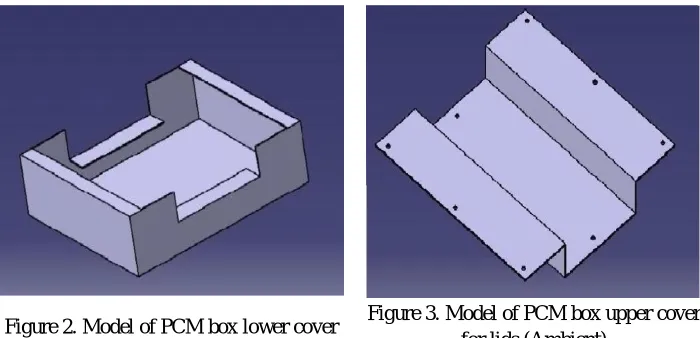
The PCM Box is made of an iron material with dimensions of 42cm x 42cm x 10cm. Thickness of the iron sheet is about 1mm. Eight (8) Holes are drilled on the side of the box of about 5mm diameter to close the top cover e of the box with lower cover.
Figure 2. Model of PCM box lower cover Figure 3. Model of PCM box upper cover for lids (Ambient)
From the Fig.3. the PCM box upper cover plate is a black painted iron sheet with three parts left a flat portion, middle slotted and a right flat portion with the lengths 10.5 cm, 21cms, and 10.5 cms respectively. The height of the slot is 6.2 cms, and the width of the cover plate is 42 cms. In the middle slotted part, the vessels are placed to heat the food items.
[image:2.595.123.473.483.652.2]Figure 4. Paraffin wax Figure 5. Grease Figure 6.A bottle of coconut oil
1) Paraffin Wax (Wax): Paraffin wax is a soft colourless solid, derived from petroleum, coal or shale oil, which consists of a mixture of hydrocarbon molecules containing between 20 and 40 carbon atoms. It is solid at room temperature and begins to melt above approximately 37 °C its boiling point is >370 ° C.
2) Grease: As per the engineering assessment and analysis, Lithium-based greases are the most commonly used; sodium and lithium-based greases have a higher melting point (dropping point) than calcium-based greases but are not resistant to the action of water. Lithium-based grease has a dropping point at 190 to 220 °C; maximum usable temperature for lithium-based grease is 120 °C.
3) Coconut Oil: Coconut oil has been tested for use as a feedstock for biodiesel to use as a diesel engine fuel. In this manner, it can be applied to power generators and transport using diesel engines. Since straight coconut oil has a high gelling temperature (22–25 °C), a high viscosity, and a minimum combustion chamber temperature of 500 °C (to avoid polymerization of the fuel), coconut oil typically is transesterified to make biodiesel.
A Box is a type of solar thermal energy collector. Sunlight is reflected by the side mirrors and focused on to the absorber. Heat transfer fluid (usually water) runs through the plate to absorb the focused sunlight. The heat transfer fluid is then used to generate high-temperature fluid.
C Selection of Orthogonal Array
An Orthogonal Array (OA) is a fractional factorial matrix, which assures a balanced comparison of levels of any factor (or) interaction of factors. It is a matrix of numbers arranged in rows and columns where each row represents the level of the factors in each run and each column represents a specific factor that can be changed from each run. This array is called orthogonal because all columns can be evaluated independently of one another. OA accommodates many design parameters simultaneously. In this experimental work, 4 parameters containing three levels of control factors.
D Parameter Selection
The parameter selection four key operating and design parameters, the mass of solid or fluid, Time (minutes), Temperature of Ambient in o C, Solar Radiation (W/m2), Phase change material (PCM) were selected. These parameters were believed to have a
significant effect on Efficiency and could be tested using the Solar Box Collector. Three levels for all the parameters were considered for Taguchi design experiment.
Performance factors are classified into three categories:
Control factors, which affect process variability as measured by the S/N ratio. Signal factors, which do not influence the S/N ratio or process mean.
Factors, which do not affect the S/N ratio or process mean.
III.EXPERIMENTATION
A Solar Box Collector model has been designed constructed and tested. This model consists of the base unit (wooden support frame), reflecting parts assembly, and heat collection element. The experiments were conducted as per ASHRAE (American Society for Heating Refrigeration and Air conditioning Engineers) to determine the Efficiency of solar Box collector using water as a heat transfer medium. The ASHRAE (86-93/1986) standard testing method stated that the collector must be tested under clear sky conditions to measure Efficiency.
The experimental setup was tested with three different absorber Dimensions and three different temperatures, hence there will be nine combinations of parameters were tested which will be analyzed with the help of Taguchi Method using Minitab software. The Taguchi method was used in determining the optimum useful heat gain according to the S/N ratios and means computed by Minitab software.
Energy input is obtained by
Ei = Is x Asc (1)
[image:3.595.124.470.72.188.2]ASC is area of aperture of solar box collector.
Energy output is obtained by
Eo = mw Cpw (Twf -Twi)/ Δt (2)
where MW is a mass of water: Cpw is specific heat of water: Twf is the final temperature of water: Twi is the initial temperature of
water, Δt is a time difference.
The energy efficiency of the solar collector is the ratio of the energy gained by (energy output) to the energy of the solar radiation (energy input) given as
η = Energy Output/ Energy Input = Eo/ Ei (3)
IV. RESULTS AND DISCUSSION
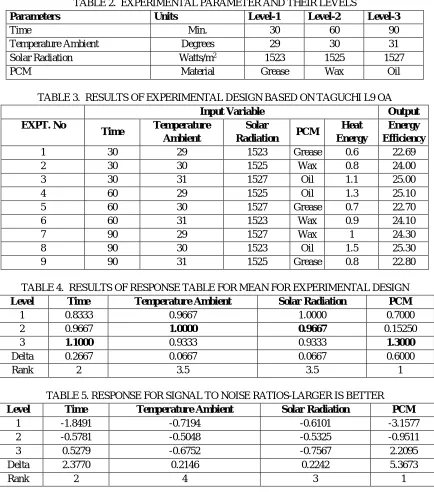
[image:4.595.83.517.256.748.2]As per the Taguchi Method design of the number of runs for the experiments is decided. The experimentation values are tabulated for nine (9) runs. The suitable four (4) parameters are taken into consideration.
TABLE 2. EXPERIMENTAL PARAMETER AND THEIR LEVELS
Parameters Units Level-1 Level-2 Level-3
Time Min. 30 60 90
Temperature Ambient Degrees 29 30 31
Solar Radiation Watts/m2 1523 1525 1527
PCM Material Grease Wax Oil
TABLE 3. RESULTS OF EXPERIMENTAL DESIGN BASED ON TAGUCHI L9 OA
Input Variable Output
EXPT. No
Time Temperature
Ambient
Solar
Radiation PCM
Heat Energy
Energy Efficiency
1 30 29 1523 Grease 0.6 22.69
2 30 30 1525 Wax 0.8 24.00
3 30 31 1527 Oil 1.1 25.00
4 60 29 1525 Oil 1.3 25.10
5 60 30 1527 Grease 0.7 22.70
6 60 31 1523 Wax 0.9 24.10
7 90 29 1527 Wax 1 24.30
8 90 30 1523 Oil 1.5 25.30
9 90 31 1525 Grease 0.8 22.80
TABLE 4. RESULTS OF RESPONSE TABLE FOR MEAN FOR EXPERIMENTAL DESIGN
Level Time Temperature Ambient Solar Radiation PCM
1 0.8333 0.9667 1.0000 0.7000
2 0.9667 1.0000 0.9667 0.15250
3 1.1000 0.9333 0.9333 1.3000
Delta 0.2667 0.0667 0.0667 0.6000
Rank 2 3.5 3.5 1
TABLE 5. RESPONSE FOR SIGNAL TO NOISE RATIOS-LARGER IS BETTER
Level Time Temperature Ambient Solar Radiation PCM
1 -1.8491 -0.7194 -0.6101 -3.1577
2 -0.5781 -0.5048 -0.5325 -0.9511
3 0.5279 -0.6752 -0.7567 2.2095
Delta 2.3770 0.2146 0.2242 5.3673
90 60 30 1 .3 1 .2 1 .1 1 .0 0.9 0.8 0.7 31 30
29 1 523 1 525 1 527 Grease Wax Oil
Time M e a n o f M e a n s
Temperature Ambient Solar Radiation PCM
[image:5.595.163.432.76.253.2]Main Effects Plot for Means Data Means
Figure 7.Main Effects Plot for Means of Energy Efficiency
90 60 30 2 1 0 -1 -2 -3 31 30
29 1 523 1 525 1 527 Grease Wax Oil
Time M e a n o f S N r a ti o s
Temperature Ambient Solar Radiation PCM
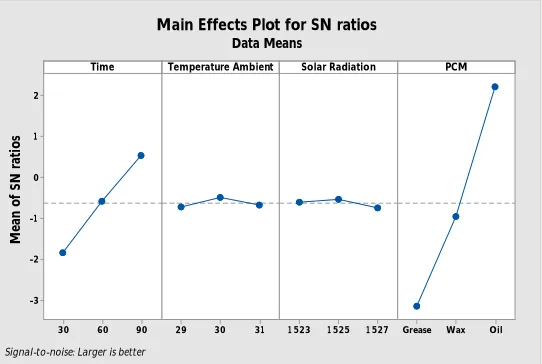
Main Effects Plot for SN ratios Data Means
Signal-to-noise: Larger is better
Figure 8. Main Effects Plot for SN Ratios for Energy Efficiency
From S/N Ratio Graph the combination is A3-B2-C2-D3 which did not match with the experiments of taguchi array, need to go for the confirmation test. Conformation test equation
yopt=m+(mAopt-m)+ +(mBopt-m)+ (mCopt-m)+(mDopt-m) and m= T /N; (4)
Where, m: average performance,
T: grand total of response for each experiment, N: total number of experiments
mAopt: response for parameter A at its optimum level,
mBopt: response for parameter B at its optimum level,
mCopt: response for parameter C at its optimum level,
mDopt: response for parameter D at its optimum level
m (Energy efficiency(Average)) = 0.23
From Table.4, mAopt, mBopt,mCopt and mDopt
Here the best combination found is A3-B2-C2-D3. Substituting the values in equation (4)
yopt = 0.23+(1.1- 0.23)+(1.0 -0.23)+(0.9667-0.23)+(1.3-0.23)
yopt = 3.676.
[image:5.595.164.435.296.478.2]TABLE 6. ANALYSIS OF VARIANCE OF ENERGY EFFICIENCY
Source DF Adj SS Adj MS % Contribution
Time 2 0.08869 0.04434 1.002589845
Temperature Ambient 2 0.00602 0.00301 0.068052665
Solar Radiation 2 0.00602 0.00301 0.068052665
PCM 2 8.74536 4.37268 98.86130483
Error 0 0 0 0
Total 8 8.84609 100
As per the analysis of Variance of Energy Efficiency, the PCM is playing a vital role of 98.861%, Time of 1.002%. In the present work, the thermal performance of a Box type solar collector with a PCM heat storage unit was studied. A simple rectangular PCM heat storage unit was designed to store solar energy during sunshine hours and to cook food in the evening. Noon Heat did not affect evening Heat, and the evening Heat using the PCM heat storage was found to be faster than noon Heat. The PCM did not melt in winter type climate i.e. when the sun is not much effective. In summer, PCM temperatures reached more than 90oC at the time of evening Heat. It is also preferable to use Solar Box heating systems as the general stove is a health hazard and Heat using HC fuel release pollutants, CO etc.
V. CONCLUSION
The Taguchi experimental design was used to obtain optimum heat transfer characteristics of solar Box collector. Experiments were conducted using water as a heat transferring medium. The orthogonal array was selected by using the Taguchi Method. S/N ration was found to find the major influence factors. Larger is the better characteristic is selected, as time is 90 minutes, Temperature of Ambient is 30oC, Solar Radiation is 1525 W/m2 and PCM is Oil. As around 98.861% contribution is by PCM
for energy efficiency.
REFERENCES
[1] Mugnier, D.; Jakob, U. (2012) Keeping Cool with the Sun Archived 2015-05-06 at the Wayback Machine. International Sustainable Energy Review, 6:1, 28-30.
[2] "Solar Process Heat". Nrel.gov. 2013-04-08. Archived from the original on 2013-09-01. Retrieved 2013-08-20. Bartlett (1998), p.393-394
[3] Leon (2006), p.62 "Solar Buildings (Transpired Air Collectors – Ventilation Preheating)" (PDF). National Renewable Energy Laboratory. Retrieved 2007-09-29.
[4] U Ashok Kumar, Prof. P. Laxminarayana "Study of Tool Wear Optimization in Micro Holes Machining of SS316 by Die Sinker Electrical Discharge Machining", International Journal of Scientific Research in Multidisciplinary Studies, Vol.3, Issue.7, pp.1-4, 2017.
[5] U Ashok Kumar, Prof. P. Laxminarayana “Optimization of process parameters of Material Removal Rate in Micro hole Machining by Die-sinker EDM”, IOSR Journal of Engineering (IOSRJEN), Vol. 07, Issue 07 ||V1|| PP 61-65, 2017.
[6] Ahmad Fudholi, Kamaruzzaman Sopian, B. Bakhtyar, Mohamed Gabbasa, Mohd Yusof Othman, Mohd Hafidz Ruslan. Review of solar drying systems with air based solar collectors in Malaysia. Renewable and Sustainable Energy Reviews 51 (2015) 1191–204 https://doi.org/10.1016/j.rser.2015.07.026 [7] Prashant Singh Chauhan, Anil Kumar, Perapong Tekasakul. Applications of software in solar drying systems: A review. Renewable and Sustainable
Energy Reviews 51 (2015) 1326–1337 https://doi.org/10.1016/j.rser.2015.07.025,
[8] N. Nallusamy, S. Sampath, R. Velraj. Experimental investigation on a combined sensible and latent heat storage system integrated with constant/varying (solar) heat sources. Renewable Energy 32 (2007) 1206–1227 https://doi.org/10.1016/j.renene.2006.04.015,
[9] Y. Rabin, I. Bar-Niv, E. Korin and B. Mikic. “Integrated solar collector storage system based on a salt hydrate phase-change material”. Solar Energy Vol. 55, No. 6, pp. 435–444, 1995 https://doi.org/10.1016/0038-092X(95)00074-2,
[10] S.D. Sharma, Takeshi Iwata, Hiroaki Kitano, Kazunobu Sagara. Thermal performance of a solar cooker based on an evacuated tube solar collector with a PCM storage unit. Solar Energy 78(2005) 416–426 https://doi.org/10.1016/j.solener.2004.08.001,
[11] W. Saman, F. Bruno, E. Halawa. Thermal performance of PCM thermal storage unit for a roof integrated solar heating system. Solar Energy 78 (2005) 341–349 https://doi.org/10.1016/j.solener.2004.08.017,
[12] U.Ashok Kumar, Prof. P. Laxminarayana “Optimization of Electrode Tool Wear in microholes machining by Die Sinker EDM using Taguchi Approach, Elsevier - Materials Today: Proceedings 1824-1831 Volume 5, Issue 1, Part 1, Pages 1824-1831, 2018.https://doi.org/10.1016/j.matpr.2017.11.281 [13] U.Ashok Kumar, Prof. P. Laxminarayana “Experimental optimisation of process parameters on micro-hole machining by Die-sinker EDM - International
journal of Advanced Materials Manufacturing & Characterization (IJAMMC), Volume 8, Issue 2, 2018. http://dx.doi.org/10.11127/ijammc2018.09.06 [14] Huseyin Benli, Ayd n Durmus. Performance analysis of a latent heat storage system with phase change material for new designed solar collectors in