Blind, Deaf and Dumb Communicator
Amit Gupta1, Likitha B S2 and Venkatrao P3
1, 2, 3
Department of Electronics and Communication Engineering BNM Institute of technology, Bangalore, Karnataka, India
Abstract: Communication is a major issue for a person who is deaf-mute and is as well blind. According to World Health Organization, about 285 million people are visually impaired worldwide, 466 million people have disabling hearing loss and 1 million people are dumb. In this project, we propose a new system prototype that can help people who are suffering from blindness, deafness and dumbness or any combination of these three disabilities. This system takes the flex sensor input by deaf-mute using the sensor glove that recognizes the hand gestures, text input by blind people using the Braille keypad and speech input by blind and deaf using a mobile app which performs speech-to-text conversion. These inputs are processed and transmitted to cloud using the concept of IoT. The transmitted data is then received and processed to produce three kinds of output. The text output will be displayed on the LCD screen, the speech output is produced using the speaker and the Braille output using six motors arranged in a form so as to resemble the Braille character. This system enables the user to communicate with any person located anywhere across the world having access to the internet.
Keywords: Braille, Sign language, flex sensor, IoT.
I. INTRODUCTION
Communication between deaf, mute and a blind person have always been a challenging task. Science and technology have made human life addictive to comfort but still there exists an underprivileged group of people who are fighting for finding an innovative way that can make the process of communication easier for them.
The blind people can talk freely by means of normal language whereas the deaf-dumb have their own manual-visual language. The only means of communication available to the vocally liable is the use of “Sign Language”. Sign language is the main technique for deaf, dumb communication.
Communication with deaf people becomes more tougher if the distance between them is more. For example, imagine a scenario in which a normal person wants to communicate with a person having a hearing disability situated at a far distance from him, then he won't be able to exchange his/her thoughts. If two deaf/dumb persons are near each other, they can use sign language to communicate, but still this technique is inefficient as both should have deep understanding of sign language. Sign language cannot be recognized by most of the normal people and blind people.
If a person has all three disabilities, for example if a blind person is deaf-mute, then there is no means in which he/she can communicate. Blind people will only be aware of the Braille script and the deaf and dumb people may not be able to understand Braille script. They face difficulties in their way of communication.
This problem motivated us to implement blind, deaf and dumb communicator. The long-term goal is to enable communication between visually impaired (i.e., blind), hearing and speech impaired (i.e., deaf and dumb) people on the one hand and the visually impaired, hearing and speech impaired people on the other.
Currently, there is no means of communication between such people who are unfortunately in significantly large numbers in a country such as India. Our model proposes the solution of inefficient communication between normal and disabled person by implementing a real time system.
II. RELATED WORK
Sign language cannot be recognized by most of the normal people and blind people. Blind people will only be aware of the Braille scripts and the deaf and dumb people may not be able to understand Braille scripts. If a person has all three disabilities, for example if a blind person is deaf-mute, then there is no means in which he/she can communicate. They face difficulties in their way of communication.
step of an automatic translation system able to translate visual speech used by deaf individuals to text, or auditory speech. Such a system would enable deaf users to communicate with each other and with normal-hearing people through telephone networks or through Internet by only using telephone devices equipped with simple cameras. This [7] paper describes the development of an Advanced Speech Communication System for Deaf People and its field evaluation in a real application domain .In particular, for purposes of high availability and disaster recovery, replication of data on cloud storage needs to be implemented efficiently. To that end, in [11] paper, they have investigated the combined problem of uploading IoT data from a set of sensor gateways and efficient replication of data on distributed cloud storage.
III. PROPOSED METHODOLOGY
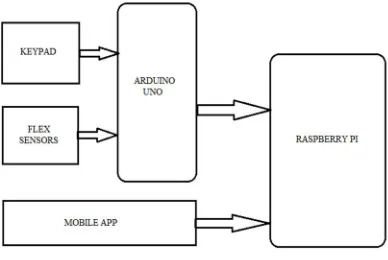
[image:2.612.207.401.268.398.2]The long-term goal is to enable communication between visually impaired (i.e., blind), hearing and speech impaired (i.e., deaf and dumb) people on the one hand and the visually impaired, hearing and speech impaired people on the other. Currently, there is no means of communication between such people who are unfortunately in significantly large numbers in a country such as India. The main aim of the project is to design and develop a user friendly technology to communicate between the deaf as well as dumb person and a blind person.
Figure 1: Transmitter section block diagram
Figure 2: Receiver section block diagram
We have taken into consideration that can arrive in case of the three types of disabilities and facilitate every disabled person and the normal person to communicate with the disabled ones. The person can communicate and transfer the message as per his ability and desire.
[image:2.612.200.411.450.581.2]IV. IMPLEMENTATION RESULTS
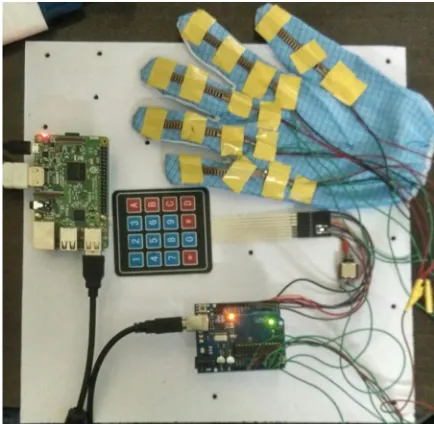
The transmitter device consists of three inputs, out of which the speech input is taken directly and sent to the web server. Another input is taken by a 4 x 4 matrix keypad, a normal keypad with Braille characters stuck over the keys are used in the project to take the input from a blind user. The hand gesture input by dumb people is taken using a hand glove attached with flex sensors on each finger. The flex sensor detects the amount of bend and identifies the message to be transmitted. These two inputs are processed in the arduino circuit board and sent to the web server using the raspberry pi. The experimental set-up of the transmitter device is as follows:
[image:3.612.200.417.169.381.2]
Figure 3: Experimental set-up of transmitter section
Figure 4: Data transmitted to the web server at the transmitter side
Figure 5: Data received by the web server at the receiver side
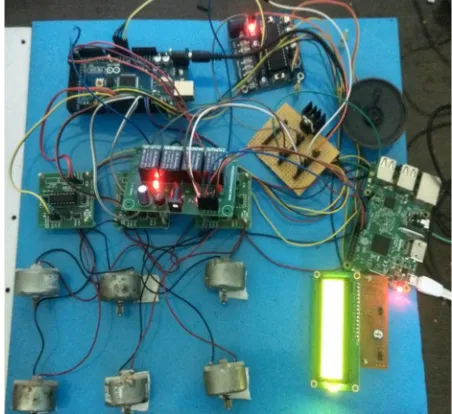
Figure 6: Experimental set-up of receiver section
V. CONCLUSION
As per the design and application of this device, if properly manufactured in small size and in large amount, this device can be manufactured at a very low price with high usability. Using this device, a person can communicate and transfer the message as per his ability and desire. Our proposed system supports real time communication which makes it more efficient.
VI. ACKNOWLEDGEMENT
With due regards, we would like to thank our project guide Mr. P. VENKATRAO, Associate professor, Department of Electronics and Communication Engineering, B N M Institute of Technology, Bengaluru-560070 for his guidance at every step. We would also like to thank our Head of the Department, Dr. P. A. VIJAYA, Department of Electronics and Communication Engineering, B N M Institute of Technology, Bengaluru-560070 for her kind support at every step of this paper. We would like to thank our friends, family members for their extreme support and blessings.
[2] Panikos Heracleous, Hiroshi Ishiguro, Norihiro Hagita, "Visual-speech to text conversion applicable to telephone communication for deaf individuals", Telecommunications (ICT), 2011 18th International Conference, 8-11 May 2011
[3] Moataz Soliman1, Tobi Abiodun1, Tarek Hamouda, Jiehan Zhou1, Chung-Horng Lung, “Smart Home: Integrating Internet of Things with Web Services and Cloud Computing”, Cloud Computing Technology and Science (Cloud Com), 2013 IEEE 5th International Conference,2-5 Dec. 2013
[4] https://cloud.google.com/speech/docs
[5] Pushpanjali Kumari, Pratibha Goel, S. R. N. Reddy, "PiCam: IoT Based Wireless Alert System for Deaf and Hard of Hearing", Advanced Computing and Communications (ADCOM), 2015 International Conference,18-20 Sept. 2015
[6] [6 and Embedded Systems (ICICES), 2016 International Conference, 25-26 Feb. 2016.
[7] Veronica Lopez-Ludena, Ruben San-Segundo, Raquel Martin, David Sanchez, Adolfo Garcia, "Evaluating a Speech Communication System for Deaf People", Intelligent Human-Machine Systems and Cybernetics (IHMSC), 2015 7th International Conference, 26-27 Aug. 2015
[8] https://en.wikipedia.org/wiki/Long-range_Wi-Fi
[9] J. Pickett, "Some applications of speech analysis to communication aids for the deaf", IEEE Transactions on Audio and Electro-acoustics, Volume.17, Issue.4, Dec 1969.
[10] Christian Gehrmann, Mohamed Ahmed Abdelraheem, "IoT Protection through Device to Cloud Synchronization", Cloud Computing Technology and Science (Cloud Com), 2016 IEEE International Conference, 12-15 Dec. 2016