IJEDR1702124 International Journal of Engineering Development and Research (www.ijedr.org) 737
Sensor Network with SGP Mechanism for
Controlling MS using CF Routing
1
Rohit Ritesh,
2Sanjay Prasad,
3Manish kr Yadav,
4Abhishek singh b,
5M.Narendran
1
Student, 2Student, 3Student, 4Student, 5Professor
1
Computer Sc ience And Engineering,
1
SRM Un iversity, Chennai, India
1rohitritesh177@g ma il.co m,2sanjayprasad594@g ma il.co m,3manishyadav1031@g mail.co m
ABSTRACT: Data collect ion and Aggregation is most important task in the wire less sensor network energy saving can be achieved in wire less sensor networks by using mobile Sink (MS) capable of ca rry ing data in unconstrained path. In large –density applications, the sensor node should be transmit the collected data to mobile sink within time constraint. In the existing system, to form a hybrid moving pattern in wh ich a mobile -sin k node only visits rendezvous points (RPs), as opposed to all nodes for data collection. Due to Processing overhead of Rendezvous point is not appropriate for la rge and delay sensitive applications. To overcome this problem, the proposed method is a Clustering Based Weighted Rendezvous Planning (CBWRP) algorithm for sensor networks. The sensor nodes are ordered into clusters. Inside a cluster, nodes transfer data to cluster head (CH) through routing protocol. Cluster Head is elected for each cluster based on the High energy first (HEF) clustering algorith m. This algorith m is used for selecting clu ster head with high ranking of residual energy of each sensor node. This algorith m is used for min imizes the energy depletion throughout sensor network. CH has a responsibility for collecting data fro m each sensor node and transmits data to nearest Rendezvous point. The travelling path of Mobile Sink (MS) to visit a ll Rendezvous point which can be considered as a NP Hard proble m. This proble m taken as delay -aware energy efficient path (DEETP) and solved as Weighted Rendezvous Planning (WRP) algorithm.WRP prefe rentially designates sensor nodes with the highest weight as a RP with distance of RP should be less than of ma ximu m a llo wed tour length. WRP algorith m calcu lating we ight for each sensor node which can be computed by hop distance and number of packets forwarded.
INDEX TERMS: High energy first algorith m; W ire less Sensor Networks; total transmission energy; ma ximu m number of hops; network lifetime
I. INTRODUCTION
Wireless Sensor Networks
A wire less sensor network is a collection of nodes organized into a cooperative network. Every node has its own processing capability, may contain mult iple types of me mory (progra m, data and flash me mories), have a RF transceiver (usually with a single o mni-d irectional antenna), have a power source (e.g., batteries and solar cells), that ma inly accommodates numerous sensors and actuators .Such systems can revolutionize the way to live and work.
Currently, wire less sensor networks are beginning to be deploy ed at an accelerated pace. This can be considered as the Internet becoming a physical network. This new skill is stimu lating with unrestrained prospective for numerous application areas. Most current deployed sensor networks involve re latively s ma ll a mount of sensors, wired to a central processing unit in which every signal processing is performed.
II. LITERATURE REVIEW
A. Rendezvous Planning in Wireless Sensor Network s with Mobile Elements
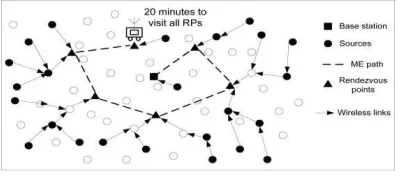
An energy saving can be achieved in wireless sensor networks by using mobile ele ments (MEs) capable of carry ing data mechanica lly. The low move ment speed of MEs hinders their use in data -intensive sensing applications with tempora l constraints. To address this issue, a rendezvous -based approach in which a subset of nodes serves as the rendezvous points (RPs) that buffer data originated from sources and transfer to MEs when they arrive. RPs allo w MEs to collect a large volume of data at a time without traveling long distances, which can achieve a necessary balance betwee n network energy saving and data collection delay.G. Xing at el (2008) formu lates the min imu m-energy rendezvous planning (MERP) problem which aims to find a set of RPs that can be visited by MEs within a required delay while the network energy consumed in transmitting data fro m sources to RPs is minimized.
• They develop two rendezvous planning algorithms: RP-CP and RP-UG. RP-CP catches the optima l RPs when MEs move along the data routing tree. RP-UG is a utility-based acquisitive heuristic that can find RPs with good ratios of network energy saving to ME trave l distance
• They design the Rendezvous-based Data Collection (RDC) protocol that facilitates reliab le data transfers at RPs by efficiently coordinating MEs‟ movement and data transmission/caching in the network
IJEDR1702124 International Journal of Engineering Development and Research (www.ijedr.org) 738 several other schemes in high-bandwidth data collection under tempora l constraints
Fig 1 M E-based data collection
B. Efficient Data Collection in Wireless Sensor Network s with Path-Constrained Mobile Sink s
The sink mobility along a constrained path can improve the energy efficiency in wire less sensor networks. Due to the path constraint, a mobile sin k with constant speed has limited commun ication time to collect data fro m the sensor nodes deployed arbitrarily. Th is poses significant challenges in jointly improving the amount of data collected and reducing the energy consumption. S. Gao at el (2011) proposed a novel data collect ion scheme, termed t he Ma ximu m A mount Shortest Path (MASP), that increases network throughput as well as conserves energy by optimizing the assignment of sensor nodes.
Path-Constrained Sink Mobility
Predictable sink mob ility is e xplo ited to improve energy effic iency of sensor networks. A mobile sink is fitted on a public transport vehicle which moves along a fixed path at times. However, a ll sensor nodes can only transfer data to the single mobile sink in one-hop mode. Actually, single-hop co mmunication between all sensor nodes and the mobile sink may be infeasible due to the limits of existing road infrastructure and communication control. An architecture of wire less sensor networks with mobile sinks is proposed for a traffic investigation application. However, it is also assumed that all sensor nodes in MSSN a re located within the direct commun ication range of the mobile sink.
Path-Controllable Sink Mobility
Most of the current work about path-controllable sink mobility has focused on how to design the optima l trajectories of mobile sinks to imp rove the network performance. Mobile e le ment scheduling problem is studied, where the path of the mobile sin k is optimized to v isit each node and collect data before buffer overflows occur. The work is e xtended to support
Fig 2 An e xa mple of path-constrained mobile WSNs
C. Maximizing the Lifetime of Wireless Sensor Network s with Mobile Sink iIn Delay -Tolerant Applications
This paper proposes a frame work to ma ximize the lifetime of the wire less sensor networks (WSNs) by using a mobile sink when the underlying applications tolerate delayed information delivery to the sink. Inside a prescribed delay tolerance level, each node does not need to throw the data immediately as it becomes available. Instead, the node can store the data for the time being and transmit it when the mobile sink is at the most favorable location for achieving the longest WSN lifetime . To find the best solution within the projected fra me work, optimizat ion proble ms that ma ximize the lifetime of the WSN subject to the delay bound constraints, node energy constraints, and flow conservation constraints.
IJEDR1702124 International Journal of Engineering Development and Research (www.ijedr.org) 739 III. PROBLEM STATEMENT
Several studies have demonstrated the benefits of using a mobile sink to reduce the energy consumption of nodes and to prevent the formation of energy holes in wireless sensor networks (WSNs). However, these benefits are dependent on the path taken by the mobile sink, ma inly in delay-sensitive applications, as all sensed data must be composed within a given time constraint. An approach projected to address this challenge is to form a hybrid moving pattern in which a mobile -sink node only visits rendezvous points (RPs), as opposed to all nodes. Sensor nodes that are not RPs forward their sensed data via mu lti hopping to the nearest RP. The essential proble m then becomes computing a tour that visits all these RPs within a given delay bound. Determining the opt ima l tour, however, is an NP-hard proble m. To deal with this problem, a methodology called weighted rendezvous planning (WRP) is proposed, whereby every sensor node is assigned a weight corresponding to its hop distance fro m the tour and the number of data packets that it forwa rds to the closest RP.
In WSNs with a mobile sin k, one funda mental proble m is to determine how the mobile sink goes about collecting sensed data. One approach is to visit each sensor node to receive sensed data directly. This is esse ntially the well -known traveling salesman proble m (TSP), where the goal is to find the shortest tour that visits all sensor nodes. To this end, researchers have proposed the use of rendezvous points (RPs) to bound the tour length. This means a subset of s ensor nodes are designated as RPs, and non-RP nodes simply forward their data to RPs.
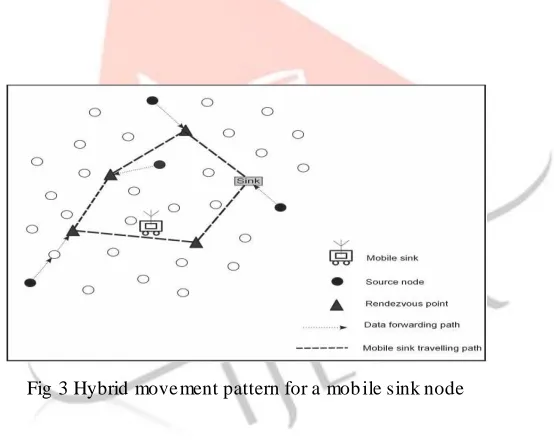
A tour is then computed for the set of RPs, as shown in Fig 3.1. As a result, the problem, which is ca lled rendezvous design, becomes selecting the most suitable RPs that minimize energy consumption in mult ihop communications while meet ing a given packet delivery bound. A secondary problem here is to select the set of RPs that result in uniform energy e xpenditure a mong sensor nodes to ma ximize network lifetime . An DEETP is an NP hard p roble m and propose a heuristic method, which is called weighted rendezvous planning (WRP), to determine the tour of a mobile -sink node. In WRP, the sensor nodes with more connections to other nodes and placed farther fro m the co mputed tour in terms of hop count are given a higher prio rity
Fig 3 Hybrid move ment pattern for a mob ile sink node
Disadvantages
• Rendezvous points can collects the data from nodes directly instead of Cluster Head
• Mobile Sin k‟s range or heavy involvement of network periphery nodes in data retrieval, processing, buffering, and delivering tasks
• These nodes run the risk of rapid energy e xhaustion resulting in loss of network connectivity and decreased network lifetime
• The specification of the appropriate nu mber and locations of rendezvous Points (RPs) is crucial.
IJEDR1702124 International Journal of Engineering Development and Research (www.ijedr.org) 740 IV. ANALYS IS
In large –density applications, the sensor node should be transmits the sensed data to mobile sink within time constraint. The proposed system the cluster head transmits to Rendezvous point rather than all sensor nodes. Due to Processing overhead of Rendezvous point is not appropriate for la rge and delay sensitive applications. To overcome this problem, the proposed method is a Clustering Based Weighted Rendezvous Planning (CBW RP) a lgorith m for sensor networks. The sensor nodes are organized into clusters. Within a cluster, nodes transmit data to cluster head (CH) through routing protocol. In the clustering process, Cluster Head is elected for each cluster .CH have a responsibilit ies for collecting data fro m each sensor node and transmits d ata to nearest Rendezvous point.
High energy first (HEF) clustering algorithm is used for selecting cluster head with high ranking of residual energy of each sensor node. This algorithm is used for minimizes the energy depletion throughout sensor network field. The travelling Path of the Mobile Sink to visit all Rendezvous point which can be considered as a NP Hard problem. This problem ta ken as delay-aware energy effic ient path (DEETP) and solved as Weighted Rendezvous Planning (WRP) algorith m.W RP algorithm calcu lating weight for each sensor node which can be co mputed by hop distance and number of packets forwarded.
HEF Clustering
HEF (High Energy First) is used for electing cluster head. This algorithm chose the highest ranking residual energy node as cluster head. HEF is a centralized cluster selection algorithm. It can also be imple mented in a distributed manner by means of synchronization approach. HEF selects the set of M highest ranking energy residue sensors for cluster heads τ at round where M denotes the required cluster numbers at round t. HEF is designed to select the cluster head based on the
Advantages
• HEF algorith m used for evaluate the effic ient CH selection for achieving energy efficient wire less sensor network
• Th is method proved that the network lifetime can be efficiently prolonged and minimizes energy consumption • An algorithm can work very we ll to prolong the network lifetime for a period of t ime, a possible failure can be
catastrophic, resulting in the fa ilure of a mission, or the loss of human life
V. ARCHIT ECTURE
The proposed system consists of four modules and each module is dependent. Each module process an input taken fro m output of the previous partition. The flow of process can be executed a nd some modules have iterative process. The modules are,
Node Creat ion And Configuration Clustering
Cluster Head Se lection Mobile -Sink Tour
A. Node Creation and Configuration
Start to proceed with the initialization script for NS -2 objects for configuring the parameters. The needed number of nodes is generated by using the node command in NS2. The nodes are disseminating in a wireless environment. The random motion is set as false. So, the nodes are not moving in a random direction. Each node is considered as an autonomous node. The nodes are configured as to process in WSN environment. The node configuration is done by using node-config command. For configuration, to specify th e Channel used by the node, Radio propagation model, Link layer type, Physical layer type, Type of interface queue and the protocol used to route the packets dynamically. To specify parameters for the simulation are declared, to describe the desired topolo gy and protocol stack.
B. Clustering
Sensor nodes grouped into clusters and each cluster have a leader called Cluster Head (CH).CH nodes aggregate the data and transmit the m to the base station (BS) either direct ly or other CH nodes. High Energy First (H EF) algorithm used for evaluates the efficient CH selection for ach ieving energy efficient wireless sensor network. This method proved that the network lifetime can be e fficiently p rolonged and minimizes energy consumption.
IJEDR1702124 International Journal of Engineering Development and Research (www.ijedr.org) 741 ranking residue energy of sensor as a cluster head. Energy for each sensor node can be computed by Energy Consumption model wh ich have transmitted power, receive powe r and sense power.
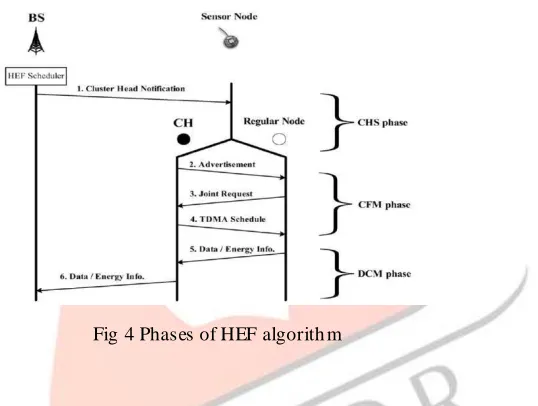
HEF algorith m consists of one or more rounds for CH selection to minimizing energy depletion. HEF selects cluster heads according to the energy remain ing for each sensor node, and then the “setup” message (indicating cluster members, and the cluster head ID for each part icipated group) is sent to the cluster head of each cluster.Each round comprises the following three phases:
Cluster Head Se lection(CHS) Phase Cluster Format ion(CFM) Phase Data Co mmun ication(DCM) Phase
Conditions of HEF Algorithm
Each node works as a clustered node or a regular sensor node in a round. Ec >=Er
where Ec -energy consumption for cluster rate. Er- refe rs energy consumption for regula r node
Fig 4 Phases of HEF algorith m
Steps of HEF Algorithm
• The cluster head of each group broadcasts the “setup” message inviting the neighbor sensor nodes to join its group
• After receiving the “setup” message at this round, the regular sensors send the “join” message to its corresponding cluster head to commit to associate with the group
• Each cluster head acknowledges the commitment, and sends TDMA schedule to its cluster members • A ll sensors perform its sensing and processing and communication tasks cooperatively at this clock cycle
(round)
• Each sensor sends its energy information to its cluster head at the end of this clock cycle
• Upon collecting cluster members‟ information at a g iven period, the cluster head sends the summative report to the base station
C. Cluster Head Selection
WRP prefe rentially designates sensor nodes with the highest weight as a RP. The we ight of a sensor node is calculated by mu ltiply ing the number of packets that it forwards by its hop distance to the closest RP on the tour. Thus, the weight of sensor node i is ca lculated as,
Wi = NFD (i) × H (i, M) eq (1) where H(i,M ) = {hi,mj|¥ mk € M,hi,mj≤ hi,mk} eq (2)
hi,j is the hop distance between nodes i and j
NFD (i) = C (i, Tmj) +1 eq (3)
IJEDR1702124 International Journal of Engineering Development and Research (www.ijedr.org) 742 corresponding RP mj.
Based on eq (1), sensor nodes that are one hop away from an RP and have one data packet buffered get the minimu m weight. Hence, sensor nodes that is farther away from the selected RPs or has more than one packet in their bu ffer have a higher priority of being recruited as an RP. The energy consumption is proportional to the hop count between sou rce and destination nodes, and the number of forwarded data packets. Hence, visit ing the highest weighted node will reduce the number of mult ihop transmissions and thereby minimizes the energy consumption.
In addition, as dense areas give rise to congestion points due to the higher number of nodes, energy holes are more like ly to occur in these areas. Hence, a mobile sink that preferentially visits these areas will prevent energy holes from forming in a WSN. W RP A lgorith m ta kes as input G (V, E), and it outputs a set of RPs. WRP first adds the fixed sin k node as the first RP. Then, it adds the highest weighted sensor node. After that, WRP ca lls TSP to ca lculate the cost of the tour. If the tour length is less than the required length ma ximu m len gth of traveled path, the selected node as an RP. Otherwise, it is re moved fro m the tour.
After a sensor node is added as an RP, W RP re moves that RPs from the tour that no longer receives any data packets fro m sensor nodes. This is because adding a sensor node to the tour may reduce the number of data packets directed to this RPs. Consequently, this step affords WRP more opportunities to add other nodes into the tour. Note that the variable “removed” is used to guarantee that an RP will be deleted fro m the tour only once. If a removed RP is added to the tour for the second time, because its corresponding variable “re moved” is true, it will not be removed fro m the tour again. In this way, all sensor nodes will be added to the tour when the required tour length for a mobile sink is bigger than the time to visit all sensor nodes.
D. Mobile-Sink Tour
There are two types of sinks which one can be act as mobile ele ment and other one act as Base Station. Travelling Sales man proble m (TSP) used to find a shortest path for visiting all Rendezvous points by a Mobile -Sink node.A mobile sink that preferentially visits areas of RP will prevent energy holes from forming in a WSN. In clustering purpose only all the sensor nodes send its data‟s to cluster head and cluster head sends the data‟s to appropriate rendezvous point and mobile sink node travel along the network and collect the data‟s from rendezvous point. This process to effectively save the energy of network.
During simu lation time the events are traced by using the trace files. The performance of the network is evaluated by e xecuting the trace files. The events are recorded into trace files while e xecuting record procedure. In this procedure, the events trace like packet received, Packets lost, Last packet received time etc. These trace values are write into the trace files. It produce Performance analysis graph for average energy consumption between WRP and CBWRP.
VI. CONCLUS ION AND FUT URE WORK
An WRP, which is a novel algorith m for controlling the movement of a mobile sink in a WSN. W RP selects the set of RPs such that the energy expenditure of sensor nodes is minimized and uniform to prevent the formation of energy holes while ensuring sensed data are collected on time. The proposed method is a Clustering Based Weighted Rendezvous Planning (CBWRP) a lgorith m for sensor networks. The sensor nodes are organized into clusters. Within a cluster, nodes transmit data to cluster head (CH) through routing protocol.HEF c lustering algorith m is to choose the highest -ranking residue energy of sensor as a cluster head. This algorithm is used for min imizing energy depletion and ma ximizing the network lifetime. A mob ile sink that preferentia lly visits areas of RP will prevent energy holes from forming in a WSN.
IJEDR1702124 International Journal of Engineering Development and Research (www.ijedr.org) 743 REFERENCES
[1] G. Xie, F. Pan: “ Cluster-Based Routing for the Mobile Sink in Wireless Sensor Networks With Obstacles”, IEEE Access, vol. 4, no.16026224, pp.2019-2028
[2] J. C. Cuevas-Martinez, J. Canada-Bago, J. A. Fernandez-Prieto, and M.A.Gadeo-Martos,„„Knowledge- baseddutycycleestimationinwireless sensor networks: Application for sound pressure monitoring,‟‟ Appl. Soft Comput., vol. 13, no. 2, pp. 967 –980, 2013
[3] Hamidreza Salarian, Kwan-Wu Chin, and Fazel Naghdy , "An Energy Efficient Mobile Sink Path Selection Strategy for Wireless Sensor Networks," IEEE Trans. Vehicular T echnology, vol. 63, no. 5, pp. 2407–2419, June 2014
[4] S. Gao, H. Zhang, and S. Das, “ Efficient data collection in wireless sensor networks with path -constrained mobile sinks,” IEEE Transactions Mobile Computing, vol. 10, no. 4, pp. 592–608, Apr. 2011.
[5] W. Liang, J. Luo, and X. Xu, “Prolonging network lifetime via a controlled mobile sink in wireless sensor networks,” in P roc. IEEE Global Telecommunications Conf., Miami, FL, USA, pp. 1–6, Dec. 2010.
[6] K. Almi‟ani, A. Viglas, and L. Libman, “Energy-efficient data gathering with tour length-constrained mobile elements in wireless sensor networks,” in Proc. 35th IEEE Conf. LCN, Denver, CO, USA, pp. 582 –589, Oct. 2010.
[7] Y. Yun and Y. Xia, “ Maximizing the lifetime of wireless sensor networks with mobile sink in delay-tolerant applications,” IEEE Trans. Mobile Computing, vol. 9, no. 9, pp. 1308–1318, Sep. 2010.
[8] G. Xing, T. Wang, Z. Xie, and W. Jia, “Rendezvous planning in wireless sensor networks with mobile elements,” IEEE Trans. Mobile Computing, vol. 7, no. 12, pp. 1430–1443, Dec. 2008.
[9] S. Basagni, A. Carosi, E. Melachrinoudis, C. Petrioli, and Z. M. Wang, “Controlled sink mobility for prolonging wireless sensor networks lifetime,” Wireless Networks, vol. 14, no. 6, pp. 831–858, Dec. 2008.