Equatio n C hapter 1 Section 1
Assessing the Accuracy of Loss Estimation Methods for Supercapacitor
Energy Storage Devices Operating under Constant Power Cycling
Ponggorn Kulsangcharoen
1, Christian Klumpner
1, Mohamed Rashed
1, Greg Asher
1George Z. Chen
2and Stuart A. Norman
31
Department of Electrical and Electronic Engineering
2Department of Chemical and Environmental Engineering
Faculty of Engineering, University of Nottingham
University Park, Nottingham, NG7 2RD, UK
3
E.ON Technologies Limited, E.ON Technology Centre
Ratcliffe on Soar, Nottingham, NG11 0EE, UK
Tel.: +44(0)115 846 6118
Fax.: +44(0)115 951 5616
Email:
[email protected]
URL:
http://www.nottingham.ac.uk/eee/
Acknowledgements
The project this report is based on was funded by E.ON as part of the E.ON International Research Initiative. Responsibility for the content of this publication lies with the author.
Keywords
«Efficiency», «Energy storage», «Estimation technique», «Power cycling», «Supercapacitors»
Abstract
This paper assesses different energy loss estimation methods using the supercapacitor model parameters extracted from the electrochemical impedance spectroscopy (EIS). Two energy loss estimation methods are applied to two similar supercapacitors from different manufacturers operating under constant power charge-discharge cycling. The simpler loss method uses only the impedance data that corresponds to the cycle frequency and the instantaneous current data whilst the more complex method uses the detailed impedance vs frequency dependency and the corresponding current harmonics available from the FFT. The experimental loss data (the benchmark) uses integration of instantaneous power processed by the supercapacitor. By comparing the difference between the estimated and the experimental losses, the performance of each method is assessed and the factors that influence the accuracy of the two loss estimation methods as well as their limitations are highlighted.
Introduction
(i.e. changes in impedance with temperature or bias voltage) may have a positive effect (when it reduces) on the losses of a given SC technology/manufacturer but may have a negative effect (when it increases) on another since each manufacturer uses different device structures/electrolyte/electrode materials. Therefore, it is important to perform a full SC characterization under various/relevant testing conditions to ensure that the SC efficiency can be maximized before they are deployed in a given application as part of an energy storage system (e.g. hybrid vehicle).
In the research literature, there are two common approaches used in SC characterization, which are small-signal and large-signal. For the small-signal approach, the SC impedance versus frequency is first determined using the electrochemical impedance spectroscopy technique. Then the SC impedance information can be used to determine the SC detailed equivalent models [1,6] and/or used directly to estimate SC power loss and efficiency [3,7,8]. For the large-signal approach, high current/power is applied to SCs directly in charge-discharge cycling pattern [6] and by calculating the SC in&out energy over a single charge-discharge cycle, SC efficiency and energy loss can be determined. To validate a given SC model, two independent approaches are usually employed and their results are cross evaluated for consistency. In [7,8], the SC efficiency and energy loss is estimated from the SC voltage obtained during the charge-discharge cycling test and the SC impedance from the EIS test. However, this method cannot determine SC energy loss precisely (>10-20% overestimate) since its formula is limited to use of a single set of RC parameter that correspond to the frequency of the charge-discharge cycling period. In addition, the minimum/maximum voltages across the bulk capacitance that correspond to the end/beginning of SC charge-discharge cycling used in the formula cannot be measured directly since they are subjected to voltage drop due to the series resistance. In [3], the SC efficiency and energy loss is estimated from the SC current during the charge/discharge tests and the SC high-order equivalent model obtained from the SC impedance modeling process. The errors that appear are due to the curve fitting algorithm required in the modeling process and the error due to the impedance versus frequency measurement and interpolation. Since a typical application requires the SC to charge-discharge over a relatively fixed duration of tens of seconds, the order of the SC model can be reduced to account for the relevant frequency range of the SC impedance, therefore the fitting algorithm can be simplified with reduced loss of accuracy. The simplified SC RC model is preferred in [6], which uses this approach to calculate an equivalent resistance that is highly dependent on the harmonic content of the SC current and the frequency and therefore cannot be used for generalized load conditions. The variation of the SC resistance with bias voltage was not considered.
In this paper, two SC current-based loss estimation techniques are evaluated. First, the SC characteristics of two devices similar in performance but from different manufacturers are determined using the electrochemical impedance spectroscopy (EIS). The two devices are then subjected to a charge-discharge constant power cycling (CPC) test but the result related to the accuracy of the estimated losses are inconclusive. A second set of tests is conducted, subjecting the device to pulse like stresses, which are more likely to mirror stresses from real applications. The more elaborate loss estimation technique is now proving more accurate. The SCs used in this evaluation are the Maxwell®
BCAP100 100F 2.7V that will be referred as M-SC and the Ioxus® RSC2R7107SR 100F 2.7V SC,
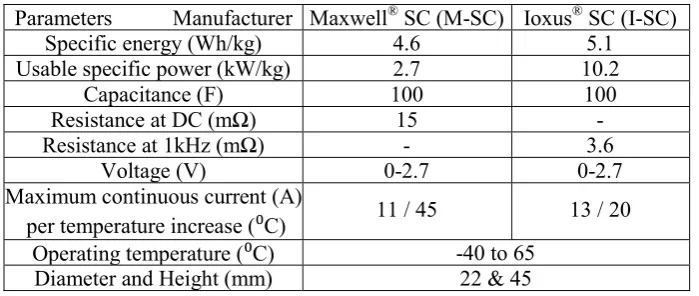
[image:2.595.124.474.619.767.2]which will be referred as I-SC. Their specifications are shown in Table I.
Table I Specifications of the supercapacitor devices under test
Parameters Manufacturer Maxwell®SC (M-SC) Ioxus®SC (I-SC) Specific energy (Wh/kg) 4.6 5.1 Usable specific power (kW/kg) 2.7 10.2
Capacitance (F) 100 100
Resistance at DC (mΩ) 15 - Resistance at 1kHz (mΩ) - 3.6
Voltage (V) 0-2.7 0-2.7
Maximum continuous current (A)
per temperature increase (⁰C) 11 / 45 13 / 20 Operating temperature (⁰C) -40 to 65
Device Characterization using the electrochemical impedance spectroscopy
(EIS) method
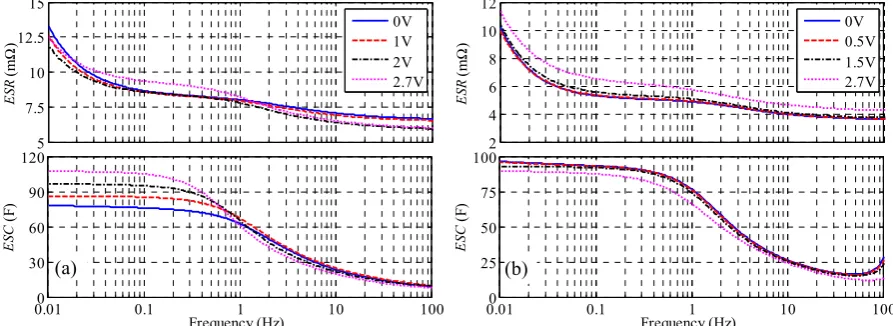
The EIS method applies a very small sinusoidal voltage signal to a single SC cell (e.g. 10 mV) and the current response signal is recorded. Both the voltage and the current information are used to extract the SC impedance change over a range of testing frequencies. The technique is very useful as it can be applied at various fixed bias voltage levels and at various fixed-temperature conditions [1,2]. From the SC impedance-frequency profiles, the SC equivalent models can be derived, which can be used to estimate efficiency and energy loss in corresponding to any given current and power profiles [3]. In this work, the Bio-logic SP-150 Potentiostat/Galvanostat machine equipped with a 20A current booster is used to perform the EIS tests, which has an impedance accuracy of <1% as stated in its specification. The EIS method is applied to M-SC and I-SC at various bias voltage and temperature conditions. The impedance results of both SCs are represented by using a single series-connected RC model are shown in Fig. 1 and Fig. 2 where ESR is the equivalent series resistance and ESC is the equivalent series capacitance.
Fig. 1(a) shows that as the bias voltage increases from 0V to 2.7V, the M-SC ESR@10mHz decreases from 13.3mΩ to 12.5mΩ (-6.2%) and its ESC@10mHz increases from 78F to 107F (+31%). When compared to the 0V bias parameters, these variations mean that as the device charges, the power circulation causes less loss due to lower ESR and also the capability of the device to store energy increases due to higher ESC. At 2V bias, as frequency increases from 10mHz to 100mHz, the ESR
reduces to 72.5% (11.9mΩ@10mHz/8.6mΩ@100mHz). On the other hand, from Fig. 1(b) shows that as the bias voltage increases from 0V to 2.7V, the I-SC ESR@10mHz increases from 10mΩ to 11mΩ
(+10%) and its ESC@10mHz decreases from 96F to 89F (-7.5%). At 1.5V bias, as frequency increases from 10mHz to 100mHz, the ESR reduces to 54% (10.4mΩ@10mHz/5.6mΩ@100mHz).
[image:3.595.72.519.557.720.2]The implications of the variable parameters with bias voltage are opposite for the I-SC compared to M-SC. Also, the variation of parameters with frequency, although in the same direction, has different ratios for the I-SC compared to M-SC. But it can be generalized that for real industrial applications with charge-discharge cycles that exceed tens of seconds (frequency range is 10-100mHz), the wide variation of the ESR with frequency and also its opposite variation with bias voltage may result in significant errors (>20%) in the estimation of power losses for a particular working cycle and if a reasonable accuracy is required in the design stage, a more advanced methodology to enable the decrease of power loss errors below 5% is required. As frequency increases beyond ≈1Hz, the bias voltage affects both SC ESRs differently. From Fig. 1(a) and 1(b), M-SC ESR@100Hz decreases as the bias increases, whilst for I-SC, the bias voltage affects its ESR for across the entire frequency range. Even though both SCs are classified as supercapacitor-type energy storage with similar specifications (100F 2.7V), their parameter variation with the bias voltage are different.
Fig. 1: ESR and ESC versus frequency at various applied bias voltage and room temperature (25°C) of (a) M-SC (b) I-SC
5 7.5 10 12.5 15
ES
R
(m
Ω
)
0V 1V 2V 2.7V
0.010 0.1 1 10 100
30 60 90 120
ES
C
(F
)
Frequency (Hz)
2 4 6 8 10 12
ES
R
(m
Ω
)
0V 0.5V 1.5V 2.7V
0.010 0.1 1 10 100
25 50 75 100
ES
C(F
)
Frequency (Hz)
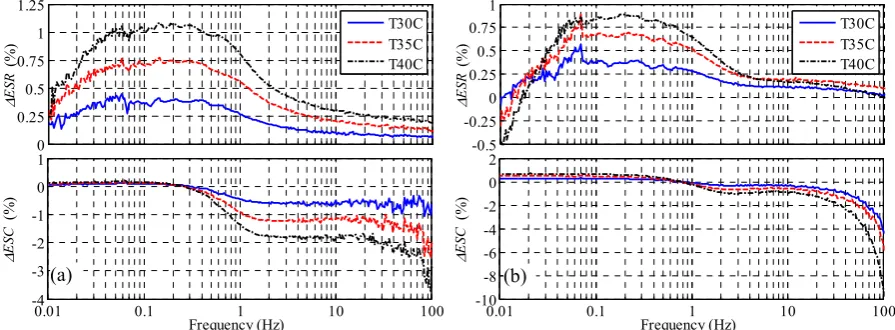
From Fig. 2(a) and 2(b), the effect of the operating temperature increase from 25°C to 40°C on both M-SC and I-SC ESRs reduction, ΔESR, are ≈1% maximum across the entire frequency range. The effect of temperature change on both SC ESCs is also small (<1%) for the frequency less than ≈1Hz. As the frequency increases beyond 1Hz, M-SC and I-SC ESC reductions, ΔESC, are 4% and 9% maximum. The ESR and ESC information collected via EIS at ambient temperature and at a bias voltage similar to the average cycle test voltage will be used in the SC loss estimation algorithms where the devices under test will be subject to constant power cycling.
Fig. 2: Change in ESR and ESC versus frequency at 2V constant bias voltage under various temperatures in comparison with room temperature (25°C) of (a) M-SC (b) I-SC
Estimating the power losses under constant power cycling method based on
SC voltage and current measurements
The constant power cycling (CPC) method is originally used in aging tests [4,5,8,9] to study SC degradation. The authors have adopted this method for evaluating the SC round-trip efficiency and loss [8] based on direct measurement of SC power in and power out, allowing the direct measurement of energies in and out and direct calculation of the energy loss over a cycle. This is why the results based on this method will be referred as experimental (EXP). To control the SC power constantly,
pSC_Ref, a current reference, iSC_Ref, is adjusted according to the SC stack voltage, vSC, change by iSC_Ref
=pSC_Ref/vSC. The vSC is also monitored and used for toggling the current direction as well as the power
direction when the preset SC min/max voltage thresholds are reached. Thus, the round-trip efficiency,
ηRT, and energy loss, ELossRT_EXP, of SCs can be determined by performing integration on a single
charge-discharge cycle of the SC power waveform as:
η = −
∫
D∫
C = − = −T T
RT SC SC D D C C D C
0 0
p dt p dt P T P T E E (1)
= +
LossRT _ EXP C D
E E E (2)
= +
Cycle C D
T T T (3)
where pSC is the instantaneous power through the SC calculated from the product of current, iSC, and
voltage, vSC, PC and PD are the average charging and discharging power, EC and ED are the charging
and discharging energy, TC and TD are SC charging and discharging duration and TCycle is
charge-discharge period. In this paper, the CPC method is performed on single cells of M-SC and I-SC by using the Bio-logic Potentiostat/Galvanostat machine which has its technology based on a linear amplifier. Therefore, there is no switching ripple and other high-frequency harmonics present in SC current and voltage waveforms. The Bio-logic machine equipped with 20A Booster has 16-bit ADC, which gives voltage and current reading resolution as small as 50µV and 2mA which is very accurate.
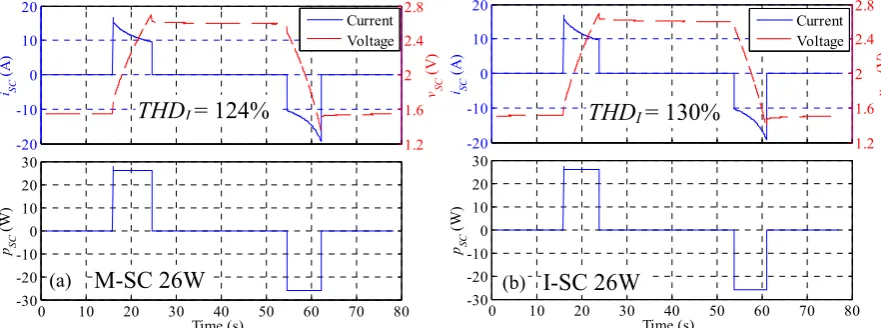
There are two constant-power patterns applied to both SC devices, which are: continuous constant power cycling (CCPC); at power levels of 7W and 21W and pulse constant power cycling (PCPC) at a power level of 26W with a 30s relaxation time as shown in Fig. 3-5. Both tests are done with the same
0 0.25 0.5 0.75 1 1.25
Δ
ES
R
(%
)
T30C T35C T40C
0.01 0.1 1 10 100
-4 -3 -2 -1 0 1
Δ
ES
C
(%
)
Frequency (Hz)
-0.5 -0.25 0 0.25 0.5 0.75 1
Δ
ES
R
(%
)
T30C T35C T40C
0.01 0.1 1 10 100
-10 -8 -6 -4 -2 0 2
Δ
ES
C (%
)
Frequency (Hz)
min/max vSC setting of 1.35V/2.7V which are the SC half- and the SC rated-voltages. The selection of
SC power and min/max vSC in the test is done such that the SC RMS current and the temperature rise is
less than the rated values shown in Table I. The total harmonic distortion, THDI, of the SC current is
also calculated for all experimental waveforms and included in the figures. The CCPC THDI is 56–
58% and the PCPC THDI is 124–130%, which is means significantly higher distortion than that of the
[image:5.595.74.519.172.338.2]CCPC, and therefore a higher amount of loss expected to be caused by harmonic currents though the equivalent ESRs.
[image:5.595.73.516.368.537.2]Fig. 3: The SC current, voltage and power during the 7W CCPC test of (a) M-SC and (b) I-SC
Fig. 4: The SC current, voltage and power during the 21W CCPC test of (a) M-SC and (b) I-SC
Fig. 5: The SC current, voltage and power during the 26W PCPC test of (a) M-SC and (b) I-SC
-6 -3 0 3 6 iSC (A ) 1.2 1.6 2 2.4 2.8 vSC (V ) Current Voltage
0 10 20 30 40 50 60 70 80
-8 -4 0 4 8 pSC (W ) Time (s) -6 -3 0 3 6 iSC (A ) 1.2 1.6 2 2.4 2.8 vSC (V ) Current Voltage
0 10 20 30 40 50 60 70
-8 -4 0 4 8 pSC (W ) Time (s) -20 -10 0 10 20 iSC (A ) 1.2 1.6 2 2.4 2.8 vSC (V ) Current Voltage
0 4 8 12 16 20 24
-30 -20 -10 0 10 20 30 pSC (W ) Time (s) -20 -10 0 10 20 iSC (A ) 1.2 1.6 2 2.4 2.8 vSC (V ) Current Voltage
0 3 6 9 12 15 18 21
-30 -20 -10 0 10 20 30 pSC (W ) Time (s) -20 -10 0 10 20 iSC (A ) 1.2 1.6 2 2.4 2.8 vSC (V ) Current Voltage
0 10 20 30 40 50 60 70 80
-30 -20 -10 0 10 20 30 pSC (W ) Time (s) -20 -10 0 10 20 iSC (A ) 1.2 1.6 2 2.4 2.8 vSC (V ) Current Voltage
0 10 20 30 40 50 60 70 80
-30 -20 -10 0 10 20 30 pSC (W ) Time (s)
(a)
M-SC 26W
THD
I= 124%
(b)
I-SC 26W
THD
I= 130%
(a)
M-SC 21W
THD
I= 56%
(b)
I-SC 21W
THD
I= 56%
(b)
I-SC 7W
THD
I= 58%
(a)
THD
I= 58%
[image:5.595.74.515.569.733.2]The cycling test is performed continuously for one hour to let the SC device temperature, TempSC, to
reach steady-state as shown in the bottom figures of Fig. 6–8. Using (1)–(3), the ηRT, ELoss_RT_EXP and
TCycle of both SCs are calculated and plotted against the elapsed test time as shown in the same figures.
Fig. 6 shows that over the entire 7W CCPC test there is not a noticeable change in ηRT (≈96.15% for
M-SC and ≈96.75% for I-SC) and same applies for the ELossRT_EXP (≈10.15J for M-SC and ≈7.2J for
I-SC) since the ESR reduction effect due TempSC increases is small (only 3–4°C increase). In Fig. 7, the
processing power is changed to 21W, so more energy loss is produced contributing to a higher TempSC
increase (≈10°C in addition to room temperature) which causes a noticeable reduction in ESR. The ηRT
of both devices are increased by a noticeable amount of 0.3–0.4% (91.15%→91.45% for M-SC and 93.4%→93.75% for I-SC) and their ELossRT_EXP values are reduced by 0.5–0.7J (21.3J→20.8J for M-SC
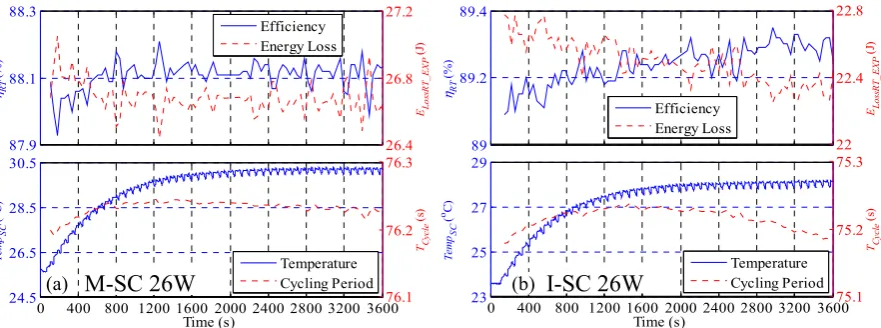
and 14.4J→13.7J for I-SC). In Fig. 8, a 26W pulsed constant power cycling (PCPC) charge-discharge pattern with a 30s relaxation time is applied to the two SC under test. Even though the applied power level is higher than the 21W CCPC, the TempSC rise over the cycling test is small due to the long
relaxation, which gives average cycle losses and temperature increase similar to the 7W CCPC condition (5°C). However, there is only a 0.2% improvement in both device ηRT (87.9%→88.1% for
M-SC and 89.1%→89.3% for I-SC) due to ESR decrease and correspondingly an ELossRT_EXP reduction
[image:6.595.77.524.299.458.2]by 0.2–0.4J (26.8J→26.6J for M-SC and 22.8J→22.4J for I-SC).
[image:6.595.76.522.504.667.2]Fig. 6: The SC round-trip efficiency, energy loss over a cycle, temperature and charge-discharge cycle period during the 7W CCPC test of (a) M-SC and (b) I-SC
Fig. 7: The SC round-trip efficiency, energy loss over a cycle, temperature and charge-discharge cycle period during the 21W CCPC test of (a) M-SC and (b) I-SC
96.1 96.2 96.3 ηRT (% ) 10.05 10.15 10.25 EL os sRT _ EXP (J ) Efficiency Energy Loss
0 400 800 1200 1600 2000 2400 2800 3200 3600 23 24 25 26 Te m pSC ( oC) Time (s) 74.2 74.3 TC ycl e (s ) Temperature Cycling Period 96 96.5 97 ηRT (% ) 7.1 7.35 7.6 EL os sRT _ EXP (J ) Efficiency Energy Loss
0 400 800 1200 1600 2000 2400 2800 3200 3600
24 25 26 27 Te m pSC ( oC) Time (s) 64.5 64.6 64.7 64.8 TC ycl e (s ) Temperature Cycling Period 91.1 91.3 91.5 ηRT (% ) 20.6 21.1 21.6 ELo ss RT _ EXP (J ) Efficiency Energy Loss
0 900 1800 2700 3600
26 29 32 35 38 Te mp SC ( oC) Time (s) 20.3 20.7 21.1 TC ycle (s ) Temperature Cycling Period 93.4 93.6 93.8 ηRT (% ) 13.5 14 14.5 ELo ssR T_ E X P (J ) Efficiency Energy Loss
0 400 800 1200 1600 2000 2400 2800 3200 3600 23 26.5 30 33.5 37 Te m pSC ( oC) Time (s) 20.2 20.5 TC ycle (s ) Temperature Cycling Period
(a) (b)
M-SC 21W
I-SC 21W
Fig. 8: The round-trip efficiency, loss, temperature and charge-discharge period during the 26W PCPC test of (a) M-SC and (b) I-SC
In bottom graphs of Fig. 6-8, it can be seen that as TempSC approaches its steady-state condition, TCycle
for both SC do not change significantly compared with their initial values (<1s change for all testing conditions) which means that the ESR change and the associated loss is not due to the period/frequency shift but due to the temperature change. The other parameter that would influence the period for a given load condition, the ESC, has been shown in Fig. 2 not to change in the frequency range 10-100mHz when TempSC increases by 10–15°C. Next, the SC energy loss estimation methods
which use the iSC data obtained from the CPC tests presented in this section will be discussed.
Energy loss estimation based on SC current and EIS equivalent parameters
Energy loss estimation using the time domain SC current (RMS method)
To estimate energy loss during the CPC test, the SC root-mean-square current, ISC_RMS, is calculated
from iSC(t) over a single charge-discharge cycling period, TCycle. Using this RMS current in Joules loss
formula (I2R), the RMS-based SC energy loss over the cycle, E
LossEST_RMS is:
(
)
= 2
LossEST _ RMS SC _ RMS Cycle Cycle
E I ESR T (4)
where ESRCycle is the actual SC ESR reading from the EIS result at the exact frequency corresponding
to TCycle. In (4), only one ESR is used from the EIS result for the estimation, which makes this
estimation technique very simple to implement. However, at very low cycle frequencies (<<0.1Hz), there are two mechanisms that can cause significant errors in the estimation of losses: first, the ESR that is used in conjunction with the harmonic currents is constant in (4) but in reality, it decreases significantly with the harmonic order, which would lead to overestimating the losses; secondly, very low frequencies that have a very long corresponding cycle duration are typically performed at reduced power/current which means that losses associated with the SC self-discharge current, which are omitted in (4), will cause a significant underestimation of losses. These two mechanisms may have a tendency to cancel each other, especially when the harmonic content is reduced (low THD). This was the reason why the two types of power cycling discussed before were chosen to assess the accuracy of the two estimation methods. To make full use of the available SC impedance information, iSC is
converted to the frequency domain in the next section.
Energy loss estimation using the frequency domain SC current (FFT method)
This estimation method uses the Fast Fourier Transform algorithm (FFT) to convert the iSC signal
obtained during the CPC test in order to analyze them in the frequency domain. By applying the FFT, the fundamental, the harmonics and the DC components of the SC currents are extracted. Using the SC current fundamental and harmonic parts, Ik, with the ESRk at the corresponding frequency from the EIS
results, a power loss, PEST_k of each kth frequency component can be calculated. Accumulating this
power loss up to the highest relevant frequency order, M, and combining it with the power loss caused by the DC current component, IDC, and the average bias voltage, VBias, the total power loss is obtained.
The estimated cycle energy loss, ELossEST_FFTis found by multiplying the total power loss with TCycle:
87.9 88.1 88.3
ηRT
(%
)
26.4 26.8 27.2
ELo
ss
R
T
_E
X
P
(J
)
Efficiency Energy Loss
0 400 800 1200 1600 2000 2400 2800 3200 3600 24.5
26.5 28.5 30.5
Te
m
pSC
(
oC)
Time (s)
76.1 76.2 76.3
TC
ycle
(s
)
Temperature Cycling Period
89 89.2 89.4
ηRT
(%
)
22 22.4 22.8
EL
os
sRT
_
EXP
(J
)
Efficiency Energy Loss
0 400 800 1200 1600 2000 2400 2800 3200 3600 23
25 27 29
Te
mp
SC
(
oC)
Time (s)
75.1 75.2 75.3
TC
ycl
e
(s
)
Temperature Cycling Period
(
)
= ⎛ ⎞ =⎜ + ⎟ ⎝∑
⎠ MLossEST _ FFT EST _ k DC Bias Cycle k 1
E P I V T (5)
= 2
EST _ k k k
P I ESR (6)
By performing the loss estimation in the frequency domain, the effect of the error due to using a single impedance measurement point from the EIS test is minimised as more ESR measurement points at the relevant frequencies are used. However, the limitation of this approach is that a very detailed EIS profile is needed to improve the accuracy of the loss estimation. There may still be errors in the method: first, the DC current component is typically very low and influenced by the error of the data acquisition system; secondly, the average bias voltage may need to consider the variation profile and not be just an arithmetic average of the cycle minimum and maximum voltage; thirdly, in order to save time on the EIS characterization, a finite number of EIS data points is measured and linear interpolation is used to derive ESRk where exact measured data points are not available.
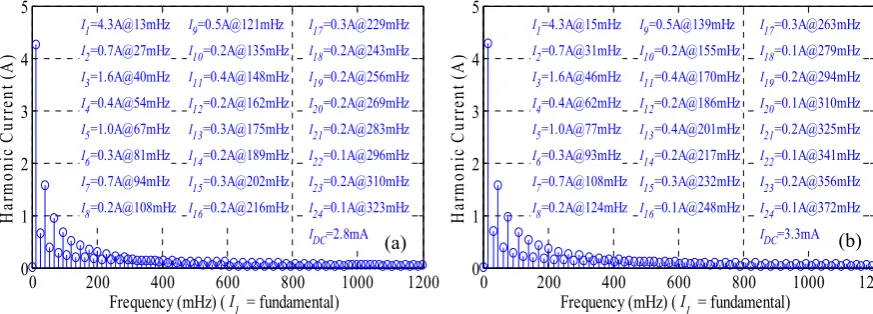
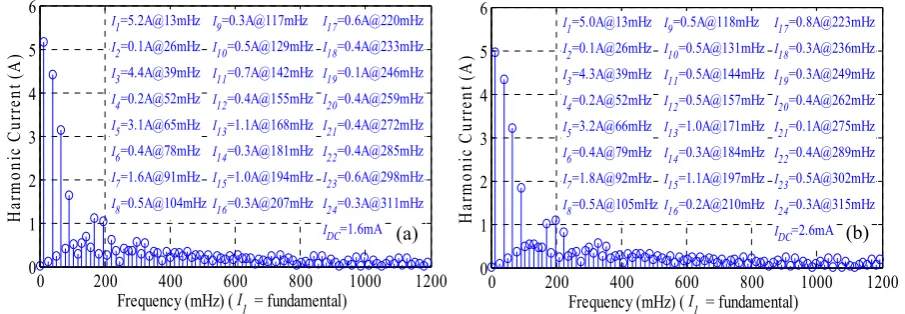
The FFT method is applied to the M-SC and I-SC currents shown in Fig. 3-5, which produce the corresponding current harmonic spectrums as shown in Fig. 9–11. It can be seen that the harmonic current patterns of the CCPC test has very large fundamental component compared with the other harmonics, which means that the RMS of the total SC current (and its corresponding loss) is mainly determined by the fundamental component. On the other hand, the harmonic current patterns of the PCPC test is quite different from that of the CCPC test as the 3rd, 5th, 7th etc harmonics become
significantly larger in amplitude which will affect the total RMS value. It can be noted that the high order current harmonics (>20th order) are very low and as their corresponding ESR further decreases, it
[image:8.595.76.513.395.552.2]means that they would have insignificant contribution to the overall losses. However, in order to achieve highest precision when comparing the two loss estimation methods, all harmonic currents shown in Fig. 9-11 are included in the loss calculation.
[image:8.595.76.521.582.743.2]Fig. 9: The SC current harmonics during the 7W CCPC test of (a) M-SC and (b) I-SC
Fig. 10: The SC current harmonics during the 21W CCPC test of (a) M-SC and (b) I-SC
0 200 400 600 800 1000 1200
0 1 2 3 4 5
I1=4.3A@13mHz
I2=0.7A@27mHz
I3=1.6A@40mHz
I4=0.4A@54mHz
I5=1.0A@67mHz
I6=0.3A@81mHz
I7=0.7A@94mHz
I8=0.2A@108mHz
I9=0.5A@121mHz
I10=0.2A@135mHz
I11=0.4A@148mHz
I12=0.2A@162mHz
I13=0.3A@175mHz
I14=0.2A@189mHz
I15=0.3A@202mHz
I16=0.2A@216mHz
I17=0.3A@229mHz
I18=0.2A@243mHz
I19=0.2A@256mHz
I20=0.2A@269mHz
I21=0.2A@283mHz
I22=0.1A@296mHz
I23=0.2A@310mHz
I24=0.1A@323mHz
IDC=2.8mA
H ar m on ic Cu rr en t ( A )
Frequency (mHz) ( I1 = fundamental) 0 200 400 600 800 1000 1200 0 1 2 3 4 5
I1=4.3A@15mHz
I2=0.7A@31mHz
I3=1.6A@46mHz
I4=0.4A@62mHz
I5=1.0A@77mHz
I6=0.3A@93mHz
I7=0.7A@108mHz
I8=0.2A@124mHz
I9=0.5A@139mHz
I10=0.2A@155mHz
I11=0.4A@170mHz
I12=0.2A@186mHz
I13=0.4A@201mHz
I14=0.2A@217mHz
I15=0.3A@232mHz
I16=0.1A@248mHz
I17=0.3A@263mHz
I18=0.1A@279mHz
I19=0.2A@294mHz
I20=0.1A@310mHz
I21=0.2A@325mHz
I22=0.1A@341mHz
I23=0.2A@356mHz
I24=0.1A@372mHz
IDC=3.3mA
H ar m on ic Cu rr en t ( A )
Frequency (mHz) ( I1 = fundamental)
0 500 1000 1500 2000 2500 3000 3500 4000 4500
0 2 4 6 8 10 12 14
I1=12.7A@45mHz
I2=2.0A@90mHz
I3=4.5A@135mHz
I4=1.4A@180mHz
I5=2.7A@225mHz
I6=1.2A@270mHz
I7=1.8A@315mHz
I8=1.0A@360mHz
I9=1.3A@406mHz
I10=1.0A@451mHz
I11=0.9A@496mHz
I12=0.9A@541mHz
I13=0.7A@586mHz
I14=0.9A@631mHz
I15=0.5A@676mHz
I16=0.8A@721mHz
I17=0.4A@766mHz
I18=0.7A@811mHz
I19=0.3A@856mHz
I20=0.7A@901mHz
I21=0.2A@946mHz
I22=0.6A@991mHz
I23=0.2A@1036mHz
I24=0.6A@1081mHz
IDC=3.7mA
H arm on ic C urre nt (A )
Frequency (mHz) ( I1 = fundamental) 0 500 1000 1500 2000 2500 3000 3500 4000 4500
0 2 4 6 8 10 12 14
I1=12.8A@49mHz
I2=2.0A@98mHz
I3=4.7A@147mHz
I4=1.2A@196mHz
I5=2.8A@245mHz
I6=1.0A@295mHz
I7=1.9A@344mHz
I8=0.9A@393mHz
I9=1.4A@442mHz
I10=0.8A@491mHz
I11=1.1A@540mHz
I12=0.7A@589mHz
I13=0.9A@638mHz
I14=0.7A@687mHz
I15=0.7A@736mHz
I16=0.7A@785mHz
I17=0.6A@835mHz
I18=0.6A@884mHz
I19=0.5A@933mHz
I20=0.6A@982mHz
I21=0.4A@1031mHz
I22=0.6A@1080mHz
I23=0.3A@1129mHz
I24=0.5A@1178mHz
IDC=4.1mA
Har m on ic Cu rr en t ( A )
Frequency (mHz) ( I1 = fundamental)
(a) (b)
Fig. 11: The SC current harmonics during the 26W PCPC test of (a) M-SC and (b) I-SC
Comparison of energy loss estimation
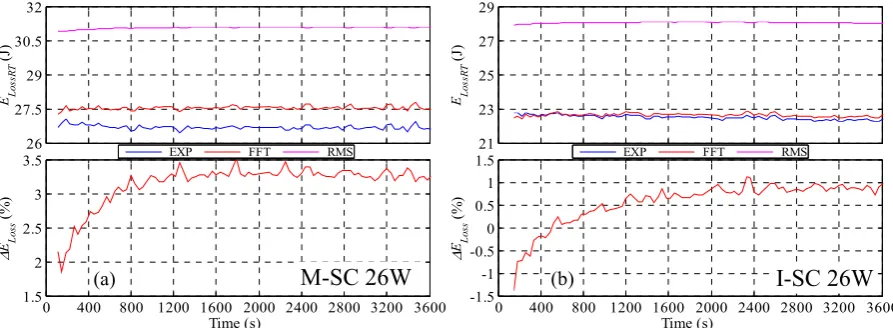
The SC cycling energy loss determined from V&I (power) data referred to as EXP (experimental) and the two SC current based methods are applied to both devices under test during the previous tests: the 7W CCPC (Fig. 3), the 21W CCPC (Fig. 4) and the 26W PCPC (Fig. 5). The evaluation of the losses determined with the three methods and their relative percentage difference against the power based method (EXP) are shown in Fig. 12-
Fig. 14
. The power based method (EXP) is considered the benchmark because its error is only affected by the voltage and current measurement errors which can be minimized by the high accuracy of the impedance spectroscopy machine. It can be seen that the difference between the estimated loss of the SC current based methods and the power based method is typically not higher than 5%.During the low power (7W) CCPC test shown in Fig. 12, it can be noticed that the RMS method produces more accurate result than the FFT method and the reason is that for this particular condition, the two opposite error mechanisms that cause underestimation (ESR of fundamental cycle frequency considered for high order current harmonic) and overestimation (omission of loss due to the DC current component) are cancelling out. This is not the case in the high power (21W) CCPC test shown in Fig. 13 where the RMS method gives highest errors. It can be seen that at the beginning of the test when the device temperature is closest to the room temperature/EIS test condition, the absolute cycle energy loss error (in J) between the FFT method and the power based (EXP) method stays constant for both devices under test at about 0.15-0.2J for both power levels. As time passes, the high power test causes warming of the device and this explains the larger drift in the estimated loss (error reaches 0.5-0.7J), smaller for I-SC as its impedance variation is more immune to temperature variations.
In contrary, the discrepancy between the cycle energy loss of the RMS method and the benchmark seems to vary quite a lot from less than 0.05J for the I-SC at low power to almost 1J for both devices at high power. There is an additional reason why the error during the high power CCPC test increases with time, which is the change of ESR with temperature that is not considered in the two SC current based methods. The reduction in ESR is real and this is shown by the decrease of losses from 21.2J at the start of the test to 20.8J after 2000 seconds (Fig. 13a). Further improvement of both loss estimation techniques can be possible by integrating a mechanism to account for the device parameter change with temperature, which can be directly measured or estimated.
The previous CCPC tests resulted in a current waveform which was very similar to a square wave, being characterized by a fairly low THD which resulted in small differences in precision between the two estimation methods. A third test that would result in highly distorted current shapes that would cause higher losses due to the higher current harmonics (Fig. 11) was conducted and the results are shown in Fig. 14. The power pulse is 26W which is similar to the high power CCPC test. It can be seen that the loss estimation using the RMS method shows significant differences compared to the power based (EXP) method: 15% for M-SC and 28% for I-SC. Fig. 14-bottom shows that the differences of the FFT method remain below 2% at the beginning of the test (M-SC device at room
0 200 400 600 800 1000 1200
0 1 2 3 4 5 6
I1=5.2A@13mHz
I2=0.1A@26mHz
I3=4.4A@39mHz
I4=0.2A@52mHz
I5=3.1A@65mHz
I6=0.4A@78mHz
I7=1.6A@91mHz
I8=0.5A@104mHz
I9=0.3A@117mHz
I10=0.5A@129mHz
I11=0.7A@142mHz
I12=0.4A@155mHz
I13=1.1A@168mHz
I14=0.3A@181mHz
I15=1.0A@194mHz
I16=0.3A@207mHz
I17=0.6A@220mHz
I18=0.4A@233mHz
I19=0.1A@246mHz
I20=0.4A@259mHz
I21=0.4A@272mHz
I22=0.4A@285mHz
I23=0.6A@298mHz
I24=0.3A@311mHz
IDC=1.6mA
H
ar
m
on
ic
C
urr
en
t (A
)
Frequency (mHz) ( I1 = fundamental) 0 200 400 600 800 1000 1200 0
1 2 3 4 5 6
I1=5.0A@13mHz
I2=0.1A@26mHz
I3=4.3A@39mHz
I4=0.2A@52mHz
I5=3.2A@66mHz
I6=0.4A@79mHz
I7=1.8A@92mHz
I8=0.5A@105mHz
I9=0.5A@118mHz
I10=0.5A@131mHz
I11=0.5A@144mHz
I12=0.5A@157mHz
I13=1.0A@171mHz
I14=0.3A@184mHz
I15=1.1A@197mHz
I16=0.2A@210mHz
I17=0.8A@223mHz
I18=0.3A@236mHz
I19=0.3A@249mHz
I20=0.4A@262mHz
I21=0.1A@275mHz
I22=0.4A@289mHz
I23=0.5A@302mHz
I24=0.3A@315mHz
IDC=2.6mA
H
arm
on
ic
C
urre
nt
(A
)
Frequency (mHz) ( I1 = fundamental)
temperature) and not exceeding 3.5% whilst the precision of the I-SC device remains between -/+ 1%. The differences in losses are smaller than at high power CCPC because the pulsed nature of the test causes lower average losses per cycle and therefore errors due to the impedance drift are lower.
[image:10.595.73.521.320.491.2]Fig. 12: The three estimated cycle energy loss and the discrepancies of the SC current based vs the power based method during the 7W CCPC test of (a) M-SC and (b) I-SC
Fig. 13: The three estimated cycle energy loss and the discrepancies of the SC current based vs the power based method during the 21W CCPC test of (a) M-SC and (b) I-SC
Fig. 14: The three estimated cycle energy loss and the discrepancies of the SC current based vs the power based method during the 26W PCPC test of (a) M-SC and (b) I-SC
9.8 9.9 10 10.1 10.2
EL
ossR
T
(J
)
EXP FFT RMS
0 400 800 1200 1600 2000 2400 2800 3200 3600
-2.5 -2 -1.5 -1 -0.5 0
Δ
ELo
ss
(%
)
Time (s)
7 7.1 7.2 7.3 7.4 7.5
ELo
ss
R
T
(J
)
EXP FFT RMS
0 400 800 1200 1600 2000 2400 2800 3200 3600
-4 -3 -2 -1 0 1 2
Δ
ELo
ss
(%
)
Time (s)
20.5 21 21.5 22
ELo
ss
R
T
(J
)
EXP FFT RMS
0 400 800 1200 1600 2000 2400 2800 3200 3600
1 2 3 4 5 6
Δ
ELo
ss
(%
)
Time (s)
13.5 14 14.5
E Lo
ss
R
T
(J
)
EXP FFT RMS
0 400 800 1200 1600 2000 2400 2800 3200 3600
-2 0 2 4 6
Δ
E Lo
ss
(%
)
Time (s)
26 27.5 29 30.5 32
ELo
ss
R
T
(J
)
EXP FFT RMS
0 400 800 1200 1600 2000 2400 2800 3200 3600
1.5 2 2.5 3 3.5
Δ
ELo
ss
(%
)
Time (s)
21 23 25 27 29
E Lo
ss
R
T
(J
)
EXP FFT RMS
0 400 800 1200 1600 2000 2400 2800 3200 3600
-1.5 -1 -0.5 0 0.5 1 1.5
Δ
E Lo
ss
(%
)
Time (s)
(a)
M-SC 26W
(b)I-SC 26W
(a)
M-SC 21W
(b)I-SC 21W
[image:10.595.73.520.533.697.2]Conclusion
Supercapacitos are typically used in power intense applications which means they are subject to significant stresses that could contribute to aging and device parameter variation. Being able to estimate accurately the losses in a device during the design stage is therefore important to ensure that early failure of SC in the equipment is avoided. To achieve that, it is therefore important to have available accurate tools to determine the losses in the device.
In this paper, two loss estimation methods based on the SC current and the SC impedance parameters were evaluated on two SCs from different manufacturers with similar specification (100F 2.7V). First a thorough evaluation of the devices under test was performed using the electrochemical impedance spectroscopy conducted at different bias voltages and temperature to identify which factors influence the variability of impedance data. Only the EIS data at ambient temperature and bias voltage similar to the average cycle test voltage were supplied to the loss estimation algorithms.
It can be concluded that the FFT current based method to estimate losses provides excellent precision in a wide range of SC powers and operating modes (continuous and pulsed power). The downside is that it relies on high computational power to perform the FFT and a very good knowledge of the device under test (very detailed EIS data).
The RMS method is much simpler to implement and may provide reasonable precision in estimating the losses for some particular operating conditions. However, the SC usually operates in conjunction to a power converter that causes a significant current ripple in the device. This will increase the total RMS current and therefore will cause an overestimation of SC losses. In reality, the switching ripple will be at high frequency where the ESR of the device is negligible, so the switching ripple will contribute very little to the SC losses, therefore, a method to remove the switching ripple from RMS calculation (e.g. low pass filter) is necessary.
References
[1] F. Rafik, H. Gualous, R. Gallay, A. Crausaz, and A. Berthon, "Frequency, thermal and voltage
supercapacitor characterization and modeling," J. Power Sources, vol. 165, pp. 928-934, 2007.
[2] M. Uno and K. Tanaka, "Accelerated Charge&Discharge Cycling Test and Cycle Life Prediction Model for
Supercapacitors in Alternative Battery Applications," IEEE Trans. Ind. Elec., vol. 59, pp. 4704-4712, 2012.
[3] T. Funaki, "Evaluating Energy Storage Efficiency by Modeling the Voltage and Temperature Dependency
in EDLC Electrical Characteristics," IEEE Trans. Power Elec., vol. 25, pp. 1231-1239, 2010.
[4] R. Chaari, O. Briat, J. Y. Delétage, E. Woirgard, and J. M. Vinassa, "How supercapacitors reach end of life
criteria during calendar life and power cycling tests," Microelec. Reliability, vol. 51, pp. 1976-1979, 2011.
[5] R. Chaari, O. Briat, J. Y. Deletage, and J. Vinassa, "Performances regeneration of supercapacitors during
accelerated ageing tests in power cycling," Proc. EPE 2011, Birmingham, UK, 2011, pp. 1-7.
[6] N. Rizoug, P. Bartholomeus, and P. Le Moigne, "Modeling and Characterizing Supercapacitors Using an
Online Method," IEEE Trans. Ind. Elec., vol. 57, pp. 3980-3990, 2010.
[7] M. W. Verbrugge and P. Liu, "Analytic solutions and experimental data for cyclic voltammetry and
constant-power operation of capacitors consistent with HEV applications," J. The Electrochem. Soc., vol.
153, pp. A1237-A1245, 2006.
[8] P. Kulsangcharoen, C. Klumpner, M. Rashed, and G. Asher, "A new duty cycle based efficiency estimation
method for a supercapacitor stack under constant power operation," Proc. PEMD2010, UK, 2010, pp. 1-6.
[9] K. Paul, M. Christian, V. Pascal, C. Guy, R. Gerard, and Z. Younes, "Constant power cycling for
accelerated ageing of supercapacitors," Proc. EPE2009, Barcelona, Spain, 2009, pp. 1-10.
[10] A. Hijazi, P. Kreczanik, E. Bideaux, P. Venet, G. Clerc, and M. Di Loreto, "Thermal Network Model of