1
This is the author's Post-print version (final draft post-refereeing as accepted for publication by the journal). The definitive, peer-reviewed and edited version of this article is published as: Nowok B., van Ham M., Findlay A.M. & Gayle V. (2013) Does migration make you happy? A longitudinal study of internal migration and subjective well-being. Environment and Planning A 45(4), 982-1002.
http://dx.doi.org/10.1068/a45287
Does migration make you happy? A longitudinal study of internal
migration and subjective well-being
Beata Nowok
ESRC Centre for Population Change, Department of Geography and Sustainable Development, University of St Andrews, Irvine Building, North Street, St Andrews, KY16 9AL, UK; e-mail: [email protected]
Maarten van Ham
OTB Research Institute for the Built Environment, Delft University of Technology, PO Box 5030, 2600 GA Delft, The Netherlands and University of St Andrews, UK and IZA Bonn, Germany; e-mail: [email protected]
Allan M Findlay
ESRC Centre for Population Change, Department of Geography and Sustainable Development, University of St Andrews, Irvine Building, North Street, St Andrews, KY16 9AL, UK; e-mail: [email protected]
Vernon Gayle
ESRC Centre for Population Change, Department of Applied Social Science, University of Stirling, Colin Bell Building, Stirling, FK9 4LA, UK; e-mail: [email protected]
Abstract. The majority of quantitative studies on the consequences of internal migration focus almost exclusively on the labour market outcomes and the material well-being of migrants. We investigate whether individuals who migrate within the UK become happier after the move than they were before, and whether the effect is permanent or transient. Using life satisfaction responses from 12 waves of the British Household Panel Survey (BHPS) and employing a fixed-effects model, we derive a temporal pattern of migrants’ subjective well-being (SWB) around the time of the migration event. Our findings make an original contribution by revealing that, on average, migration is preceded by a period when individuals experience a significant decline in happiness for a variety of reasons including changes in personal living arrangements. Migration itself causes a boost in happiness, and brings people back to their initial levels. The research contributes therefore to advancing an understanding of migration in relation to set point theory. Perhaps surprisingly, long-distance migrants are at least as happy as short-distance migrants despite the higher social and psychological costs involved. The findings of this paper add to the pressure to re-theorize migration within a conceptual framework that accounts for social well-being from a life course perspective.
2
1. Introduction
The study of internal and international migration has traditionally been shaped by economic questions relating to the labour market. At a micro-level, a decision to migrate is mainly explained by cost-benefit calculations leading to an expected positive net return, usually measured by monetary income (van Ham, 2002). In other words, people are often assumed to maximize their utility expressed in pecuniary terms (Chiswick, 2008). The migration decision-making process at the family level is based on the evaluation of a joint return with potentially unequal gains or losses for spouses (Cooke, 2008). Much empirical evidence indicates that migration is beneficial for the careers of migrants, unless they are tied-movers (mostly women) who sacrifice their labour-market outcome for the sake of the net gain of the family as a whole.
Compared with the economic consequences of migration, much less is known about the implications of migration for the general subjective well-being (SWB) of individuals. Whether migration brings happiness to all migrants is an important question, especially in the context of the growing interest in using well-being measures to evaluate societal progress. As is common in the literature, we use the terms SWB and happiness interchangeably. They refer to people’s evaluations of their life which can be cognitive or affective (e.g. Diener, 2009; Diener et al, 2003). From a theoretical perspective, incorporating SWB in an explanation of migration decision-making can still be encompassed within a utility-maximizing framework. Now, however, utility is captured by subjective judgments of satisfaction rather than monetary income.
A SWB framework for the analysis of migration has a number of advantages. It takes a wider perspective that incorporates the richness and diversity of current geographical mobility in terms of motivations and outcomes. Migration is a stressful event (Magdol, 2002; McCollum, 1990), and people migrate for a variety of reasons, not only economic ones, but most expect to increase their quality of life and happiness through changing their place of residence. Due to its complexity, migration affects many domains of the migrant life regardless of the motivations for a move, and these effects can be either positive or negative. A positive labour market outcome of migration does not have to coincide with a migrant’s experience of the quality of life in a destination area, especially in the context of the illusory general belief that money brings happiness (Kahneman et al, 2006). We may expect negative effects of migration on SWB when a person moves involuntarily or when he or she mispredicts post-migration utility.
Evaluating migration in terms of happiness and not just money also has substantial policy implications (Diener and Seligman, 2004). Policies designed to stimulate the economy by encouraging geographical mobility, such as regional policies aimed at attracting new businesses, or policies drawing on Florida’s (2002) idea of the benefits of attracting the creative class to cities, do not necessarily lead to increased individual and overall societal well-being. Countries like France (Stiglitz et al, 2009) and the UK (Prime Minister’s Office, 25 November 2010; Stratton, 2010) have now recognized general well-being as a valuable complementary measure to evaluate social progress and to develop policy responses.
3 multiple migrants).
2. Background
Set-point theory of SWB has been a prevailing paradigm in psychology (Headey, 2010; Lucas et al, 2003). The central premise is that individuals have stable levels of SWB shaped by genetics and personality. Deviations from the set-points may occur in the face of major life events, such as marriage, migration, unemployment, or serious injury, but their effects are usually transitory. There is, however, increasing evidence of lasting changes in individual happiness levels. Unemployment can cause a long-term decrease in SWB (Clark et al, 2008a; Lucas et al, 2004) and marriage can have a long-lasting positive effect on SWB (Lucas et al, 2003). Easterlin (2006a) posits that life events in family and health domains have a lasting effect on SWB, whereas improved material circumstances do not raise happiness in the long run because of people’s adaptation to the new level of living and adjustment of aspirations. Headey (2010) found large and permanent changes in SWB set-points for a large number of individuals participating in the German Socio-Economic Panel Survey (SOEP). He challenged set-point theory and called for a substantial revision. Considering the emerging findings, it appears that happiness is shaped by both psychological factors and life circumstances (Easterlin, 2006b). This implies that people can play an active role in increasing their own happiness by making considered choices within their life strategies.
Migration can be seen as a means of achieving lasting improvement in SWB. People migrate for various reasons but most expect to improve their lives in one way or another. They migrate to take advantage of opportunities available elsewhere. In terms of theoretical approach, human capital or cost-benefit models dominate the migration literature. People are assumed to behave rationally and to move when the expected value of the benefits exceeds the costs (pecuniary and non-pecuniary). When more than one individual is involved in migration decision making, as in the case of family migration, a rational evaluation of the costs and benefits of moving are often more complex. Migration may be rational from the standpoint of the family as a whole, but not from the standpoint of each family member considered separately. Family migration may therefore provide disproportionate and unequal benefits to male and female partners (Coulter and van Ham, 2012; Mulder and Cooke, 2009).
4
As mentioned above, most research into the consequences of internal migration refers to objective outcomes in the economic domain. Outcomes differ substantially between lead and tied migrants (van Ham and Büchel, 2006). Women migrants are much more likely to be tied migrants than men (Mincer, 1978), even when the woman actually is the primary wage earner (Cooke, 2003), or has a higher ranking occupation than her partner (Boyle et al, 1999a). An extensive literature demonstrates that following family migration women’s labour market status suffers in a number of ways (Boyle et al, 1999b; 2001; Halfacree, 1995; Lichter, 1983; Mincer, 1978). After migration women are less likely to be employed, have smaller incomes and work shorter hours than other equivalent women (Boyle et al, 2001; Cooke and Bailey, 1999; Morrison and Lichter, 1988; Shihadeh, 1991). These may result, however, from a self-selection of women with lower chances to succeed in the labour market, which is difficult to resolve with cross-sectional data. Studies using longitudinal data found that married women ‘recover’ to pre-migration income levels within one to three years after the move (Clark and Huang, 2006; LeClere and McLaughlin, 1997). The labour market outcome of migration is usually positive for men.
Success in the economic domain does not imply, however, an increase in happiness, especially in the long term. The relation between income and happiness has attracted widespread attention (Clark et al, 2008b; Easterlin, 1995; 2001; Easterlin et al, 2010; Ferrer-i-Carbonell, 2005; Kahneman et al, 2006; Stutzer, 2004). The weak effect of absolute income on SWB may be explained in several ways. First, in evaluating their financial situation people compare themselves to others. As a result relative income rather than absolute income is seen to affect happiness. Second, people get used to material possessions and very often they underestimate the process of habituation. Similarly, people’s expectations adapt to their financial possibilities. Finally, having a higher income often shifts time-use towards activities associated with higher tension and stress. As people become wealthier they tend to devote more time to work and commuting and less time to passive leisure activities (Kahneman et al, 2006).
The impact of other characteristics such as age, gender, marital status and education on happiness levels seems to be surprisingly limited and evidence is sometimes mixed (Diener, 2009; Diener and Seligman, 2004; Dolan et al, 2008; Layard et al, 2012). Here we highlight the influence of some selected migration-related characteristics. The literature suggests no significant difference between men and women when average levels of SWB are considered. Females are more likely, however, to report very high or very low levels of SWB. As regards age, many studies have found, usually adopting some kind of ceteris paribus
approach, that SWB in adulthood can be characterized by a U-shaped curve with the lowest happiness occurring in middle age. In many European countries, a U-shape can be found without the inclusion of control variables. A very useful overview of the relationship between well-being and age is included in Blanchflower and Oswald (2008) and the discussion that followed (Blanchflower and Oswald, 2009; Glenn, 2009)
Happiness research emphasizes that individual evaluations of well-being go beyond economics. What is more important, the goal of raising happiness through acquiring extra material goods is almost certainly doomed in the long run. We expect, therefore, that assessment of long-term returns to migration in SWB terms will in most cases differ from calculations in monetary terms. An important question, which we aim to answer, is whether migration has a positive impact on individual long-term happiness. Since happiness is considered by many as the ultimate goal in life, voluntary migration should facilitate this goal. People may, however, exaggerate the contribution of single factors to overall SWB, especially income. The inevitable shift of attention to other aspects of daily life after migration will influence, therefore, the anticipated gains in happiness.
5
First, men and women tend to prioritize various domains of life that are affected by changing place of residence in different ways. Second, women are more likely to be trailing spouses. Being a tied-mover may, however, be less harmful in SWB terms than in economic terms, since trailing spouses might be less career-oriented. Finally, it is expected that SWB return to migration will depend on the type of movement under study (e.g. short- versus long-distance migration).
3. Data and methods
3.1.Migration and the British Household Panel Survey
Panel data are especially beneficial in evaluating the impact of migration as they allow a comparison of the situation before and after the migration event. For this study we use the British Household Panel Survey (BHPS), for the years 1996–2008 (2008 is the final year of the original panel). In 1996 questions on overall life satisfaction were introduced. The BHPS is a nationally representative sample of approximately 5,500 private households with approximately 10,000 adults recruited in 1991. The adult members (aged over 15) of the same sample of households are interviewed every year. Throughout its life time, the BHPS was enriched with additional (geographical) samples. Therefore, in 2008 the total sample size was around 9,000 households including some 15,000 individuals. The BHPS attempts to follow up all migrants who remain in Great Britain. Although, as expected, attrition among migrants is higher than among non-migrants, its extent is relatively small and does not pose a problem for the analysis of geographical mobility (Buck, 2000; Rabe and Taylor, 2010). This does not, however, preclude the possibility that sample attrition is selective with respect to certain variables.
6
more biased sample. In our BHPS dataset one-time migrants were older than multiple ones, which suggests that they have been captured and observed at the end of their migration careers. Although our analysis is based on all observed moves, regardless of reason1 or distance, some results for one-time migrants are presented for comparative purposes later in the paper to show the importance of data selection.
On average in the sample an individual moves a distance of 32 km. Nonetheless, half of all moves are less than 3.2 km. About 9% of all moves are motivated by reasons related to the respondent’s job. The share of job-related migrations increases with the distance moved - 31% for distances exceeding 25 km as opposed to 3% below this threshold. The number of migrations experienced by heterosexual couples (both married and cohabiting) over the period 1996-2008 equals about 3,700. Approximately 11% of those couples migrate for reasons associated with the job of either or both partners. Half of the job-related moves of the couples are associated with only the man’s job, while around 20% is associated with only the woman’s job.
The SWB measure is derived by the evaluation question: ‘How dissatisfied or satisfied are you with your life overall?’ There are seven possible response options ranging from ‘not satisfied at all’ to ‘completely satisfied’. A neutral point on the scale is 4 at which respondents report that they are neither satisfied nor dissatisfied. This single-item measure is used as a dependant variable in our study. Some may argue that the validity of this measure is moderate, but more valid measures of well-being have not been created yet (Schneider and Schimmack, 2009).
3.2.Modelling approach
Our objective is to examine how SWB changes relative to the time of migration. To account for individual differences and effectively track the same people over time we apply a fixed-effects model2. In order to capture the time path of SWB we create a series of dummy duration variables. They represent the number of years before or after the occurrence of a migration event (the details of dealing with multiple migrants are presented below). The resulting regression equation takes the form:
SWB𝑖𝑡 = α𝑖 + β𝐗𝑖𝑡+ ∑T2 θ𝑘
𝑘=−T1 M𝑖𝑡
𝑘 + ε
𝑖𝑡, (1)
where SWB𝑖𝑡 denotes the subjective well-being of individual i in period t. The individual fixed effect,α𝑖, controls for any time-constant unobserved heterogeneity. 𝐗𝑖𝑡 is a vector of time-varying covariates. It includes a set of individual and household characteristics that are common in the literature on SWB. In particular, we consider age, marital status and labour market status at the individual level and birth of a child and number of children at the household level. ε𝑖𝑡 is a stochastic error term, indexed i for the individual and t for time. The dummy variables, M𝑖𝑡𝑘, indicate if a person i migrates in period t-k, with k indexing the variables beginning T1 years before and ending T2 years after migration. The last group refers
1
Since the substantive results of the analysis do not change after removal of students, whose
migration is often temporary, they are included in the sample as well.
2
We have also estimated the model in a random-effects framework and formally compared
7
to all years beyond T2. For instance, M𝑖𝑡3 = 1 if an individual i migrated three years before
year t. In other words, at year t he or she has been living in a new place of residence for three years. If M𝑖𝑡−3= 1, it indicates that a person i will migrate from a current place of residence in three years. The parameters θ𝑘 measure therefore the impact of migration prior to (𝑘 < −1) and following the move (𝑘 ≥ 0).
Note that in the case of people who move several times within the observation period, years between two subsequent migrations are identified as both before and after a move. We assume that there is only one effect for each year, where the anticipation effect takes precedence over the adaptation effect back to year T1 (changing this threshold for a shorter one has very limited impact on the substantive results). As a robustness test, we also ran the model assuming both lag and lead effects at the same time for years between migrations. In this test the general time pattern of SWB remained unchanged.
We adopted a similar modelling approach as was used for examining life satisfaction effects of major life events by Clark et al. (2008a) and Frijters et al. (2011). The latter authors include also a change of residence event in their analysis. In the economic literature analogous models are used to evaluate earnings losses of displaced workers (Couch, 2001; Couch et al, 2011; Couch and Placzek, 2010; Jacobson and LaLonde, 1993; White, 2010). Given the nature of our dependant variable (seven ordered outcomes) an ordered response regression might seem more appropriate. There are two main reasons in favour of a linear model. First, linear analysis is superior in its ease of interpretation. Second, the analysis of SWB using ordered response regression and linear models lead to similar substantive results (Clark et al, 2008a; Ferrer-i-Carbonell and Frijters, 2004).
4. Results
4.1.Empirical regularities in SWB and migration
Our data confirm that most people are reasonably happy (Diener and Diener, 1996). Around 76% of the BHPS respondents indicate SWB above neutral. The SWB metric records an average level of happiness of 5.23 (on a 7 point scale) and there is no significant difference between men and women. Migrants are, on average, significantly less happy than non-migrants. Migrants are defined as outlined in Section 3 of this paper and thus the aggregate measures for migrants are derived from all available observations prior to and after migration events. The average SWB scores for migrants and non-migrants are respectively 5.16 and 5.30. Multiple migrants are unhappier (5.12) than one-time migrants (5.20).
8
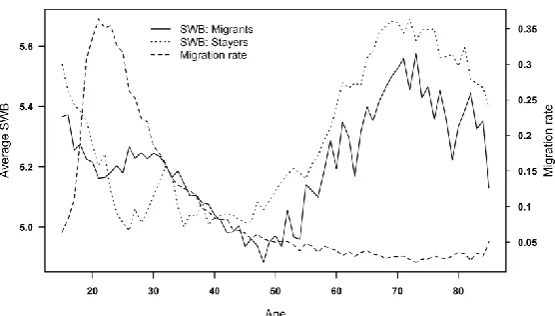
Figure 1 Average subjective well-being (SWB) of migrants and stayers and migration rate by age, 1996-2008
We can make a few observations based on the presented age schedules and the relationship between them. The average SWB of the total population starts high in young adulthood, reaches the minimum at age 45, then rises substantially to age 70 and starts to decline thereafter. Most migration events are concentrated between ages 18-30. Non-migrants are happier than migrants at all ages except between 23 and 40 years. The higher SWB of migrants at the most mobile ages, which drives the happiness of the whole population, suggest a positive impact of changing place of residence, at least in short term. An increase in SWB for migrants may also be attributed to the relationship between age and other aspects of the family life-cycle and the resulting motives for migration (e.g. marriage). In order to understand the impact of migration on SWB, it is therefore of importance to follow the same individuals over time, and control for other life events and personal characteristics.
9
Table 1 Post-migration average subjective well-being (SWB) by reason for migration, gender and distance a
Reason for
migration Gender
Distance in kilometres
0-5 5-10 10-25 25-50 50-100 100-200 200+
Job
Male 5.22 (0.16) 5.23 (0.37) 5.27 (0.39) 5.34 (0.25) 5.31 (0.21) 5.21 (0.16) 5.21 (0.15)
Female 5.36 (0.23) 5.33 (0.44) 5.15 (0.10) 5.29 (0.27) 5.25 (0.00) 5.18 (0.06) 5.17 (0.19) Other reasons
Male 5.14 (0.01) 5.15 (0.02) 5.12 (0.10) 5.16 (0.23) *
5.15 (-0.05) 5.04 (-0.13) 5.12 (0.24)
Female 5.16 (0.08) *
5.08 (0.04) 5.18 (0.11) 5.27 (0.06) 5.18 (-0.09) 5.03 (0.00) 5.03 (0.08)
All reasons All 5.15 (0.05)*
5.12 (0.05)
5.15 (0.11) *
5.23 (0.16) *
5.22 (-0.02) 5.13 (-0.02) 5.15 (0.13)
Notes: a in parentheses change compared to pre-migration SWB; * significant at 5%
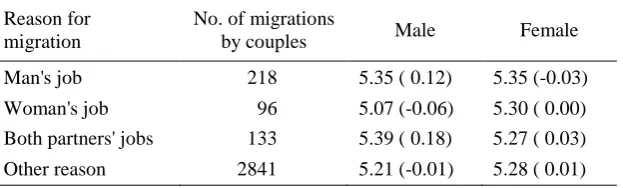
The average SWB of males and females does not differ much. There are, however, some remarkable discrepancies between the happiness of partners, both married and cohabiting, migrating together (Table 2). Men become happier only when migration is related to their own job and migration is even more rewarding when the spouse’s job is also a motivating factor. The post-migration SWB of women migrating with partners remains practically the same as it was before the move, regardless of migration reason. They are relatively happy and being a tied migrant is not really harmful for their level of happiness.
Table 2 Post-migration average subjective well-being (SWB) of partners in migrating couples a, b
Reason for migration
No. of migrations
by couples Male Female
Man's job 218 5.35 ( 0.12) 5.35 (-0.03) Woman's job 96 5.07 (-0.06) 5.30 ( 0.00) Both partners' jobs 133 5.39 ( 0.18) 5.27 ( 0.03) Other reason 2841 5.21 (-0.01) 5.28 ( 0.01)
Notes: a couples include both married and cohabiting partners; b in parentheses change compared to pre-migration SWB (all are not significant at 5%).
An analogous comparison of men’s and women’s labour income before and after migration reveals a different picture. Men’s income starts to increase considerably after migration, whereas women’s income remains more or less stable. In the case of migrating partners, being a trailing spouse means having a lower income for women in the first years after migration. These findings are similar to the results previously found in the literature.
4.2.Dynamic effect of migration on SWB
The examined period spreads over eleven years. It begins five years prior to the year when a person reports a move and ends five years after the move. The first year of the eleven year period sets the initial happiness level and it is assumed that this level is not affected by future (anticipated) migration behaviour. The coefficient 𝜃−5 is, therefore, fixed and equal to zero
[image:9.595.75.387.435.529.2]10
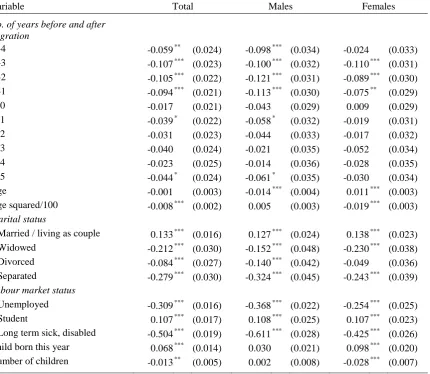
measured. However, time zero is the time of the interview and inevitably the interview occurred after the migration event. Thus the migration event took place at an unspecified time between minus one and zero on the graph. Detailed regression results are presented in Table 3.
Figure 2 The dynamic effect of migration on subjective well-being (SWB) for total, males and females; all moves
Notes: In this and following figures error bars indicate 95% confidence intervals.
For the full sample, the regression coefficients on the migration-related dummies are all negative except for the year of migration for women (Figure 2 and the first ten rows of Table 3). SWB drops to a level significantly lower than zero four years before the change of residence and remains significantly negative until the year preceding the change. The first important finding of this study is therefore that migration boosts migrants’ happiness relative to feelings of well-being before moving. More precisely, migration seems to take away negative feelings or unhappiness, but as Figure 2 shows the upward shift in subjective well-being does not continue in the years after migration. In the year of migration the SWB seems to have returned to its original level and stagnates thereafter. Results in Frijters et al (2011) also show a slight drop in life satisfaction in the quarters before a change of residence. The pattern presented above is compatible with the idea that migration takes place as a result of increasing stress (up to a certain threshold). Moving to overcome the stressor is therefore a positive action, but it does not bring any additional happiness or improved well-being relative to the migrant’s status before the stressor took effect. The interpretation of the findings would uphold research on the ‘immobility paradox’ (Fischer and Malmberg, 2001) that notes that most people do not move unless they have to. A final feature of Table 3 that is worth highlighting is that the results substantiate the view that circumstances at a time well before the migration event are critical in bringing about the decision to move. There is a three year lag between the low point on the SWB graph and the time of migration, which may be caused by the time it takes to search and find a new residential location that satisfies the desires of the potential movers.
[image:10.595.182.411.144.305.2]11
Table 3 Fixed-effects model of subjective well-being; the coefficient estimates for the whole sample a, b
Variable Total Males Females
No. of years before and after
migration
-4 -0.059 ** (0.024) -0.098 *** (0.034) -0.024 (0.033) -3 -0.107 *** (0.023) -0.100 *** (0.032) -0.110 *** (0.031) -2 -0.105 *** (0.022) -0.121 *** (0.031) -0.089 *** (0.030) -1 -0.094 *** (0.021) -0.113 *** (0.030) -0.075 ** (0.029) 0 -0.017 (0.021) -0.043 (0.029) 0.009 (0.029) 1 -0.039 * (0.022) -0.058 * (0.032) -0.019 (0.031) 2 -0.031 (0.023) -0.044 (0.033) -0.017 (0.032) 3 -0.040 (0.024) -0.021 (0.035) -0.052 (0.034) 4 -0.023 (0.025) -0.014 (0.036) -0.028 (0.035) 5 -0.044 * (0.024) -0.061 * (0.035) -0.030 (0.034) Age -0.001 (0.003) -0.014 *** (0.004) 0.011 *** (0.003) Age squared/100 -0.008 *** (0.002) 0.005 (0.003) -0.019 *** (0.003)
Marital status
Married / living as couple 0.133 *** (0.016) 0.127 *** (0.024) 0.138 *** (0.023) Widowed -0.212 *** (0.030) -0.152 *** (0.048) -0.230 *** (0.038) Divorced -0.084 *** (0.027) -0.140 *** (0.042) -0.049 (0.036) Separated -0.279 *** (0.030) -0.324 *** (0.045) -0.243 *** (0.039)
Labour market status
Unemployed -0.309 *** (0.016) -0.368 *** (0.022) -0.254 *** (0.025) Student 0.107 *** (0.017) 0.108 *** (0.025) 0.107 *** (0.023) Long term sick, disabled -0.504 *** (0.019) -0.611 *** (0.028) -0.425 *** (0.026) Child born this year 0.068 *** (0.014) 0.030 (0.021) 0.098 *** (0.020) Number of children -0.013 ** (0.005) 0.002 (0.008) -0.028 *** (0.007)
Notes:a coefficients on wave dummies are not reported; reference category is never married;
b
standard errors in parentheses; * significant at 10%, ** significant at 5%,*** significant at 1%.
The models also reveal that females migrating in couples experience similar SWB trends as their partners (results not shown). This contradicts conclusions from the family migration literature which shows that women who move in a couple often experience temporary negative effects of migration. This might be true for their income and labour market position, but being a tied mover does not seem to affect their happiness. This may suggest that tied movers are a selective group of people who attach lower importance to work than the lead movers. Another result which is noteworthy is that men’s happiness does not appear to be affected by either the birth of a child or the number of children in the household.
12
distance moves that require the migrant to form new social bonds (van Ham, 2012). On this basis one might anticipate that short distance movers would be happier than longer distance movers simply because they experience less social costs when moving.
[image:12.595.180.416.253.413.2]Figure 3 plots changes in the SWB around the time of the migration event estimated separately for long- and short-distance moves. Curiously, and counter to our hypothesis, long-distance migrants seem to be happier in general than short-distance movers, despite the assumed breaking up of social networks. Moreover, the positive effect of migration is observed for a longer period (two years after move) before it starts to wear off. The sample size for longer distance migrants is small and therefore some caution is required when interpreting the results. In Figure 4, where we look at men and women separately, we therefore focus on short-distance moves compared to all moves, as this is a relatively large group.
Figure 3 The dynamic effect of short- and long-distance migration on subjective well-being (SWB); all moves
Interestingly, for men, short distance moves take place after a relatively large decline in SWB (Figure 4) and men do not recover to their initial level of well-being in the years after the move. Men moving over longer distances do seem to boost their level of happiness more, which is likely to be caused by job-related gains. For women we do not find any differences between short distance moves and all other moves in terms of their impact on SWB. Again these results suggest that the relative importance of different life domains in determining general life satisfaction differs between genders.
[image:12.595.89.508.578.722.2]13
4.3.The effects of sample selection and life events on SWB
Thus far the results have been based on models including multiple migration events for some sample members. Limiting the models to examine SWB effects only for one-time migrants produces starkly different outcomes (Figure 5). It is important, however, to bear in mind that concentrating only on one-time migrants introduces some bias in the data (Section 3.1). Including only one-time migrants shows that female SWB trajectories are not statistically different from those estimated for all moves. Males, in contrast, receive a significant and lasting boost to their happiness after migration and do not experience any significant drop in well-being prior to the move. These results suggest that there is no universal SWB trajectory that holds for all types of migration.
Figure 5 The dynamic effect of migration on subjective well-being (SWB) for total, males and females; one-time migrants
[image:13.595.181.415.233.396.2]A disaggregated longitudinal analysis of migration also gives insights into phenomena occurring prior to migration in relation to SWB. Migration is known to be associated with other major life events prior to the migration date (like having a baby, changing job and especially, forming or breaking up a partnership). Table 4 shows relative chances of selected partnership transitions in the four-year period preceding migration for the BHPS migrants as compared to stayers. Stress from changing personal circumstances might lead to a drop in SWB before a move (as observed in Figures 2-5) and the actual move is then an instrument to regain some, or all, of the initial SWB level.
Table 4 Relative chance of selected partnership transitions (future migrants compared to stayers)
Transition Migrants/stayers
From To
Never married Living as couple 13.3
Married/civil partnership 5.4
Married/civil partnership Separated 9.1
Divorced 4.5
Widowed 0.9
Separated Living as couple 6.1
Divorced Living as couple 4.4
[image:13.595.78.443.593.741.2]14
migrants to have experienced a separation or divorce before migration. Others have shown that divorce is preceded by a significant drop in life satisfaction among males but not among females (Clark et al, 2008a). This may explain, at least partially, the lack of any significant drop in SWB prior to migration for one-time migrants. Women can deal better with separation or divorce but they seem to carry a greater additional burden before a move than men, which is connected mainly with the scope of housework and responsibility for children (Magdol, 2002).
5. Discussion and conclusions
The overall goal of this paper has been to answer the question whether migration makes you happy by analysing contemporary longitudinal data from the BHPS. The majority of quantitative studies on the consequences of internal migration focus almost exclusively on the labour market outcomes and the material well-being of migrants. One of the strengths of this paper is that we study the impact of migration within a conceptual framework that accounts for social well-being. The second strength of this paper is that the use of longitudinal data allowed us to examine whether the effects of migration on happiness are transient or permanent.
The results show that there are significant SWB changes associated with mobility with the strongest effect in the year of migration. Migrants are happier just after the move than they were just prior to it. A broader temporal perspective reveals, however, that migration is preceded by a decline in SWB. Opportunities available to migrants at new places of residence seem to provide a way out of unhappiness. An alternative hypothesis could be that a decline in happiness before the move reflects the anticipation of the negative effects of moving (in relation to the associated stresses of social networks disruption, leaving familiar surroundings and adjusting to the new environment). The boost in happiness received through migration brings people back to their initial level of SWB. Counter to our expectations, long-distance movers are at least as happy as short-long-distance movers despite the higher social costs that are involved. Moreover, happiness outcomes after migration, as opposed to labour market outcomes, do not differ significantly by gender. The happiness of women, who are more often than men tied migrants, does not seem to be dented by migration even though their career opportunities may become more limited.
In the broader context of SWB our results support the set-point theory of happiness. Individuals shift away from a baseline SWB in relation to migration, but they tend to come back to their long-term happiness level at a later date. It is questionable whether it is possible to accomplish a long lasting improvement in SWB through migration (at least the types of migration movement captured by the BHPS), a result which is important in the on-going debate on policy aiming at improving the well-being of individuals and societies.
This study has shown that the use of long-run longitudinal data is essential for research into the drivers of and barriers to happiness. Analyses which are limited to investigating happiness at only one point in time, or to comparing levels of SWB only at one point before and after the migration event, are likely to arrive at erroneous conclusions.
15
consequences of migration by migration motives. In this study we distinguish short-distance moves from long-distance moves but this is only a crude approximation of migration reasons.
In closing, we ask and attempt to briefly answer two questions. First, what has this paper contributed to the wider understanding of migration and well-being? Second, what are the implications of this research in relation to exploring the relations between migration and set-point theory?
In answer to the first question, the paper has sought to offer a particularly rigorous analysis of one metric associated with well-being relative to the timing of migration. The originality of the findings, as summarised above, lies in showing that for the individual mover there is a transient relationship with happiness, relating primarily to the years before migration. The returns to migration in terms of happiness appear to be time-specific and not to accumulate after migration, unlike for example potential returns to human capital where one would expect that benefits might accrue to the migrant over many years as anticipated by neo-classical models of labour migration. Those seeking to theorise migration at the scale of the individual mover need therefore to consider why non-economic returns as measured by indicators of well-being suggest only transient losses and gains. The research findings might therefore be taken to challenge existent theorisations of migration, such as those suggesting that the deeper drivers of migration lie in the social and cultural meanings of mobility rather than in more easily understood economic rewards (Findlay and Stockdale, 2003; Halfacree and Boyle, 1993). A more likely resolution of the differences between the current authors’ findings and the conceptualisation of migration in the research literature might be found in the suggestion that the research results in this paper relate to the kinds of internal migration captured by the BHPS (involving mainly moves associated with factors like housing needs and life-course adjustments such as divorce (Boyle et al, 2008)). Different findings might emerge from analysis of other data sets linking well-being before and after long-distance and international migration. For longer distance moves different scales of cultural and social disruption seem probable. We anticipate that in the case of such moves migrant experiences of integration or exclusion may produce different SWB outcomes.
Turning finally to the wider implications in relation to set-point theory, some might suggest that the findings indicate that internal migration is unlike life events such as marriage, loss of a job or major injury. While these events often have a lasting impact on happiness (Clark et al, 2008a; Lucas et al, 2003), our analyses of internal migration seem to confirm set point theory views that individuals have stable levels of well-being. Once destabilising events such as migration (or the causes necessitating migration) have been negotiated, people return to their original level of well-being. An alternative interpretation (and one that we believe our results begin to support as a result of offering detailed insights of temporal variations in SWB) would be that the prospects of mobility as well as the act of engaging in internal migration may be a critical means for restoring an individual’s level of social well-being, especially following previous stressful events.
16
Acknowledgements. We gratefully acknowledge financial support from the Economic and Social Research Council (ESRC) (RES-625-28-0001). This project is part of the ESRC Centre for Population Change (CPC). Financial support from the EU (NBHCHOICE Career Integration Grant under FP7-PEOPLE-2011-CIG) is also gratefully acknowledged. The BHPS data used in this publication were made available through the ESRC Data Archive. The data were originally collected by the ESRC Research Centre on Micro-Social Change at the University of Essex (now incorporated within the Institute for Social and Economic Research). Neither the original collectors of the data nor the Archive bear any responsibility for the analyses or interpretations presented here.
References
Blanchflower D G, Oswald A J, 2008, "Is well-being U-shaped over the life cycle?" Social Science and Medicine66 1733-1749
Blanchflower D G, Oswald A J, 2009, "The U-shape without controls: A response to Glenn"
Social Science and Medicine69 486-488
Boyle P, Cooke T, Halfacree K H, Smith D, 1999a, "Gender inequality in employment status following family migration in GB and the US: the effect of relative occupational status" International Journal of Sociology and Social Policy19 109-143
Boyle P, Cooke T, Halfacree K H, Smith D, 1999b, "Integrating GB and US Census Microdata for studying the impact of family migration on partnered women's labour market status" International Journal of Population Geography5 157-178
Boyle P, Cooke T, Halfacree K H, Smith D, 2001, "A cross-national comparison of the impact of family migration on women's employment status" Demography38 201-213 Boyle P, Kulu H, Cooke T, Gayle V, Mulder C H, 2008, "Moving and union dissolution"
Demography45 209-22
Buck N H, 2000, "Using panel surveys to study migration and residential mobility", in
Researching Social and Economic Change: The Uses of Household Panel Studies Ed. D Rose(Routledge, London) pp 250-272
Champion T, 2005, "Population movement within the UK", in Focus on People and Migration Ed. R Chappell(Palgrave Macmillan, Basingstoke) pp 91-113
Chiswick B R, 2008, "Are immigrants favorably self-selected? An economic analysis", in
Migration Theory: Talking Across Disciplines Eds C D Brettell, J F Hollifield 2nd edition (Routledge, New York) pp 63-82
Clark A E, Diener E, Georgellis Y, Lucas R E, 2008a, "Lags and leads in life satisfaction: a test of the baseline hypothesis" Economic Journal118 F222-F243
Clark A E, Frijters P, Shields M A, 2008b, "Relative income, happiness, and utility: an explanation for the Easterlin paradox and other puzzles" Journal of Economic Literature46 95-144
Clark W A V, Huang Y, 2006, "Balancing move and work: women's labour market exits and entries after family migration" Population, Space and Place12 31-44
Cooke T J, 2003, "Family migration and the relative earnings of husbands and wives" Annals of the Association of American Geographers93 338-349
Cooke T J, 2008, "Gender role beliefs and family migration" Population, Space and Place14
163-175
Cooke T J, Bailey A J, 1999, "The effect of family migration, migration history and self-selection on married women's labour market achievement", in Migration and Gender in the Developed World Eds P Boyle, K Halfacree(Routledge, London) pp 102–113 Couch K A, 2001, "Earnings losses and unemployment of displaced workers in Germany"
Industrial and Labor Relations Review54 559-572
17
business cycle: an analysis with administrative data" Economics Letters111 16-19 Couch K A, Placzek D W, 2010, "Earnings losses of displaced workers revisited" American
Economic Review100 572-589
Coulter R, van Ham M, 2012, "Partner disagreement on moving decisions and the subsequent moving behaviour of couples" Population Space and Place18 16-30
Cummins R A, 1996, "The domains of life satisfaction: An attempt to order chaos" Social Indicators Research38 303-328
Diener E, 2009, "Subjective well-being", in The Science of Well-Being: The Collected Works of Ed Diener Ed. E Diener(Springer, The Netherlands) pp 11-58
Diener E, Diener C, 1996, "Most people are happy" Psychological Science7 181-185
Diener E, Scollon C N, Lucas R E, 2003, "The evolving concept of subjective well-being: the multifaceted nature of happiness" Advances in Cell Aging and Gerontology 15 187-219
Diener E, Seligman M E P, 2004, "Beyond money: toward an economy of well-being"
Psychological Science in the Public Interest5 1-31
Dolan P, Peasgood T, White M, 2008, "Do we really know what makes us happy? A review of the economic literature on the factors associated with subjective well-being"
Journal of Economic Psychology29 94-122
Easterlin R A, 1995, "Will raising the incomes of all increase the happiness of all?" Journal of Economic Behavior and Organization27 35-47
Easterlin R A, 2001, "Income and happiness: towards a unified theory" The Economic Journal111 465-484
Easterlin R A, 2006a, "Building a better theory of well-being", in Economics and Happiness: Framing the Analysis Eds L Bruni, P Porta(Oxford University Press, Oxford)
Easterlin R A, 2006b, "Life cycle happiness and its sources. Intersections of psychology, economics, and demography" Journal of Economic Psychology27 463-482
Easterlin R A, McVey L A, Switek M, Sawangfa O, Zweig J S, 2010, "The happiness– income paradox revisited" Proceedings of the National Academy of Sciences 107
22463-22468
Ferrer-i-Carbonell A, 2005, "Income and well-being: An empirical analysis of the comparison income effect" Journal of Public Economics89 997-1019
Ferrer-i-Carbonell A, Frijters P, 2004, "How important is methodology for the estimates of the determinants of happiness?" Economic Journal114 641-659
Findlay A M, Nowok B, 2012 "The uneven impact of different life domains on the wellbeing of migrants." CPC Working Paper 25 (ESRC Centre for Population Change, UK) Findlay A M, Stockdale A, 2003, "The temporal and social embeddedness of migration: a
methodological exploration using biographical analysis" Geography Research Forum 23 4-29
Fischer P A, Malmberg G, 2001, "Settled people don't move: on life course and (im-)mobility in Sweden" International Journal of Population Geography7 357-371
Florida R, 2002 The Rise of the Creative Class (Basic Books, New York)
Frijters P, Johnston D W, Shields M A, 2011, "Life satisfaction dynamics with quarterly life event data" Scandinavian Journal of Economics113 190-211
Glenn N, 2009, "Is the apparent U-shape of well-being over the life course a result of inappropriate use of control variables? A commentary on Blanchflower and Oswald (66: 8, 2008, 1733-1749)" Social Science and Medicine69 481-485
Halfacree K H, 1995, "Household migration and the structuration of patriarchy: evidence from the USA" Progress in Human Geography19 159-182
18
Headey B, 2010, "The set point theory of well-being has serious flaws: on the eve of a scientific revolution?" Social Indicators Research97 7-21
Jacobson L S, LaLonde R J, 1993, "Earnings losses of displaced workers" American Economic Review83 685
Kahneman D, Krueger A B, Schkade D, Schwarz N, Stone A A, 2006, "Would you be happier if you were richer? A focusing illusion" Science312 1908-1910
Layard R, Clark A, Senik C, 2012, "The causes of happiness and misery", in World Happiness Report Eds J Helliwell, R Layard, J Sachs (Earth Institute, Columbia University, New York)
LeClere F B, McLaughlin D K, 1997, "Family migration and changes in women's earnings: a decomposition analysis" Population Research and Policy Review16 315-335
Lichter D T, 1983, "Socioeconomic returns to migration among married women" Social Forces62 487-503
Lucas R E, Clark A E, Georgellis Y, Diener E, 2003, "Reexamining adaptation and the set point model of happiness: reactions to changes in marital status" Journal of Personality and Social Psychology84 527-539
Lucas R E, Clark A E, Georgellis Y, Diener E, 2004, "Unemployment alters the set point for life satisfaction" Psychological Science15 8-13
Magdol L, 2002, "Is moving gendered? The effects of residential mobility on the psychological well-being of men and women" Sex Roles47 553-560
McAdams K K, Lucas R E, Donnellan M B, 2011, "The role of domain satisfaction in explaining the paradoxical association between life satisfaction and age" Social Indicators Research (forthcoming)
McCollum A, 1990 The Trauma of Moving: Psychological Issues for Women (Sage Publications, London)
Mincer J, 1978, "Family migration decisions" The Journal of Political Economy86 749-773 Morrison D R, Lichter D T, 1988, "Family migration and female employment: the problem of
underemployment among migrant married women" Journal of Marriage and Family 50 161-172
Mulder C H, Cooke T J, 2009, "Family ties and residential locations" Population, Space and Place15 299-304
Pavot W, Diener E, in press, "Happiness experienced: The science of subjective well-being", in Oxford Handbook of Happiness Eds I Boniwell, S David(Oxford University Press, Oxford)
Prime Minister’s Office, 25 November 2010, "PM speech on wellbeing", http://www.number10.gov.uk/news/speeches-and-transcripts/2010/11/pm-speech-on-well-being-57569
Rabe B, Taylor M, 2010, "Residential mobility, quality of neighbourhood and life course events" Journal of the Royal Statistical Society: Series A (Statistics in Society) 173
531-555
Schimmack U, 2008, "The structure of subjective well-being", in The Science of Subjective Well-Being Eds R Larsen, M Eid(Guilford Press, New York) pp 97–123
Schneider L, Schimmack U, 2009, "Self-informant agreement in well-being ratings: a meta-analysis" Social Indicators Research94 363-376
Shihadeh E S, 1991, "The prevalence of husband-centered migration: employment consequences for married mothers" Journal of Marriage and Family53 432-444 Stiglitz J, Sen A, Fitoussi J, 2009, "Report by the Commission on the Measurement of
Economic Performance and Social Progress", www.stiglitz-sen-fitoussi.fr
http://www.guardian.co.uk/politics/2010/nov/14/david-cameron-19 wellbeing-inquiry
Stutzer A, 2004, "The role of income aspirations in individual happiness" Journal of Economic Behavior & Organization54 89-109
van Ham M, 2002 Job access, workplace mobility, and occupational achievement (Eburon, Delft)
van Ham M, 2012, "Housing behaviour", in Handbook of Housing Studies Eds D Clapham, W A V Clark, K Gibb(Sage, London) pp 47-65
van Ham M, Büchel F, 2006, "Unwilling or unable? Spatial and socio-economic restrictions on females' labour market access" Regional Studies40 345-357
van Praag B M S, Frijters P, Ferrer-i-Carbonell A, 2003, "The anatomy of subjective well-being" Journal of Economic Behavior & Organization51 29-49