multiSNV: a probabilistic approach for improving
detection of somatic point mutations from multiple
related tumour samples
Malvina Josephidou
*, Andy G. Lynch and Simon Tavar ´e
*Cancer Research UK Cambridge Institute, Li Ka Shing Centre, Robinson Way, Cambridge CB2 0RE, UK
Received October 17, 2014; Revised January 16, 2015; Accepted February 09, 2015
ABSTRACT
Somatic variant analysis of a tumour sample and its matched normal has been widely used in can-cer research to distinguish germline polymorphisms from somatic mutations. However, due to the exten-sive intratumour heterogeneity of cancer, sequenc-ing data from a ssequenc-ingle tumour sample may greatly underestimate the overall mutational landscape. In recent studies, multiple spatially or temporally sep-arated tumour samples from the same patient were sequenced to identify the regional distribution of so-matic mutations and study intratumour heterogene-ity. There are a number of tools to perform somatic variant calling from matched tumour-normal next-generation sequencing (NGS) data; however none of these allow joint analysis of multiple same-patient samples. We discuss the benefits and challenges of multisample somatic variant calling and present multiSNV, a software package for calling single nu-cleotide variants (SNVs) using NGS data from mul-tiple same-patient samples. Instead of performing multiple pairwise analyses of a single tumour sample and a matched normal, multiSNV jointly considers all available samples under a Bayesian framework to in-crease sensitivity of calling shared SNVs. By leverag-ing information from all available samples, multiSNV is able to detect rare mutations with variant allele fre-quencies down to 3% from whole-exome sequencing experiments.
INTRODUCTION
Somatic single nucleotide variants (SNVs) are point muta-tions found in the genomes of tumour cells, but not their matched normals. They often play important roles in tu-mour initiation, progression and metastasis by changing the amino acid sequence (missense mutation) or prematurely
truncating encoded proteins (nonsense mutation). Discov-ering such cancer-related SNVs is confounded by the pres-ence of millions of germline point mutations. To distinguish somatic from germline SNVs, it has become routine to se-quence matched tumour-normal samples from the same in-dividual.
Many cancer types are known to have a high degree of intratumour heterogeneity, so that the mutations present in a single tumour sample might not represent the full set of mutations in a particular cancer patient. As a result, multi-region sequencing studies, where multiple samples from the same individual are sequenced, are becoming increasingly popular.
Shah et al.(2009) assessed the mutational spectrum in a patient with metastatic lobular breast cancer and iden-tified that out of 32 coding mutations, 19 were specific to metastases (1). Similarly, Yachidaet al. (2010) compared somatic mutations in seven patients with metastatic pan-creatic cancer and inferred that a mean of 36% of muta-tions were ‘progressor’ mutamuta-tions not detectable across all samples of the same patient (2). Gerlingeret al.(2012) per-formed whole-exome sequencing on multiple samples from patients with metastatic clear cell renal carcinoma and in-ferred a branched model of tumour evolution with approxi-mately 31% to 37% of somatic mutations common to all tu-mour samples (3). Similarly, Zhanget al.(2014) performed whole-exome sequencing on 48 tumour regions from 11 lo-calized lung adenocarcinomas and found that 76% of all mutations were common to all regions of the same patient (4). De Bruinet al.(2014) sequenced 25 regions from seven nonsmall cell lung cancer patients and assessed how the poor prognosis of this cancer type might be linked to in-tratumour heterogeneity and divergent genomic instability processes (5).
Analysis of multiregion sequencing poses a new challenge for somatic variant calling, as both somatic sites and the dis-tribution of somatic mutations across related samples need to be identified. Accurate and sensitive detection of the re-gional distribution of mutations can be key to reconstruct-ing the evolution of a tumour, so somatic variant callers
*To whom correspondence should be addressed. Tel: +44 1223 769501; Fax: +44 1223 769510; Email: [email protected] Correspondence may also be addressed to Simon Tavar´e. Tel: +44 1223 769501; Fax: +44 1223 769510; Email: [email protected]
C
The Author(s) 2015. Published by Oxford University Press on behalf of Nucleic Acids Research.
need to have enough power to identify rare mutations, with-out overcalling events.
Calling SNVs from related samples
Somatic SNV calling has rapidly evolved over the past 5 years or so, from simple approaches based on hard thresh-olding on the number of variant reads, to fully probabilistic models. These probabilistic approaches report confidence scores by directly modelling the uncertainty in the sequenc-ing data. This uncertainty is the result of Polymerase chain reaction (PCR) errors, contamination from normal cells, se-quencing artefacts and mapping errors as well as the lim-ited depth of coverage. The premise of sophisticated somatic variant callers is to allow optimal prediction of somatic vari-ation at low depth of coverage and low variant allele fre-quencies.
Some of the first probabilistic SNV callers such as (6) called mutations in tumour and matched normal samples separately and identified somatic SNVspost-hocby exclud-ing mutations found in both the tumour and its matched normal. These were succeeded by their Bayesian equiva-lents, which jointly inferred mutations in tumour-normal pairs via a probabilistic model that accounted for the corre-lation between two samples from the same patient (7).
Even though there are now several excellent pairwise so-matic variant callers, none of them can jointly analyse multi-ple related tumour sammulti-ples. These are therefore analysed ei-ther independently using one tumour-normal pair at a time (5), or by using GATK’s UnifiedGenotyper (8). The former method is inconvenient as it results in making multiple re-dundant analyses of the normal sample and requires merg-ing different output files. The latter approach is not ideal as GATK’s UnifiedGenotyper is specifically tuned to detect germline rather than somatic mutations from multiple un-related samples (9,10). Most importantly, none of the ap-proaches can easily be adapted to account for known pat-terns of relatedness between samples from the same patient. We argue that fully Bayesian approaches can improve so-matic variant calling from multiple related samples, in a sim-ilar manner that these approaches have improved somatic variant calling from matched tumour-normal pairs com-pared to independent sample analysis. In this contribution, we discuss the advantages and challenges of extending the current Bayesian paradigm to multiple same-patient sam-ples. As a proof of principle, we present multiSNV, a first version of a somatic variant caller that extends pairwise analysis of tumour-normal pairs to joint analysis of mul-tiple samples from the same patient.
multiSNV calls somatic SNVs across all available same-patient samples without pooling reads. It is based on a Bayesian framework that captures the relatedness between samples by modelling the probability of a mutation in a given sample, conditioned on the somatic status of all other samples. We present the statistical model, benchmark it on simulated and real data and compare performance to alter-native workflows. We find that when multiple tumour sam-ples are available, multisample variant calling can identify validated mutations with higher sensitivity.
MATERIALS AND METHODS
Modelling a multisample variant caller
Most current (pairwise) somatic variant callers are based on some approximation of the joint distribution of the tumour and normal genotypes,P(GN,GT), derived by directly mod-elling the dependency between the tumour and normal sam-ple,P(GT|GN). A Bayesian approach to multisample vari-ant calling should similarly try to infer the joint distribu-tion of genotypes overntumour samples and the normal, P(GN,GT1, . . . ,GTn). Since tumour samples often consist
of cells with different genotypes and unknown copy num-ber, we argue that modelling the joint distribution of allelic compositions is more appropriate. The allelic composition of a patient sample denotes the aggregate set of alleles de-tected at a genomic locus, so when the allelic composition in a tumour sample,STi,does not match the allelic
compo-sition in the normal,SN, the site may be treated as an SNV candidate.
Statistical model used in multiSNV
In this first version of a multisample somatic variant caller, we infer the most likely set of allelic compositions
{SN,ST1, . . . ,STn}by using Gibbs sampling to approximate
the posterior distributionP(SN,ST1, . . . ,STn|D).Ddenotes
the sequencing data (read bases with their correspond-ing base qualities) from the normal sample andn tumour samples so that at a particular chromosomal locus, D=
{DN,DT1, . . . ,DTn}.
To implement Gibbs sampling, we initialize the allelic compositions to random values and then draw a value for the allelic composition of each sample from its correspond-ing conditional distribution. Each newly drawn allelic com-position value is used to update the conditional distribu-tions of the rest of the samples and this procedure is re-peated for a large number of iterations to allow the Markov chain to converge. Upon convergence, samples drawn from the conditionals may be assumed to come from the required joint distribution. We then infer as a point estimate of each allelic compositionS, the most frequently drawn state.
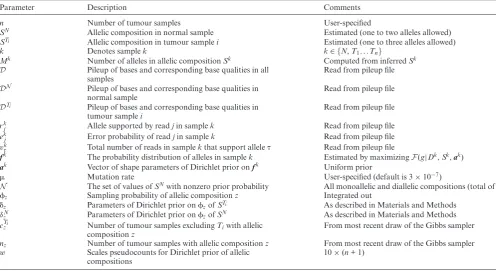
A list of parameters used to describe the inference model in multiSNV is given in Table1.
Modelling the conditional distributions. The conditional probability distribution of the allelic composition in the normal sampleSNis given by the product of the likelihood of the sequenced reads at a locus and the prior probability of observingSNgiven the allelic composition in the tumour samples:
P(SN|ST1, . . . ,STn,D)∝P(D|SN,ST1, . . . ,STn)P(SN|ST1, . . . ,STn)
We assume conditional independence of the form:
P(D|SN,ST1, . . . ,STn)=P(DN,DT1, . . . ,DTn|SN,ST1, . . . ,STn)
=P(DN|SN,ST1, . . . ,STn) n
i=1
P(DTi|SN,ST1, . . . ,STn)
Table 1. List of parameters used to describe the inference model in multiSNV
Parameter Description Comments
n Number of tumour samples User-specified
SN Allelic composition in normal sample Estimated (one to two alleles allowed)
STi Allelic composition in tumour samplei Estimated (one to three alleles allowed)
k Denotes samplek k∈{N,T1. . .Tn}
Mk Number of alleles in allelic compositionSk Computed from inferredSk
D Pileup of bases and corresponding base qualities in all samples
Read from pileup file
DN Pileup of bases and corresponding base qualities in
normal sample
Read from pileup file
DTi Pileup of bases and corresponding base qualities in
tumour samplei
Read from pileup file
rk
j Allele supported by readjin samplek Read from pileup file
ek
j Error probability of readjin samplek Read from pileup file
vk
τ Total number of reads in samplekthat support allele Read from pileup file
fk The probability distribution of alleles in samplek Estimated by maximizingF(g|Dk,Sk,ak)
ak Vector of shape parameters of Dirichlet prior onfk Uniform prior
Mutation rate User-specified (default is 3×10⁻⁷)
N The set of values ofSNwith nonzero prior probability All monoallelic and diallelic compositions (total of 10)
z Sampling probability of allelic compositionz Integrated out
␦z Parameters of Dirichlet prior onzofSTi As described in Materials and Methods
δN
z Parameters of Dirichlet prior onzofSN As described in Materials and Methods
cTi
z Number of tumour samples excludingTiwith allelic compositionz
From most recent draw of the Gibbs sampler
nz Number of tumour samples with allelic compositionz From most recent draw of the Gibbs sampler w Scales pseudocounts for Dirichlet prior of allelic
compositions
10×(n+ 1)
multiSNV analyses each location in the genome independently, so these parameters refer to a single genomic locus.
composition, so that:
P(Dk|SN,ST1, . . . ,STn)=P(Dk|Sk)
It follows that the conditional probability distribution of the allelic composition in the normal sample is given by:
P(SN|ST1, . . . ,STn,D)∝ P(DN|SN)P(SN|ST1, . . . ,STn)
Similarly, the conditional probability distribution of the al-lelic composition in tumour sampleiis given by:
P(STi|S−Ti,SN,D)∝ P(DTi|STi)P(STi|SN,S−Ti)
whereS−Tidenotes the set of all tumour allelic compositions
exceptSTi. The following subsections describe our choice of
likelihood and priors.
Likelihood model. The pileup of aligned reads that cover a particular chromosomal location in patient samplekis rep-resented by vectorrk, where each elementrk
j of the vector is∈{A,C,G,T}. Each base has an associated base quality that gives the overall probability that the base has been mis-called. In our model, we assume that all three base calling errors are equally probable, so that if for example,rkj = A, the overall probability that the base has been miscalled as Aisekj, and the probability that the base has been miscalled asAgiven that it isC,GorT, is uniform. It is convenient to define
Gk=
(gA,gC,gG,gT) :gi ≥0, gA+gC+gG+gT=1,
gi =0 ifi∈/ Sk
The probability distribution of alleles in samplekis denoted byfk∈Gk. The probability of baserk
jbeing called as∈{A, C,G,T}is
P(rkj =τ|Sk,fk)=(1−ekj)fτk+e k j 3(1− f
k τ)
Since the basesrkj are independent, the likelihood of the se-quencing dataDkis given by the product of the individual likelihoods:
P(Dk|Sk,fk)= j
P(rkj|Sk,fk)
Estimatingfk. To estimate the probabilitiesfkwe compute the maximum-a-posteriori estimate from the posterior den-sityF(g|Dk,Sk,ak),g ∈Gk, assuming a flat Dirichlet prior on the nonzero elements ofGk, parameterized byak.
For the normal sample, nonzeroak
τ are set to about five times the median normal coverage as we want to bias our ra-tio towards allele fracra-tions of 1 for homozygous sites and 0.5 for heterozygous sites. For tumour samples, we use a weaker prior with all nonzeroak
τ set to around 20% of the median coverage in tumour samples.
We compute the likelihoodP(Dk|Sk,g) in the limitek j → 0, expecting this to be a good approximation as low quality bases are filtered out. Under these assumptions, the poste-riorF(g|Dk,Sk,ak) is Dirichlet, parameterized byak
τ+vkτ wherevk
sup-port allele. This gives:
fτk=
⎧ ⎪ ⎨ ⎪ ⎩
vk
τ+aτk−1
τ∈Sk
(vk
τ+aτk)−Mk, τ ∈ Sk
0, τ /∈ Sk
whereMkis the number of alleles in the allelic composition Sk.
The explicit modelling of the probability distribution of alleles∈{A,C,G,T}allows us to represent tumour sam-ples as a heterogeneous mixture of cells with potential copy number aberrations. This improves sensitivity of detecting rare variants or variants at sites with altered ploidy.
Modelling the prior probability of each tumour allelic compo-sition. We approximate the distribution of tumour allelic compositions{ST1, . . . ,STn}as a multinomial sample from a
universe withk=24−2 types (all allelic compositions with
one to three alleles), and sampling probabilities1, . . . ,k. Thezhave a Dirichlet prior parameterized by␦z, defined according to how close a tumour allelic compositionzis to the inferred normal allelic compositionSN. We set the pa-rameter␦ztow, whenever the allelic compositionzis one mutation away fromSN, or in other words whenzhas one extra nucleotide compared toSN. Since this corresponds to a somatic SNV at the locus, the default value ofis set to 3×10⁻⁷, which is close to the estimated somatic mutation
rate. The parameterw is a weighting factor. For all other allelic compositions (excludingz=SN), we set␦
ztow2, as we consider these transitions to be less likely. We set␦z forz=SNso that
z
δz=w. The prior probability of each tumour allelic composition is:
P(STi =z|S−Ti,SN)= c
Ti
z +δz
z (cTi
z +δz)
wherecTi
z is the number of times allelic compositionzhas been observed in the set of tumour allelic compositions ex-cluding STi. AscTi
z increases, P(STi =z|S−Ti,SN) also in-creases, so that the algorithm has more power to detect shared mutations. To avoid overcalling these shared events, the weighting factor,w, is set to 10×(n+ 1), wherenis the number of tumour samples.
Modelling the prior probability of the normal allelic com-position. We use a similar approach to model the prior probability ofSN, assuming the normal sample is pure and diploid. We denote the set of allelic compositions with one or two alleles byN and let:
P(SN=z|ST1, . . . ,STn)=
0, z∈/N
nz+δzN
z∈N(nz+δ
N
z),z∈N
wherenzis the number of tumour samples with allelic com-position equal toz, andδN
z is the parameter of the Dirichlet prior on the sampling probabilityz, wherez∈N. These parameters are defined according to how close an allelic
compositionzis to the reference allele:
δN z =
⎧ ⎪ ⎨ ⎪ ⎩
wα,heterozygous reference wβ, heterozygous variant wγ,homozygous variant wδ, homozygous reference
with values defined as suggested in (11), following (12), so thatα=3.34×10⁻⁴,β =8.33×10⁻⁸,γ =1.665×10⁻⁴,
δ=0.9985. The weighting factorwis similarly set to 10× (n+ 1).
Software package
The multiSNV software package has been implemented in C++ and is available athttp://www.compbio.group.cam.ac. uk/software/multisnv
RESULTS
Benchmarking multiSNV
We evaluated multiSNV using both simulated datasets and real exome-sequencing data from a validated multi-region sequencing study on clear-cell renal carcinoma (3). We benchmarked the performance of multiSNV against four other variant callers: SomaticSniper, MuTect, Uni-fiedGenotyper and Platypus as these represent well the currently available options for analysing multiple related samples. SomaticSniper (13) and MuTect (14) call somatic SNVs from tumour-normal pairs, so analysis of multiple tumour samples requires calling variants on each tumour-normal pair independently and then combining calls. In contrast, both Platypus (15) and UnifiedGenotyper (9,10) can call variants from multiple samples, but neither has been designed to address the challenges of calling somatic variants from matched tumour/normal samples.
Simulation study
We simulated reads from four matched tumour samples and a normal, under a model of uniform sequencing depth with perfectly aligned reads and independent sequencing error, using SimulateReadsForVariants from GATK. The proba-bility of sampling a variant allele was set to the variant al-lele frequency, and sequencing noise was added at the base quality rate. We ran multiSNV and the four other variant callers using settings close to default|-details may be found in the Supplementary Material.
Sequencing Depth 15X
Variant Allele Frequency
Sensitivity 0.0 0.2 0.4 0.6 0.8 1.0
0.1 0.2 0.3 0.4 0.5
b
Sequencing Depth 30X
Variant Allele Frequency
Sensitivity 0.0 0.2 0.4 0.6 0.8 1.0
0.1 0.2 0.3 0.4 0.5
Sequencing Depth 60X
Variant Allele Frequency
Sensitivity 0.0 0.2 0.4 0.6 0.8 1.0
0.1 0.2 0.3 0.4 0.5
multiSNV UnifiedGenotyper Platypus SomaticSniper MuTect
Base Quality Score Q15
Sequencing Depth Obser v ed F a lse P o sitiv
es (per Mb)
0 1 00 200 3 00 400 5 00
0 10 20 30 40 50 60
a
Base Quality Score Q20
Sequencing Depth Obser v ed F a lse P o sitiv
es (per Mb)
0 2 55 07 5 1 0 0 1 2 5
0 10 20 30 40 50 60
Base Quality Score Q30
Sequencing Depth Obser v ed F a lse P o sitiv
es (per Mb)
0 5 0 1 00 150 2 00 250
0 10 20 30 40 50 60
[image:5.612.62.564.72.319.2]multiSNV UnifiedGenotyper Platypus SomaticSniper MuTect multiSNV (5%) UnifiedGenotyper (5%) Platypus (5%) SomaticSniper (5%) MuTect (5%)
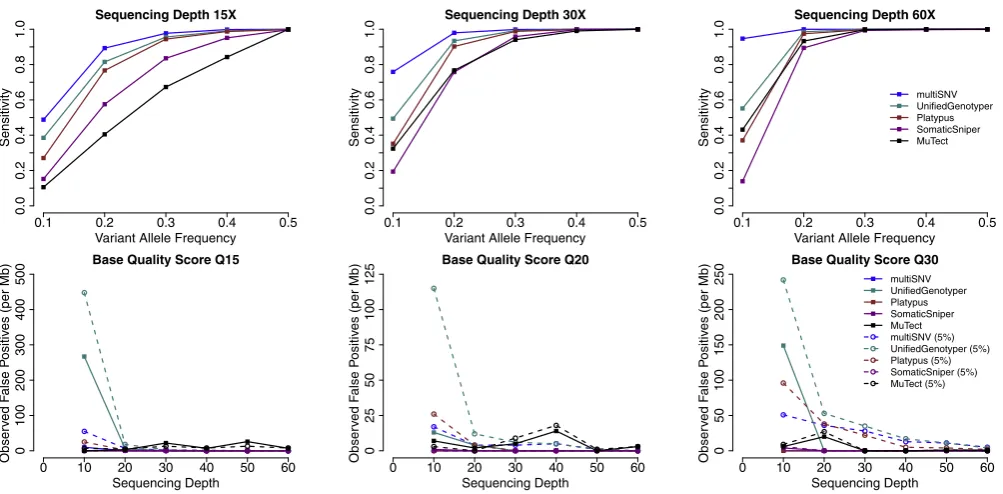
Figure 1. (a) Sensitivity in detecting shared mutations of increasing variant allele frequency at three different sequencing depths, using simulated reads of base quality score Q30. (b) Observed false-positive rate per megabase as a function of sequencing depth in the presence of 0 and 5% tumour contamination in the normal. Reads were simulated under a model of independent and uniform sequencing error, introduced at base quality rates of Q15, Q20 and Q30.
Figure1, the three multisample callers outperform Somat-icSniper and MuTect, and multiSNV is consistently more sensitive than all other methods. This is particularly evident at low allele frequencies. For example, at a variant allele fre-quency of 0.1 and sequencing depth 60, multiSNV outper-forms the second most sensitive variant caller by more than 70%. This suggests that even though joint analysis of multi-ple sammulti-ples enhances sensitivity compared to independent pairwise analyses, there are clear advantages to a multisam-ple caller that is tailored to detect somatic variation from related tumour samples.
Robustness to independent sequencing noise. To confirm that the enhanced sensitivity of multiSNV is not at the expense of a high false-positive rate, we assessed the ro-bustness of multiSNV to independent sequencing noise at default settings. This was done by simulating reads with Phred-scaled base qualities of 15, 20 and 30, and setting the variant allele frequency to 0, for different sequencing depths. We computed the false-positive rate, defined as the ratio of the number of false-positive calls to the total num-ber of simulations (100 000).
False-positive rate results for all five variant callers for sequencing depths between 10 and 60 are shown in Figure1. Most variant callers handle this type of sequencing error well, but multiSNV is one of the better performing with a false-positive rate lower than 10 per megabase, even at very low base qualities (Q15) and low sequencing depth (10). It drops towards 0 as noise levels decrease or sequencing depth increases.
Robustness to contamination of the normal by tumour cells. We also tested robustness to false positives when the normal
sample is contaminated by tumour cells, by setting the vari-ant allele frequency in all tumour samples to 0.5 and intro-ducing 5% contamination in the normal sample. The results of this simulation experiment are summarized in Figure1. multiSNV has some inherent robustness to contamination of the normal (we bias the normal to be homozygous ref-erence and the expected allele fractions in the normal to be close to 0.5 or 1); however, the likelihood model itself does not explicitly account for any possible contamination from tumour cells. This implies that all variant reads in the nor-mal are attributed to random sequencing error. It follows that the false-positive rate is higher when simulated reads have higher base qualities, as the probability of observing these high-quality variant reads is very low if the normal is homozygous reference, leading to more false-positive calls. We note that if there is significant contamination in the nor-mal, the likelihood model should be extended accordingly.
Clear-cell renal carcinoma data
Originally, SNVMix2 had been used to call somatic vari-ants and the regional distribution of a subset of nonsynony-mous, coding SNVs was verified using Sanger sequencing. We ran multiSNV, SomaticSniper, MuTect, UnifiedGeno-typer and Platypus and compared their overall number of calls, concordance with dbSNP and sensitivity in cor-rectly detecting the regional distribution of the validated SNVs. We did not compare performance to SNVMix2 as this method analyses samples independently instead of as tumour-normal pairs.
Somatic variant analysis. We ran all tools using the set-tings described in the Supplementary Material (default un-less otherwise stated). Only sites with nonzero depth in all samples were considered in the analysis. Approximately 2.7% of somatic events called by multiSNV involved a germline heterozygous site, of which 65% were loss-of-heterozygosity events. We excluded these sites from the com-parative analysis because MuTect rejects sites where the normal appears to be contaminated or heterozygous, and SomaticSniper, Platypus and UnifiedGenotyper do not call SNVs on germline heterozygous sites. Overall, less than 0.9% of somatic events failed to reach convergence when multiSNV was allowed to run up to a maximum of 3000 Gibbs cycles. This was generally due to extremely low vari-ant allele frequencies, and/or low depth. A summary of variant analysis results from multiSNV and the other vari-ant callers is shown in Table2.
Platypus called the fewest somatic sites (2530) when no filtering was applied, followed by UnifiedGenotyper (6294). To get a high confidence dataset from Platypus, we kept only sites that were flagged as‘alleleBiased’and‘PASS’, which reduced the number of sites by more than three times. Sim-ilarly, when we used the publicly available scripts suggested for filtering SomaticSniper (Supplementary Material), the raw number of somatic sites dropped by more than 17 times, down to 622.
We applied simple filters to the output of multiSNV, as described in the Supplementary Material. This reduced the number of somatic sites called from 21 504 to 7736. MuTect found the most somatic sites (274 792); however, only 1410 satisfied the six built-in filters and were included in its high confidence (HC) calls.
Overlap with dbSNP. A frequent source of false positives in somatic variant analysis is germline variation being mis-called as somatic. We compared the overlap of somatic calls made by each variant caller with dbSNP build 137 (exclud-ing sites after build 129). It is likely that not all sites called as somatic and found in dbSNP are false positives; how-ever, on average this is a good measure of the false-positive rate. multiSNV had the lowest overlap with dbSNP on both unfiltered (6.93%) and high confidence (6.15%) mode, fol-lowed by SomaticSniper (8.82%).
Sensitivity in calling validated somatic sites and SNVs. We used the set of validated mutations to compare how many of the validated somatic sites and SNVs were called by each method. Overall, 27 SNV sites from patient 1 and 17 SNV sites from patient 2 were originally validated. multiSNV (in both modes) and UnifiedGenotyper called all SNV sites,
whereas SomaticSniper missed three, even when no filters were applied. MuTect and Platypus in the unfiltered mode called all sites, but in both cases two were then rejected by the built-in filters.
SNVs were validated in several patient samples at these somatic sites, as reported in the Supplementary Material of (3). Out of 432 candidate SNVs, 171 were found to be gen-uine somatic variants. We compared the ‘validated sensitiv-ity’ of the five methods by computing the number of vali-dated SNVs called divided by the total number of valivali-dated SNVs.
Figure2shows all true-positive and false-negative SNVs plotted as a function of sequencing depth and variant al-lele frequency, from reads filtered at mapping quality Q30 and base quality Q20. Out of 171 validated SNVs, multi-SNV had five false negatives of which four were present at observed allele frequencies of 0, indicating that these sites could only be identified by subsequent validation ex-periments. Compared to MuTect (HC) and SomaticSniper (HC), UnifiedGenotyper, Platypus and multiSNV can more readily call SNVs at low sequencing depth as they consider multiple samples jointly, which improves power. The ma-jority of false negatives with UnifiedGenotyper and Platy-pus were the result of very low variant allele frequencies, which appeared even at relatively high sequencing depth. This is because these tools are not somatic variant callers as such, so they lack the sensitivity to rare variants of tools like MuTect. SomaticSniper had the most false negatives and these appeared both at low sequencing depth and low variant allele frequency. In general, the performance of So-maticSniper is compromised compared to MuTect because it assumes that variant allele frequencies are close to 0.5.
As seen from Figure2, multiSNV outperformed all other tools in terms of having the least number of false negatives, and was the only method whose validated sensitivity did not decrease after applying filters. By leveraging informa-tion from multiple samples, multiSNV was able to detect somatic mutations appearing at allele frequencies of 2.8% compared to 4.4% for MuTect, 5.9% for Platypus, 7.7% for UnifiedGenotyper and 12.0% for SomaticSniper.
A consensus approach. Platypus is unique in the cohort of variant callers considered, as it uses local de novo assem-bly, local realignment and probabilistic haplotype estima-tion, and it jointly calls indels, complex polymorphisms and SNPs (15). Unlike other variant callers, it has been shown to achieve high specificity without the need for extensive false-positive filtering. Compared to multiSNV, Platypus achieved a lower validated sensitivity (90.1 versus 97.1%), while calling 10×fewer somatic sites. Thus, even though multiSNV is superior in correctly detecting the regional dis-tribution of mutations at somatic sites, Platypus is more ro-bust to artefactual variation, so a combined approach can leverage on the strengths of the two algorithms.
Table 2. Summary of somatic variant calling statistics on the two datasets from (3) using SomaticSniper, MuTect, UnifiedGenotyper, Platypus and multi-SNV and a combined approach using multimulti-SNV and Platypus together
Method Run time (min) Somatic sites Somatic SNVs %age in dbSNP Validated sensitivity (%) Lowest VAF (%)
SomaticSniper 611 10 922 17 325 8.82 77.8 10.1
SomaticSniper (HC) - 622 1 776 10.3 66.1 12.0
MuTect 13 100 274 792 871 741 32.6 96.5 2.78
MuTect (HC) - 1 410 3 129 16.2 88.3 4.35
UnifiedGenotyper 2 428 6 294 23 638 10.1 90.1 7.69
Platypus 1 169 2 530 10 197 18.5 91.2 5.88
Platypus (HC) - 796 3 968 25.0 90.1 5.88
multiSNV 2 174 21 115 85 809 6.93 97.1 2.78
multiSNV (HC) 429 7 712 20 872 6.15 97.1 2.78
multiSNV (HC) + Platypus
- 840 3 796 15.0 97.1 2.78
Filters were used whenever they were available for the given variant caller to identify a high confidence cohort of calls (denoted by HC). dbSNP concordance was computed using NCBI dbSNP Build 137, excluding sites after 129. The last three columns show how well each variant caller did on the validated SNVs. Sensitivity was calculated by dividing the total number of true positives by the total number of SNVs that were validated. The last column shows the SNV with the lowest variant allele frequency that was detected by each variant caller.
SomaticSniper (HC)
Sequencing Depth
V
a
riant Allele Frequency
0 50 100 150 200
0.00
0.10
0.20
0.30
0.40
0.50
UnifiedGenotyper
Sequencing Depth
0 50 100 150 200
MuTect (HC)
Sequencing Depth
0 50 100 150 200
Platypus (HC)
Sequencing Depth
V
a
riant Allele Frequency
0 50 100 150 200
0.00
0.10
0.20
0.30
0.40
0.50
multiSNV (HC)
Sequencing Depth
0 50 100 150 200
False Negative True Positive
[image:7.612.57.569.310.700.2]identifies the regional distribution of mutations. This ap-proach generates the top performing caller|-matching the sensitivity of multiSNV while reducing the original set of somatic sites by almost 10 times.
DISCUSSION
Several prominent cancer studies have started sequencing multiple tumour samples from the same patient to dissect the intratumour heterogeneity of cancer. This creates a need for a somatic variant caller that extends the Bayesian ap-proaches used in the analysis of matched tumour-normal pairs to joint analysis of multiple same-patient samples. The main challenge is to model the joint distribution of geno-types (allelic compositions) with no information about the phylogenetic relationship between the tumour samples. This is trivial for tumour-normal pairs, as it is reasonable to as-sume that the (heterogeneous) tumour sample has evolved from a homogeneous normal sample. In the case of multi-ple, heterogeneous tumour samples, it is not trivial to infer the conditional dependencies between the samples. Even in the case where we have primary and metastatic samples, we may not assume that a mutation present in the primary sam-ple also exists in the metastatic one, as the given mutation might have come from a clone present in the primary sam-ple, and not ancestral to any of the clones in the metastasis. In this first version of a multisample somatic caller, we assume samples are independent. More elaborate models could benefit from an ‘active learning’ approach, so that the regional distribution of calls is used to learn dependency structures and update the priors|-this can in turn enhance the variant calling. Although powerful, such a model runs the risk of letting false-positive calls update the priors|-this might falsely bias the variant calling and the inferred depen-dencies. Independent modelling simplifies statistical mod-elling and it also allows us to view any inferred dependence structure as unbiased, as sample dependencies are not used to call SNVs. It also allows us to make confidence state-ments about calls, for example when two samples are found to be empirically similar to one another, we can be more confident in calls made in one sample, if they are also seen in the second sample.
Aside being easily generalized to an arbitrary number of samples, multiSNV also addresses several of the issues that complicate variant calling from sequencing data. It is more flexible than some of the current pairwise somatic variant callers as it is able to identify SNVs at locations that are germline heterozygous or where no allele matches the ref-erence. In addition, there is a built-in strand-bias test that pools reads from all somatic samples to increase the num-ber of reads before applying Fisher’s exact test. This is a more powerful approach than testing for strand-bias inde-pendently and it also has the advantage of generalizing to multiallelic sites. multiSNV is particularly good at detecting SNVs at low variant allele frequencies. This is because mul-tiSNV calls SNVs by identifying the most likely allelic com-position of each sample based on a likelihood model that is flexible enough to capture the effects of somatic variation by allowing for nondiploid genomes and an arbitrarily low variant allele frequency. As a result, sensitivity to call so-matic variants depends more on the depth of coverage and
less on the variant allele frequency. Furthermore, whenever an SNV is shared between multiple samples, multiSNV will use this information to update the prior probability of ob-serving an SNV in a particular sample, based on how fre-quent that SNV is in the other same-patient samples. As a result, multiSNV has an enhanced ability to resolve low variant-allele frequencies, particularly in cases where the SNV is present at higher allele frequencies in other samples. A downside of this behaviour is that multiSNV will be sus-ceptible to correlated sequencing artefacts such as context-related sequencing errors (for example at homopolymers) or misalignment due to the presence of indels, where ‘false-positive’ variant reads will be observed across different sam-ples.
We compared multiSNV against SomaticSniper and Mu-Tect, two widely used pairwise somatic variant callers, as well as UnifiedGenotyper and Platypus, which are currently the only available multisample variant callers. We used both simulated and real datasets. In simulations, most variant callers showed reasonable robustness to independent se-quencing noise and multiSNV was one of the better rithms in this aspect. Moreover, when we assessed algo-rithms based on their sensitivity to detect mutations present in multiple tumour samples, we found that the joint anal-ysis approach in multiSNV consistently outperformed all other variant callers, particularly the pairwise callers (So-maticSniper and MuTect), especially when mutations were present at lower allele frequencies.
We used the multiregion exome sequencing datasets from (3) to test multiSNV and the four other variant callers us-ing real data. Where available, we applied tool-specific filters to reduce the number of calls to a high confidence set. We found that somatic sites called by multiSNV had the lowest concordance with dbSNP, both with and without applying filters. MuTect and Platypus had the highest overlap with dbSNP, suggesting they might be more prone to miscalling germline variation as somatic.
that such integrative approaches will outperform any single method.
CONCLUSION
Our simulation and whole-exome sequencing analysis re-sults demonstrate that multisample somatic variant calling can outperform independent or pairwise independent anal-yses of multiple related samples. In particular, we show that multiSNV will identify the correct regional distribution of mutations down to variant allele frequencies of 2.78%, while false-positive filtering and consensus approaches can reduce the overall number of calls with no adverse effect on the known number of false negatives. We anticipate that mul-tisample somatic variant calling will become the gold stan-dard when analysing NGS data from multiregion sequenc-ing studies with spatially separated samples and longitudi-nal studies with samples collected at different time-points to track cancer evolution.
SUPPLEMENTARY DATA
Supplementary Dataare available at NAR Online.
ACKNOWLEDGEMENTS
We thank Charles Swanton, Marco Gerlinger, James Larkin, Stuart Horswell and Andrew Rowan for providing access to, and helpful discussions about, the clear cell carci-noma data used in the paper, and Mary Fortune for statis-tical discussions.
FUNDING
Cancer Research UK grant C14303/A17197. Funding for open access charge: University of Cambridge.
Conflict of interest statement.None declared.
REFERENCES
1. Shah,S.P., Morin,R.D., Khattra,J., Prentice,L., Pugh,T., Burleigh,A., Delaney,A., Gelmon,K., Guliany,R., Senz,J.et al.(2009) Mutational evolution in a lobular breast tumour profiled at single nucleotide resolution.Nature,461, 809–813.
2. Yachida,S., Jones,S., Bozic,I., Antal,T., Leary,R., Fu,B., Kamiyama,M., Hruban,R.H., Eshleman,J.R., Nowak,M.A.et al.
(2010) Distant metastasis occurs late during the genetic evolution of pancreatic cancer.Nature,467, 1114–1117.
3. Gerlinger,M., Rowan,A.J., Horswell,S., Larkin,J., Endesfelder,D., Gronroos,E., Martinez,P., Matthews,N., Stewart,A., Tarpey,P.et al.
(2012) Intratumor heterogeneity and branched evolution revealed by multiregion sequencing.N. Engl J. Med.,366, 883–892.
4. Zhang,J., Fujimoto,J., Zhang,J., Wedge,D.C., Song,X., Zhang,J., Seth,S., Chow,C.-W., Cao,Y., Gumbs,C.et al.(2014) Intratumor heterogeneity in localized lung adenocarcinomas delineated by multiregion sequencing.Science,346, 256–259.
5. de Bruin,E.C., McGranahan,N., Mitter,R., Salm,M., Wedge,D.C., Yates,L., Jamal-Hanjani,M., Shafi,S., Murugaesu,N., Rowan,A.J.
et al.(2014) Spatial and temporal diversity in genomic instability processes defines lung cancer evolution.Science,346, 251–256. 6. Goya,R., Sun,M.G., Morin,R.D., Leung,G., Ha,G., Wiegand,K.C.,
Senz,J., Crisan,A., Marra,M.A., Hirst,M.et al.(2010) SNVMix: predicting single nucleotide variants from next-generation sequencing of tumors.Bioinformatics,26, 730–736.
7. Roth,A., Ding,J., Morin,R.D., Crisan,A., Ha,G., Giuliany,R., Bashashati,A., Hirst,M., Turashvili,G., Oloumi,A.et al.(2012) JointSNVMix: a probabilistic model for accurate detection of somatic mutations in normal/tumour paired next-generation sequencing data.
Bioinformatics,28, 907–913.
8. Newburger,D.E., Kashef-Haghighi,D., Weng,Z., Salari,R., Sweeney,R.T., Brunner,A.L., Zhu,S.X., Guo,X., Varma,S., Troxell,M.L.et al.(2013) Genome evolution during progression to breast cancer.Genome Res.,23, 1097–1108.
9. McKenna,A., Hanna,M., Banks,E., Sivachenko,A., Cibulskis,K., Kernytsky,A., Garimella,K., Altshuler,D., Gabriel,S., Daly,M.et al.
(2010) The Genome Analysis Toolkit: a MapReduce framework for analyzing next-generation DNA sequencing data.Genome Res.,20, 1297–1303.
10. DePristo,M.A., Banks,E., Poplin,R., Garimella,K.V., Maguire,J.R., Hartl,C., Philippakis,A.A., del Angel,G., Rivas,M.A., Hanna,M.
et al.(2011) A framework for variation discovery and genotyping using next-generation DNA sequencing data.Nat. Genet.,43, 491–498.
11. Li,R., Li,Y., Fang,X., Yang,H., Wang,J., Kristiansen,K. and Wang,J. (2009) SNP detection for massively parallel whole-genome
resequencing.Genome Res.,19, 1124–1132.
12. Zhao,Z. and Boerwinkle,E. (2002) Neighboring-nucleotide effects on single nucleotide polymorphisms: a study of 2.6 million
polymorphisms across the human genome.Genome Res.,12, 1679–1686.
13. Larson,D.E., Harris,C.C., Chen,K., Koboldt,D.C., Abbott,T.E., Dooling,D.J., Ley,T.J., Mardis,E.R., Wilson,R.K. and Ding,L. (2012) SomaticSniper: identification of somatic point mutations in whole genome sequencing data.Bioinformatics,28, 311–317.
14. Cibulskis,K., Lawrence,M.S., Carter,S.L., Sivachenko,A., Jaffe,D., Sougnez,C., Gabriel,S., Meyerson,M., Lander,E.S. and Getz,G. (2013) Sensitive detection of somatic point mutations in impure and heterogeneous cancer samples.Nat. Biotechnol.,31, 213–219. 15. Rimmer,A., Phan,H., Mathieson,I., Iqbal,Z., Twigg,S.R.F.,
Wilkie,A.O.M., McVean,G., Lunter,G. and WGS500 Consortium. (2014) Integrating mapping-, assembly- and haplotype-based approaches for calling variants in clinical sequencing applications.