Testability Models for Object-Oriented
Frameworks
Divya Ranjan1, Anil Kumar Tripathi2
1Department of Computer Science, Faculty of Science, Banaras Hindu University, Varanasi, India; 2Department of Computer Engi-
neering, Institute of Technology, Banaras Hindu University, Varanasi, India. Email: [email protected], [email protected]
Received April 10th, 2010; revised April 21st, 2010; accepted April 23rd, 2010.
ABSTRACT
Frameworks are time-tested highly reusable architectural skeleton structures. They are designed ‘abstract’ and ‘inco- mplete’ and are designed with predefined points of variability, known as hot spots,to be customized later at the time of framework reuse. Frameworks are reusable entities thus demand stricter and rigorous testing in comparison to one- time use application. The overall cost of framework development may be reduced by designing frameworks with high testability. This paper aims at discussing a few metric models for testability analysis of object-oriented frameworks in an attempt to having quantitative data on testability to be used to plan and monitor framework testing activities so that the framework testing effort and hence the overall framework development effort may be brought down.
Keywords: Object-Oriented Frameworks, Complexity, Framelet-Based Design and Testability
1. Introduction
Frameworks represent semi-codes for defining and im-plementing time-tested highly reusable architectural ske- leton design experiences and hence become very useful in development of software applications and systems. The object-oriented paradigm provides a promising set of so- lutions to attain reusability with the help of objects, class- es, templates, inheritance, overloading and genericity [1,2] so object-oriented frameworks are much more com- mon than non object-oriented frameworks and have become a synonym for software frameworks. It should be noted that a framework without object-orientation is also possible. As per Gamma et al. [3], famous in reuse literature as gang of four, an object-oriented framework is a set of cooperating classes that make up a reusable design for a specific class of software which provides architectural guidance by partitioning the design into abstract classes and defining their responsibilities and collaborations. The five elements of an object-oriented framework, as identi-fied by Gurp and Bosch [4], are design documents, inter-faces, abstract classes, components and classes. An ab-stract class usually has at least one unimplemented ope- ration deferred to for its implementation during frame- work reuse.
Applications are built from frameworks by extending or customizing the framework, while retaining the original
design. The framework-centered development lifecycle broadly consists of following three phases [5]: 1) the framework development phase aims at producing re-usable design in a domain, consisting of domain analysis, architectural design, framework design, framework im-plementation, framework testing activities; 2) the frame-work usage phase is also referred to as the frameframe-work instantiation phase or application development phase. Once framework is developed, it is deployed for the de-velopment of framework-based applications that include the core framework designs or part of it and new classes need to be developed to fulfill the actual applications requirements and 3) the framework evolution and main- tenance phase.
One has to be very careful about developing fault free reusable frameworks because if the framework contains defects, the defects will be passed on to the applications developed from the framework during framework usage phase [6].The reusable framework thus demands stricter and rigorous testing in comparison to a one-time use ap-plication [7,8]. It would be advisable to guaranty the pro- duction of high quality frameworks without incurring heavy costs for rigorous testing. This calls for analyzing testability of reusable artifacts so as to reduce the overall cost of framework-based development [9].
test coverage, assuming that such coverage is possible. Several definitions of software testability are available in literature but intuitively, a software component that is test- able has the following desirable properties [11]:
test sets are small and easily generated,
test sets are non-redundant,
test outputs are easily interpreted and
software faults are easily locatable.
In spite of wide importance and promotion of frame-works, over the last decades, a widely accepted set of measures to quantify its characteristics has not been es-tablished. Moreover, there is a complete lack of frame-work testability metrics related studies in literature that could produce quantitative data on testability to be used to plan and monitor framework testing activities so that the framework testing effort and hence the overall framework development effort may be brought down. A recent work [9] proposed models for testability analysis of framework that particularly consider that the frameworks are inher-ently abstract and variable in nature. This paper proposes few more models for testability analysis of object-oriented frameworks, considering few design related aspects of frameworks.
Some obvious reasons for rigorous testability analysis of a framework could be summarized as [9]:
1) A testable framework ensures low testing cost and helps in reduction of overall development cost of a framework which has been designed and implemented as a semi-code.
2) Frameworks are reusable entities and hence high testability is essential. As testable system is known to pro- vide increased reliability.
3) High testability brings high reusability. Many a times a framework reuser will want to test few features to assess its quality. If testing a framework is tough then framework reuser will hesitate in testing and using the framework and will seek to choose another framework or go for development without deploying a framework.
4) To calm obvious scientific curiosity that while writ-ing test cases for frameworks why it is tougher in some case than the other cases or, so to say, why for one framework we had to think very hard before we were able to write a meaningful test suite, whereas for other frame- works we could generate test cases in a straightforward way.
5) Testability holds a prominent place as part of the maintainability characteristic in ISO 9126 quality model ISO, 1991, so this study also increases our understanding of software quality in general.
6) Framework testability analysis creates a base for formulating the strategy for designing highly testable frameworks, i.e., framework design for test (FDFT).
The paper is organized in three sections. Proposed testability models for software frameworks appear in Sec-
tion 2 and Section 3 presents conclusions.
2. Models for Testability Analysis of
Object-Oriented Frameworks
This section aims at discussing various metric models for testability analysis of object-oriented frameworks con-sidering few design related aspects of frameworks. Fol-lowing discussion takes into account the factors that affect the testability of an object-oriented framework, as identi-fied by Ranjan and Tripathi in [12]. They identiidenti-fied va- rious factors and sub factors that affect the testability of frameworks so as to take care of those factors to bring high testability in frameworks. As per their observations, the factors that affect the testability of a framework are related to the characteristics of documentation of a frame- work, domain of a framework, design of a framework and the test support available for the framework testing like test tools, environments, reusable test artifacts and built-in tests etc.
2.1 A Testability Model Considering the Structural Complexity of a Framework
It is empirically proved that complexity metrics are good predictors of testing effort [13]. An interesting model of OO system complexity, proposed by Tegarden and Sheetz [14], consists of the system complexity, structural com-plexity, and perceptual complexity constructs. System complexity represents aspects of OO techniques and cha- racteristics inherent to the problem. This construct influ-ences the structural aspects of the system and the per-ceptual complexity of the OO system. Structural com-plexity deals with the measurable characteristics of the resulting OO system such as the number of classes and the interconnections between the classes whereas perceptual complexity deals with the ability of the developer to un-derstand the problem, the structural components of the OO system, the use of OO techniques, and how to inte-grate these ideas to create an OO system.
As per this model, structural complexity identifies four levels of describing complexity of OO systems: variable, method, object, and system. At each level, measures are identified that account for the cohesion (Intra) and cou-pling (Inter) aspects of the system. Thus, the structural complexity of object-oriented framework may be ex-pressed as:
N
i
Inter N
i
Intra
Fr CO i CO i
SC
1 1
(1)
where,
Intra Intra
Intra CV CM
CO
(2)
and
Inter Inter
Inter
CV
CM
where,
N = Total number of objects in the framework SCFr = Structural Complexity of the framework COIntra = Intra Object Complexity in the framework COInter= Inter Object Complexity in the framework CVIntra = Intra Variable Complexity in an object CVInter = Inter Variable Complexity in an object CMIntra = Intra Method Complexity in an object CMInter = Inter Method Complexity in an object
It is very clear that framework testability is inversely proportional to its structural complexity. Therefore, using Equation (1) we can write,
N i N i Interi Intrai Fr CO CO Tb 1 11 (4)
It for sure that and
, in the abovemodel, will never be zero together. Because total number of objects in the framework will always be >= 1. In case when N = 1, the value of may become zero but
the value of will not be zero then also.
N i Intrai CO 1
N i1 Intrai N i Interi CO 1 Interi CO
N i CO 12.2 A Testability Model Considering Complexity of Framework Interfaces
A framework may have its interfaces linked to external entities like other frameworks, components, or library functions etc. [15], known as external interfaces. More the number of other entities to be integrated with the frame-work, the more effort are required for their integration testing. This effort increases with the number and com-plexities of the constituent interfaces.
A framework testability model, considering complexity of framework interfaces, may be expressed as
LInf i i LInf CInf i CInf FItf i FItf Fr N C N C N C 1 Tb i i 1 1 11
(5)
where,
FItfi
C = Complexity of framework’s ithinterface with other framework
CInfi
C = Complexity of framework’s ithinterface with component
LInfi
C = Complexity of framework’s ithlibrary interface
FItf
N = Total number of interfaces with other frameworks
CInf
N = Total number of interfaces with component
2.3 A eaviness of
ing , i.e. consisting
of how much time and ef
LInf
N = Total number of library interfaces
Testability Model Considering H Framework in Terms of its Size
Size happens to be an obvious influencing factor for test- effort [16]. A framework of huge size
of large number of classes, methods, attributes and depth of inheritance etc., is considered heavy. We here make use of (a subset of) object-oriented metrics proposed by Chidamber and Kemerer [17].
The number and complexities of the methods involved in the framework is a predictor
fort is required to test. We define WMFr(the consoli-dated weighted method per framework in line with WMC proposed in [17]) as follows:
NC
i
W WMFr
1 i
MC (6)
where
NMi
j ij i c WMC 1
(7) and
= Sum of weighted methods of all classes in FUT WMFr
i
WMC = Weighted method per class of th class in FUT Total number of classes in FUT
i =
= Nc
ij
C Complexity of jthmethod in ithclass of FUT
Mi
N = Total number of methods in ithclass
heaviness o
F f
fram follows:
ramework testability model considering ework in terms of its size may be defined as
1 1
1
Mi
Fr Nc N
Tb
( ij)
i j c
because,(8) WMFr
TEFr (9) M appearing in Equation 8
panded as below in Equations 10 and
Nc and N may further be
11
Fr Fr
C NOCC NOAC
N (10)
where,
Nc = Total number of classes in FUT
= Number of concrete classes in the FUT in the FUT
e meth-od
NOCCFr
NOACFr = Number of abstract classes
And, methods in a class shall comprise of all th crete methods, abstract methods, and overridden
s. Thus,
OM AM CM
M N N N
N (11) where
N = Total number of methods in FUT
otal number of concrete methods in FUT in FUT M
NCM = T
NAM = Total number of abstract methods
2.4 A Testability Model Considering Framelet-Based Design of Frameworks
Framelets are the small, flexible, relatively independent and reusable assets, which are designed based on the concept of frameworks. They are mini-frameworks that usually contain less than ten classes and have a simple, clearly defined interface [18]. They evolved as a means of modularizing the frameworks where a family of inter-related framelets is an alternative to complex frameworks. It is basically a design principle that instead of designing one full fledged and complex framework, design it with a family of related framelets with lean interfaces [19]. De-signing a framework in framelet-based fashion promotes reducing overall complexity of the framework and is like using divide and conquers approach to facilitate both, the design and testing of the framework.
Understanding a framelet-based framework is easier than a full fledged and complex framework because a framelet-based framework is made up of loosely coupled small frameworks, known as framelets. Testability of a framelet-based framework depends upon the testability of constituent framelets and the coupling among them. So, we may write,
Fr N
Tb Fmlt
i
Fmlt Fmlt Tb
COUP i i
1
1 (12)
where
ility of the framework
amelets
ithframelet
t a small framework,
hat the quality of the software system TbFr = Testab
NFmlt= Total number of constituent fr
COUPFmlti = Sum of measure of coupling of her
with ot framelets
TbFmlti = Testability of ithframelet in
S ce, a framelet is nothing bu
consisting of not more than ten classes and very lean interfaces with other framelets [19], so any discussion or metric model regarding framework’s testability will be applicable for estimating testability of a framelet.
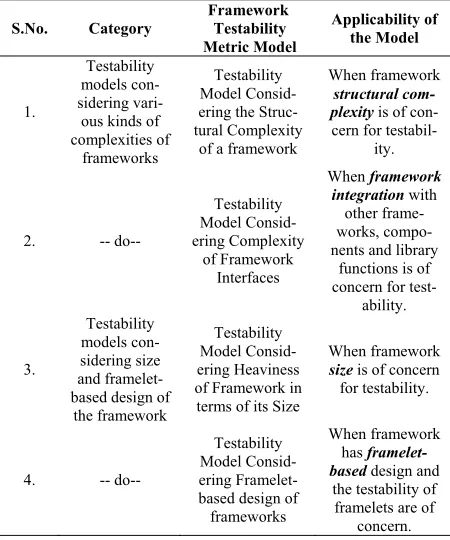
Each of the testability metric models, discussed above, has different intention or applicability which is discussed in the following Table 1, however, more than one model may also be employed at the same time.
3. Conclusions
It is quite obvious t
[image:4.595.310.535.103.373.2]which has been developed with reuse depends heavily upon the quality of the underlying reusable artifacts. Frameworks are an important reusable artifact and are believed to be at the core of leading-edge software tech-nology in the twenty first century [20]. Software frame-works and design patterns make reuse of design experi-ences possible but unlike design patterns (that may not have any code) software frameworks are semi-codes and hence call for thorough testing before they can be de-ployed as reusable entities. Although the technology for
Table 1.Applicability of framework testability metric models
Framework
S.No. Category Testability Applicability of the Model Metric Model
1. m
s ering the Struc- structural
com-Testability odels con-idering vari-ous kinds of complexities of
frameworks
Testability Model
Consid-tural Complexity of a framework
When framework
plexity is of con-cern for
testabil-ity.
2. -- do--
Model
Consid-eri ty
integration with
3.
Testability models
con-b
Model Consid-ering Heaviness
Whe ork
size is of concern
4. -- do-- er -
W
has framelet-
Testability
ng Complexi of Framework
Interfaces
Testability
When framework
other frame-works, compo-nents and library
functions is of concern for
test-ability.
n framew sidering size
and framelet- ased design of the framework
of Framework in terms of its Size
Testability Model
Consid-for testability.
hen framework
ing Framelet based design of
frameworks
based design and the testability of
framelets are of concern.
constructing frameworks ork-ba ware
relatively advanced, we comparatively lack a sufficient
[1] J. W. Hoope Software Reuse:
Guidelines and ishing, Cambridge,
s, Prospects,” Journal of Computing and Infor-
ented
ed Frameworks: Concepts and
Problems and Experiences,” and framew sed soft is
theoretical basis for testing them. This paper attempted to discuss a few metric models for testability analysis of object-oriented frameworks in an attempt to having quan- titative data on testability to be used to plan and monitor framework testing activities so that the framework testing effort and hence the overall framework development ef-fort may be brought down. The framework testability models presented here takes into account few design re-lated aspects of object-oriented frameworks.
REFERENCES
r and R. O. Chester, “ Methods,” Perseus Publ 1991.
[2] M. Smolarova and P. Navrat, “Software Reuse: Principles, Pattern
mation Technology, Vol. 5, No. 1, 1997, pp. 33-49. [3] E. Gamma, R. Helm, R. Johnson and J. M. Vlissides,
“Design Patterns: Elements of Reusable Object-Ori Software,” Addison-Wesley Professional Computing Se- ries, Massachusetts, 1994.
[4] J. Gurp and J. Bosch, “Design, Implementation and Evolution of Object-Orient
Guidelines,” Software - Practice and Experience, Vol. 31, No. 3, 2001, pp. 277-300.
Framework-orks Using Hook Technology,” Procee-
se Program,” IEEE Computer Society
Inter-IEEE Software, Vol. 15, No. 5, 1998, pp.
ability Analysis of Frameworks,” Journal of
Soft-lity Assurance,” Software Engineering Jour-
eering, Vol. 17, No.
eworks,” The Journal of Defense
n and S. D. Sheetz, “Object-Oriented System
Approach to Software Engi-
or
Software
oskimies, “Framelets—Small and
. C. Schmidt, “Object-Oriented Research Report, University of Karlskrona/Ronneby,
Sweden, 1997.
[6] J. Al-Dallal and P. Sorenson, “System Testing for Object- Oriented Framew
dings of the 17th IEEE International Conference on Auto- mated Software Engineering, Edinburgh, September 2002, pp. 231-236.
[7] J. S. Poulin and J. M. Caruso, “Determining the Value of a Corporate Reu
Comp
national Software Metrics Symposium, Baltimore, May 1993, pp. 16-27.
[8] E. J. Weyuker, “Testing Component-Based Software: A Cautionary Tale,”
54-59.
[9] D. Ranjan and A. K. Tripathi, “Variability-Based Models
for Test neer
ware Engineering and Applications, Vol. 3, No. 6, 2010, pp. 455-459.
[10] R. Bache and M. Mullerburg, “Measures of Testability as a Basis for Qua
nal, Vol. 5, No. 2, 1990, pp. 86-92.
[11] R. S. Freedman, “Testability of Software Components,”
IEEE Transactions on Software Engin
6, 1991, pp. 553-564.
[12] D. Ranjan and A. K. Tripathi, “Testability Analysis of Object-Oriented Fram
Loos
Software Engineering, accepted for publication.
[13] H. M. Olague, L. H. Etzkorn, S. L. Messimer and H. S.
Delugach, “An Empirical Validation of Object-Oriented Class Complexity Metrics and their Ability to Predict Error-Prone Classes in Highly Iterative, or Agile Software: A Case Study,” Journal of Software Maintenance and Evolution: Research and Practice, Vol. 20, No. 3, 2008, pp.171-197.
[14] D. P. Tegarde
lexity: An Integrated Model of Structure and Per- ceptions,” Presented at OOPSLA 1992. http://www.acis. pamplin.vt.edu/faculty/tegarden/wrk-pap/OOPSLA92.pdf [15] M. Mattsson and J. Bosch, “Framework Composition:
Problems, Causes and Solutions,” Proceedings of Techno- logy of Object-Oriented Languages and Systems, Nether- lands, 1997, pp. 203-214.
[16] P. Jalote, “An Integrated
ing,” Narosa Publishing House, Darya Ganj, 2009. [17] S. R. Chidamber and C. F. Kemerer, “A Metrics Suite f
Object-Oriented Design,” IEEE Transactions on Software Engineering, Vol. 20, No. 6, 1994, pp. 476-493.
[18] W. Pree, “Design Patterns for Object-Oriented
Development,” Addison-Wesley Publishing Company, Massachusetts, 1995.
[19] W. Pree and K. K
ely Coupled Frameworks,” ACM Computing Surveys, Vol. 32, No. 6, 2000.
[20] M. E. Fayad and D