Modal Characterization using Principal
Component Analysis: application to
Bessel, higher-order Gaussian beams
and their superposition
A. Mourka
1, M. Mazilu
1, E. M. Wright
1,2& K. Dholakia
1,21SUPA, School of Physics and Astronomy, University of St. Andrews, North Haugh, St. Andrews KY16 9SS, UK,2College of Optical Sciences, The University of Arizona, 1630 East University Boulevard, Tuscon, Arizona 85721-0094, USA.
The modal characterization of various families of beams is a topic of current interest. We recently reported a
new method for the simultaneous determination of both the azimuthal and radial mode indices for light
fields possessing orbital angular momentum. The method is based upon probing the far-field diffraction
pattern from a random aperture and using the recorded data as a ‘training set’. We then transform the
observed data into uncorrelated variables using the principal component analysis (PCA) algorithm. Here,
we show the generic nature of this approach for the simultaneous determination of the modal parameters of
Hermite-Gaussian and Bessel beams. This reinforces the widespread applicability of this method for
applications including information processing, spectroscopy and manipulation. Additionally, preliminary
results demonstrate reliable decomposition of superpositions of Laguerre-Gaussians, yielding the
intensities and relative phases of each constituent mode. Thus, this approach represents a powerful method
for characterizing the optical multi-dimensional Hilbert space.
T
he characterization of the modal decomposition of light remains a key requirement in numerous fields in
optics. This includes classical and quantum information processing
1, laser resonator dynamics
2, fiber optics
delivery of light
3–5and the orbital angular momentum of light
6,7. A number of schemes for characterizing
such fields have emerged that rely upon exploration of the far-field diffraction pattern of the field but pure
inspection of the form of the pattern is insufficient to delineate the desired modal parameters in a robust manner.
Identification of (for example) Laguerre-Gaussian (LG) beams has been recently shown using diffractive
struc-tures such as arrays of pinholes
8and a triangular aperture
9,10. Furthermore, researchers have also used slits
11,12, and
holograms
13,14. However, all these experimentally realized approaches can be used to measure only one single
degree of freedom (the azimuthal index) of the LG beams, neglecting the radial component and indeed have never
been applied to other families of light beams. Furthermore, open questions include the optimal aperture to use
and how robust the determination of mode indices is in the presence of any misalignment. Recently, we developed
a method using multivariate analysis to obtain both the radial and azimuthal mode indices simultaneously for
light fields possessing orbital angular momentum
15. Our studies are reinforced by theoretical work on the angular
and radial mode analysis of optical beams
16that deals with decomposition of beam into LG components using a
Mach Zehnder scheme. However this method does not measure the relative phase between the modes and it needs
multiple exposures.
Our PCA approach is based on ‘training’ our optical system with the measured far-field diffraction patterns
from known pure incident light fields upon a random diffuser and transforming the observed patterns into
uncorrelated variables using the principal component analysis (PCA) algorithm.
It is important to establish the validity of our method for the other families of light fields to demonstrate its full
applicability. In this regard Hermite-Gaussian (HG) modes are of major interest in laser resonator output
analysis
17and spectroscopy
18. Pure HG modes are characterized by nodes in orthogonal directions in a
Cartesian co-ordinate space as is well documented
19. Bessel light modes offer new directions in manipulation
20,
nanosurgery
21, microscopy
22and are delineated again by an azimuthal index
m
and a radial
k
-vector. Both of these
fields are also of interest for information processing
23.
SUBJECT AREAS:
OPTICS AND PHOTONICSPHYSICS
ADAPTIVE OPTICS
APPLIED PHYSICS
Received
25 September 2012
Accepted
26 February 2013
Published
12 March 2013
symmetry.
In the last part of the paper, we consider the applicability of the
PCA method to characterize the complex superposition of LG beams
i.e. the detected beams are not pure modes but the result of a general
linear superposition of these modes. Here, we generalize the method
presented previously
15by using an optical eigenmode
31,32decomposi-tion together with a Gerchberg-Saxton (GS) algorithm
33. We show
that our thus extended method is able to measure the complex
ampli-tudes of the different LG components in a limited superposition of
LG beams, key for practical applications.
Results
Modal characterization of Hermite-Gaussian beams
.
To illustrate
our generic approach we first begin with a discussion of propagating
the data set, leaving PC1 invariant, in order to find a second axis,
perpendicular to PC1, showing the second largest variation. This
corresponds to the second principal component (PC2). This
process can be repeated until all major variance of the dataset are
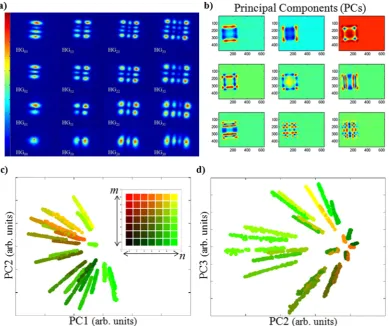
taken into account. The first nine principal components (PCs) of the
measure are shown in Figure 1b. The intensity patterns of the
‘unknown’ beam modes can be represented in the same way, using
the method of the nearest neighbor measurement in order to classify
them
24. The experimentally observed transverse intensity profiles of
[image:2.595.105.495.352.678.2]the slightly rotated lowest-order HG beams are presented in
Figure 1a. The effect of the rotation of the HG beams is studied in
a later section. As seen by ‘training’ our optical system by using the
first nine PCs, 100% classification efficiency for the detection of the
‘unknown’ propagating HG beams can be achieved. By the same
Figure 1
|
Modal characterization of propagating Hermite-Gaussian (HG) beam modes.(a) The experimentally observed transverse intensity profiles ofthe lowest-order Hermite-Gaussian beam modes, starting with HG00(lower left-hand side) and going up to HG33(upper right-hand side). The color
coded for the intensity is highlighted on the left-hand side where the blue and the red colors indicate the lower and higher intensity respectively, (b) the first 9 principal components (PCs) of the measure, (c) first two principal components analysis and color coded for themandnindices of the HG
token, all the ‘unknown’ HG beam modes have been correctly
identified as the expected HG beam modes.
[image:3.595.87.509.51.202.2]We then considered the diffraction of Hermite-Gaussian beams
from a glass diffuser. This is an aperture that can break the symmetry
of a given HG beam mode and, as might be expected speckle patterns
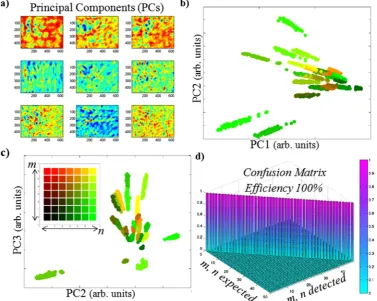
result (Figure 2a). Here, the resulting speckle patterns from the
dif-fraction of Hermite-Gaussian beams from a glass diffuser can be used
to probe the modal characteristics of the HG beams (Figure 2b). In
Figure 3 we see the range of speckle patterns that result from the
random perturbation of the glass diffuser and their subsequent
ana-lysis. Furthermore, it is to be noted that the use of a random aperture
presents an experimental benefit as all diffraction patterns have
sim-ilar peak intensities enabling acquisition with simsim-ilar exposure
dura-tions. Remarkably, using this ‘random’ aperture we achieve 100%
classification efficiency, by ‘training’ our optical system using the
first nine PCs, as indeed for the propagating beams (Figure 3d).
[image:3.595.110.488.397.698.2]The fundamental question of beam misalignment in the optical
system and the impact upon the detection efficiency is also very
interesting. We therefore investigated the influence of the beam
rota-tion around its central optical axis, on the classificarota-tion ability of our
method. This can be done by controllably rotating the SLM mask
used to generate the considered beams. Here, we studied the effect of
Figure 2|
Experimental implementation of the random aperture. (a) Design of the experiment where a HG mode (HG13) is focused on a glass diffuser aperture and a speckle pattern is transmitted and (b) (See Supplementary video file S1) the video includes an animation in which the incident HG00beam mode is presented on the left-hand side while on the right-hand side the resulting speckle pattern from its diffraction from the glass diffuser takes place.Figure 3
|
Modal characterization of the diffracted Hermite-Gaussian (HG) beams from a random aperture. (a) The first 9 principal components of the measure, (b) analysis for the first two principal components, (c) analysis for the second and third principal components and color coded for themrotation angles from
2
7
p
/32 to 7
p
/32. The PCA ‘training step’ was
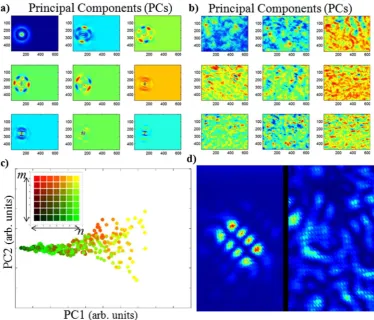
done using 15 rotated beams in the studied range. By using the first
nine PCs, we observed 99% classification efficiency for correctly
identifying the ‘unknown’ HG beam mode even in presence of
rota-tion (Figure 4). This may prove very useful for applicarota-tions such as
beam converters and laser resonators, where the beam alignment is
crucial
25–28. As previously discussed
15, this detection method can
accommodate a certain degree of misalignment or variations in the
optical system. Since the correct detection can still be achieved,
pro-vided that either a larger ‘training set’ is considered and/or a larger
dimensionality of the data is allowed by taking more PCs into
account. Our PCA detection method is limited by the number of
detectable degrees of freedom of the far-field diffraction patterns
29.
Indeed, low resolution cameras would greatly decrease the
distin-guishability between the different beams and decrease the number of
modes that can be detected in a complex superposition. We also note
that very specific misalignments, such as a rotation by
p
/2 for
example, would make some HG modes indistinguishable. We can
deduce from this statement that the PCA method is also limited by
specific beam dependence misalignments. The precise limitation
can be assessed by considering the optical degrees of freedom (see
section on modal characterization of Laguerre-Gaussian beam
superposition).
Modal characterization of diffracted Bessel beams
.
We now apply
our PCA detection method to Bessel beams. Forty-nine different
Bessel beam modes were considered. We explored beams where
the azimuthal index
m
, varied from
2
3 to 3 with integer step sizes,
and for seven different values of the radial index
k
r. This maintains
the same dimensionality used before for the Hermite-Gaussian beams
analysis. The far-field diffraction patterns of the diffracted Bessel
beams from a random (glass diffuser) aperture were considered.
First the ‘training step’ is applied in which the response of the
optical diffracting system is measured for every single Bessel beam
considered. Then the second step followed, where we used the
classi-fication algorithm which corresponds to the actual identiclassi-fication or
measurement of an ‘unknown’ Bessel beam, delivering
simultane-ously the mode indices which characterize this beam. As depicted
in Figure 5, the classification results again displaying 100% efficiency
i.e. all the ‘unknown’ Bessel beams have been correctly identified.
Modal characterization of Laguerre-Gaussian beam superposition
.
In quantum optics, entanglement requires an analysis of
superpo-sitions of states. Such superposuperpo-sitions may also occur in the classical
domain, for example when considering light fields with fractional
azimuthal index
30. It is therefore interesting to extend our approach
to the more general case of a superposition of multiple
Laguerre-Gaussian (LG) beams having different relative amplitudes and
phases
31. To that end, we trained the PCA eigenface algorithm on a
[image:4.595.110.485.51.371.2]set of 900 random complex superpositions (keeping the total intensity
constant) of four LG beams (l
5
[0, 1] and
p
5
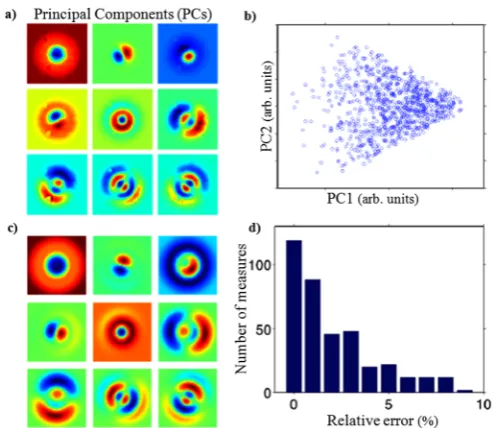
[0 , 1]). A startling
observation is that 97% of the whole training-set’s variability can be
accounted for only the first nine principal components (Figure 6).
Indeed, the superposition is described by four complex numbers
leading to four real amplitudes and three relative phases. The
non-linear relationship between these degrees of freedom and the far-field
Figure 4|
Modal characterization of the rotated Hermite-Gaussian (HG) beams which were diffracted from a random aperture. (a) The first 9 principal components of the rotated HG beam modes, (b) the first 9 principal components of the diffracted HG beam modes from a random aperture andtheir (c) first and second principal components analysis and color coded for themandnmode indices of the HG beams, and (d) (See Supplementary
diffraction pattern leads to the nine linear degrees of freedom observed
experimentally (Figure 6a) and numerically (Figure 6c). Further, the
projection onto these first principal components forms a dense cloud
showing a non-normal distribution due to the constant intensity
constraint (Figure 6b). Finally, we can identify the amplitude
distribution of an unknown beam by using nearest neighbor
classification. Experimentally, the best results were achieved when
averaging over the six closest neighbors (see error histogram
Figure 6d). The relative phase between the constituent beams can be
retrieved by using an optical eigenmode
32,33decomposition together
with a Gerchberg-Saxton (GS) algorithm
34(for more details see
Supplementary information S3 and S5). The knowledge of these
amplitudes and phases of the individual components makes their
representation on a higher-order Poincare´ sphere possible
35.
Discussion
[image:5.595.110.489.54.366.2]This paper presents a powerful method by which the mode indices of
both Hermite-Gaussian and Bessel beams can be determined. In
addition to standard methods used to characterize higher-order
beam modes, we have shown how the PCA algorithm can be used
to characterize diffracted light modes. Our detection method is very
simple to implement and uses a straightforward optical system (e.g.
ground glass). It is based on the measurement of correlations
between the probed far-field diffraction patterns and the ‘training
set’ of preliminary recorded far-field diffraction patterns of the
con-sidered Hermite-Gaussian and Bessel beams. The Principal
Component Analysis (PCA) algorithm calculates a projection of
the ‘unknown’ beam onto the term of the mode composition. The
experimental data show that the methodology preserves a high
detectability in case of strong beam distortions (e.g. those caused
Figure 5
|
Modal characterization of the diffracted Bessel beams from a random aperture. (a) The first 9 principal components of the Bessel beam modes and their (b) first two principal components analysis, (c) second and third principal components analysis and (d) color coded for the azimuthal indexmand the radial indexkrof the Bessel beams considered.Figure 6
|
Modal characterization of the LG beam superposition. The first (a) experimental and (c) theoretical principal components deducedfrom 900 random LG beam superposition (l5[0, 1] andp5[0, 1]),
(b) first two principal component projections (experimental), (d) experimentally measured individual beam detection errors for a different set of 100 random superpositions. The intensity error is defined as (ci-mi)2whereciandmiare the, encoded and respectively measured, real
[image:5.595.304.551.441.655.2]by a random aperture), provided that the ‘training set’ members
undergo the same distortions. Thus, it is tolerant to misalignment,
beam fluctuations, rotation, focusing and defocusing provided it has
been ‘trained’ for these fluctuations. Furthermore, the used mask
does not need any clever design or complicated mathematical
frame-work. The shape of the diffracting mask used to measure the mode
indices is in fact of little importance. The crucial step is ‘training’ any
diffracting optical system and the ability to access a sufficiently large
and relevant number of optical degrees of freedom
29. This allows the
transformation of the observed far-field diffraction pattern into
uncorrelated variables (principal components) that can be mapped
onto transversal mode profile index.
Our PCA detection method can be generalized to other orthogonal
mode families, which will be useful for many applications relating the
optical technologies, such as the modal decomposition for optical
fibers, laser resonators and information processing. Our method is
generic and may be extended to superpositions of different families
of light fields. Here, the amplitudes of the different LG components
in a limited superposition of LG beams were measured. In future
work, we will test the applicability of the method to superposition of
larger number of modes and study its limitations for general beam
characterization.
between even and odd symmetry with altering themvalue. Themth-order function
hasmnulls andm11peaks. Most lasers preferentially oscillate in modes of
rect-angular rather than cylindrical symmetry, thus HG modes are very commonly used.
The electric field,E(r,Q, z), of the Bessel beam is given by:
E(r,Q,z)~E0:expðikzzÞ:JmðkrrÞ:expð+imQÞ ð2Þ
where theE0is the field amplitude,krandkzare the radial and longitudinal
com-ponents of the free-space wavevector, such thatk~ ffiffiffiffiffiffiffiffiffiffiffiffiffiffik2
rzk2z q
~2p=l,Jmis the Bessel
function of themth-order andr,Qandzare the radial, azimuthal and longitudinal
cylindrical coordinates respectively. The zero order Bessel beam has a transverse intensity profile with a central maximum spot surrounded by concentric rings.
Whereas for all the higher-order Bessel beams, integerm?0, the phase singularity of
chargemon the beam axis results in a transverse intensity profile of concentric rings
but with a phase singularity on the beam axis. This results in a ‘non-diffracting’ dark,
rather than bright, core whose radius increases with the azimuthal indexm. Due to
their intensity profile and their reconstructed properties, these beams can find many
applications in various fields36,37.
Nowadays both light fields, considered here, can be holographically generated
using a computer controlled device, such as a spatial light modulator (SLM)38. The
holograms were calculated according to the Equations (1) and (2) respectively; additionally the required phase distribution was imprinted onto the incident Gaussian beam which was illuminating the SLM. The optical Fourier transform of a HG function is always another HG function of the same order. In this study, the forty-nine lowest-order HG modes were created and analyzed.
For the Bessel beams study also far-field diffraction patterns of forty-nine different Bessel beam modes from a random aperture were respectively determined. Since, one way of interpreting the Bessel beam is to consider a set of plane waves propagating on a cone. This decomposition of the Bessel beam into plane waves manifests itself in the
angular spectrum of the beam, which is an annulus ink-space. Here, annuli were
displayed on the SLM which when Fourier transformed created the different Bessel beams considered. A wavefront correction to all beams was applied using the optical
eigenmode (OEi) decomposition technique32,33.
The experimental set-up used is shown in Figure 7 and is similar to that used
previously15. A laser beam (He-Ne,l5633 nm, P
max55 mW) with an output
Gaussian profile of beam waistw55 mm, was expanded using a dual lens telescope
(L1and L2). A half-wavelength (l/2) plate was used in order to rotate the polarization
of the incoming beam to the optimum angle for the SLM (Holoeye, LC-R 2500) and maximize the power diffracted into the first order. The polarization state was verified by the use of a polarized beam-splitter after the half-wavelength (l/2) plate. The holograms used to generate the Hermite-Gaussian and Bessel beams were displayed
[image:6.595.44.293.50.236.2]on the SLM. A lens (L3) and a pinhole were introduced to the beam path to allow for
Figure 7
|
The experimental arrangement for the observation of the far-field diffraction patterns of Bessel beams, higher order Gaussian beams and their superposition from a glass diffuser. L5lens, SLM5spatiallight modulator, M5mirror, CCD5charge couple device camera,
F5ND filter. Focal lengths of lenses: f15150 mm, f251000 mm,
[image:6.595.139.454.583.706.2]f35680 mm, f45400 mm, and f55800 mm.
spatial filtration to block all the unwanted diffraction orders. Then, a lens (L4) was
used to image the different laser beam modes on the random aperture, which in our
case was a glass diffuser (Edmund Optics, 0,5udiffusing angle). We ensured that the
angle of incidence of the incoming beam was as small as possible (preferably,10u) in
order to get the maximum diffraction efficiency. Finally, lens L5served to create the
far-field diffraction patterns in its back focal plane where a CCD camera (pike, Allied Vision Technologies) was used, in order to record and save the patterns onto the hard-drive of a computer.
Detection through ‘eigenface’ classification.Principal component analysis (PCA) algorithm refers to an algorithm that uses an orthogonal transformation in order to convert a set of observed data of possibly correlated variables into a set of linearly independent and uncorrelated variables called principal components (PCs) or
‘eigenfaces’39. The main goal of the PCA algorithm is to reduce the dimensionality of
the data set. The number of the PCs is less than or equal to the number of the original observed data. This orthogonal transformation is defined in such a way that the first principal component (PC1) has the largest possible variance within the set of measures and each subsequent component reflects the next highest variance possible under the constraint that it be orthogonal to the components considered. The resultant PCs or ‘eigenfaces’ are ordered such that few of them can be used in order to account for most of the variation in all the original data set. Thus, a simpler basis can
be provided for the further multivariate analysis of the data40. Whilst PCA has been
established for over one hundred years (a technique dated back to 1901)39and widely
applied in various areas, e.g. face recognition41and cancer detection42, this method has
been recently considered or used in the case of diffraction theory and the analysis of
the transverse state of a light field15.
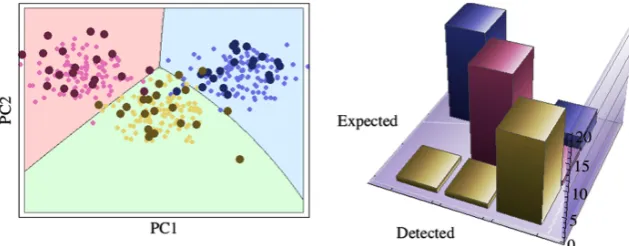
The first step of applying the PCA algorithm to our study corresponds to creating a database of all possible Hermite-Gaussian or Bessel beams that we wish to detect. After subtraction of the common mean intensity, the covariance matrix of the recorded intensity patterns is calculated. Then, the resultant eigenvector with the largest eigenvalue is termed the first ‘eigenface’ which corresponds to the largest variability of the Hermite-Gaussian or Bessel beam modes ‘training set’. In the same way, the second ‘eigenface’ corresponds to the second largest variability of the cov-ariance matrix and so on. Projecting the measured beams onto these ‘eigenfaces’, we determine the first and subsequent principal components (PCs) representation of the measure. The Hermite-Gaussian or Bessel beams with the same (mode indices) variables form very tight clusters (Figure 8), due to the readout noise and small vibrations of the optical system. Finally, a classification algorithm of the nearest
neighbor is applied in order to classify the ‘unknown’ data24. However, other methods
such as the Mahalanobis distance can be also applied43. Figure 8, shows the 3D chart of
the confusion matrix, displaying the efficiency of this method i.e. whether all the ‘unknown’ beam modes have been correctly identified as the expected beam modes. The ideal confusion matrix is the identity matrix.
1. Zurek, W. H. Reversibility and Stability of Information Processing Systems.Phys.
Rev. Lett.53, 391–394 (1984).
2. Siegman, A. E. Hermite-gaussian functions of complex argument as optical-beam
eigenfunctions.J. Opt. Soc. Am.63, 1093–1094 (1973).
3. Shapira, O., Abouraddy, A. F., Joannopoulos, J. D. & Fink, Y. Complete Modal
Decomposition for Optical Waveguides.Phys. Rev. Lett.94, 143902 (2005).
4. Schimpf, D. N. & Ramachandran, S. Polarization-resolved imaging of an ensemble
of waveguide modes.Opt. Lett.37, 3069–3071 (2012).
5. Beom Soo Soh, D.et al. Modal power decomposition of beam intensity profiles
into linearly polarized modes of multimode optical fibers.J. Opt. Soc. Am. A21,
1241–1250 (2004).
6. Bekshaev, A. Y., Soskin, M. S. & Vasnetsov, M. V. Optical vortex symmetry breakdown and decomposition of the orbital angular momentum of light beams.
J. Opt. Soc. Am. A20, 1635–1643 (2003).
7. Molina-Terriza, G., Vaziri, A., Rˇ eha´cˇek, J., Hradil, Z. & Zeilinger, A. Triggered
Qutrits for Quantum Communication Protocols.Phys. Rev. Lett.92, 167903
(2004).
8. Berkhout, G. C. G. & Beijersbergen, M. W. Method for Probing the Orbital Angular Momentum of Optical Vortices in Electromagnetic Waves from
Astronomical Objects.Phys. Rev. Lett.101, 100801 (2008).
9. Mourka, A., Baumgartl, J., Shanor, C., Dholakia, K. & Wright, E. M. Visualization
of the birth of an optical vortex using diffraction from a triangular aperture.Opt.
Express19, 5760–5771 (2011).
10. Hickmann, J. M., Fonseca, E. J. S., Soares, W. C. & Cha´vez-Cerda, S. Unveiling a Truncated Optical Lattice Associated with a Triangular Aperture Using Light’s
Orbital Angular Momentum.Phys. Rev. Lett.105, 053904 (2010).
11. Ferreira, Q. S., Jesus-Silva, A. J., Fonseca, E. J. S. & Hickmann, J. M. Fraunhofer
diffraction of light with orbital angular momentum by a slit.Opt. Lett.36, 3106–
3108 (2011).
12. Sztul, H. I. & Alfano, R. R. Double-slit interference with Laguerre-Gaussian
beams.Opt. Lett.31, 999–1001 (2006).
13. Berkhout, G. C. G., Lavery, M. P. J., Padgett, M. J. & Beijersbergen, M. W. Measuring orbital angular momentum superpositions of light by mode
transformation.Opt. Lett.36, 1863–1865 (2011).
14. Berkhout, G. C. G., Lavery, M. P. J., Courtial, J., Beijersbergen, M. W. & Padgett,
M. J. Efficient Sorting of Orbital Angular Momentum States of Light.Phys. Rev.
Lett.105, 153601 (2010).
15. Mazilu, M., Mourka, A., Vettenburg, T., Wright, E. M. & Dholakia, K. Simultaneous determination of the constituent azimuthal and radial mode indices
for light fields possessing orbital angular momentum.Appl. Phys. Lett.100,
231115 (2012).
16. Abouraddy, A. F., Yarnall, T. M. & Saleh, B. E. A. Angular and radial mode
analyzer for optical beams.Opt. Lett.36, 4683–4685 (2011).
17. Kogelnik, H. & Li, T. Laser Beams and Resonators.Appl. Opt.5, 1550–1567 (1966).
18. Novotny, L., Sa´nchez, E. J. & Sunney Xie, X. Near-field optical imaging using metal
tips illuminated by higher-order Hermite–Gaussian beams.Ultramicroscopy71,
21–29 (1998).
19. Siegman, A. E. Lasers.Universe Science Books, 642–652 (1986).
20. Garces-Chavez, V., McGloin, D., Melville, H., Sibbett, W. & Dholakia, K. Simultaneous micromanipulation in multiple planes using a self-reconstructing
light beam.Nature419, 145–147 (2002).
21. Tsampoula, X.et al. Femtosecond cellular transfection using a nondiffracting light
beam.Appl. Phys. Lett.91, 053902 (2007).
22. Fahrbach, F. O., Simon, P. & Rohrbach, A. Microscopy with self-reconstructing
beams.Nat. Photon.4, 780–785 (2010).
23. Bennett, C. H. & DiVincenzo, D. P. Quantum information and computation.
Nature404, 247–255 (2000).
24. Cover, T. & Hart, P. Nearest neighbor pattern classification.IEEE Trans. Inf.
Theory13, 21–27 (1967).
25. Beijersbergen, M. W., Allen, L., van der Veen, H. E. L. O. & Woerdman, J. P.
Astigmatic laser mode converters and transfer of orbital angular momentum.Opt.
Commun.96, 123–132 (1993).
26. Padgett, M., Arlt, J., Simpson, N. & Allen, L. An experiment to observe the
intensity and phase structure of Laguerre--Gaussian laser modes.Am. J. Phys.64,
77–82 (1996).
27. Abramochkin, E. & Volostnikov, V. Beam transformations and nontransformed
beams.Opt. Commun.83, 123–135 (1991).
28. Habraken, S. J. M. & Nienhuis, G. Modes of a rotating astigmatic optical cavity.
Phys. Rev. A77, 053803 (2008).
29. Piestun, R. & Miller, D. A. B. Electromagnetic degrees of freedom of an optical
system.J. Opt. Soc. Am. A17, 892–902 (2000).
30. Go¨tte, J. B.et al. Light beams with fractional orbital angular momentum and their
vortex structure.Opt. Express16, 993–1006 (2008).
31. Vaziri, A., Weihs, G. & Zeilinger, A. Superpositions of the orbital angular
momentum for applications in quantum experiments.J. Opt. B: Quantum
Semiclass. Opt.4, S47–S51 (2002).
32. De Luca, A. C., Kosmeier, S., Dholakia, K. & Mazilu, M. Optical eigenmode
imaging.Phys. Rev. A84, 021803 (2011).
33. Mazilu, M., Baumgartl, J., Kosmeier, S. & Dholakia, K. Optical Eigenmodes; exploiting the quadratic nature of the energy flux and of scattering interactions.
Opt. Express19, 933–945 (2011).
34. Saxton, R. G. a. W. A practical algorithm for the determination of the phase from
image and diffraction plane pictures.Optik35, 237–246 (1972).
35. Milione, G., Sztul, H. I., Nolan, D. A. & Alfano, R. R. Higher-Order Poincare´
Sphere, Stokes Parameters, and the Angular Momentum of Light.Phys. Rev. Lett.
107, 053601 (2011).
36. McGloin, D. & Dholakia, K. Bessel beams: diffraction in a new light.Contem. Phys.
46, 15–28 (2005).
37. Mazilu, M., Stevenson, D. J., Gunn-Moore, F. & Dholakia, K. Light beats the
spread: ‘‘non-diffracting’’ beams.Laser Photonics Rev.4, 529–547 (2010).
38. Vasara, A., Turunen, J. & Friberg, A. T. Realization of general nondiffracting
beams with computer-generated holograms.J. Opt. Soc. Am. A6, 1748–1754
(1989).
39. Pearson, K. LIII. On lines and planes of closest fit to systems of points in space.
Philos. Mag.2, 559–572 (1901).
40. Everitt, B. & Hothorn, T. InAn Introduction to Applied Multivariate Analysis with
R, Springer New York, Ch.3, 61–103 (2011).
41. Peter, N. B. Eigenfaces vs. Fisherfaces: Recognition Using Class Specific Linear
Projection.IEEE T. Pattern Anal.19, 711–720 (1997).
42. van ’t Veer, L. J.et al. Gene expression profiling predicts clinical outcome of breast
cancer.Nature415, 530–536 (2002).
43. Draper, B. A., Baek, K., Bartlett, M. S. & Beveridge, J. R. Recognizing faces with
PCA and ICA.Comput. Vis. Image Und.91, 115–137 (2003).
Acknowledgements
We thank the UK Engineering and Physical Sciences Research Council for funding. Kishan Dholakia is a Royal Society-Wolfson Merit Award Holder.
Author contributions
All authors developed and planned the project. A.M. performed the experimental work; M.M. analyzed the data and all authors wrote, reviewed and approved the manuscript.