ISSN Online: 2327-4379 ISSN Print: 2327-4352
DOI: 10.4236/jamp.2019.711202 Nov. 29, 2019 2927 Journal of Applied Mathematics and Physics
Research on Transformation Characteristics of
Binomial Coefficient Formula and Its Extended
Model
Minghan Zhu
1, Jeffrey Zheng
21School of Software, Yunnan University, Kunming, China
2Yunnan Laboratory of Quantum Information, Kunming, China
Abstract
Combinatorial methods are used to give specific mathematics, and the proof of combinatorial identities is the hot spot research of combinatorial mathematics. Binomial coefficients play an important role in the fields of physics, mathe-matics and computer science. In variances of rotation and reflection is the core characteristic for combinatorial systems. This paper uses different parameters to form reflection, rotation and specific features by using variant construction model and method, meanwhile the quantitative distribution characteristics of binomial coefficient formula are analyzed by three-dimensional maps. Using variant construction, the combinatorial clustering properties are investigated to apply binomial formulas and sample distributions, and various combina-torial patterns are illustrated. It is proved that the basic binomial coefficient formula and its extended model have obvious properties of reflection and ro-tation invariance.
Keywords
Binomial Coefficient, Spatial Extension, Variant Construction, Reflection, Rotation
1. Introduction
There are one-to-one relationships between binomial coefficients and PASCAL triangles. Mathematicians from ancient to modern are deeply interested with them from the angle of in variances [1]. Using visual technology of computer graphics and image processing, data streams are transformed into graphics or How to cite this paper: Zhu, M.H. and
Zheng, J. (2019) Research on Transforma-tion Characteristics of Binomial Coefficient Formula and Its Extended Model. Journal of Applied Mathematics and Physics, 7, 2927-2932.
https://doi.org/10.4236/jamp.2019.711202
DOI: 10.4236/jamp.2019.711202 2928 Journal of Applied Mathematics and Physics images as maps that could be displayed on the screen, and then various theory, method and technology are developed for interactive processing [2].
The resulting distribution with the family of that binomial formula and its ex-tended model contain obvious invariant properties of reflection and rotation in the paper. It is expected that this kind of invariant formula can be closely asso-ciated with the invariant properties in quantum mechanics, classical physics, mathematics, computer science and convolutional neural network, which could be helpful to explore the optimization research of various applied computing methods [3].
2. Theoretical Basis
2.1. Binomial Coefficient and Combinatorial Number
Binomial coefficient [4]: or combinatorial numbers, is defined as, the m-th coef-ficient of expanded x (Where n is a natural number and m is an integer).
Combinatorial number [5]: the number of all combinations of m (m ≤ n) ele-ments selected from n different eleele-ments. It means the number of combinations of m elements from n different elements on the symbol expressed [6].
2.2. Variant Construction
The variant construction [7] proposed in 2010 is composed of three parts: va-riant logic, vava-riant measurement and vava-riant map. Vava-riant logic is a new logic system based on 0 - 1 vector model.
Based on the traditional vector state, the system extends its phase spaces using two kinds of vector operations: permutation and complementarity. The n logical function space is extended from a traditional function space to a functional con-figuration space by two extended logic operations.
Variant measurements and variant maps have been applied to different prob-lems, including classical cryptographic sequence analysis, quantum cryptographic sequence detection, chromosome whole gene sequence illustration, electrocardio-gram signal detection, bat signal processing and other applications [7].
This paper focuses attention mainly to extend a basic binomial formula in va-riant measurement [7].
2.3. Reflection and Rotation Invariants
The reflection transformation [8] is one significant part of conversion in the Euclid plane geometry. The axial reflection on the plane and the mirror reflec-tion are both called the reflecreflec-tion transformareflec-tion [9].
DOI: 10.4236/jamp.2019.711202 2929 Journal of Applied Mathematics and Physics
3. Process Flow
Derive from Binomial Coefficient Formula
Ordered structure of four measures: {a, b, c, d} in the monograph on variant constructions [7] pages 39-50. There are 192 different ways of representing structures under both permutation and combination. Any one of arbitrary structure corresponds to a set of binomial coefficients.
In this paper, the binomial formula f m p k
(
, ,)
m p pk k
−
=
is selected,
and the value range is 0 ≤ p ≤ m; 0 ≤ k ≤ p; k ≤ m − p.
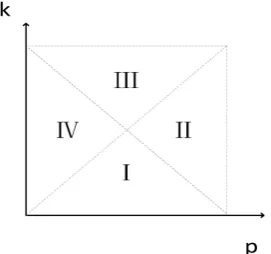
According to the binomial coefficient formula, multiple steps of transforma-tions on different values contain various features of reflection and rotation inva-riances. Different binomial coefficient formulas are shown in four regions with distinguished characteristics. On a set of four binomial coefficient formula, their parameters and valued ranges are different. The transforming process for the four Zones {I, II, III, IV} is shown in Figure 1.
[image:3.595.262.486.379.531.2]The Zone I can be calculated from the formula. Range of Zone III can be car-ried out by reflecting binomial coefficients of corresponding positions in Figure 2. To simulate this type of reflection effects on the Zone III, the formula f3 can be applied.
Figure 1. Process flow on a set of binomial coefficient formula.
[image:3.595.307.443.563.690.2]DOI: 10.4236/jamp.2019.711202 2930 Journal of Applied Mathematics and Physics Because of reflection and rotation invariance between Zone I, III and Zone II, IV, rotated from Zone I, III to Zone II, IV. The binomial coefficients of the four regions are symmetric with the diagrams on m − p = k and p = k.
In Figure 2, the four Zones and their relevant positions are systematically il-lustrated. Formula for each Zone and corresponding parameters are listed as follows.
1) f m p k
(
, ,)
m p pk k
−
=
, 0 < p < m; 0 < k < p; k < m − p;
2) 3
(
, ,)
m k k f m p k
p p
−
=
, 0 ≤ k ≤ m; 0 ≤ p ≤ k; k ≤ m − p;
3) 2
(
, ,)
k m k
f m p k
m p m p
−
= − −
, 0 ≤ p ≤ m; 0 ≤ k ≤ p; k > m − p;
4) 4
(
, ,)
p m p
f m p k
m k m k
−
= − −
, 0 ≤ k ≤ m; 0 ≤ p ≤ k; k > m − p.
4. Further Results
In three-dimensional representation:
The distribution of different values is analyzed and discussed visually by using the measurement diagram in the combinatorial coefficients.
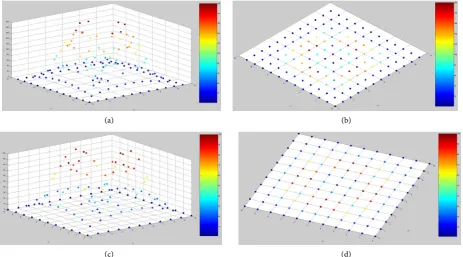
Applying the function f1m = 11, a total of 42 points are in the region of 12*12 shown in Figure 3(a) and Figure 3(b) and the distribution presents symmetric features. The color increases from blue to red. It can be clearly observed that there are two points at the highest level, the tangent values are equal, and there is no highest point in the top view Figure 3(a). Therefore, top view Figure 3(d) shows the distribution of the highest points.
When m = 11 and m = 10, the three-dimensional visualization results of func-tion f1 are shown in Figures 3(a)-(d).
For Zone II, m = 11 and m = 10 as examples to compare the coefficient dis-tribution by the rule of odd-even after reflection binomial formula.
Finally, for Zone II and IV, rotation effects are illustrated by the extended bi-nomial coefficient distributions shown in Figures 4(a)-(d) through f2 and f4, as the rotation of f1 and f3 functions on rotation invariant.
There is no vertex at the top of the triangle on the top view, and the highest value is represented for two numerical points when m is odd. The top view tri-angle has the highest vertex when m is even.
5. Conclusion
DOI: 10.4236/jamp.2019.711202 2931 Journal of Applied Mathematics and Physics (a) (b)
[image:5.595.67.533.64.330.2]
(c) (d)
Figure 3. Three dimensional maps of initial binomial coefficient formula (a) m = 11 in front view; (b) m = 11 in top view; (c) m = 10 in front view; (d) m = 10 in top view.
(a) (b)
(c) (d)
Figure 4. Three dimensional maps of the four Zones (a) m = 11 in front view; (b) m = 11 in top view; (c) m = 10 in front view; (d)
m = 10 in top view.
[image:5.595.68.532.374.631.2]DOI: 10.4236/jamp.2019.711202 2932 Journal of Applied Mathematics and Physics big data analysis and simulation targets with complex combinatorial measure-ments in the future.
Acknowledgements
This project is supported by The Key Project of Quantum Communication Technology of Yunnan (2018ZI002) and Yunnan overseas high-level Scholar project.
Conflicts of Interest
The authors declare no conflicts of interest regarding the publication of this pa-per.
References
[1] Brualdi, R.A. (2005) Combinatorial Mathematics. 4th Edition, China Machine Press.
[2] Pang, X.M. (2009) Application of Combinatorial Transformation in Equations, Po-lynomials and Simple Graphs. Nankai University, Tianjin.
[3] Morgan, F. (2009) Geometric Measure Theory. World Publishing Corporation. [4] Wu, J. (2012) Beauty of Mathematics. Posts and Telecom Press.
[5] Knuth, D.E. (2011) The Art of Computer Programming (Volume 4: Combinatorial Algorithms, Part 1). National Defence Industry Press.
[6] Knuth, D.E. (2002) The Art of Computer Programming (Volume 1, 3rd Edition). National Defence Industry Press.
[7] Zheng, J.Z.J. (2019) Variant Construction from Theoretical Foundations to Appli-cations. Springer, China, 39-50, 237-245.
https://link.springer.com/book/10.1007/978-981-13-2282-2
https://doi.org/10.1007/978-981-13-2282-2_3
[8] Wang, Q.P. (2008) Reflection Transformation in Metrological Logic. Fuzzy Systems and Mathematics, 32.
[9] Yin, S.H. (2012) Calculation of Moment of Inertia of Rigid Body by Bernoulli Coef-ficient Table. Science Journal of Normal University, 32.