Munich Personal RePEc Archive
Cognitive Reflection Test: Whom, how,
when
Brañas-Garza, Pablo and Kujal, Praveen and Lenkei, Balint
Middlesex University London
2015
1
Cognitive Reflection Test: Whom, how, when
1Pablo Brañas-Garza2, Praveen Kujal1, Balint Lenkei
Middlesex University London
Abstract
We report the results of a meta-study of 118 Cognitive Reflection Test studies comprising of 44,558
participants across 21 countries. There is a negative correlation between being female and the overall,
and individual, correct answers to CRT questions. Taking the test at the end of an experiment negatively
impacts performance. Monetary incentives do not impact performance. Overall students perform better
compared to non-student samples. Exposure to CRT over the years may impact outcomes, however,
the effect is driven by online studies. We obtain mixed evidence on whether the sequence of questions
matters. Finally, we find that computerized tests marginally improve results.
Keywords: CRT, Experiments, Gender, Incentives, Glucose and Cognition.
1 We thank all authors that shared their data with us. We are especially thankful to Tere Garcia, Antonio Espin and Georgui Kolev for their comments, and the audience at the London Experimental Workshop (RHU 2015),
Middlesex BBS (2015) and SABE (Sibiu 2015).
2
1. Motivation
The Cognitive Reflection Test (CRT) was first proposed by Frederick (2005) and since then has
been extensively used in the Experimental Economics and Psychology literature. Frederick
proposed the CRT based on a dual-system theory (e.g. Epstein 1994, Sloman 1996, Stanovich
and West 2000, Kahneman and Frederick 2002) made up of two cognitive processes: System
1, executed quickly without much reflection and System 2, more deliberate and requiring
conscious thought and effort. The questions in the CRT have an immediate (intuitive) incorrect
response (System 1). However, the correct response requires some deliberation, i.e. the
activation of System 2.
Frederick (2005) showed that individuals with high CRT scores are more patient and more
willing to gamble in the domain of gains. He also provided evidence that the CRT scores are
highly correlated with some other tests of analytic thinking (e.g. ACT, NFC, SAT and WPT) and
that the test has a (male) gender bias. Toplak et al. (2011) claim that the CRT can be viewed as
a combination of cognitive capacity, disposition for judgement and decision making. They argue
that the CRT captures important characteristics of rational thinking that are not measured in
other intelligence tests. The standard CRT test consists of the following three questions:
A bat and a ball cost $1.10 in total. The bat costs $1.00 more than the ball. How much
does the ball cost? (Intuitive answer 10, correct answer 5).
If it takes 5 machines 5 minutes to make 5 widgets, how long would it take 100 machines
3
In a lake, there is a patch of lily pads. Every day, the patch doubles in size. If it takes 48
days for the patch to cover the entire lake, how long would it take for the patch to cover
half of the lake? (Intuitive answer 24, correct answer 47).3
Since Frederick (2005), several researchers have adopted the CRT as a measure of cognitive
abilities and used it to study its predictive power in decision making (e.g. Oeschler et al 2009,
Campitelli and Labollita 2010, Hoppe and Kusterer 2011, Besedes et al 2012, Andersson et al
2013, Moritz et al 2013 etc.). Oechssler et al (2009) investigate whether behavioral biases are
related to cognitive abilities. Replicating the results of Frederick (2005), they find that
participants with low scores on the CRT are more likely to be subject to the conjunction fallacy
and to conservatism in updating probabilities (also see Liberali et al 2012, Alós-Ferrer and
Hügelschäfer 2014)
The CRT has also been found to be a good predictor of the degree of strategic behavior in
laboratory experiments (e.g. Brañas-Garza et al 2012, Carpenter et al 2013, Kiss et al 2015
etc.). It is a useful test to measure strategic behavior as it not only captures the reflective
processes but also the ability to execute small computational tasks (Corgnet et al 2015). For
example, Brañas-Garza et al (2012) investigate the relationship between CRT outcomes and
subjects’ performance in the repeated feedback-free p-Beauty Contest Game (BCG) (Nagel
1995), where a higher level of reasoning indicates better strategic behavior. They find that
individuals with higher scores on the CRT choose numbers closer to the Nash equilibrium. It
seems that the CRT helps us in identifying sophisticated subjects who play according to the
Nash equilibrium in this strategic environment. Kiss et al (2015) look at the effect of CRT on
withdrawal decisions in an extended version of Diamond and Dybvig’s (1983) bank-run game.
4
They find that participants with higher cognitive abilities (as measured by the CRT) tend to
identify the dominant strategy easier when strategic uncertainty is present in the game.
It is now well established in the Experimental Economics and Psychological literature that
subjects with better cognitive abilities are other-regarding (e.g. Ben-Ner et al 2004, Chen et al.
2013). In recent years the link between CRT scores and social preferences has been
investigated (Corgnet et al 2015, Cueva-Herrero et al 2015, Peysakhovic and Rand 2015, Ponti
and Rodriguez-Lara 2015). Corgnet et al (2015) find that individuals with a high CRT score are
more likely to make altruistic choices in simple non-strategic decisions. Their choices increase
social welfare by increasing the other person’s payoff at a very low (or none) cost for the
individual. On the other hand, the choices of less reflective subjects are more correlated with
spiteful motives.
There is also evidence regarding the relationship between behavioral biases and cognitive
reflection in the literature on behavioral finance and experimental asset markets (e.g. Cheung
et al 2014, Noussair et al 2014, Corgnet et al 2014, Bosch-Rosa et al 2015, Holt et al 2015
etc.). Corgnet et al (2014) find that high CRT subjects earned significantly more on average
than the initial value of their portfolio while low CRT subjects earned less. Interestingly, subjects
with low CRT scores were net purchasers (sellers) of shares when the price was above (below)
fundamental value while the opposite was true for subjects with high CRT scores. Bosch-Rosa
et al. (2015) show that if subjects with only low cognitive abilities are trading in an experimental
asset market it will lead to bubble formation. While, in markets with only highly cognitive
individuals assets trade close to their fundamental values. In a recent paper Holt et al (2015)
study gender differences in an experimental asset market where participants answer the
5
gender differences in bubble formation, they find that male subjects performed better on all
questions, and the difference was largest for the more mathematical speed question.
Males generally score significantly higher on the CRT than females (e.g. Frederick 2005,
Hoppe and Kusterer 2011, Cueva-Herrero et al 2015, Holt et al 2015 etc.). It has been well
documented in the experimental literature that in general males have higher mathematical
abilities and score higher than females on math tests (e.g. Benbow and Stanley 1980, Aiken
1986-1987, Benbow et al. 2000, Mau and Lynn 2010 etc.). We test for whether the hypothesis
regarding the reported gender differences holds in a large sample comprising of very different
studies (e.g. different locations, lab based, incentivized, non-student samples etc.).
An important question both in economics and psychology has been regarding the use of
incentives in experiments. The available evidence supports both viewpoints suggesting that
whether incentives matter or not may be context dependent. Riedel et al (1988) and Scott et al
(1988) find a positive relationship between monetary incentives and performance levels while
others (e.g. Jenkins et al 1998, Camerer and Hogarth 1999, Bonner and Sprinkle 2002) find
evidence to the contrary. Studies that reject the impact of monetary incentives on performance
outcomes argue that while it increases effort, it either doesn’t improve performance at all or it
only increases the performance of those who possess better cognitive abilities (Awasthi and
Pratt 1990)4. In this paper we aim to test whether monetary incentives significantly impact the
number of correct responses in the CRT.
The issue of external validity is important for the experimental literature. There are mixed views
on whether studies conducted with (volunteering) university students provide reliable results
(Peterson 2001, Levitt and List 2007, Falk and Heckman 2009, Falk et al 2013, Exadaktylos et
6
al 2013). Common objections are that student subject pool sample sizes are small and not
representative. Our meta-study also compares the CRT results for student and non-student
samples of participants.
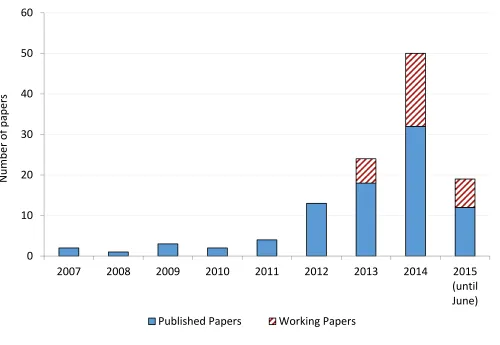
Figure 1 presents the total number of working and published papers included in our analysis
over the period of 2007 to 2015. One can see that in recent years the CRT has been
increasingly used. It has been argued that due to its increasing popularity subjects may have
[image:7.612.59.559.316.661.2]had prior experience with the test (Toplak et al 2014).
Figure 1: Number of papers in our meta-study according to the year the papers were published
The emergence of popular online experimental platforms such as the Amazon Mechanical Turk
(AMT henceforth) (for review on AMT see Paolacci et al 2010, Buhrmester et al 2011, 0
10 20 30 40 50 60
2007 2008 2009 2010 2011 2012 2013 2014 2015 (until June)
Number
o
f paper
s
7
Goodman et al 2013) may have contributed to the acceleration of this process. In later sections
we discuss whether the year a particular CRT study was conducted and whether it was
conducted on line affected test scores. This is closely related to another issue that is important
in the experimental literature, that is, whether different administration modes (i.e. computerized
or paper and pencil) provide significantly different outcomes (e.g. George et al 1992, King and
Miles 1995, Cole et al 2006, etc.). In our meta-analysis we also address whether the use of
computerized settings matter.
The paper is organized as follows. Section 2 presents the procedures and techniques used for
data collection. Section 3 provides the main findings. Section 4 explores and discusses these in
further detail and provides an overview. Section 5 concludes. All additional information is in the
Appendix.
2. Procedures
2.1. Data collection
The information and data on the CRT were obtained through two channels. First, an e-mail
inviting members of the Economic Science Association (ESA) was sent. In addition, a reminder
e-mail was sent before the process was closed in June 2015. Respondents were provided with
an online survey where they could input information about their study. Second, we searched for
research articles using the phrase “Cognitive Reflection Test” on Google Scholar. If an article
was identified as one where the CRT was conducted the corresponding author was e-mailed
the survey. The researchers were asked to respond to the following questions on the survey:
8
How many of the total answered the B&B, Machines, and Lillypad questions correctly
(and the fraction of females among them).
Out of the total how many participants answered all Three, Two or One question(s)
correctly (and the fraction of females among them).
Whether the subjects received monetary incentives for correct answers.
Whether the CRT was computerized or it was a paper and pencil test.
The order of the CRT questions.
Whether the CRT was conducted before, in-between or after the experiment.
Figure A1 (Appendix) presents a screen shot of the actual questionnaire that researchers were
asked to fill out.
2.2. Sample creation
Appendix B provides a list of all research articles included in our analysis. Some research
papers in our meta-analysis include two or more CRT studies. Overall our data comprises of
118 studies with 44,558 participants between the years 2007 and 2015. The articles represent
a wide range of disciplines including Behavioural Economics, Management and Psychology
with researchers from 21 different countries5. The largest number of studies was conducted in
the USA and Germany, 42 and 15, respectively. The study with the lowest number of
observations was 40, while the study with the most had 4,312. The full sample of 44,558
subjects was broken down into further sub-categories. These were:
Female (vs Male=0).
Computerized (vs paper and pencil=0).
9
Students (vs Non-students=0).
Position (whether the CRT was conducted before, in-between or after experiments).
Sequence (the order in which the CRT questions were asked).
Monetary incentives (whether the experimenter paid monetary incentives for correct
answers).
Visibility (the year in which the studies were conducted, see also Table 2).
Appendix Table A1 includes a breakdown regarding the number of observations available in
each category in our sample.
2.3. Empirical strategy
We use OLS6 regressions to estimate the relationship between CRT outcomes and the list of
variables defined earlier. The robust standard errors are clustered around study IDs. Note that
our meta-analysis includes 118 studies and there is a remarkable heterogeneity among them
(e.g. paper and pencil/computerized; incentivized/non-incentivized etc.). In order to check for
the robustness of our analysis we re-run our main regressions (Table 1) with six additional
sub-samples (see Appendix):
A sub-sample including female subjects only (Appendix Table A2). In section 4.1 we
analyze the impact of gender differences on CRT results.
A sub-sample excluding studies where participants were university students (Appendix
Table A3). In section 4.3 we analyze the difference in CRT results between university
student samples and samples including non-students.
A sub-sample excluding the studies where experiments were not conducted (Appendix
Table A4). In section 4.4 we analyze the impact of positioning of the CRT compared to
10
the main experiment (i.e. before, in-between or after). Our general sample includes
studies where the researchers did not run experiments. Having these observations in our
sample could potentially lead to biased estimates. Further, by excluding these
observations we can isolate the effect of these studies on the positioning of the CRT
test.
A sub-sample excluding the studies where the sequence of the questions were randomly
determined (Appendix Table A5). In section 4.5 we analyze the effect of the CRT
question sequences on test outcomes. We divide our full sample between standard
sequence (i.e. B&B, Machines, Lillypad) and other sequences. The general sample
however includes studies where the sequence of questions is randomly determined.
There is a 1 in 6 chance that randomization generates a standard sequence. By
excluding random sequences we can isolate the effect of having standardized
sequences in the other sequence sub-sample.
A sub-sample excluding studies where monetary incentives were used to reward correct
answers (Appendix Table A6). In section 4.6 we analyze the impact of monetary
incentives on CRT performance.
A sub-sample excluding studies where the experimenters used Amazon Mechanical
Turk (Appendix Table A7). In section 4.7 we discuss subjects’ exposure to the CRT over
the years. Popular online experimental platforms such as the AMT may have made the
test more visible over the years. Further, the ease of access to the correct answers
raises important methodological concerns7.
11
3. Basic findings
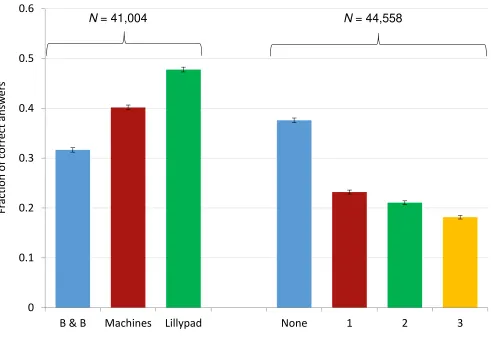
Figure 2 shows a summary of our results for the correct answers by individual questions and for
[image:12.612.61.552.219.558.2]the test as a whole.
Figure 2: The fraction of correct answers in the meta-study.
The left side refers to the number of correct answers for each question, i.e. B&B, Machines and
Lillypad (N = 41,004). While the B&B question was answered correctly by 32% in the sample,
the fraction rises to 48% for the Lillypad question. It seems that the B&B question is more
cognitively demanding for the subjects. The two-tailed t-tests (equal/unequal variances)
comparing the means of the B&B, Machines, Lillypad distributions reject the null hypothesis of
equal means (p<0.001). 0
0.1 0.2 0.3 0.4 0.5 0.6
B & B Machines Lillypad None 1 2 3
Fr
act
ion
of c
orr
ec
t
ans
w
er
s
12
The right hand side of Figure 2 gives the results based upon the total number of correct
answers, i.e. None, 1, 2, 3 (N = 44,558)8. Note that 38% of the participants provide none
meanwhile, 18% provide all correct answers. Our results indicates that a third of the population
lack reflective, or cognitive, abilities. Meanwhile, the remaining 62% have at least some. As
previously, the two-tailed t-tests (equal/unequal equal variances) comparing the distribution of
the None, 1, 2, 3 correct answers reject the null hypothesis of equal means everywhere
(p<0.01).
4. Whom, how, when
4.1. Gender bias
Frederick (2005) (N = 3,428) showed that males perform better in the CRT (also see Oechssler
et al. 2009, Hoppe and Kusterer 2011, Cueva-Herrero et al 2015, Holt et al 2015, etc.). We
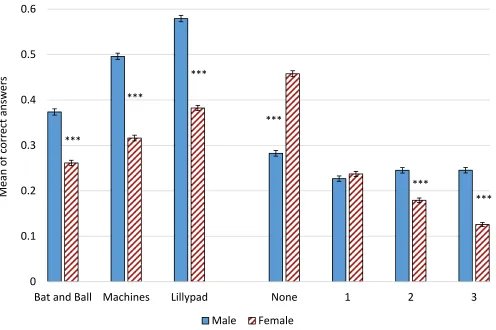
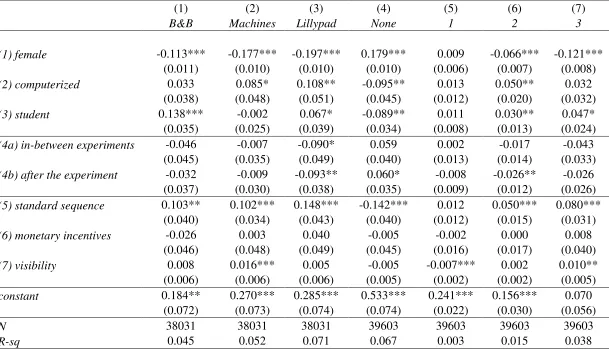
obtain similar results (N = 44,558; females 52.76%) (Figure 3). We find that: (i) males perform
better in every single question, (ii) females are more likely to answer none of the questions
correctly, and (iii) males are more likely to answer all three questions correctly. Importantly,
gender differences persist even when we control for test characteristics (e.g. monetary
incentives, computerized, student samples, positioning of the experiment etc.) (see row 1,
Table 1).
--- Insert Table 1 here ---
Knowing that the CRT has a strong male bias is useful for sample building. For instance, say
that we would like to select subjects with certain characteristics from the sample. Our study
suggests that using the 3-correct-answers criteria will give us twice as many males than
13
females. This implies that we not only select highly cognitive individuals, but also that the
[image:14.612.59.555.176.506.2]sample is strongly biased towards males.
Figure 3: Mean of correct answers by gender.
Note: The asterisks reflect the p-values from the regressions analysis (Table 1, row 1).
Bosch-Rosa et al (2015), for example, divide their subject pool between individuals with low
and high cognitive abilities based on the CRT results in order to perform a later task. Our
results suggest however that their findings might be partly driven by gender effects. A similar
problem arises in Brañas-Garza et al (2012) where they find that high CRT scorers are more
likely to play according to the Nash Equilibrium in the Beauty Contest Game. This may again be
due to the higher proportion of males rather than just an overall effect of high CRT scorers. 0
0.1 0.2 0.3 0.4 0.5 0.6
Bat and Ball Machines Lillypad None 1 2 3
Mea
n o
f c
orr
ec
t ans
w
er
s
Male Female
***
***
***
***
14
Tables A3, A4, A5, A6, A7 (Appendix) report the results from various robustness checks
conducted to test the validity of our model (see section 2.3). The initial results on gender
differences (Table 1) remain negative and statistically significant (p<0.01) throughout. In
addition we replicated the regressions with a female only sample (Table A2). We find that all
previous results hold. In sum, gender has an important impact on CRT performance and if used
as a sorting criteria may bias the distribution of participants.
4.2. Hand run vs. computerized?
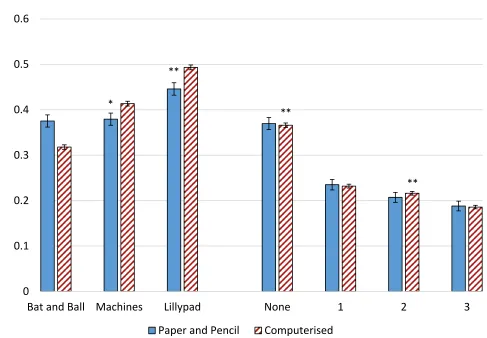
Figure 4 presents the mean of correct answers for the CRT questions for hand run -paper and
pencil- vs. computerized studies (12.09% and 87.91% of the full sample, respectively). The
regression results in Table 1 (row 2) find that the dummy variable for computerized is only
weakly significant. It seems that computerized implementation favors performance in the
Machines (p<0.1) and Lillypad questions (p<0.05), however, we do not observe significant
effects on the B&B question (p>0.1). However, we do observe that subjects using computers
are less likely (p<0.05) to fail all three questions and more likely to have two correct answers
(p<0.05). We find this puzzling since one would expect that using paper and pencil would be
more conducive to obtaining correct answers.
The robustness checks in the Appendix corroborate these findings. While Tables A2, A4, A6
report somewhat stronger effects, Tables A3, A5 and A7 report identical results. Note, however,
we do not have information on whether participants could work out solutions on paper while
responding to the computerized questions.
Summarizing, we find that running the CRT on computers as compared to paper and pencil
15
Figure 4: Mean of correct answers by computerized/paper and pencil test.
Note: The asterisks reflect the p-values from the regressions analysis (Table 1, row 2).
4.3. Students vs. non-students
Most economics experiments are run with university students. This has raised an obvious
question about external validity of experimental data. In recent years there has been a number
of papers analyzing this (e.g. Levitt and List 2007, Falk and Heckman 2009, Exadaktylos et al
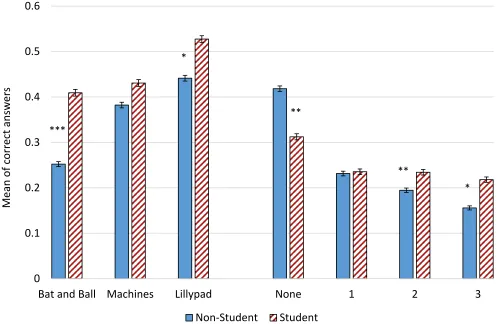
2013). Our sample includes several studies that were conducted with university students
(42.28% of all observations) and others with non-student samples. We find that students score
significantly better in the B&B and, only slightly better in the Machines and Lillypad question
(Figure 5). The right hand side of Figure 5 shows that university students are less likely to have 0
0.1 0.2 0.3 0.4 0.5 0.6
Bat and Ball Machines Lillypad None 1 2 3
Mean o
f c
orr
ect ans
w
er
s
Paper and Pencil Computerised
*
**
**
16
all three questions answered incorrectly, while at the same time they are more likely to give two
[image:17.612.55.553.179.503.2]and three correct answers.
Figure 5: Mean of correct answers by student.
Note: The asterisks reflect the p-values from the regressions analysis (Table 1, row 3).
Table 1 (row 3) confirms the findings in Figure 5. The student coefficient is statistically
significant for the B&B (p<0.01) and Lillypad(p<0.1) questions implying that students are more
likely to give correct answers to these two questions. In contrast, the coefficient for zero correct
answers is negative and statistically significant at the 5% level. This implies that non-students
on average are more likely to obtain all incorrect answers relative to students. Furthermore,
students are more likely to have two (p<0.05) and all three (p<0.1) answers given correctly. 0
0.1 0.2 0.3 0.4 0.5 0.6
Bat and Ball Machines Lillypad None 1 2 3
Mea
n o
f c
orr
ec
t ans
w
er
s
Non-Student Student
***
*
**
**
17
We performed a robustness check (Table A3) only including non-student samples. However,
we do not find large differences between Table 1 and A3. The gender bias is identical for both
students and non-students samples. The robustness check in Table A2 shows that these
effects are stronger when using a female only sample. Tables A4, A5, A6, A7 report results with
similar signs but with less statistical power. In sum, our results allow us to state that one can
expect the average CRT scores to be higher when using student samples.
4.4 When?
It is important to understand whether the implementation of the test before, in-between or after
the experiment (37.66%, 17.75% and 44.58% of our sample) affects outcomes. A priori one
would expect no differences. However, it has been shown that brain activity is reliant on blood
glucose levels as it affects the firing of neurons (Weiss, 1986). Experimental tasks require
almost always require some form of cognition (reading instructions, answering questionnaires,
quizzes etc.) and it would be reasonable to assume that glucose levels would be lower towards
the end of the experiment. This would then consequently imply that if the CRT is conducted at
the end of the experimental then performance on the CRT should be negatively affected.
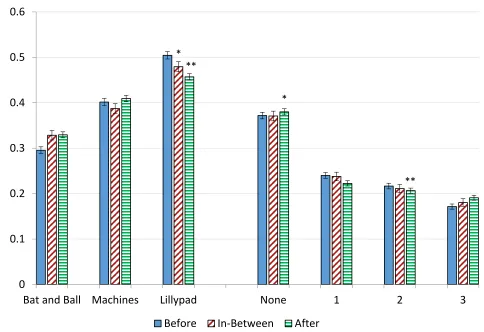
Looking at Figure 6 (rows 4a and 4b in Table 1) one sees that there are significant differences
in CRT performance depending upon whether it was conducted before, in-between or after the
experiment. Conducting it in-between or after has a negative and statistically significant effect
on the Lillypad question (p<0.1 and p<0.05, respectively) (rows 4a and 4b, Table 1). In addition,
conducting it after is more likely to result in None (p<0.1) and less likely to have exactly two
questions answered correctly (p<0.05). It is important to note that the after-the-experiment
coefficient remain negative throughout (row 4b, Table 1). This suggests that conducting the
18
Figure 6: Mean of correct answers by the position of the test compared to the main experiment.
Note: The asterisks reflect the p-values from the regressions analysis (Table 1, rows 4a and 4b).
Note, however, that prior data includes studies where no experiments were conducted. We
conducted further analysis by removing these studies from the sample. This gives us even
stronger results (Table A4, rows 4a and 4b). Now it is even less likely that subjects are to
answer the B&B and Lillypad questions correctly if CRTs conducted in-between or after the
experiments. This negative effect is lower for in-between experiments (p<0.05) and stronger for
after the experiments (p<0.01) variables. The stronger negative effect for the variable after is
coherent with the argument that glucose levels are being depleted as subjects are progressing
through the experiment. Similarly, we observe that subjects are less likely to answer all three 0
0.1 0.2 0.3 0.4 0.5 0.6
Bat and Ball Machines Lillypad None 1 2 3
Mea
n o
f c
orr
ec
t ans
w
er
s
Before In-Between After
**
*
19
questions correctly both in-between and after experiments (both p<0.05) and more likely to
have None (both p<0.05) (rows 4a and 4b, Table A4).
The robustness checks in Tables A2, A3, A5, A7 report results with similar signs but with
identical or somewhat less statistical power compared to the main results in Table1. In contrast,
A6 reports stronger effects.
These results are important considering the argument that glucose levels in the brain play an
important role in cognition. Effortful, controlled or executive processes and tasks (e.g.
experiments) require more glucose than simpler, less effortful or automatic processes. When
glucose levels are low, cerebral functioning is disrupted, producing numerous cognitive and
behavioral deficits (Gailliot and Baumeister, 2007). In sum, our results show that conducting the
CRT after the experiment can have a negative effect on CRT results.
4.5 The sequence of questions
Frederick (2005) proposed the CRT questions in the following order: B&B, Machines, and
Lillypad. This has become the most commonly used sequence and 83.78% of our sample
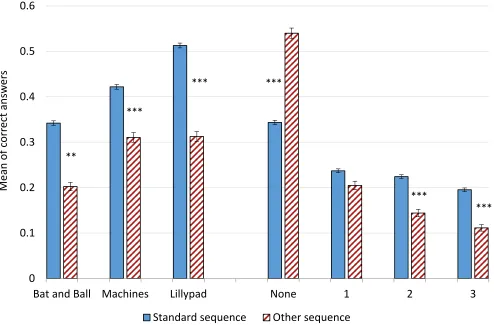
corresponds to this. Figure 7 indicates that subjects score better on the CRT when the
questions are presented in the standard order. Row 5 in Table 1 is consistent with the findings
in Figure 7 as the coefficient on standard sequence is highly significant for the B&B (p<0.05),
Machines (p<0.01) and Lillypad (p<0.01) questions. Looking at the results in row 5 (Table 1)
one can also conclude that the likelihood of None is much higher when the questions are not
asked in the standard order (p<0.01). Likewise, subjects are more likely to answer two (p<0.01)
or three (p<0.01) questions for the standard implementation.
However, one may argue that our control group other sequences includes studies where the
20
sequences can also include questions asked in a standard way with probability 1 in 6.
Therefore, in Table A5 we replicated the main regressions excluding the studies with random
sequences. The effect of standardized sequence on correct CRT responses is now marginal
(Row 5, Table A5). We cannot thus conclude that the standardized sequence would bias
[image:21.612.60.554.262.587.2]responses in the CRT.
Figure 7: Mean of correct answers by the sequence of the questions.
Note: The asterisks reflect the p-values from the regressions analysis (Table 1, row 5).
4.6. Incentives
The effect of financial incentives on human behavior has been a long debated issue in the
economics and psychology literature (for a review see Camerer and Hogarth 1999). The
dominant argument in the experimental methodology is that incentives are important for profit 0
0.1 0.2 0.3 0.4 0.5 0.6
Bat and Ball Machines Lillypad None 1 2 3
Mea
n o
f c
orr
ec
t ans
w
er
s
Standard sequence Other sequence
**
***
*** ***
***
21
maximizing individuals. In our case this would imply that the number of correct answers would
improve under monetary incentives (14.67% of our sample).
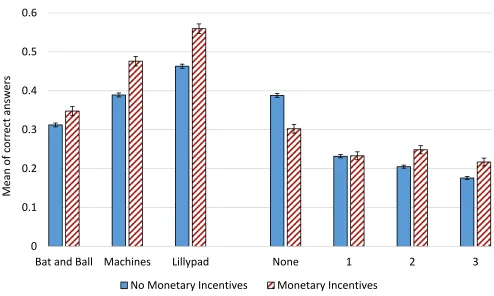
The regression analysis (row 6, Table 1) shows that the variable monetary incentives is not
statistically significant at any of the common significance levels. This implies that paying subject
[image:22.612.58.552.263.559.2]for correct answers on the CRT does not increase performance levels.
Figure 8: Mean of correct answers by monetary incentives.
Note: No asterisks are shown since there are not significant results in the regression (Table 1, row 6).
The series of robustness checks using different samples in Tables A2, A3, A4, A5, A7
(Appendix) for our regressions seem to indicate the same: While three tables (A2, A3 and A4)
show a marginal effect, in Tables A5 and A7 the no-effect of monetary incentives remains
persistent throughout. In addition, Table A6 presents the regression results excluding studies 0
0.1 0.2 0.3 0.4 0.5 0.6
Bat and Ball Machines Lillypad None 1 2 3
Mea
n o
f c
orr
ec
t ans
w
er
s
22
that use monetary incentives to reward correct answers. However, the overall results in Table
A6 do not seem to contradict previous findings in Table 1.
The role of incentives with regard to the degree of cognition can also be important (Awasthi and
Pratt, 1990). They find that the effectiveness of monetary incentives depends on the cognitive
skill of the decision maker. That is, monetary incentives were associated with higher
performance only for high cognition individuals. We cannot comment on whether there is a
relation between cognition and incentives. Note that in our data both the measure of IQ and
performance is the same variable, i.e. the number of correct answers. One may also argue that
the test was a marginal part of a larger study and payments were not salient (Gneezy and
Rustichini, 2000). Finally, we lack specific details on how and the quantity subjects were paid.
4.7. Exposure to the CRT over the years (visibility)
Toplak et al. (2014) argue that the test in its original form is becoming increasingly popular and
is perhaps losing its efficacy. This argument has validity if the student pool remains the same,
or same subjects take the test on more than one occasion over their University life. Another
issue with testing this conjecture is that some studies are conducted on-line. Answers to the
CRT are easily available on line and this sheds doubt on its studying its efficacy using on-line
studies. We investigate these issues below.
Table 2 presents the number of studies included by year in our meta-analysis. In our
regressions we used the variable visibility to describe the effect of exposure to the CRT over
the years. The variable was generated by assigning the value 1 for studies conducted in 2007,
2 for 2008 and so on.
23
In Table 1 (row 8) the variable visibility shows that the number of years of exposure has a
positive impact on obtaining all three correct answers (p<0.05). Visibility negatively affects
subjects answering only one question correctly (p<0.01), the coefficients on two and three
correct answers turn positive but non-significant. No effect is found for None (p>0.1), i.e.
exposure to the test is not decreasing the number of participants giving zero correct answers. In
addition, we find that subjects are more likely to answer the Machines question correctly
(p<0.01). Overall, some support (row 8, Table1) is lent to the argument that years of exposure
positively affect test outcomes. This effect, however, does not seem to be too large or
persistent. The robustness checks (see Table A2, A3, A4, A5 and A6) provide similar weak
findings for the exposure conjecture.
However our results dramatically change when AMT studies – where participants have
immediate access to the internet- are excluded from the sample. We replicated the regressions
excluding all AMT studies (row 8, Table A7). We now find that the previously significant effects
on visibility are substantially weaker. All in all we cannot observe a clear link between length of
exposure and success.
5. Discussion
The CRT has become increasingly popular in predicting reflection in economic and psychology
experiments. We conduct a meta-survey of the methods employed in 118 studies (N = 44,558)
across several countries. Our goal was to study whether different forms of implementation
mattered in terms of performance on the CRT and consequently the predictive power of the test
in those studies. We have three important results.
First, we find that the gender bias result first reported in Frederick (2005) is robust. Men perform
24
then this could lead to (gender) sample imbalance. For instance, if one uses three correct
answers then the sample is disproportionately biased towards males.
Second, we find statistical evidence to support the argument that monetary incentives do not
play an important role in improving CRT performance. Note however that we do not have data
on the amount, or how, subjects were paid. Due to this the extent of our result is limited.
Third, we find that conducting the CRT after the experiments negatively effects test outcomes.
Conducting the test after decreases the probability of obtaining correct answers, meanwhile,
the probability of obtaining None is increased. This result is important as it provides an indirect
support to the argument that glucose is important in cognitive tasks and cognition declines with
time and effort. After removing studies from the data where the researchers did not run
experiments we find even more significant results.
We also find that students are more likely to answer all three questions correctly compared to
non-students, and less likely to have zero correct answers. We test for the year effect (visibility)
and find no clear evidence that exposure positively affects tests results. Regarding the standard
sequence of the questions, only a marginal effect appears after removing studies where
researchers used randomized sequences. Finally, comparing test scores for hand-run vs.
computerized tests we found a weakly positively significant effect of computerized
25
(1) (2) (3) (4) (5) (6) (7)
B&B Machines Lillypad None 1 2 3
(1) female -0.113*** -0.177*** -0.197*** 0.179*** 0.009 -0.066*** -0.121***
(0.011) (0.010) (0.010) (0.010) (0.006) (0.007) (0.008)
(2) computerized 0.033 0.085* 0.108** -0.095** 0.013 0.050** 0.032
(0.038) (0.048) (0.051) (0.045) (0.012) (0.020) (0.032)
(3) student 0.138*** -0.002 0.067* -0.089** 0.011 0.030** 0.047*
(0.035) (0.025) (0.039) (0.034) (0.008) (0.013) (0.024)
(4a) in-between experiments -0.046 -0.007 -0.090* 0.059 0.002 -0.017 -0.043
(0.045) (0.035) (0.049) (0.040) (0.013) (0.014) (0.033)
(4b) after the experiment -0.032 -0.009 -0.093** 0.060* -0.008 -0.026** -0.026
(0.037) (0.030) (0.038) (0.035) (0.009) (0.012) (0.026)
(5) standard sequence 0.103** 0.102*** 0.148*** -0.142*** 0.012 0.050*** 0.080***
(0.040) (0.034) (0.043) (0.040) (0.012) (0.015) (0.031)
(6) monetary incentives -0.026 0.003 0.040 -0.005 -0.002 0.000 0.008
(0.046) (0.048) (0.049) (0.045) (0.016) (0.017) (0.040)
(7) visibility 0.008 0.016*** 0.005 -0.005 -0.007*** 0.002 0.010**
(0.006) (0.006) (0.006) (0.005) (0.002) (0.002) (0.005)
constant 0.184** 0.270*** 0.285*** 0.533*** 0.241*** 0.156*** 0.070
(0.072) (0.073) (0.074) (0.074) (0.022) (0.030) (0.056)
N 38031 38031 38031 39603 39603 39603 39603
[image:26.792.64.673.83.433.2]R-sq 0.045 0.052 0.071 0.067 0.003 0.015 0.038
Table 1: Regression analysis
26
Year of study 2005 2006 2007 2008 2009 2010 2011 2012 2013 2014
Number of studies 1 6 3 4 15 16 15 27 15 16
[image:27.792.177.633.206.280.2]
Table 2: Number of studies included according to the year they were conducted
27
References
Aiken, L. (1986-1987) Sex differences in mathematical ability: A review of the literature. Educational
Research Quarterly, 10: 25-35.
Alós-Ferrer, C., Hügelschäfer, S. (2014) Faith in Intuition and Cognitive Reflection. University of
Cologne Working Paper. Study 3.
Andersson, O., Tyran, J.R., Wengström, E., Holm, H.J. (2013) Risk Aversion Relates to Cognitive
Ability: Fact or Fiction? IFN Working Paper No. 964.
Awasthi, V., Pratt, J. (1990) The Effects of Monetary Incentives on Effort and Decision Performance:
The Role of Cognitive Characteristics. The Accounting Review,65(4): 797-811.
Benbow, C.P. and Stanley, J.C. (1980) Sex Differences in Mathematical Ability: Fact or Artifact?
Science, 210(4475): 1262–264.
Benbow, C. P., Lubinski, D., Shea, D. L. and Eftekhari-Sanjani, H. (2000) Sex differences in
mathematical reasoning ability: Their status 20 years later. Psychological Science, 11: 474-480.
Ben-Ner, A., Kong, F., Putterman, L. (2004) Share and Share Alike? Gender-pairing, Personality, and
Cognitive Ability as Determinants of Giving. Journal of Economic Psychology,25(5): 581-589.
Besedes, T., Deck, C., Sarangi, S., Shor, M. (2012) Decision-making Strategies and Performance
among Seniors. Journal of Economic Behavior and Organization, 81(2): 524-533.
Bonner, S.E., Sprinkle, G.B. (2002) The effects of monetary incentives on effort and task performance:
theories, evidence, and a framework for research. Accounting, Organizations and Society, 27: 303–345.
Bosch-Rosa, C., Meissner, T., Bosch-Domenech, A. (2015) Cognitive Bubbles. SFB 649 Discussion
28
Buhrmester, M., Kwang, T., Gosling, S.D. (2011) Amazon's Mechanical Turk: A New Source of
Inexpensive, Yet High-Quality, Data? Perspectives on Psychological Science, 6(1): 3-5.
Brañas-Garza, P., García-Muñoz, T. and González, R.H. (2012) Cognitive effort in the Beauty Contest
Game. Journal of Economic Behavior & Organization, 83(2): 254–260.
Camerer, C. F., Hogarth, R.M. (1999) The Effects of Financial Incentives in Experiments: A Review and
Capital-Labor-Production Framework. Journal of Risk and Uncertainty,19(1): 7-42.
Campitelli, G., Labollita, M. (2010) Correlations of cognitive reflection with judgments and choices.
Judgment and Decision Making,5(3): 182-191.
Carpenter, J., Graham, M., Wolf, J. (2013) Cognitive ability and strategic sophistication. Games and Economic Behavior, 80(1): 115–130.
Chen, C.C., Chiu, I.M., Smith, J., Yamada, T. (2013) Too smart to be selfish? Measures of cognitive
ability, social preferences, and consistency. Journal of Economic Behavior & Organization, 90(0): 112– 122.
Cheung, S. L., Hedegaard, M., Palan, S. (2014) To See is to Believe. Common Expectations in
Experimental Asset Markets. European Economic Review, 66: 84–96.
Cole, M.S., Bedeian, A.G., Field, H.S. (2006) The Measurement Equivalence of Web-Based and
Paper-and-Pencil Measures of Transformational Leadership: A Multinational Test. Organizational
Research Methods,9(3): 339-368.
Corgnet, B., Espín, A.M., Hernán-González, R. (2015) The cognitive basis of social behavior: cognitive
reflection overrides antisocial but not always prosocial motives. ESI Working Paper 15-04.
Corgnet, B., Espin, A., Hernan-Gonzalez, R., Kujal, P., Rassenti, S. (2015) To trust, or not to trust:
29
Corgnet, B., Hernan-Gonzalez, R., Kujal, P. and Porter, D. (2014) The Effect of Earned Versus House
Money on Price Bubble Formation in Experimental Asset Markets, Review of Finance, 1-34. [doi: 10.1093/rof/rfu031]
Cueva-Herrero, C., Iturbe-Ormaetxe, I., Mata-Prez, E., Ponti, G., Yu, H., Zhukova, V. (2015) Cognitive
(Ir)reflection: New Experimental Evidence. Forthcoming in Journal of Behavioral and Experimental Economics.
Diamond, D.W., Dybvig, P.H. (1983) Bank Runs, Deposit Insurance, and Liquidity. Journal of Political Economy, 91(3): 401-419.
Epstein, S. (1994) Integration of the cognitive and the psychodynamic unconscious. American Psychologist, 49: 709–724.
Exadaktylos, F., Espín, A.M., Branas-Garza, P. (2013) Experimental subjects are not different. Scientific Reports, 3(1213): 1-6.
Falk, A., Heckman, J. (2009) Lab experiments are a major source of knowledge in the social sciences.
Science,326: 535–538.
Falk, A., Meier, S., Zehnder, C. (2013) Do lab experiments misrepresent social preferences? The case
of self-selected student samples. Journal of the European Economic Association,11(4): 839–852.
Frederick, S. (2005) Cognitive Reflection and Decision Making. Journal of Economic Perspectives,
19(4): 25-42.
Gailliot, M.T. and Baumeister, R.F. (2007) The Physiology of Willpower: Linking Blood Glucose to
Self-Control. Personality and Social Psychology Review,11(4): 303-327.
George, C.E., Lankford, J.S. Wilson, S.E. (1992) The effects of computerised versus paper-and- pencil
30
Gneezy, U., Rustichini, A. (2000a) Pay enough or don’t pay at all. Quarterly Journal of Economics,
115(3): 791–810.
Goodman, J. K., Cryder, C.E., Cheema, A.A. (2013) Data Collection in a Flat World: Strengths and
Weaknesses of Mechanical Turk Samples. Journal of Behavioral Decision Making, 26: 213-224.
Holt, C.A, Porzio, M. and Song, M.Y. (2015) Price Bubbles, Expectations, and Gender in Asset Markets:
An Experiment. University of Virginia working paper.
Hoppe, E. I., Kusterer, D.J. (2011) Behavioral biases and cognitive reflection. Economics Letters,110: 97–100.
Jenkins, G. D., Mitra, A., Gupta, N., Shaw, J.D. (1998) Are financial incentives related to performance?
A meta-analytic review of empirical research. Journal of Applied Psychology, 83(5): 777-787.
Kahneman, D. and Frederick, S. (2002) Representativeness revisited: At- tribute substitution in intuitive
judgment. In T. Gilovich, D. Griffin and D. Kahneman (Eds.), Heuristics and biases: The psychology of
intuitive judgment, 49-81, New York: Cambridge University Press.
King, W.C., Miles, E.W. (1995) A quasi-experimental assessment of the effect of computerizing
noncognitive paper-and-pencil measurements: A test of measurement equivalence. Journal of Applied
Psychology, 80: 643-651.
Kiss, H.J., Rodriguez-Lara, I., Rosa-García, A. (2015) Think Twice Before Running! Bank Runs and
Cognitive Abilities. Forthcoming in Journal of Behavioral and Experimental Economics.
Levitt, S.D., List, J.A. (2007) What do laboratory experiments measuring social preferences reveal about
31
Liberali, J. M., Reyna, V. F., Furlan, S., Stein, L. M., Pardo, S. T. (2012) Individual Differences in
Numeracy and Cognitive Reflection, with Implications for Biases and Fallacies in Probability Judgment.
Journal of Behavioral Decision Making, 25(4): 361–381.
Mau, W.C. and Lynn, R. (2010) Gender differences in homework and test scores in Mathematics,
Reading and Science at tenth and twelfth grade. Psychology, Evolution & Gender, 2(2): 119-125.
Moritz, B., Hill, A.V., Donohue, K. (2013) Individual Differences in the Newsvendor Problem: Behavior
and Cognitive Reflection. Journal of Operations Management,31(1-2): 72-85.
Nagel, R. (1995) Unraveling in Guessing Games: An Experimental Study. American Economic Review,
85(5): 1313-26.
Noussair, C.N., Trautmann, S.T., van de Kuilen G. (2014) Higher Order Risk Attitudes, Demographics,
and Financial Decisions. Review of Economic Studies, 81 (1): 325-355.
Oechssler, J., Roider, A., Schmitz, P.W. (2009) Cognitive abilities and behavioral biases. Journal of Economic Behavior & Organization, 72(1):147-152.
Paolacci, G., Chandler, J., Ipeirotis, P.G. (2010) Running experiments on Amazon Mechanical Turk.
Judgment and Decision Making,5(5): 411–419.
Peterson, R.A. (2001) On the Use of College Students in Social Science Research: Insights from a
Second-Order Meta-analysis. Journal of Consumer Research,28(3): 450-461.
Peysakhovich, A., Rand, D.G. (2015) Habits of Virtue: Creating Norms of Cooperation and Defection in
the Laboratory. Forthcoming in Management Science.
Ponti, G., Rodriguez-Lara, I. (2015) Social Preferences and Cognitive Reflection: Evidence from Dictator
32
Riedel, J.A., Nebeker, D.M., Cooper, B.L. (1988) The Influence of Monetary Incentive on Goal Choice,
Goal Commitment, and Task Performance, Organizational Behavior and Human Decision Processes,
42: 155-180.
Scott, W. E., Farh, J.L., Podsakoff, P.M. (1988) The Effects of ‘Intrinsic’ and ‘Extrinsic’ Reinforcement
Contingencies on Task Behavior,’’ Organizational Behavior and Human Decision Processes, 41: 405-425.
Sloman, S.A. (1996) The empirical case for two systems of reasoning. Psychological Bulletin, 119: 3– 22.
Stanovich, K.E. and West, R.F. (2000) Individual differences in reasoning: Implications for the rationality
debate? Behavioral and Brain Sciences, 23: 645-665.
Toplak, M.E., West, R.F., Stanovich, K.E. (2011) The Cognitive Reflection Test as a predictor of
performance on heuristics and biases tasks. Memory & Cognition, 39: 1275-1289.
Toplak, M.E., West, R.F. and Stanovich, K.E. (2014) Assessing miserly information processing: An
expansion of the Cognitive Reflection Test. Thinking & Reasoning, 20(2): 147-168.
33
Appendix A
35 Distribution (full sample) Distribution (regression)
Number of studies 118 118
Total number of observations 44,558 39,603
N (Bat and Ball, Machines, Lillypad correct answers) 41,004 38,031
Bat and Ball correct 31.75% 32.24%
Machines correct 40.24% 40.84%
Lillypad correct 47.78% 48.59%
N (3,2,1 and None correct answers) 44,558 39,603
All 3 answers correct 18.17% 18.64%
Only 2 answers correct 21.12% 21.45%
Only 1 answers correct 23.18% 23.33%
None of the answers correct 37.54% 36.57%
N (gender) 41,705 39,603
Female 52.76% 52.89%
Male 47.24% 47.11%
N (computerized or paper and pencil) 42,797 39,603
Computerized 87.91% 89.65%
Paper and Pencil 12.09% 10.35%
N (student) 43,684 39,603
Student 42.28% 41.42%
Non-Student 57.72% 58.58%
N (position of the test) 44,558 39,603
CRT took place before the experiment 37.66% 34.77%
CRT took place after the experiment 44.58% 46.46%
CRT took place in-between experiments 17.75% 18.77%
N (sequence of the questions) 44,558 39,603
Questions asked in standard sequence (B&B, Machines, Lillypad) 83.78% 84.92%
Questions asked in randomized sequence 11.64% 13.09%
Questions asked in B&B; Lilly Pad; Machines sequence 0.90% 1.01%
Questions asked in Machines; Lilly Pad; B&B sequence 2.82% 0%
Questions asked in Lilly Pad; B&B; Machines sequence 0.87% 0.97%
N (monetary incentives) 44,558 39,603
Incentivized 14.67% 15.82%
Non-Incentivized 85.33% 84.18%
N (country information) 44,217 39,603
Anglo-Saxon 49.65% 46.59%
Europe 41.65% 43.70%
[image:36.612.35.552.128.684.2]Rest of the world 8.70% 9.71%
36
(1) (2) (3) (4) (5) (6) (7)
B&B Machines Lillypad None 1 2 3
(1) computerized 0.069* 0.100** 0.112** -0.130*** 0.032** 0.058*** 0.040
(0.038) (0.048) (0.045) (0.049) (0.015) (0.022) (0.025)
(2) student 0.127*** -0.027 0.039 -0.080** 0.031*** 0.029 0.020
(0.036) (0.026) (0.041) (0.039) (0.009) (0.018) (0.022)
(3a) in-between experiments -0.046 0.009 -0.071 0.047 0.000 -0.015 -0.032
(0.047) (0.039) (0.053) (0.048) (0.014) (0.020) (0.030)
(3b) after the experiment -0.045 -0.004 -0.092** 0.064 -0.010 -0.029 -0.025
(0.043) (0.035) (0.042) (0.043) (0.010) (0.018) (0.026)
(4) standard sequence 0.093** 0.106*** 0.151*** -0.149*** 0.017 0.059*** 0.072**
(0.041) (0.033) (0.044) (0.044) (0.013) (0.018) (0.028)
(5) monetary incentives 0.012 -0.064 0.101* 0.000 -0.016 -0.037 0.053
(0.057) (0.064) (0.053) (0.066) (0.021) (0.030) (0.034)
(6) visibility 0.009* 0.017*** 0.008 -0.007 -0.007*** 0.004 0.011**
(0.005) (0.005) (0.005) (0.005) (0.002) (0.002) (0.004)
constant 0.053 0.072 0.039 0.759*** 0.228*** 0.086** -0.073*
(0.069) (0.073) (0.068) (0.080) (0.027) (0.036) (0.044)
N 19995 19995 19995 20945 20945 20945 20945
[image:37.792.99.641.69.393.2]R-sq 0.026 0.020 0.032 0.031 0.005 0.009 0.013
Table A2: Robustness check: Females only
37
(1) (2) (3) (4) (5) (6) (7)
B&B Machines Lillypad None 1 2 3
(1) female -0.086*** -0.154*** -0.178*** 0.165*** -0.007 -0.061*** -0.097***
(0.010) (0.013) (0.014) (0.012) (0.008) (0.010) (0.008)
(2) computerized -0.030 0.012 0.053 -0.057 0.041*** 0.035 -0.020
(0.065) (0.066) (0.057) (0.063) (0.005) (0.022) (0.051)
(3a) in-between experiments -0.051 -0.044 -0.093* 0.077* 0.017** -0.026* -0.069*
(0.046) (0.031) (0.048) (0.039) (0.008) (0.014) (0.035)
(3b) after the experiment -0.032 -0.004 -0.049 0.045 -0.003 -0.011 -0.031
(0.023) (0.048) (0.042) (0.042) (0.007) (0.018) (0.028)
(4) standard sequence 0.189*** 0.156*** 0.199*** -0.203*** -0.004 0.061*** 0.146***
(0.038) (0.038) (0.044) (0.040) (0.012) (0.016) (0.031)
(5) monetary incentives 0.073 0.066 0.189** -0.108 -0.023** 0.058*** 0.072
(0.090) (0.097) (0.070) (0.088) (0.008) (0.020) (0.073)
(6) visibility 0.040*** 0.028 0.018 -0.022 -0.010*** 0.003 0.029***
(0.006) (0.017) (0.015) (0.014) (0.002) (0.006) (0.009)
constant -0.193** 0.088 0.006 0.817*** 0.278*** 0.085** -0.180**
(0.073) (0.111) (0.095) (0.097) (0.016) (0.037) (0.069)
N 21983 21983 21983 23199 23199 23199 23199
[image:38.792.143.685.109.431.2]R-sq 0.041 0.044 0.078 0.071 0.007 0.017 0.042
Table A3: Robustness check: Regressions with non-student samples only
Notes: Robust standard errors in parentheses. *** p<0.01, ** p<0.05, *p<0.1. The regressions also controls for the country
38
(1) (2) (3) (4) (5) (6) (7)
B&B Machines Lillypad None 1 2 3
(1) female -0.107*** -0.167*** -0.186*** 0.170*** 0.009 -0.063*** -0.116***
(0.012) (0.008) (0.010) (0.010) (0.008) (0.007) (0.009)
(2) computerized 0.084** 0.136*** 0.145*** -0.130*** 0.000 0.055*** 0.076***
(0.035) (0.038) (0.048) (0.041) (0.010) (0.021) (0.024)
(3) student 0.108*** -0.026 0.051 -0.070 0.014 0.030* 0.026
(0.037) (0.029) (0.049) (0.042) (0.009) (0.017) (0.024)
(4a) in-between experiments -0.130** -0.039 -0.140** 0.101** 0.015 -0.022 -0.093**
(0.055) (0.048) (0.058) (0.050) (0.015) (0.020) (0.036)
(4b) after the experiment -0.109*** -0.037 -0.135*** 0.095** 0.005 -0.029 -0.071**
(0.041) (0.048) (0.047) (0.041) (0.012) (0.019) (0.028)
(5) standard sequence 0.120*** 0.115*** 0.175*** -0.164*** 0.018 0.057*** 0.089***
(0.038) (0.031) (0.041) (0.038) (0.012) (0.015) (0.029)
(6) monetary incentives 0.046 0.091* 0.110* -0.081 -0.007 0.019 0.069*
(0.045) (0.051) (0.059) (0.052) (0.017) (0.021) (0.039)
(7) visibility 0.002 0.013* 0.005 -0.004 -0.004 0.004 0.004
(0.007) (0.007) (0.009) (0.008) (0.003) (0.003) (0.006)
constant 0.392*** 0.441*** 0.396*** 0.399*** 0.195*** 0.170*** 0.237***
(0.117) (0.100) (0.119) (0.114) (0.033) (0.047) (0.082)
N 28268 28268 28268 28624 28624 28624 28624
[image:39.792.152.679.117.472.2]R-sq 0.056 0.068 0.086 0.086 0.002 0.019 0.048
Table A4: Robustness check: excluding the studies where the researchers did not run experiments
39
(1) (2) (3) (4) (5) (6) (7)
B&B Machines Lillypad None 1 2 3
(1) female -0.117*** -0.176*** -0.196*** 0.176*** 0.012** -0.065*** -0.124***
(0.000) (0.000) (0.000) (0.000) (0.034) (0.000) (0.000)
(2) computerized 0.021 0.077 0.098* -0.087* 0.013 0.048** 0.026
(0.601) (0.118) (0.062) (0.060) (0.274) (0.017) (0.443)
(3) student 0.111*** -0.017 0.046 -0.063* 0.011 0.022* 0.030
(0.003) (0.520) (0.272) (0.079) (0.183) (0.083) (0.251)
(4a) in-between experiments -0.055 0.000 -0.097* 0.064 -0.003 -0.019 -0.043
(0.266) (0.995) (0.073) (0.147) (0.845) (0.231) (0.242)
(4b) after the experiment 0.007 0.027 -0.050 0.017 -0.010 -0.013 0.006
(0.859) (0.371) (0.193) (0.606) (0.236) (0.305) (0.826)
(5) standard sequence -0.031 -0.087* -0.044 0.024 0.047* 0.001 -0.072**
(0.524) (0.068) (0.288) (0.664) (0.092) (0.956) (0.016)
(6) monetary incentives -0.005 0.019 0.060 -0.025 -0.003 0.005 0.023
(0.918) (0.690) (0.224) (0.584) (0.867) (0.772) (0.570)
(7) visibility 0.007 0.014** 0.004 -0.004 -0.007*** 0.002 0.009*
(0.214) (0.023) (0.532) (0.424) (0.004) (0.281) (0.096)
constant 0.317*** 0.460*** 0.475*** 0.373*** 0.204*** 0.201*** 0.222***
(0.000) (0.000) (0.000) (0.000) (0.000) (0.000) (0.000)
N 32846 32846 32846 34418 34418 34418 34418
[image:40.792.149.692.99.455.2]R-sq 0.037 0.049 0.053 0.048 0.003 0.01 0.036
Table A5: Robustness check: Excluding studies where the sequence of questions was randomized
Notes: Robust standard errors in parentheses. *** p<0.01, ** p<0.05, *p<0.1. The regressions also controls for the country
40
(1) (2) (3) (4) (5) (6) (7)
B&B Machines Lillypad None 1 2 3
(1) female -0.107*** -0.176*** -0.197*** 0.181*** 0.004 -0.066*** -0.118***
(0.011) (0.010) (0.011) (0.010) (0.007) (0.008) (0.008)
(2) computerized 0.063* 0.112** 0.154*** -0.132*** 0.016 0.066*** 0.051
(0.036) (0.047) (0.044) (0.040) (0.013) (0.018) (0.032)
(3) student 0.108*** -0.037 0.046 -0.066* 0.017** 0.027* 0.022
(0.036) (0.024) (0.040) (0.035) (0.007) (0.014) (0.023)
(4a) in-between experiments -0.070 -0.055* -0.115** 0.083* 0.012 -0.026 -0.069**
(0.050) (0.030) (0.056) (0.045) (0.010) (0.016) (0.032)
(4b) after the experiment -0.065 -0.047 -0.123*** 0.088** -0.004 -0.033** -0.051*
(0.040) (0.033) (0.043) (0.038) (0.008) (0.014) (0.027)
(5) standard sequence 0.119*** 0.122*** 0.162*** -0.153*** 0.006 0.053*** 0.094***
(0.039) (0.032) (0.041) (0.040) (0.011) (0.015) (0.029)
(6) visibility 0.016*** 0.024*** 0.011** -0.011** -0.009*** 0.004 0.016***
(0.005) (0.005) (0.005) (0.005) (0.002) (0.002) (0.004)
constant 0.271*** 0.390*** 0.365*** 0.428*** 0.246*** 0.177*** 0.149**
(0.088) (0.073) (0.084) (0.086) (0.026) (0.039) (0.062)
N 31766 31766 31766 33338 33338 33338 33338
[image:41.792.102.638.101.422.2]R-sq 0.051 0.063 0.077 0.072 0.005 0.016 0.046
Table A6: Robustness check: excluding studies where the experimenters used monetary incentives to reward correct answers
Notes: Robust standard errors in parentheses. *** p<0.01, ** p<0.05, *p<0.1. The regressions also controls for the country
41
Notes: Robust standard errors in parentheses. *** p<0.01, ** p<0.05, *p<0.1. The regressions also controls for the country
of the study by using two dummy variables: europe and anglo-saxon.
(1) (2) (3) (4) (5) (6) (7)
Bat and Ball Machines Lillypad None 1 2 3
(1) female -0.115*** -0.181*** -0.202*** 0.180*** 0.014** -0.070*** -0.124***
(0.012) (0.011) (0.011) (0.011) (0.007) (0.008) (0.009)
(2) computerized 0.032 0.084* 0.106** -0.095** 0.014 0.049** 0.032
(0.040) (0.049) (0.052) (0.046) (0.011) (0.020) (0.034)
(3) student 0.171*** 0.033 0.095** -0.113*** 0.001 0.031** 0.081***
(0.041) (0.032) (0.046) (0.042) (0.009) (0.015) (0.029)
(4a) in-between experiments -0.033 0.019 -0.088* 0.054 -0.010 -0.020 -0.023
(0.047) (0.041) (0.049) (0.042) (0.015) (0.016) (0.035)
(4b) after the experiment -0.030 -0.001 -0.093* 0.055 -0.008 -0.025 -0.022
(0.045) (0.035) (0.047) (0.043) (0.009) (0.015) (0.032)
(5) standard sequence 0.059 0.059 0.118** -0.121*** 0.042** 0.042** 0.038
(0.041) (0.036) (0.046) (0.045) (0.016) (0.019) (0.029)
(6) monetary incentives -0.022 0.006 0.045 -0.010 -0.002 0.002 0.010
(0.043) (0.042) (0.047) (0.043) (0.014) (0.017) (0.036)
(7) visibility 0.003 0.010* 0.001 -0.002 -0.005** 0.002 0.005
(0.006) (0.006) (0.006) (0.005) (0.002) (0.002) (0.005)
constant 0.248*** 0.339*** 0.333*** 0.499*** 0.200*** 0.167*** 0.134**
(0.077) (0.075) (0.079) (0.081) (0.025) (0.035) (0.054)
N 31200 31200 31200 31870 31870 31870 31870
[image:42.792.122.674.112.468.2]R-sq 0.049 0.057 0.068 0.064 0.003 0.013 0.043
42
Appendix B
List of articles included in the meta-study
#001 Agranov, M., Caplin, A., Tergiman, C. (2015) Naive Play and the Process of Choice in the Guessing
Games. Forthcoming in Journal of the Economics Science Association.
#002 Akiyama, E., Hanaki, N., Ishikawa, R. (2013) It is not just confusion! Strategic uncertainty in an
experimental asset market, Aix-Marseille School of Economics Working Paper 2013 No. 40.
#003 Akiyama, E., Hanaki, N., Ishikawa, R. (2014) How do experienced traders respond to inflows of
inexperienced traders? An experimental analysis. Journal of Economic Dynamics and Control, 45(C): 1-18.
#004 Alós-Ferrer, C., Hügelschäfer, S. (2014) Faith in Intuition and Cognitive Reflection. University of
Cologne Working Paper. Study 3
#005 Alter, A. L., Oppenheimer, D. M., Epley, N., Eyre, R. N. (2007) Overcoming intuition: Metacognitive
difficulty activates analytic reasoning. Journal of Experimental Psychology: General, 136: 569-576.
#006 Andersson, O., Tyran, J.R., Wengström, E., Holm, H.J. (2013) Risk Aversion Relates to Cognitive
Ability: Fact or Fiction?. IFN Working Paper No. 964.
#007 Baghestanian, S., Frey, S. (2013) Go Figure. Analytic and Strategic Skills are Separable. Indiana
University, Working paper.
#008 Balafoutas, L., Kerschbamer, R., Oexl, R. (2014) Distributional preferences and ego depletion.
Working Paper.
#009 Barham, B., Chavas, J.P., Fitz, D., Salas, V.R., Schechter, L. (2014) The Roles of Risk and
Ambiguity in Technology Adoption. Journal of Economic Behavior and Organization, 97: 204-218.
#010 Barr, N., Pennycook, G., Stolz, J.A., Fugelsang, J.A. (2015) Reasoned connections: A dual-process
43
#011 Barr, N., Pennycook, G., Stolz, J.A., Fugelsang, J.A. (2015) The brain in your pocket: Evidence that
Smartphones are used to supplant thinking. Computers in Human Behavior, 48: 473-480.
#012 Bartling, B., Engl, F., Weber, R.A. (2014) Game Form Misconceptions Do Not Explain the
Endowment Effect, CESifo Working Paper No. 5094.
#013 Belot, M., Bhaskar, V., Van De Ven, J. (2012) Can Observers Predict Trustworthiness? Review of
Economics and Statistics, 94:1: 246-259.
#014 Bergman, O., Ellingsen, T., Johannesson, M., Svensson, C. (2010) Anchoring and cognitive ability.
Economics Letters, 107:66-68.
#015 Besedes, T., Deck, C., Quintanar, S.M., Sarangi, S., Shor, M. (2014) Effort and Performance: What
Distinguishes Interacting and Non-interacting Groups from Individuals?. Southern Economic Journal, 81(2):
294-322.
#016 Besedes, T., Deck, C., Sarangi, S., Shor, M. (2012) Decision-making Strategies and Performance
among Seniors. Journal of Economic Behavior and Organization, 81(2): 524-533.
#017 Bigoni, M., Dragone, D. (2012) Effective and efficient experimental instructions. Economics Letters,
117(2): 460-463.
#018 Borghans, L., Golsteyn, B.H.H. (2014) Default Options and Training Participation. Empirical
Economics, 46(4): 1417-1428.
#019 Bosch-Domènech, A., Brañas-Garza, P., Espín, A. M. (2014) Can exposure to prenatal sex
hormones (2D: 4D) predict cognitive reflection?. Psychoneuroendocrinology, 43: 1-10.
#020 Bosch-Rosa, C., Meissner, T., Bosch-Domènech, A. (2015) Cognitive bubbles. Universitat Pompeu
Fabra, Department of Economics and Business Working Paper 1464.
#021 Brañas-Garza, P., García-Muñoz, T., Hernán-Gonzalez, R. (2012) Cognitive Effort In The Beauty
44
#022 Browne, M., Pennycook, G., Goodwin, B., McHenry, M. (2014) Reflective minds and open hearts:
Cognitive style and personality predict religiosity and spiritual thinking in a community sample. European
Journal of Social Psychology, 44(7): 736–742.
#023 Camilleri, A. R., Larrick, R. P. (2014) Metric and scale design as choice architecture tools. Journal of
Public Policy & Marketing, 33(1): 108-125.
#024 Campitelli, G., Gerrans, P. (2014) What does the cognitive reflection test measure? A mathematical
modelling approach. Memory and Cognition, 42(3): 434-447.
#025 Campitelli, G., Labollita, M. (2010) Correlations of cognitive reflection with judgments and choices.
Judgment and Decision Making, 5(3): 182-191.
#026 Carpenter, J., Graham, M., Wolf, J. (2013) Cognitive Ability and Strategic Sophistication. Games
and Economic Behavior, 80(1): 115-130.
#027 Caudek, C. (2014) Individual differences in cognitive control on self-referenced and
other-referenced memory. Consciousness and Cognition, 30: 169-183.
#028 Cheung, S. L., Hedegaard, M., Palan, S. (2014) To See is to Believe. Common Expectations in
Experimental Asset Markets. European Economic Review, 66: 84–96.
#029 Cheyne, J.A., Pennycook, G. (2013) Sleep paralysis post-episode distress: Modeling potential
effects of episode characteristics, general psychological distress, beliefs, and cognitive style. Clinical
Psychological Science, 1: 135-148.
#030 Coates, E.L., Blaszczynski, A. (2014) Predictors of Return Rate Discrimination in Slot Machine Play.
Journal of Gambling Studies, 30(3): 669-83.
#031 Cobo-Reyes, R., Jimenez, N. (2012) The dark side of friendship: ‘envy’. Experimental Economics,